
Life, 1908-12-24 · page 13 of 20
Life — December 24, 1908 — page 13: what you’re looking at
What you’re looking at
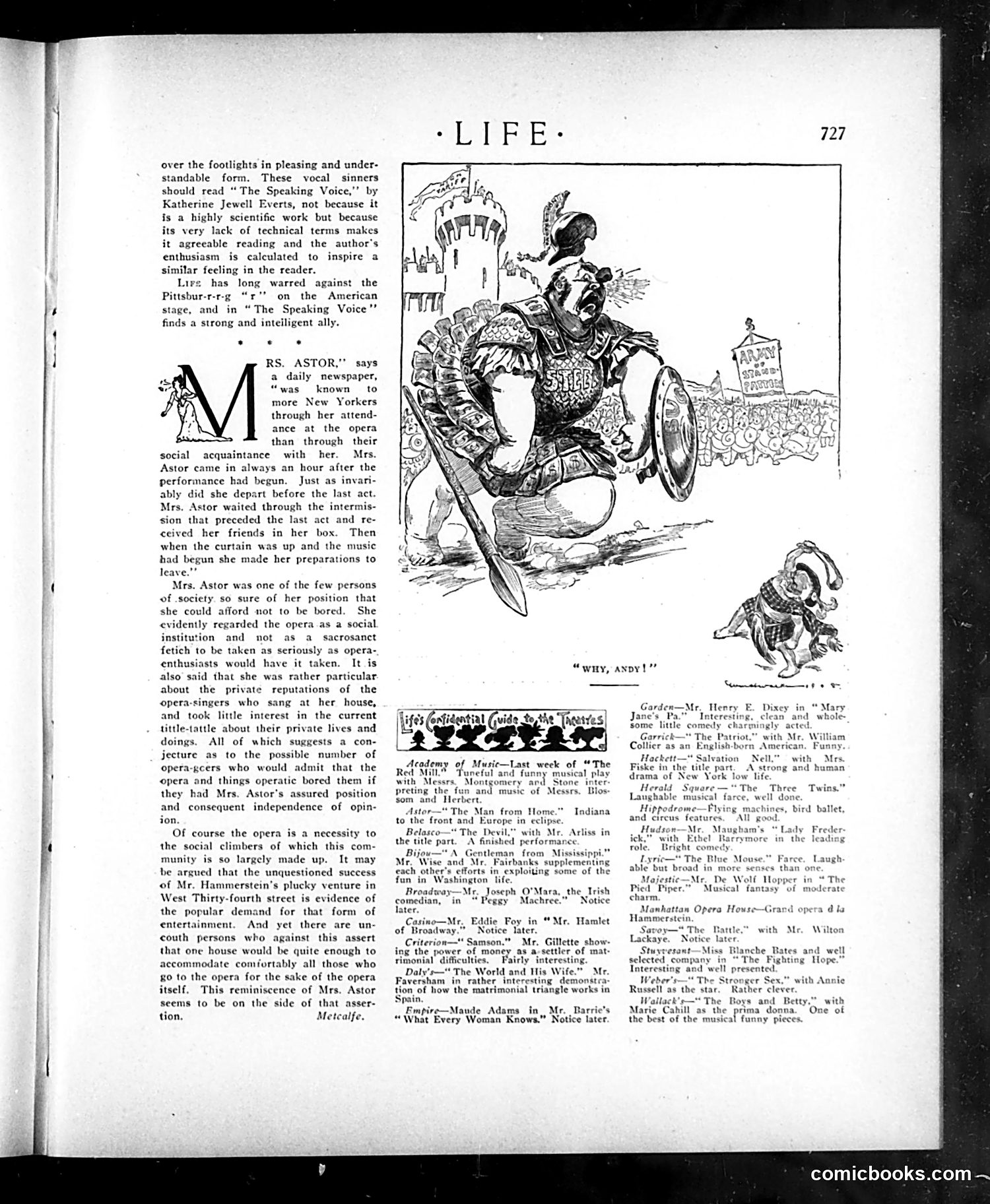
This page reviews theatrical performances, primarily opera and musical comedy productions. The main cartoon illustrates a scene titled "Why, Andy!" featuring what appears to be operatic characters in elaborate costume and armor, drawn in a exaggerated caricature style typical of Life's satirical approach. The text discusses Mrs. Astor's social prominence and her attendance at opera performances, satirizing how wealthy society figures treated the opera as a social obligation rather than genuine artistic appreciation. The magazine mocks the pretension of high society—suggesting opera-goers valued social status over actual musical merit. The reviews of various theatrical productions (listed at bottom) indicate this is entertainment criticism commentary from what appears to be the early 20th century based on the typography and illustration style.
📄 Transcribed text from this page (OCR, searchable)
Machine-transcribed from the original scan — historical spelling and the odd misread are preserved.
over the footlights in pleasing and under- standable form. These vocal sinners should read “The Speaking Voice," by Katherine Jewell Everts, not because it is a highly scientific work but because its very lack of technical terms makes it agreeable reading and the author's enthusiasm is calculated to inspire a similar feeling in the reader. Lire has long warred against the Pittsbur-r-r-g “‘r’’ on the American stage, and in “The Speaking Voice’’ finds a strong and intelligent ally. se 8 8 RS. ASTOR," says a daily newspaper, “was known to more New Yorkers through her attend- ance at the opera than through their social acquaintance with her. Mrs. Astor came in always an hour after the performance had begun. Just as invari- ably did she depart before the last act. Mrs. Astor waited through the intermis- sion that preceded the last act and re- ceived her friends in her box. Then when the curtain was up and the music had begun she made her preparations to leave." Mrs. Astor was one of the few persons of society. so sure of her position that she could afford not to be bored. She evidently regarded the opera as a social institution and not as a_ sacrosanct fetich to be taken as seriously as opera- enthusiasts would have it taken. It is also said that she was rather particular about the private reputations of the ‘opera-singers who sang at her house, and took little interest in the current tittle-tattle about their private lives and doings. All of which suggests a con- jecture as to the possible number of opera-gcers who would admit that the opera and things operatic bored them if they had Mrs. Astor's assured position and consequent independence of opin- ion. Of course the opera is a necessity to the social climbers of which this com- munity is so largely made up. It may be argued that the unquestioned success of Mr. Hammerstein’s plucky venture in West Thirty-fourth street is evidence of the popular demand for that form of entertainment. And yet there are un- couth persons who against this assert that one house would be quite enough to accommodate comfortably all those who g0 to the opera for the sake of the opera itself. This reminiscence of Mrs. Astor seems to be on the side of that asser- tion. Metcalfe. af why, apy!” Academy of Music—Last week of “The Red Mill.” Tuneful and funny musical play with Messrs. Montgomery ard Stone inter preting the fun and music of Messrs. Blos som and Herbert. Astor—" The Man from Home.” Indiana to the front and Europe in eclipse. Belasco—“ The Devil,” with Mr. Arliss in the title part. A finished performance Bijou—" A Gentleman from Mississip Mr, Wise and Mr. Fairbanks supplementi cach other's efforts in exploiting some of the fun in Washington life. Broadway—Mr. Joseph O'Mara, the Trish comedian, in“ Beggy Machree.” Notice later. Casino—Mr, Eddie Foy in “Mr. Hamlet of Broadway.” Notice later. Criterion—" Samson.” Mr. Gillette show- ing the power of money as a:settler of mat- rimonial’ difficulties, Fairly interesting. Daly's—* The World and Wife.” Mr. Faversham in rather interesting demonstr: tion of how the matrimonial triangle works in Spain. Empire—Maude Adams in, Mr. Barrie's “What Every Woman Knows.” Notice later. Mr. Henry E Interesting. The Patriot.” with Mr. William as an English-b« American. Fun Hackett —" Salvation ho Mrs Fiske in the title part. d human drama of New York low life Herald Square —“ The Three Twins.” Laughable musical farce, we Hippodrome—Flying machines, bird ballet, and circus features. All good. done t lson—Mr. Maugham's “Lady Freder ick, with Ethel Rarrymore in the leading role, Bright comedy Lyric—" The Blue Mouse.” Farce. Laugh able b J in more senses than one. fr. De Wolf Hopper in “The Pied T Musical fantasy of moderate charm. Manhattan Opera Howse—Grard adis Hammerstein Savoy—* Th Tattle.” with Mr. Wilton Lackaye. Notice later Stuyvesant— Miss anche Bates and w selected company in “The Fighting Hope Interesting and well presented Webder’s—" The Stronger Sex,” with Annie Russell as the star. Rather clever, Waillack's—" The Boys and Marie Cahill as the prima di the best of the musical funny comicbooks.com