
Life, 1908-12-24 · page 8 of 20
Life — December 24, 1908 — page 8: what you’re looking at
What you’re looking at
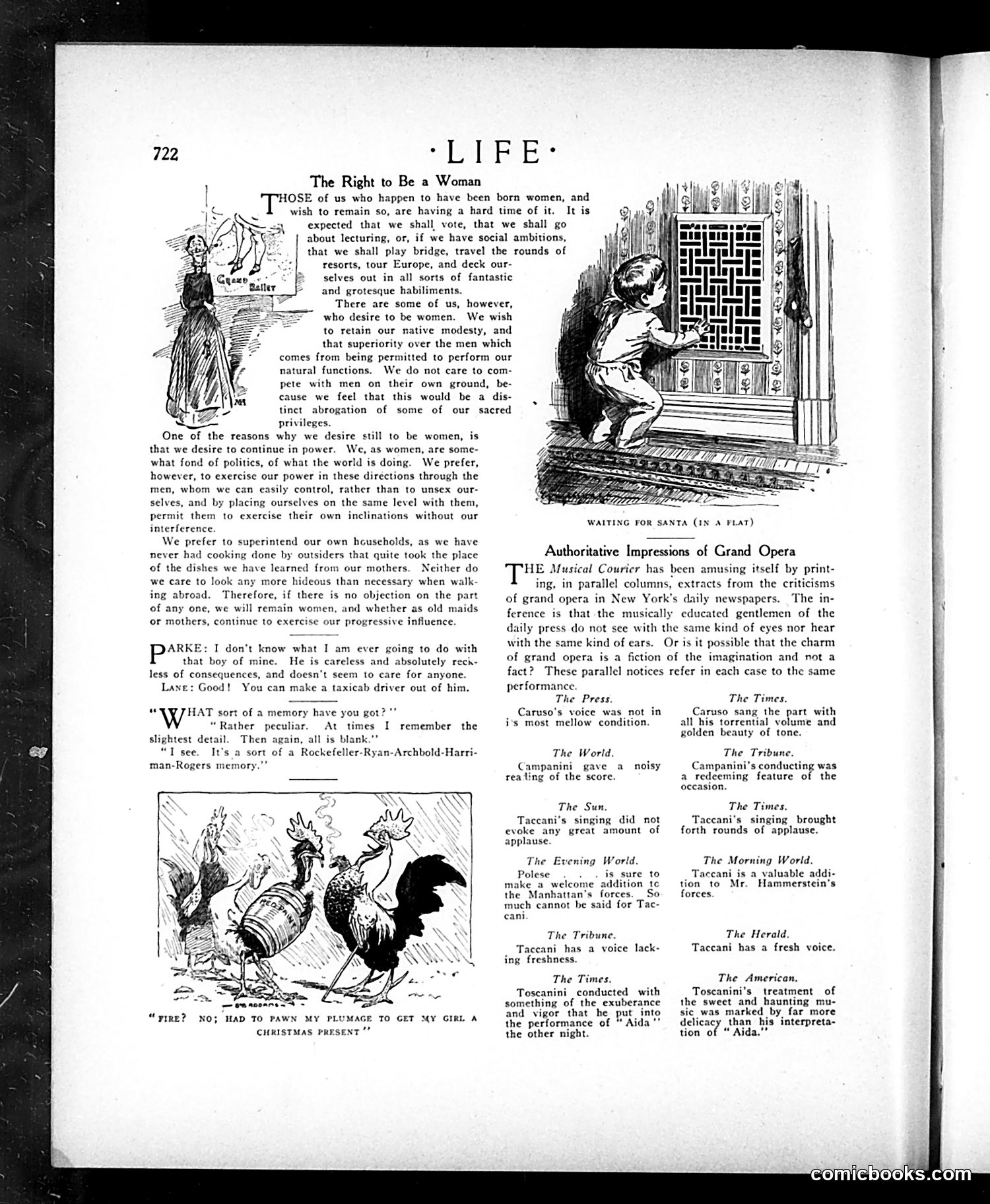
**Main Article: "The Right to Be a Woman"** This essay argues women should retain traditional domestic authority rather than pursue complete equality with men. The author contends women possess "natural functions" and "sacred privileges" that shouldn't be surrendered for unsex equality. The piece advocates women maintain power over household management and influence through men rather than compete directly. **Lower Cartoon:** A rooster and hen appear in a domestic scene. The caption reads: "FIRE? NO; HAD TO PAWN MY PLUMAGE TO GET MY GIRL A CHRISTMAS PRESENT!" This satirizes male financial burden in courting—the rooster has literally sacrificed his defining feature (plumage) to afford a gift, mocking the expectation that men bear courtship expenses while women remain economically dependent.
📄 Transcribed text from this page (OCR, searchable)
Machine-transcribed from the original scan — historical spelling and the odd misread are preserved.
“ERE The Right to Be a Woman HOSE of us who happen to have been born women, and wish to remain so, are having a hard time of it. expected that we shall vote, that we shall go about lecturing, or, if we have social ambitions, that we shall play bridge, travel the rounds of a SEH It is resorts, tour Europe, and deck our- selves out in all sorts of fantastic and grotesque habiliments. There are some of us, however, who desire to be women. We wish to retain our native modesty, and that superiority over the men which comes from being permitted to perform our natural functions. We do not care to com- pete with men on their own ground, be- cause we feel that this would be a dis- tinct abrogation of some of our sacred privileges. One of the reasons why we desire still to be women, is that we desire to continue in power. We, as women, are some- what fond of politics, of what the world is doing. We prefer, however, to exercise our power in these directions through the men, whom we can easily control, rather than to unsex our- selves, and by placing ourselves on the same level with them, permit them to exercise their own inclinations without our interference. We prefer to superintend our own houscholds, as we have never had cooking done by outsiders that quite took the place of the dishes we have learned from our mothers. Neither do we care to look any more hideous than necessary when walk- ing abroad. Therefore, if there is no objection on the part of any one, we will remain women, and whether as old maids or mothers, continue to exercise our progressive influence. ARKE: I don’t know what I am ever going to do with that boy of mine. He is careless and absolutely reck- less of consequences, and doesn’t seem to care for anyone. Lawe: Good! You can make a taxicab driver out of him. HAT sort of a memory have you got?” “Rather peculiar. At times I slightest detail. Then again, all is blank.”’ “T see. It’s a sort of a Rockefeller-Ryan-Archbold-Harri- man-Rogers memory remember the tr a i “ying? NO; HAD TO PAWN MY PLUMAGE TO GET MY GIRL A CHRISTMAS PRESENT WAITING FOR SANTA (IN A PLAT) Authoritative Impressions of Grand Opera HE Musical Courier has been amusing itself by print- ing, in parallel columns, extracts from the criticisms of grand opera in New York's daily newspapers. The in- ference is that the musically educated gentlemen of the daily press do not see with the same kind of eyes nor hear with the same kind of ears. Or is it po: ible that the charm of grand opera is a fiction of the imagination and not a fact? These parallel notices refer in each case to the same performance. The Press. Caruso’s voice was not in is most mellow condition. The World. Campanini gave a realing of the score. noisy The Sun. Taccani’s singing did not evoke any great amount of applause: The Evening World. Polese is sure to make a welcome addition te the Manhattan's forces. So much cannot be said for Tac- cani The Tribune. Taccani has a voice lack- ing freshness. The Times. Toscanini conducted with something of the exuberance and vigor that he put into the performance of “Aida” the other night. The Times, Caruso sang the part with all his torrential volume and golden beauty of tone. The Tribune. Campanini's conducting was a redeeming feature of the occasion. The Times. accani's singing brought forth rounds of applause. The Morning World. Taccani is a valuable addi- tion to Mr. Hammerstein's forces. The Herald. Taccani has a fresh voice. The American, Toscanini’s treatment of the sweet and haunting mu- sic was marked by far more delicacy than his interpreta- tion of “ Aida.”