
Life, 1908-12-24 · page 12 of 20
Life — December 24, 1908 — page 12: what you’re looking at
What you’re looking at
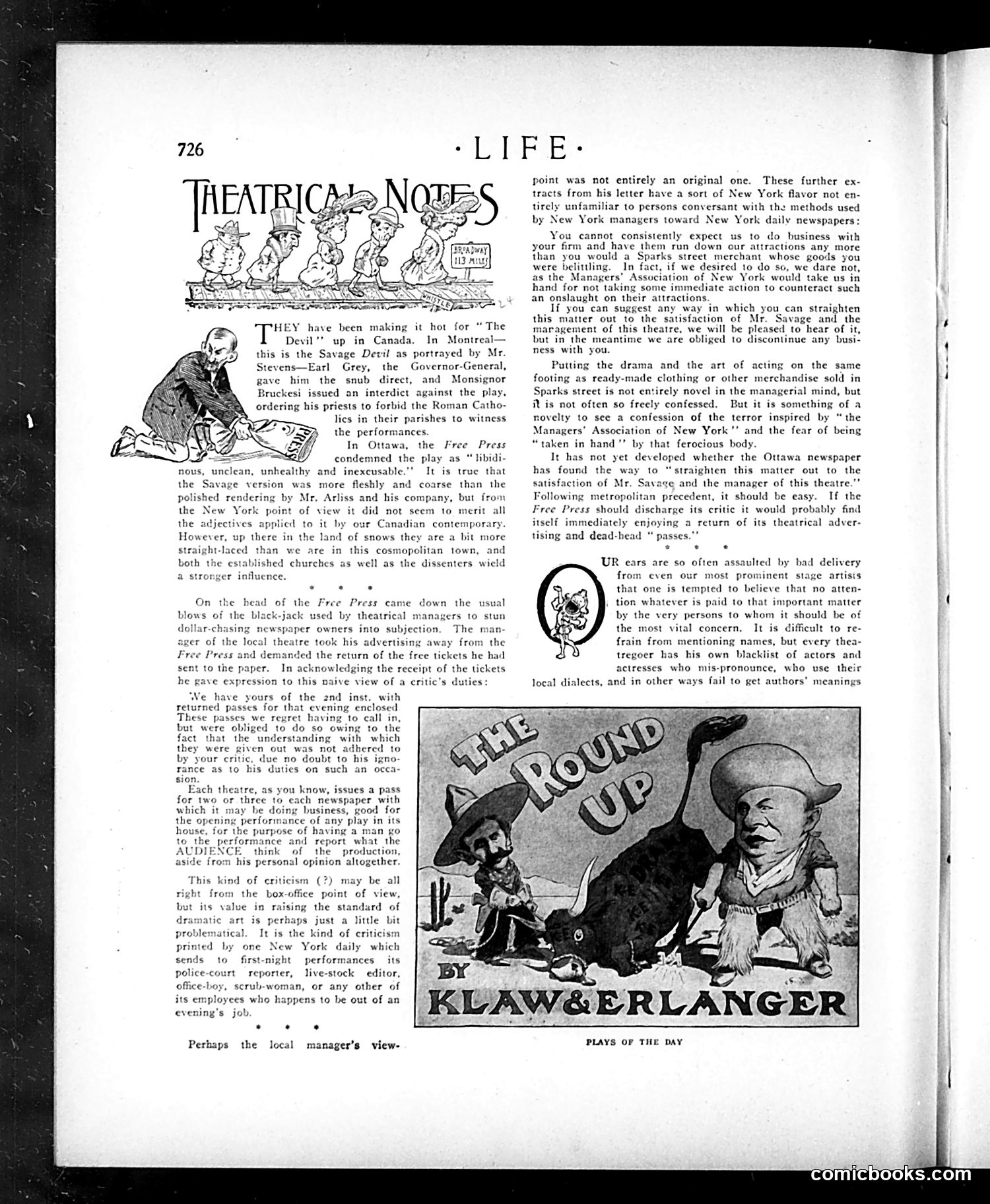
The page contains theater criticism discussing a Canadian production of "The Devil" and disputes between theatrical managers and newspaper critics over free passes. The main cartoon, titled "**The Pound**" and credited to **Klaw & Erlanger** (prominent theatrical producers), depicts what appears to be a dog pound or cage scene. The visual pun conflates theatrical management with animal control—likely satirizing Klaw & Erlanger's treatment of performers or their heavy-handed business practices. The cartoon suggests these producers "cage" or control their talent similar to how a pound confines animals. The surrounding text criticizes how theater managers attempt to silence critics through complimentary pass policies, arguing this creates conflicts of interest in theatrical journalism.
📄 Transcribed text from this page (OCR, searchable)
Machine-transcribed from the original scan — historical spelling and the odd misread are preserved.
HEY have been making it hot for h (2) Devil’? up in Canada. In Montreal— Je) this is the Savage Devil as portrayed by Mr. Stevens—Earl Grey, the Governor-General, gave him the snub direct, and Monsignor Bruckesi issued an interdict against the play ordering his priests to forbid the Roman Catho- lics in their parishes to witness the performances. In Ottawa, the Free Press condemned the play as “ libidi nous, unclean, unhealthy and inexcusable.’ It truce that the Savage version was more fleshly and coarse than the polished rendering by Mr. Arliss and his company, but fr the New York point of view it did not seem to merit all the adjectives applied to it by Canadian contemporary However, up there in the land of snows they are a bit more straight-laced than we are in this cosmopolitan town, and both the established churches as well as the dissenters wield a stronger influence. On of the Free Press came down the usual plows k-jack used by theatrical managers to stun dollar-chasing newspaper owners into subjection. The man: ager of the local theatre took his advertising away from the Free Press and demanded the return of the free tickets he had sent to the paper. In acknowledging the receipt of the tick he gave expression to this naive view of a critic’s du ies: ‘Ve have yours of the 2nd inst. with returned passes for that evening enclosed These passes we regret having to call in, but were obliged to do so owing to the fact that the understanding with which they were given out was not adhered to by your critic, due no doubt to his ig rance as to his duties on such an occa- sion Each theatre, as you know, issues a pass for two or three to each newspaper with which it may be doing business, good for the opening performance of any play in its house, for the purpose of having a man go to the performance and report what the AUDIENCE. think of the production, aside from his personal opinion altogether. This kind of criticism (?) may be all right from the box-office point of view, in raising the standard of aps just a little bit tical. It is the kind of criticism but its value atic art is perl one New York daily which to first-night perforn ces its police-court reporter, live-stock editor, e-hoy, scrub-woman, or any other of its employees who happens to be out of an evening's job. Perhaps the local manager’s view- op Oi |e) a oh point was not entirely an original one. These further ex- tracts from his letter have a sort of New York flavor not en- tirely unfamiliar to persons conversant with the methods used by New York manag: toward New York daily newspapers: You cannot consistently expect us to do business with your firm and have them run down our attractions any more than you would a Sparks street merchant whose goods you were belittling. In fact, if we desired to do so, we dare not, as the Managers’ Association of New York would take us in hand for not taking some immediate action to counteract such an onslaught on their attractions If you can suggest any way in which you can straighten this matter out to the satisfaction of Mr. Savage and the maragement of this theatre. we will be pleased to hear of it, but in the meantime we are obliged to discontinue any busi- ness with you. Putting the drama and the art of acting on the same footing as ready-made clothing or other merchandise sold in Sparks street is not entirely novel in the managerial mind, but 2 is not often so freely confessed. But it is something of a novelty to see a confession of the terror inspired by “the Managers’ Association of New York"? and the fear of being “taken in hand" by that ferocious body. It has not yet developed whether the Ottawa newspaper has found the way to “straighten this matter out to the satisfaction of Mr. Savage and the manager of this theatre.’’ Following metropolitan precedent, it should be easy. If the Free Press should discharge its critic it would probably find itself immediately enjoying a return of its theatrical adver- tising and dead-head “ passes.”’ UR ears are so often assaulted by bad delivery from even our most prominent stage artists that one is tempted to believe that no atten- tion whatever is paid to that important matter by the very persons to whom it should be of the most vital concern, It is difficult to re- frain from mentioning names, but every thea- tregoer has his own blacklist of actors and actresses who mis-pronounce, who use their local dialects, and in other ways fail to get authors’ meanings PLAYS OF THE DAY