
Life, 1908-12-24 · page 3 of 20
Life — December 24, 1908 — page 3: what you’re looking at
What you’re looking at
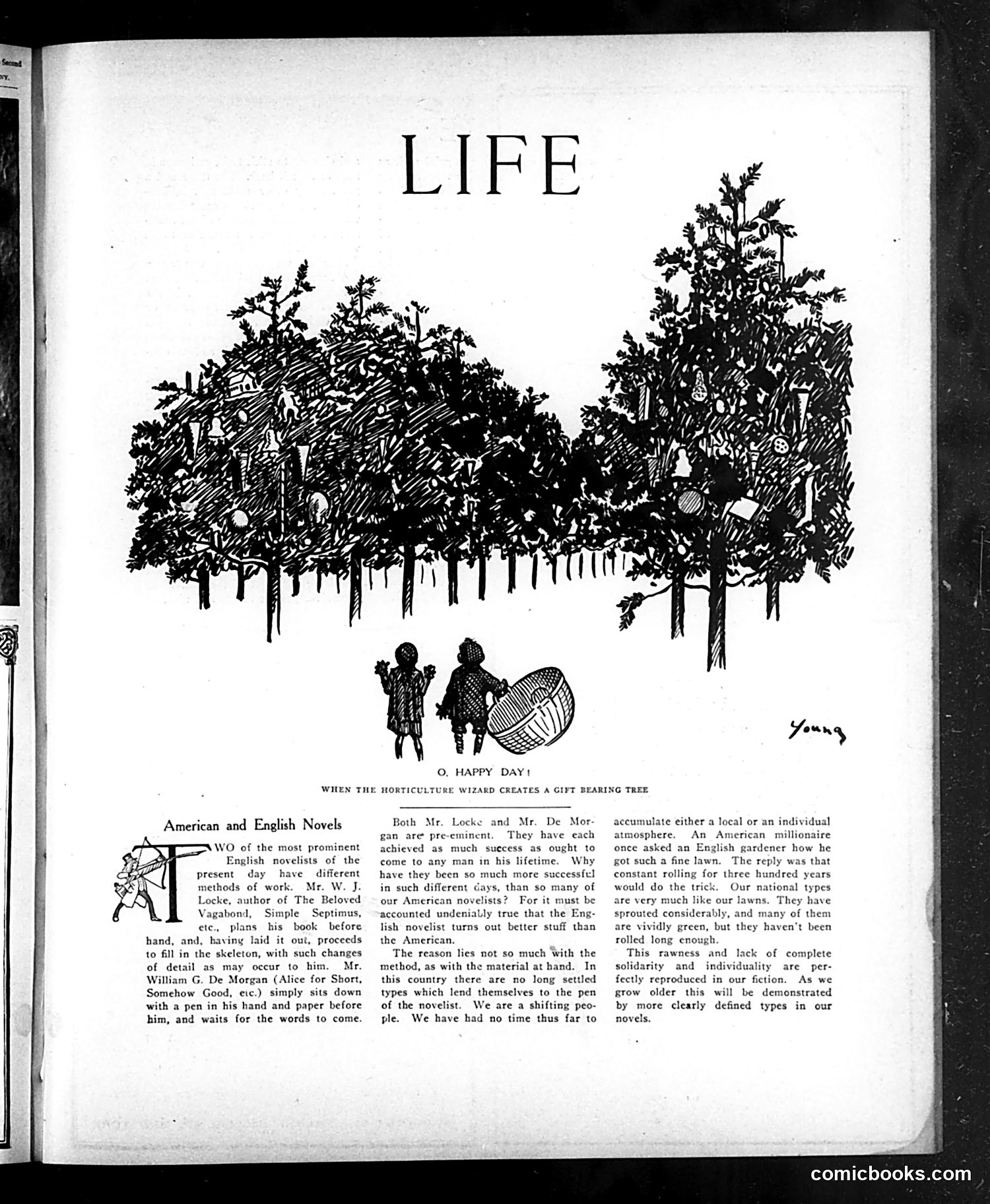
The page features an illustration titled "O Happy Day! When the Horticulture Wizard Creates a Gift Bearing Tree" showing two figures beneath a fantastical tree—likely satirizing unrealistic expectations about solving social problems through simple means. The accompanying article discusses two prominent English novelists of the present day: W.J. Locke (author of *The Beloved Vagabond*) and William De Morgan (*Alice for Short, Somehow Good*, etc.). The text compares English and American novel-writing methods, arguing that English authors produce superior work because they work from well-established literary traditions, while American writers lack this foundation. The satire appears to mock the American literary establishment's eagerness to adopt English methods as a quick fix—much like the "gift-bearing tree" fantasy above.
📄 Transcribed text from this page (OCR, searchable)
Machine-transcribed from the original scan — historical spelling and the odd misread are preserved.
WHEN THE American and English Novels WO of the most prominent English novelists of the present day have different methods of work. Mr. W. J. Locke, author of The Beloved Vagabond, Simple Septimus, ete, plans his book before hand, and, having laid it out, proceeds to fill in the skeleton, with such changes of detail as may occur to him. Mr. William G. De Morgan (Alice for Short, Somehow Good, cic.) simply sits down with a pen in his hand and paper before him, and waits for the words to come. ©, HAPPY DAY! URE WIZARD CREATES A GIPT BEARING TREE Both Mr. Locke and Mr. De Mor: gan are pre-eminent. They have each achieved as much success as ought to come to any man in his lifetime. Why have they been so much more successftl in such different days, than so many of our American novelists? For it must be accounted undeniably true that the Eng- lish novelist turns out better stuff than the American. The reason lies not so much With the method, as with the material at hand. In this country there are no long settled types which lend themselves to the pen of the novelist. We are a shifting peo- ple. We have had no time thus far to accumulate either a local or an individual atmosphere. An millionaire once asked an English gardener how he got such a fine lawn. The reply was that constant rolling for three hundred years would do the trick. Our national types are very much like our lawns. They have sprouted considerably, and many of them are vividly green, but they haven't been rolled long enough. This rawness and lack of complete solidarity and individuality are per- fectly reproduced in our fiction. As we grow older this will be demonstrated by more clearly defined types in our novels. American comicbooks.com