
A complete issue · 24 pages · 1908
Life — November 26, 1908
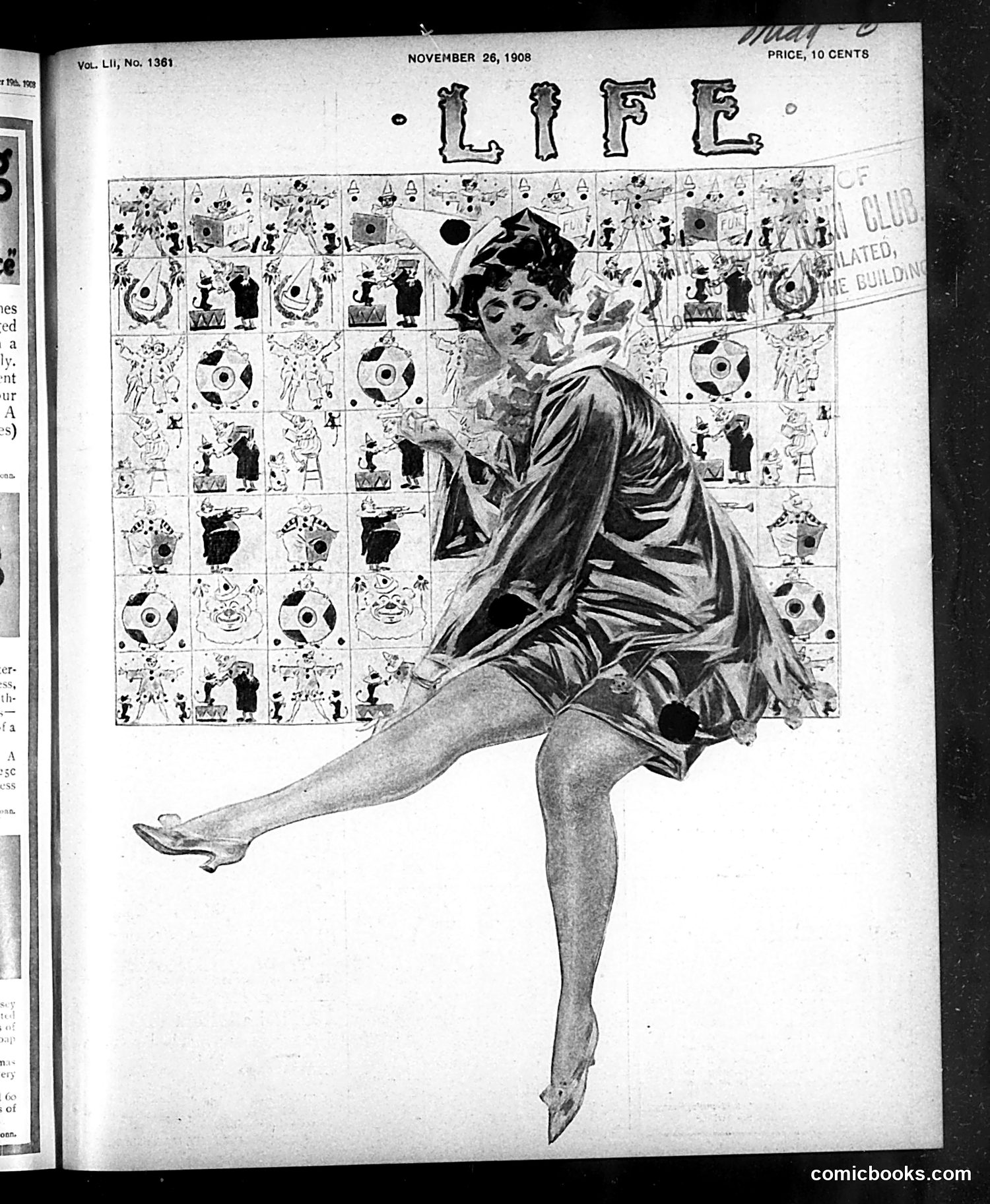
This is a cover illustration for *Life* magazine showing a woman in a theatrical pose—seated and kicking her leg up playfully—positioned in front of what appears to be a calendar or grid of comic panels. The woman wears a stylish hat and draped clothing typical of 1908 fashion. The calendar grid behind her contains repeated vignettes with various figures and scenes, though specific details are difficult to discern at this resolution. The composition suggests this may be satirizing popular entertainment, calendar culture, or theatrical productions of the era. Without clearer text identifying the specific figures or events referenced, the precise satirical target remains unclear, though the overall tone appears light and entertainment-focused rather than overtly political.
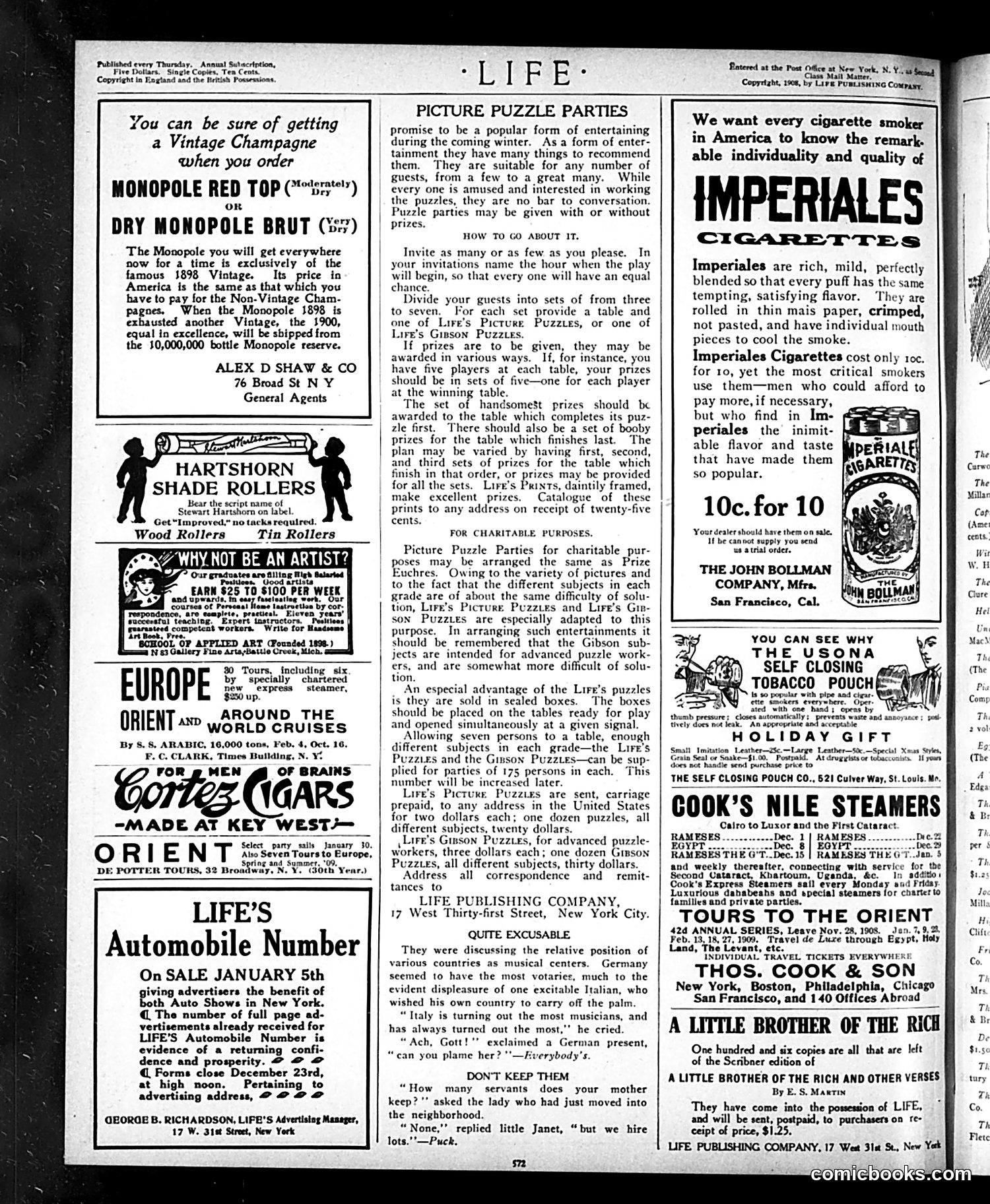
This page is primarily **advertising and commercial content** rather than political cartoons or satire. The advertisements include: - Monopole champagne and wine promotions - Hartshorn shade rollers with illustrated figures - A "Why Not Be an Artist?" school advertisement - Various travel cruises and steamship services - Cigarette ads (Imperiales, Cortez) - Tobacco pouches and other consumer goods The one notable feature is a small dialogue joke titled "Don't Keep Them" at the bottom, depicting a humorous domestic exchange about hiring help in a neighborhood—typical of Life's light domestic humor from this era. The page reflects early 20th-century American consumer culture and advertising design rather than political commentary.
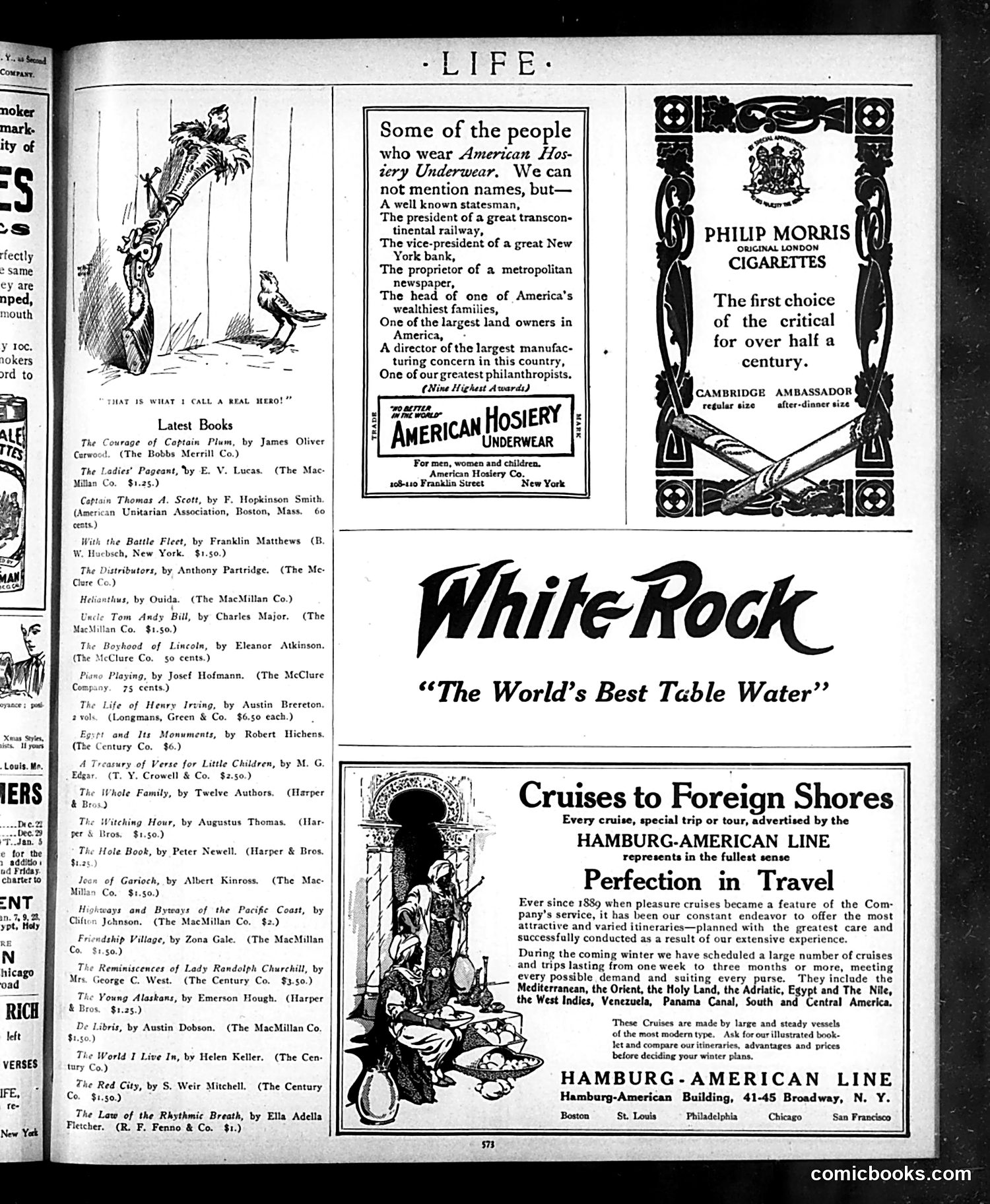
This page is primarily **advertising and book listings** rather than political satire. The main cartoon ("That is What I Call a Real Hero!") shows a figure climbing a giraffe—a humorous non-political joke about perspective and what constitutes heroism, likely satirizing exaggerated adventure narratives in popular literature listed below. The page features advertisements for **American Hosiery Underwear**, **Philip Morris Cigarettes**, **White Rock Table Water**, and the **Hamburg-American Line** cruise service. These ads represent typical early-20th-century consumer marketing with decorative Art Deco styling. The "Latest Books" section lists contemporary titles, suggesting this is a general entertainment and cultural page rather than focused political commentary. The giraffe cartoon's point appears simply humorous rather than socially or politically pointed.
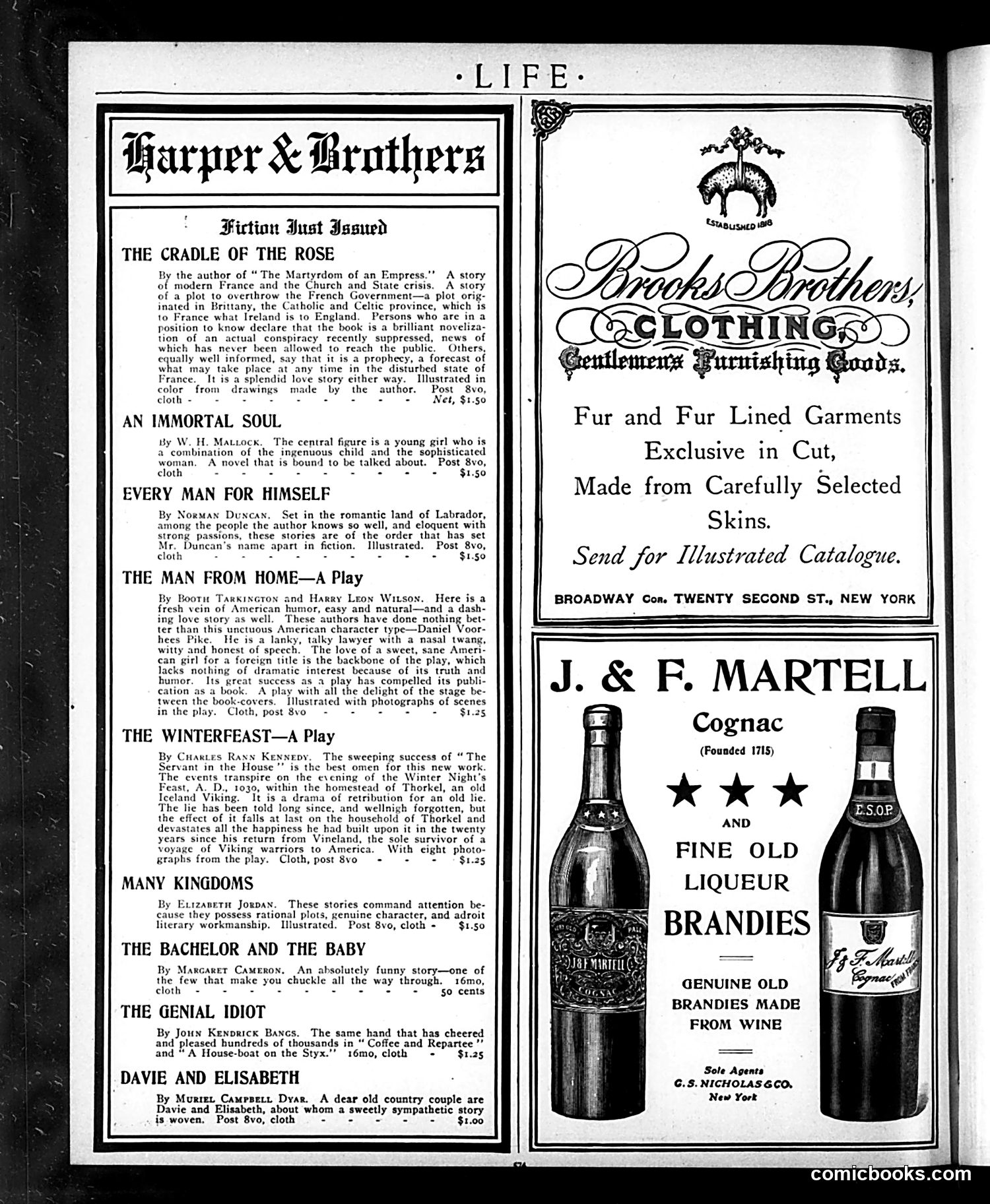
This page is **primarily advertising**, not satirical content. The left column features Harper & Brothers fiction listings—books by various authors with plot descriptions and prices (typically $1.00-$1.50). The right side contains two advertisements: Brooks Brothers clothing for gentlemen, emphasizing fur-lined garments; and J. & F. Martell Cognac brandies, marketed as "genuine old brandies made from wine" with their distinctive bottles pictured. There is **no political cartoon or satirical content visible** on this page. It represents typical early-20th-century *Life* magazine layout, mixing literary advertisements with luxury consumer goods targeting wealthy readers. The content reflects period class markers and purchasing power rather than social commentary.
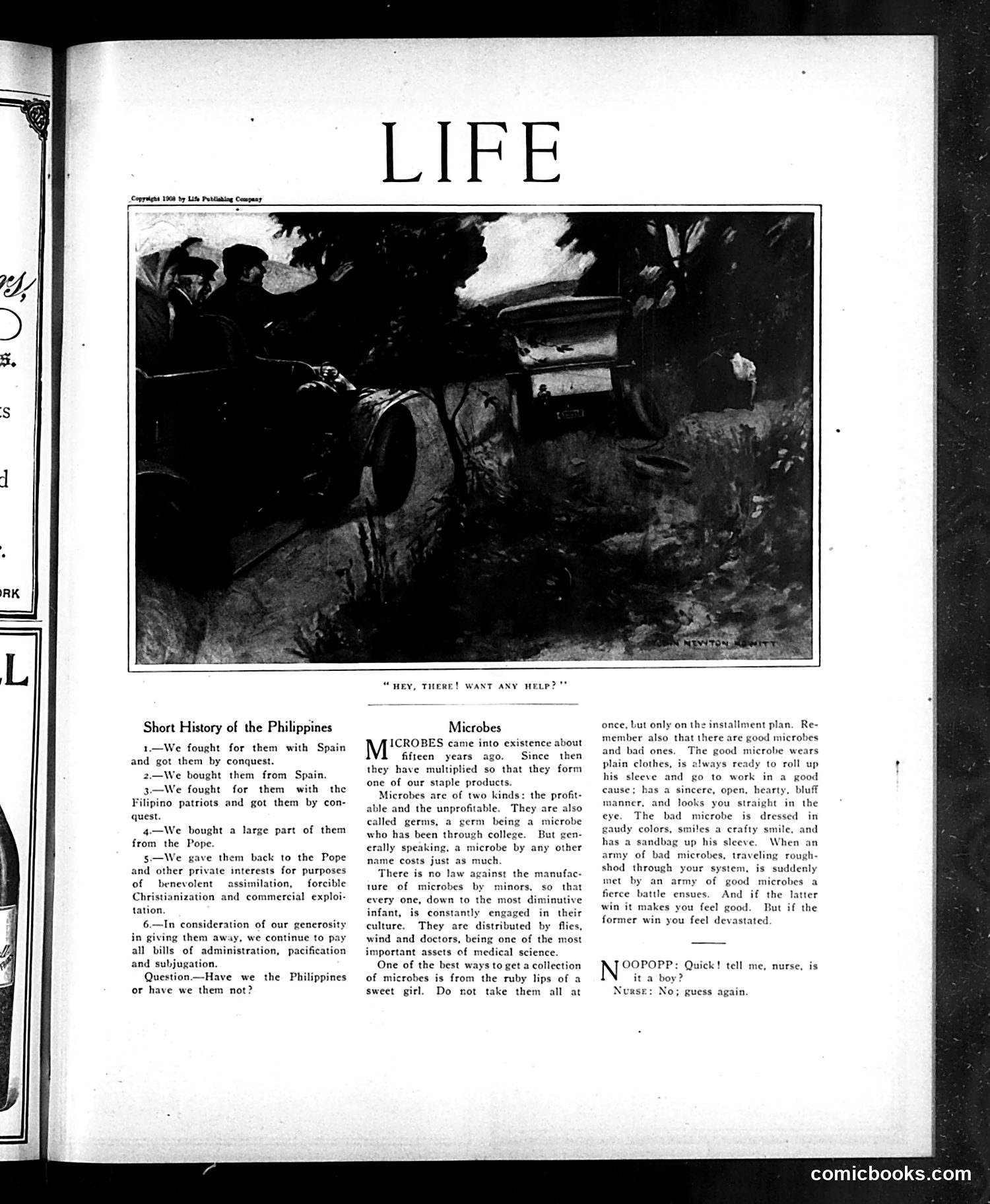
This page combines a satirical cartoon with educational humor about microbes. The main illustration depicts soldiers in a WWI trench, with the caption "HEY, THERE! WANT ANY HELP?" The joke plays on the invisible threat of disease—a microbe offering "help" to soldiers already suffering from infection and poor sanitary conditions. The accompanying text humorously personifies microbes as troublemakers, describing them as distributed by "flies, wind and doctors." It satirizes both the prevalence of disease in military settings and the era's limited understanding of germ theory. The brief dialogue at bottom about a nurse appears unrelated—possibly a separate joke or advertisement. The satire targets inadequate military sanitation and the very real danger microbes posed to soldiers, a significant problem during WWI.
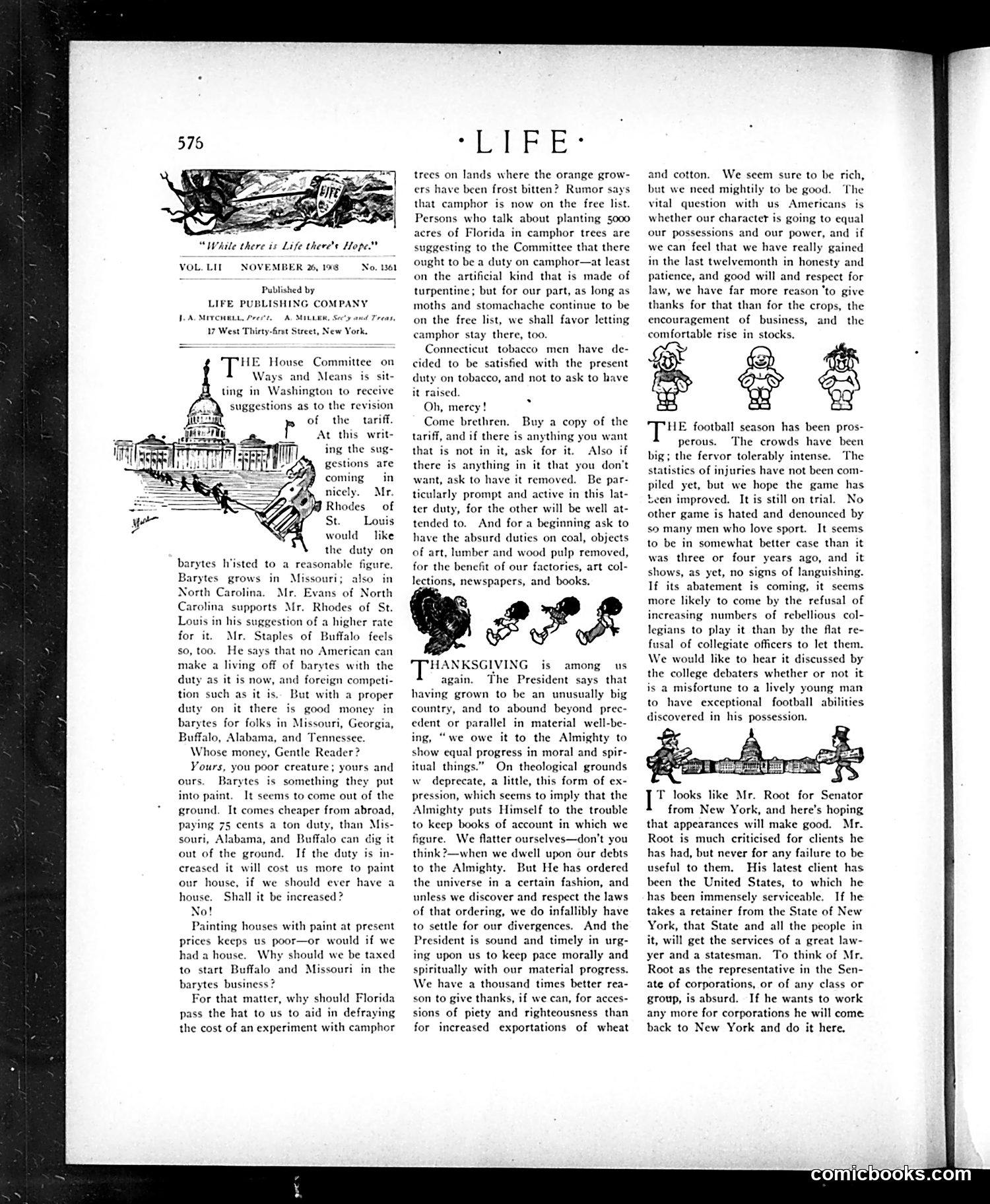
This page contains editorial commentary on several topics, with small cartoon illustrations accompanying the text. The main illustrations appear to be simple decorative vignettes rather than specific political caricatures. One shows the Capitol building, referencing congressional debate over tariffs on barytes (a mineral). Another depicts children in a circle, accompanying discussion of Thanksgiving. The editorial discusses: - **Tariff debates** in Congress regarding barytes imports - **House Committee on Ways and Means** considering duty rates - **Football season** criticism and college debates about the sport - **Senator Root of New York**, criticized regarding corporations and representation The tone is satirical commentary on everyday political and social issues of the era (November 1908), rather than attack-style political cartooning.
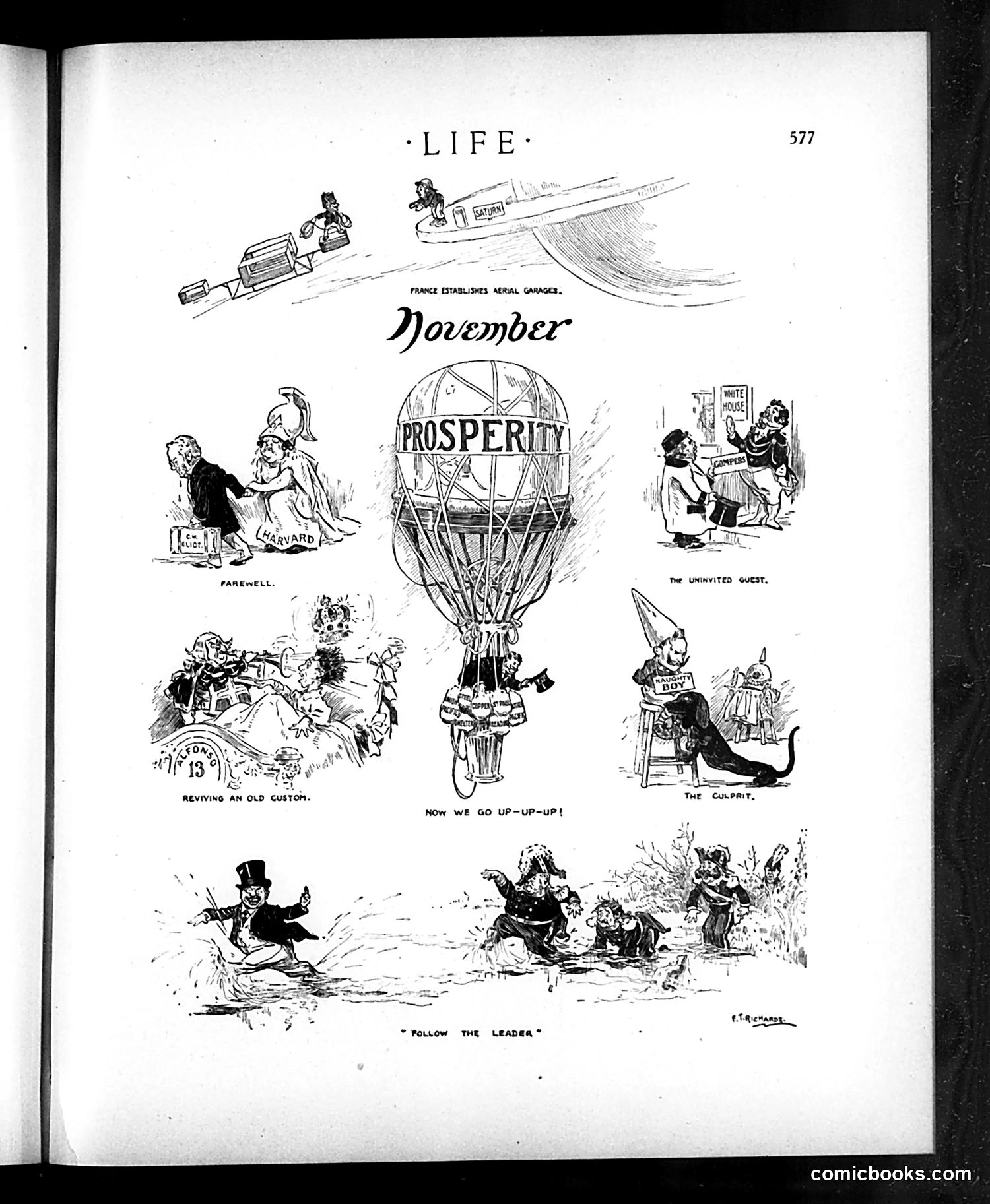
This page presents November-themed satirical cartoons mocking post-WWI prosperity and political figures. The central hot-air balloon labeled "PROSPERITY" suggests inflated economic optimism. Surrounding vignettes include: - **"Farewell"**: Harvard figure departing (unclear reference) - **"The Uninvited Guest"**: Someone barred from entering, likely political commentary - **"Reviving an Old Custom"**: Figures around 1919, possibly referencing resumed pre-war traditions - **"The Culprit"**: A devil-like figure, suggesting blame-assignment - **"Follow the Leader"**: Bottom scene showing people pursuing a leader figure into water—likely satirizing blind political followership The overall message appears critical of post-war American optimism and political leadership, suggesting the "prosperity" balloon is dangerously inflated and citizens foolishly follow leaders without question. The artist is credited as E.T. Scoones.
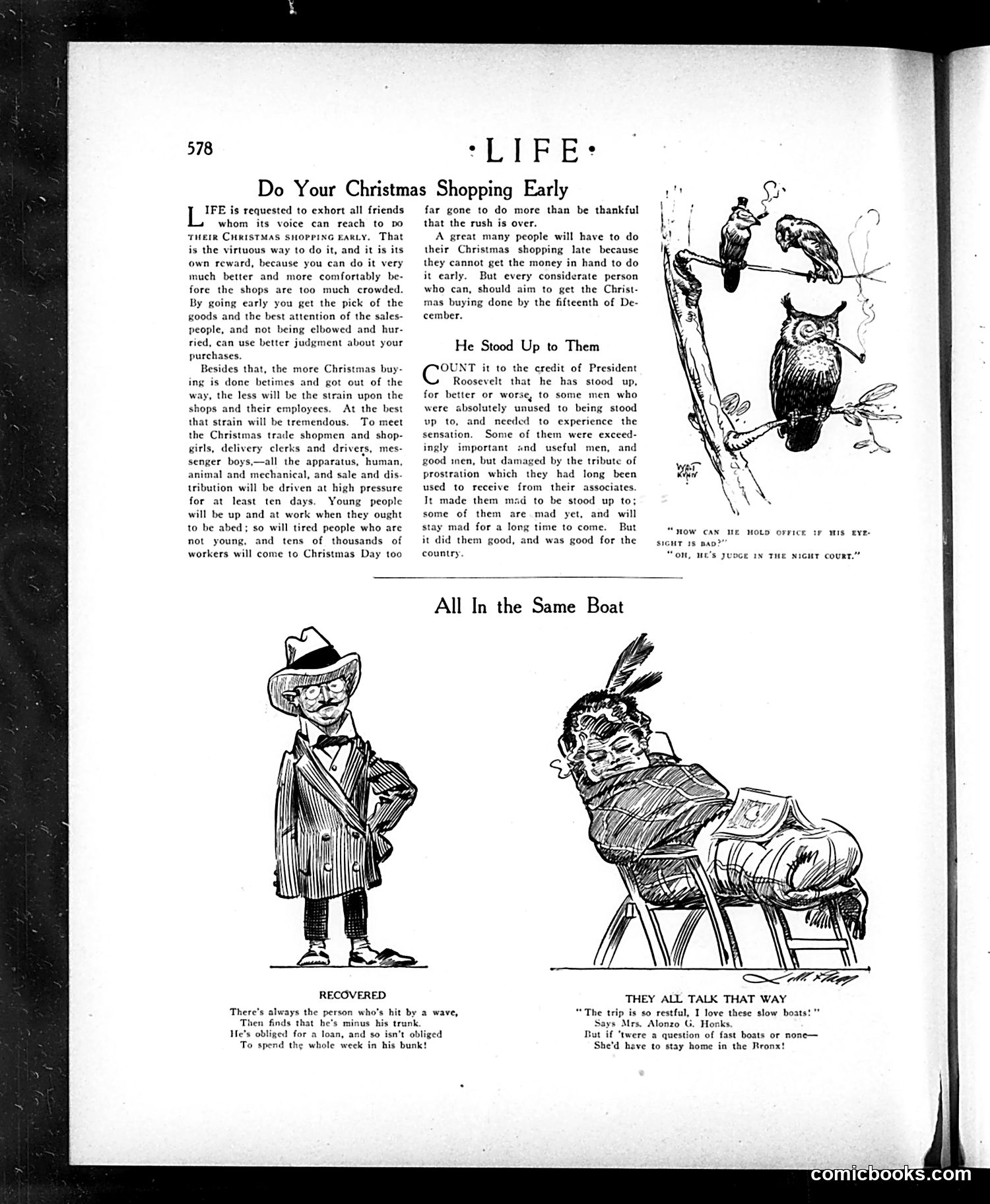
This page contains three separate pieces of satirical content: **"Do Your Christmas Shopping Early"** argues that early shopping reduces retail crowding and strain on workers—clerks, delivery drivers, and "mechanical" labor. It praises President Roosevelt for standing up to men "unused to being stood up to," suggesting he faced resistance from powerful figures who needed to experience accountability. **"He Stood Up to Them"** (top right cartoon) depicts an owl confronting birds, illustrating Roosevelt's willingness to challenge opposition. **"All in the Same Boat"** (bottom) shows two contrasting figures: a recovered businessman and passengers in a slow boat. The accompanying verse and caption suggest irony about economic recovery and travel preferences—implying some prefer slower, steadier progress over risky ventures. The page reflects 1930s New Deal-era themes of economic recovery and social responsibility.
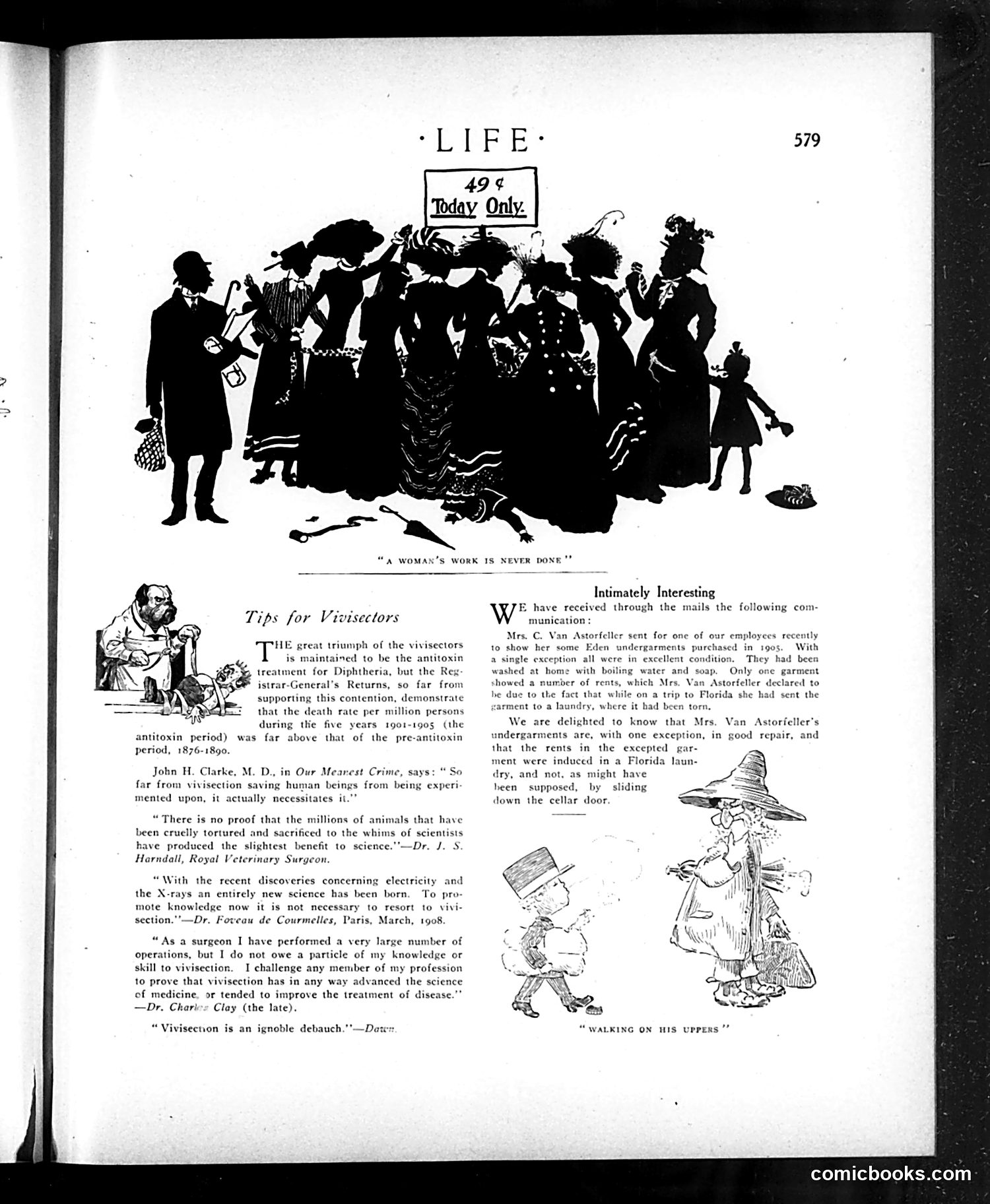
**Main Cartoon ("A Woman's Work is Never Done"):** The silhouette shows numerous women of various social classes engaged in endless household and domestic labor, holding a "49¢ Today Only" sale sign. This satirizes the relentless, undervalued nature of women's work—suggesting domestic labor is perpetually discounted and never truly valued or completed. **"Tips for Vivisectors" Section:** This critiques animal vivisection (medical experimentation on live animals). The text presents opposing medical opinions: some doctors defend vivisection as scientifically necessary, while others argue it contributes nothing to medical advancement. The accompanying sketches humorously depict a frog "walking on his uppers" (wearing worn-out shoes), mocking the practice through anthropomorphic satire.
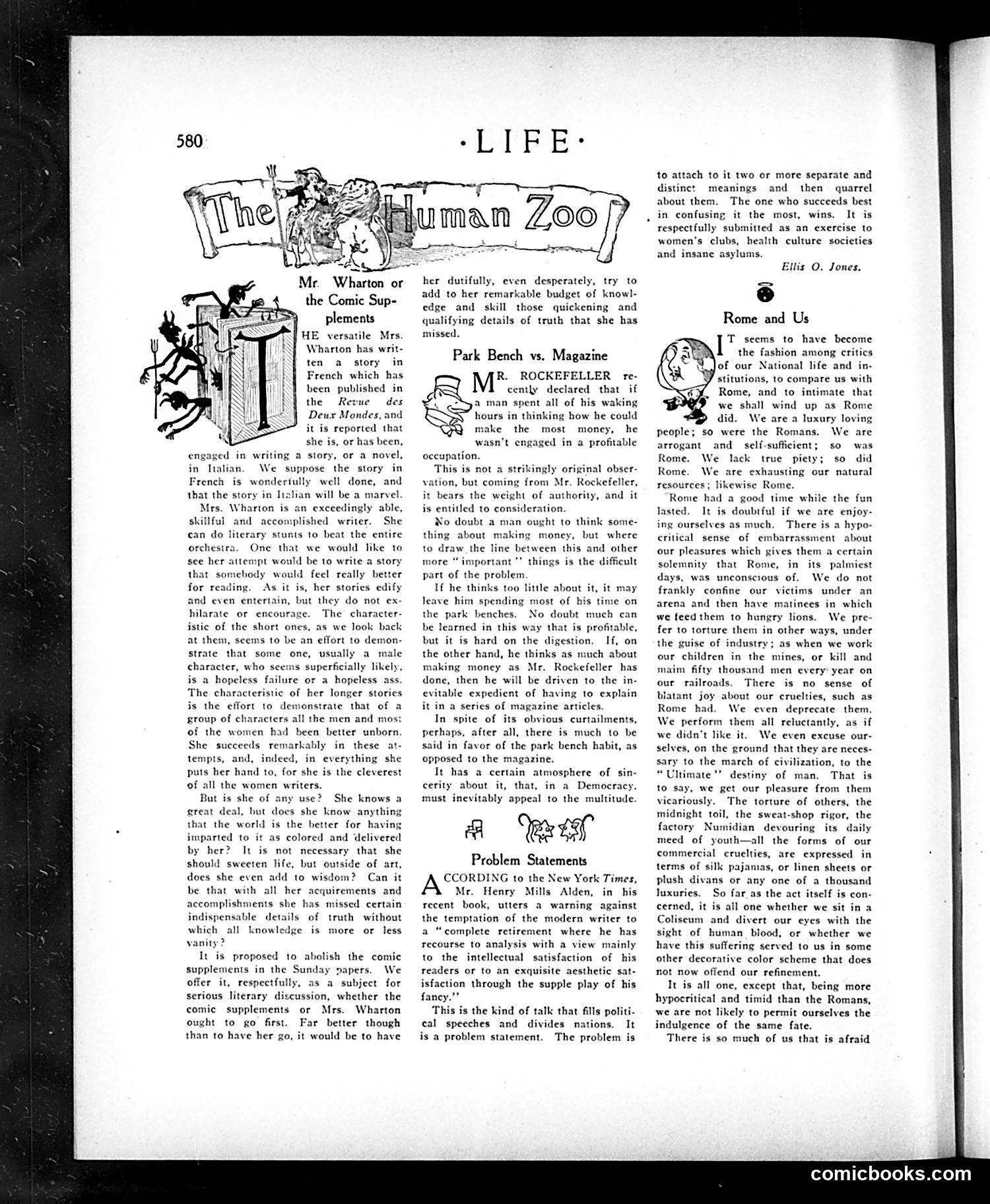
This page features two distinct pieces: **"The Human Zoo"** (left) satirizes Mrs. Wharton, a prolific American writer. The cartoon depicts her as a specimen in a zoo-like display, mocking her prodigious output. The text explains she's writing stories and novels in Italian, suggesting both her ambition and the satirical point that her relentless productivity is almost inhuman or circus-like worthy. **"Rome and Us"** (right) compares American civilization unfavorably to Rome, suggesting America risks Rome's fate through moral decline. It critiques American consumerism and materialism as symptoms of decadence. **"Park Bench vs. Magazine"** presents Rockefeller's philosophy on money-making versus leisure, framed as a debate about life priorities—characteristic Life magazine social commentary on wealth and work.
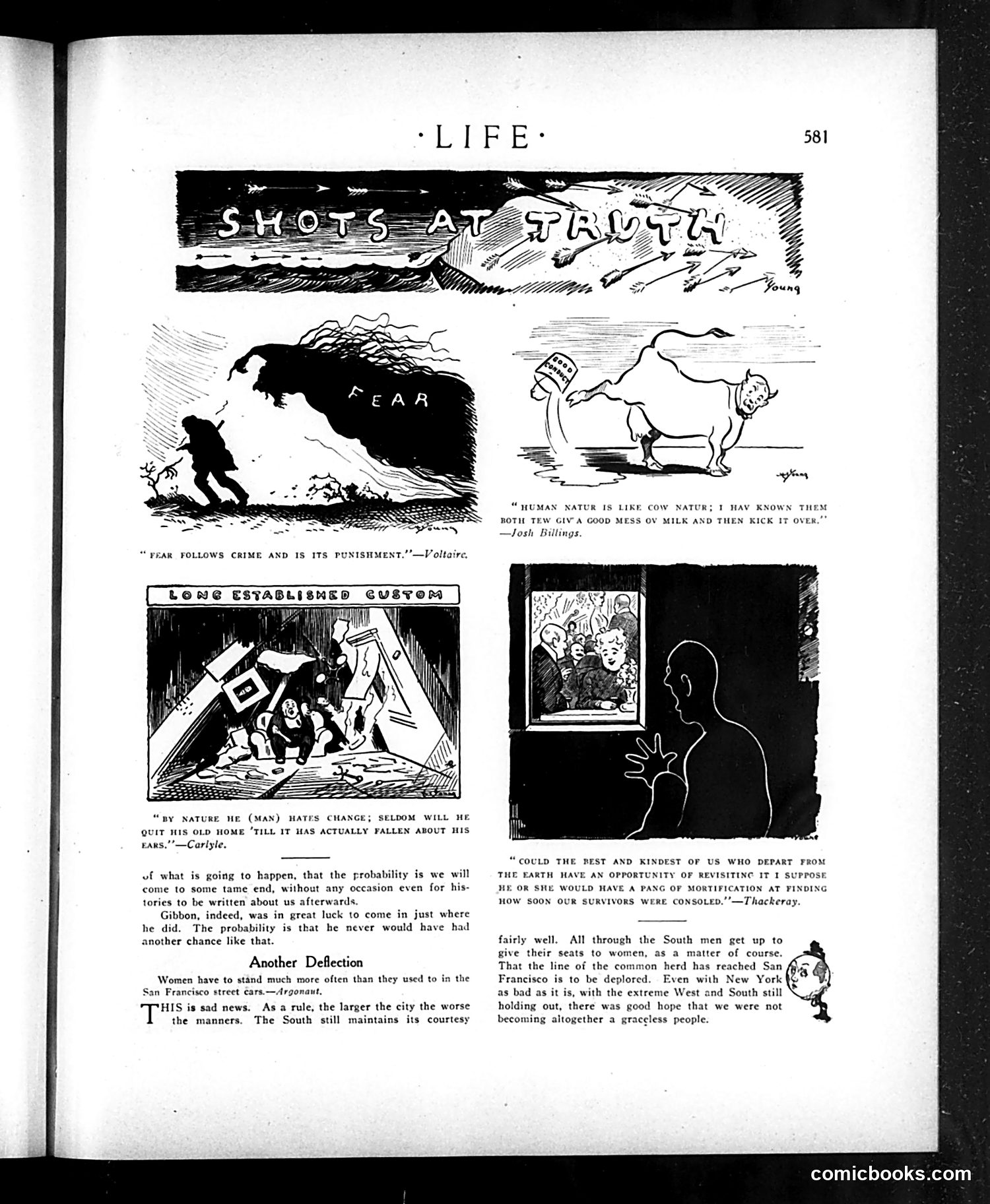
This page presents satirical cartoons and commentary on human nature and social behavior. The top cartoon depicts "Fear" as a dark, looming force pursuing a small figure—illustrating Voltaire's quote that "fear follows crime and is its punishment." Another cartoon shows a cow being milked with the caption attributing to Josh Billings: "Human nature is like cow nature; I have known them both few give a good mess of milk and then kick it over." The "Long Established Custom" panel criticizes men's resistance to change, quoting Carlyle. The final cartoon shows a silhouette gesturing toward a framed picture, with a Thackeray quote about death and "revisiting" the living world. A brief article titled "Another Deflection" comments on women's declining courtesy in San Francisco streetcars compared to the South.
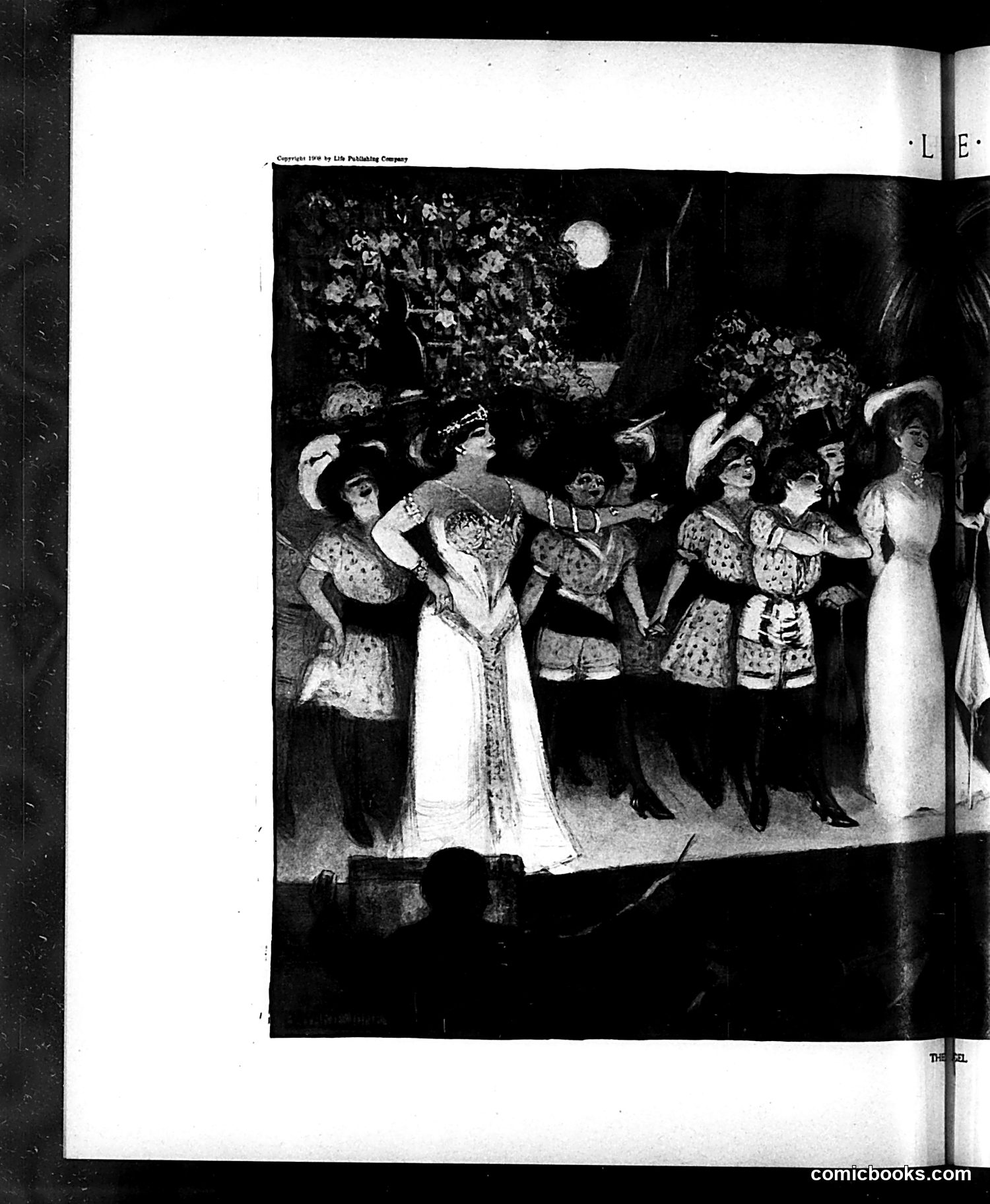
This appears to be a theatrical or operatic scene rather than political satire. The image shows elegantly dressed figures in what looks like an early 20th-century garden setting beneath a full moon. The central female figure wears a flowing white gown, while surrounding characters sport ornate costumes with feathered hats and decorative details typical of period drama or light opera. Without visible text identifying the specific production, I cannot determine which opera or play is depicted. The elaborate staging, moonlit backdrop, and formal costumes suggest this illustrates a romantic or comedic theatrical scene—possibly from a popular operetta of the era—rather than political commentary. The copyright notice indicates this is from Life Publishing Company, but the specific context and meaning require identification of the theatrical work shown.
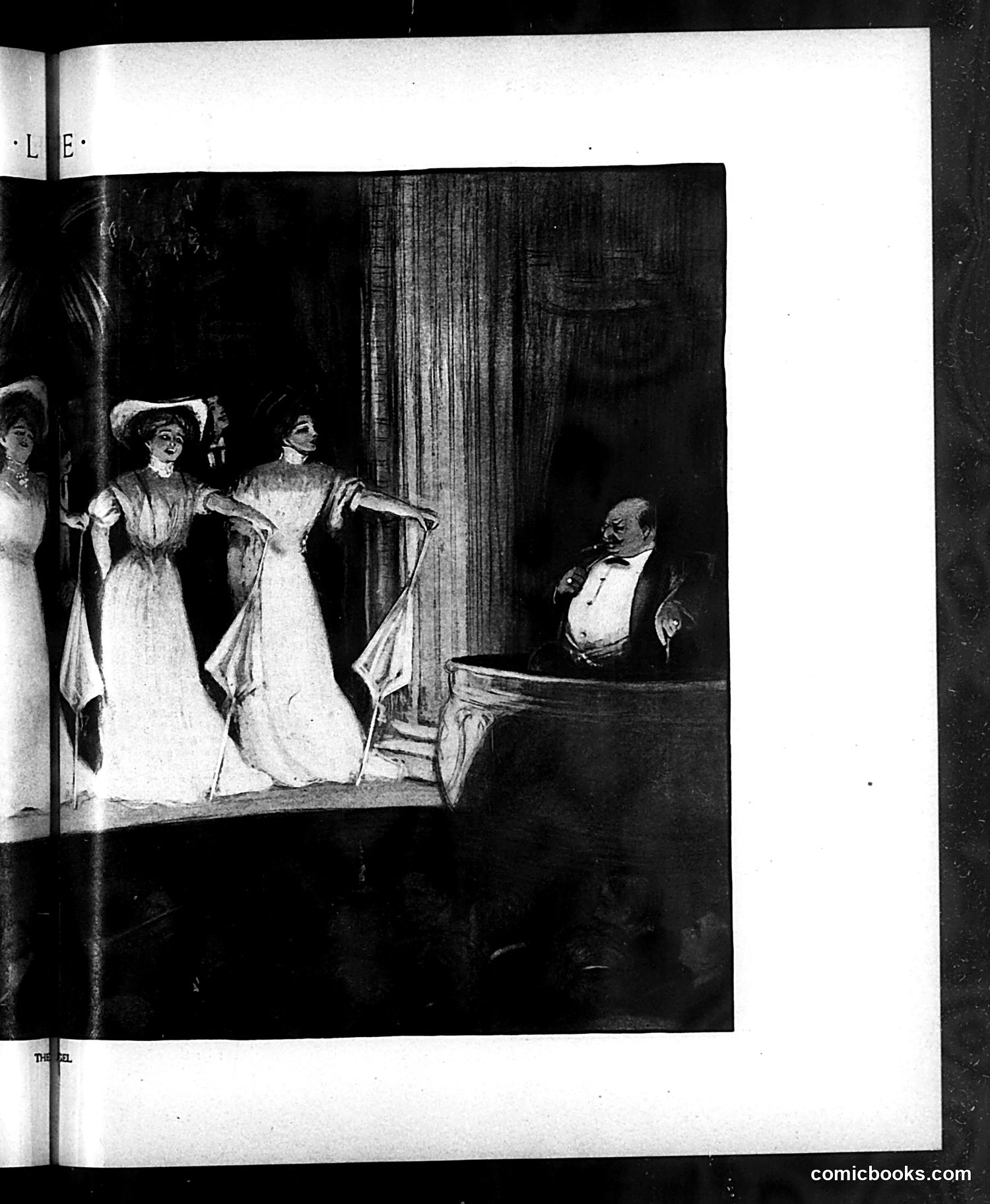
This illustration depicts an early 20th-century theatrical or operatic scene. A well-dressed man in formal attire (tuxedo) sits alone on the right, appearing to be an audience member or patron, while several women in elaborate white gowns and period dress stand on stage to the left, framed by heavy curtains. The satire likely comments on the spectacle of theatrical entertainment and male spectatorship—possibly mocking either the artificiality of staged performance or the voyeuristic nature of entertainment consumption. The stark contrast between the solitary, portly male viewer and the multiple costumed female performers suggests social commentary about gender dynamics in entertainment. Without visible text identifying specific figures or events, the precise satirical target remains unclear, though the composition critiques some aspect of Edwardian-era theatrical culture.
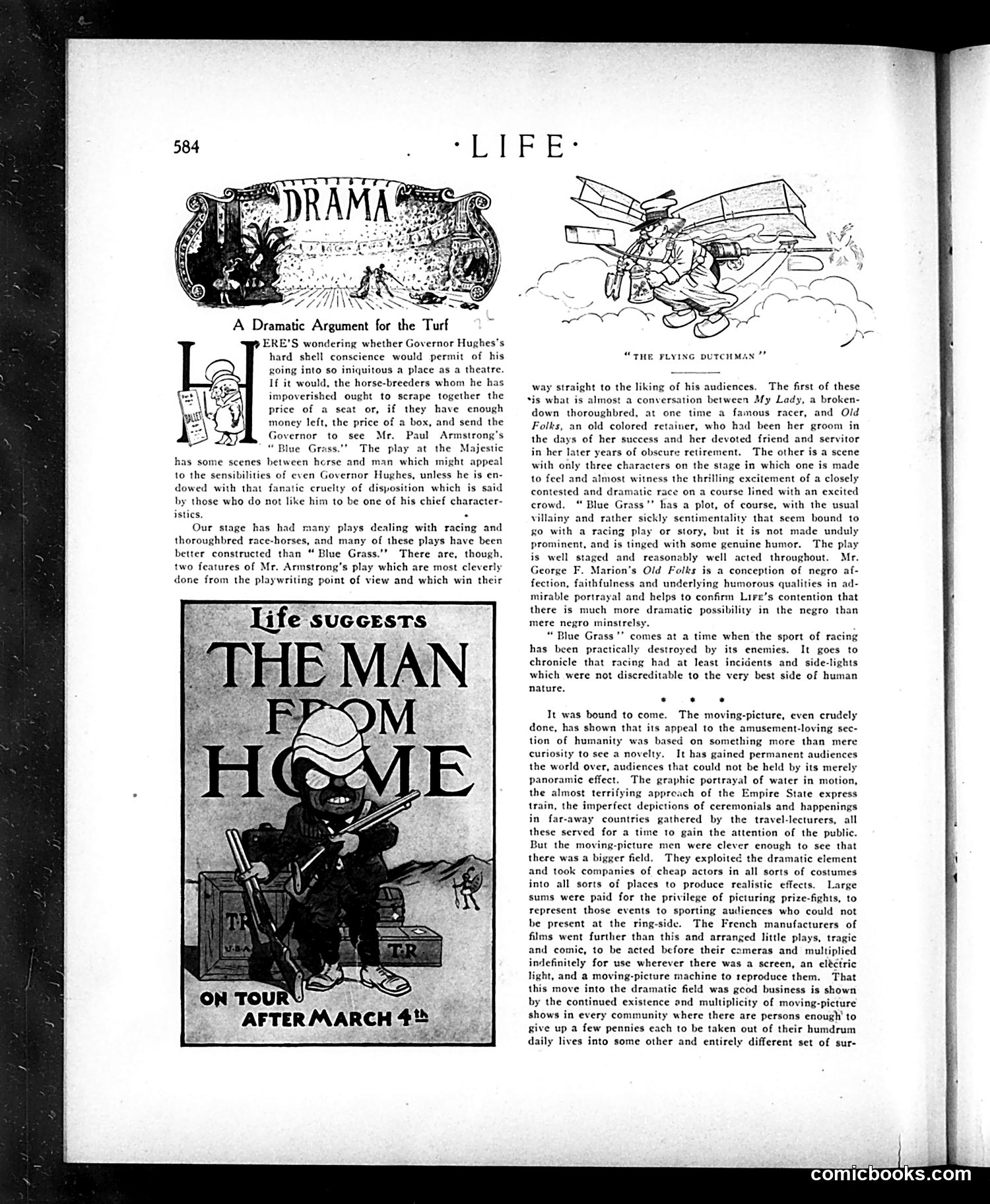
This page contains two distinct pieces critiquing early 1900s entertainment and politics. **"A Dramatic Argument for the Turf"** (main article) satirizes Governor Hughes's moral rigidity. The author sarcastically suggests Hughes—who apparently opposed horse racing and impoverished breeders through his policies—should attend the play "Blue Grass" at the Majestic Theatre. The play depicts a conversation between a retired racehorse and her former groom, treating the animal with dignity. The satire's point: if even Hughes cares about animal welfare, surely he'd appreciate racing's legitimate dramatic and moral dimensions, not just condemn it wholesale. **"The Man from Home" advertisement** (lower left) promotes a touring theatrical production, unrelated to the main article's themes. The second section discusses how moving pictures (early cinema) evolved from mere novelty—showing trains and water—into genuine dramatic storytelling, even depicting prize-fights for audiences unable to attend live events. Both pieces reflect Progressive Era tensions between entertainment, morality, and regulation.
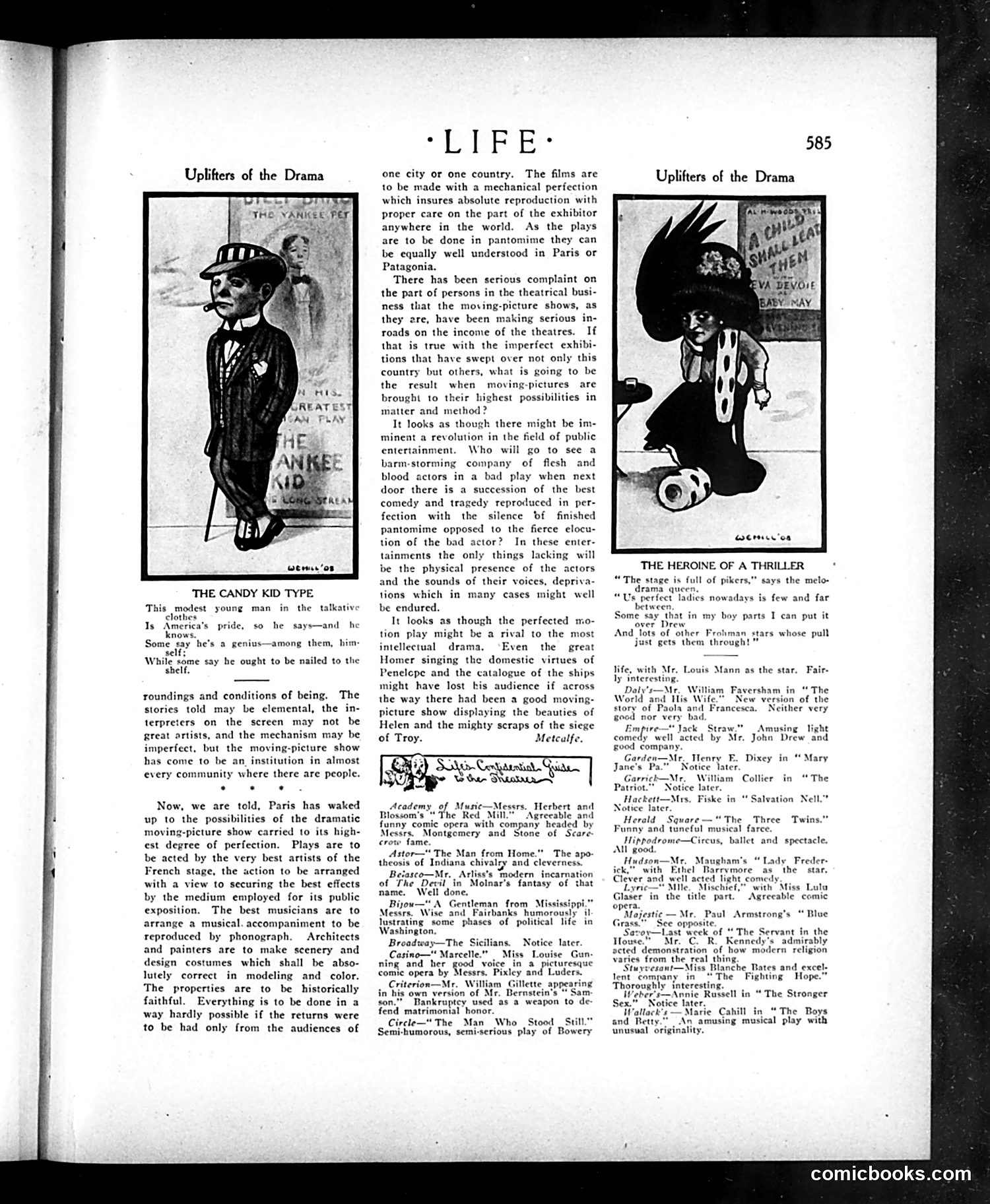
This Life magazine article satirizes anxieties about emerging **motion pictures** threatening live theater. The left illustration shows "The Candy Kid Type"—a vain, self-satisfied young actor of modest talent, embodying the theatrical performers Life fears may soon be obsolete. The article's core argument: Paris is perfecting motion pictures with finest actors, perfect pantomime, historically accurate sets, and synchronized music. Once available everywhere, these flawless films will devastate live theater. Why pay for inferior "barn-storming" actors in bad plays when superior silent films play next door? Life suggests even Homer couldn't compete against a good moving-picture show. The satire targets theater industry anxiety about technological displacement—a real concern in early 1900s. The "Candy Kid" embodies the vulnerable live performer facing an impending entertainment revolution, mocked for his pride in obsolescent skills.
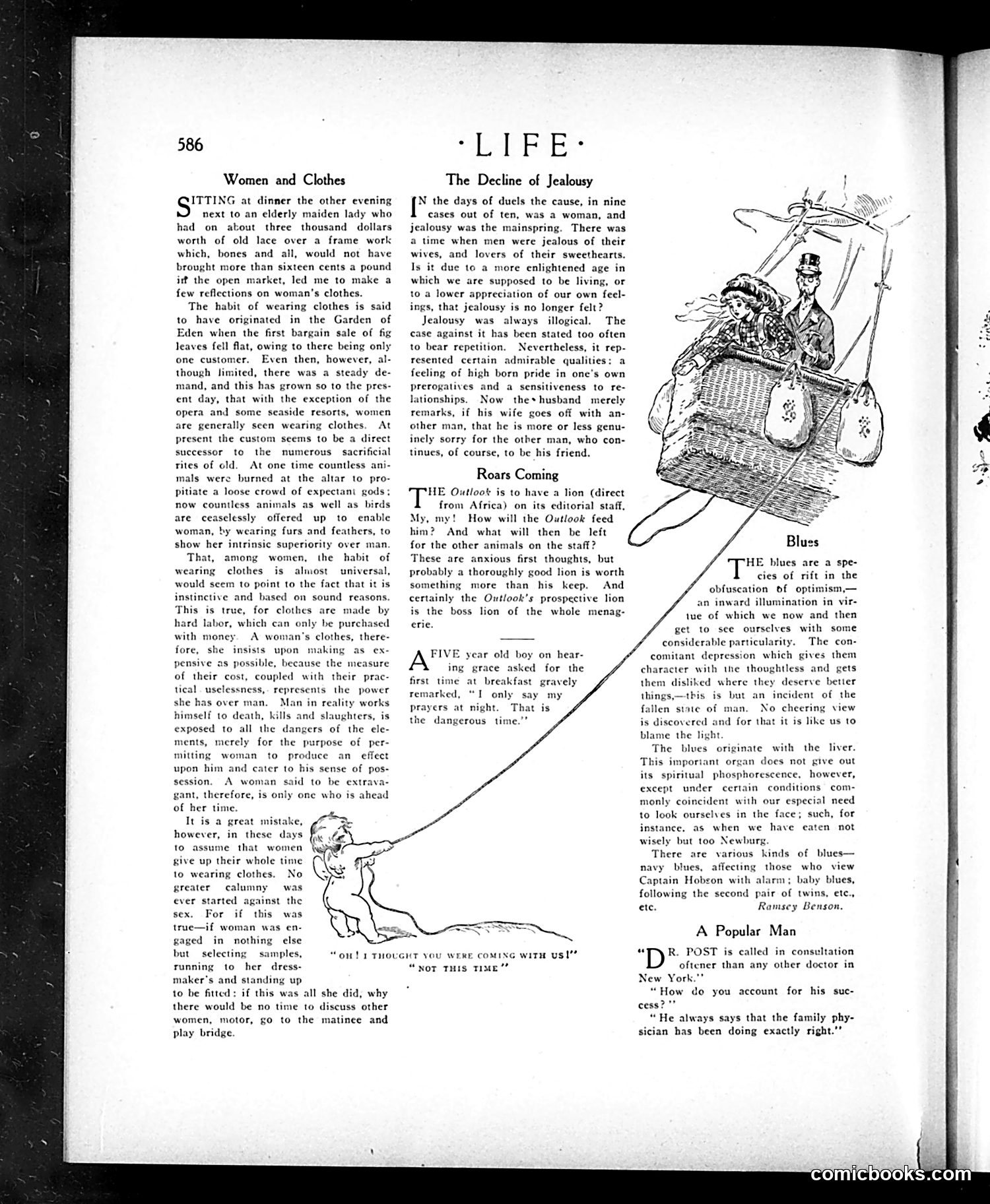
This page contains three separate satirical pieces typical of Life magazine's social criticism: **"Women and Clothes"** (left column): A tongue-in-cheek essay mocking women's expensive fashion habits. The author sarcastically compares clothing expenditure to ancient animal sacrifices, suggesting women use elaborate dress to demonstrate power over men who labor to afford their wardrobe. The humor lies in the exaggerated complaint that women have *no time* for clothes because they're too busy discussing other women, driving cars, attending matinees, and playing bridge. **"The Decline of Jealousy"** (right column): Commentary lamenting that modern men no longer experience jealousy—once a motivation for duels. The piece sardonically observes that husbands now merely express polite sympathy when wives take lovers, remaining friends with the rival. It critiques modern indifference as spiritual decline. **Small cartoon/vignette** (bottom): Shows a woman apparently surprised at an encounter, with caption "Oh! I thought you were coming with us! Not this time." The overall tone reflects early 20th-century satirical critique of changing gender relations and modern social behaviors.
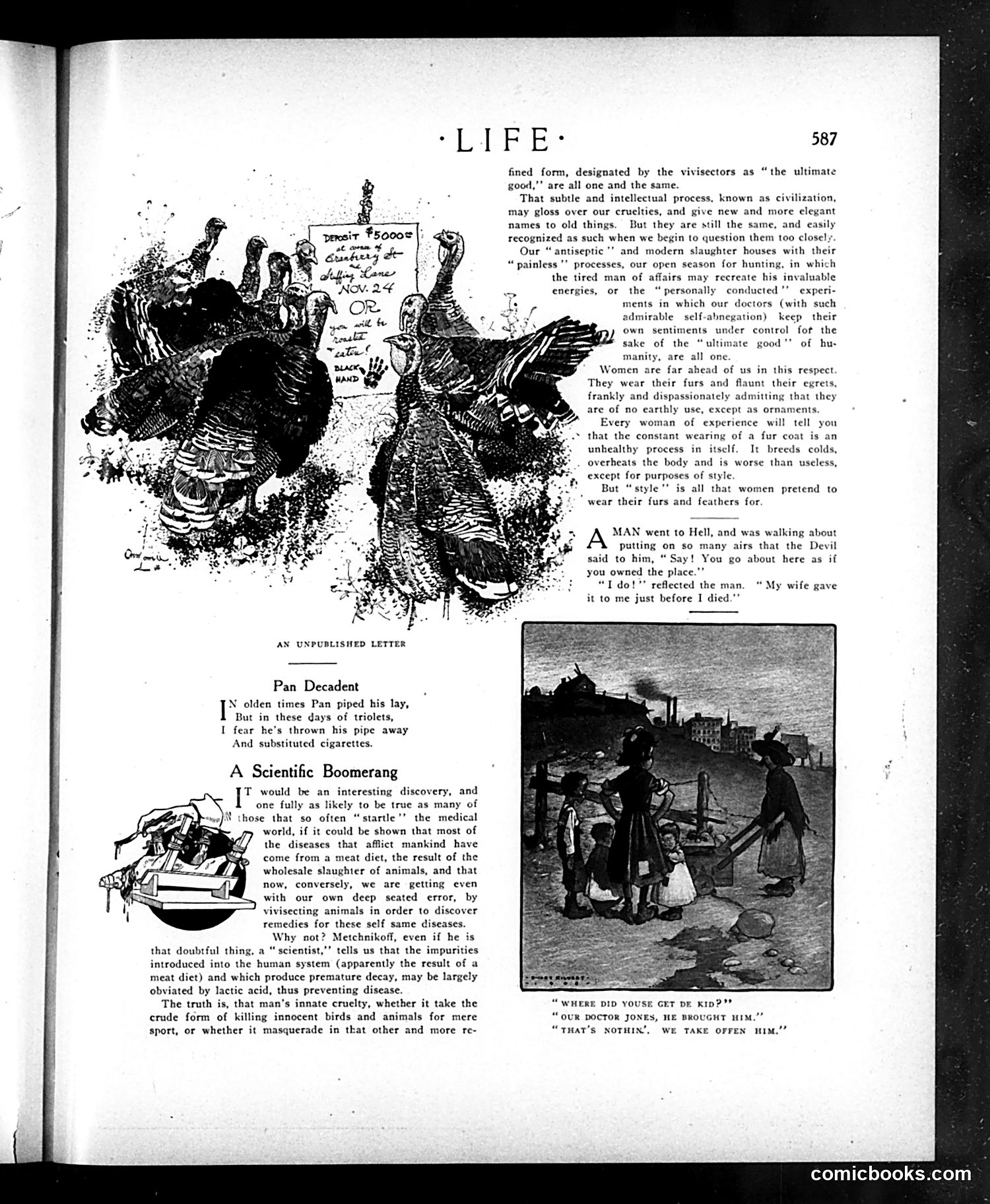
This *Life* magazine page satirizes hypocrisy around animal cruelty in early 20th-century America. The main article argues that modern civilization masks its brutality behind euphemisms—calling slaughterhouses "antiseptic" and vivisection "science"—while women openly flaunt furs and feathers without pretense, making them more honest. The cartoon (top left) appears to depict figures with animal characteristics, likely criticizing the contradiction between condemning "savage" practices while engaging in them ourselves. "A Scientific Boomerang" sardonically suggests diseases from meat-eating are now being "repaid" through animal testing for cures—nature's ironic revenge. The joke at bottom depicts working-class characters acquiring a child through questionable means (likely orphan trafficking or abandonment), using crude dialect to mock indifference to human welfare. The satire's point: society's selective morality—condemning cruelty in some contexts while permitting it in others, especially when profitable or fashionable.
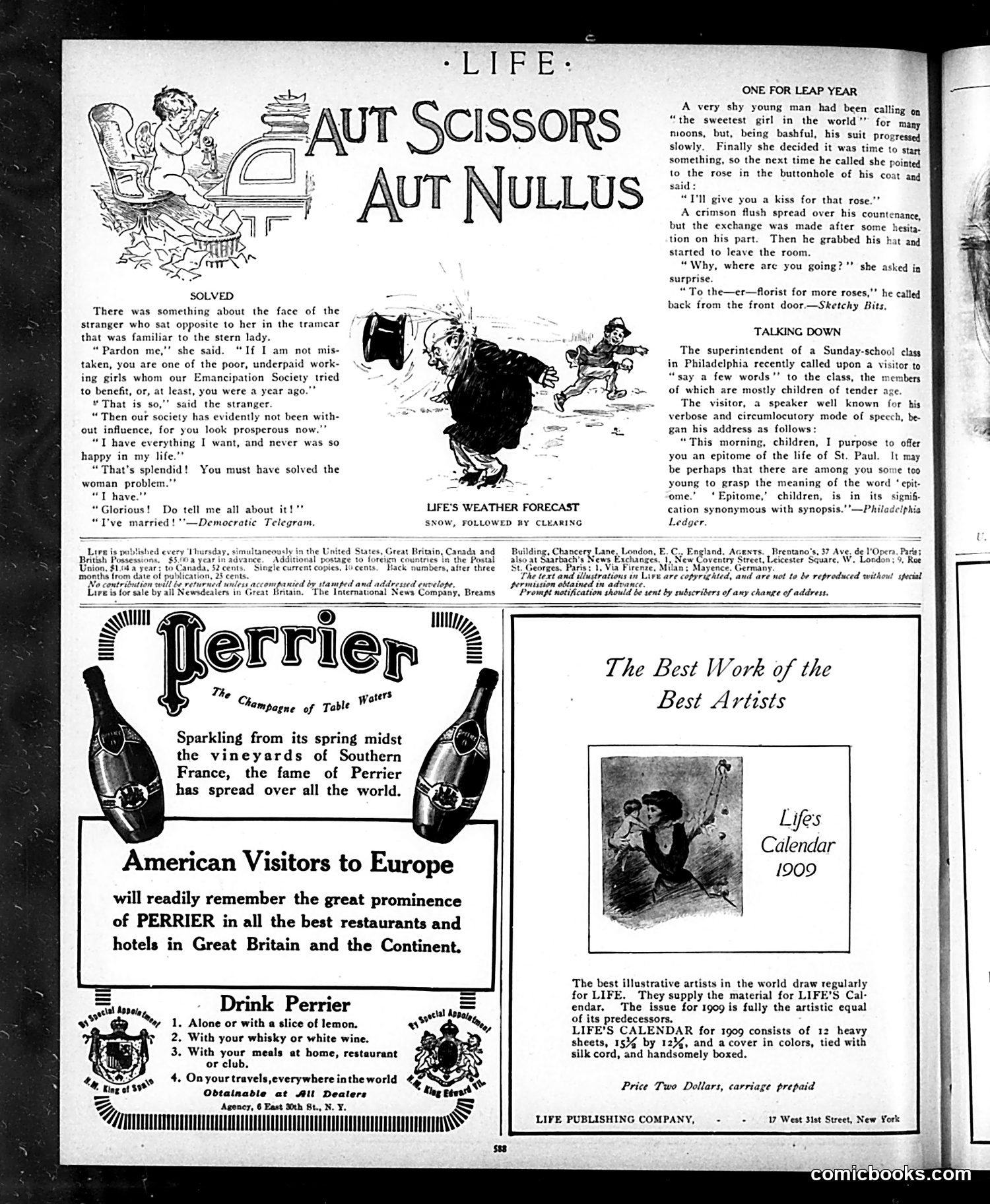
This page contains three separate humorous pieces typical of early 1900s satire: **"Aut Scissors, Aut Nullus" (Solved):** A stern society lady encounters a former poor working girl she once patronized through an "Emancipation Society." The girl now appears prosperous and happy. The lady assumes *the society's* charitable work caused the improvement, but the girl cryptically implies she solved her own problems—the joke being the lady's misplaced pride in her organization's supposed impact. **"One for Leap Year":** A shy suitor finally accepts a rose from his longtime love interest on Leap Year (when women traditionally propose). He rushes off to buy more roses, missing her romantic intent—satire of masculine obliviousness and the era's gender-role conventions. **"Talking Down":** A verbose Philadelphia Sunday school speaker over-explains the word "epitome" to children in needlessly complex language, ironically demonstrating the very problem he's addressing—satirizing condescending adult speech patterns. The page also contains advertisements for Perrier water and Life's 1909 calendar.
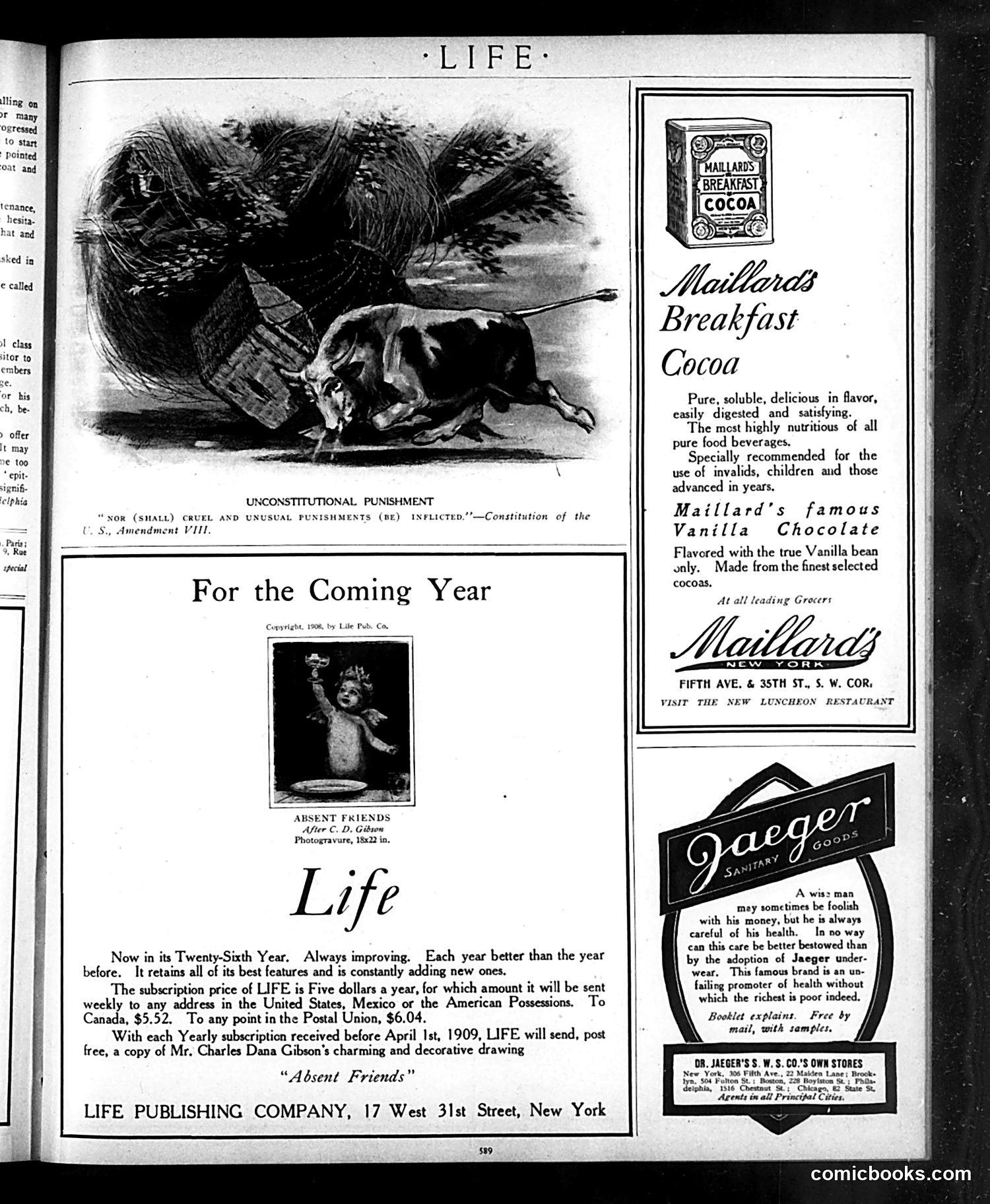
The top cartoon illustrates the Eighth Amendment's prohibition against cruel and unusual punishment. It depicts a figure being subjected to what appears to be violent physical punishment—likely a whipping or beating. The image sarcastically critiques the gap between constitutional protections and actual practice. The specific reference to "Constitution of the U.S., Amendment VIII" suggests this comments on contemporary punishment practices that violated the stated law. Without additional context identifying the specific figure or incident, the cartoon appears to be a general indictment of extrajudicial violence or excessive punishments occurring despite legal protections. The page is primarily promotional material for *Life* magazine's subscription renewal and period advertisements (cocoa, chocolate, and undergarments), with this political cartoon serving as the editorial content.
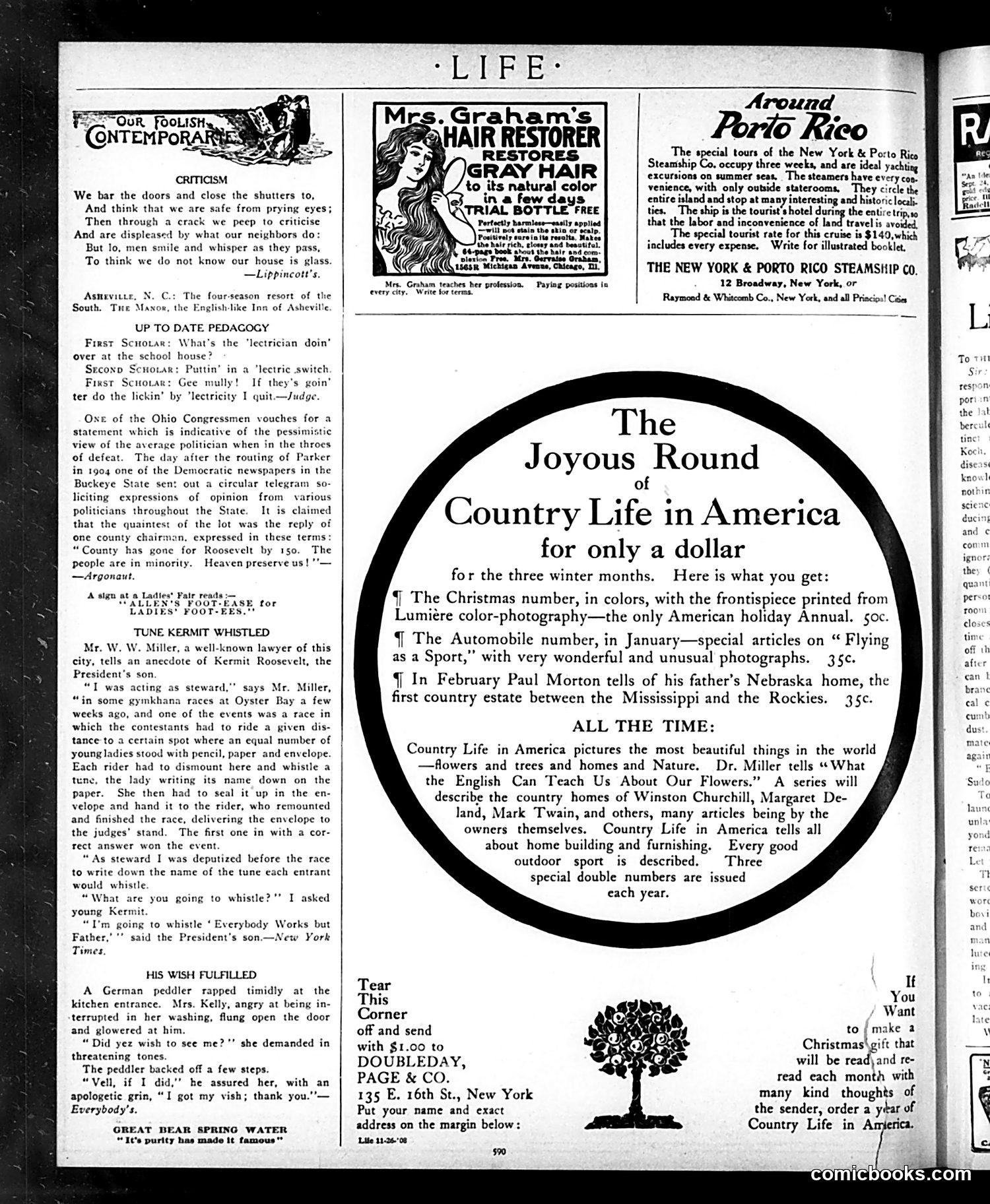
This page from *Life* magazine presents several brief satirical pieces and advertisements typical of early 20th-century American humor: **"Our Foolish Contemporary"** opens with a poem about hypocrisy—criticizing neighbors while unaware that one's own faults are equally visible ("our house is glass"). **"Up to Date Pedagogy"** is a short joke contrasting rural dialect speech with modern technology: a student assumes that installing an electric switch means corporal punishment will now be administered electrically, leading him to quit school. **"Tune Kermit Whistled"** references Kermit Roosevelt (President Theodore Roosevelt's son) in an anecdote about a gymkhana race where contestants whistle tunes that ladies must identify—Kermit chose "Everybody Works but Father," a popular song. **"His Wish Fulfilled"** depicts a German immigrant peddler; the humor relies on a language misunderstanding where Mrs. Kelly's hostile greeting satisfies his wish to "see" her angry response. The page also advertises Mrs. Graham's hair restoration product and promotes Country Life magazine subscriptions and Puerto Rico steamship tours—typical period advertising.
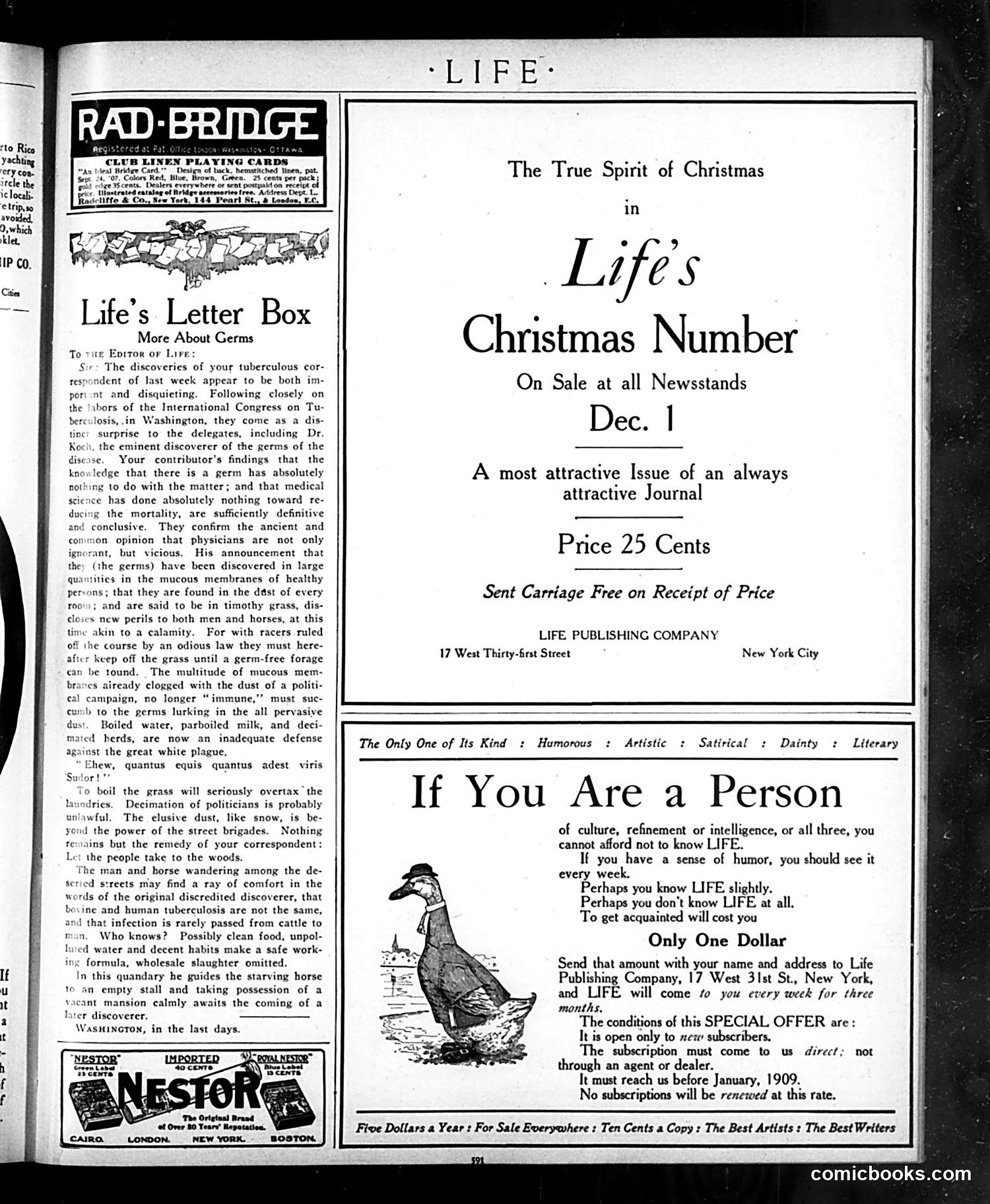
This page is primarily **advertising and promotional content** for Life magazine, rather than political cartoons. The main feature is a full-page advertisement promoting Life's Christmas Number (December 1, price 25 cents) and a subscription offer ($1 for three months). The pitch emphasizes that Life is "humorous," "artistic," "satirical," and "literary" — targeting educated readers who value culture and humor. On the left is **"Life's Letter Box,"** a satirical reader response mocking contemporary germ theory. The writer sarcastically amplifies recent tuberculosis research discoveries, suggesting their implications are absurdly catastrophic — that people must avoid grass, boil everything, and flee to the woods. This ridicules both overblown public health panic and medical experts' inability to translate germ discovery into practical prevention. The tone suggests skepticism about whether knowing germs exist actually helps anyone. The **small duck illustration** and various advertisements (Rad-Bridge cards, Nestor automobiles) fill remaining space. This reflects early-1900s American anxieties about modern science and disease.
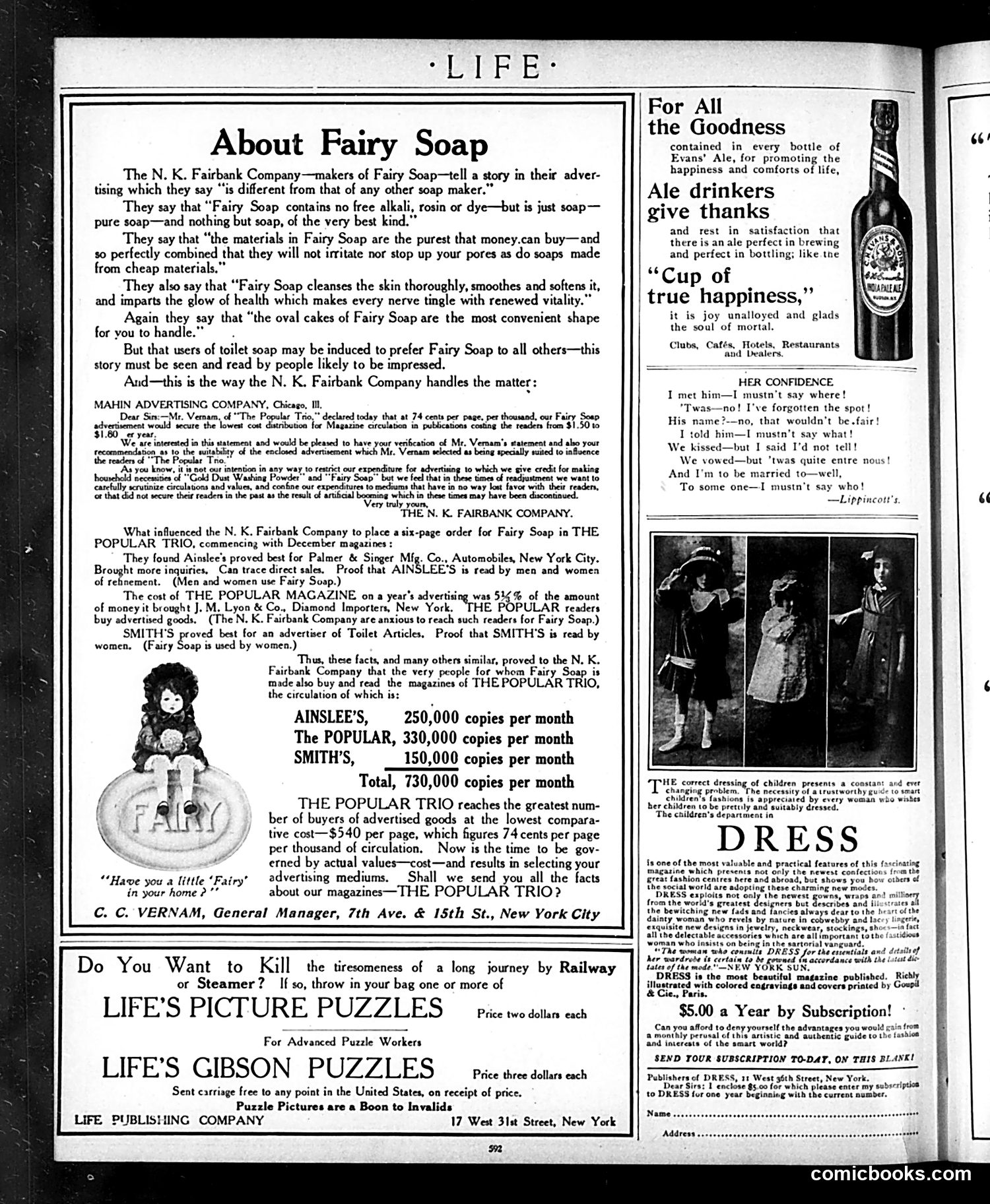
This page is primarily **advertising and promotional content**, not political satire. It consists of: 1. **Fairy Soap Advertisement** (center-left): The N.K. Fairbank Company describes their soap's purity and benefits, claiming it contains "no free alkali, rosin or dye." The ad emphasizes the product's superiority through testimonials from advertising agencies. 2. **Evans' Ale Advertisement** (right): Promotes ale as a perfect beverage, using flowery language about "true happiness." 3. **"Her Confidence" Vignette** (right): A playful romantic poem about a secret meeting and engagement—likely used to appeal to female readers. 4. **Dress Magazine Advertisement** (lower right): Promotes a fashion publication. 5. **Life's Picture Puzzles** (bottom): Recreational advertising for puzzle books. The page demonstrates early 20th-century magazine advertising strategy: pairing product ads with appealing editorial content and using circulation data to attract advertisers. There is **no political cartoon or satire** present—this is purely commercial content typical of Life magazine's revenue model.
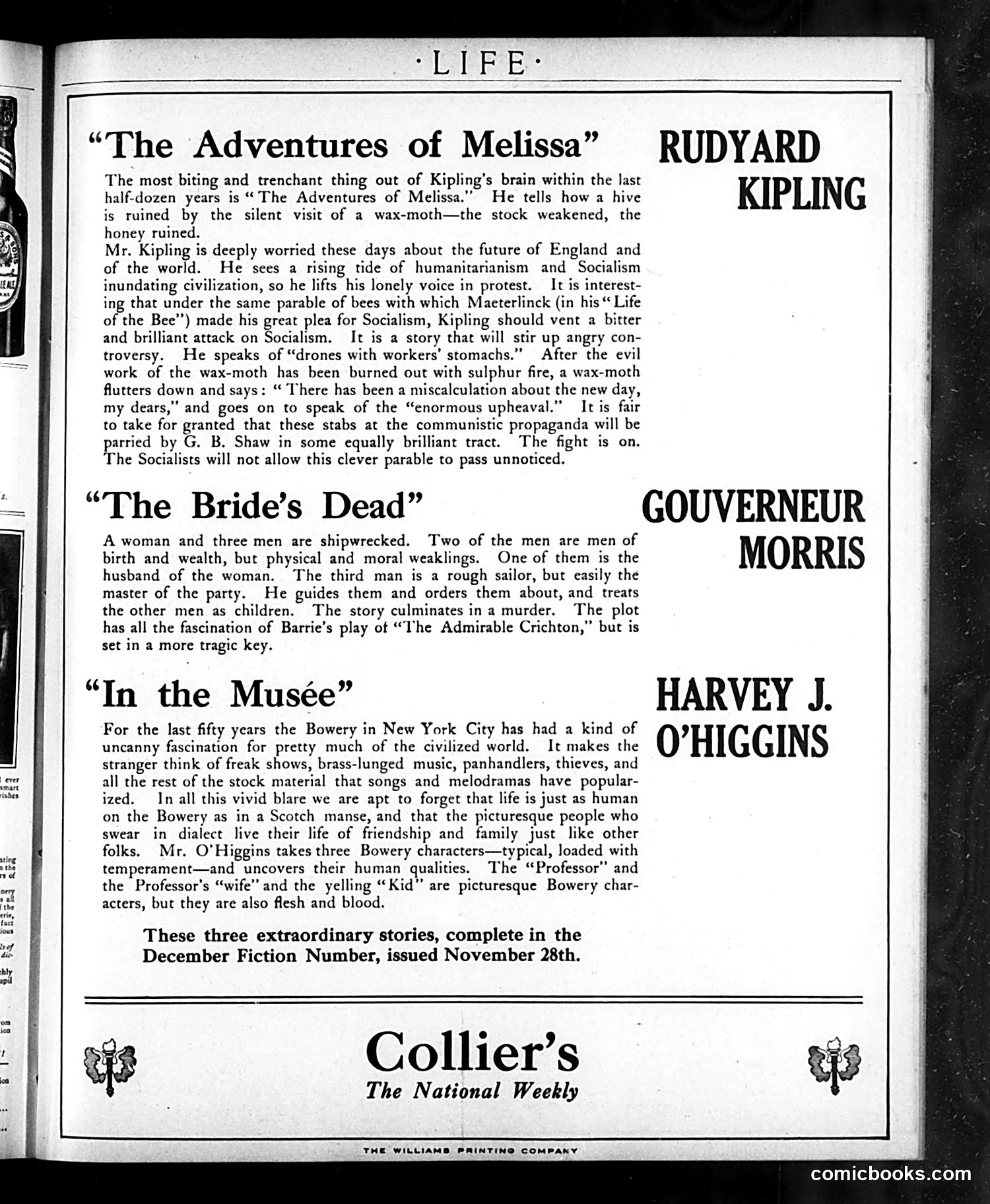
This page is **not a cartoon** but rather an advertisement for *Collier's* magazine's December fiction issue, featuring three stories with editorial commentary. The key political content concerns Rudyard Kipling's "The Adventures of Melissa"—an allegory using a beehive threatened by a wax-moth to **attack Socialism**. The reviewer notes the irony: Maeterlinck used the same bee parable to *defend* Socialism, while Kipling weaponizes it against the movement. References to "drones with workers' stomachs" and "communistic propaganda" are Kipling's jabs at socialist ideology and labor movements. The reviewer predicts G.B. Shaw will respond with a counter-argument, anticipating intellectual combat between conservative and progressive writers. The other two stories—"The Bride's Dead" (Gouverneur Morris) and "In the Musée" (Harvey J. O'Higgins)—appear to be literary fiction without overt political content, though O'Higgins's Bowery story emphasizes humanizing working-class characters beyond stereotypes. The page captures early 20th-century anxieties about socialism's rise in industrial societies.
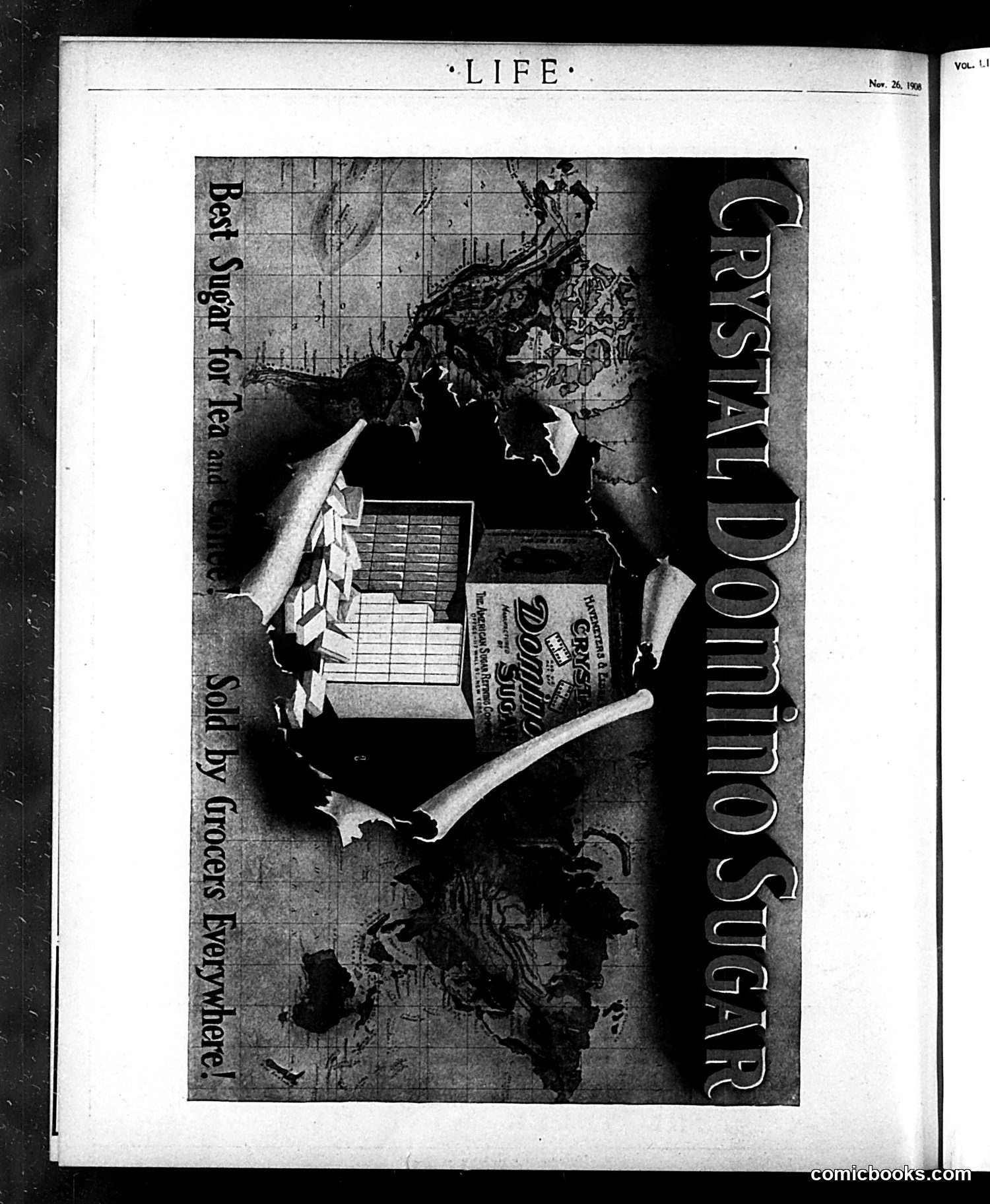
This page contains a **Crystal Dominos Sugar advertisement**, not political satire. The image shows a woman in 1920s attire holding up a box of the product while gesturing toward a map and various domestic/cooking implements. The text on the left side reads: "Best Sugar for Ice and Ices," "Sold by Grocers Everywhere," and appears to reference the product's use in household cooking and ice-making—common domestic tasks of the era. The large text "CRYSTAL DOMINOS SUGAR" dominates the right side. This is a commercial advertisement promoting refined sugar as an essential household ingredient, capitalizing on women's domestic roles during this period.