
Life, 1908-11-26 · page 14 of 24
Life — November 26, 1908 — page 14: what you’re looking at
What you’re looking at
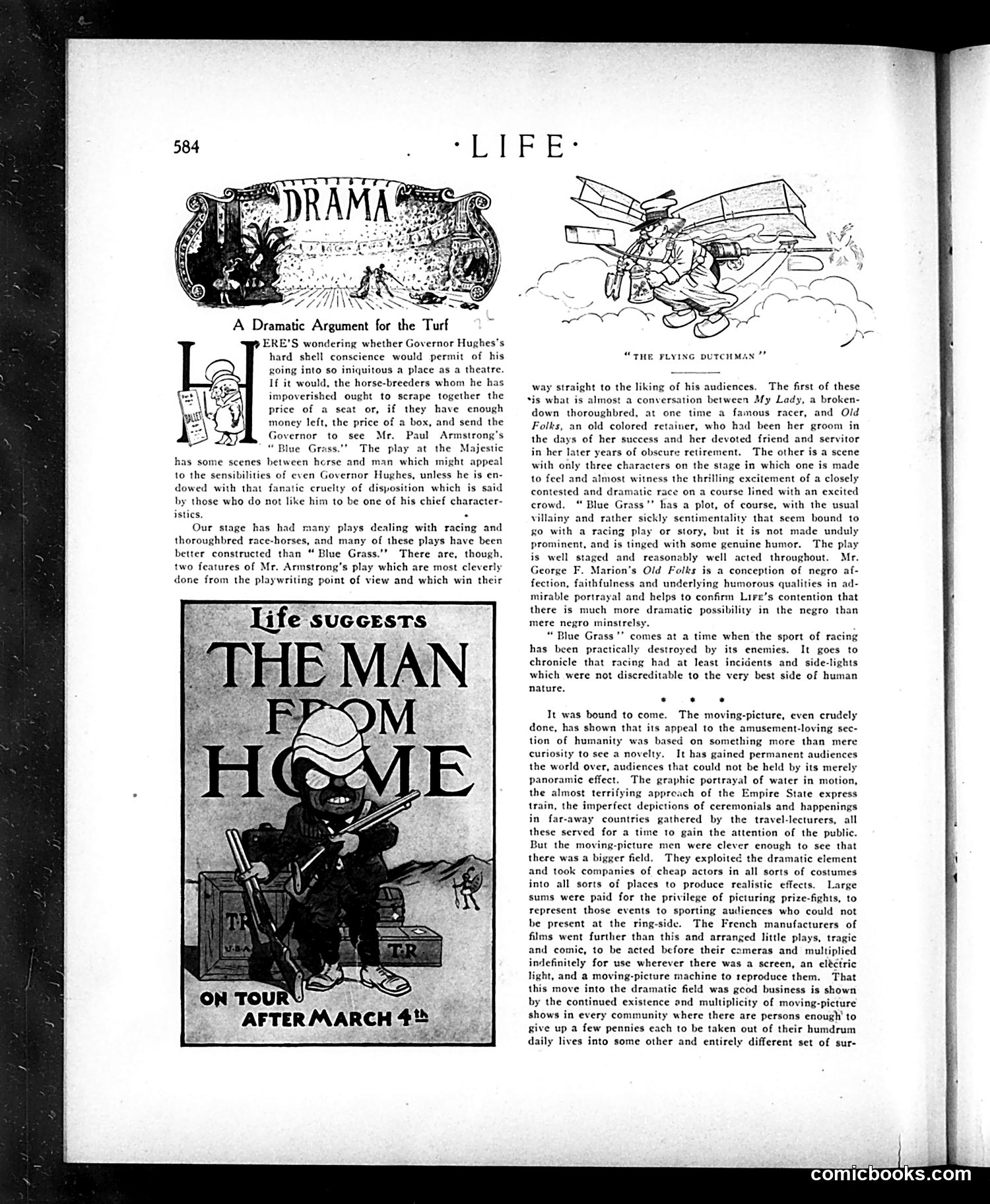
This page contains two distinct pieces critiquing early 1900s entertainment and politics. **"A Dramatic Argument for the Turf"** (main article) satirizes Governor Hughes's moral rigidity. The author sarcastically suggests Hughes—who apparently opposed horse racing and impoverished breeders through his policies—should attend the play "Blue Grass" at the Majestic Theatre. The play depicts a conversation between a retired racehorse and her former groom, treating the animal with dignity. The satire's point: if even Hughes cares about animal welfare, surely he'd appreciate racing's legitimate dramatic and moral dimensions, not just condemn it wholesale. **"The Man from Home" advertisement** (lower left) promotes a touring theatrical production, unrelated to the main article's themes. The second section discusses how moving pictures (early cinema) evolved from mere novelty—showing trains and water—into genuine dramatic storytelling, even depicting prize-fights for audiences unable to attend live events. Both pieces reflect Progressive Era tensions between entertainment, morality, and regulation.
📄 Transcribed text from this page (OCR, searchable)
Machine-transcribed from the original scan — historical spelling and the odd misread are preserved.
A Dramatic Argument for the Turf ERE’S wondering whether Governor Hughes's hard shell conscience would permit of his going into so iniquitous a place as a theatre. If it would, the horse-breeders whom he has impoverished ought to scrape together the price of a seat or, if they have enough money left, the price of a box, and send the Governor to see Mr. Paul Armstrong's “Blue Grass."" The play at the Majestic has some scenes between horse and man which might appeal to the sensibilities of even Governor Hughes, unless he is en- dowed with that fanatic cruelty of jon which is said by those who do not like him to be one of his chief character- istics. . Our stage has had many plays dealing with racing and thoroughbred race-horses, and many of these plays have been better constructed than “Blue Grass.” There are, though, two features of Mr. done from the playwriting point of view and which win their rmstrong’s play which are most cleverly way straight to the liking of his audiences. The first of these sis what is almost a conversation between My Lady, a broken- down thoroughbred, at one time a famous racer, and Old Folks, an old colored retainer, who had been her groom in the days of her success and her devoted friend and servitor in her later years of obscure retirement. The other is a scene with only three characters on the stage in which one is made to feel and almost witness the thrilling excitement of a closely contested and dramatic race on a course lined with an excited crowd. “Blue Grass" has a plot, of course, with the usual villainy and rather sickly sentimentality that seem bound to go with a racing play or story, but it is not made unduly prominent, and is tinged with some genuine humor. The play is well staged and reasonably well acted throughout. Mr. George F. Marion's Old Folks is a conception of negro af- fection, faithfulness and underlying humorous qualities in ad- mirable portrayal and helps to confirm Lire’s contention that there is much more dramatic possibility in the negro than mere negro minstrelsy. “ Blue Grass ’” comes at a time when the sport of racing has been practically destroyed by its enemies. It goes to chronicle that racing had at least incidents and side-lights which were not discreditable to the very best side of human nature. * 8 6 It was bound to come. The moving-picture, even crudely done, has shown that its appeal to the amusement-loving sec- tion of humanity was based on something more than mere curiosity to see a novelty. It has gained permanent audiences the world over, audiences that could not be held by its merely panoramic effect. The graphic portrayal of water in motion, the almost terrifying approach of the Empire State express train, the imperfect depictions of ceremonials and happenings in far-away countries gathered by the travel-lecturers, all these served for a time to gain the attention of the public. But the moving-picture men were clever enough to see that there was a bigger field, They exploited the dramatic element and took companies of cheap actors in all sorts of costumes into all sorts of places to produce realistic effects. Large sums were paid for the privilege of picturing prize-fights, to represent those events to sporting audiences who could not be present at the ring-side. The French manufacturers of films went further than this and arranged little plays, tragic and comic, to be acted before their cameras and multiplied indefinitely for use wherever there was a screen, an eltctric light, and a moving-picture machine to reproduce them. That this move into the dramatic field was geod business is shown by the continued existence and multiplicity of moving-picture shows in every community where there are persons enough’ to give up a few pennies each to be taken out of their humdrum daily lives into some other and entirely different set of sur- comicbooks.com