
Life, 1908-11-26 · page 23 of 24
Life — November 26, 1908 — page 23: what you’re looking at
What you’re looking at
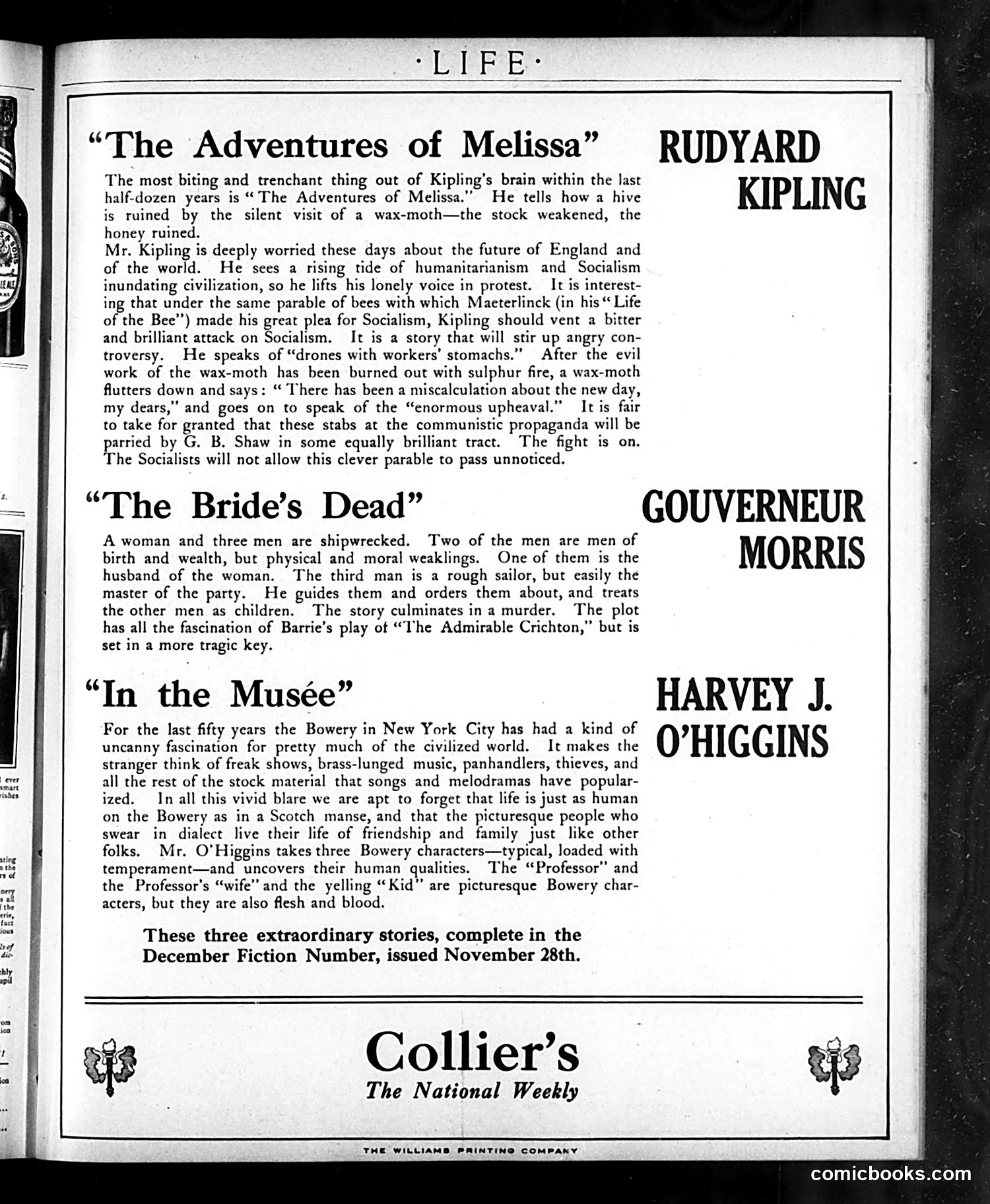
This page is **not a cartoon** but rather an advertisement for *Collier's* magazine's December fiction issue, featuring three stories with editorial commentary. The key political content concerns Rudyard Kipling's "The Adventures of Melissa"—an allegory using a beehive threatened by a wax-moth to **attack Socialism**. The reviewer notes the irony: Maeterlinck used the same bee parable to *defend* Socialism, while Kipling weaponizes it against the movement. References to "drones with workers' stomachs" and "communistic propaganda" are Kipling's jabs at socialist ideology and labor movements. The reviewer predicts G.B. Shaw will respond with a counter-argument, anticipating intellectual combat between conservative and progressive writers. The other two stories—"The Bride's Dead" (Gouverneur Morris) and "In the Musée" (Harvey J. O'Higgins)—appear to be literary fiction without overt political content, though O'Higgins's Bowery story emphasizes humanizing working-class characters beyond stereotypes. The page captures early 20th-century anxieties about socialism's rise in industrial societies.
📄 Transcribed text from this page (OCR, searchable)
Machine-transcribed from the original scan — historical spelling and the odd misread are preserved.
“The Adventures of Melissa” The most biting and trenchant thing out of Kipling’s brain within the last half-dozen years is ‘The Adventures of Melissa.” He tells how a hive is ruined by the silent visit of a wax-moth—the stock weakened, the honey ruined. Mr. Kipling is deeply worried these days about the future of England and of the world. He sees a rising tide of humanitarianism and Socialism inundating civilization, so he lifts his lonely voice in protest. It is interest- ing that under the same parable of bees with which Maeterlinck (in his “ Life of the Bee’) made his great plea for Socialism, Kipling should vent a bitter and brilliant attack on Socialism. It is a story that will stir up angry con- troversy. He speaks of “drones with workers’ stomachs.” After the evil work of the wax-moth has been burned out with sulphur fire, a wax-moth flutters down and says: “ There has been a miscalculation about the new day, my dears,” and goes on to speak of the “enormous upheaval.” It is fair to take for granted that these stabs at the communistic propaganda will be parried by G. B. Shaw in some equally brilliant tract. The fight is on. The Socialists will not allow this clever parable to pass unnoticed. “The Bride’s Dead” A woman and three men are shipwrecked. Two of the men are men of birth and wealth, but physical and moral weaklings. One of them is the husband of the woman. The third man is a rough sailor, but easily the master of the party. He guides them and orders them about, and treats the other men as children. The story culminates in a murder. The plot has all the fascination of Barrie’s play ot “Ihe Admirable Crichton,” but is set in a more tragic key. “In the Musée” For the last fifty years the Bowery in New York City has had a kind of uncanny fascination for pretty much of the civilized world. It makes the stranger think of freak shows, brass-lunged music, panhandlers, thieves, and all the rest of the stock material that songs and melodramas have popular- ized. In all this vivid blare we are apt to forget that life is just as human on the Bowery as in a Scotch manse, and that the picturesque people who swear in dialect live their life of friendship and family just like other folks. Mr. O'Higgins takes three Bowery characters—typical, loaded with temperament—and uncovers their human qualities. The “Professor” and the Professor's “wife” and the yelling “Kid” are picturesque Bowery char- acters, but they are also flesh and blood. These three extraordinary stories, complete in the December Fiction Number, issued November 28th. Collier’s The National Weekly THE WILLIAMS PRINTING COMPAKY RUDYARD KIPLING GOUVERNEUR MORRIS HARVEY J. O’HIGGINS comicbooks.com