
Life, 1908-11-26 · page 16 of 24
Life — November 26, 1908 — page 16: what you’re looking at
What you’re looking at
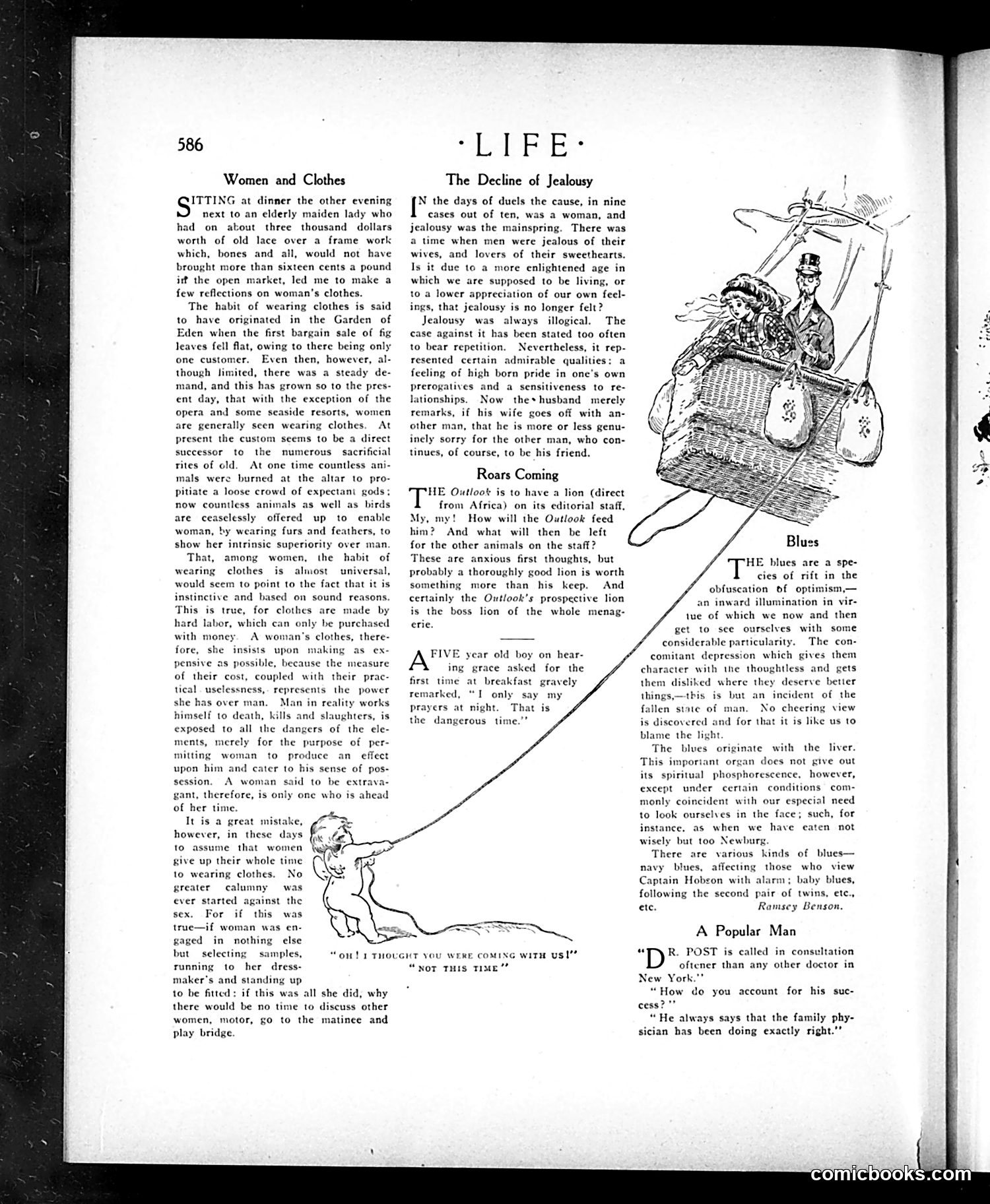
This page contains three separate satirical pieces typical of Life magazine's social criticism: **"Women and Clothes"** (left column): A tongue-in-cheek essay mocking women's expensive fashion habits. The author sarcastically compares clothing expenditure to ancient animal sacrifices, suggesting women use elaborate dress to demonstrate power over men who labor to afford their wardrobe. The humor lies in the exaggerated complaint that women have *no time* for clothes because they're too busy discussing other women, driving cars, attending matinees, and playing bridge. **"The Decline of Jealousy"** (right column): Commentary lamenting that modern men no longer experience jealousy—once a motivation for duels. The piece sardonically observes that husbands now merely express polite sympathy when wives take lovers, remaining friends with the rival. It critiques modern indifference as spiritual decline. **Small cartoon/vignette** (bottom): Shows a woman apparently surprised at an encounter, with caption "Oh! I thought you were coming with us! Not this time." The overall tone reflects early 20th-century satirical critique of changing gender relations and modern social behaviors.
📄 Transcribed text from this page (OCR, searchable)
Machine-transcribed from the original scan — historical spelling and the odd misread are preserved.
586 Women and Clothes ITTING at dinner the other evening next to an elderly maiden lady who had on atout three thousand dollars worth of old lace over a frame work which, bones and all, would not have brought more than sixteen cents a pound if the open market, led me to make a few reflections on woman's clothes. The habit of wearing clothes is said to have originated in the Garden of Eden when the first bargain sale of fig leaves fell flat, owing to there being only one customer. Even then, however, al- though limited, there was a steady de- mand, and this has grown so to the pres- ent day, that with the exception of the opera and some seaside resorts, women are generally seen wearing clothes. At present the custom seems to be a direct successor to the numerous sacrificial rites of old. At one time countless ani- mals were burned at the altar to pro- pitiate a loose crowd of expectant gods: now countless animals as well as birds are ceasclessly offered up to enable woman, by wearing furs and feathers, to show her intrinsic superiority over man. That, among habit of wearing clothes is universal, would scem to point to the fact that it is instinctive and based on sound reasons. This is for clothes are made by hard labor, which can only be purchased with money. A woman’s clothes, there- fore, she insists upon making 28 possible, because the mi women, the almost true, as ex- pensive asure of their cost, coupled with their prac- tical uselessness,. represents the power she has over man. Man in reality works himself to death, kills and slaughters, is exposed to all the dangers of the ele- ments, merely for the purpose of per- mitting woman to produce an effect upon him and cater to his sense of pos- session be extravs gant, therefore, is only one who is ahead of her time. It is a gr A woman said to to assume that women give up their whole time to wearing clothes. No greater calumny was ever started against the sex. For if this true—if woman was en- gaged in nothing else but selecting samples, running to her dress- maker's and standing up to be fitted: if this was all she did, why there would be no time to discuss other women, motor, go to the matinee and play bridge was “oul! 1 tuovent you “Lh PEE* The Decline of Jealousy N the days of duels the cause, in nine cases out of ten, was a woman, and jealousy was the mainspring. There was a time when men were jealous of their wives, and lovers of their sweethearts. Is it due to a more enlightened age in which we are supposed to be living, or to a lower appreciation of our own feel- ings, that jealousy is no longer felt? Jealousy was always illogical. The case against it has been stated too often to bear repetition. Nevertheless, it rep- resented certain admirable qualities: a feeling of high born pride in one’s own prerogatives and a sensitiveness to re- lationships. Now theshusband merely remarks, if his wife goes off with an- other man, that he is more or less genu- inely sorry for the other man, who con- tinues, of course, to be his friend. Roars Coming HE Outlook is to have a lion (direct from Africa) on its editorial staff, My, my! How will the Outlook feed him?) And what will then be left for the other animals on the staff? These are anxious first thoughts, but probably a thoroughly good lion is worth something more than his keep. And certainly the Outlook's prospective lion is the boss lion of the whole menag- year old boy on hear- ing grace asked for the first time at breakfast remarked, “I only say my prayers at night. That is the dangerous time.’? gravely WERE COMING witH USI” “Not THs TIME” HE blues are a spe- cies of rift in the obfuscation of optimism,— an inward illumination in vir- tue of which we now and then get to sce ourselves with some considerable particularity. The con- comitant depression which gives them character with the thoughtless and gets them disliked where they deserve better things,—this is but an incident of the fallen state of man. No cheering view is discovered and for that it is like us to blame the light. The blves originate with the This imporiant organ does not give out its spiritual phosphorescence, however, except under certain conditions com- monly coincident with our especial need to look ourselves in the face; such, for instance, as when we have eaten not isely but too Newbury There are various navy blues, affecting those who view Captain Hobson with alarm; baby blues, following the second pair of twins, ete. ete. Ramsey Benson. A Popular Man * R. POST is called in consultation oftener than any other doctor in New York."* How do you account cess?’ “He always says that the family phy- sician has been doing exactly right.’’ liver. kinds of blues— for his suc-