
Life, 1908-11-26 · page 10 of 24
Life — November 26, 1908 — page 10: what you’re looking at
What you’re looking at
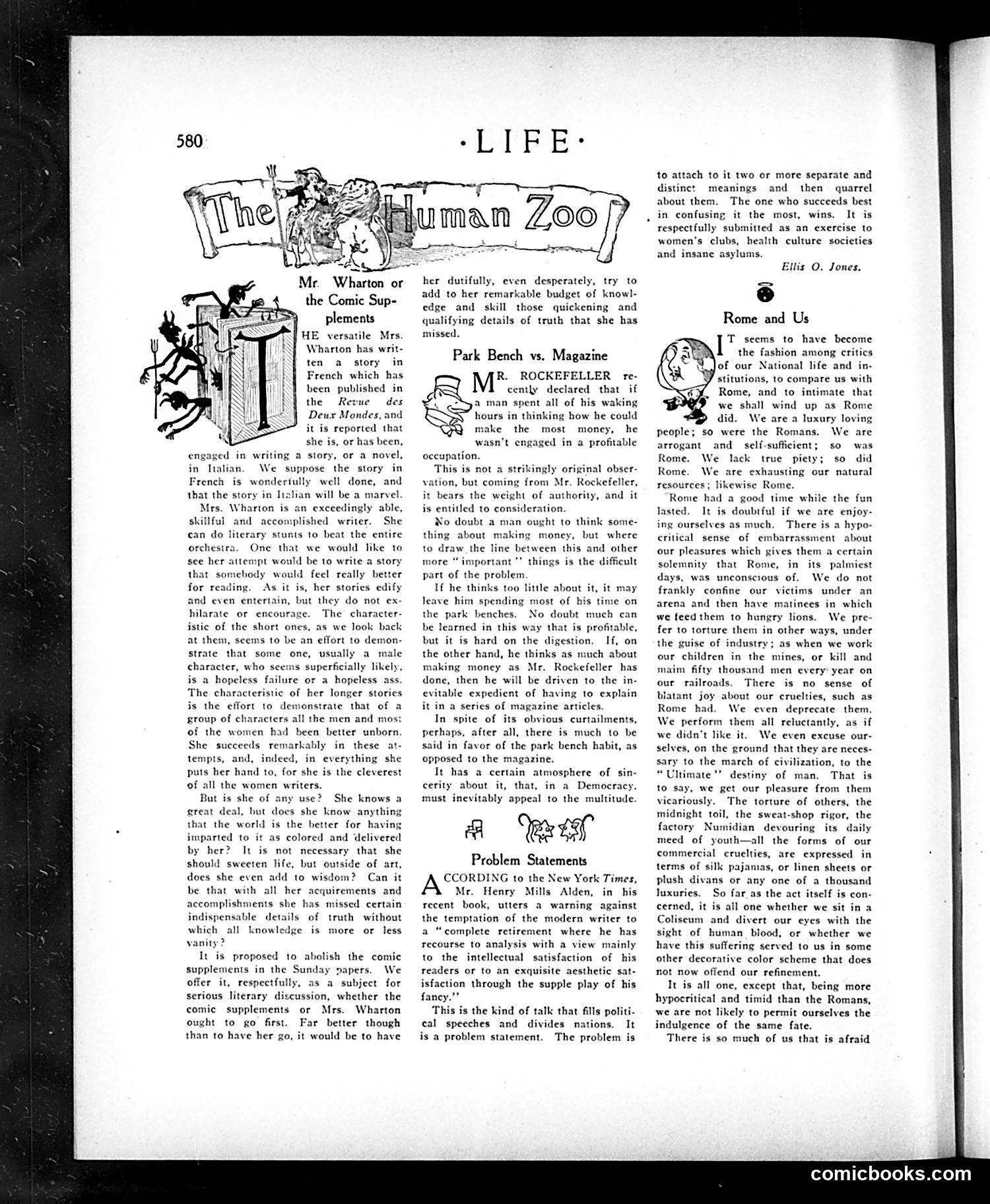
This page features two distinct pieces: **"The Human Zoo"** (left) satirizes Mrs. Wharton, a prolific American writer. The cartoon depicts her as a specimen in a zoo-like display, mocking her prodigious output. The text explains she's writing stories and novels in Italian, suggesting both her ambition and the satirical point that her relentless productivity is almost inhuman or circus-like worthy. **"Rome and Us"** (right) compares American civilization unfavorably to Rome, suggesting America risks Rome's fate through moral decline. It critiques American consumerism and materialism as symptoms of decadence. **"Park Bench vs. Magazine"** presents Rockefeller's philosophy on money-making versus leisure, framed as a debate about life priorities—characteristic Life magazine social commentary on wealth and work.
📄 Transcribed text from this page (OCR, searchable)
Machine-transcribed from the original scan — historical spelling and the odd misread are preserved.
Mr. Wharton or the Comic Sup- plements HE versatile Mrs. Wharton has writ- ten a story in French which has been published in the Revue des Deux Mondes, and it is reported that she is, or has been, ed in writing a story, or a novel, in Italian. We suppose the story in French is wondertully well done, and that the story in Itslian will be a marvel. Mrs. Wharton is an exceedingly able skillful and accomplished writer. She can do literary stunts to beat the entire orchestra. One that we would like to see her altempt would be to write a story that somebody would feel really better for reading. As it is, her stories edify and even entertain, but they do not ex- The character- as we look back at them, seems to be an effort to demon- Strate that some one, usually a male character, who nS superficially like is a hopeless failure or a hopeless ass. The characteristic of her longer stories is the effort to demonstrate that of a group of characters all the men and mos: of the women had been better unborn. She succeeds remarkably in these at and, indeed, in everything she puts her hand to, for she is the cleverest of all the women writers. But is she of any use? hilarate or encourage. istic of the short ones, tempts, She knows a great deal, but does she know anything that the world is the better for having imparted to it as colored and delivered by her? It is not necessary that she should sweeten life, but outside of art, does she even add to wisdom? Can it be that with all her acquirements and accomplishments she has missed certain truth without more or less indispensable details of which all vanity? It is proposed to abolish the comic supplements in the Sunday papers. We offer it, respectfully, as a subject for serious literary discussion, whether the comic supplements or Mrs. Wharton ought to go first. Far better though than to have her go, it would be to have knowledge is her dutifully, even desperately, try to add to her remarkable budget of know!- edge and skill those quickening and qualifying details of truth that she has missed. Park Bench vs. Magazine R. ROCKEFELLER re- cently declared that if a man spent all of his waking hours in thinking how he could make the most money, he wasn’t engaged in a profitable occupation. This is not a strikingly original obser- vation, but coming from Mr. Rockefeller, bears the weight of authority, and it is entitled to consideration No doubt a man ought to think some- ney, but where thing about making to draw the line between this and other things is the difficult more part of the problem If he thinks too little about it, it may leave him spending most of his time on No doubt much can “important "* the park benches. be learned in this way that is profitable, but it is hard on the digestion. If, on the other hand, he thinks as much about ing money as Mr. Rockefeller has done, then he will be driven to the in- evitable expedient of having to explain it in a series of magazine articles. In spite of its obvious curtailments, perhaps, after all, there is much to be said in favor of the park bench habit, as opposed to the magazine. It has a certain atmosphere of sin- cerity about it, that, in a Democracy. must inevitably appeal to the multitude. A Vege Problem Statements CCORDING to the New York Times, Mr. Henry Mills Alden, in his recent book, utters a warning against the temptation of the modern writer to a “complete retirement where he has recourse to analysis with a view mainly to the intellectual satisfaction of his readers or to an exquisite aesthetic sat- isfaction through the supple play of his fancy. This is the kind of talk that fills politi- cal speeches and divides nations. It is a problem statement. The problem is to attach to it two or more separate and distinct. meanings and then quarrel about them. The one who succeeds best in confusing it the most, wins. It is respectfully submitted as an exercise to women's clubs, health culture societies and insane asylums. Ellis O. Jones. @ Rome and Us T seems to have become the fashion among critics of our National life and in- stitutions, to compare us with Rome, and to intimate that we shall wind up as Rome did. We are a luxury loving people; so were the Romans. We are arrogant and self-sufficient; so Rome. We lack true piety; so did Rome. We are exhausting our natural resources; likewise Rome. Rome had a good time while the fun lasted. It is doubtful if we are enjoy- ing ourselves as much. There is a hypo- sense of embarrassment about our pleasures which gives them a certain solemnity that Rome, in its palmiest days, was unconscious of. We do not frankly confine our victims under an arena and then have matinees in which we feed them to hungry lions. We pre- fer to torture them in other ways, under the guise of industry; as when we work our children in the mines, or kill and maim fifty thousand men every: year on our railroads. There is no sense of blatant joy about our cruelties, such as Rome had. We even deprecate them We perform them all reluctantly, as if we didn’t like it. We even excuse our- selves, on the ground that they are neces- sary to the march of civilization, to the “Ultimate destiny of man, That is to say, we get our pleasure from them vicariously. The torture of others, the midnight toil, the sweat-shop rigor, the factory Numidian devouring its daily meed of youth—all the forms of our commercial cruelties, are expressed in terms of silk pajamas, or linen sheets or plush divans or any one of a thousand luxuries. So far as the act itself is con- cerned, it is all one whether we sit in a Coliseum and divert our eyes with the sight of human blood, or whether we have this suffering served to us in some other decorative color scheme that does not now offend our refinement. It is all one, except that, being more hypocritical and timid than the Romans, we are not likely to permit ourselves the indulgence of the same fate. There is so much of us that is afraid was critical comicbooks.com