
Life, 1908-11-26 · page 6 of 24
Life — November 26, 1908 — page 6: what you’re looking at
What you’re looking at
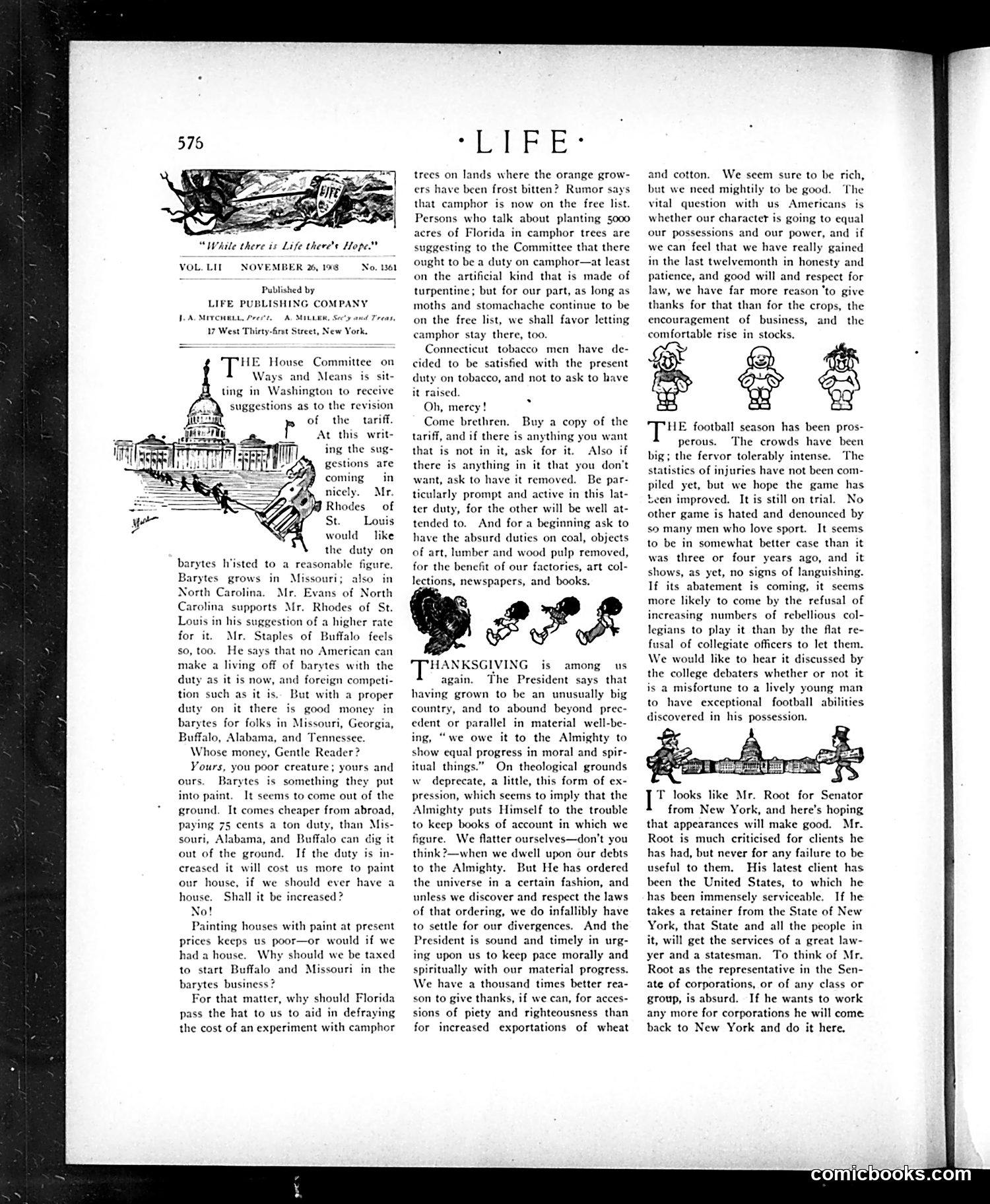
This page contains editorial commentary on several topics, with small cartoon illustrations accompanying the text. The main illustrations appear to be simple decorative vignettes rather than specific political caricatures. One shows the Capitol building, referencing congressional debate over tariffs on barytes (a mineral). Another depicts children in a circle, accompanying discussion of Thanksgiving. The editorial discusses: - **Tariff debates** in Congress regarding barytes imports - **House Committee on Ways and Means** considering duty rates - **Football season** criticism and college debates about the sport - **Senator Root of New York**, criticized regarding corporations and representation The tone is satirical commentary on everyday political and social issues of the era (November 1908), rather than attack-style political cartooning.
📄 Transcribed text from this page (OCR, searchable)
Machine-transcribed from the original scan — historical spelling and the odd misread are preserved.
“While there is Life there's Hopes” VOL.LIT NOVEMBER 2,198 No, 1361 Published by LIFE PUBLISHING COMPANY JA MITCHELL, Pres 17 West Thirty-first Street, New York. A. MILLER, See!y and Treat, HE House Committee on Ways and Means is sit- ting in Washington to receive suiggestions as to the revision of the tariff. At this: writ- ing the sug- gestions are coming in nicely. Mr. Rhodes of St. Louis would — like the duty on barytes h'isted to a reasonable figure. Barytes grows in Missouri; also in North Carolina. Mr. Evans of North Carolina supports Mr. Rhodes of St. Louis in his suggestion of a higher rate for it. Mr. Staples of Buffalo feels so, too. He says that no American can make a living off of barytes with the duty as it is now, and foreign competi- tion such as it is, But with a proper duty on it there is good money in barytes for folks in Missouri, Georgia, Buffalo, Alabama, and Tennessee. Whose money, Gentle Reader? Yours, you poor creature; yours and ours. Barytes is something they put into paint. It seems to come out of the ground. It comes cheaper from abroad, paying 7§ cents a ton duty, than Mis- souri, Alabama, and Buffalo can dig it out of the ground. If the duty is in- creased it will cost us more to paint our house, if we should ever have a house. Shall it be increased? No! Painting houses with paint at present prices keeps us poor—or would if we had a house. Why should we be taxed to start Buffalo and Missouri in the barytes business ? For that matter, why should Florida pass the hat to us to aid in defraying the cost of an experiment with camphor “EAPEAE * trees on lands where the orange grow- ers have been frost bitten? Rumor says that camphor is now on the free list. Persons who talk about planting 5000 acres of Florida in camphor trees are suggesting to the Committee that there ought to be a duty on camphor—at least on the artificial kind that is made of turpentine; but for our part, as long as moths and stomachache continue to be on the free list, we shall favor letting camphor stay there, too. Connecticut tobacco men have de- cided to be satisfied with the present duty on tobacco, and not to ask to have it raised. Oh, mercy! Come brethren. Buy a copy of the tariff, and if there is anything you want that is not in it, ask for it. Also if there is anything in it that you don’t want, ask to have it removed. Be par- ticularly prompt and active in this lat- ter duty, for the other will be well at- tended to. And for a beginning ask to have the absurd duties on coal, objects of art, lumber and wood pulp removed, for the benefit of our factories, art col- lections, newspapers, and books. ers HANKSGIVING is among us again. The President says that having grown to be an unusually big country, and to abound beyond prec- edent or parallel in material well-be- ing, “we owe it to the Almighty to show equal progress in moral and spir- itual things.” On theological grounds w deprecate, a little, this form of ex- pression, which seems to imply that the Almighty puts Himself to the trouble to keep books of account in which we figure. We flatter ourselves—don't you think ?—when we dwell upon our debts to the Almighty. But He has ordered the universe in a certain fashion, and unless we discover and respect the laws of that ordering, we do infallibly have to settle for our divergences. And the President is sound and timely in urg- ing upon us to keep pace morally and spiritually with our material progress. We have a thousand times better re: son to give thanks, if we can, for acces- sions of piety and righteousness than for increased exportations of wheat and cotton. We seem sure to be rich, but we need mightily to be good. The vital question with us Americans is whether our character is going to equal our possessions and our power, and if we can feel that we have really gained in the last twelvemonth in honesty and patience, and good will and respect for law, we have far more reason ‘to give thanks for that than for the crops, the encouragement of business, and the comfortable rise in stocks. * & HE football season has been pros- perous. The crowds have been big; the fervor tolerably intense. The statistics of injuries have not been com- piled yet, but we hope the game has Leen improved. It is still on trial. No other game is hated and denounced by so many men who love sport. It seems to be in somewhat better case than it was three or four years ago, and it shows, as yet, no signs of languishing. If its abatement is coming, it seems more likely to come by the refusal of increasing numbers of rebellious col- legians to play it than by the flat re- fusal of collegiate officers to let them. We would like to hear it discussed by the college debaters whether or not it is a misfortune to a lively young man to have exceptional football abilities discovered in his possession. I" looks like Mr. Root for Senator from New York, and here's hoping Mr. Root is much criticised for clients he has had, but never for any failure to be that appearances will make good. useful to them. His latest client has been the United States, to which he has been immensely serviceable. If he takes a retainer from the State of New York, that State and all the people in it, will get the services of a great law- yer and a statesman. To think of Mr. Root as the representative in the Sen- ate of corporations, or of any class or group, is absurd. If he wants to work any more for corporations he will come back to New York and do it here,