
Life, 1908-11-26 · page 15 of 24
Life — November 26, 1908 — page 15: what you’re looking at
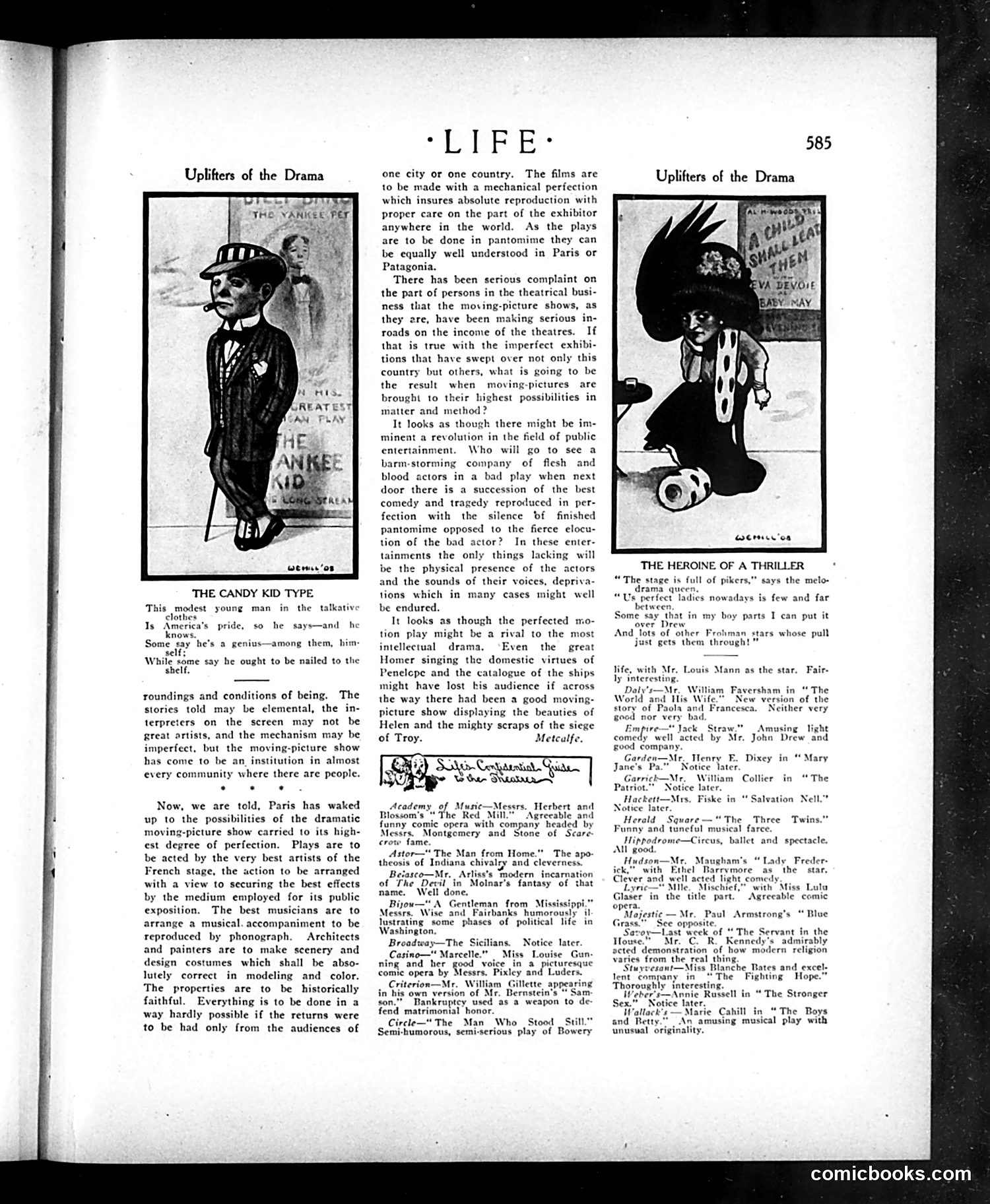
What you’re looking at
This Life magazine article satirizes anxieties about emerging **motion pictures** threatening live theater. The left illustration shows "The Candy Kid Type"—a vain, self-satisfied young actor of modest talent, embodying the theatrical performers Life fears may soon be obsolete. The article's core argument: Paris is perfecting motion pictures with finest actors, perfect pantomime, historically accurate sets, and synchronized music. Once available everywhere, these flawless films will devastate live theater. Why pay for inferior "barn-storming" actors in bad plays when superior silent films play next door? Life suggests even Homer couldn't compete against a good moving-picture show. The satire targets theater industry anxiety about technological displacement—a real concern in early 1900s. The "Candy Kid" embodies the vulnerable live performer facing an impending entertainment revolution, mocked for his pride in obsolescent skills.
📄 Transcribed text from this page (OCR, searchable)
Machine-transcribed from the original scan — historical spelling and the odd misread are preserved.
Uplifters of the Drama ‘THE CANDY KID TYPE This modest young man in the clothes Is America’s knows. Some say he’s a genius—among them, him: self; While some say he ought to be nailed to the shelf. talkativ pride, so he says—and he roundings and conditions of being. The stories told may be elemental, the in- terpreters on the screen may not be great artists, and the mechanism may be imperfect, but the moving-picture show has come to be an institution in almost every community where there are people. . 8 Now, we are told, Paris has waked up to the possibilities of the dramatic moving-picture show carried to its high est degree of perfection. Plays are to be acted by the very best artists of the French stage, the action to be arranged with a view to securing the best effects by the medium employed for its public exposition. The best musicians are to arrange a musical. accompaniment to be reproduced by phonograph. Architects and painters are to make scenery and design costumes which shall be abso- lutely correct in modeling and color. The properties are to be historically faithful. Everything is to be done in a way hardly possible if the returns were to be had only from the audiences of “iP Et one city or one country. The films are to be made with a mechanical perfection which insures absolute reproduction with proper care on the part of the exhibitor anywhere in the world. As the plays are to be done in pantomime they can be equally well understood in Paris or Patagonia. There has been serious complaint on the part of persons in the theatrical busi- ness that the moving-picture shows, as they are, have been making serious in- roads on the income of the theatres. If that is true with the imperfect exhibi- tions that have swept over not only this country but others, what is going to be the result when moving-pictures are brought to their highest possibilities in matter and method? It looks as though there might be im- minent a revolution in the field of public entertainment. Who will go to see a barm-storming company of flesh and blood actors in a bad play when next door there is a succession of the best comedy and tragedy reproduced in per- fection with the silence bf finished pantomime opposed to the fierce elocu- n of the bad actor? In these enter- nments the only things lacking will be the physical presence of the actors and the sounds of their voices, depriva- tions which in many cases might well be endured. It looks as though the perfected mo- tion play might be a rival to the most intellectual drama, ‘Even the great Homer singing the domestic virtues of Penelope and the catalogue of the ships might have lost bis audience if across the way there had been a good moving- picture show displaying the beauties of Helen and the mighty scraps of the siege Metcalfe. Academy of Music—Messrs. Herbert and Blossom’s “ The Red Mill." Agreeable and funny comic opera with company headed by Messrs, Montgomery and Stone of Scare crow fame. Astor—" The Man from Home." The apo- theosis of Indiana chivalsy and cleverness. Bejasco—Mr._ Arliss’s ‘modern incarnation of The Devil in Molnar’s fantasy of that name. Well done. Biyou—" A Gentleman from Mi: iD Messrs. Wise and Fairbanks humorously il justrating some phases of political life in Washington, Broadway—The Sicilians. Not _Casino—" Marcelle.” ning and her good voice in a picturesq’ comic opera by Messrs. Pixley and Luders. Criterion—Mr. William Gillette in his own version of Mr. Bernstei son.’ Bank: icy used as a weapon to de- fend matrimonial honor. Circle—" The Man Who Stood | Still.” Semi-humorous, semi-serious play of Bowery later. Uplifters of the Drama THE HEROINE OF A THRILLER “The stage is full of pikers,” says the melo- drama queen. “Us perfect ladies nowadays is few and far between Some say that in my boy parts T can put it over Drew And lots of other Frohman stars whose pull just gets them through!” life, with Mr, Louis Mann as the star. Fair- ly interesting, Daly's—Mr. William Fav World and His Wife.” Ne story of Paola and Francesca, good nor very bad. Empire Jack | Straw.” Amusing Tight comedy well ‘acted by Mr. John Drew and good company. Garden—Mr. Menry FE. Jane's Pa.” Notice later. Garrich-—Mr, William Patriot.” Notice later. Hackett—Mrs, Notice later. Herald Square—" The Three Funny and tuneful musical farce. Hippodrome—Cireus, ballet and spectacle, AM good, Hudso ick,” with Ethel Clever and well Lyric—"* Mlle. Glaser in the title part. opera. “Majestic — Mr, Paul Grass."" See opposite. Sazoy—Last week of “ The Servant in the Tlouse." *s admirably acted demonstration of how modern religion varies from the real thing. Stuyvesant—Miss Blanche Bates and excel. lent company in “The Fighting Hope.” Thoroughly interesting. Weber's—Annie Russell in “ The Stronger Sex.” Notice later. Waltack’s — Marie Cahill in “The Boys _ An amusing musical play with unusual original sham in “The version of the either very Dixey in “ Mary Collier in “The Salvation Nell.” Twins.” Maugham's “Lady Freder- Barrymore as the star, cted light, comedy Mischief,” with Miss Lula Agreeable comic Armstrong's “ Blue comicbooks.com