
A complete issue · 24 pages · 1908
Life — November 12, 1908
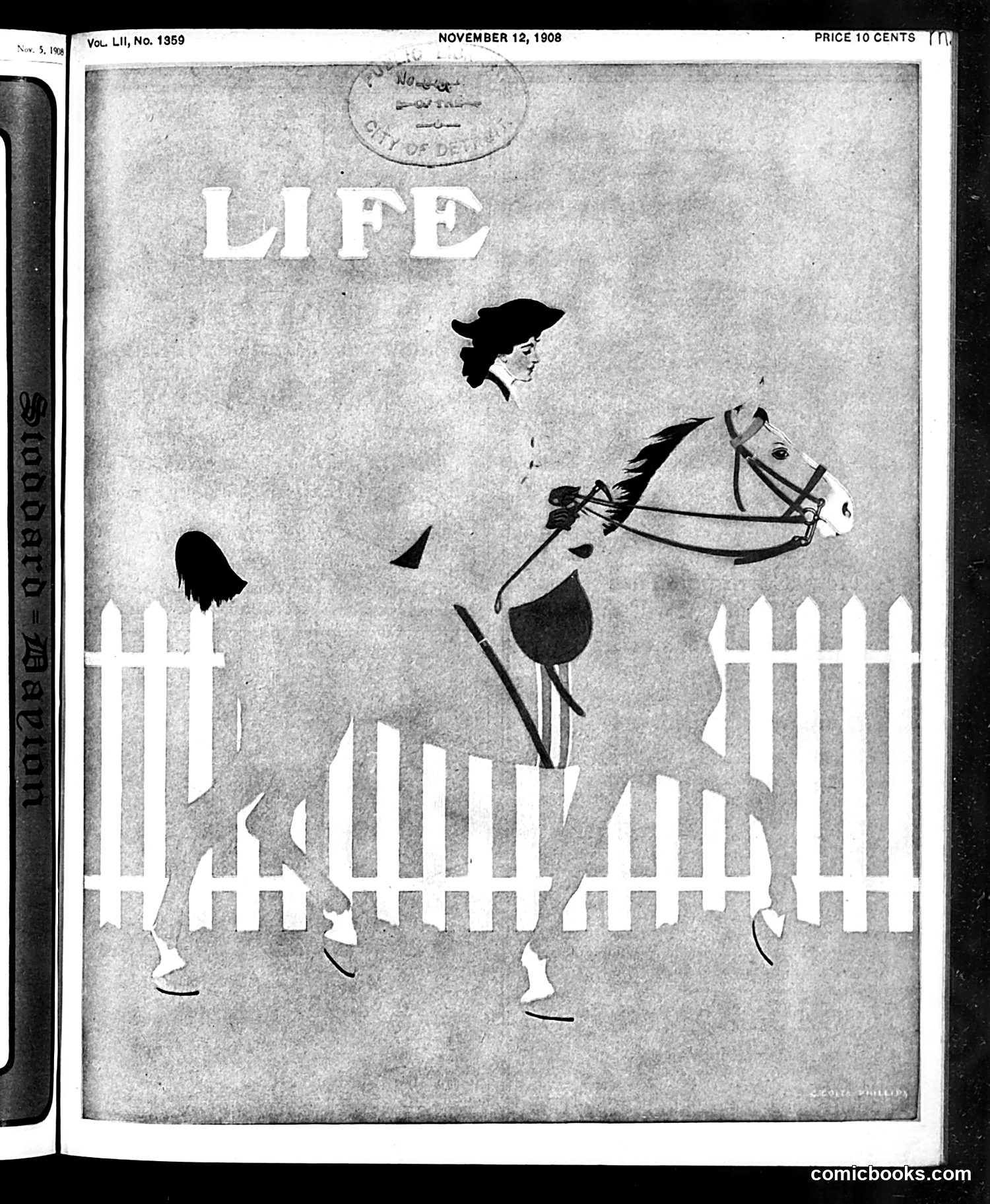
This is the cover of *Life* magazine from November 1908, priced at 10 cents. The illustration shows a woman in a hat riding a horse over a white picket fence—a stylized depiction of equestrian sport or fox hunting. Without additional OCR text from the magazine's interior, the specific satirical meaning is unclear. However, the image likely comments on women's changing roles in early 1900s American society, possibly mocking or celebrating women's participation in traditionally male-dominated leisure activities like horseback riding and hunting. The refined aesthetic suggests commentary on upper-class pursuits and gender conventions of the era. The exact political or social reference requires the magazine's article text to determine.
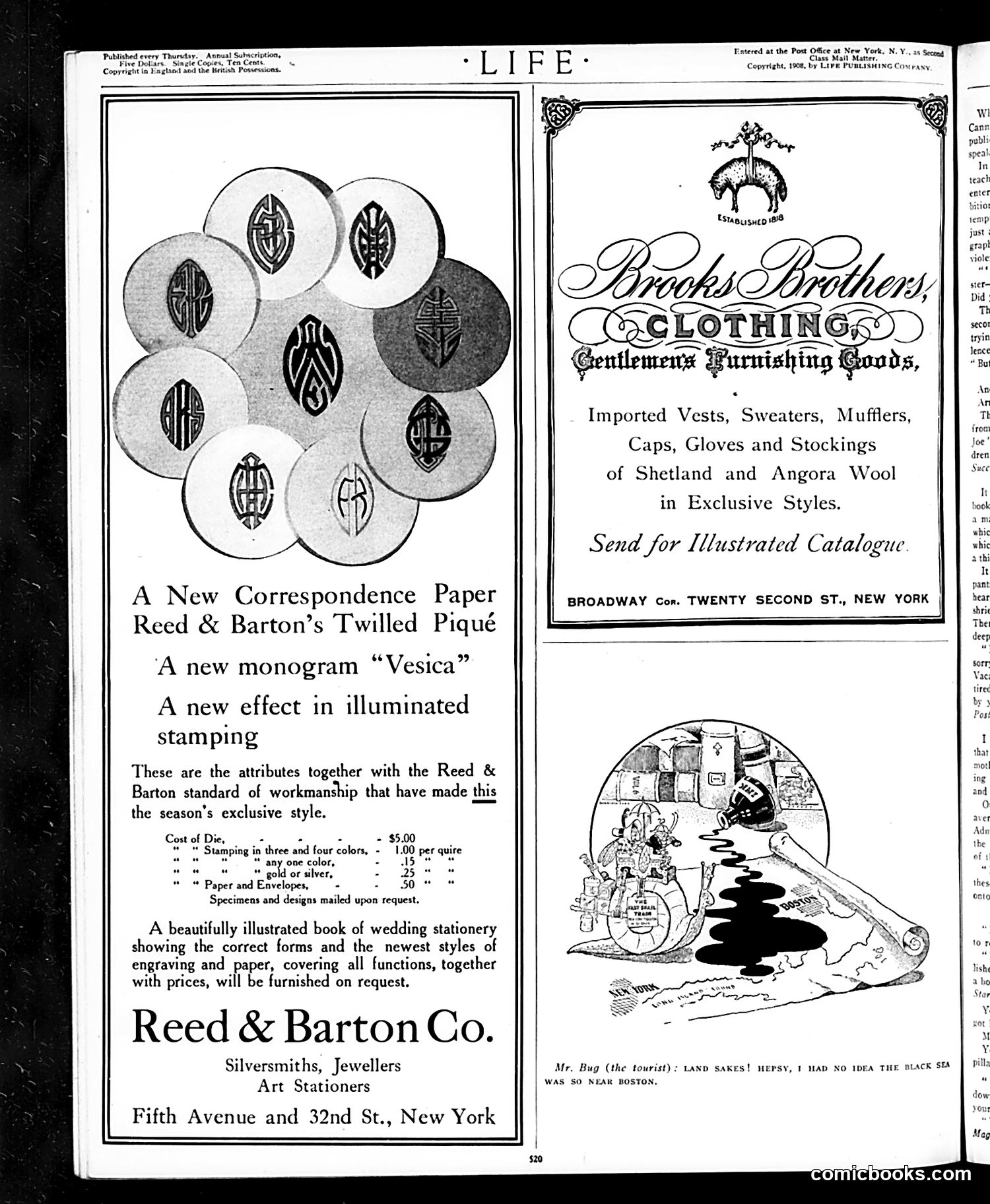
This page consists primarily of **advertisements** rather than political satire or editorial content. The left side advertises **Reed & Barton Co.** stationery and monogrammed correspondence paper, highlighting their "Vesica" monogram design and illuminated stamping services. The right side features **Brooks Brothers** clothing advertisement and a small cartoon illustration labeled "Mr. Bug (the tourist): Land sakes! Hefsy, I had no idea the black sea was so near Boston." This cartoon appears to be a simple **travel humor joke**: a tourist character (depicted as a bug) is surprised to discover the "Black Sea" is apparently near Boston, likely playing on the absurdity of finding a geographically distant sea near an American city. The humor is mild and relies on wordplay or visual confusion rather than political commentary.
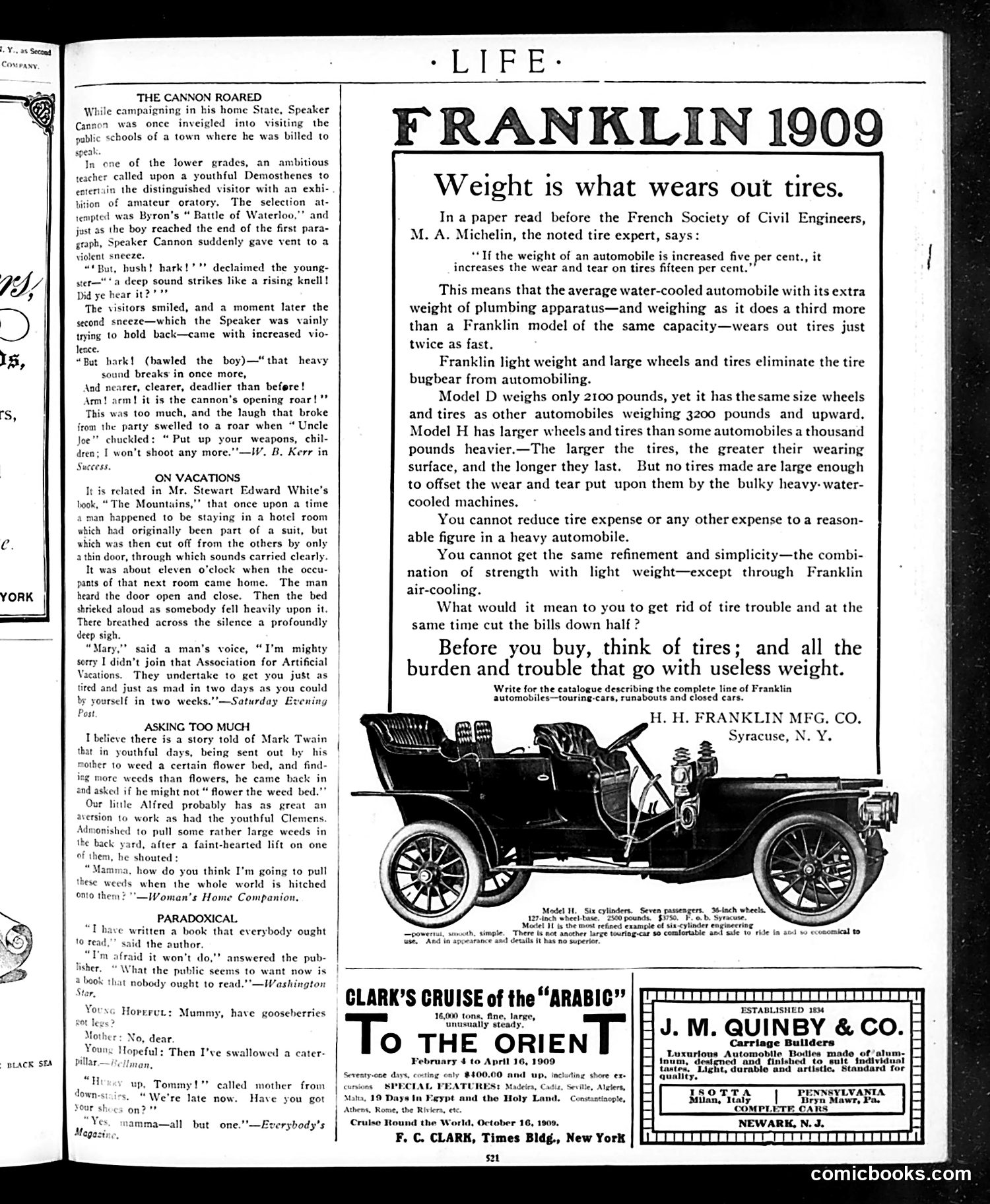
This page contains **primarily advertisements rather than political cartoons**. The dominant feature is a Franklin automobile advertisement (1909) promoting the Model D and Model H vehicles. The ad's central argument concerns tire wear: Franklin claims its lighter weight (2,100 pounds versus competitors' 3,200+ pounds) reduces tire expense and wear, positioning this as a major consumer benefit. The left column contains miscellaneous short humorous pieces and anecdotes typical of Life's satirical content—including "The Cannon Roared," "On Vacations," and various jokes—but these lack political significance. A secondary advertisement promotes Clark's cruises to the Orient, and J.M. Gallery & Co. advertises carriage building services. **This is primarily a commercial advertising page with light entertainment filler.**
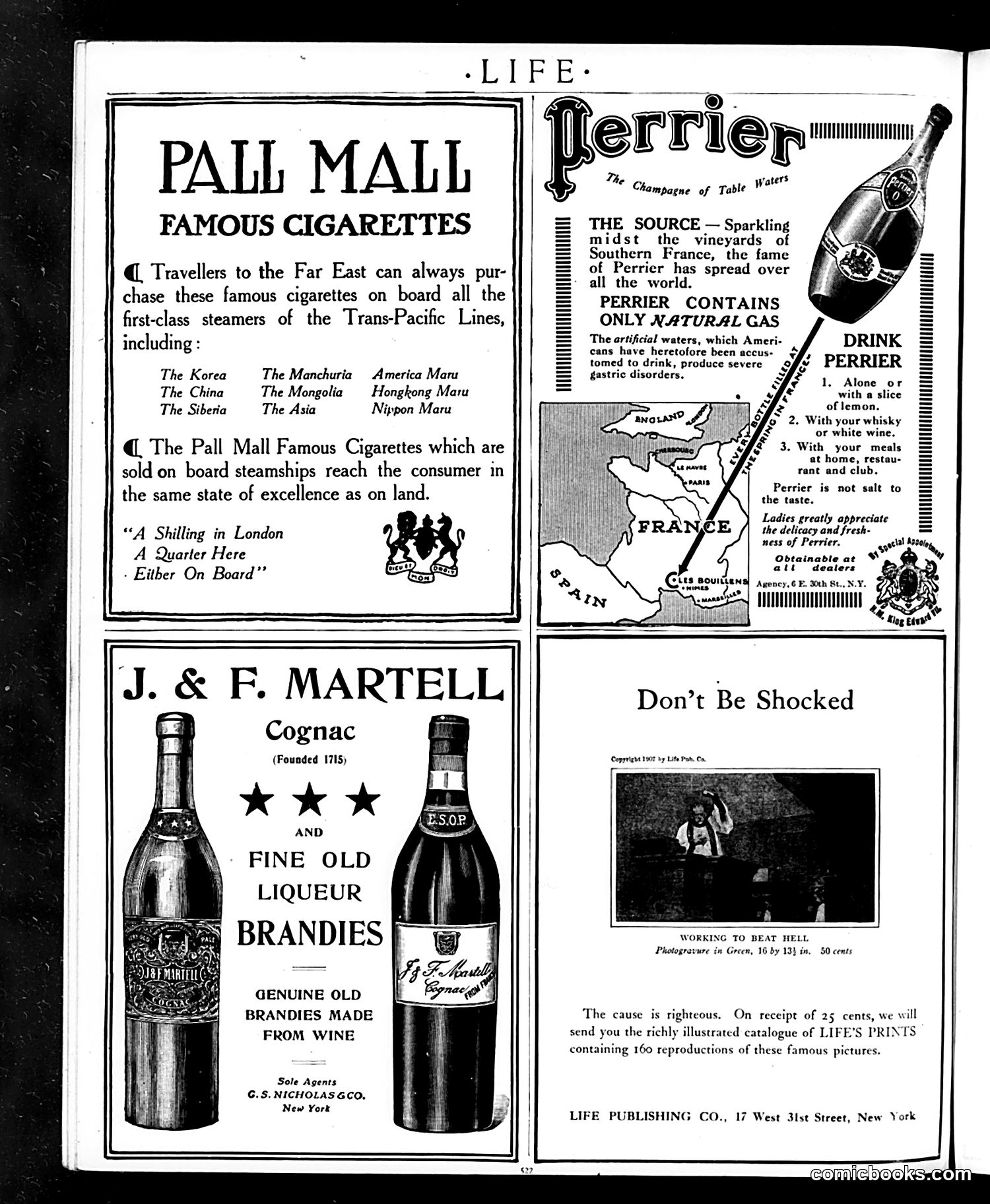
This page is primarily **advertising, not satire or political commentary**. It contains three liquor and tobacco ads typical of early 20th-century Life magazine: 1. **Pall Mall cigarettes** – marketed to international travelers on steamships 2. **Perrier water** – positioned as a health alternative to artificial mineral waters 3. **J. & F. Martell Cognac** – premium French brandy The only non-advertising content is a small section titled "Don't Be Shocked," featuring a photograph labeled "Working to Beat Hell" with a caption offering Life magazine prints for 25 cents. The page reflects the era's advertising practices, before restrictions on tobacco and alcohol promotion. There is no political satire or social commentary present—just commercial messaging typical of this publication's revenue model.
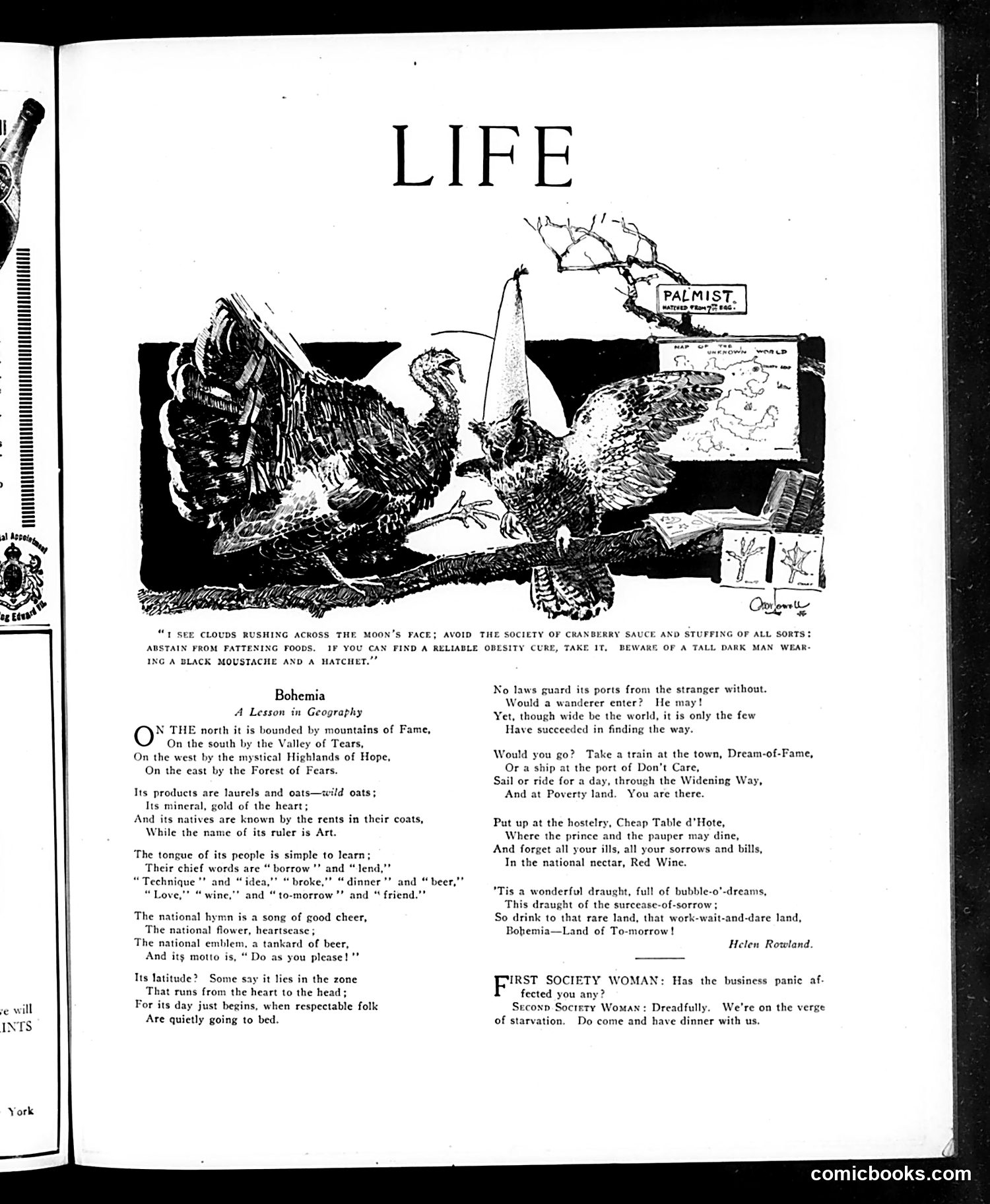
The main cartoon depicts two birds (likely representing countries or political entities) consulting a "Palmist" (fortune teller). One bird appears anxious while examining maps and documents, suggesting concerns about territorial or political matters. Below, "Bohemia: A Lesson in Geography" mocks a European region through satirical verse and dialogue. The poem describes Bohemia's boundaries, resources, and people in exaggerated terms. The accompanying dialogue between "First Society Woman" and "Second Society Woman" jokes about starvation and dinner invitations, possibly satirizing wealthy society's ignorance of or indifference to economic hardship. The overall page appears to critique both geopolitical uncertainty and upper-class obliviousness to social problems through humor.
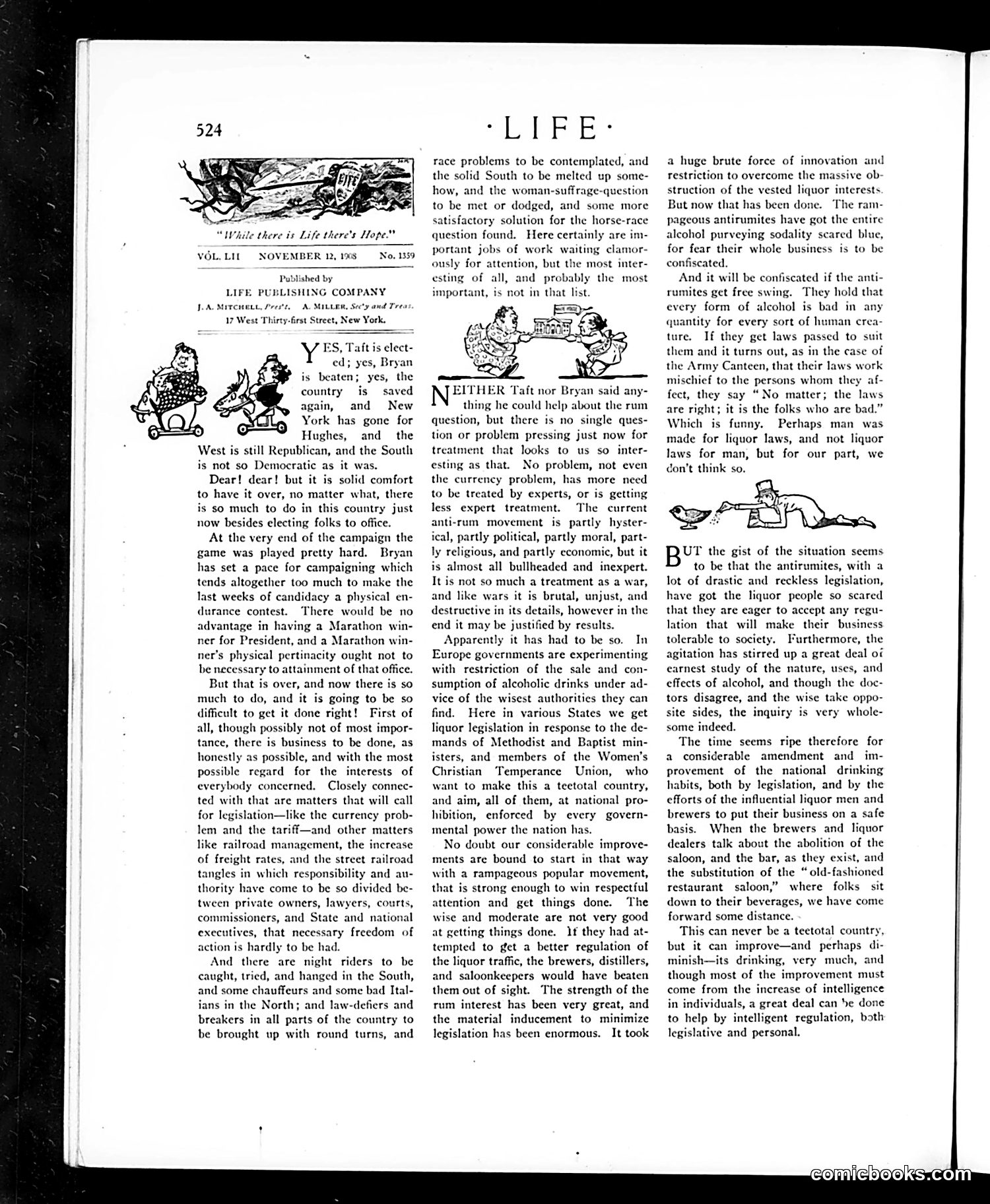
The page features political commentary on the 1908 presidential election. The headline "While there is Life there's Hope" references the election outcome. The text discusses William Howard Taft's victory over William Jennings Bryan, noting the country remains Republican and the South Democratic. The main satirical focus concerns Prohibition—a major political issue of the era. The article critiques the anti-liquor movement as overly zealous and politically motivated, driven by Methodist and Baptist ministers and the Women's Christian Temperance Union. It argues these groups pushed for total prohibition without practical consideration for enforcement or business regulation. The cartoons (small illustrations visible) appear to mock both the pro-Prohibition crusaders and their political tactics, though specific figures are difficult to identify from the image quality provided.
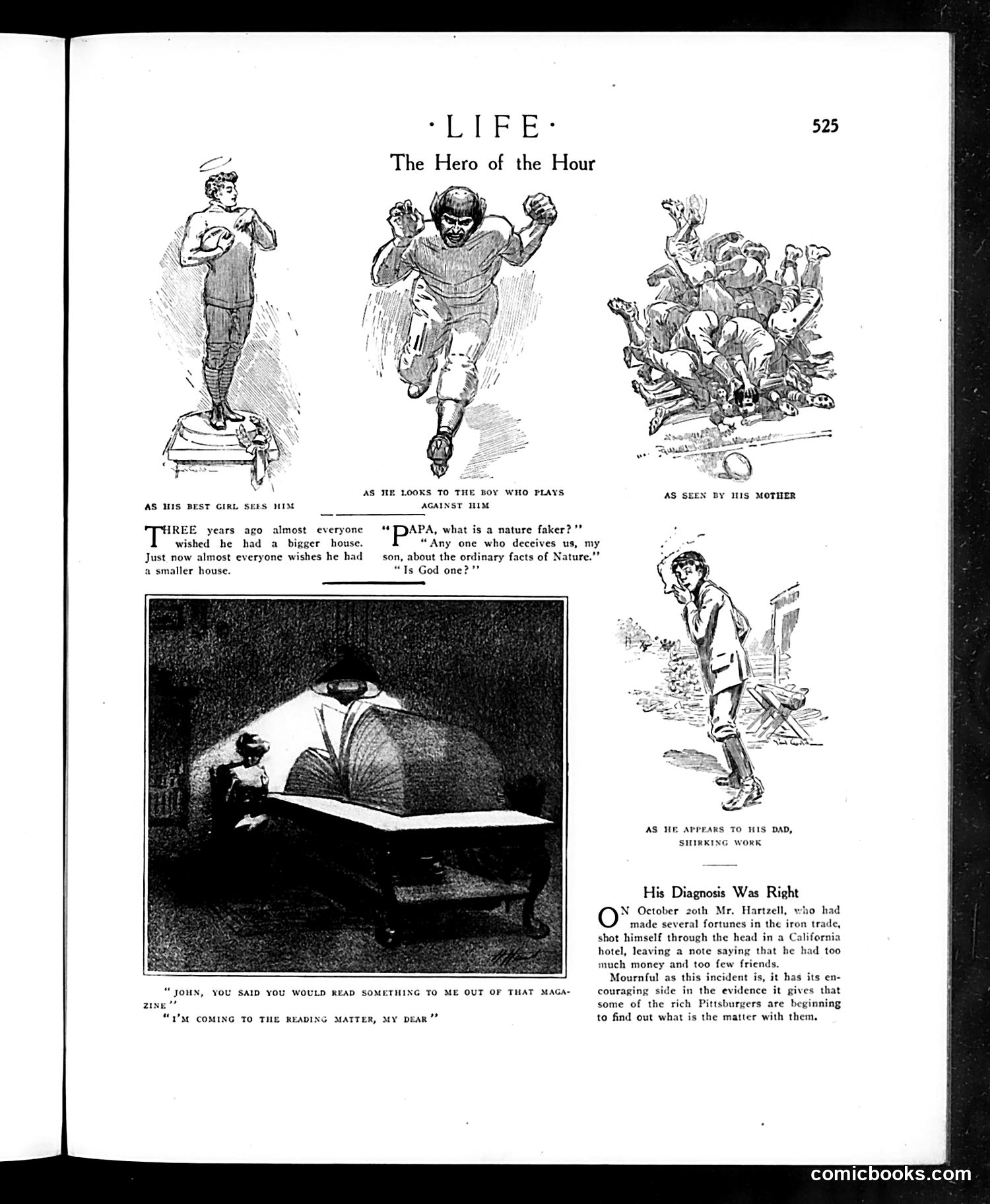
This satirical piece critiques a wealthy boy whose parents indulge his every wish. The narrative describes a child who wanted "a bigger house" three years ago and got one—illustrating parental overindulgence. The sketches show how different observers perceive him: his girlfriend sees him positively, other boys view him as a rival/threat, his mother sees only innocence, and his father sees someone shirking responsibility. The central photograph depicts a domestic scene where a woman reads to a reclining man, captioned with dialogue about reading material from a magazine—likely satirizing leisure and escapism among the wealthy. The bottom section, "His Diagnosis Was Right," references Mr. Hartzell, a Pittsburgh businessman who shot himself, with commentary suggesting wealthy industrialists are beginning to examine their own moral character and excess.
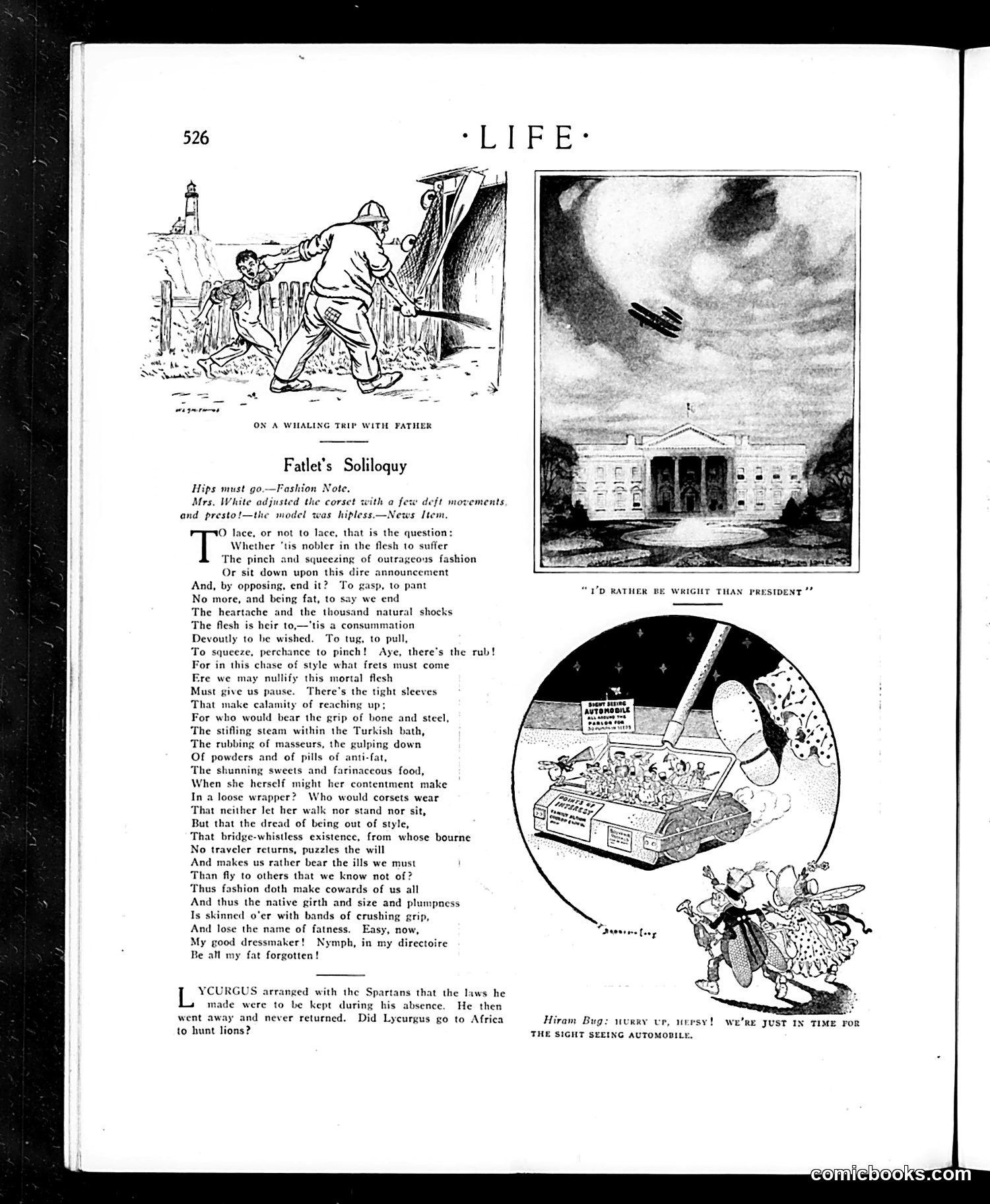
This page contains three satirical pieces about early 20th-century American life: 1. **"On a Whaling Trip with Father"** (top left): A sketch mocking father-child outings, likely commenting on class leisure activities. 2. **"Fatlet's Soliloquy"** (center): A lengthy poem satirizing women's fashion constraints—corsets, tight sleeves, and beauty standards that restrict movement and breathing. The speaker laments how fashion demands bodily suffering for appearance. 3. **"I'd Rather Be Wright Than President"** (top right): A photograph showing an airplane flying over the White House, referencing the Wright Brothers' aviation achievements as more impressive than presidential accomplishments. 4. **"Hirom Bug"** (bottom): A cartoon about automobile sightseeing, likely satirizing new automotive tourism culture. The page criticizes fashion excess, celebrates technological progress, and mocks contemporary American social pretensions.
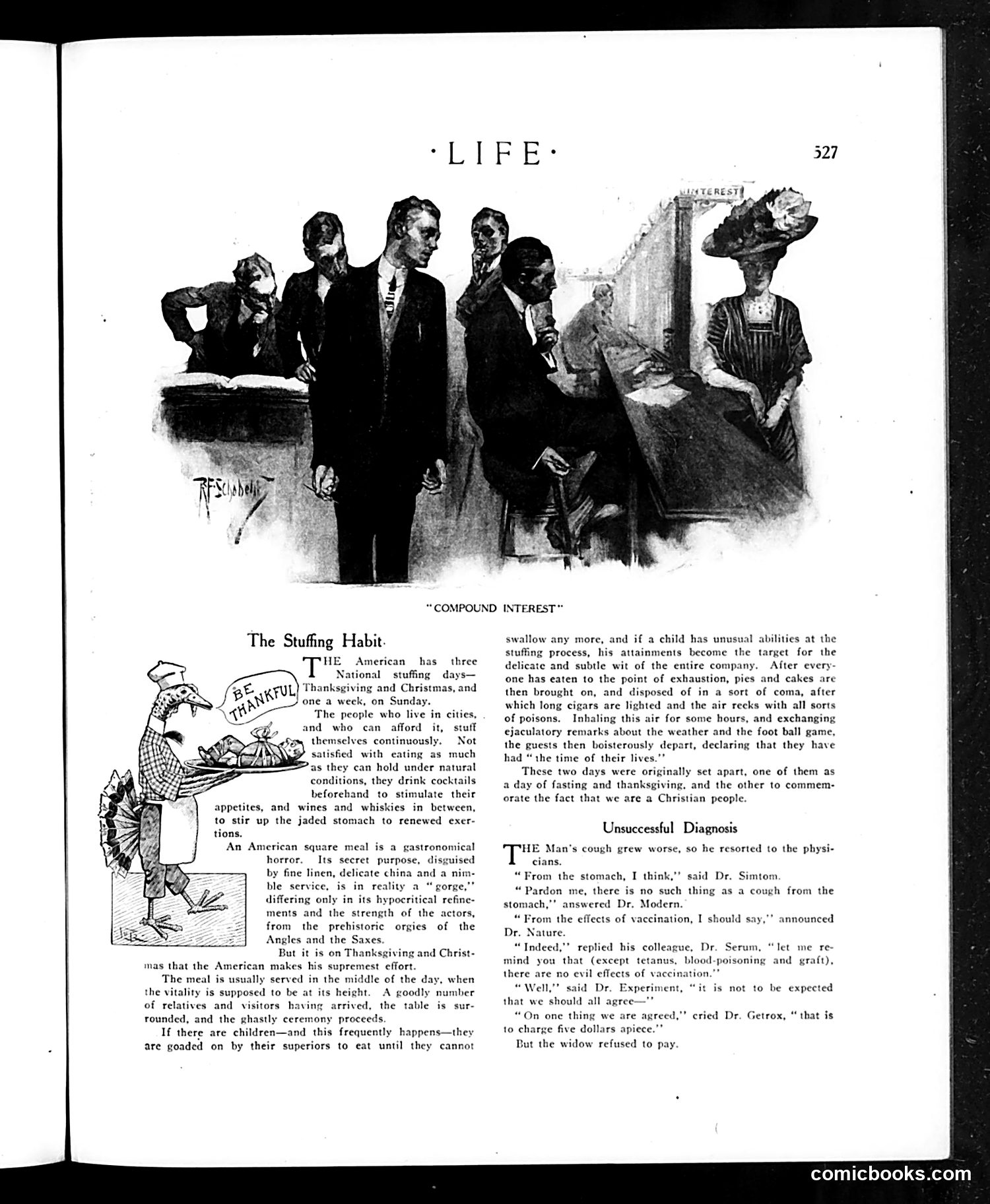
This page contains two distinct sections: **Top illustration** ("Compound Interest"): Shows well-dressed men at what appears to be a banking or financial counter, with a fashionably dressed woman on the right. The caption suggests this is satirizing financial practices or banking procedures, though the specific reference is unclear without additional context. **Bottom section** ("The Stuffing Habit" and "Unsuccessful Diagnosis"): The left cartoon depicts a portly figure being force-fed, satirizing American Thanksgiving overeating culture. The right text section presents a humorous medical dialogue where doctors diagnose a man's persistent cough through various competing theories (stomach ailments, vaccination effects, etc.), ultimately ending with a widow refusing to pay the medical bill—satirizing medical incompetence and quack diagnoses. Both pieces mock American social practices and professional pretension of the era.
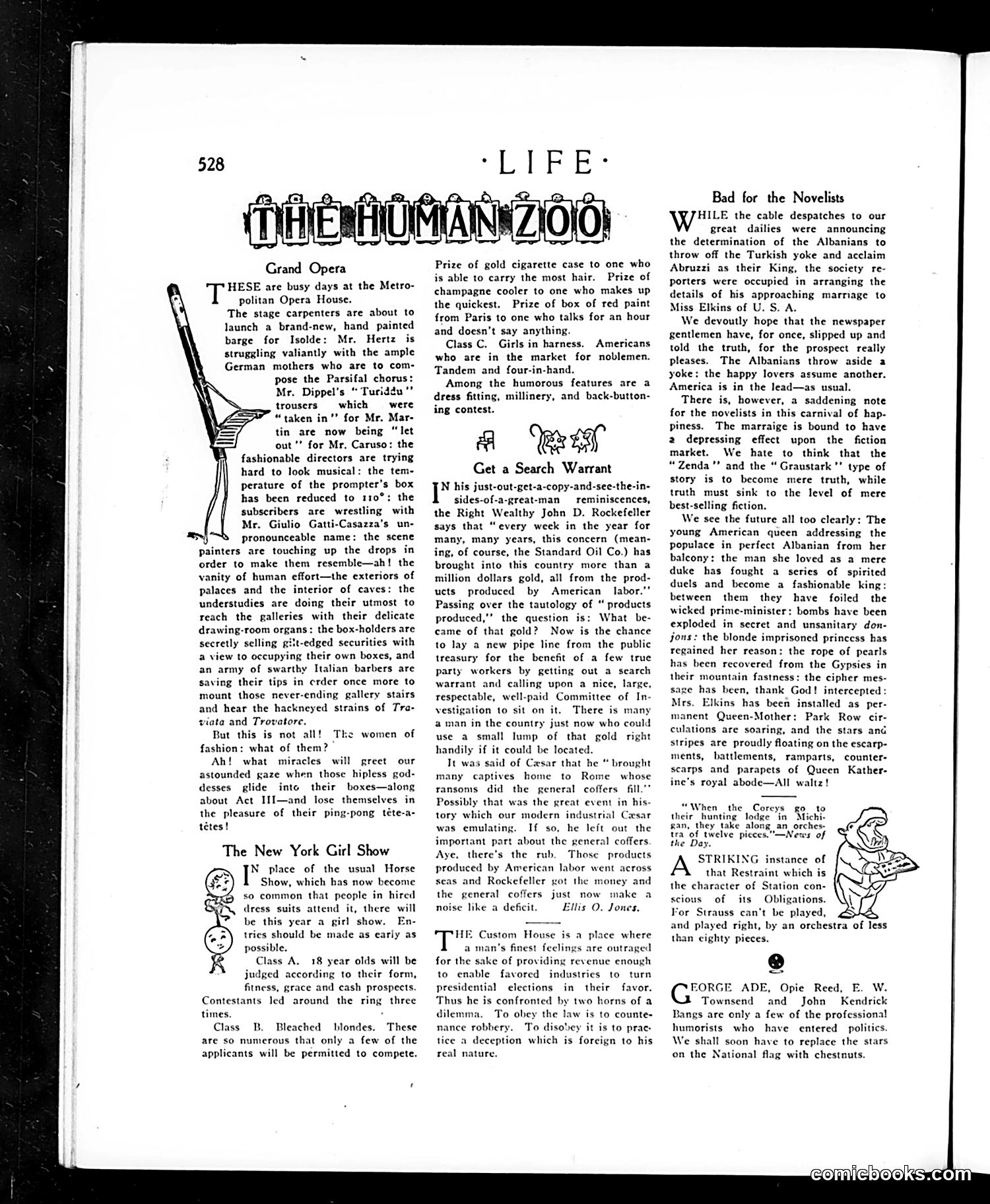
This page satirizes high society's pretensions through the metaphor of a "zoo." The left column mocks the Metropolitan Opera House's grand opera season, ridiculing how wealthy patrons display themselves like animals in a menagerie—the "vanity of human effort" reduced to spectacle. The "New York Girl Show" section continues this theme, describing debutante competitions where young women are literally "judged according to their form, fitness, grace and cash prospects," treating marriage-market contestants as if cataloging zoo specimens. The satire targets wealthy Americans' self-importance: their elaborate social rituals, conspicuous consumption, and reduction of culture and courtship to competitive displays for an audience. The magazine's title itself—treating high society *as* a zoo—underscores the mockery of treating privileged people as curiosities.
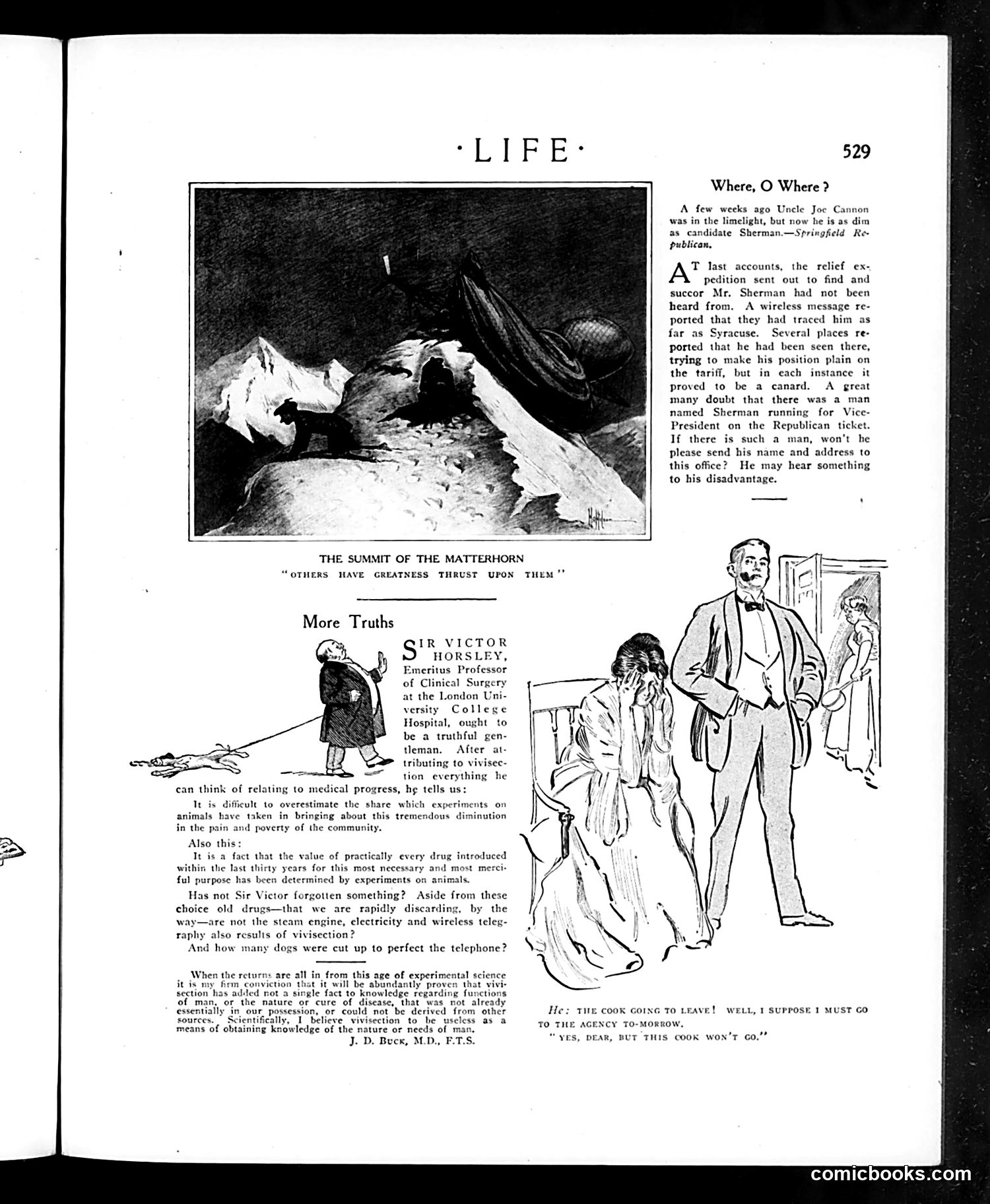
This *Life* magazine page contains two separate items: **"Where, O Where?"** is a brief news item reporting that Uncle Joe Cannon, a prominent political figure, has disappeared while running as a vice-presidential candidate on the Republican ticket. Relief expeditions are searching for him, with satirical speculation that he may be hiding to avoid embarrassment. **"More Truths"** features commentary by Sir Victor Horsley, a London surgeon, defending animal experimentation in medical research. The accompanying cartoon illustrates the point: a cook is leaving employment because he cannot ethically support animal testing, saying "this cook won't go" — a pun on vivisection debates of the era, when public opinion was divided over using animals in scientific research. Both items reflect early 20th-century political and scientific controversies.
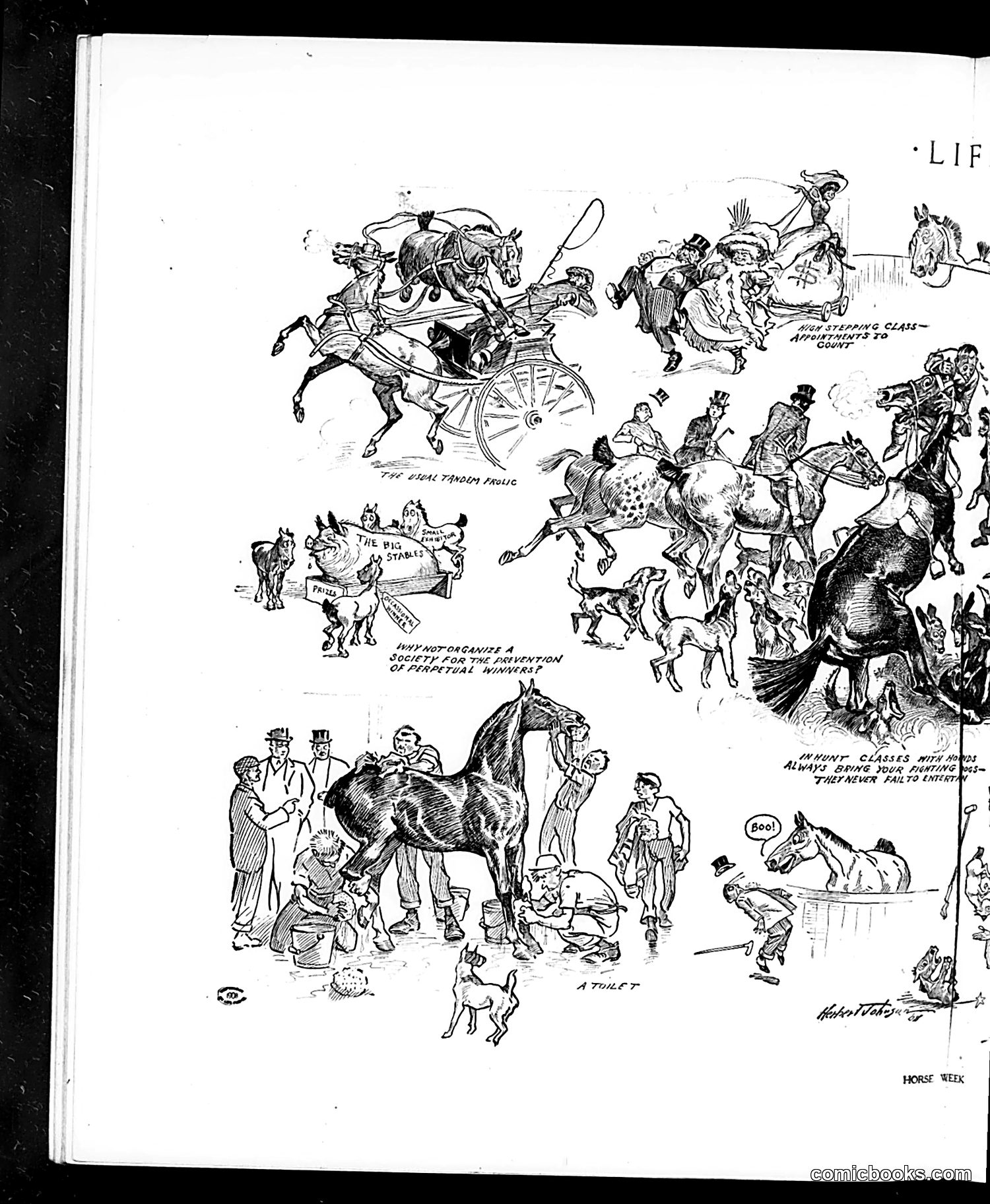
This page from *Life* magazine contains multiple satirical sketches about horses and riding, labeled "HORSE WEEK." The cartoons depict various equestrian scenarios with exaggerated, comedic characters: 1. **Upper left**: "The Dear Tandem Waltz" shows an elaborate horse-drawn carriage with multiple riders in chaotic poses. 2. **Center**: "Why Not Organize a Society for the Prevention of Unnatural Miniature Wineries" depicts figures with horses and absurdist institutional commentary. 3. **Lower section**: "A Toilet" and other scenes show people with horses in humorous, everyday situations—farriers, riders, and social interactions around horses. The humor appears focused on equestrian culture absurdities and physical comedy rather than specific political figures. Without clearer attribution or dates, the precise satirical targets remain unclear, though the sketches mock pretentious horse-related activities and social conventions of the era.
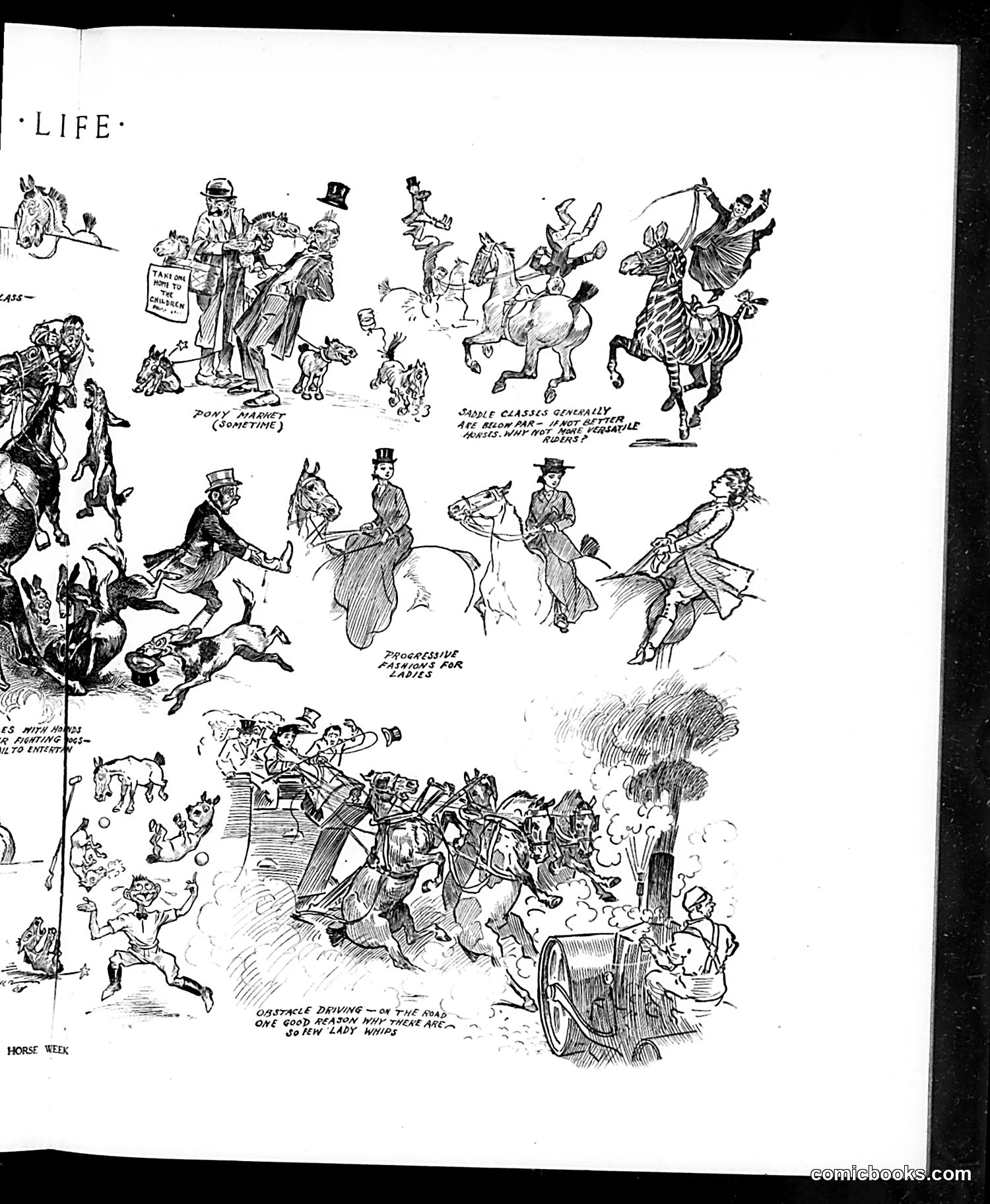
This page satirizes fashionable horseback riding among the wealthy elite. The sketches depict various riding scenarios with captions mocking aristocratic pretensions: - "Pony racing (sometime)" shows well-dressed gentlemen attempting to manage unruly horses - "Saddle classics generally are below par—just because horses obey the rules, why should our riders?" ridicules riders who ignore proper technique - "Progressive fashions for ladies" depicts women in elaborate outfits on horseback, suggesting gender-based fashion absurdities - "Obstacle driving—in the road one good horse with two are so in hand riding" (text unclear) shows chaotic carriage mishaps The humor targets the upper class's amateur horsemanship and the ridiculous fashion requirements placed on society riders, contrasting their pretensions with actual equestrian incompetence. The cartoons suggest that wealth doesn't guarantee skill or sense.
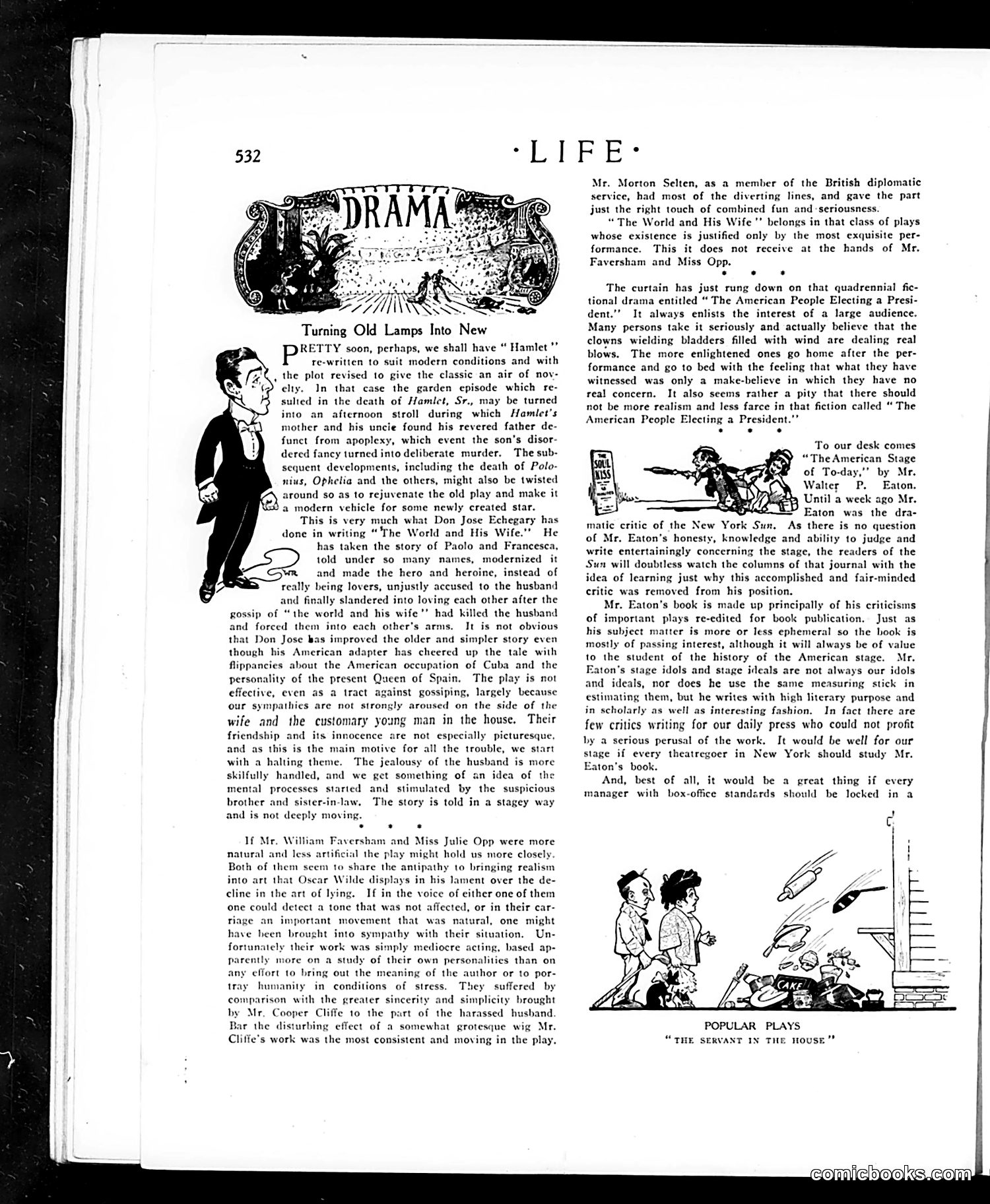
This page reviews contemporary theater productions. The main article critiques "The World and His Wife," a modernized adaptation of the Paolo and Francesca legend by Spanish playwright Don Jose Echegary. The reviewer argues that adapting classical stories for contemporary stars—like rewriting Hamlet with modern settings—doesn't necessarily improve them. The critique focuses on the play's weak execution despite its cast (William Faversham and Julie Opp). The reviewer faults the actors for artificial, affected performances lacking genuine emotion. Cooper Cliffe's portrayal of the jealous husband receives praise for sincerity and consistency. A sidebar references "The American People Electing a President," sarcastically calling it a "quadrennial fictional drama," suggesting the writer views presidential politics as theatrical performance rather than serious governance—a common satirical trope in Life magazine's commentary on American civic life.
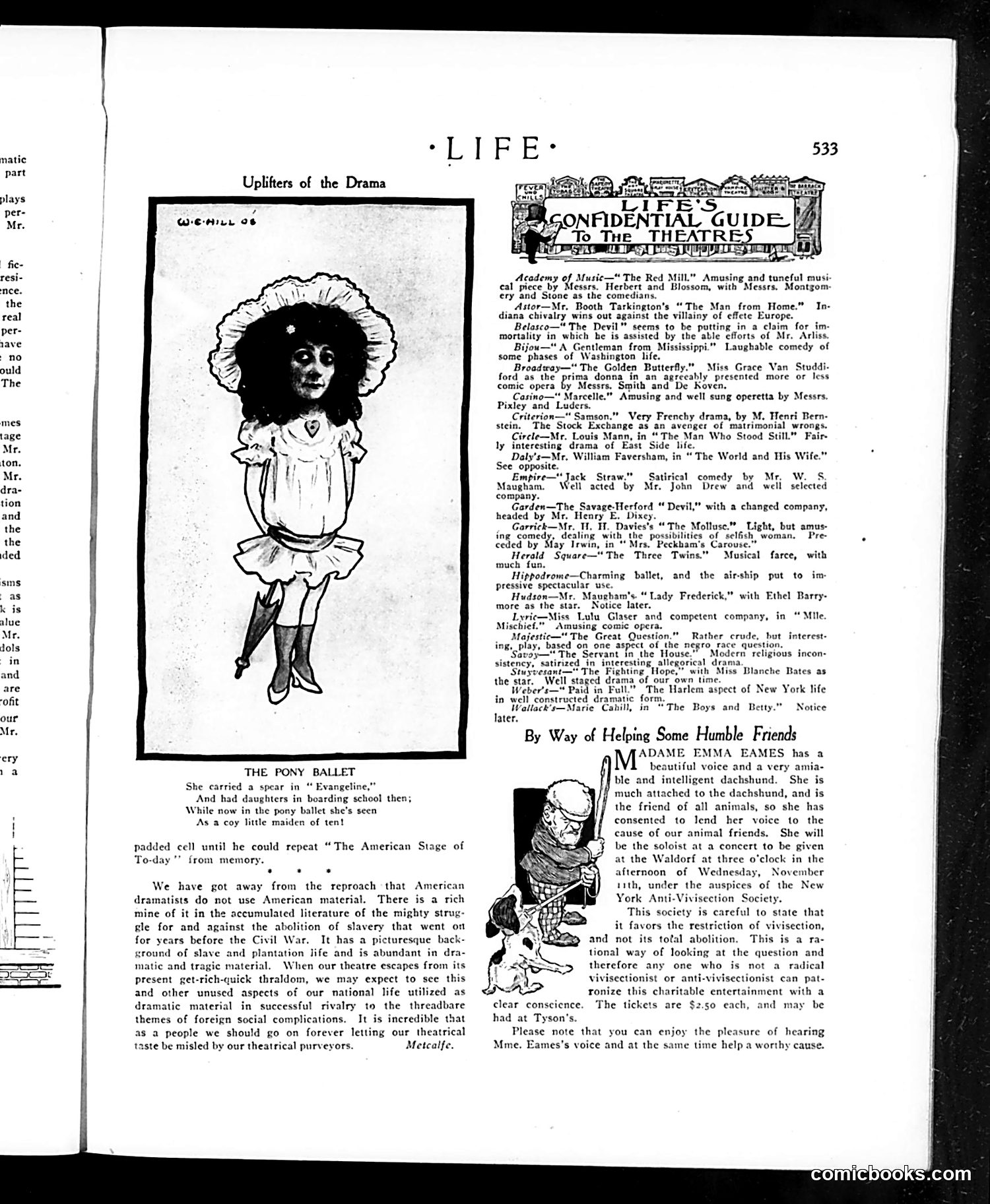
This page satirizes lowbrow American theater. The cartoon depicts a caricatured woman who once played a dignified role in "Evangeline" (a serious play) but now performs in a frivolous "Pony Ballet"—a chorus line featuring scantily-clad dancers. The exaggerated features suggest mockery of both the performer's decline and the entertainment industry's shift toward spectacle. The accompanying text by critic Metcalfe argues that American drama has abandoned serious native material (like the slavery conflict and Civil War) in favor of "get-rich-quick" foreign comedies about "social complications." He criticizes theaters for prioritizing profit and theatrical purveyors' taste over artistic merit. The piece advocates for American dramatists to exploit the nation's rich historical material rather than recycling European themes. The "Pony Ballet" exemplifies this cultural degradation—entertainment valued for spectacle rather than substance.
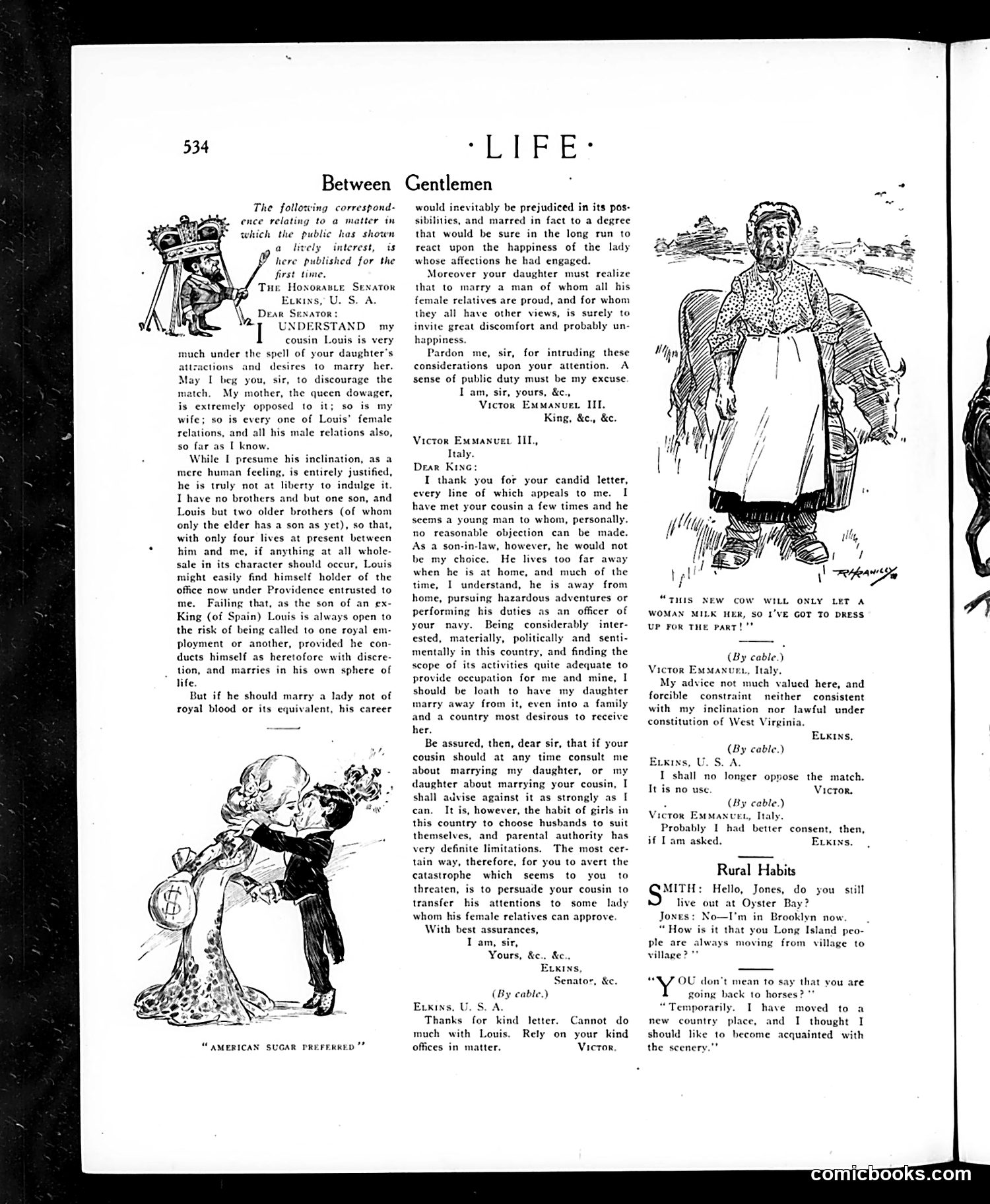
This page satirizes a real international marriage controversy, likely involving Victor Emmanuel III of Italy and an American senator's daughter. The mock correspondence mimics diplomatic formality while highlighting class tensions. **The Setup:** Victor Emmanuel II (Italy's king) writes to Senator Elkins (U.S.A.), opposing his cousin's marriage to Elkins's daughter. He argues the match threatens royal succession and career prospects—the woman isn't of sufficient rank. **The Satire:** Elkins's reply politely but firmly refuses, explaining he values American interests over European royal concerns. His daughter will choose her own husband despite parental wishes—reflecting American democratic values versus European aristocratic control. **The Point:** The exchange mocks Old World pretensions about bloodline and station when confronted with American individualism. The cartoons reinforce this: "American Sugar Preferred" depicts a crowned figure courting a wealthy American woman, suggesting U.S. wealth now rivals European nobility in importance. The satire celebrates American independence from aristocratic hierarchy.
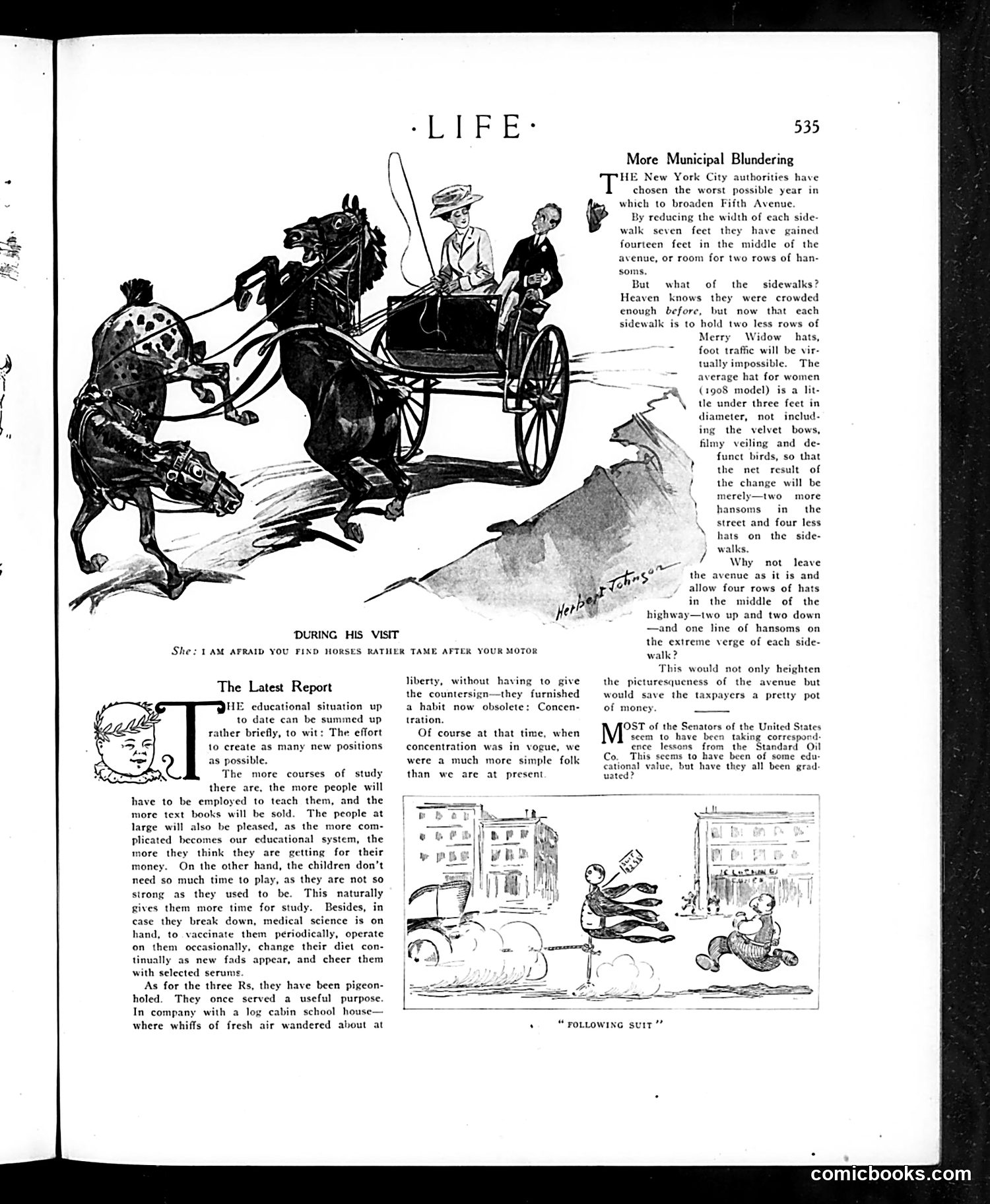
**Top Cartoon ("During His Visit"):** A woman in a motor car complains to her companion that horses seem "tame" compared to automobiles. The satire mocks the newly wealthy's fascination with motorcar technology and their dismissal of traditional transportation—suggesting superficial status-seeking among the social elite. **"More Municipal Blundering" Section:** Criticizes New York City's Fifth Avenue widening project. The satire highlights the absurd consequences: narrower sidewalks now crowded with enormous women's hats (the "Merry Widow" style, apparently three feet in diameter with elaborate decoration), while the widened avenue merely accommodates more hansoms (horse-drawn carriages). The author sardonically proposes leaving the avenue unchanged to preserve both practicality and "picturesqueness." **"The Latest Report" Section:** Satirizes educational expansion as self-serving: creating more teaching positions, courses, and textbooks primarily benefits administrators and publishers rather than students, who receive less play time and more vaccinations and operations under modern education's complications. **Bottom reference to Senators:** Oblique criticism of political corruption, likening senators' behavior to Standard Oil's notorious practices.
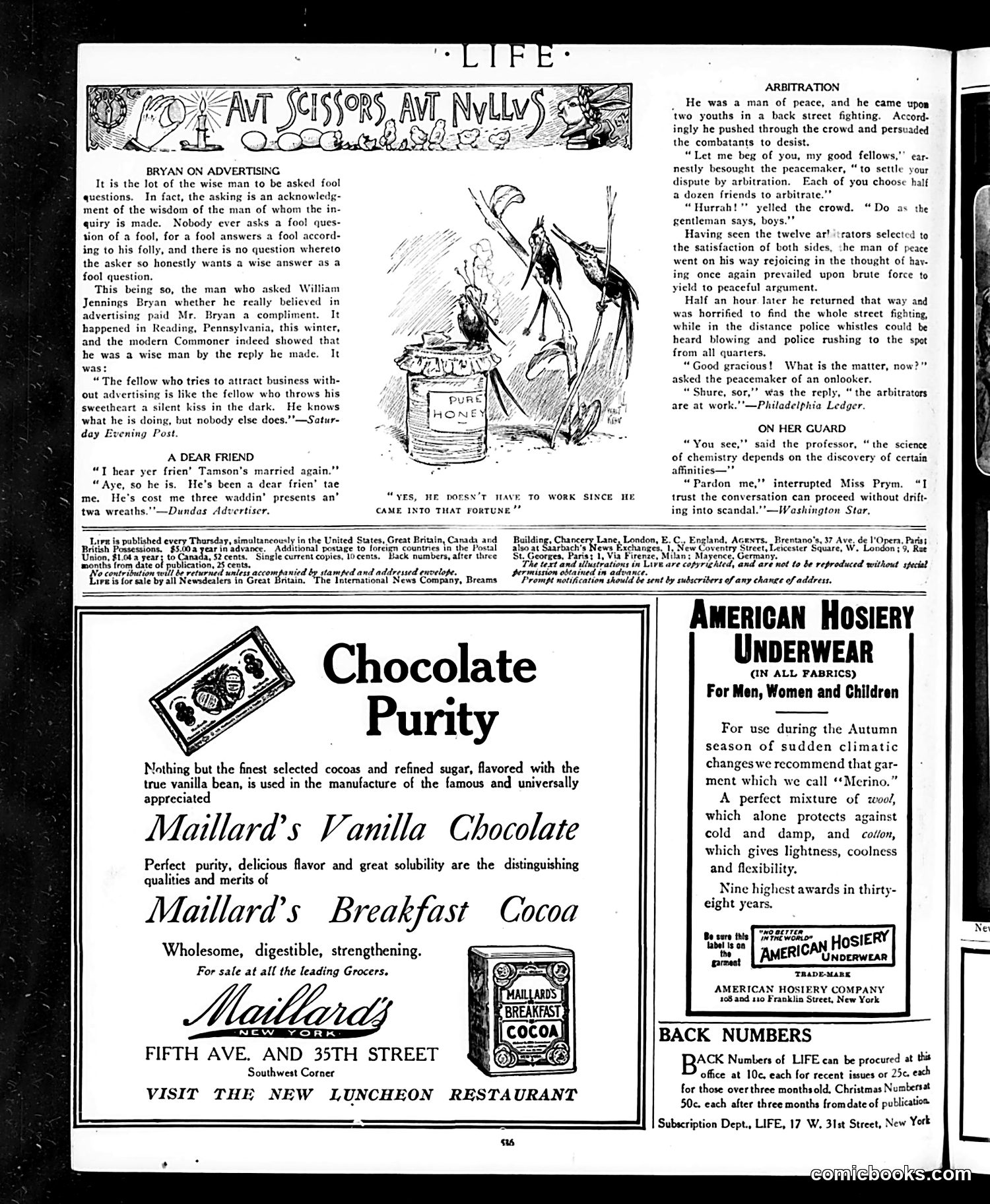
This page contains three satirical pieces typical of early 20th-century American humor: **"Bryan on Advertising"** quotes William Jennings Bryan (the three-time presidential candidate), presenting his famous analogy comparing advertising to a silent kiss in the dark—effective for the sender but useless without an audience. The text frames this as a clever response, flattering Bryan's wisdom. **"A Dear Friend"** is a Scottish dialect joke about a man whose frequent "dear friend" keeps getting married, forcing him to repeatedly buy wedding gifts and wreaths—a dark humor piece about reluctant financial obligation masquerading as friendship. **"Arbitration"** satirizes the futility of peaceful dispute resolution. A peacemaker convinces two fighting boys to settle via arbitration with selected judges, only to return hours later finding the arbitrators themselves fighting. The joke mocks the notion that adding more people solves conflict. **"On Her Guard"** is a mild joke about a female student (Miss Prym) interrupting a chemistry professor's discussion of "affinities," suspecting romantic innuendo. The page is primarily advertising for Maillard's chocolate and American Hosiery Company.
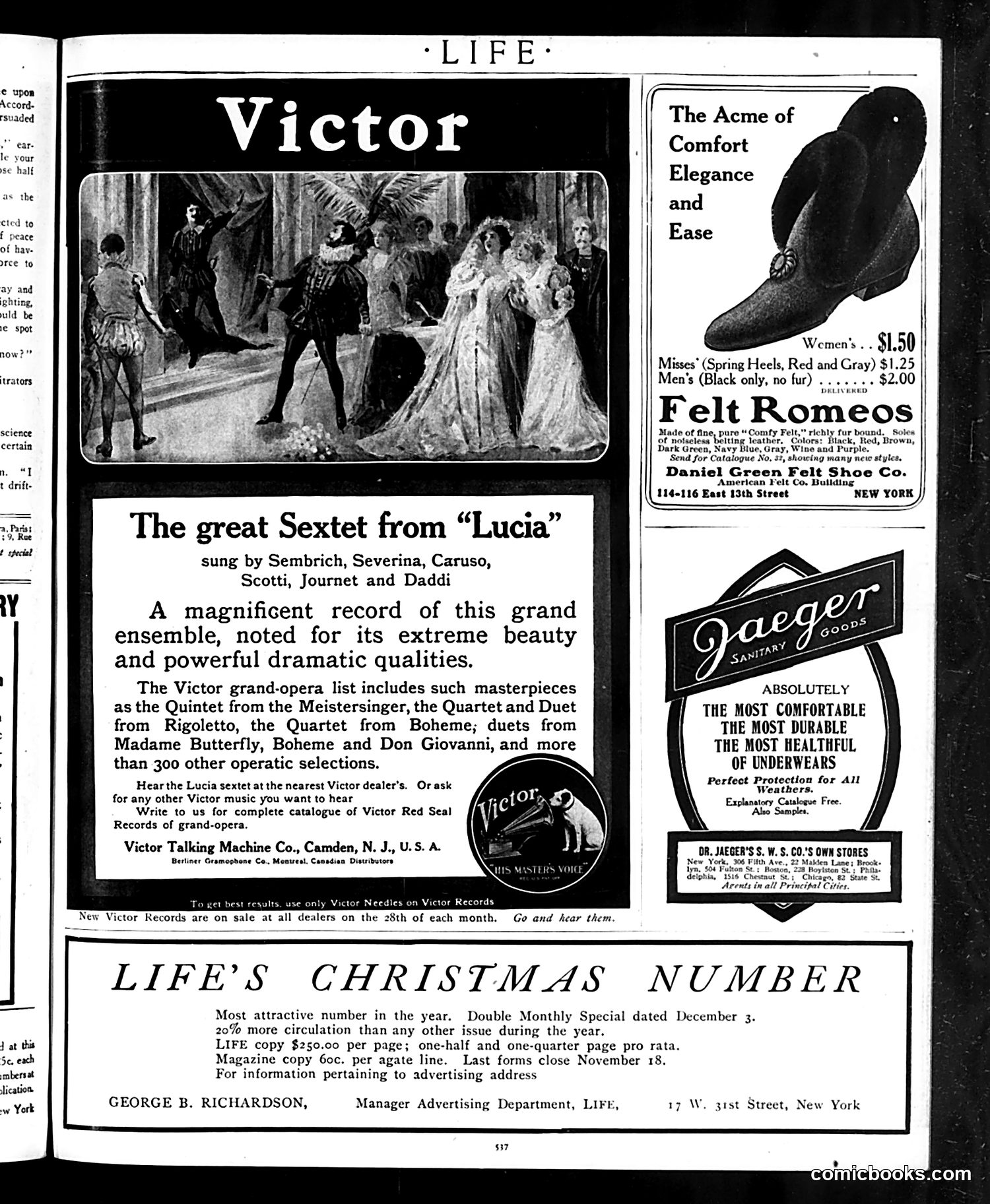
This page is primarily **advertising and promotional content** for Life magazine's Christmas issue, not political satire or cartoon commentary. The main image shows a scene from the opera "Lucia di Lammermoor," illustrating a Victor Records advertisement promoting a recording of the famous sextet performed by celebrated singers (Sembrich, Caruso, Scotti, and others). The accompanying text emphasizes Victor's extensive grand-opera catalog of over 300 selections. The other advertisements promote **Felt Romeo shoes** and **Daegost sanitary underwear**—typical early 20th-century consumer goods marketed to middle-class readers. The bottom section announces Life's Christmas issue as their most profitable advertising opportunity, offering premium rates ($250 per page). There is **no political satire or social commentary** on this particular page—it's a straightforward commercial vehicle showcasing period consumer culture and entertainment products.
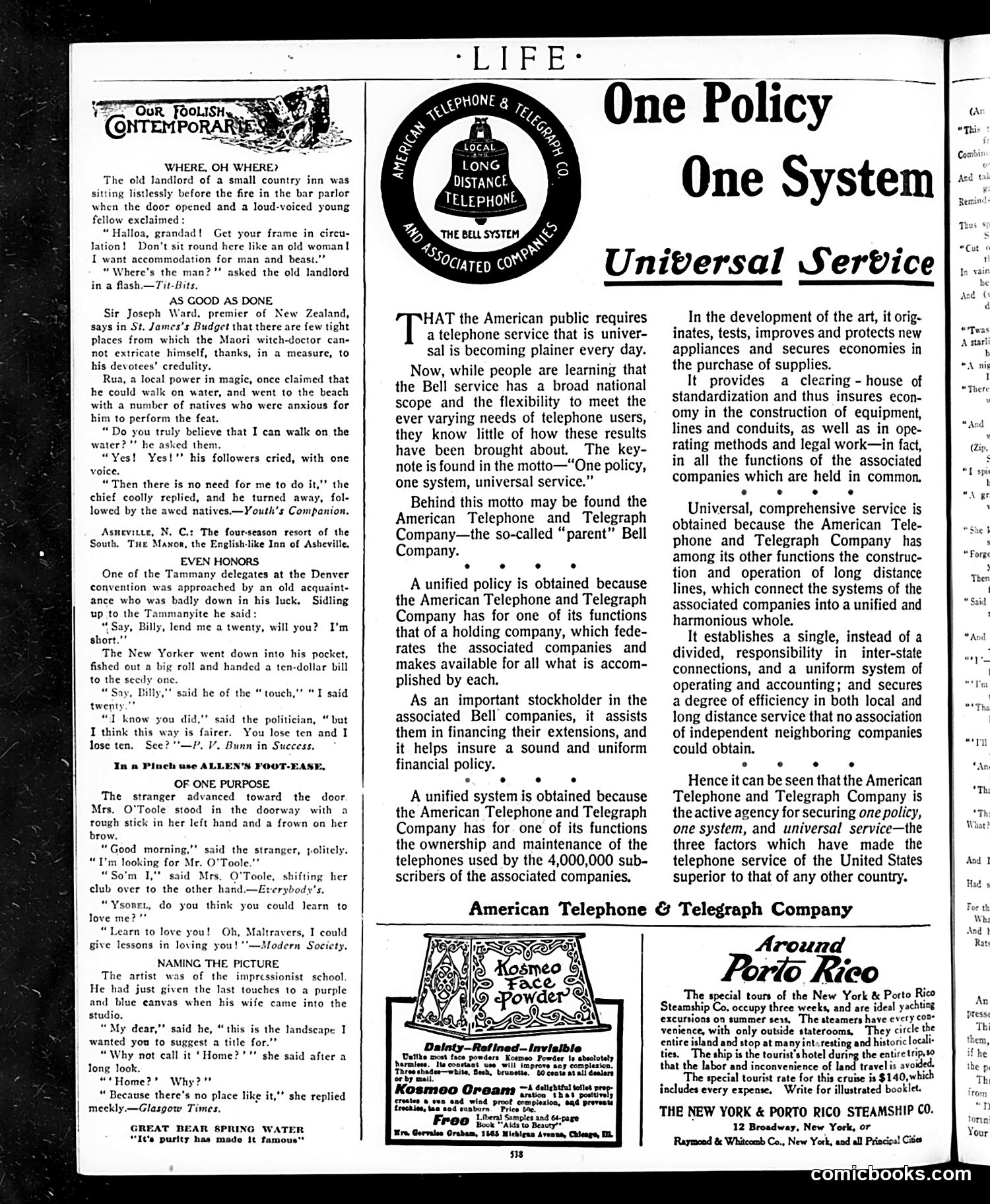
This Life magazine page (appears to be early 1900s) contains multiple satirical anecdotes and a large advertisement for American Telephone & Telegraph Company. **The cartoons/jokes** are brief, text-based humor pieces typical of the era: - An innkeeper's comeback to a rude young traveler - A Maori witch-doctor who claims he can walk on water but doesn't need to prove it since his followers believe him anyway - Political satire about a Tammany Hall delegate giving a beggar $10 instead of $20, claiming it's "fairer" since both lose equally - Various domestic humor sketches **The satire** is gentle and observational rather than sharp—poking fun at human nature (laziness, credulity, dishonesty, marital dynamics). **The AT&T advertisement** occupies significant space, arguing for telephone monopoly under the motto "One Policy, One System, Universal Service"—a corporate argument for why consolidated control ensures better service. This reflects early-1900s debates about utility monopolies.
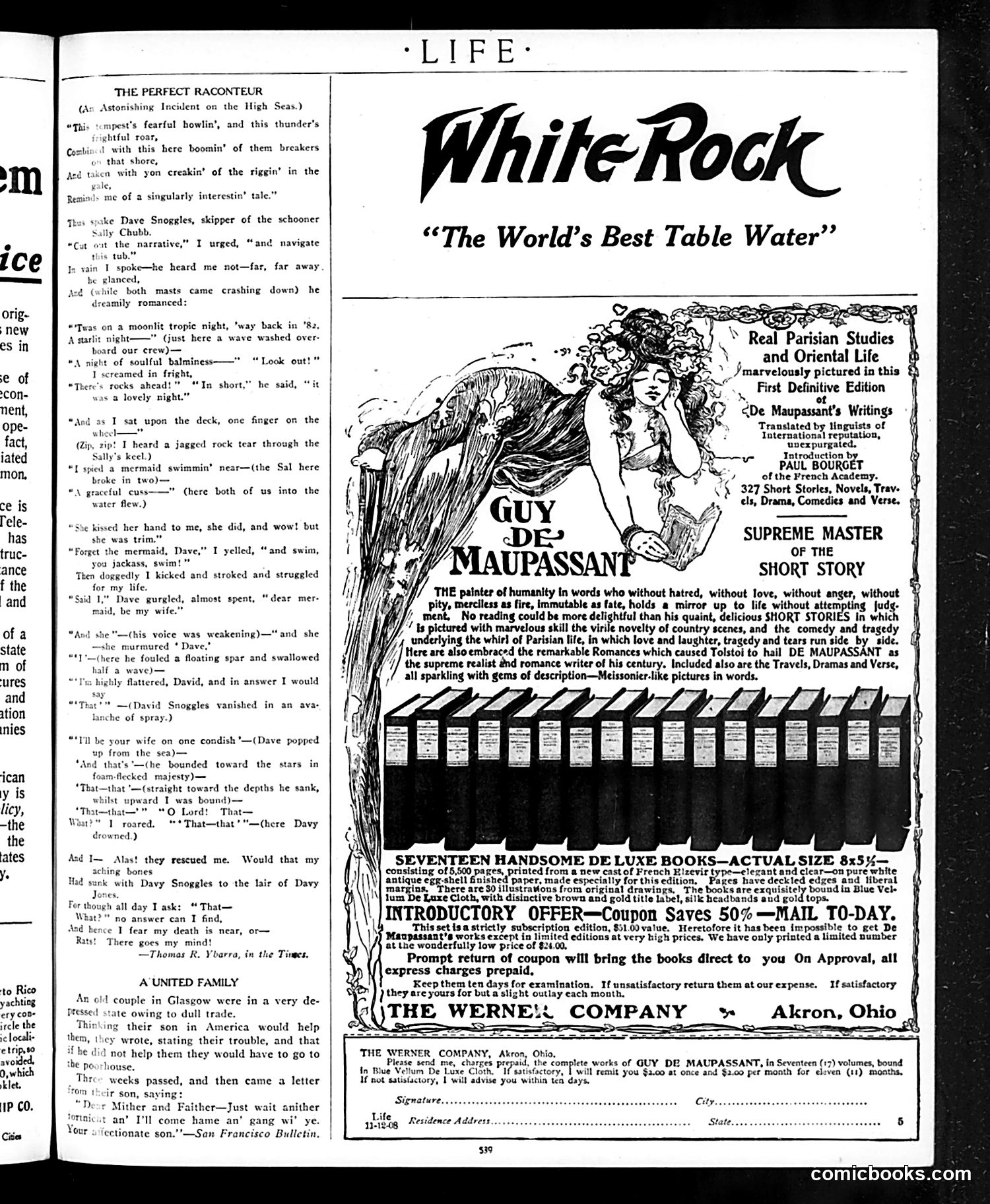
This page is primarily **advertising**, not editorial satire. The dominant content is a large advertisement for "The Werner Company" of Akron, Ohio, promoting a 17-volume deluxe book set of Guy de Maupassant's writings, illustrated and translated. The left column contains "The Perfect Raconteur," a story excerpt attributed to Thomas R. Ibarra in *The Times*, featuring maritime adventure dialogue about waves and rescue at sea. Below is "A United Family," a brief anecdote about an elderly couple and their son. The Maupassant books advertisement emphasizes literary prestige—calling him the "Supreme Master of the Short Story"—and offers a subscription purchase option. This reflects early 20th-century direct-mail marketing for illustrated classic literature aimed at educated middle-class readers.
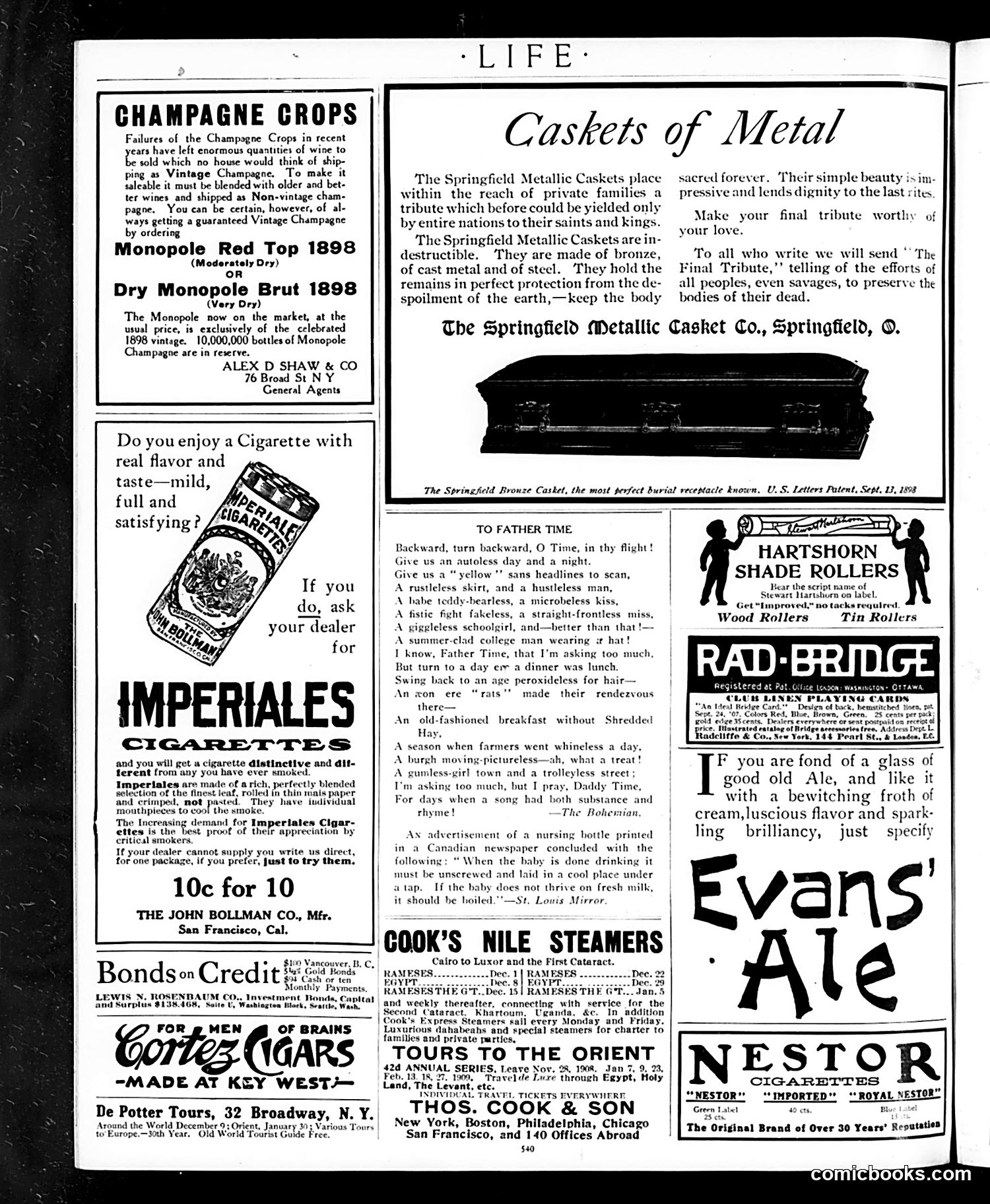
This page is primarily **advertising**, with one notable satirical poem titled "To Father Time." The poem mocks early-1900s consumer anxieties about modern life's complications. It asks "Father Time" to reverse progress and restore a simpler past—specifically requesting: - Rustless skirts and "hustleless" men - Absence of teddy bears, microbes, and "fakeless" things - No "rats" (hair-styling pieces worn under hair) - No peroxide for hair bleaching - A return to when breakfast didn't require Shredded Wheat cereal - "Whineless" farmers and "moving-pictureless" towns **The satire**: The poem gently ridicules Americans' simultaneous embrace of modern conveniences while nostalgically lamenting their complications. Items like safety razors, automobiles ("hustleless"), and processed foods promised to simplify life but instead created new anxieties—hair maintenance, food preparation standards, entertainment expectations. The poem's tone is humorous rather than harsh; it's social commentary wrapped in whimsy, poking fun at the tension between progress and tradition that defined the era. The surrounding advertisements (champagne, caskets, cigarettes, shade rollers) reinforce this theme of modern consumer products.
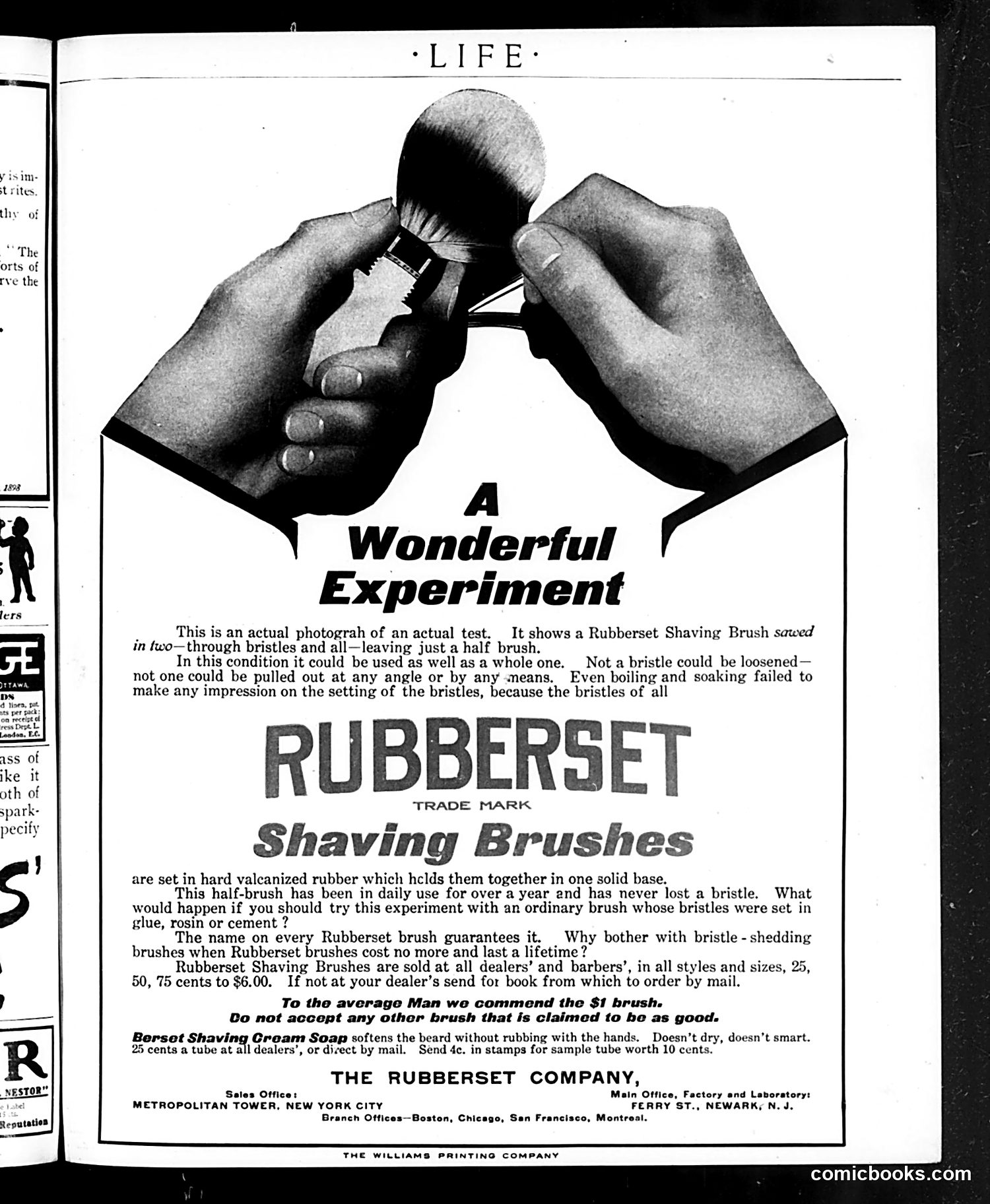
This is primarily a **product advertisement**, not political satire. The "Wonderful Experiment" demonstrates Rubberset's durability claim: a shaving brush has been literally sawed in half, yet continues functioning with no bristles lost after a year of use. The advertisement contrasts Rubberset brushes (bristles set in "hard vulcanized rubber") against competitors' inferior products (using "glue, rosin or cement"), which shed bristles easily. The dramatic image of hands holding the bisected brush serves as visual proof of the product's superiority. This appears in *Life* magazine's advertising section—a common venue for brand testimonials. The text emphasizes durability and lifetime value while undercutting competitors' claims. There is no political or satirical content; it's straightforward commercial persuasion typical of early-to-mid 20th-century product marketing.
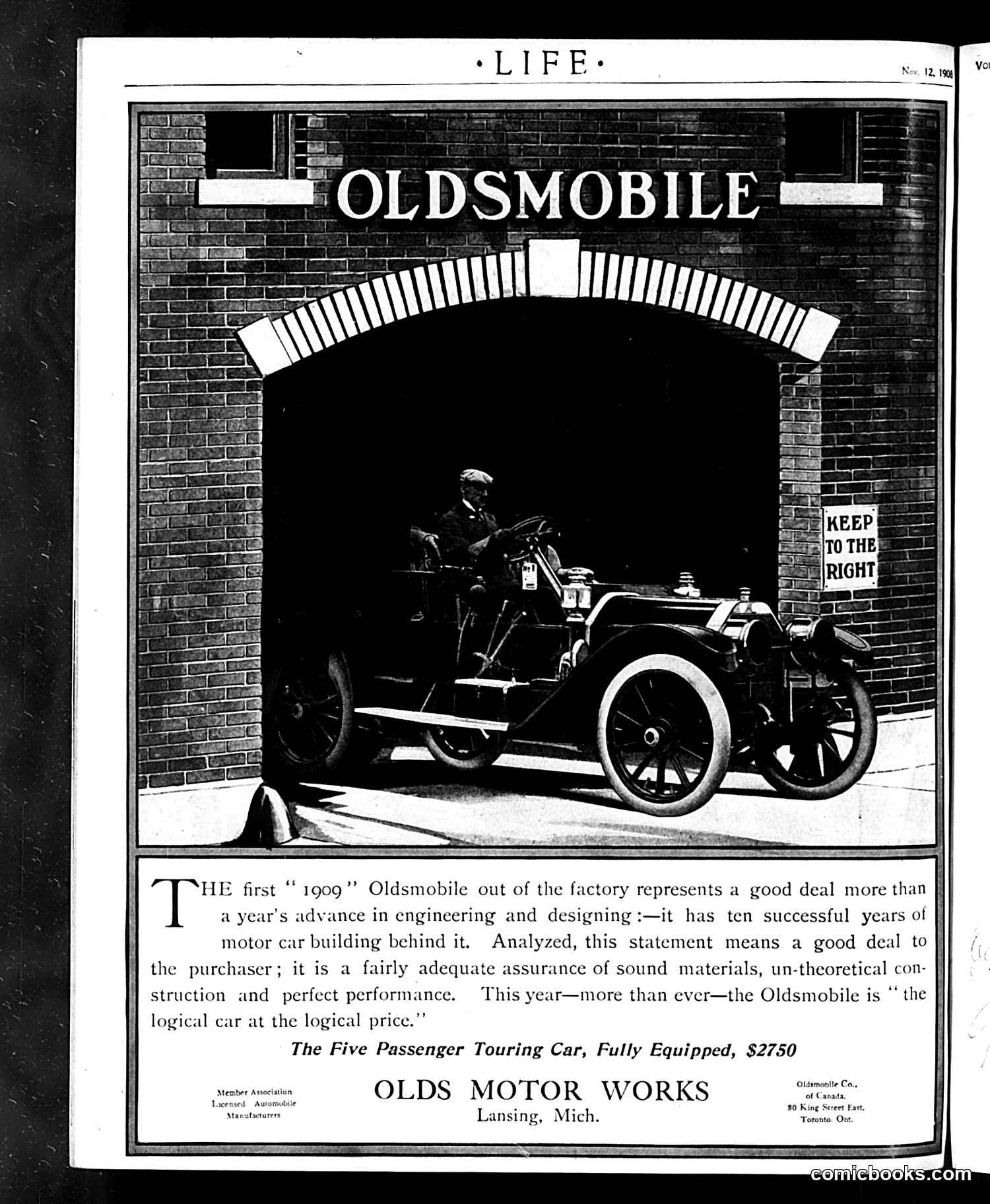
This is **not a cartoon or satire**—it's a straightforward automobile advertisement from Life magazine (dated November 12, 1909, based on the visible date). The page shows an **Oldsmobile advertisement** featuring a photograph of the 1909 model parked in a brick archway garage. A driver sits in the open-air vehicle. The text emphasizes Oldsmobile's track record: "ten successful years" of manufacturing, claiming this heritage guarantees "sound materials" and "perfect performance." The car is marketed as "the logical car at the logical price," priced at $2,750—positioning it as sensible mid-range transportation. The only quasi-humorous element is the small "KEEP TO THE RIGHT" sign visible on the building, a period traffic notice with no satirical intent. **This is promotional content, not editorial satire.**