
Life, 1908-11-12 · page 14 of 24
Life — November 12, 1908 — page 14: what you’re looking at
What you’re looking at
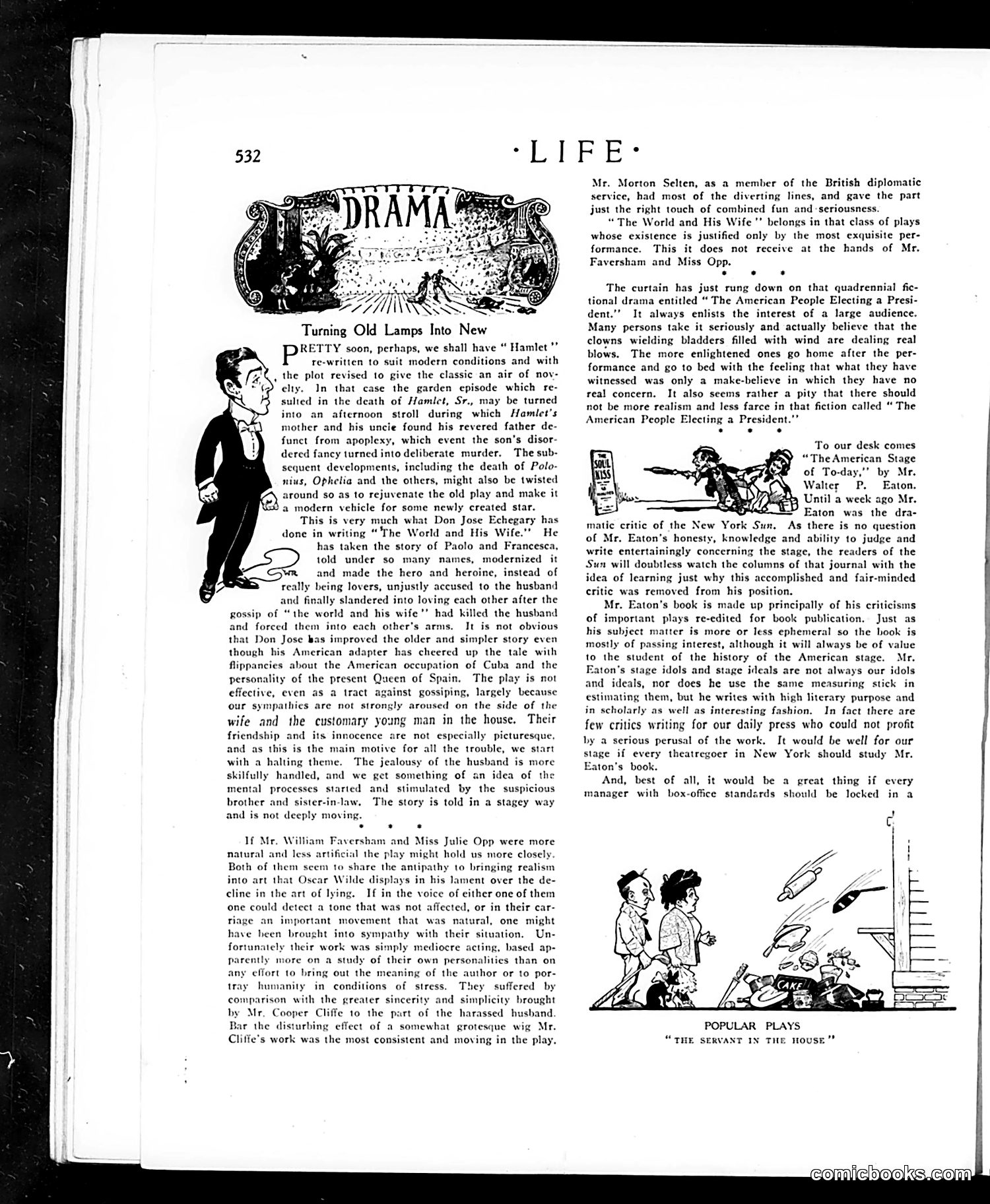
This page reviews contemporary theater productions. The main article critiques "The World and His Wife," a modernized adaptation of the Paolo and Francesca legend by Spanish playwright Don Jose Echegary. The reviewer argues that adapting classical stories for contemporary stars—like rewriting Hamlet with modern settings—doesn't necessarily improve them. The critique focuses on the play's weak execution despite its cast (William Faversham and Julie Opp). The reviewer faults the actors for artificial, affected performances lacking genuine emotion. Cooper Cliffe's portrayal of the jealous husband receives praise for sincerity and consistency. A sidebar references "The American People Electing a President," sarcastically calling it a "quadrennial fictional drama," suggesting the writer views presidential politics as theatrical performance rather than serious governance—a common satirical trope in Life magazine's commentary on American civic life.
📄 Transcribed text from this page (OCR, searchable)
Machine-transcribed from the original scan — historical spelling and the odd misread are preserved.
Turning Old Lamps Into New RETTY soon, perhaps, we shall have “ Hamlet "’ re-written to suit modern conditions and with the plot revised to give the classic an air of nov- clty. In that case the garden episode which re- sulted in the death of Hamlct, Sr., may be turned into an afternoon stroll during which Hamlet's mother and his uncie found his revered father de- funct from apoplexy, which event the son's disor- dered fancy turned into deliberate murder. The sub- sequent developments, including the death of Polo- nius, Ophelia and the others, might also be twisted around so as to rejuvenate the old play and make it a modern vehicle for some newly created star. This is very much what Don Jose Echegary has done in writing “The World and His Wife.” He has taken the story of Paolo and Francesca, told under so many names, modernized it and made the hero and heroine, instead of really being lovers, unjustly accused to the husband and finally slandered into loving each other after the gossip of “the world and his wife’? had killed the husband and forced them into each other's arms. It is not obvious that Don Jose bas improved the older and simpler story even though his American adapter has cheered up the tale with flippancies about the American occupation of Cuba and the personality of the present Queen of Spain, The play is not effective, even as a tract against gossiping, largely because our sympathies are not strongly aroused on the side of the wife and the customary young man in the house, Their friendship and its innocence are not especially picturesque, and as this is the main motive for all the trouble, we start with a halting theme. The jealousy of the husband is more skilfully handled, and we get something of an idea of the mental processes started and stimulated by the suspicious brother and sister-in-law. The story is told in a stagey way and is not deeply mov . 8 If Mr. William Faversham and Miss Julie Opp were more natural and less artificial the p ht hold us more closely Both of them scem to share the antipathy to bringing realism into art that Oscar Wilde displays in his lament over the de- cline in the art of lying. If in the voice of either one of them one could detect a tone that was not affected, or in their car- riage an important movement that was natural, one might have been brought into sympathy with their situation. Un- fortunately their work was simply mediocre acting, based ap- parently more on a study of their own personalities than on any effort to bring out the meaning of the author or to por- tray humanity in conditions of stress. They suffered by comparison with the greater sincerity and simplicity brought by Mr, Cooper Cliffe 10 the part of the harassed husband. Bar the disturbing effect of a somewhat grotesque wig Mr. Cliffe’s work was the most consistent and moving in the play. “LIFE * Mr. Morton Selten, as a member of the British diplomatic service, had most of the diverting lines, and gave the part just the right touch of combined fun and seriousness. “The World and His Wife"? belongs in that class of plays whose existence is justified only by the most exquisite per- formance. This it docs not receive at the hands of Mr. Faversham and Miss Opp. The curtain has just rung down on that quadrennial fic- tional drama entitled “ The American People Electing a Presi- dent.”’ It always enlists the interest of a large audience. Many persons take it seriously and actually believe that the clowns wielding bladders filled with wind are dealing real blows. The more enlightened ones go home after the per- formance and go to bed with the feeling that what they have witnessed was only a make-believe in which they have no real concern. It also seems rather a pity that there should not be more realism and less farce in that fiction called “ The American People Electing a President . 8 6 To our desk comes “TheAmerican Stage of To-day,” by Mr. Walter P. Eaton. Until a week ago Mr. Eaton was the dra- matic critic of the New York Sun, As there is no question of Mr. Eaton's honesty, knowledge and ability to judge and write entertainingly concerning the stage, the readers of the Sun will doubtless watch the columns of that journal with the idea of learning just why this accomplished and fair-minded critic was removed from his position. Mr. Eaton's book is made up principally of his criticisms of important plays re-edited for book publication. Just as his subject matter is more or less ephemeral so the book is mostly of passing interest, although it will always be of value to the student of the history of the American stage. Mr. Zaton's stage idols and stage ideals are not always our idols and ideals, nor does he use the same measuring stick in estimating them, but he writes with high literary purpose and in scholarly as well as interesting fashion. In fact there are few critics writing for our daily press who could not profit by a serious perusal of the work. It would be well for our stage if every theatregoer in New York should study Mr. Eaton's book. And, best of all, it would be a great thing if every manager with box-office standards should be locked in a POPULAR PLAYS “THE SERVANT IN THE HOUSE”?