
Life, 1908-11-12 · page 6 of 24
Life — November 12, 1908 — page 6: what you’re looking at
What you’re looking at
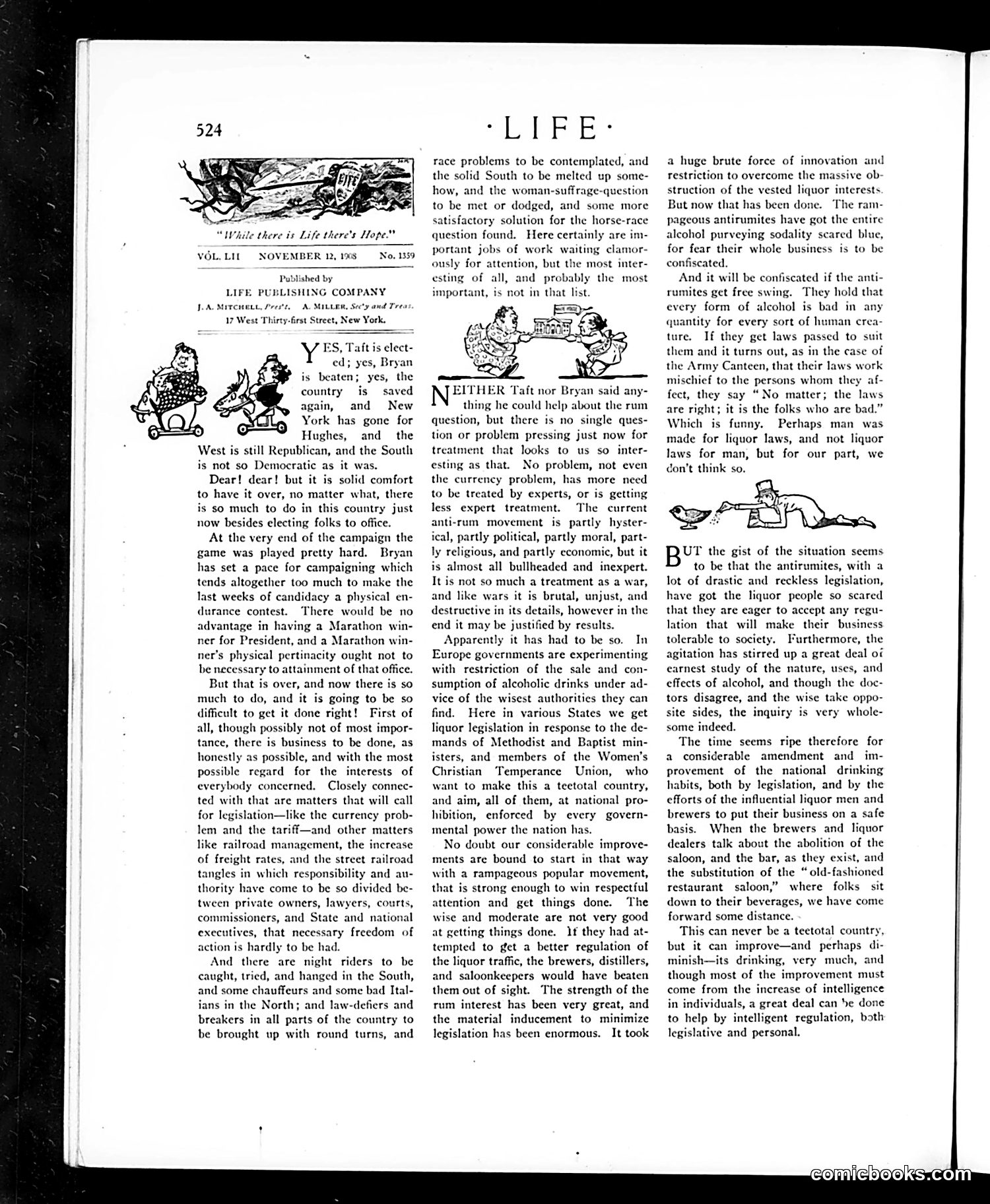
The page features political commentary on the 1908 presidential election. The headline "While there is Life there's Hope" references the election outcome. The text discusses William Howard Taft's victory over William Jennings Bryan, noting the country remains Republican and the South Democratic. The main satirical focus concerns Prohibition—a major political issue of the era. The article critiques the anti-liquor movement as overly zealous and politically motivated, driven by Methodist and Baptist ministers and the Women's Christian Temperance Union. It argues these groups pushed for total prohibition without practical consideration for enforcement or business regulation. The cartoons (small illustrations visible) appear to mock both the pro-Prohibition crusaders and their political tactics, though specific figures are difficult to identify from the image quality provided.
📄 Transcribed text from this page (OCR, searchable)
Machine-transcribed from the original scan — historical spelling and the odd misread are preserved.
NOVEMBER 22, 1208 VOL, LIL blished by LIFE PUBLISHING COMPANY JA. MITCHELL, Preste Secty and Trea Taft is elect- ed; yes, Bryan is beaten; yes, the country is saved again, and New York has gone for Hughes, and the West is still Republican, and the South is not so Democratic as it was. Dear! dear! but it is solid comfort to have it over, no matter what, there is so much to do in this country just now besides electing folks to office. At the very end of the campaign the game was played pretty hard. Bryan has set a pace for campaigning which tends altogether too much to make the last weeks of candidacy a physical en- durance contest. There would be no advantage in having a Marathon win- ner for President, and a Marathon win- ner’s physical pertinacity ought not to be necessary to attainment of that office. But that is over, and now there is so much to do, and it is going to be so difficult to get it done right! First of all, though possibly not of most impor- tance, there is business to be done, as honestly as possible, and with the most possible regard for the interests of everybody concerned. Closely connec- ted with that are matters that will call for legislation—like the currency prob- lem and the tariff—and other matters like railroad management, the increase of freight rates, and the street railroad tangles in which responsibility and au- thority have come to be so divided be- tween private owners, lawyers, courts, commissioners, and State and national executives, that necessary freedom of ction is hardly to be had. And there are night riders to be caught, tried, and hanged in the South, and some chauffeurs and some bad Ital- ians in the North; and law-defiers and breakers in all parts of the country to be brought up with round turns, and LIP E race problems to be contemplated, and the solid South to be melted up some- how, and the woman-suffrage-question to be met or dodged, and some more satisfactory solution for the horse-race question found. Here certainly are im- portant jobs of work waiting clamor- ously for attention, but the most inter- esting of all, and probably the most important, is not in sae li moa oS N EITHER Taft nor Bryan said any- thing he could help about the rum. question, but there is no single ques- tion or problem pressing just now for treatment that looks to us so inter- esting as that. No problem, not even the currency problem, has more need to be treated by experts, or is getting less expert treatment. The current anti-rum movement is partly hyster- ical, partly political, partly moral, part- ly religious, and partly economic, but it Imost all bullheaded and inexpert. It is not so much a treatment as a war, and like wars it is brutal, unjust, and destructive in its details, however in the end it may be justified by results. Apparently it has had to be so. In Europe governments are experimenting with restriction of the sale and cor sumption of alcoholic drinks under ad- vice of the wisest authorities they can find. Here in various States we get liquor legislation in response to the de- mands of Methodist and Baptist min isters, and members of the Women’s Christian Temperance Union, who want to make this a teetotal country, and aim, all of them, at national pro- hibition, enforced by every govern- mental power the nation h No doubt our considerable improve- ments are bound to start in that way with a rampageous popular movement, that is strong enough to win respectful attention and get things done. The wise and moderate are not very good at getting things done. lf they had at- tempted to get a better regulation of the liquor traffic, the brewers, distillers, and saloonkeepers would have beaten them out of sight. The strength of the rum interest has been very great, and the material inducement to minimize legislation has been enormous. It took a huge brute force of innovation and restriction to overcome the massive ob- struction of the vested liquor interests. But now that has been done. The ram- pageous antirumites have got the entire alcohol purveying sodality scared blue, for fear their whole business is to be confiscated. And it will be confiscated if the anti- rumites get free swing. They hold that every form of alcohol is bad in any quantity for every sort of human crea- ture. If they get laws passed to suit them and it turns out, as in the case of the Army Canteen, that their laws work mischief to the persons whom they a fect, they say “No matter; the laws are right; it is the folks who are bad.” Which is funny. Perhaps man was made for liquor laws, and not liquor laws for man, but for our part, we con't think so. UT the gist of the situation seems to be that the antirumites, with a lot of drastic and reckless legislation, have got the liquor people so scared that they are eager to accept any regu- lation that will make their business tolerable to society. Furthermore, the agitation has stirred up a great deal of earnest study of the nature, uses, and effects of alcohol, and though the doc- tors disagree, and the wise take oppo- site sides, the inquiry is very whole- some indeed. The time seems ripe therefore for a considerable amendment and im- provement of the national drinking habits, both by legislation, and by the efforts of the influential liquor men and brewers to put their business on a safe basis. When the brewers and liquor dealers talk about the abolition of the saloon, and the bar, as they exist, and the substitution of the “old-fashioned restaurant saloon,” where folks sit down to their beverages, we have come forward some distance. This can never be a teetotal country, but it can improve—and perhaps di- minish—its drinking, very much, and though most of the improvement must come from the increase of intelligence in individuals, a great deal can be done to help by intelligent regulation, both legislative and personal.