
Life, 1908-11-12 · page 15 of 24
Life — November 12, 1908 — page 15: what you’re looking at
What you’re looking at
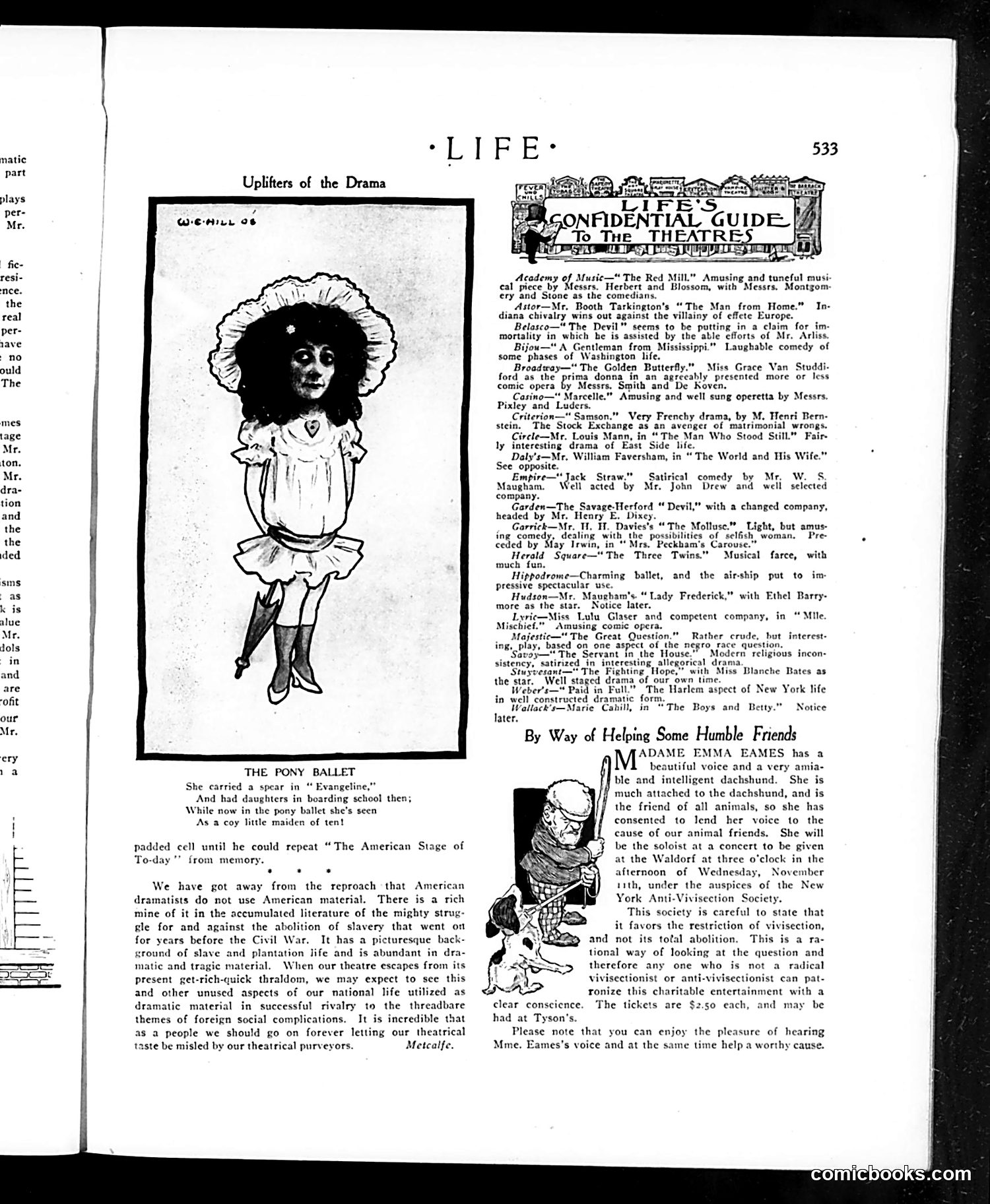
This page satirizes lowbrow American theater. The cartoon depicts a caricatured woman who once played a dignified role in "Evangeline" (a serious play) but now performs in a frivolous "Pony Ballet"—a chorus line featuring scantily-clad dancers. The exaggerated features suggest mockery of both the performer's decline and the entertainment industry's shift toward spectacle. The accompanying text by critic Metcalfe argues that American drama has abandoned serious native material (like the slavery conflict and Civil War) in favor of "get-rich-quick" foreign comedies about "social complications." He criticizes theaters for prioritizing profit and theatrical purveyors' taste over artistic merit. The piece advocates for American dramatists to exploit the nation's rich historical material rather than recycling European themes. The "Pony Ballet" exemplifies this cultural degradation—entertainment valued for spectacle rather than substance.
📄 Transcribed text from this page (OCR, searchable)
Machine-transcribed from the original scan — historical spelling and the odd misread are preserved.
matic part plays per- Mr. | fie~ resi- nce. the real per- ave no ould The mes lage Mr. ton. Mr. dra- tion and the the ded Uplifters of the Drama Weir os THE PONY BALLET She carried a spear in ‘ Evangelin And had daughters in boarding school then; While now in the pony ballet she’s seen As a coy little maiden of tent padded cell until he could repeat “The American Stage of To-day ” from memory. We have got away from the reproach that American dramatists do not use American material. There is a rich mine of it in the accumulated literature of the mighty strug- gle for and against the abolition of slavery that went om for years before the Civil War. It has a picturesque back- ground of slave and plantation life and is abundant in dra- matic and tragic material. When our theatre escapes from its present get-rich-quick thraldom, we may expect to sce this and other unused aspects of our national life utilized as dramatic material in successful rivalry to the threadbare themes of foreign social complications. It is incredible that as a people we should go on forever letting our theatrical taste be misled by our theatrical purveyors. Metcalfe. Academy of Music" The Red Mill” Amusing and tuneful musi cal ‘piece by Messrs. Herbert and Blossom, with Messrs, Montgom- ery and Stone as the comedians. Astor—Mr. Booth Tarkington's “The Man from Home.” In- diana chivalry wins out against the villainy of effete Europe. Belasco—" The Devil” seems to be putting in a claim for im- mortality in which be assisted by the able efforts of Mr. Arliss. Bijou—" A Gentleman from Mississippi.” Laughable comedy of some phases of Washington life. Broadway—" The Golden Butterfly.” Miss Grace Van Studdi- ford as the prima donna in an agreeably presented more or less comic opera by Messrs, Smith and De Koven. Casino—"' Marcelle.” Amusing and well sung operetta by Messrs. Pixley and Luders. Criterion—" Samson.” Very Frenchy drama, by M, Henri Bern- stein. The Stock Exchange as an avenger of matrimonial wrongs. Circle—Mr. Louis Mann, in “The Man Who Stood Still.” Faire ly interesting drama of East Side life. Daly’s—Mr, William Faversham, in “The World and His Wife.” See opposit Empire: Maugham. company. Garden—The Savage-Herford “ Devil," with a changed company, headed by Mr. Henry E. Dixey Garrick—Mr. 11. H.. Davies's “The Mollusc.” Light, but amus- ing Somedy, dealing with the possibilities of selfish woman. Pre- ceded by May Irwin, in ‘Mrs. Peckham’s Carouse.”” Herald Square—"The Three Twins” Musical farce, with much fun. Hippodrome—Charming ballet, and the airship put to im pressive spectacular use. Hudson—Mr. Maugham's. “Lady Frederick,” with Ethel Barry- more as the star. Notice later. Lyric—Miss Lulu Glaser and competent company, in“ Mlle. Mischief.” Amusing comic opera. Majestic—" The Great Question.” Rather crude, hut interest- ing, play, based on one aspect of the negro race question. ‘Savoy—" The Servant in the House.” Modern religious incon- sistency, satirized in interesting allegorical drama Stuyvesant—" The Fighting Hope,” with Miss Blanche Bates as the star. Well staged drama of our own time, “ees Weber's— Paid in Full.” The Harlem aspect of New York life in well constructed dramatic form. Wallack’s—Marie Cahill, in “The Boys and Betty.” Notice later, By Way of Helping Some Humble Friends MA28xe EMMA EAMES has a beautiful voice and a very amia- ble and intelligent dachshund. She is much attached to the dachshund, and is the friend of all animals, so she has consented to lend her voice to the cause of our animal friends. She will be the soloist at a concert to be given at the Waldorf at three o'clock in the afternoon of Wednesday, November 1ith, under the auspices of the New York Anti-Vivisection Society. This society is careful to state that it favors the restriction of vivisection, and not its total abolition. This is ar. tional way of looking at the question and therefore any one who is not a radical vivisectionist or anti-vivisectionist can pat- ronize this charitable entertainment with a clear conscience. The tickets are $2.50 each, and may be had at Tyson's. Please note that you can enjoy the pleasure of hearing Mme. Eames’s voice and at the same time help a worthy cause. Jack Straw” Satirical comedy by Mr: W.S. Well acted by Mr. John Drew and well selected