
A complete issue · 22 pages · 1908
Life — August 20, 1908
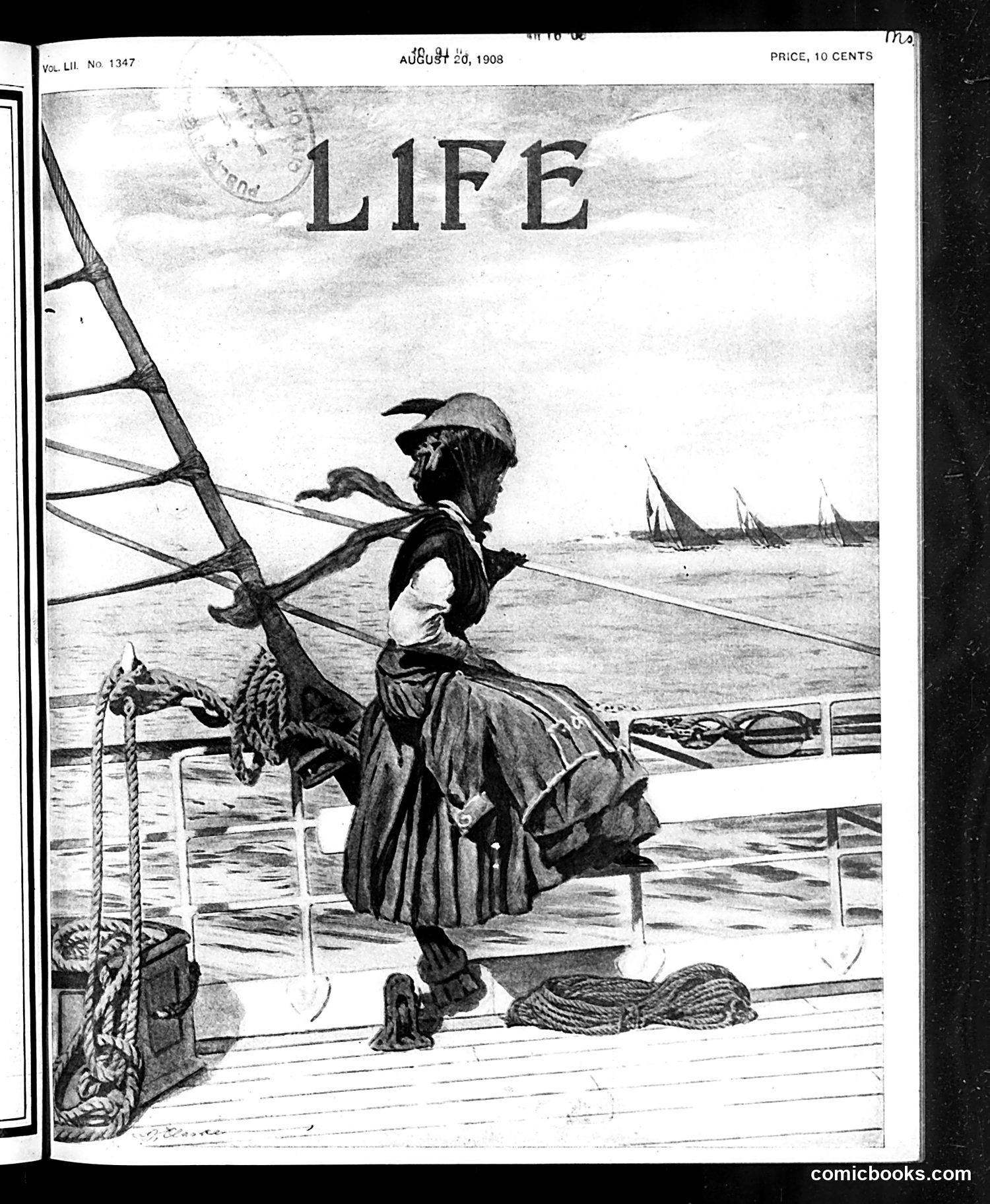
This cover illustration depicts a woman standing on a ship's deck, gazing toward sailing vessels on the horizon. She wears a long coat and hat typical of Edwardian fashion, positioned near rope and nautical equipment. The image likely represents leisure travel or maritime romance popular in early 1900s culture. The woman's contemplative pose—looking outward toward distant sailboats—suggests themes of aspiration, adventure, or romantic yearning that were common satirical subjects in Life magazine's coverage of upper-class life. Without accompanying article text, the precise satirical point remains unclear, but the composition emphasizes the fashionable woman as an object of observation, possibly mocking contemporary notions of femininity, class aspirations, or romantic idealization.
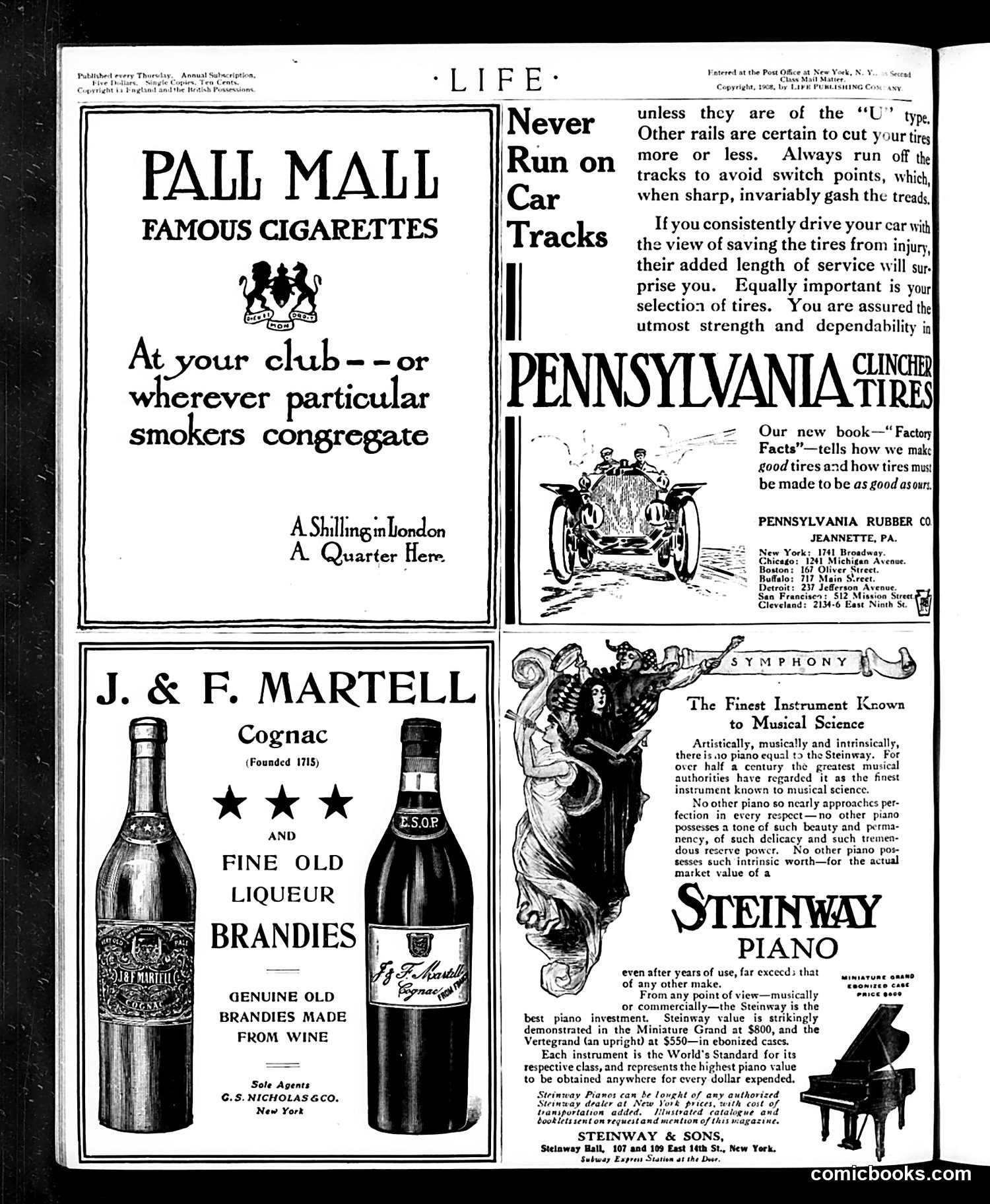
This page is primarily **advertising**, not editorial content or satire. It contains four luxury product advertisements: 1. **Pall Mall Cigarettes** — promotes a British tobacco brand available at gentlemen's clubs 2. **Pennsylvania Tires** — emphasizes durability and proper tire selection for automobiles 3. **J. & F. Martell Cognac** — advertises French brandy and fine spirits 4. **Steinway Piano** — presents their instrument as the finest available, citing endorsements from "musical authorities" The ads reflect early 20th-century consumer culture targeting affluent readers. There is **no political satire or social commentary** visible. The page simply demonstrates how *Life* magazine monetized its audience through high-end product placement, appealing to wealthy, sophisticated consumers interested in luxury goods and leisure activities.
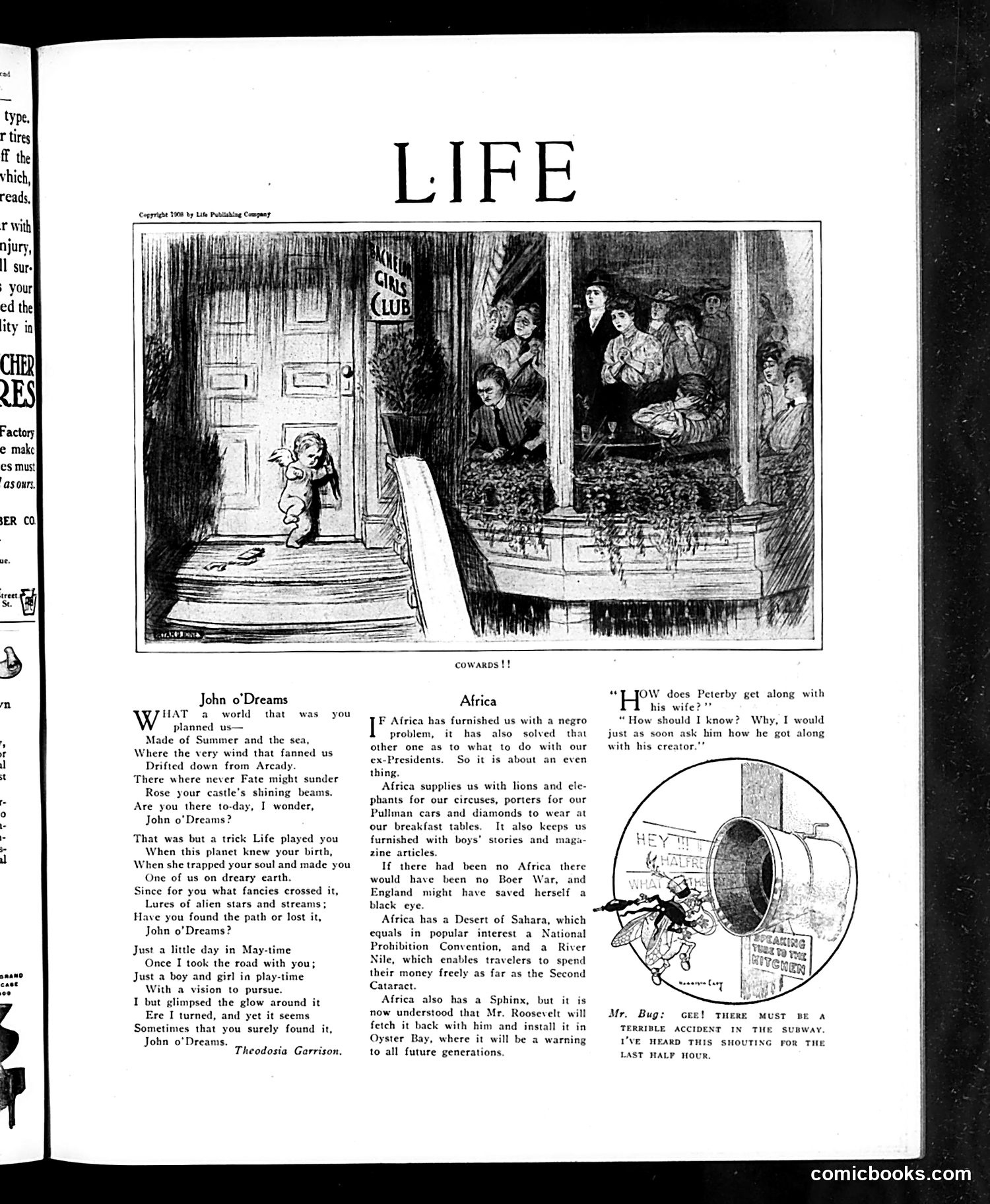
This page contains two distinct pieces: **"John o'Dreams" poem** by Theodisia Garrison: A nostalgic verse about lost youth and wonder, unrelated to current events. **"Africa" section**: A satirical commentary on Africa's role in solving various Western problems. The text humorously suggests Africa supplies circuses with exotic animals, provides stories for boys' magazines, and references historical conflicts (Boer War, black eye references). It concludes by noting Mr. Roosevelt will "fetch it back" and install a Sphinx at Oyster Bay—an apparent jab at President Theodore Roosevelt's enthusiasm for African big-game hunting and collecting. **"Mr. Bug" cartoon**: Shows a subway accident with anthropomorphic insects, captioned as a transportation disaster heard "the last half hour"—likely satirizing contemporary urban transportation mishaps. The page reflects early 1900s American attitudes toward Africa as an exotic resource for Western entertainment and presidential ambition.
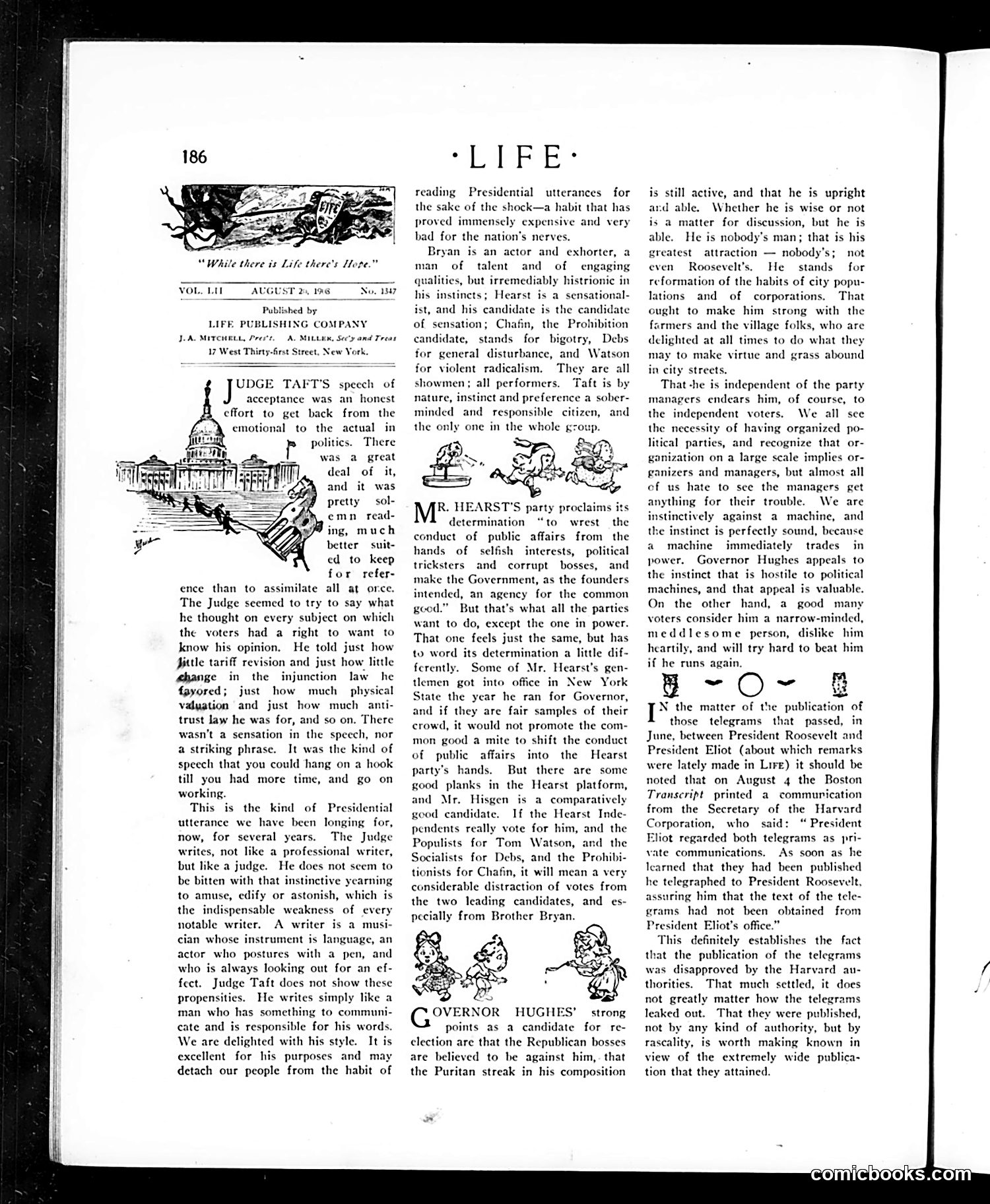
This page from *Life* magazine (August 2, 1908) satirizes the 1908 U.S. presidential race. The left cartoon shows Judge Taft accepting the Republican nomination—the text praises his judicial temperament and ability to communicate clearly without partisan bias, contrasting him favorably with more emotional politicians. The right section discusses William Jennings Bryan and William Hearst as Democratic candidates. The satire criticizes Hearst's party platform as populist posturing, sarcastically noting his supporters (Tom Watson, Eugene Debs, prohibitionists) represent such divergent interests that they'd fracture Democratic votes, benefiting the Republicans. The page's core joke: Hearst's coalition is so ideologically incompatible that his candidacy actually helps the opposition.
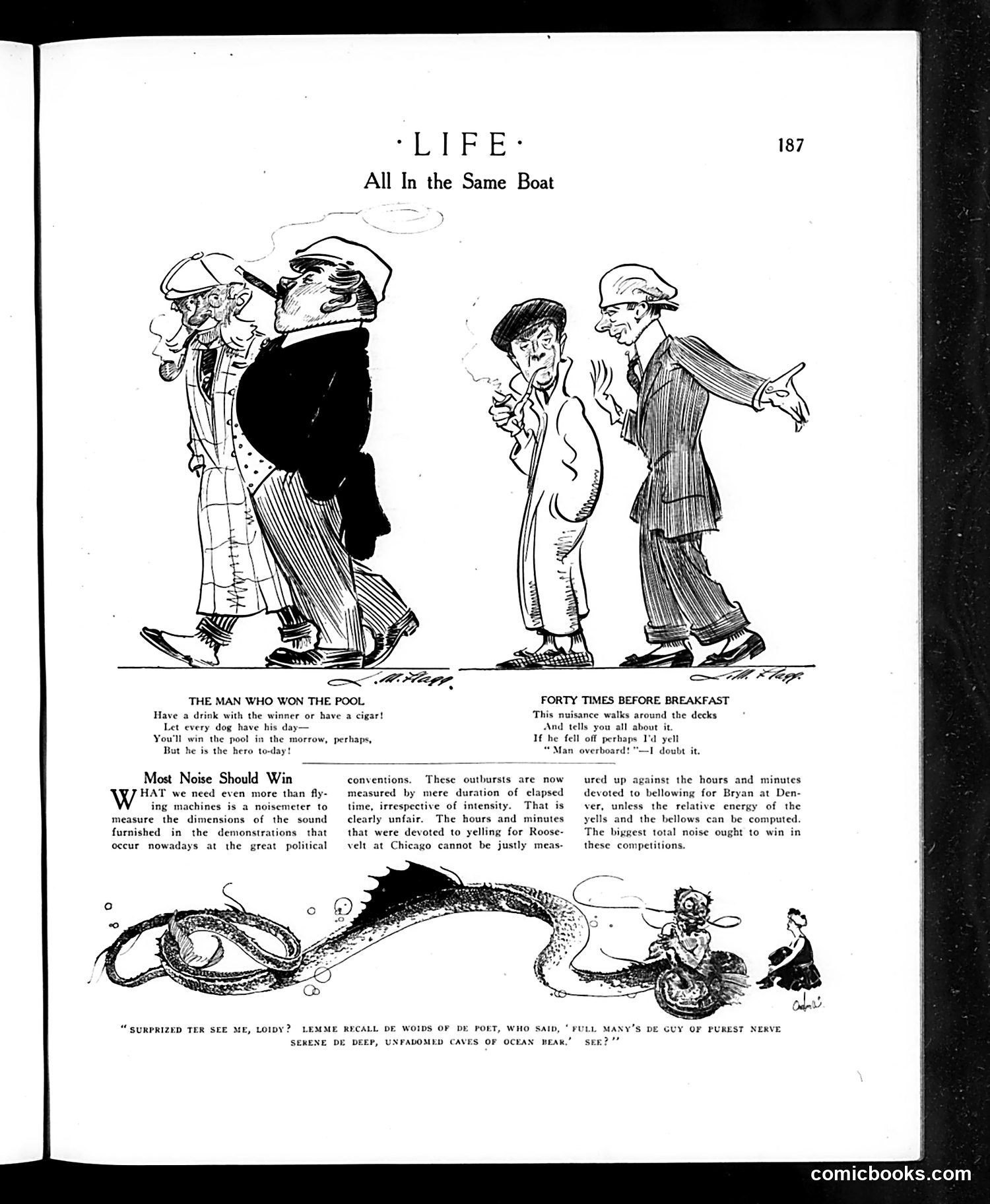
This page from *Life* magazine contains three satirical pieces: **"All in the Same Boat"** (top): Two cartoon panels mock politicians in comparable predicaments. The left shows a man winning a pool, advised to enjoy his winnings now because he'll "win the pool in the mirror, perhaps, / But he is the shell, alas, empty!" The right depicts someone walking the decks forty times before breakfast, with threats of falling overboard. Both use maritime metaphors for political or social entrapment. **"Most Noise Should Win"** (middle): The article critiques using noise duration—rather than intensity—to measure political demonstrations. It references yelling competitions at political conventions, specifically mentioning bellowing for Bryan at Denver versus Roosevelt at Chicago, arguing this measurement system is unfair. **Sea Monster Cartoon** (bottom): A whimsical illustration of a sea serpent encountering a small figure, with pseudo-French dialogue, appears purely comedic rather than political. The page satirizes political measurement standards and campaign excess.
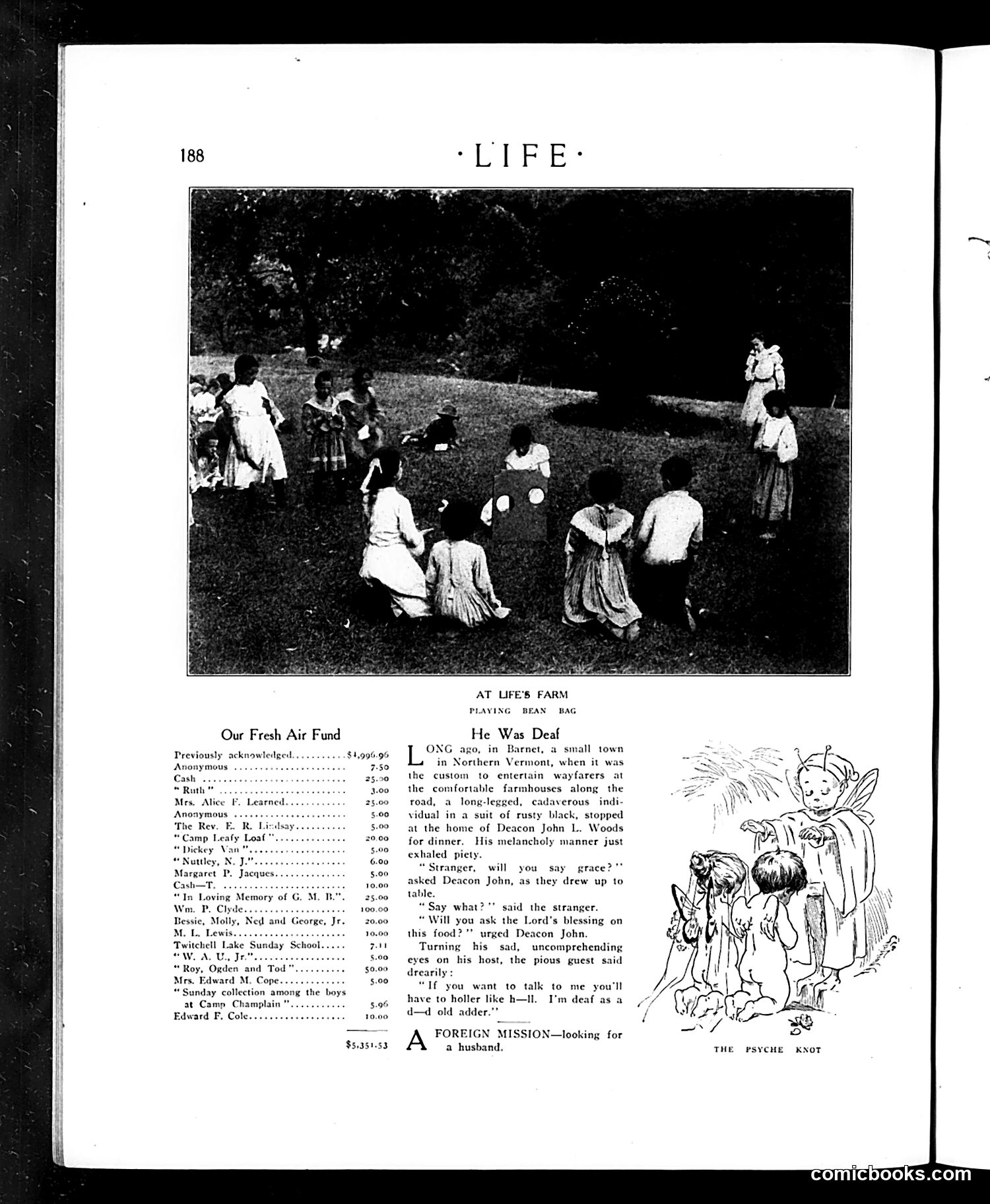
The top photograph shows children playing bean bag on a farm, illustrating Life magazine's "Fresh Air Fund"—a real charitable program providing city children rural recreation. The text story "He Was Deaf" describes a stranger visiting a Vermont farmhouse. When the host, Deacon John L. Woods, asks the guest to say grace before dinner, the stranger mishears and responds rudely, saying the deacon must "holler like h—ll" because he's "deaf as a d—d old adder." The joke relies on the stranger's misunderstanding of the social ritual—he thinks the deacon is hard of hearing rather than requesting a prayer blessing. The cartoon "The Psyche Knot" on the right appears unrelated to these pieces.
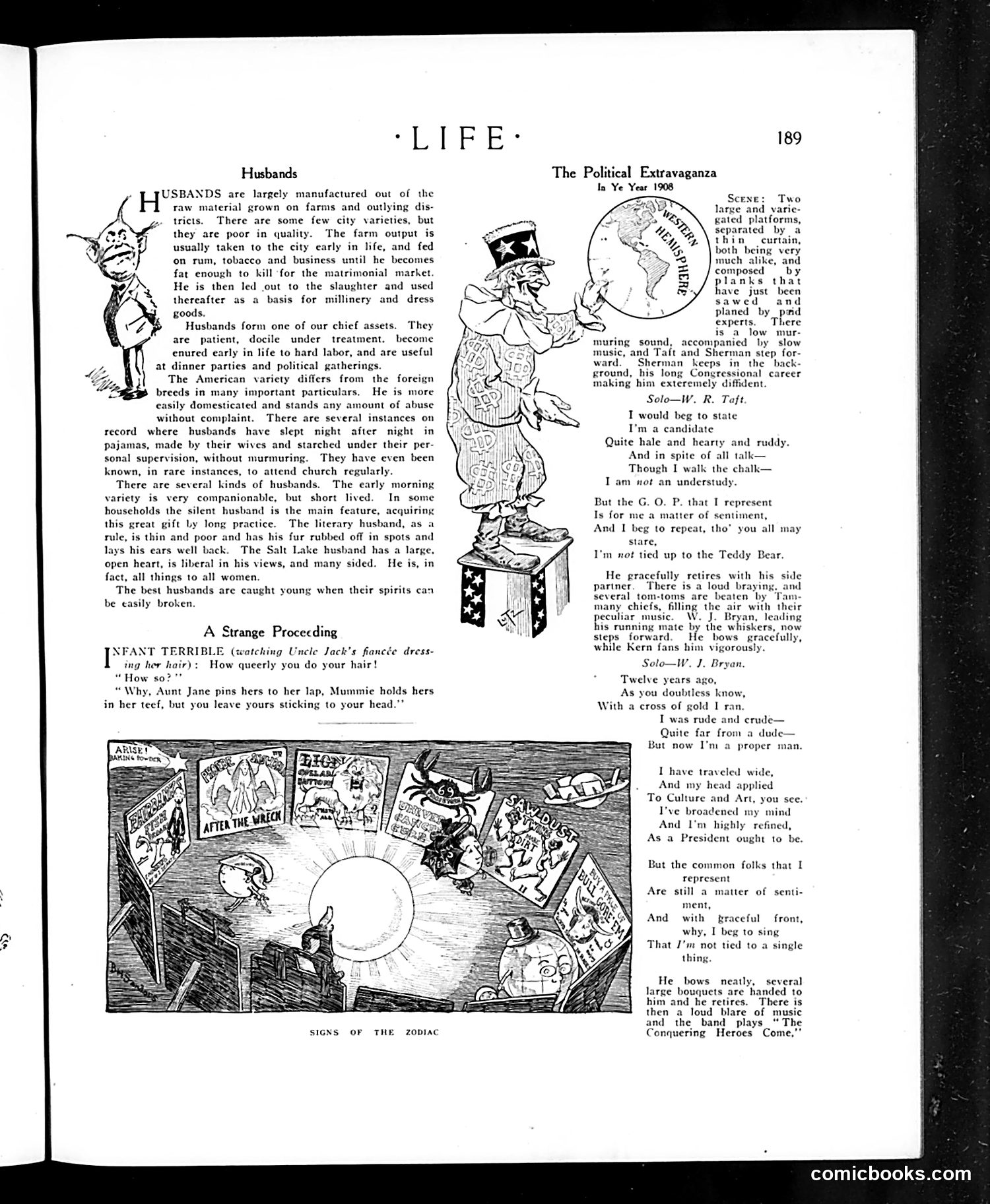
This page contains satirical political and social commentary typical of early 1900s Life magazine. **"The Political Extravaganza"** (right side) depicts a caricatured political figure performing acrobatics on a pedestal labeled with what appears to be Congressional imagery. The accompanying verse mocks his transformation from a rough candidate into a refined politician, suggesting hypocrisy about his claimed self-improvement and refined character. **"A Strange Proceeding"** (lower left) presents a comic strip titled "Signs of the Zodiac," showing someone viewing various newspaper front pages or advertisements arranged in a circle around a central light source—likely satirizing how people consume sensational news. The text sections on husbands and domestic life provide additional social satire about gender roles and marriage expectations of the era.
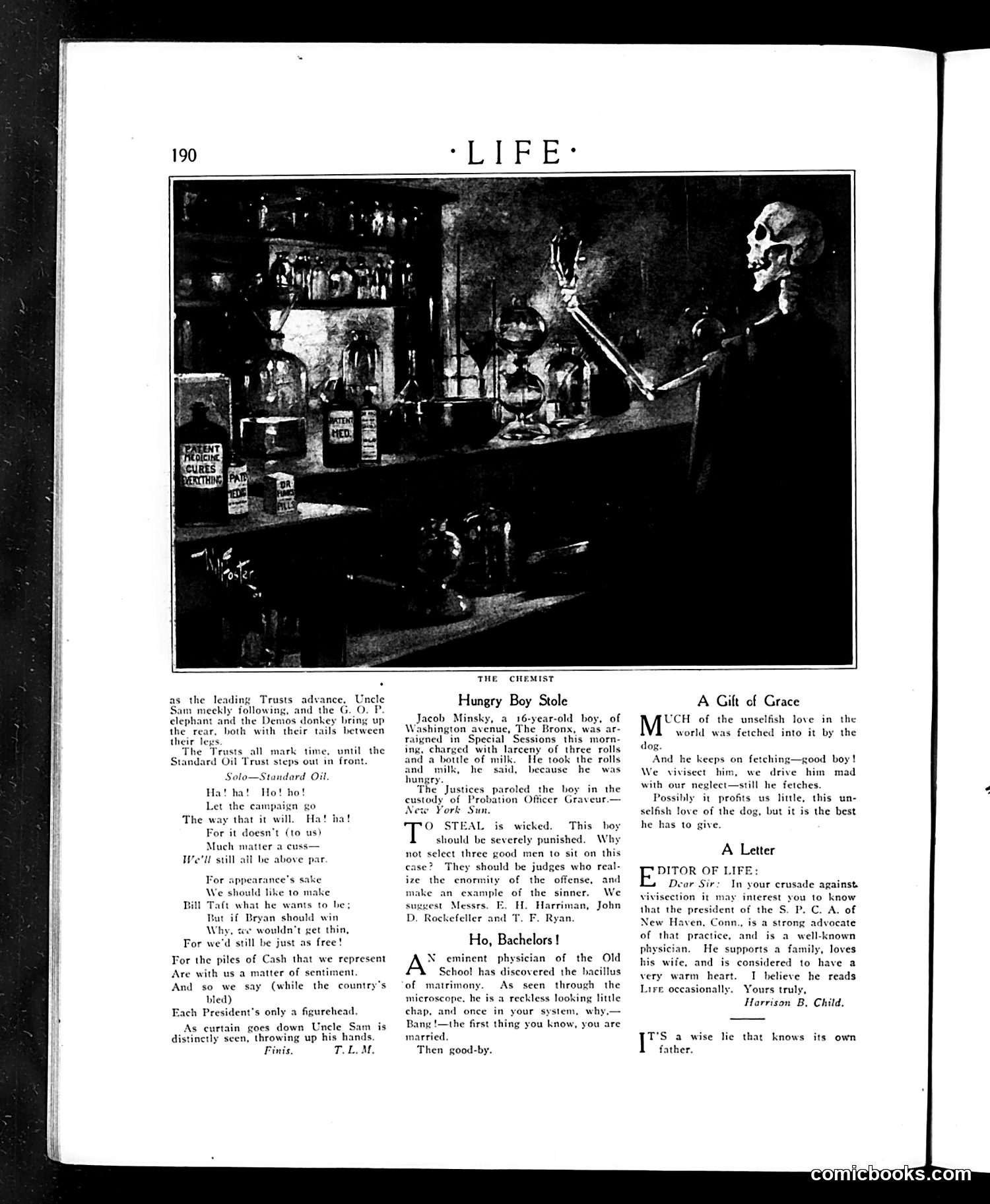
This page contains three separate pieces of satirical content: **"The Chemist"** (top image): A dark cartoon depicting a skeleton holding laboratory equipment amid bottles and vessels. The accompanying verses mock politicians—specifically referencing "Uncle Sam," "the G.O.P. elephant," and "Cash"—suggesting corruption or moral decay within political institutions. The skeleton imagery implies death or decay of political integrity. **"Hungry Boy Stole"** and related pieces: Short humorous verses about a boy stealing bread rolls and milk, arrested by "the Justices." The satire appears to critique the justice system's treatment of petty theft by the poor. **"A Letter"** section: Reader correspondence advocating against vivisection (animal experimentation), addressed to the magazine's editor. The page represents *Life's* characteristic blend of political satire, social commentary, and reader engagement from the early 20th century.
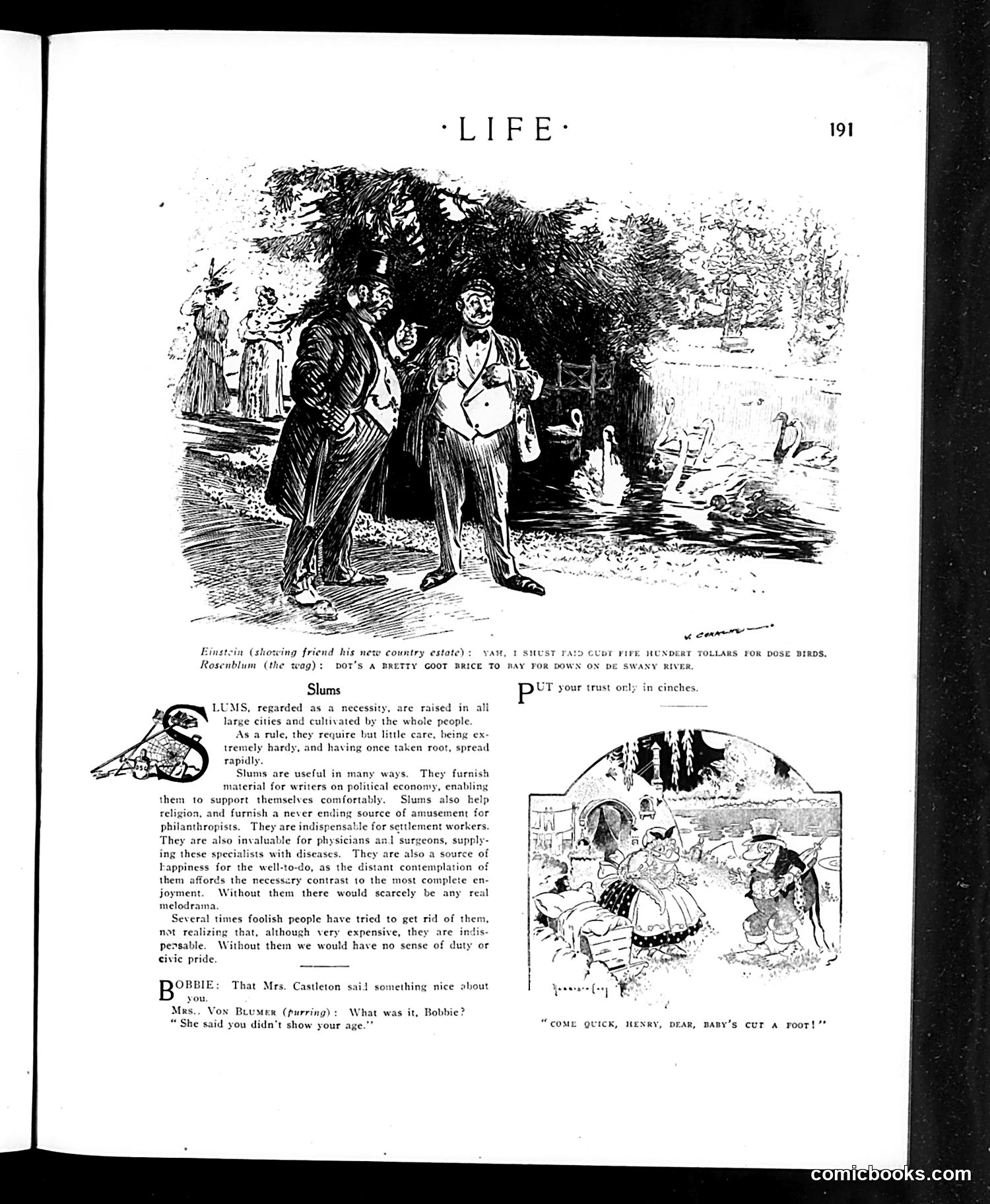
This page contains satirical commentary on **urban slums** in late 19th/early 20th century America. The main illustration shows wealthy gentlemen observing poor conditions, with one boasting he'll "pay five hundred dollars for dose birds" rather than help the impoverished. The "Slums" text section critiques how privileged society views slums as useful—providing material for writers, amusement for the wealthy, and justification for philanthropy—rather than addressing actual suffering. It sarcastically notes that despite repeated failed efforts to eliminate slums, the wealthy have no "sense of duty or civic pride." The dialogue between Bobbie and Mrs. Vox Blumes satirizes superficial society gossip, contrasting trivial social commentary with the serious social conditions depicted above.
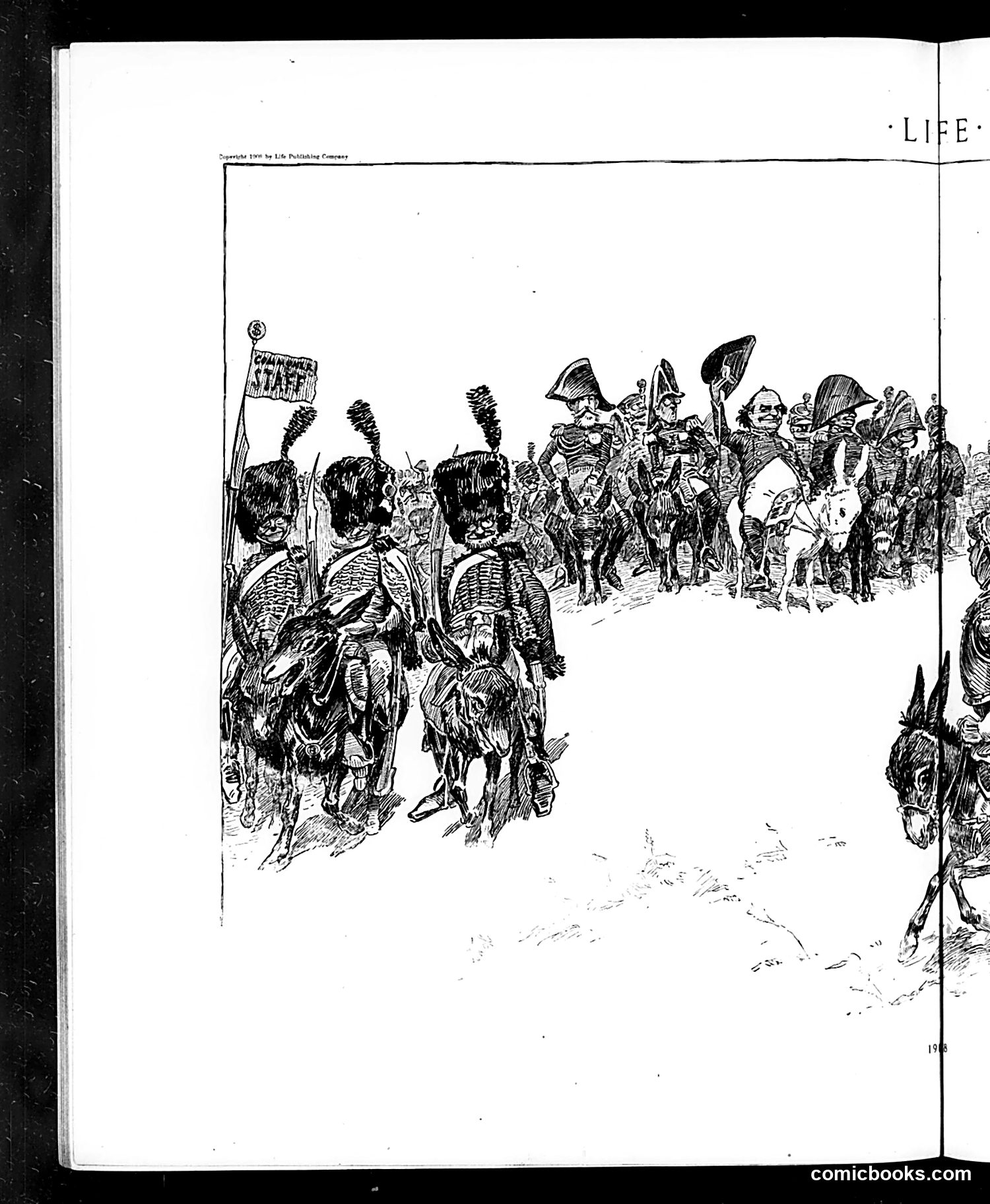
This page from *Life* magazine shows a military procession cartoon. The image depicts mounted soldiers in elaborate uniforms and tall plumed hats in the foreground, with one carrying a flag, while additional mounted officers appear in the background. Without visible OCR text or a caption on this page, the specific political target is unclear. However, the artistic style and composition suggest satire of military pomposity or aristocratic excess—common *Life* magazine themes. The exaggerated uniforms, ornate headgear, and ceremonial nature of the procession indicate mockery of either militarism generally or a specific historical military parade or regime. The page number "19" suggests this is interior content rather than a cover or advertisement. More context would be needed to identify the precise historical reference or political commentary intended.
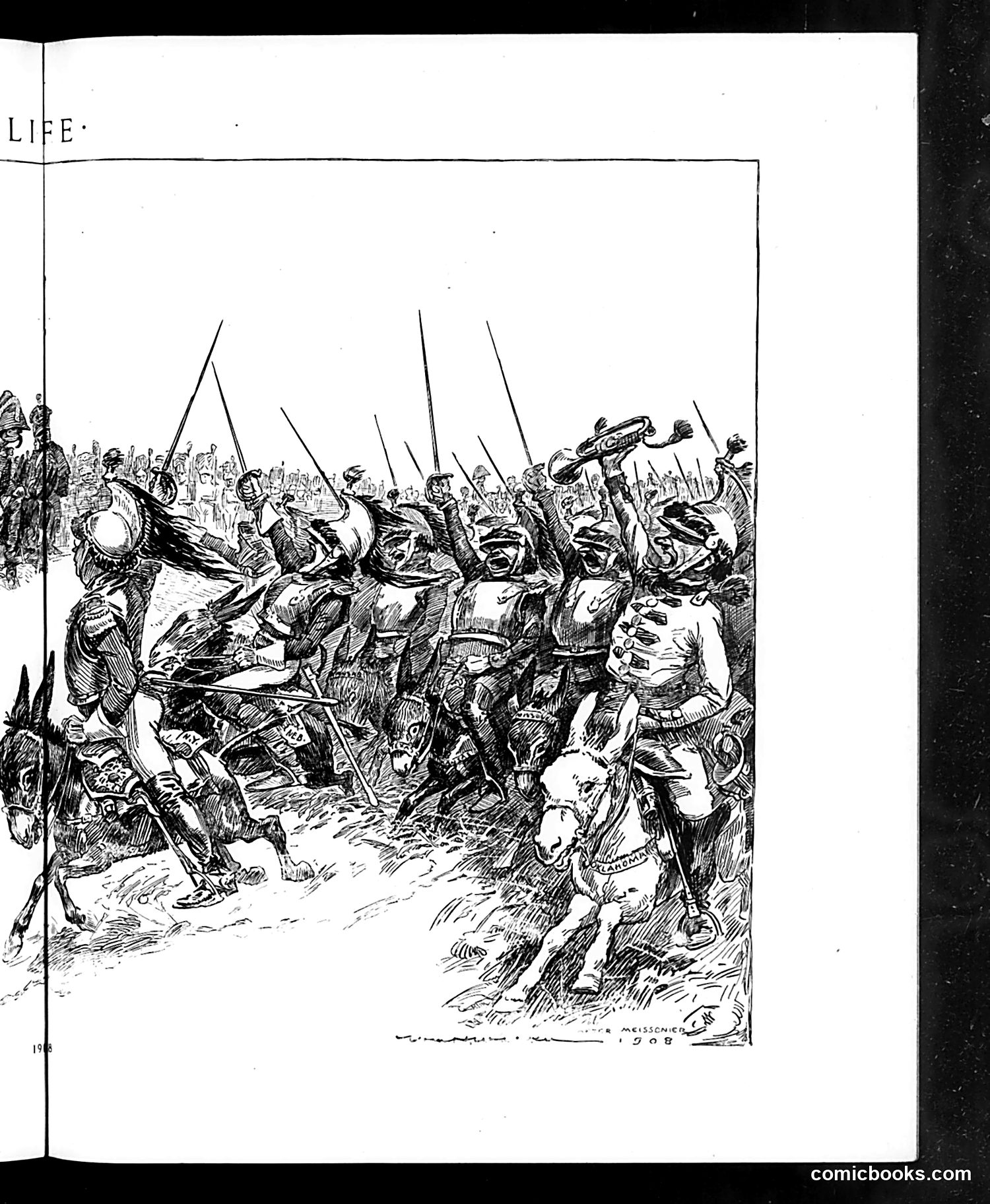
This page features a satirical illustration dated 1908 (visible in the signature). The image depicts a military procession with mounted cavalry and soldiers carrying long lances or poles, drawn in a detailed ink style typical of early 20th-century political cartoons. The heading "LIFE" at the top indicates this is from the satirical magazine. The military parade scene appears to critique militarism or military buildup, common themes in American political satire of the Progressive Era (1900s-1910s). The exaggerated, chaotic nature of the composition—with figures appearing somewhat absurd or overwrought—suggests mockery rather than celebration of military pageantry. Without additional text visible on this page, the specific political target remains unclear, though it likely comments on contemporary military or imperial policies.
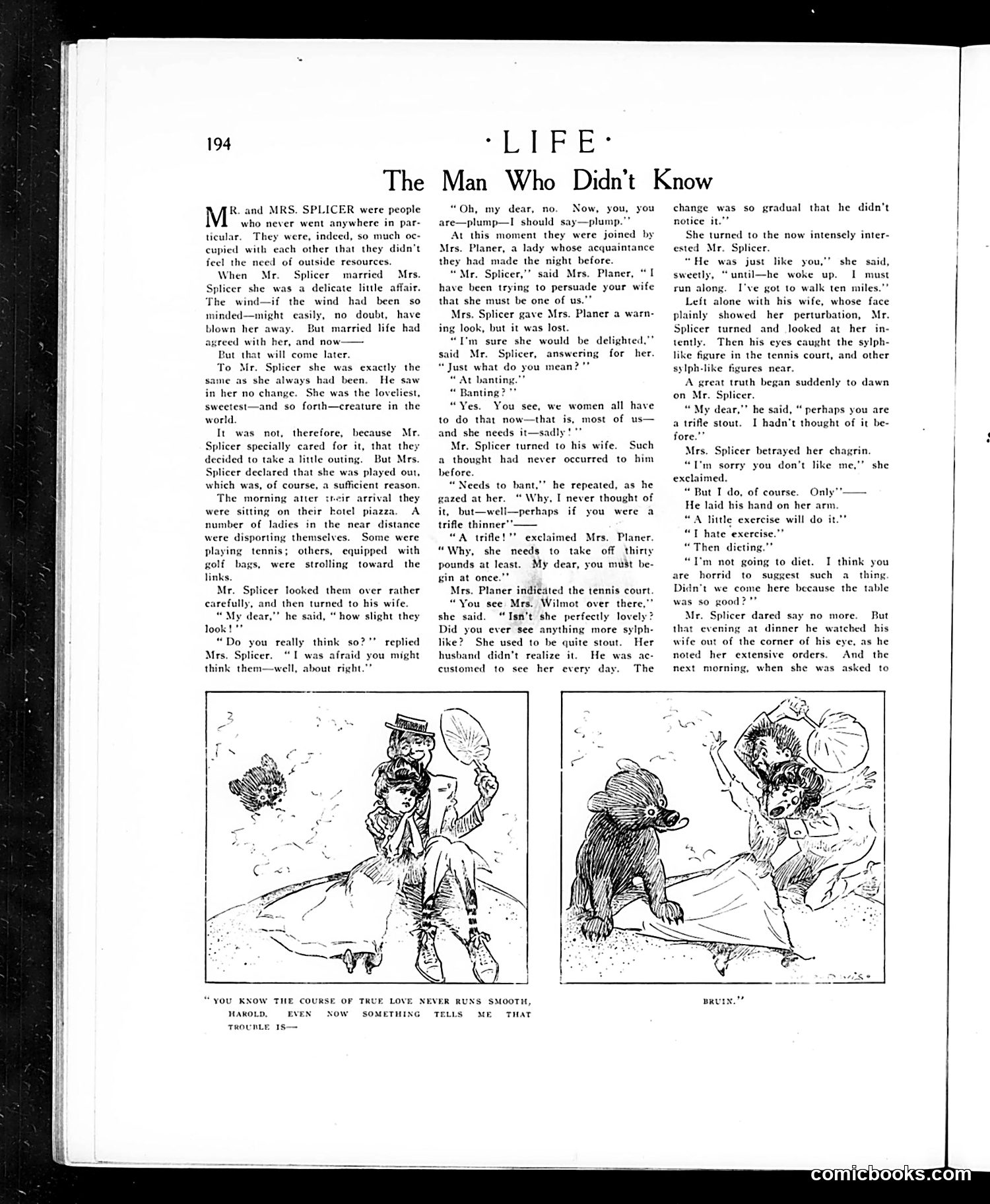
This is a short fiction story with two accompanying illustrations, not a political cartoon. The narrative concerns Mr. and Mrs. Splicer, a couple whose marriage suffers from Mr. Splicer's obliviousness—he fails to notice his wife's emotional needs and infidelities. The two sketches illustrate comedic scenes of marital discord: the left shows the couple at what appears to be a social gathering, while the right depicts them on a beach with other couples. The story satirizes male inattentiveness in marriage, a common theme in early 20th-century American humor. The satire targets husbands who remain willfully ignorant of their wives' obvious unhappiness and romantic adventures, presenting this obliviousness as both foolish and socially embarrassing.
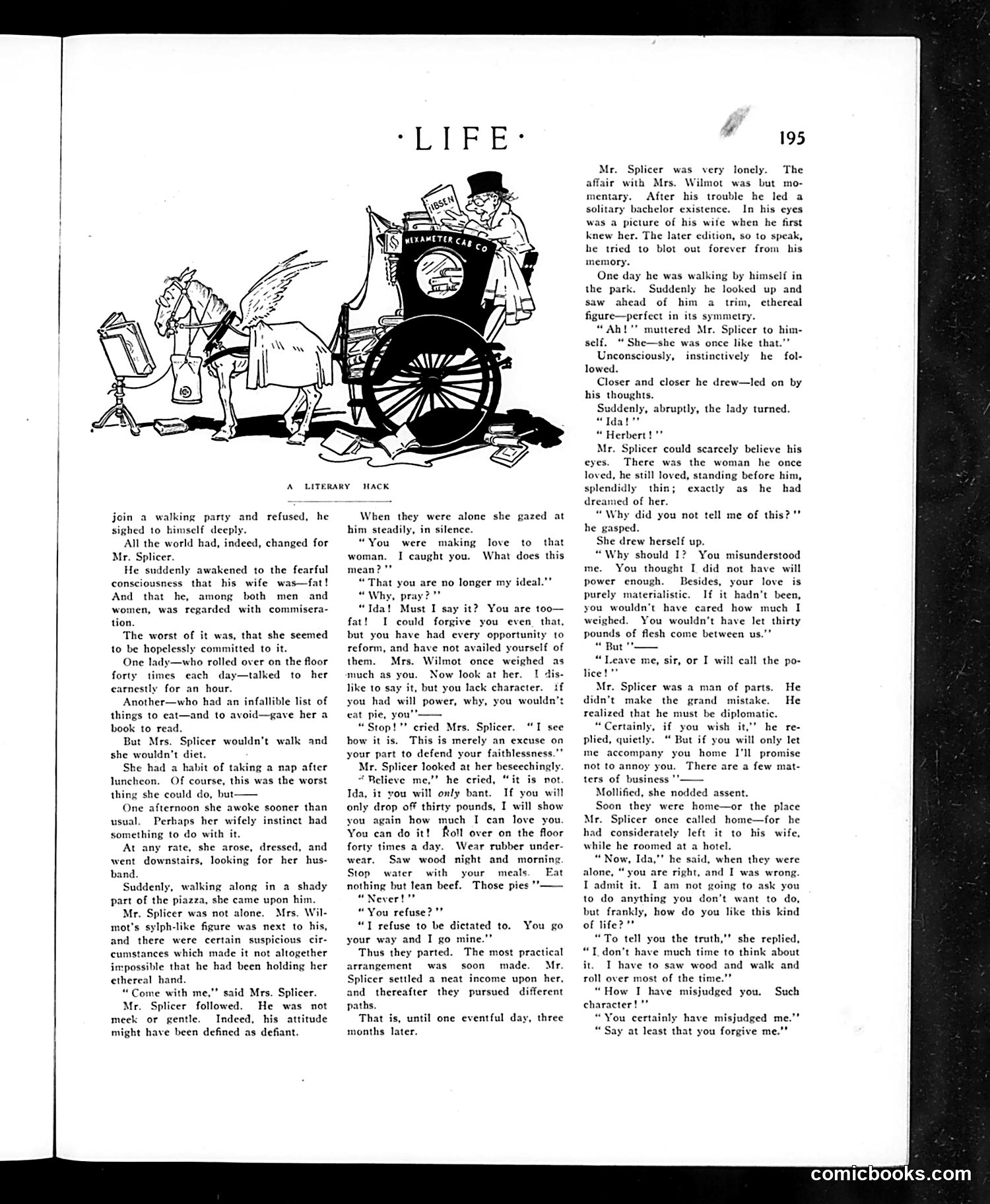
The cartoon depicts a disheveled writer being ejected from a horse-drawn cab labeled "LITERARY CAB." The figure is surrounded by scattered papers and manuscripts, with a caricatured cabbie gesturing dismissively. This satirizes struggling writers or journalists—the "literary hack"—portrayed as unsuccessful, impoverished, and dependent on precarious work. The horse-cab imagery suggests turn-of-the-century New York literary culture. The scattered papers emphasize failed writing projects. The accompanying story concerns Mr. Splicer, a man pursuing an affair, suggesting the cartoon's placement illustrates themes of personal failure and desperation—both romantic and professional—common to Life's satirical commentary on urban life and human folly.
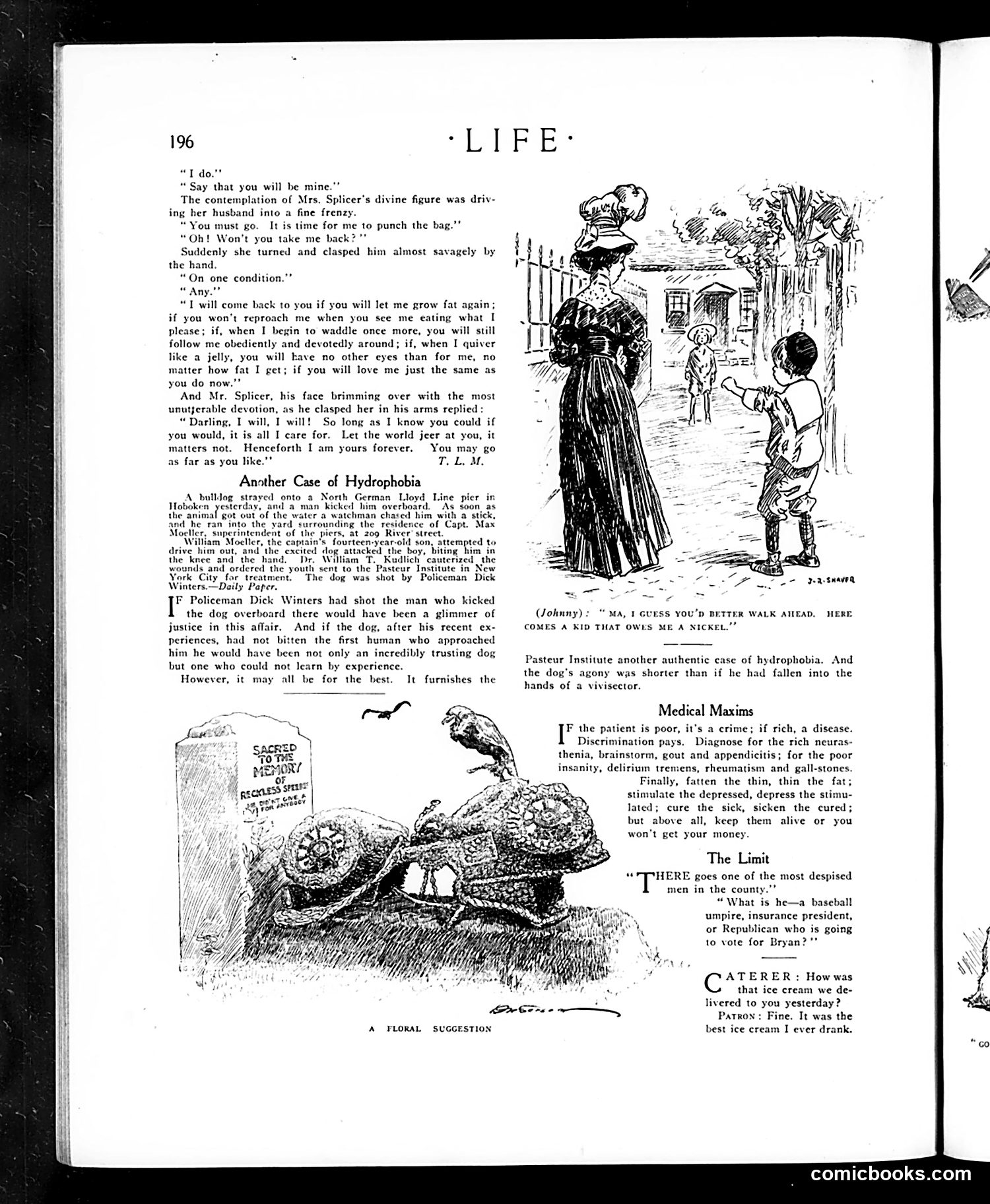
This page contains several satirical pieces typical of early 1900s *Life* magazine humor: **Main Story (top)**: A domestic comedy about Mr. and Mrs. Splicer. The joke concerns beauty standards and marital devotion—she demands he accept her if she gains weight again, and he dramatically agrees. The satire targets both changing female body ideals (the era's obsession with slenderness) and performative male devotion. **"Another Case of Hydrophobia"**: A news item followed by editorial commentary. A dog kicked into the Hudson, later bites a boy, gets shot. The satirist argues the *dog* was justified in biting—it learned from being mistreated. The humor is sardonic social criticism: the dog acted rationally given experience, unlike humans who expect animals to be forgiving. **"Medical Maxims"**: A cynical list mocking doctors for diagnosing wealthy patients with fashionable ailments (neurasthenia, gout) while giving poor patients stigmatizing diagnoses (insanity, delirium tremens)—and prioritizing wealthy patients' survival for payment. **"The Limit"**: A brief joke about despised professions—baseball umpires, insurance presidents, or Republicans supporting Bryan (likely William Jennings Bryan). The cartoons illustrate these satirical pieces with simple line drawings.
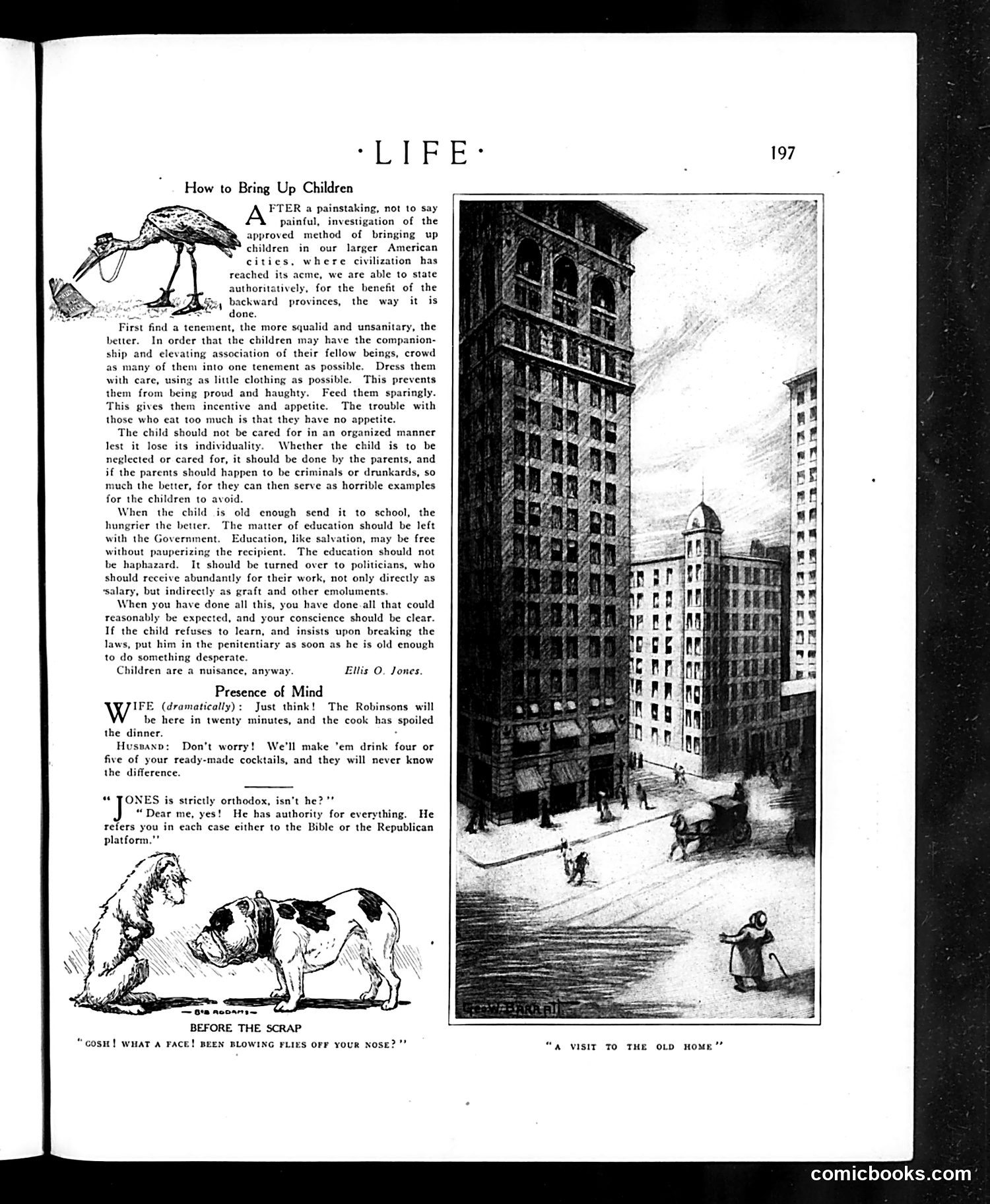
This satirical article mocks how wealthy urban Americans raise children in early 20th-century cities. Written by Ellis O. Jones, it uses **ironic inversion**: the text appears to give earnest advice while actually condemning neglectful child-rearing practices among the poor. The satire targets: - **Crowded tenements** housing many children - **Minimal clothing and sparse feeding** justified as character-building - **Parental neglect**, especially when parents are criminals or alcoholics - **Political corruption** in education (politicians receiving "graft and other emoluments") The cartoon "Before the Scrap" depicts two dogs about to fight, with one saying the other's nose has flies on it—a crude insult joke unrelated to the main article. "Presence of Mind" is a short comic dialogue mocking dinner guests being made drunk on cheap cocktails to distract from a ruined meal—commentary on social pretense. The photograph "A Visit to the Old Home" shows tenement building conditions, visually reinforcing the article's critique of urban poverty and living conditions.
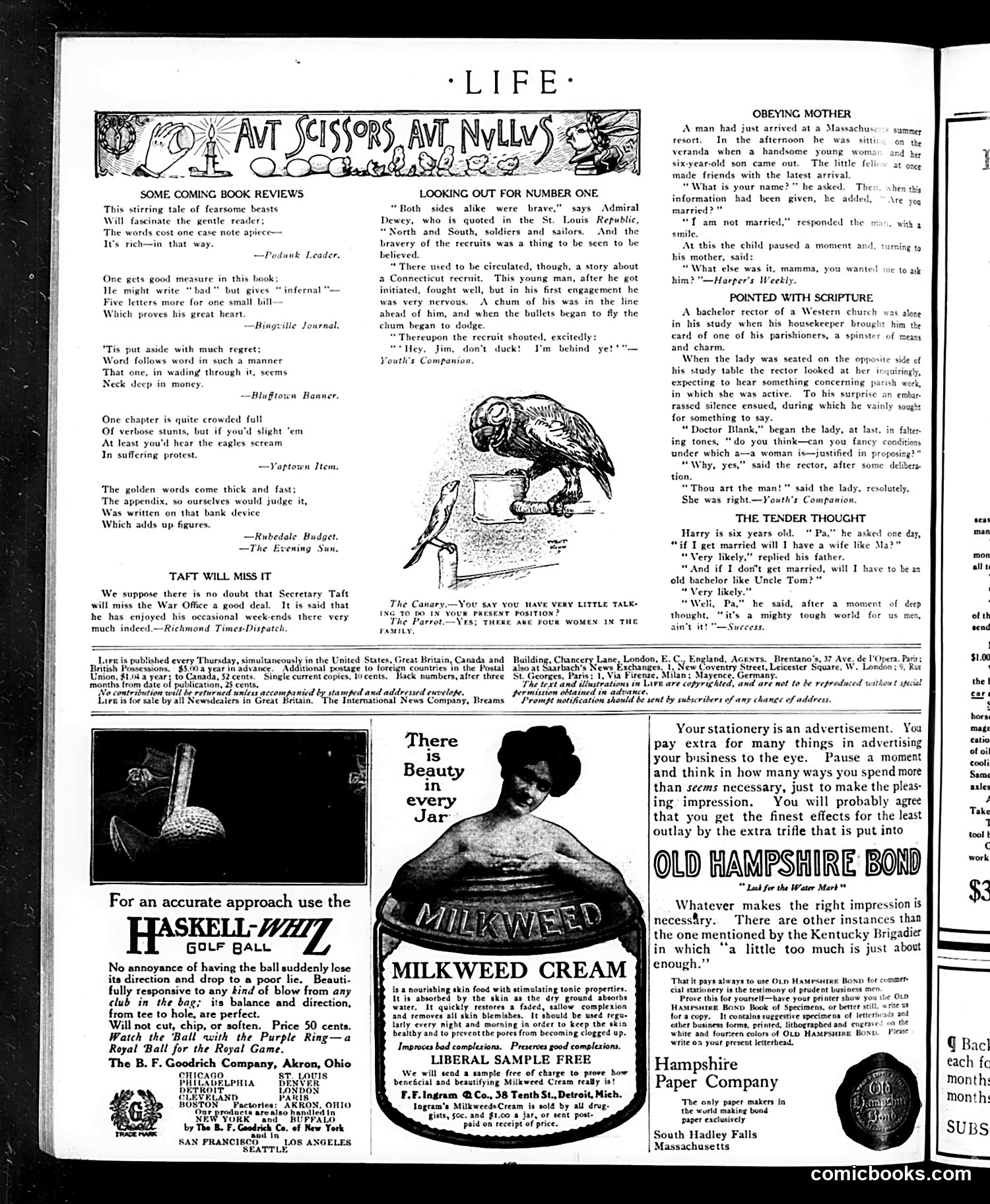
This page from *Life* magazine contains several short humorous anecdotes satirizing American social conventions and gender dynamics of the early 20th century. **"Looking Out for Number One"** mocks a nervous Civil War recruit who panics under fire, shouting at his friend ahead to stop dodging—revealing self-preservation instinct over courage. **"Obeying Mother"** presents a child asking a bachelor if he's "married," then suggesting he must be something else—implying unmarried men are somehow incomplete or defective by social standards. **"Pointed with Scripture"** satirizes a woman's boldness: she asks a rector if women can justify proposing marriage. When he says yes, she proposes to him herself, using the biblical phrase "Thou art the man!"—turning scripture against him. **"The Tender Thought"** humorously depicts a boy's pragmatic realization that marriage or bachelorhood both present hardships for men—suggesting skepticism about matrimony's promises. The page primarily satirizes Victorian-era gender expectations, marital conventions, and male anxieties about relationships.
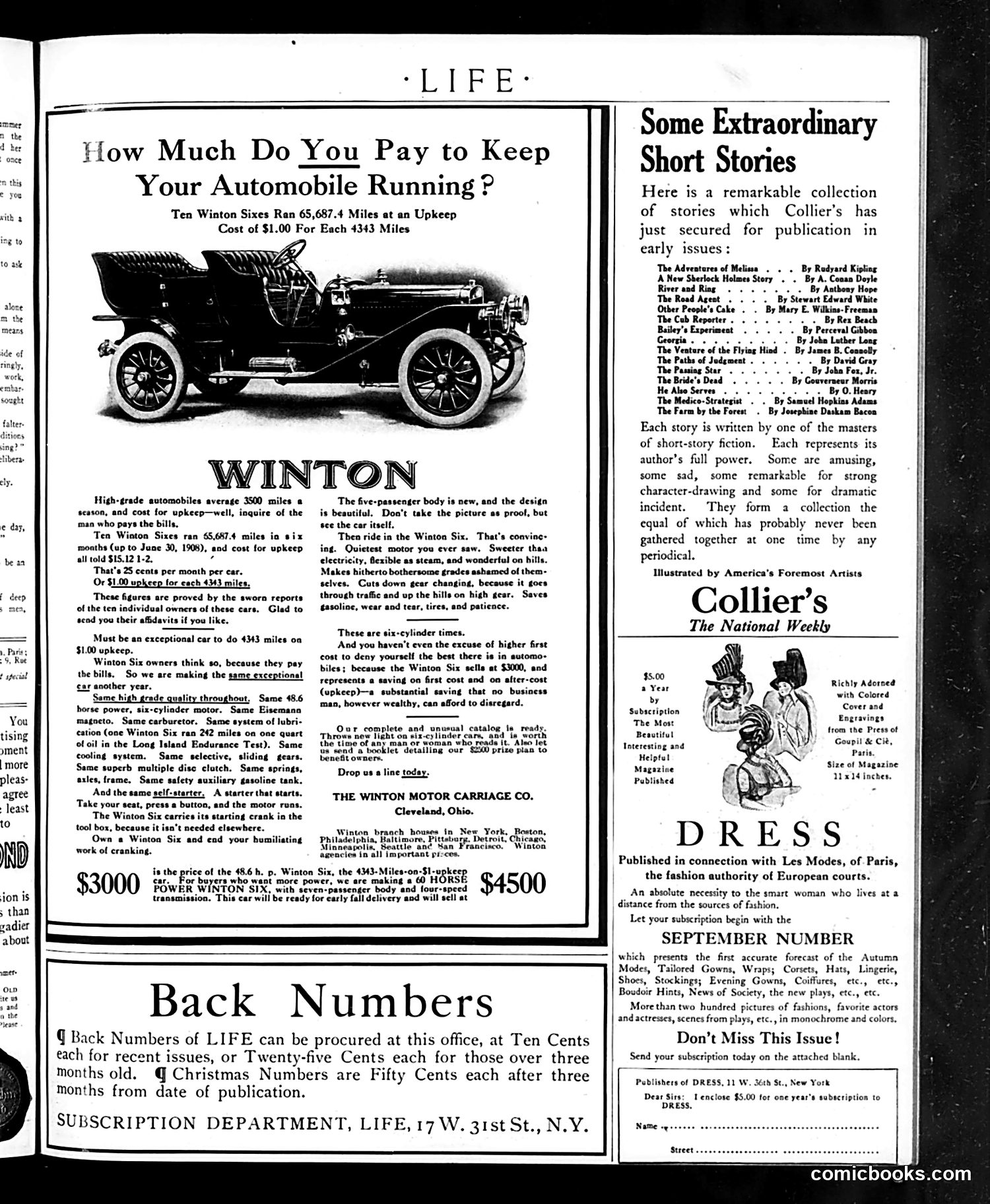
This page is primarily **advertising**, not satire. The main content is a Winton automobile advertisement claiming exceptional fuel efficiency—$1.00 per 4,343 miles based on "sworn reports" from ten owners. The pitch emphasizes reliability and low operating costs during an era when automobile ownership was still a luxury expense. Key selling points include the six-cylinder engine, self-starter (eliminating hand-crank humiliation), and five-passenger capacity at $3,000. The page also advertises **Collier's** magazine's upcoming publication of short stories by famous authors (Kipling, Conan Doyle, Wilkins-Freeman), and **Dress** magazine focusing on European fashion. There are **no political cartoons** on this page. It represents early 1900s consumer marketing emphasizing mechanical innovation and cost-effectiveness as status symbols for the wealthy.
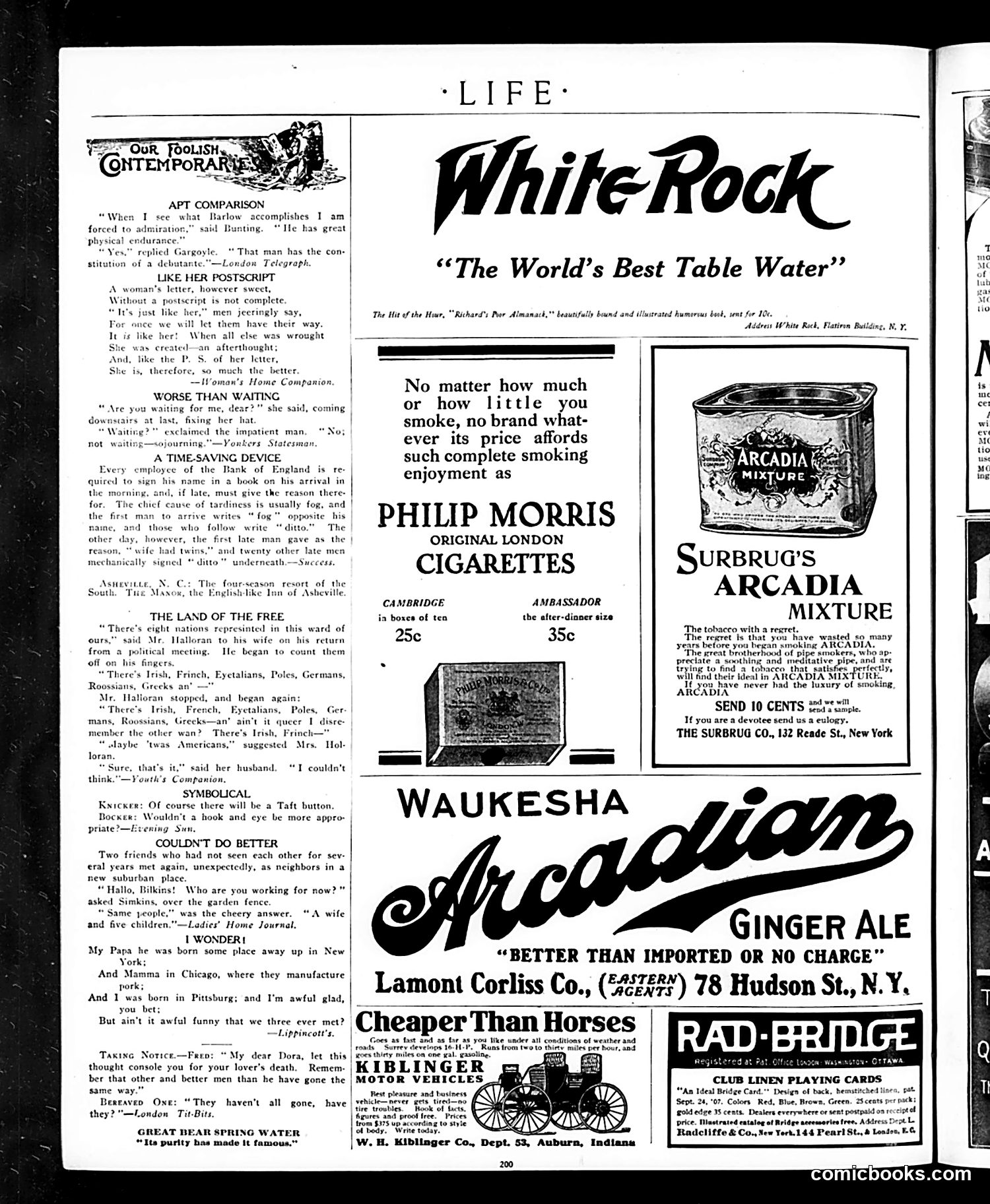
This page is primarily **advertising**, not political satire. It dates from the early 1900s (likely 1905-1910) based on product types and design. The left column contains brief humorous anecdotes and jokes—typical "filler" content for Life magazine of this era. These touch on domestic life, immigration, and social observations but lack sharp political commentary. One piece notes a man counting immigrants of various nationalities, reflecting early-1900s awareness of immigration but without clear satirical point. The bulk of the page features product advertisements: White Rock table water, Philip Morris cigarettes, Arcadia pipe tobacco, Waukesha ginger ale, Rad-Bridge playing cards, and Kiblinger motor vehicles. These ads reflect consumer products and luxuries of the Edwardian era. **No clear political cartoon or social satire is identifiable** on this page. It represents Life magazine's mixed format of light humor, social commentary, and commercial advertising typical of American periodicals in the early 20th century.
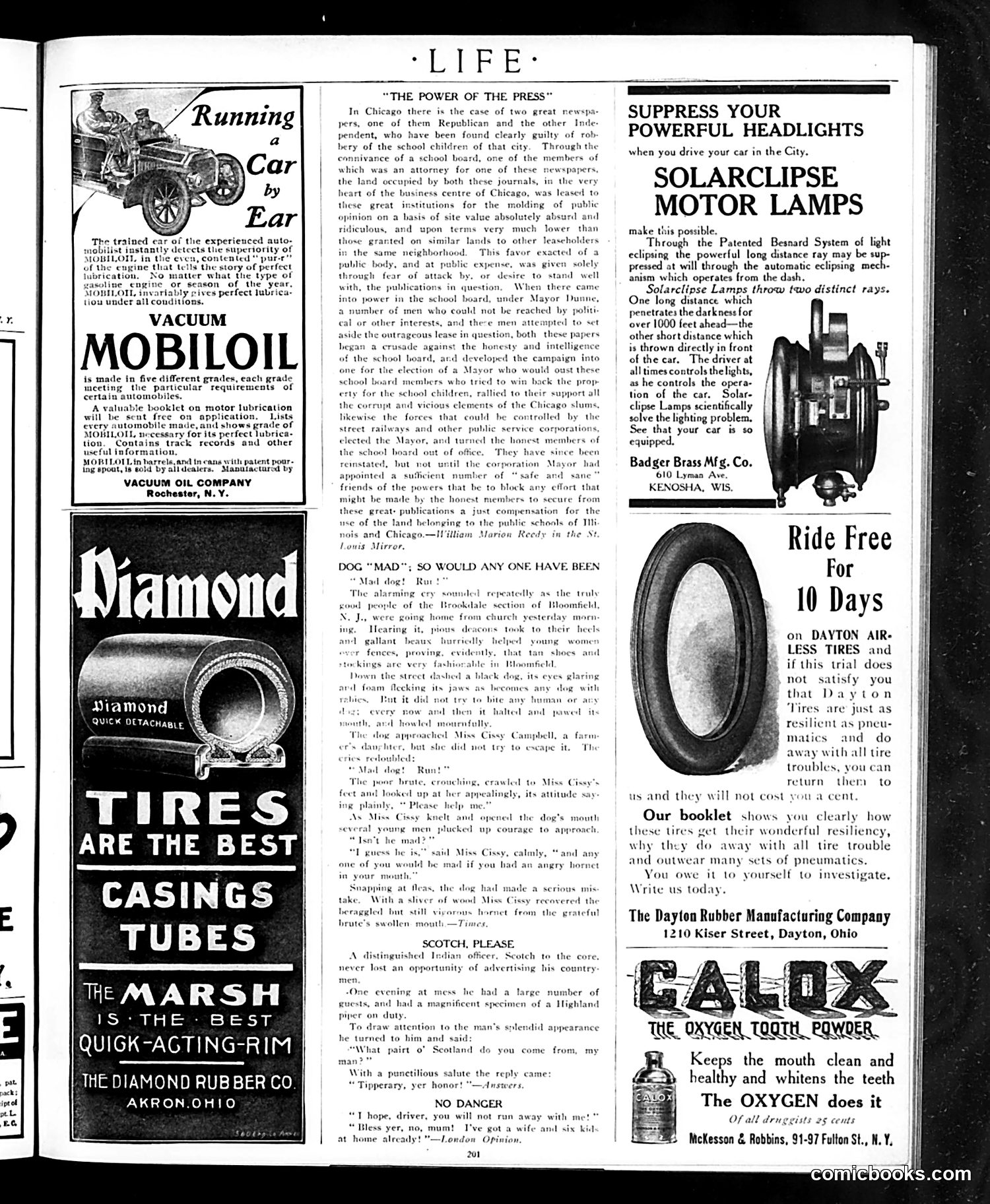
This page is primarily **advertising**, with three short humorous anecdotes in the center. The cartoons/jokes are: 1. **"Dog 'Mad'; So Would Anyone Have Been"**: A domestic story where a dog has swallowed a hornet and goes mad. A girl (Miss Cissy) removes the insect, demonstrating the obvious moral—anyone would be angry with a hornet in their mouth. 2. **"Scotch, Please"**: A brief joke about a Scottish officer who constantly promotes Scotland. When asked where he's from, he patriotically answers, implying Scotland is superior. 3. **"No Danger"**: A cab driver reassures a passenger he won't run away—because he has a wife and six children at home waiting. The joke plays on the assumption that a poor driver might abandon his job; the punchline reveals his domestic obligations keep him honest. These are gentle, anecdotal humor typical of early-20th-century Life magazine—no political satire present. The page is dominated by period automotive advertisements (Mobiloil, Diamond Tires, Solarclipse Motor Lamps, Dayton Air-Less Tires, and Gal-O Tooth Powder).
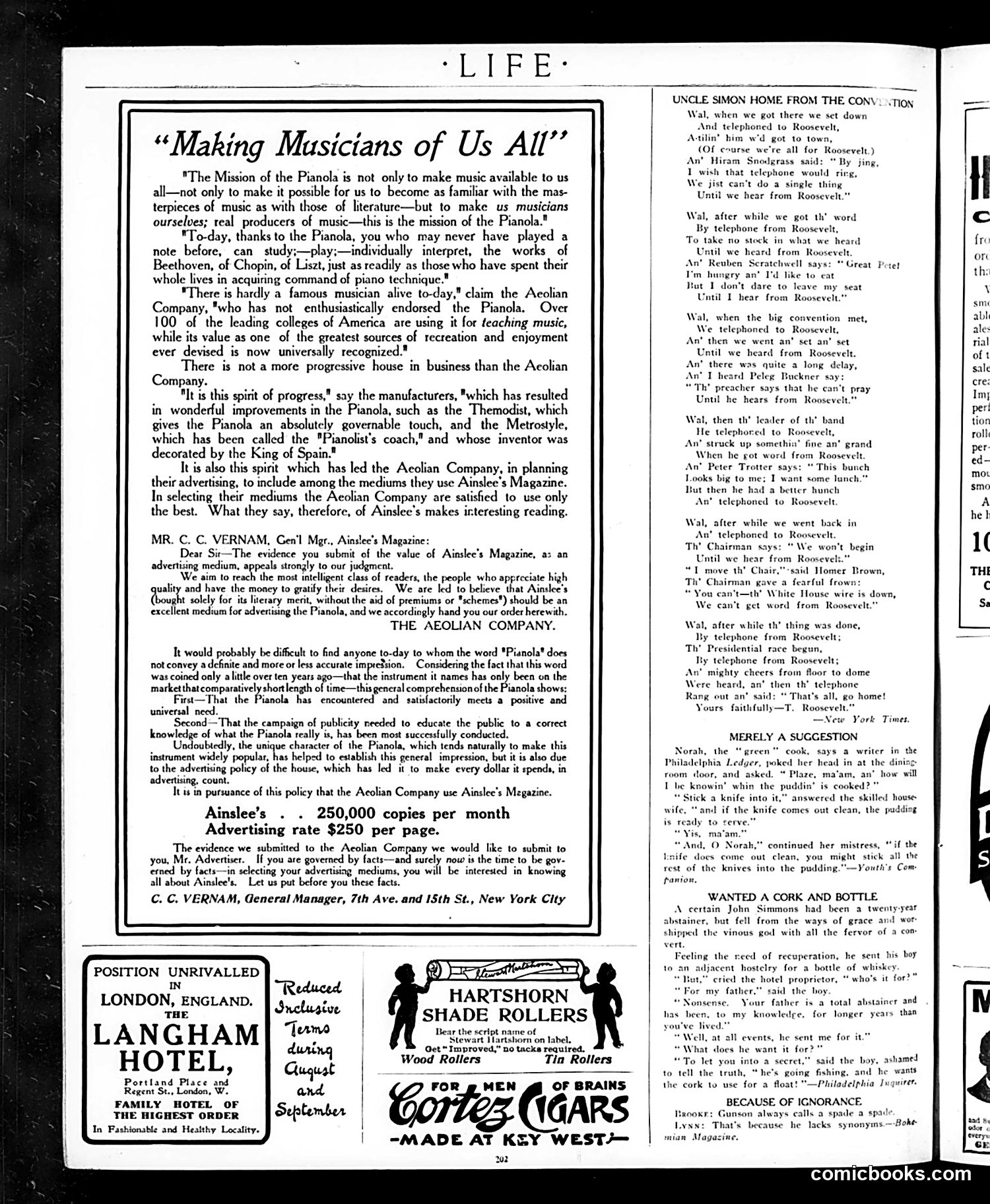
This page is primarily **advertising**, not satire or political commentary. The main feature is a lengthy advertisement for the **Pianola** (an automatic player piano by the Aeolian Company). The ad claims the device democratizes music-making, allowing anyone—regardless of musical training—to "play" classical masterworks by Beethoven and Chopin through mechanical means. The satirical *implicit* point (typical of Life's approach) seems to be **ironic**: the Pianola promises to make everyone a "musician" without actual musical skill or effort. The device is presented as revolutionary progress, yet the premise—that pressing keys mechanically constitutes musical interpretation and artistry—is arguably absurd. The secondary content includes lighthearted humor pieces ("Uncle Simon Home from the Convention," "Merely a Suggestion") unrelated to the main advertisement. **For modern readers**: This reflects early-1900s anxieties about technology's impact on labor and skill. The Pianola promised leisure and culture to the middle class, but skeptics saw it as a hollow substitute for genuine musicianship.
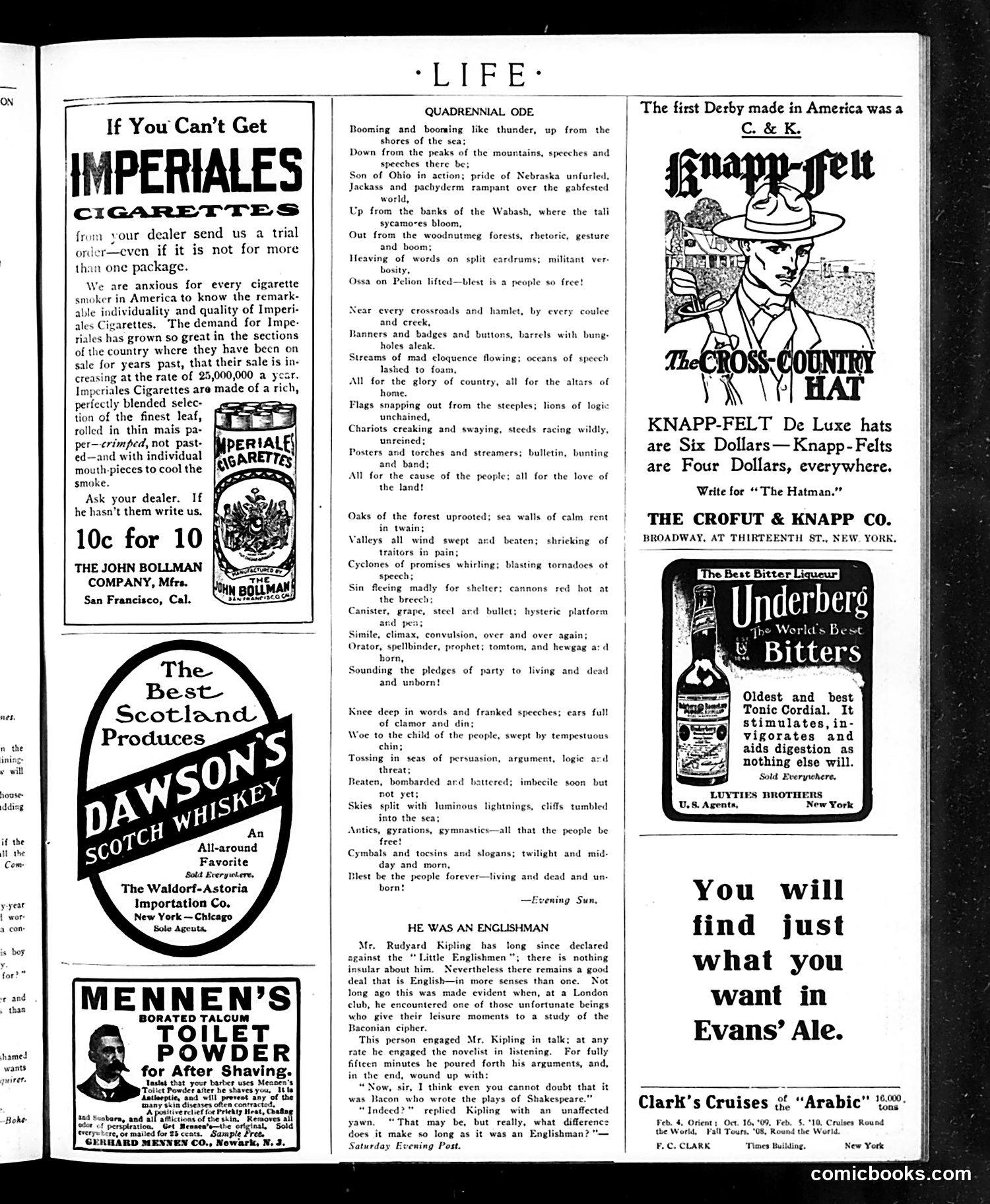
This page is primarily **advertising** with one significant editorial poem. The central content is "Quadrennial Ode," a satirical poem mocking American **presidential election campaigns**. The poem uses grandiose, bombastic language to ridicule the excessive rhetoric, spectacle, and empty promises of election season—depicting campaigns as loud, chaotic theatrical productions filled with "speeches and speeches," "rhetoric, gesture and boom," "posters and torches," and "platform" hysteria. Phrases like "Jackass and pachyderm rampant" reference the Democratic donkey and Republican elephant symbols. The poem sarcastically celebrates this electoral chaos as proof that "a people [are] so free," implying the opposite: that American democracy drowns in meaningless noise rather than substantive discourse. Below, a brief article about Rudyard Kipling criticizing "Little Englishmen" begins but is cut off. The surrounding advertisements (cigarettes, whiskey, talcum powder, hats, bitters, ale, cruises) are typical period marketing with no apparent satirical intent.
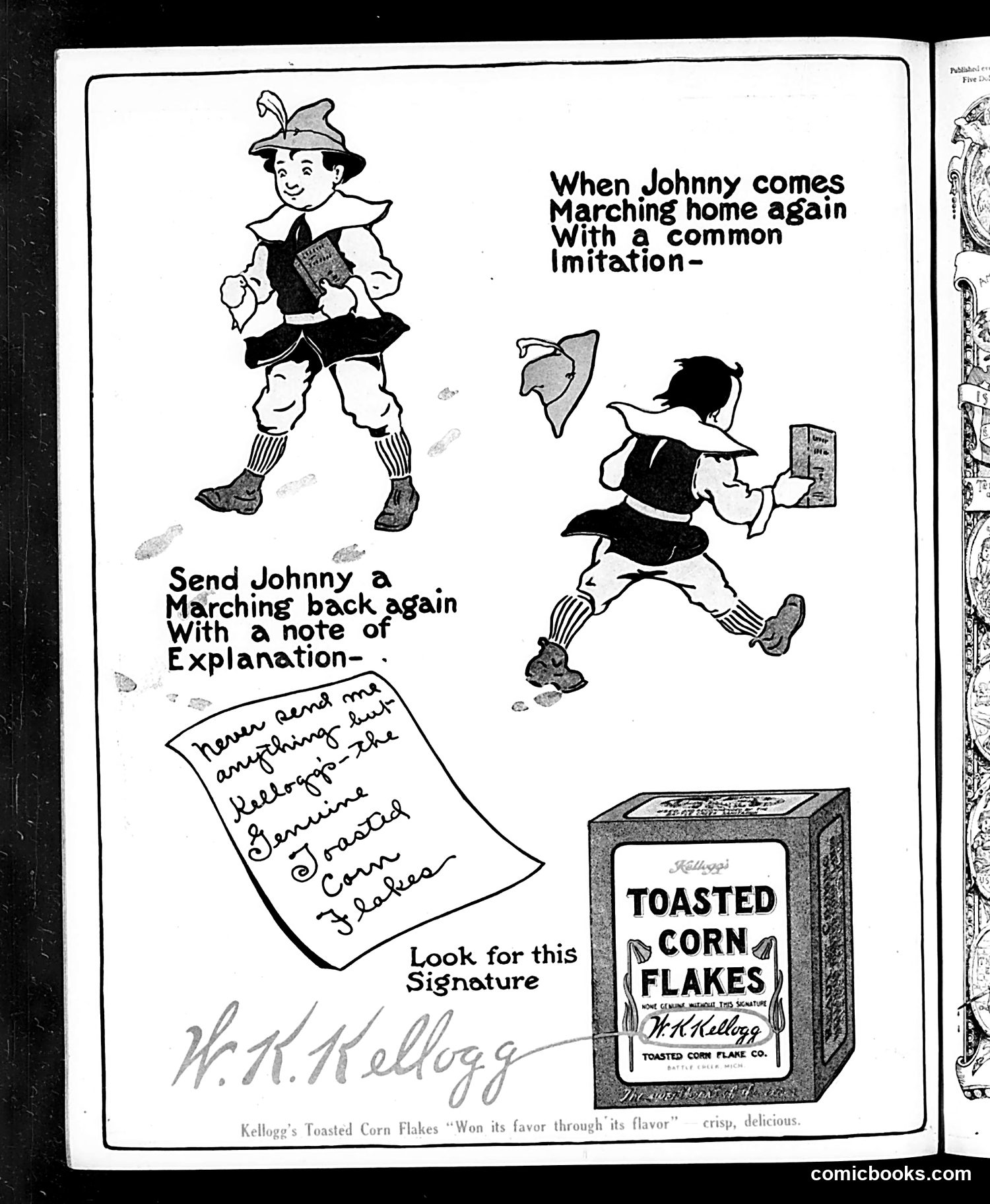
This is a vintage Kellogg's cereal advertisement disguised as humorous content. The comic shows a boy returning home with a "common imitation" cereal, prompting parents to send him back with an explanatory note. The joke targets counterfeit or generic breakfast cereals—common during this era when brands faced knockoff competition. The text encourages consumers to verify authenticity by checking W.K. Kellogg's signature on the box, positioning the branded product as the legitimate choice. The "Johnny Comes Marching Home" reference alludes to the Civil War-era song, creating patriotic nostalgia. This advertisement uses social pressure and brand loyalty messaging typical of early-to-mid twentieth-century marketing, positioning Kellogg's as the trustworthy, authentic option against inferior imitations.