
Life, 1908-08-20 · page 13 of 22
Life — August 20, 1908 — page 13: what you’re looking at
What you’re looking at
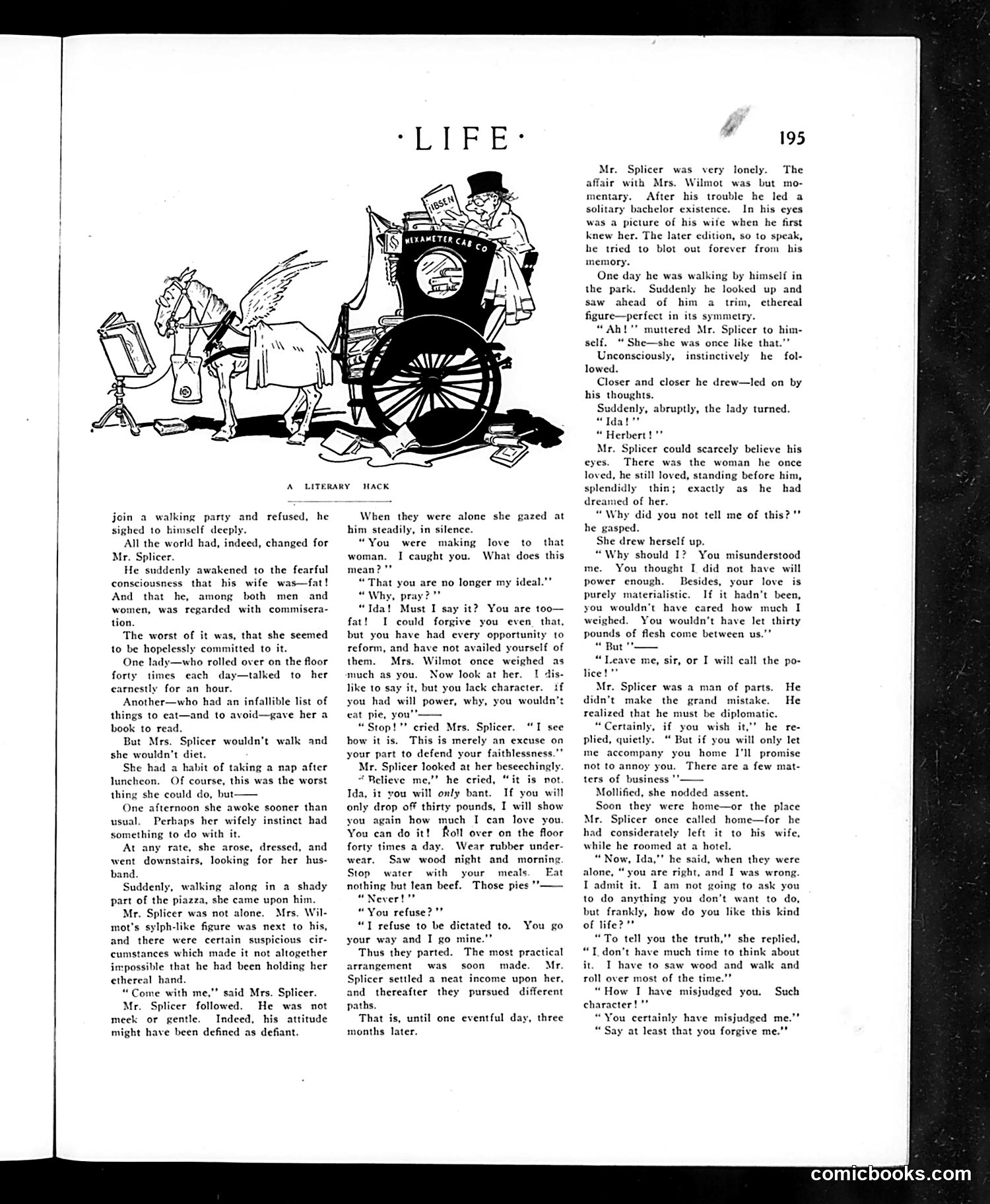
The cartoon depicts a disheveled writer being ejected from a horse-drawn cab labeled "LITERARY CAB." The figure is surrounded by scattered papers and manuscripts, with a caricatured cabbie gesturing dismissively. This satirizes struggling writers or journalists—the "literary hack"—portrayed as unsuccessful, impoverished, and dependent on precarious work. The horse-cab imagery suggests turn-of-the-century New York literary culture. The scattered papers emphasize failed writing projects. The accompanying story concerns Mr. Splicer, a man pursuing an affair, suggesting the cartoon's placement illustrates themes of personal failure and desperation—both romantic and professional—common to Life's satirical commentary on urban life and human folly.
📄 Transcribed text from this page (OCR, searchable)
Machine-transcribed from the original scan — historical spelling and the odd misread are preserved.
A LITERARY join a walking party and refused, he sighed to himself deeply. All the world had, indeed, changed for Mr. Splicer. He suddenly awakened to the fearful consciousness that his wife was—fat! And that he, among both men and women, was regarded with commisera- tion. ‘The worst of it was, that she seemed to be hopelessly committed to it. One lady—who rolled over on the floor forty each day—talked to her earnestly for an hour. Another—who had an infallible list of things to eat—and to avoid—gave her a book to read. But Mrs. Splicer wouldn't walk and she wouldn't diet. She had a habit of taking a nap after luncheon. Of course, this was the worst thing she could do, but— One afternoon she awoke sooner than usual. Perhaps her wifely instinct had something to do with it. At any rate, she arose, dressed, and went downstairs, looking for her hus- band Suddenly, walking along in a shady part of the piazza, she came upon him. Mr. Splicer was not alone. Mrs. Wil- mot's sylph-like figure was next to his, and there were certain suspicious cir- cumstances which made it not altogether impossible that he had been holding her ethereal hand. “Come with me,” times, said Mrs. Splicer. Mr. Splicer followed. He was not meck or gentle. Indced, his attitude might have been defined as defiant. S52 WOAMETER Cygne —— “48 co ¥ is ) MACK When they were alone she gazed at him steadily, in silence. “You were making woman. I caught you. mean? “That you are no longer my ideal, “Why, pray?” “Ida! Must I say it? You are too— fat! I could forgive you even. that, but you have had every opportunity to reform, and have not availed yourself of them. Mrs. Wilmot once weighed as much as you. Now look at her. I dis- like to say it, but you lack character. if you had will power, why, you wouldn't cat pie, you “Stop!” cried Mrs. Splicer. “I see how it is. This is merely an excuse on your part to defend your faithlessness.”’ Mr. Splicer looked at her beseechingly. Relieve me,” he cried, “it is not Ida, it you will only bant. If you will only drop of thirty pounds, I show you again how much I can love you You can do it! Roll over on the floor forty times a day. Wear rubber under- wear, Saw wood night and morning Stop water with your meals. Eat nothing but lean beef. Those pies "” “Never!” “You refuse?" “T refuse to be dictated to. your way and I go mine."” Thus they parted. The most practical arrangement soon made. Mr. Splicer settled a neat income upon her, and thereafter they pursued different paths. That is, until one eventful day, three months later. love to that What does this You go 4y 195 Mr. Splicer was very lonely. The affair with Mrs. Wilmot was but mo- mentary. After his trouble he led a solitary bachelor existence. In his eyes was a picture of his wife when he first knew her. The later edition, so to speak, he tried to blot out forever from his memory. One day he was walking by himself in the park. Suddenly he looked up and saw ahead of him a trim, ethereal figure—perfect in its symmetry. “ Ah!" muttered Mr. Splicer to him- self, ‘ She—she was once like that.’’ Unconsciously, instinctively he fol- lowed. Closer and closer he drew: his thoughts. Suddenly, abruptly, the lady turned. “Idat’ “ Herbert! "" Mr. Splicer could scarcely believe his eyes. There was the woman he once loved, he still loved, standing before him, splendidly thin; exactly as he had dreamed of her. Why did you not tell me of this?" asped. She drew herself up. “Why should I? You misunderstood You thought I did not have will power enough. Besides, your love is purely materialistic. If it hadn't been, you wouldn't have cared how much I weighed. You wouldn't have let thirty pounds of flesh come between us.’’ “ But" “Leave me, sir, or I will call the po- lice!” Mr. Splicer was a man of parts. He didn't make the grand mistake. He realized that he must be diplomatic. Certainly, if you wish it,’’ he re- plied, quietly. “ But if you will only let me accompany you home I'll promise not to annoy you. There are a few mat- ters of business Mollified, she nodded assent. Soon they were home—or the place Mr. Splicer once called home—for he had considerately left it to his wife, while he roomed at a hotel. “ Now, Ida,’ he said, when they were alone, “you are right, and I was wrong I admit it. I am not going to ask you to do anything you don’t want to do, but frankly, how do you like this kind of life? “To tell you the truth,’? she replied, “T.don't have much time to think about it. I have to saw wood and walk and roll over most of the time.’” “How I have misjudged you. character! You certainly have misjudged me. “Say at least that you forgive me. Jed on by he me. Such comicbooks.com