
Life, 1908-08-20 · page 4 of 22
Life — August 20, 1908 — page 4: what you’re looking at
What you’re looking at
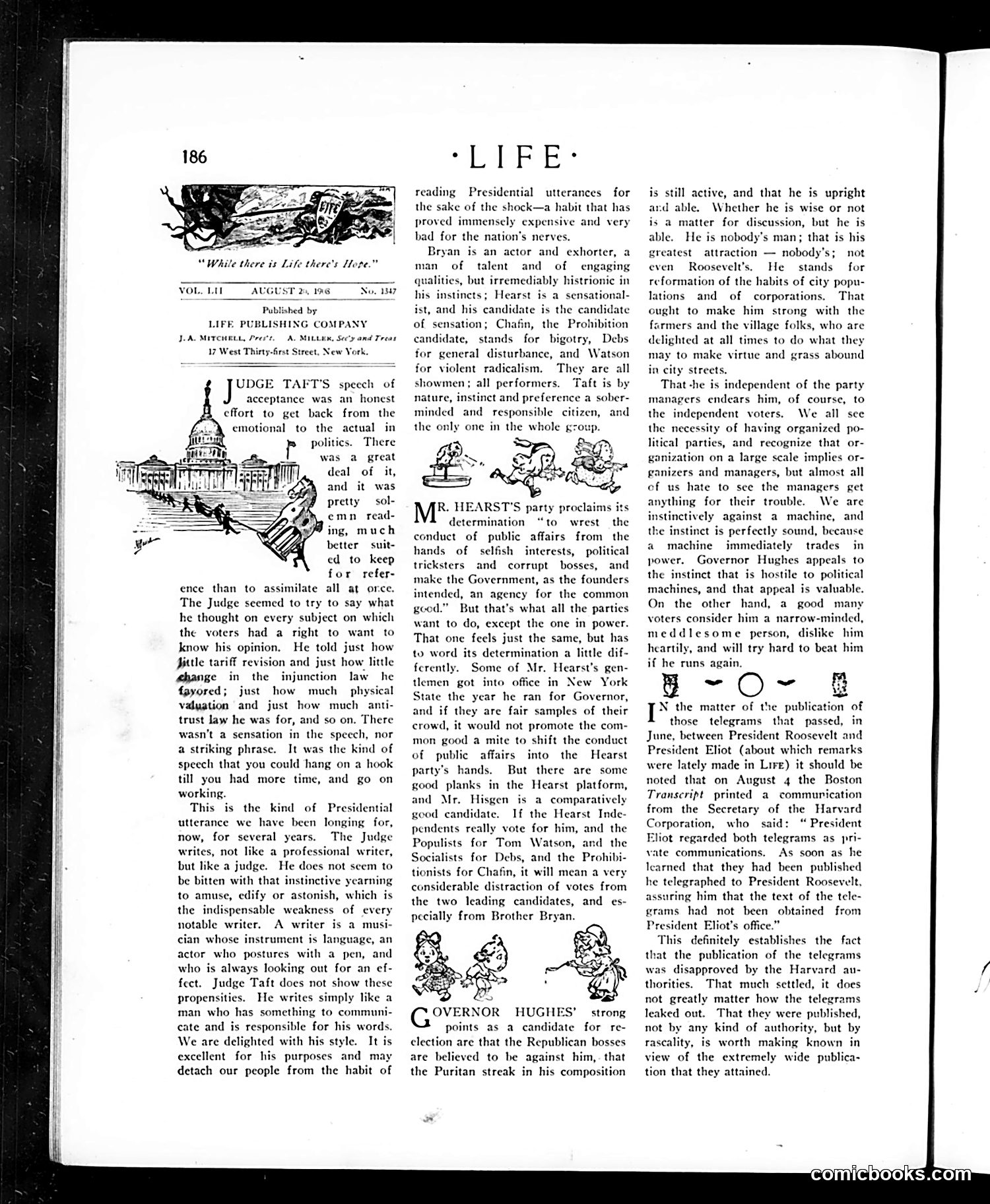
This page from *Life* magazine (August 2, 1908) satirizes the 1908 U.S. presidential race. The left cartoon shows Judge Taft accepting the Republican nomination—the text praises his judicial temperament and ability to communicate clearly without partisan bias, contrasting him favorably with more emotional politicians. The right section discusses William Jennings Bryan and William Hearst as Democratic candidates. The satire criticizes Hearst's party platform as populist posturing, sarcastically noting his supporters (Tom Watson, Eugene Debs, prohibitionists) represent such divergent interests that they'd fracture Democratic votes, benefiting the Republicans. The page's core joke: Hearst's coalition is so ideologically incompatible that his candidacy actually helps the opposition.
📄 Transcribed text from this page (OCR, searchable)
Machine-transcribed from the original scan — historical spelling and the odd misread are preserved.
“While there is Life there's Hove. VOL. Lil JeA. MITCHELL, Pret 17 West Thirty-first UDGE TAFT’S specch of acceptance was an honest effort to get back from the emotional to the actual in politics. There was a great deal of it, and it was pretty sol- emn_ read- ing, much better suit- ed to keep for refer- ence than to assimilate all at once. The Judge seemed to try to say what he thought on every subject on which the voters had a right to want to know his opinion. He told just how Jittle tariff revision and just how little ghange in the injunction law he fayored; just how much physical valuation and just how much anti- trust law he was for, and so on. There wasn't a sensation in the speech, nor a striking phrase. It was the kind of speech that you could hang on a hook till you had more time, and go on working. This is the kind of Presidential utterance we have been longing for, now, for several years. The Judge writes, not like a professional writer, but like a judge. He does not seem to be bitten with that instinctive yearning to amuse, edify or astonish, which is the indispensable weakness of every notable writer. A writer is a musi- cian whose instrument is language, an actor who postures with a pen, and who is always looking out for an ef- fect. Judge Taft does not show these propensities. He writes simply like man who has something to communi cate and is responsible for his words. We are delighted with his style. It is excellent for his purposes and may detach our people from the habit of #1L (PE * reading Presidential utterances for the sake of the shock—a habit that has proved immensely expensive and very bad for the nation’s nerves. Bryan is an actor and exhorter, a man of talent and of engaging qualities, but irremediably histrionic in his instincts; Hearst is a sensational- st, and his candidate is the candidate of sensation; Chafin, the Prohibition candidate, stands for bigotry, Debs for general disturbance, and Watson for violent radicalism. They are all showmen; all performers. Taft is by nature, instinct and preference a sober- minded and responsible citizen, and the only one in the whole group. M* HEARST'S party proclaims its determination “to wrest the conduct of public affairs from the hands of selfish interests, political tricksters and corrupt bosses, and make the Government, as the founders intended, an agency for the common good.” But that’s what all the parties want to do, except the one in power. That one feels just the same, but has to word its determination a little dif- ferently. Some of Mr. Hearst’s gen- tlemen got into office in New York State the year he ran for Governor, and if they are fair samples of their crowd, it would not promote the com- mon good a mite to shift the conduct of public affairs into the Hearst party’s hands. But there are some good planks in the Hearst platform, and Mr. Hisgen is a comparatively geod candidate. If the Hearst Inde- pendents really vote for him, and the Populists for Tom Watson, and the Socialists for Debs, and the Prohibi- tionists for Chafin, it will mean a very considerable distraction of votes from the two leading candidates, and es- pecially from Brother Bryan. OVERNOR HUGHES’ - strong points as a candidate for re- election are that the Republican bosses are believed to be against him, that the Puritan streak in his composition is still active, and that he is upright and able. Whether he is wise or not is a matter for discussion, but he i able. He is nobody's man; that is his greatest attraction — nobody's; not even Roosevelt’s. He stands for reformation of the habits of city popu- lations and of corporations. That ought to make him strong with the farmers and the village folks, who are delighted at all times to do what they may to make virtue and grass abound in city streets, That -he is independent of the party managers endears him, of course, to the independent voters. We all see the necessity of having organized po- litical parties, and recognize that or- ganization on a large scale implies or- ganizers and managers, but almost all of us hate to see the managers get anything for their trouble. We are instinctively against a machine, and the instinct is perfectly sound, because a machine immediately trades in power. Governor Hughes appeals to the instinct that is hostile to political machines, and that appeal is valuable. On the other hand, a good many voters consider him a narrow-minded, meddlesome person, dislike him heartily, and will try hard to beat him if he runs again. B-O~ B I the matter of the publication of those telegrams that passed, in June, between President Roosevelt and President Eliot (about which remarks were lately made in Lire) it should be noted that on August 4 the Boston Transcript printed a communication from the Secretary of the Harvard Corporation, who said: “ President Eliot regarded both telegrams as pri- vate communications. As soon as he learned that they had been published he telegraphed to President Roosevelt, assuring him that the text of the tele- grams had not been obtained from President Eliot's office.” This definitely establishes the fact that the publication of the telegrams was disapproved by the Harvard au- thorities. That much settled, it does not greatly matter how the telegrams leaked out. That they were published, not by any kind of authority, but by rascality, is worth making known in view of the extremely wide publica- tion that they attained.