
A complete issue · 20 pages · 1908
Life — April 9, 1908
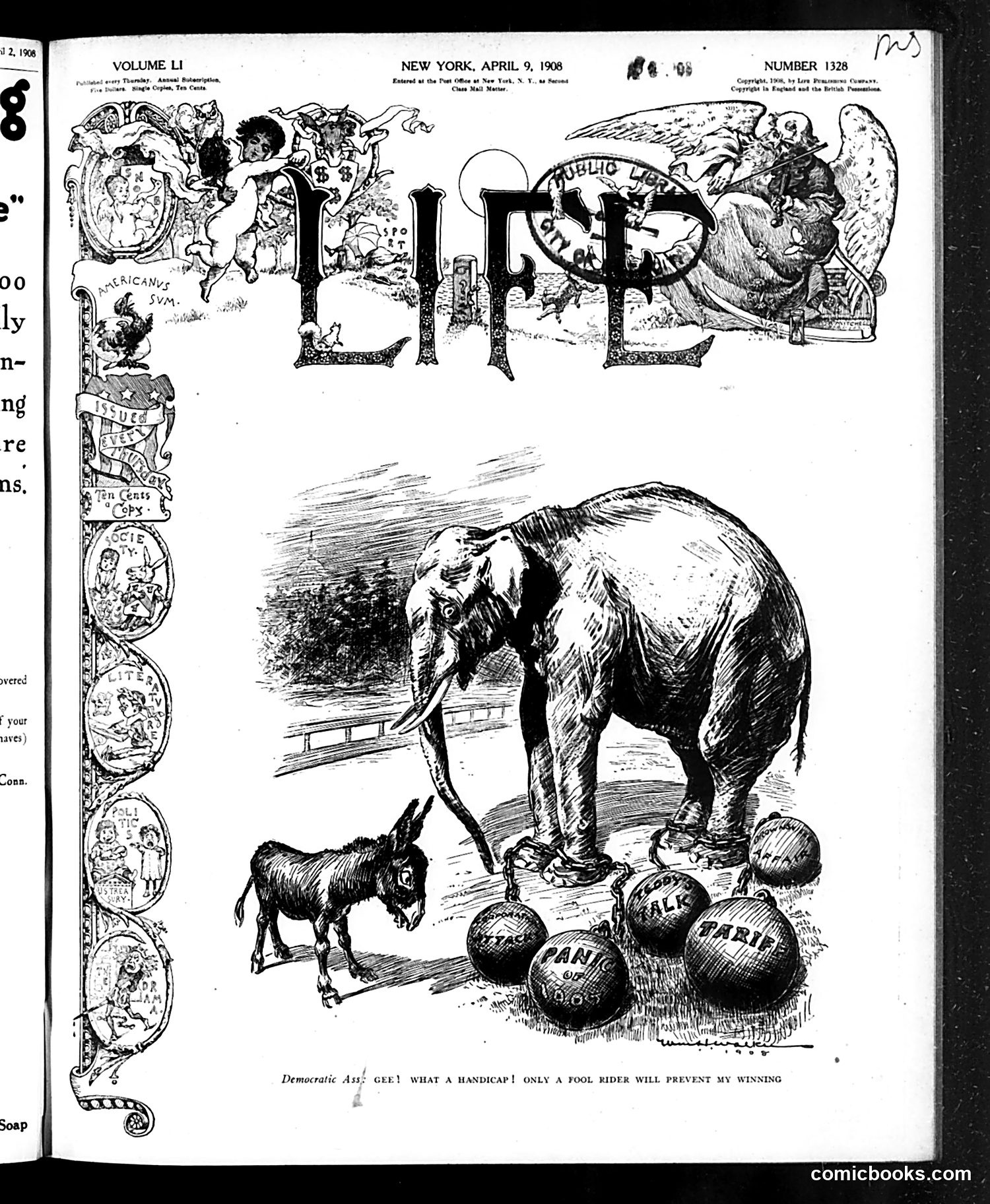
This cartoon satirizes the 1908 U.S. presidential race, depicting an elephant (Republican Party symbol) tied to a small donkey (Democratic Party symbol) by a rope. The elephant is weighed down by large balls labeled "PANIC" and "HARD TIMES," referencing the financial crisis of 1907. The caption reads: "Democratic Ass! Gee! What a handicap! Only a fool rider will prevent my winning." The cartoon suggests Republicans blame Democrats for economic troubles, claiming the GOP elephant could easily win despite being burdened by economic hardship—if only incompetent Democratic leadership doesn't interfere. It's partisan commentary on how each party weaponized the financial panic during the election.
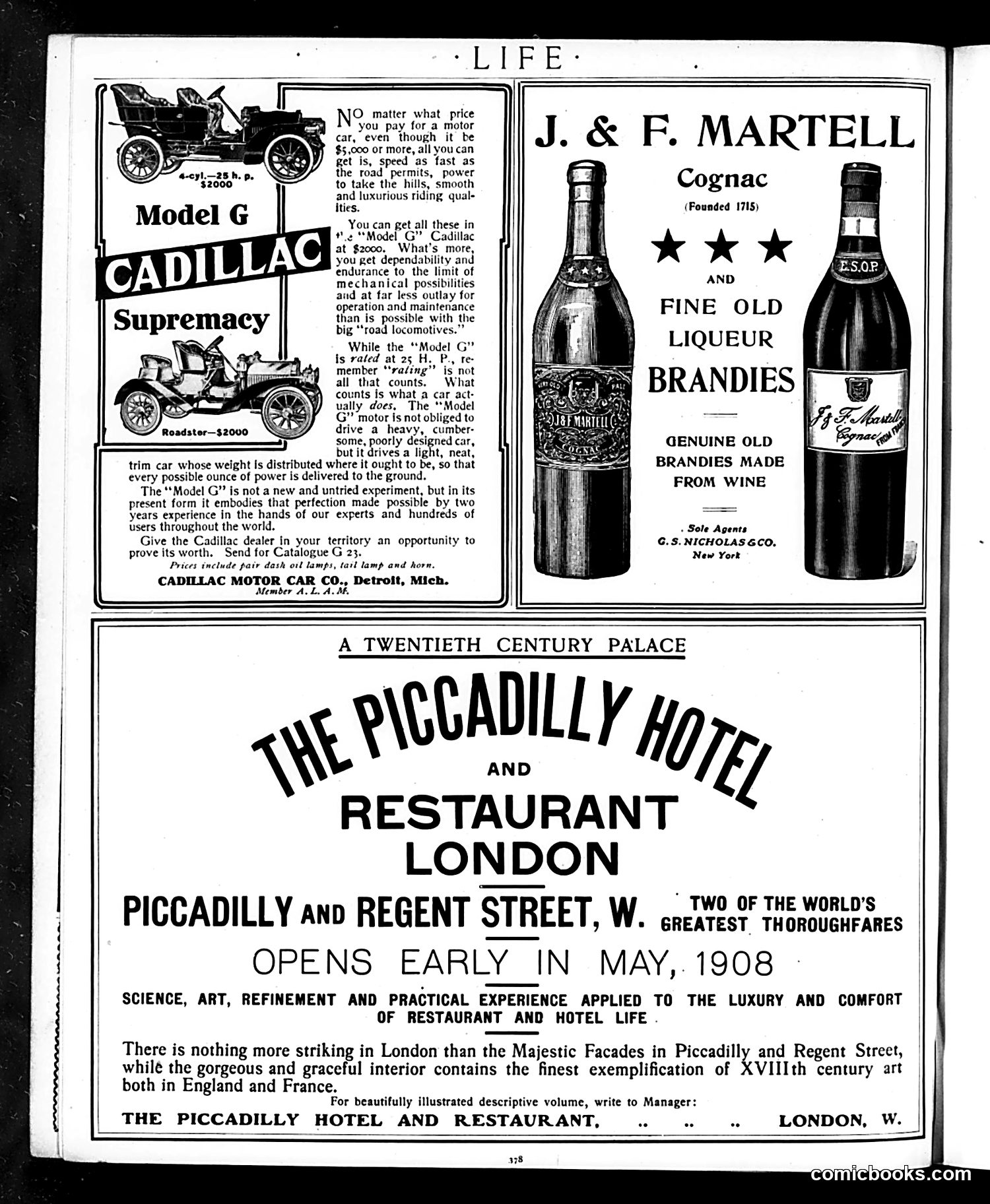
This page contains **three advertisements, not political cartoons or satire**. The top-left advertises the **Cadillac Model G automobile**, emphasizing its power and luxury for $5,000+. The text compares it favorably to other "road locomotives," suggesting fierce competition in the early auto market. Top-right advertises **J. & F. Martell Cognac** (founded 1715), a French brandy sold in New York. The large bottom advertisement announces the opening of **The Piccadilly Hotel and Restaurant in London** (May 1908), located on Piccadilly and Regent Street. It emphasizes luxury, combining "science, art, refinement and practical experience" for high-end clientele. All three target wealthy readers—appropriate for *Life* magazine's affluent audience circa 1908.
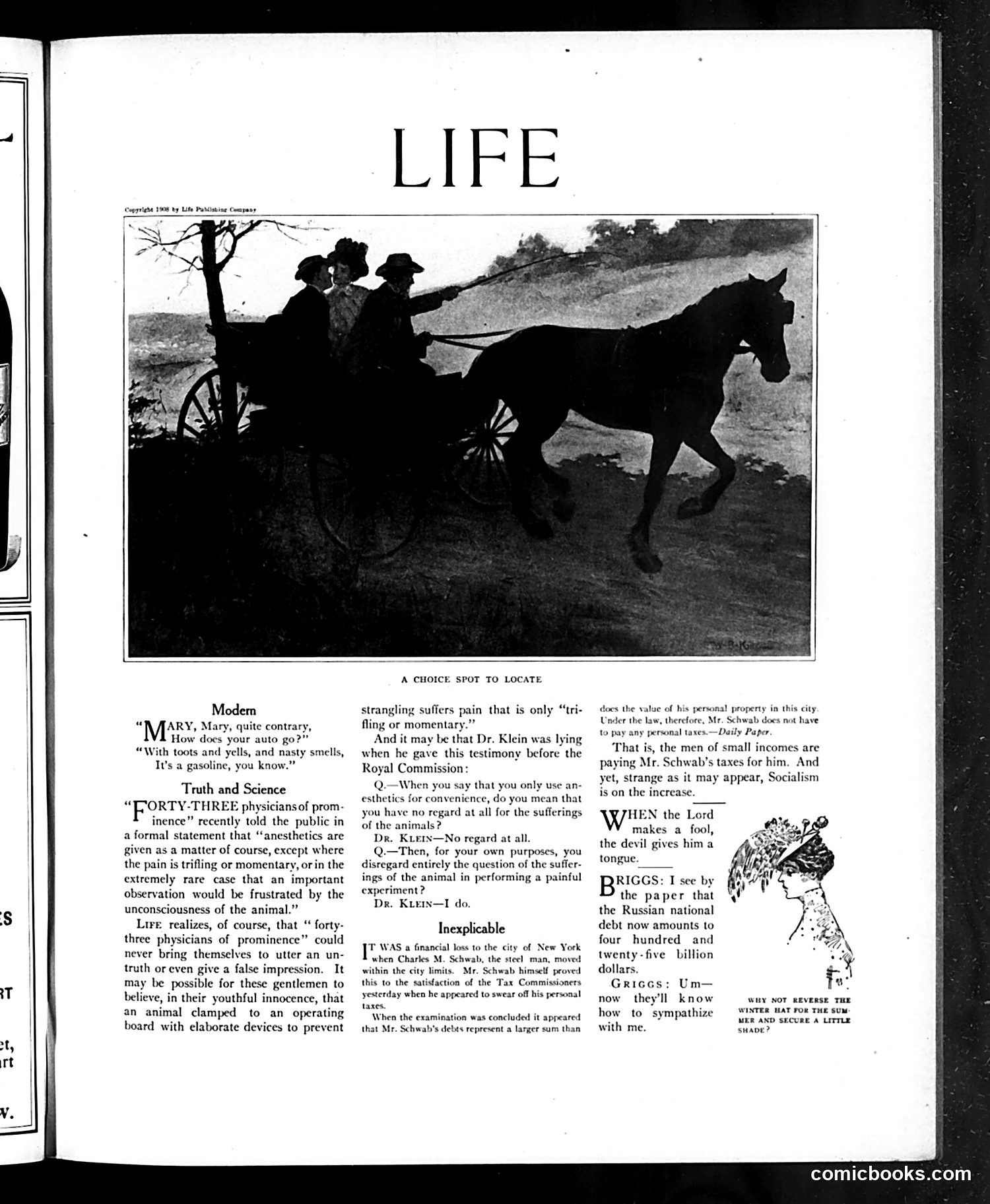
This Life magazine page contains satirical commentary on early 1900s American social issues. **Main Image:** "A Choice Spot to Locate" shows a silhouetted horse-drawn carriage on a rural road—likely satirizing where wealthy New Yorkers might establish summer homes or escape the city. **"Modern Mary":** A humorous dialogue mocking automobile enthusiasts who claim cars run on minimal resources ("gasoline, you know"), poking fun at early auto culture exaggeration. **"Truth and Science":** A longer satirical piece criticizing vivisection (animal experimentation) by Dr. Klein, questioning physicians' claims that animal testing causes negligible suffering. The piece advocates for animal welfare while mocking scientific justifications for painful experiments. **"Inexplicable":** Brief commentary on Charles M. Schwab's tax evasion case in New York, questioning how debts supposedly exceed assets. The page overall critiques wealthy privilege, scientific rationalization of cruelty, and tax fraud.
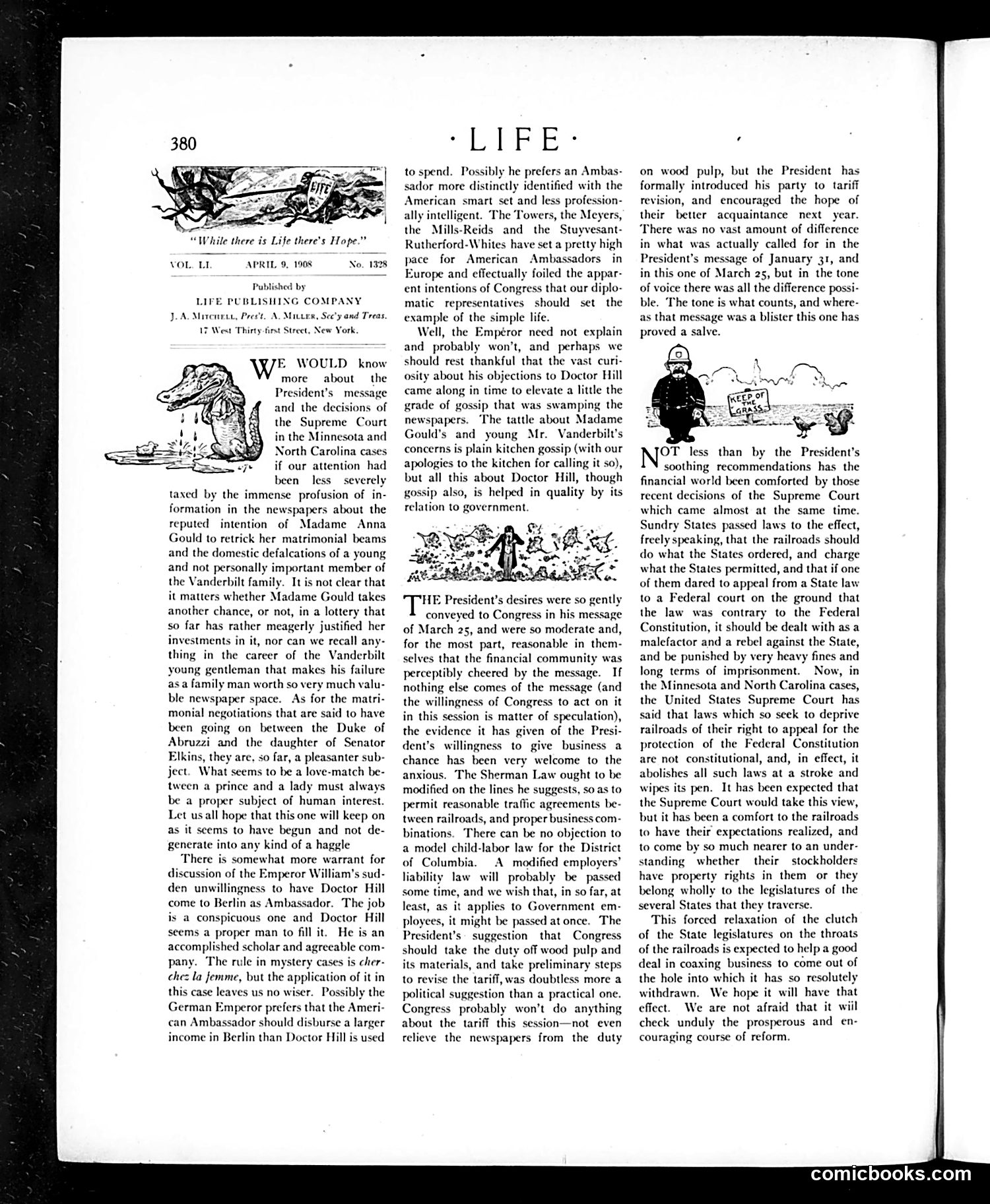
This page contains editorial commentary on President Theodore Roosevelt's message to Congress regarding financial and railroad regulation. The text discusses Roosevelt's moderate proposals favorably, noting they reassured the financial community while addressing reform concerns. The small cartoon at top left appears to show a figure in water, captioned "While there is Life there's Hope"—likely a visual pun on the magazine's name relating to economic recovery prospects. The page also addresses the Madame Anna Gould matrimonial scandal, dismissing it as gossip unworthy of serious attention compared to substantive policy matters. The editorial tone suggests approval of Roosevelt's balanced approach to railroad regulation and tariff reform, viewing his proposals as pragmatic rather than radical.
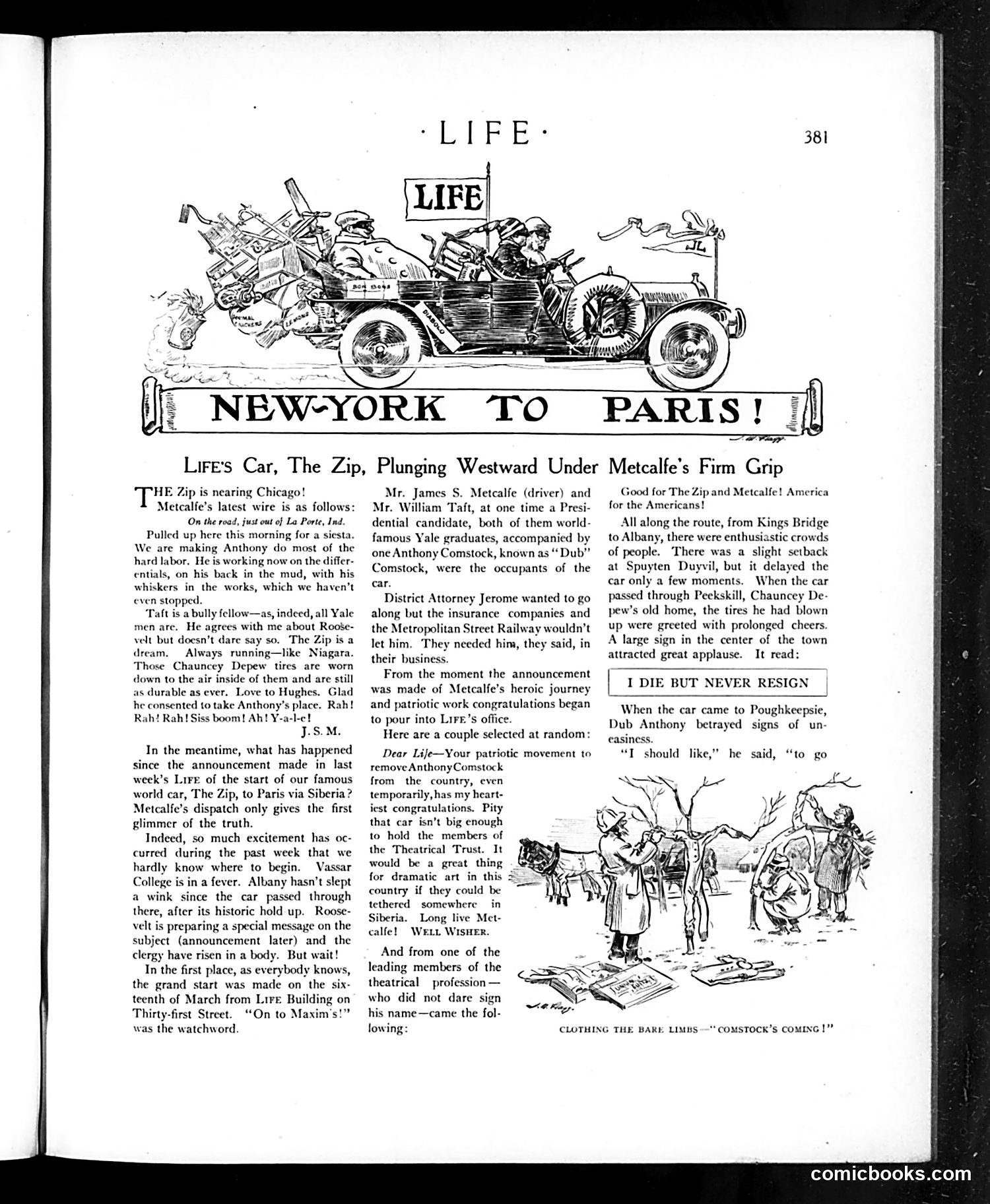
This Life magazine page satirizes a real cross-country automobile journey. The main illustration shows "The Zip," a car overloaded with supplies, traveling from New York to Paris (humorously labeled, as the car clearly cannot cross the ocean). The article describes James S. Metcalfe's actual expedition, mentioning real people including William Taft (a former Presidential candidate and Yale graduate) and Anthony Comstock (a famous vice crusader). The text humorously documents the car's progress through upstate New York toward Chicago, noting enthusiastic public receptions and humorous incidents. The bottom illustration captioned "Clothing the Bare Limbs—'Comstock's Coming!'" appears to be a separate joke about Comstock's puritanical reputation, showing figures hurriedly covering themselves—a visual pun on his censorious nature.
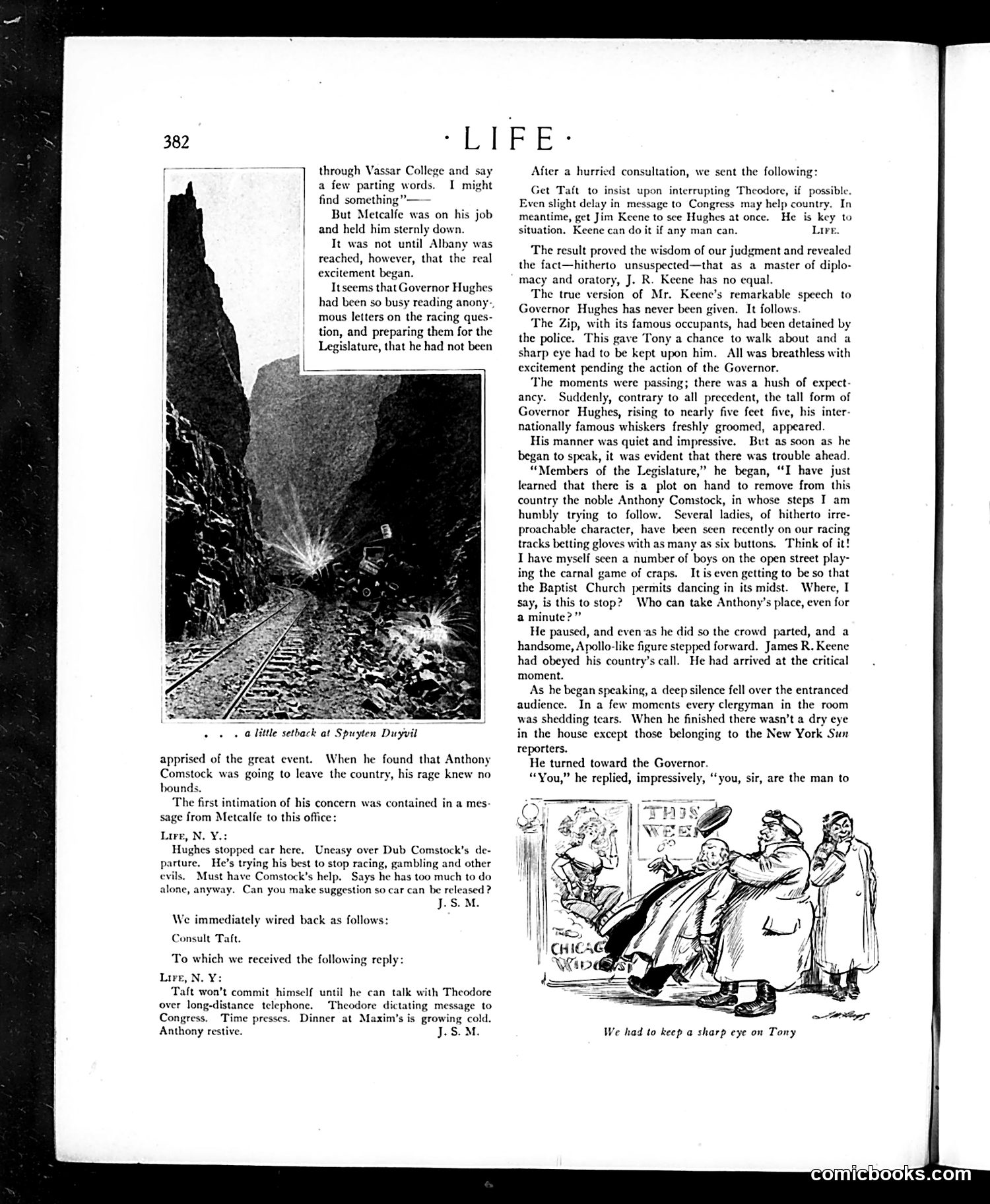
This page satirizes a political crisis involving Governor Hughes and Anthony Comstock. The text describes Hughes stopping a car, concerned about Comstock's plans to leave the country. References mention Comstock's involvement with racing, gambling, and other "evils," suggesting moral crusade activities. The bottom illustration labeled "We had to keep a sharp eye on Tony" depicts what appears to be a confrontation or monitoring situation, likely satirizing Comstock's self-appointed role as moral guardian. The page's humor derives from the tension between Hughes's political authority and Comstock's moral crusading—suggesting Comstock's interventions in public matters required government oversight. Without the specific historical moment, the exact political stakes remain unclear, but the satire targets Comstock's moral zealotry as requiring restraint.
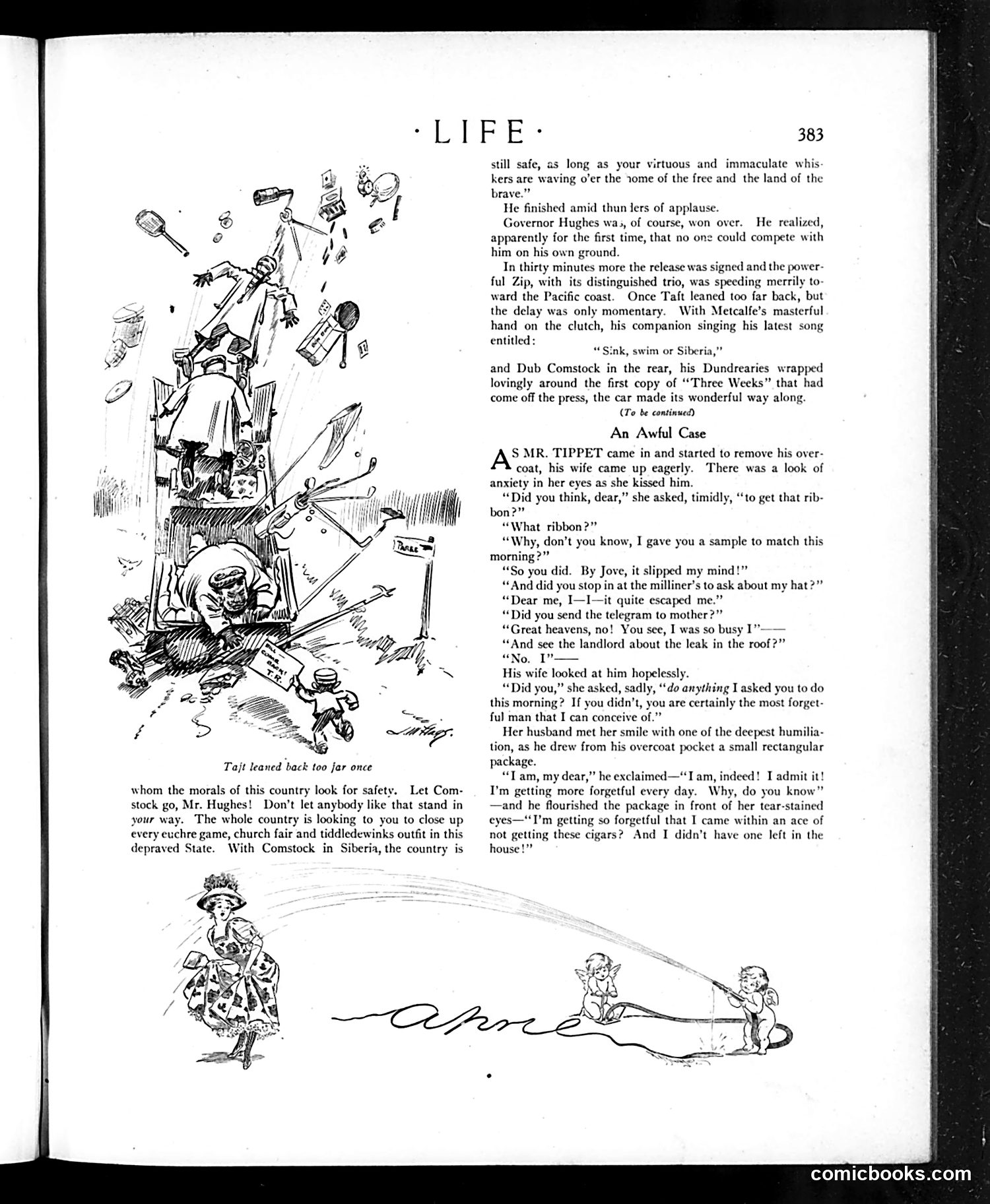
This page contains two separate satirical pieces: **Upper cartoon:** Depicts a chaotic automobile crash with passengers and luggage scattered about. The caption "Taft leaned back too far once" references President William Howard Taft, likely mocking his weight or physical appearance through the joke that leaning back caused the vehicle's collapse. This reflects the popular contemporary ridicule of Taft's size. **Lower section:** A short story titled "An Awful Case" about Mr. Tippet, a forgetful husband who repeatedly fails to complete errands his wife requests. The satire targets domestic incompetence and absent-mindedness, a common theme in early 20th-century humor about married life. Both pieces exemplify Life magazine's typical blend of political caricature and domestic comedy.
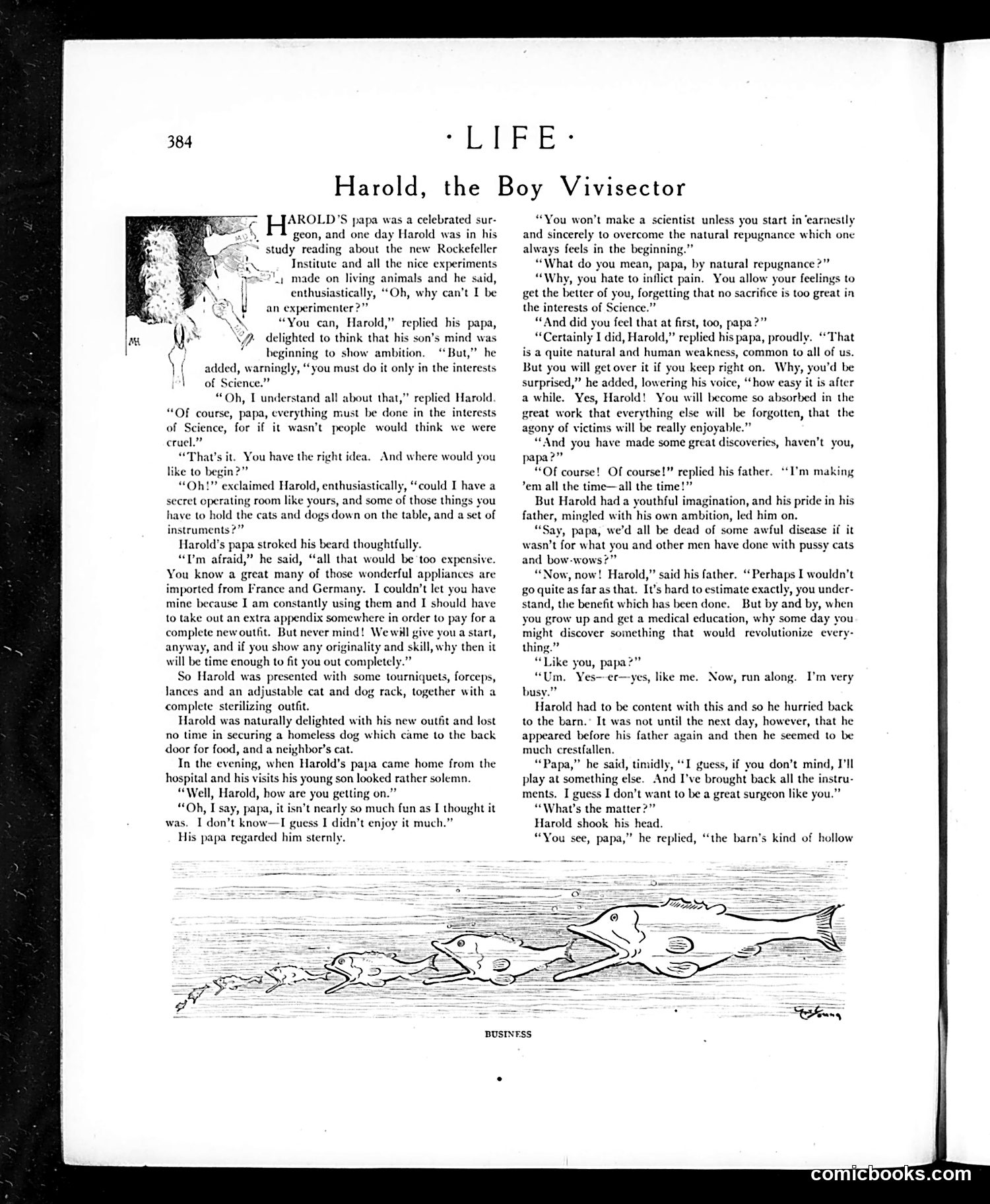
This is a satirical story about a young boy whose father, a surgeon, encourages him to become a scientist. Harold becomes enthusiastic about conducting experiments on living animals. His father initially supports this as "natural" scientific curiosity, though he expresses concerns about expense. The satire targets parental ambition and the justification of animal cruelty in the name of scientific progress. Harold's father argues that overcoming "natural repugnance" to inflicting pain is necessary for scientific advancement—a rationalization the story presents as morally questionable. The cartoon at page bottom (showing prone figures) likely illustrates the consequences of such "vivisection." The piece satirizes how adults rationalize children's cruelty by framing it as educational aspiration.
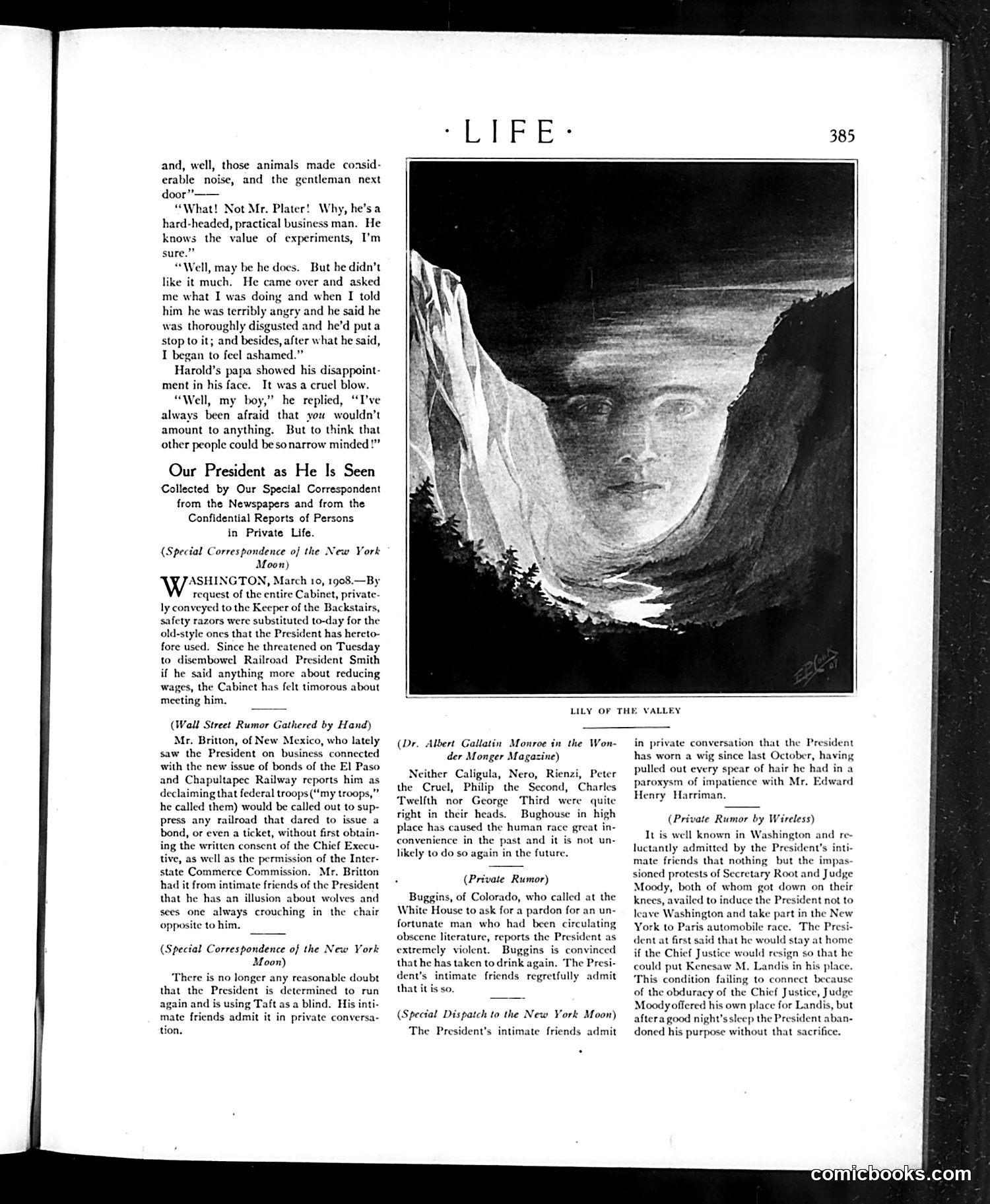
This page contains gossip and rumor about President Theodore Roosevelt's private life and habits, typical of Life's satirical coverage. The featured photograph shows "Lily of the Valley," a scenic landscape. The text reports various rumors about Roosevelt collected from newspapers and confidential sources: - A story about Roosevelt threatening Railroad President Smith over wage discussions - Gossip that Roosevelt has worn a wig since October - Claims that Roosevelt's friends are pressuring him to leave politics and pursue an automobile race to Paris - Reports questioning whether Roosevelt has resumed drinking The page exemplifies early 1900s political satire through printed rumor and innuendo about a sitting president's personal habits, appearance, and decision-making—content that would face modern scrutiny regarding accuracy and propriety.
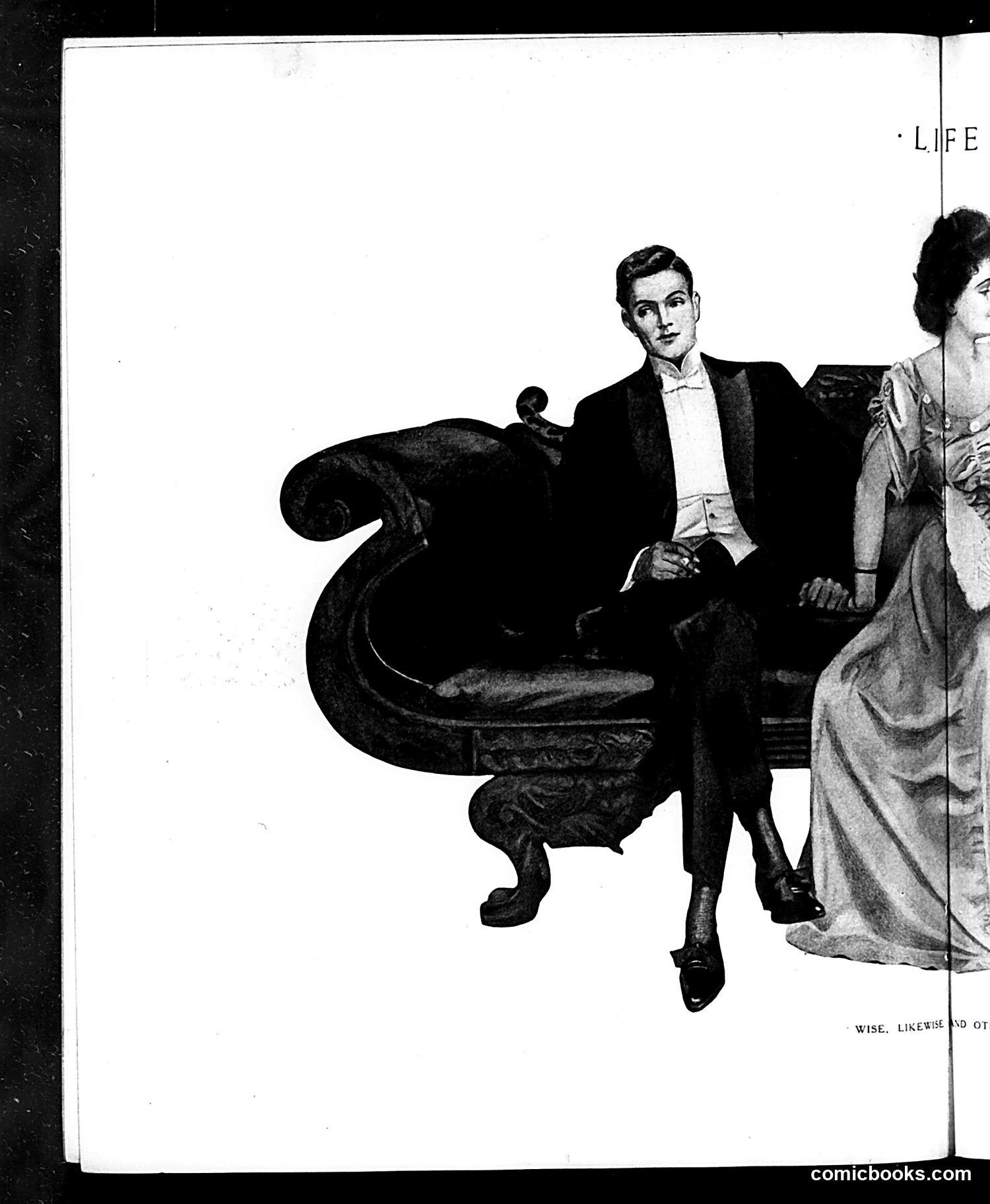
This appears to be a satirical illustration from *Life* magazine showing a well-dressed man in formal evening wear (tuxedo) seated on an ornate classical chair or settee. A woman in period dress is visible on the right edge. The partially visible caption reads "WISE, LIKEWISE [?]" though the full text is cut off. Without complete caption text, the specific satire is unclear. The imagery suggests commentary on upper-class social pretension or romantic/courtship behavior among the wealthy elite, a common *Life* magazine subject. The man's studied pose and formal attire may mock fashionable society manners or affected sophistication. The classical furniture reinforces themes of old-money pretension. The specific figure and precise satirical target remain uncertain without the complete caption.
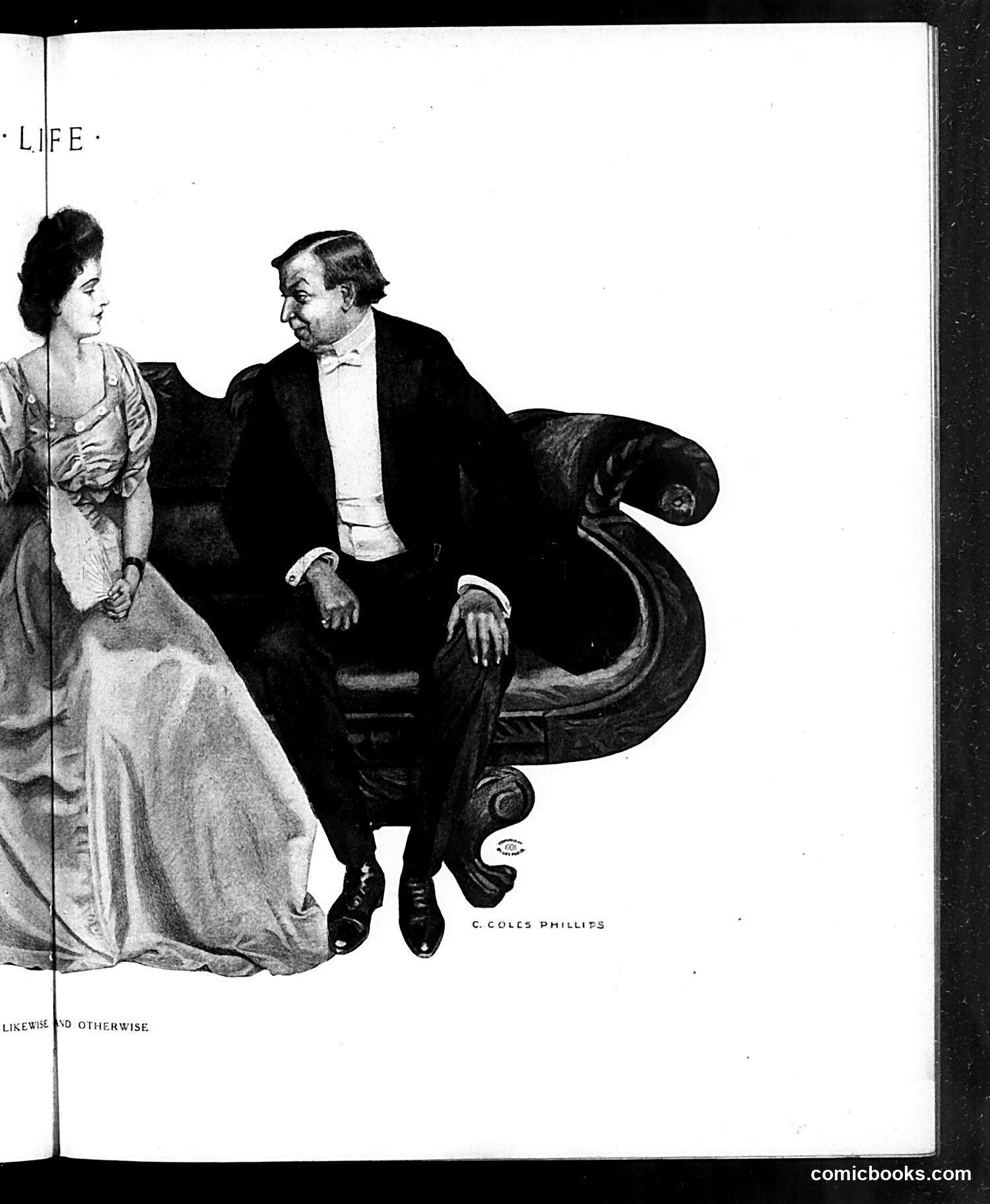
This appears to be a social satire illustration from *Life* magazine by artist C. Coles Phillips. The image shows a well-dressed man seated on an ornate chair, engaged with a woman in formal evening wear. The title "LIFE" appears at top left, with partial text visible reading "LIKEWISE AND OTHERWISE" at bottom. The illustration likely satirizes upper-class social interactions or courtship rituals of the early 20th century. The formal attire, luxurious furniture, and body language suggest commentary on genteel society conduct—possibly mocking pretension, romantic conventions, or class posturing typical of *Life* magazine's satirical approach. However, without complete visible text or clearer historical context on the page, the specific social target of this satire remains unclear.
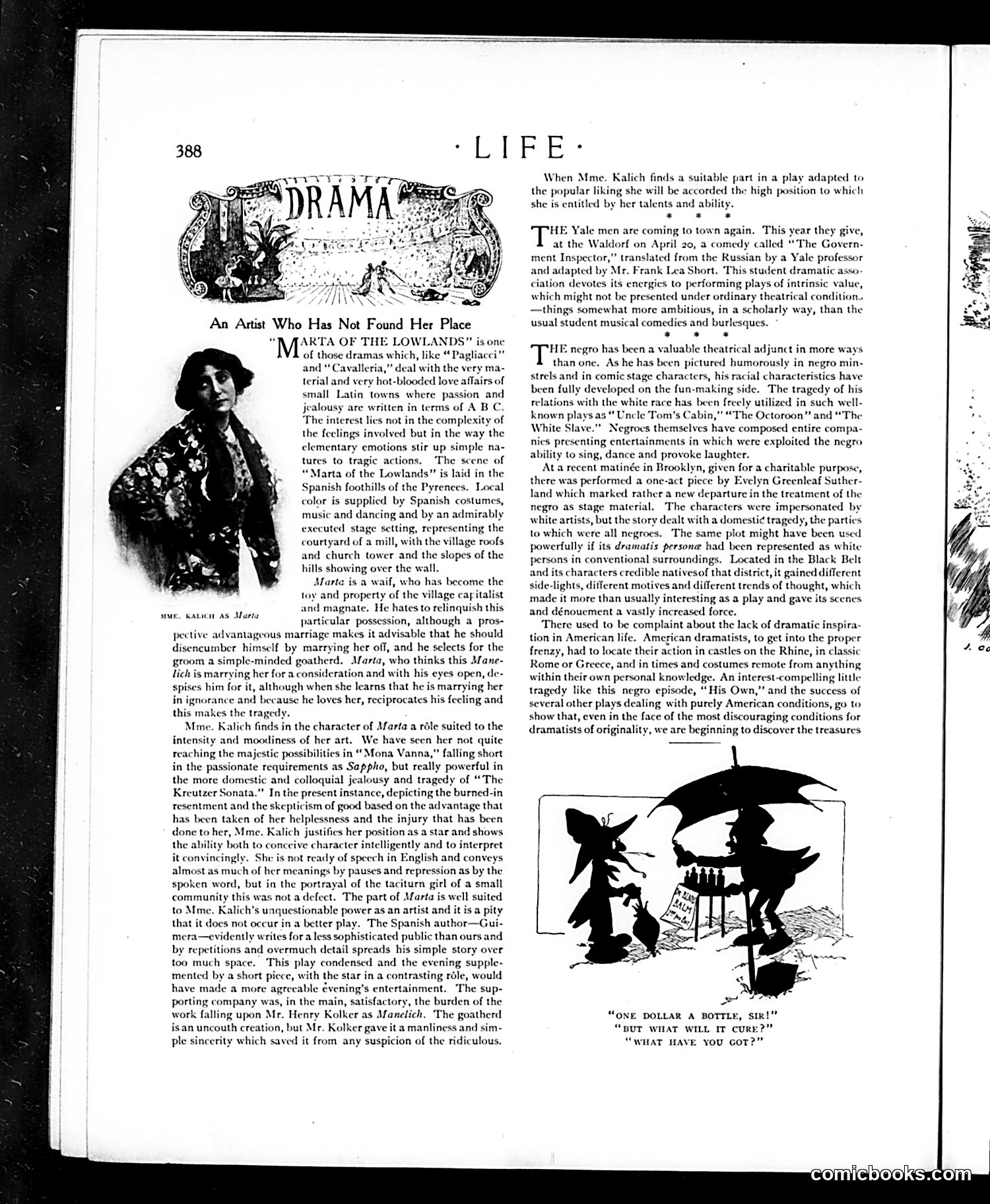
This drama section reviews theatrical productions. The main article discusses "Marta of the Lowlands," praising actress Mme. Kalich's performance in a Spanish play set in the Pyrenees featuring passion and jealousy. The text also covers the Yale Dramatic Association's performance of "The Government Inspector" (adapted from Russian), and discusses the theatrical use of Black performers and characters—noting how African American actors have appeared in plays dealing with domestic tragedy, though typically in stereotypical roles. The cartoon at bottom shows silhouetted figures with dialogue: "One dollar a bottle, sir!" / "But what will it cure?" / "What have you got?" This appears to be satirical commentary on patent medicine or quack remedies—a common target of Life magazine's satire.
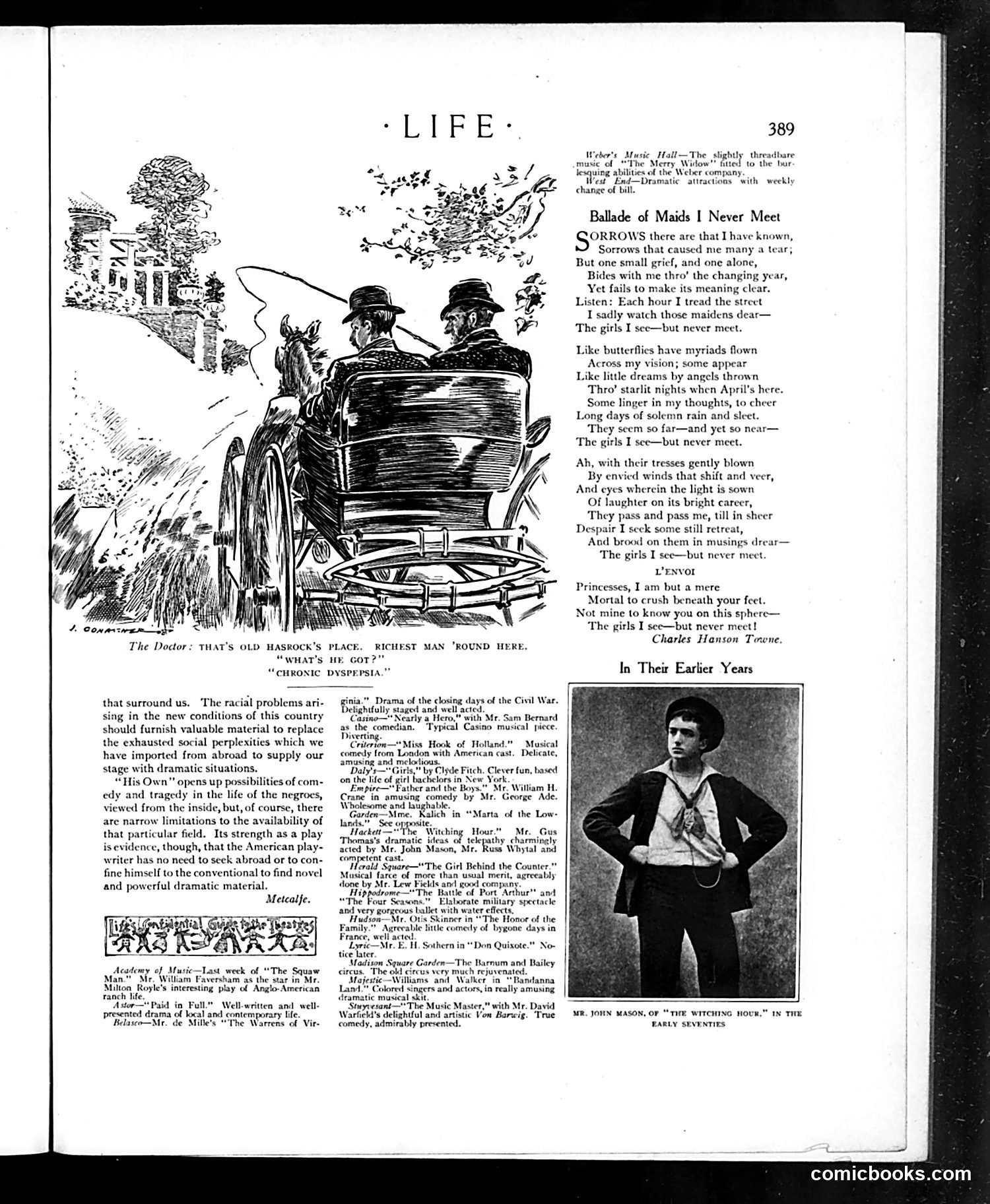
The main cartoon depicts two well-dressed men in a carriage with a horse, captioned "The Doctor: THAT'S OLD HARSOCK'S PLACE. RICHEST MAN 'ROUND HERE. 'WHAT'S HE GOT?' 'CHRONIC DYSPEPSIA.'" **The satire:** The joke mocks wealthy industrialists of the Gilded Age era. Despite possessing material riches and property ("old Harsock's place"), the richest man suffers from chronic dyspepsia (severe indigestion)—suggesting that wealth cannot buy health or happiness. The implication is that the stress of accumulating and maintaining great fortunes creates physical ailments, undermining the supposed benefits of being wealthy. This reflects period anxieties about the health costs of capitalist excess. The page also includes poems and theatrical reviews unrelated to the cartoon.
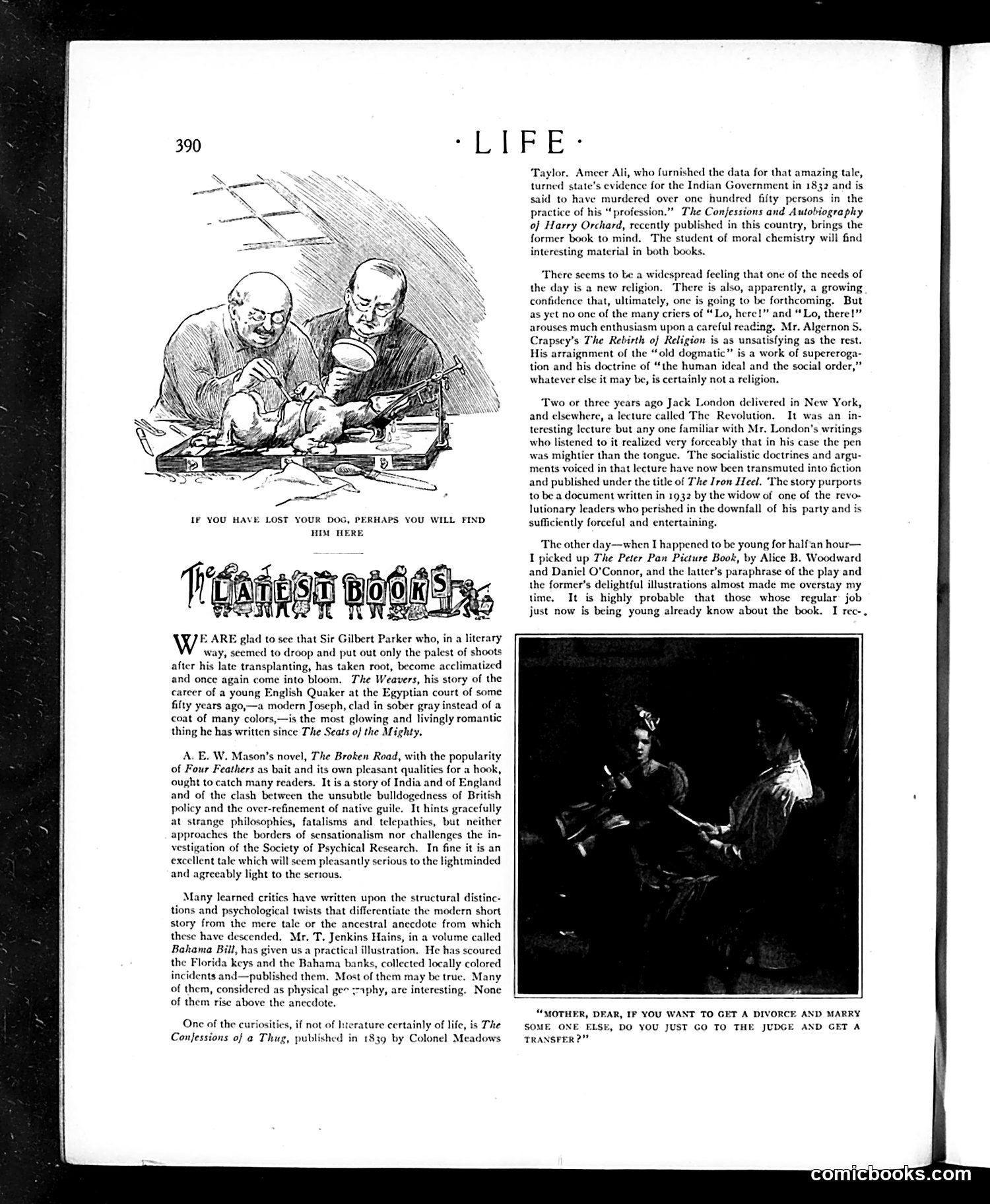
This page from *Life* magazine contains **book reviews and literary criticism**, not political cartoons per se, though it employs satirical commentary. The **top cartoon** shows two men examining something small, captioned "If you have lost your dog, perhaps you will find him here" with "The Latest Books" below—a joke suggesting newly published books are so negligible they'd appeal only to someone looking for a lost dog. The text mocks several contemporary authors and works: Gilbert Parker's renewed literary productivity, A.E.W. Mason's adventure novels, and T. Jenkins Hains's collection of anecdotal stories dismissed as mere "anecdotes" lacking literary merit. The piece also critiques the era's apparent hunger for "new religions," referencing Algernon Crapsey's *The Rebirth of Religion* as unsatisfying. Jack London receives backhanded praise: his written fiction of socialist ideas (*The Iron Heel*) surpasses his spoken lectures on revolution. The **bottom photograph** appears unrelated, showing what seems to be a domestic scene with accompanying caption about divorce procedures. Overall, the page reflects early 20th-century literary gatekeeping and intellectual skepticism toward popular authors.
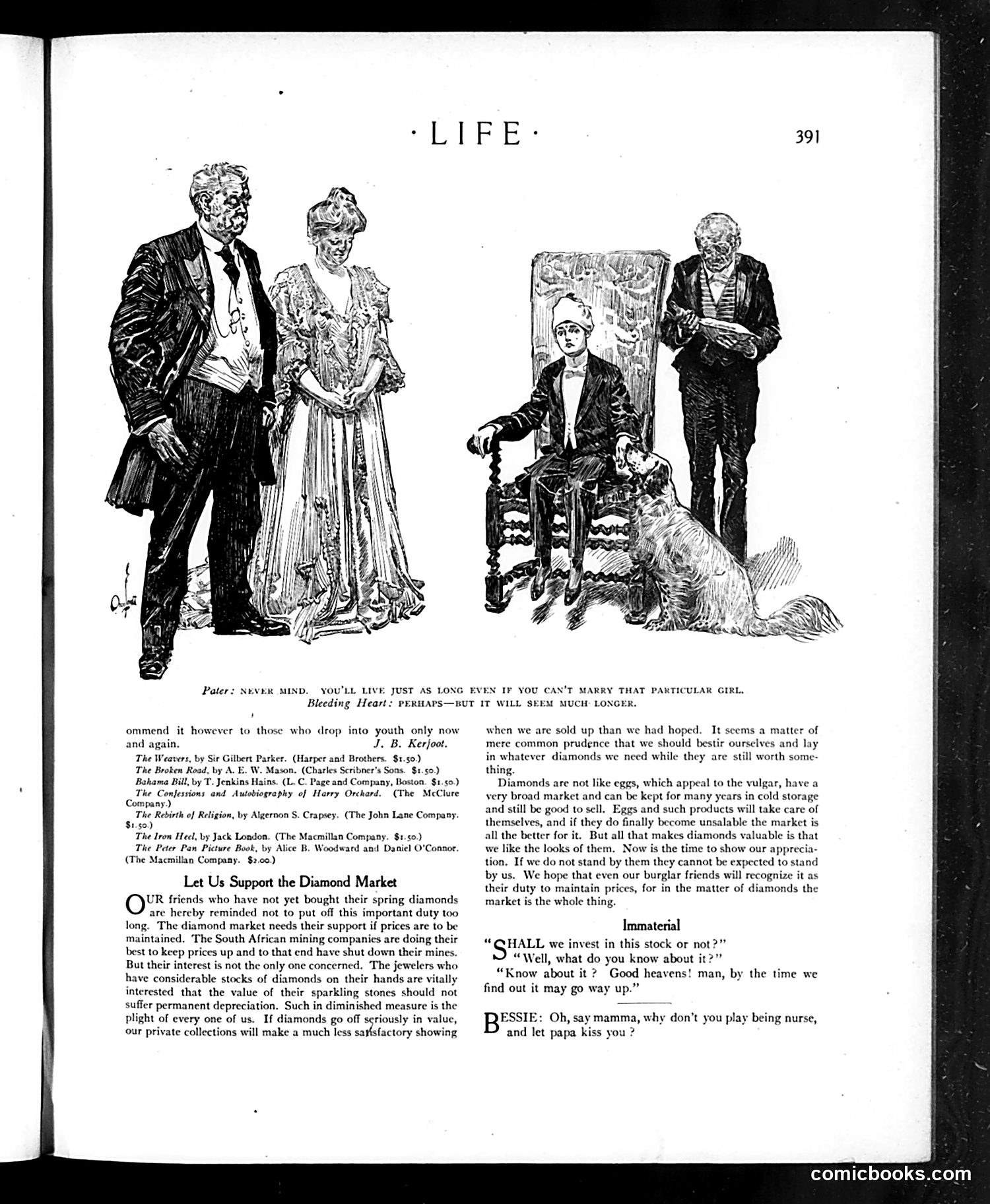
The top illustration shows a domestic scene with two couples: a stern father ("Pater") advising a lovesick young man ("Bleeding Heart") that he'll survive unrequited love. The joke is the young man's retort that waiting will feel interminable—satirizing romantic melodrama and youthful emotional intensity. The main text section "Let Us Support the Diamond Market" is **satirical social commentary**. It sarcastically urges readers to buy diamonds as a civic duty, claiming the market needs support because South African mining companies have shut down mines to maintain artificial prices. The satire mocks: - **Conspicuous consumption** among the wealthy - **Cartels and market manipulation** by diamond producers - The absurdity of treating luxury goods as moral obligations - The self-interest disguised as prudence (even "burglar friends" should maintain prices) The final jokes about stock investment and a child's innocent suggestion complete the page's theme of satirizing adult pretense and questionable financial/moral reasoning.
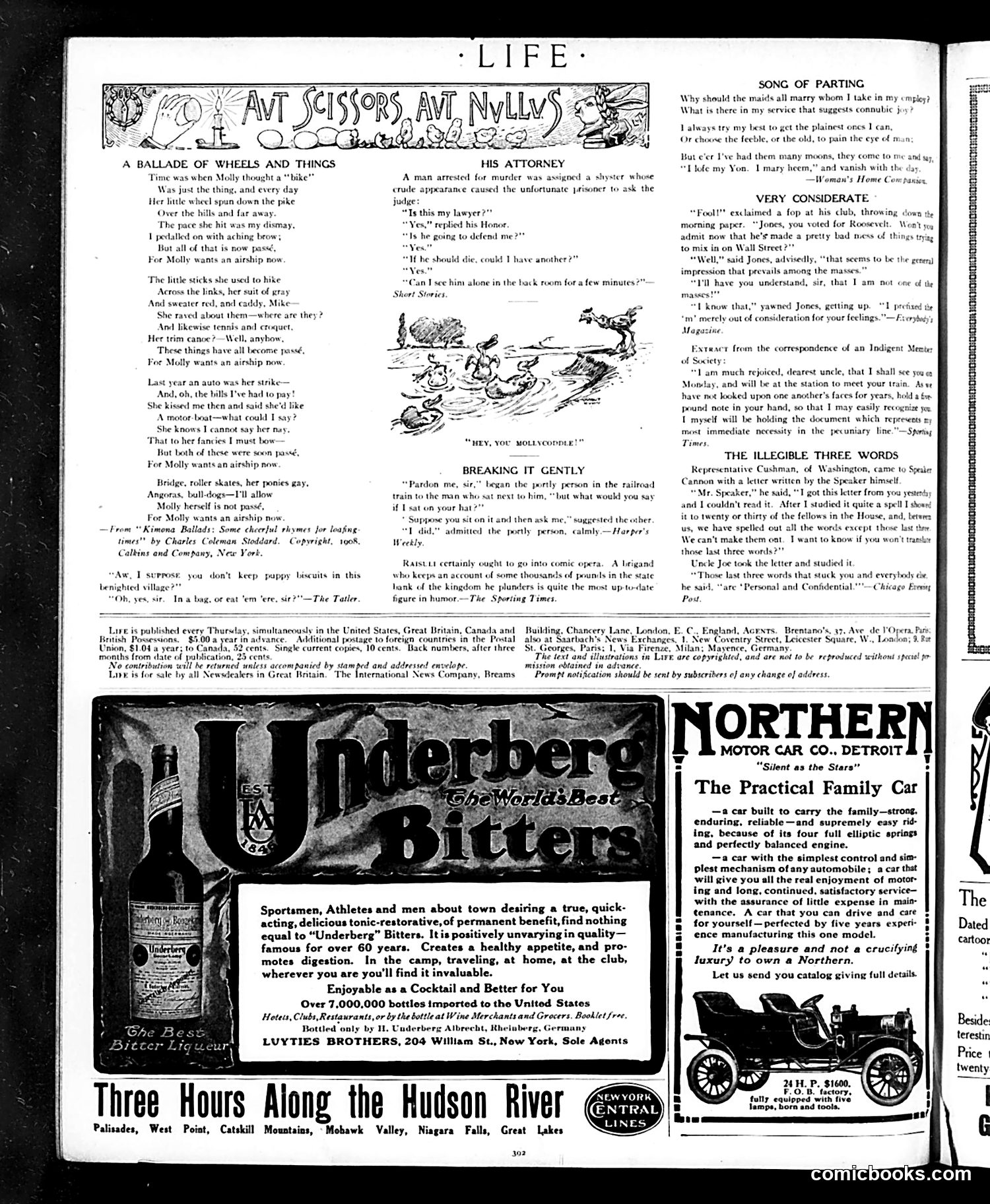
This page from Life magazine (circa 1908, based on visible copyright) contains several humorous pieces satirizing contemporary social behaviors: **"A Ballade of Wheels and Things"** mocks the fickleness of wealthy women, particularly "Molly," who constantly abandons fashionable pursuits (bicycles, tennis, motor-boats) for the latest craze—now airships. The satire targets both female consumerism and the rapid technological change of the early 1900s. **"His Attorney"** and **"Breaking It Gently"** are brief joke pieces about miscommunication and social awkwardness—typical humor formats of the era. **"Very Considerate"** appears to satirize political discourse, specifically someone's reluctance to criticize Roosevelt's Wall Street involvement. The page is primarily **humorous prose and poetry** rather than political cartooning. The illustrations are small decorative sketches supporting the text. The overall tone reflects Life's satirical focus on upper-class manners, emerging technology, and social pretension during the Progressive Era.
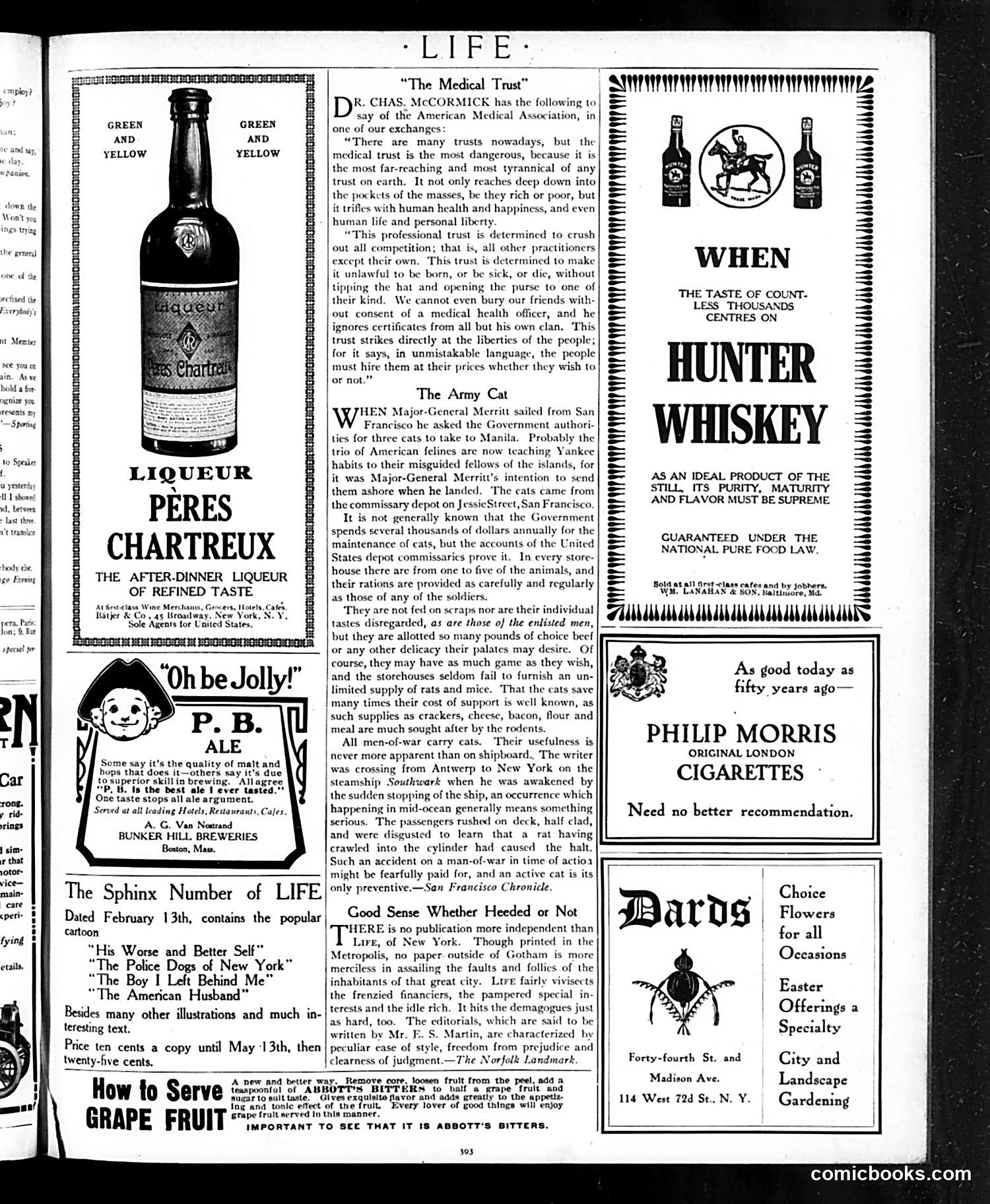
This page contains **no political cartoons**, but rather **editorial commentary and advertisements** from an early 1900s satirical magazine. The main text piece, "The Medical Trust," reproduces a scathing critique of the American Medical Association, characterizing it as a monopolistic cartel that exploits the public by controlling access to medical care, forcing people to pay their fees "whether they wish to or not." The author argues doctors prevent unlicensed practitioners from competing and even regulate death itself through required medical certification—a libertarian critique of professional licensing. "The Army Cat" is a humorous anecdote about General Merritt requesting cats for Manila, leading to observations about the U.S. military's actual budget for maintaining cats in storehouses. It's a light satire on military bureaucracy and resource allocation. The remainder consists of **period advertisements** for liqueur, ale, whiskey, cigarettes, and florists—typical of LIFE's revenue model.
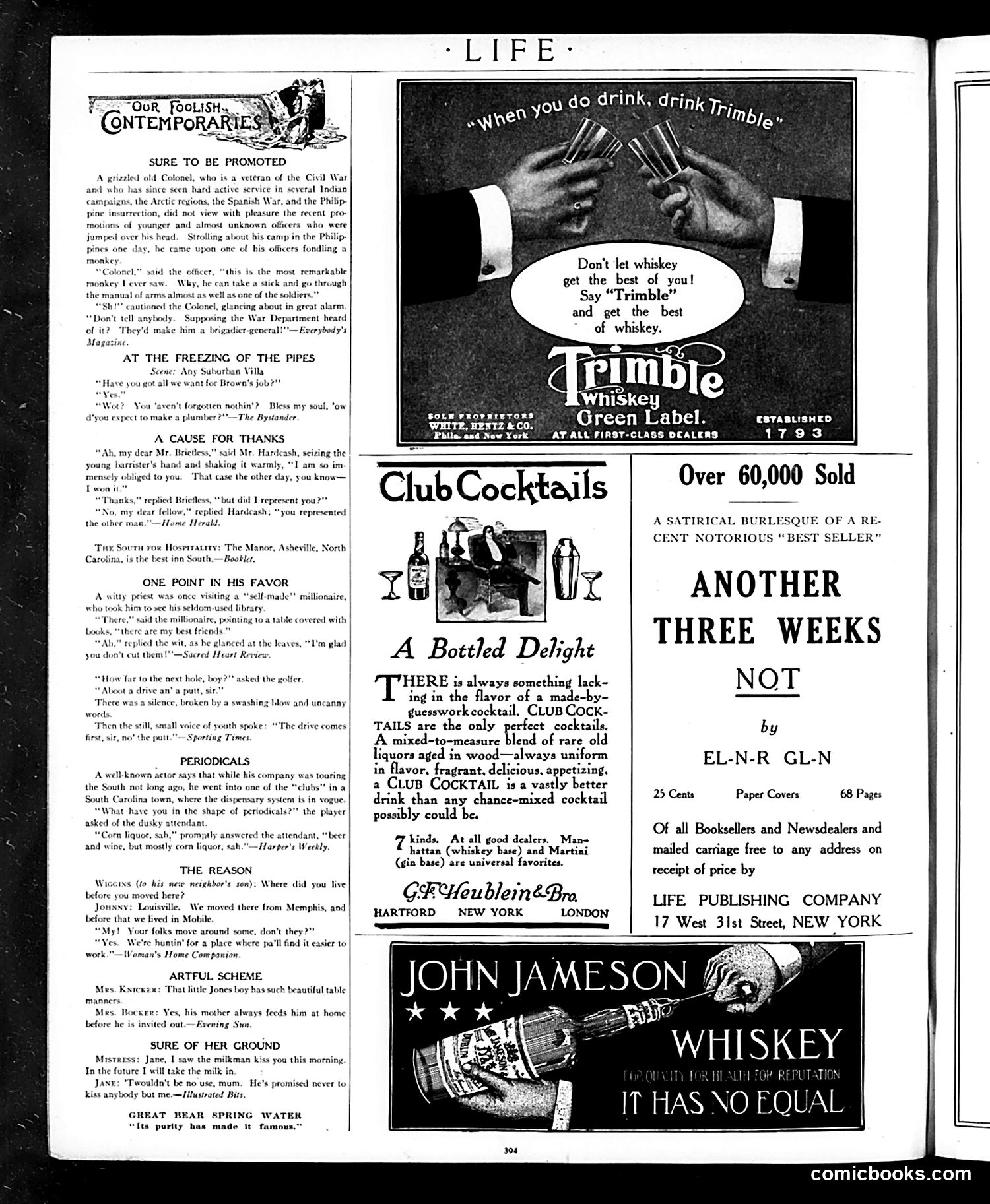
This page primarily contains **humorous anecdotes and advertisements** rather than political cartoons. The humor pieces satirize American social types: a Civil War colonel passed over for promotion (mocking military bureaucracy), a self-made millionaire with an unused library (satirizing nouveau riche pretension), a dispensary attendant offering "corn liquor" as reading material (poking fun at Southern prohibition enforcement), and various domestic scenes exposing human hypocrisy. The advertisements dominate the page, hawking **whiskey brands** (Trimble, John Jameson) and **bottled cocktails** (Club Cocktails, Heublein)—a striking reminder this predates Prohibition. An ad for "Another Three Weeks" (a notorious scandalous novel) promises 68 pages for 25 cents. The overall tone is genteel, middle-class satire typical of early 20th-century Life magazine—poking gentle fun at social pretension, military incompetence, and domestic arrangements, while freely advertising alcohol. The page reflects an era when such advertisements were considered appropriate magazine content.
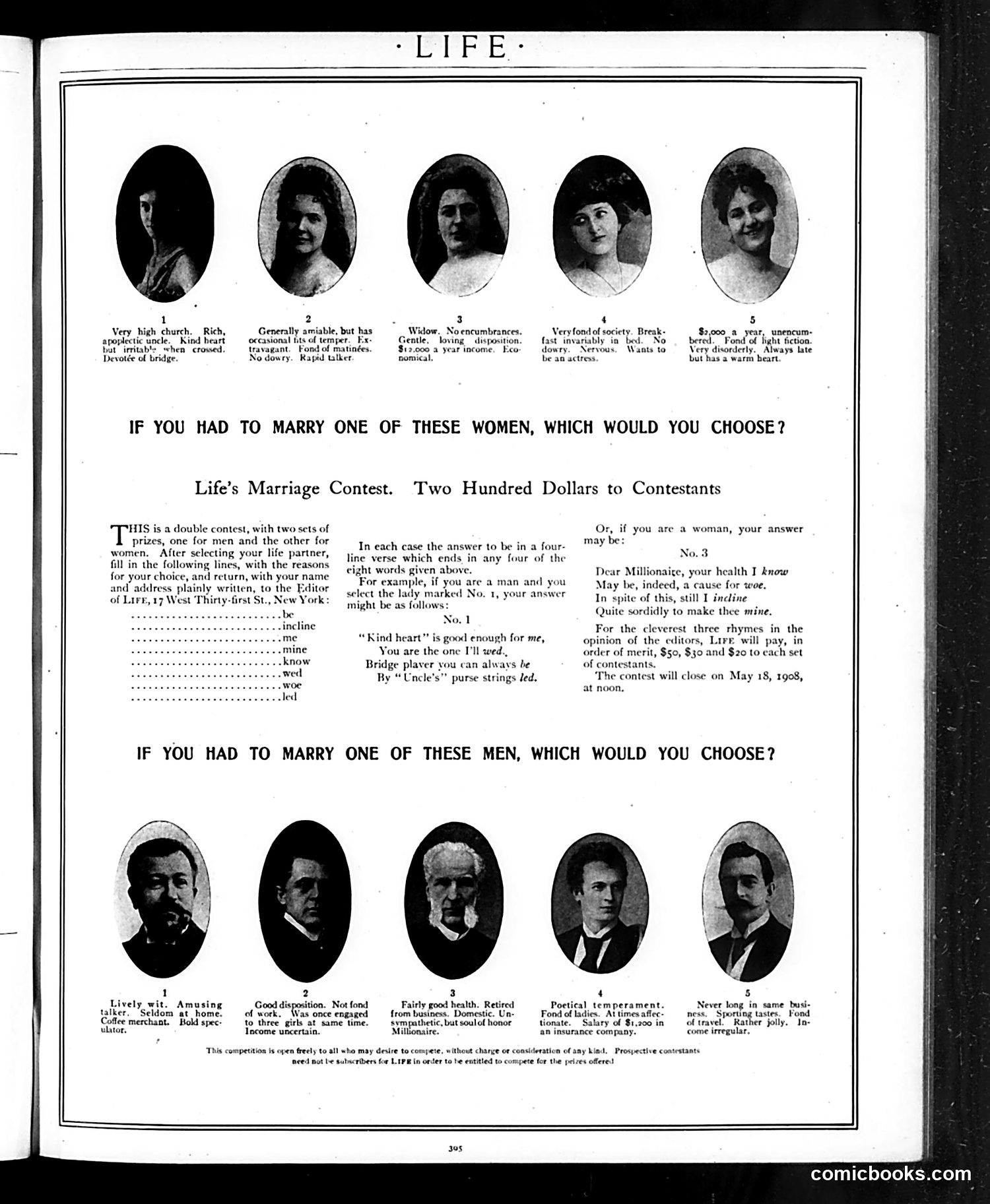
This is a satirical dating game where readers choose hypothetical marriage partners from five women and five men, then submit four-line rhyming verses explaining their choice for $200 in prizes. The women are characterized by stereotypical desirability markers: wealth, temperament, social status, and appearance. The men similarly combine financial status with personality traits (reliability, domesticity, adventure). The satire targets early 20th-century marriage mercenary attitudes—contestants must justify choices in verse, making explicit the calculating nature of mate selection based on money, social position, and superficial qualities. The contest mock-seriously asks readers to commodify romance, exposing how marriage was often a transactional arrangement rather than an emotional commitment. The deadline (May 18, 1908) and prize structure suggest this was a popular reader-engagement gimmick typical of *Life* magazine's satirical humor about American social conventions.
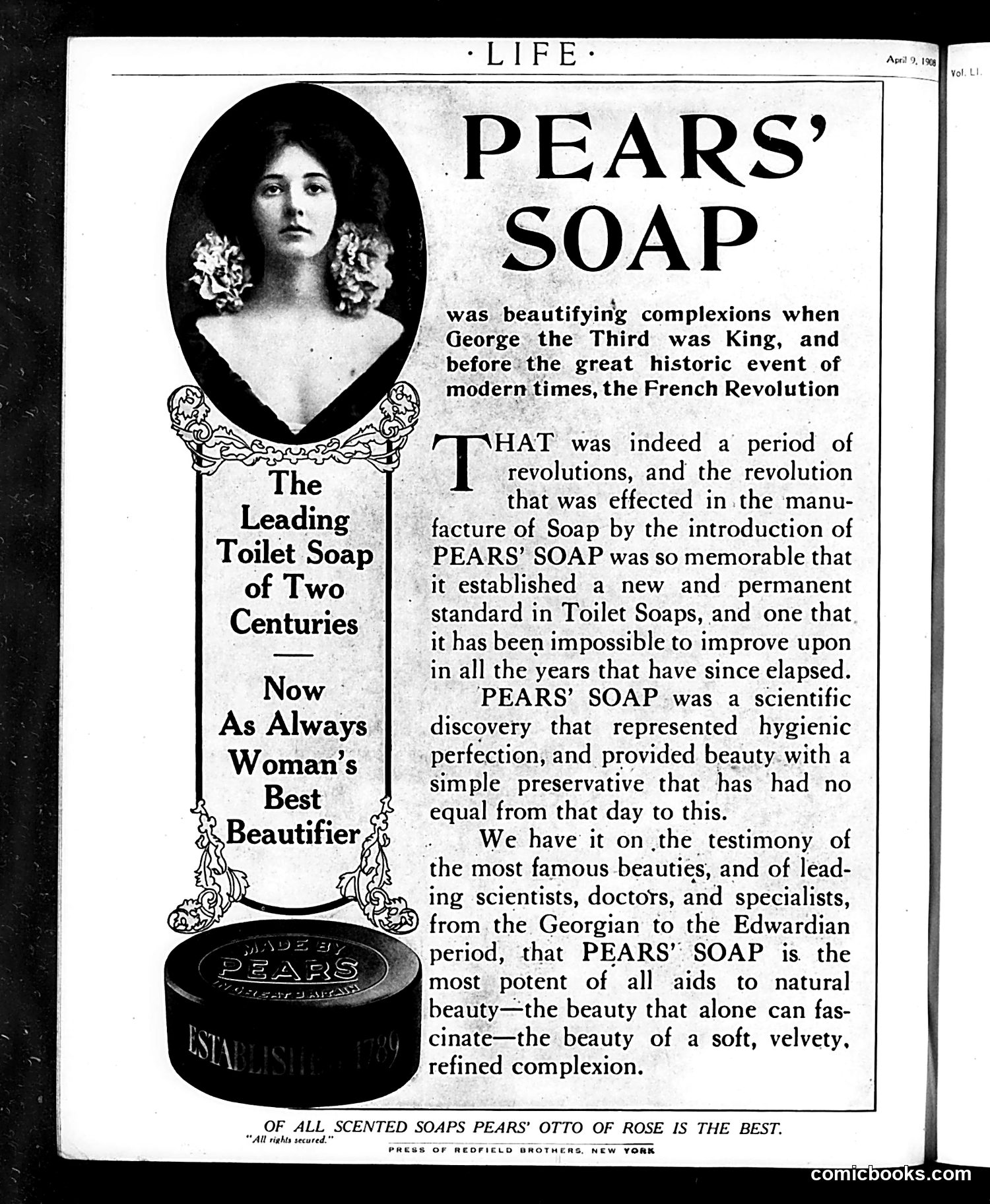
This is a **Pears' Soap advertisement**, not a political cartoon. It's a full-page commercial from Life magazine (dated April 9, 1908, visible in header). The ad uses historical prestige and scientific authority to market soap. It claims Pears' has beautified complexions since the reign of George III and predates the French Revolution—positioning the product as timelessly elegant. The copy argues Pears' represented a "revolution" in soap manufacturing itself, establishing an unimprovable standard. The advertisement appeals to vanity and class aspiration by citing endorsements from "famous beauties," scientists, doctors, and specialists across Georgian to Edwardian periods. This reflects early 20th-century marketing tactics: legitimizing consumer products through historical longevity, pseudo-scientific claims, and celebrity/expert testimony. The illustration shows an idealized woman with decorative flourishes, embodying the refined beauty the soap promises to deliver. There is no satire here—this is straightforward, if hyperbolic, commercial persuasion.