
Life, 1908-04-09 · page 14 of 20
Life — April 9, 1908 — page 14: what you’re looking at
What you’re looking at
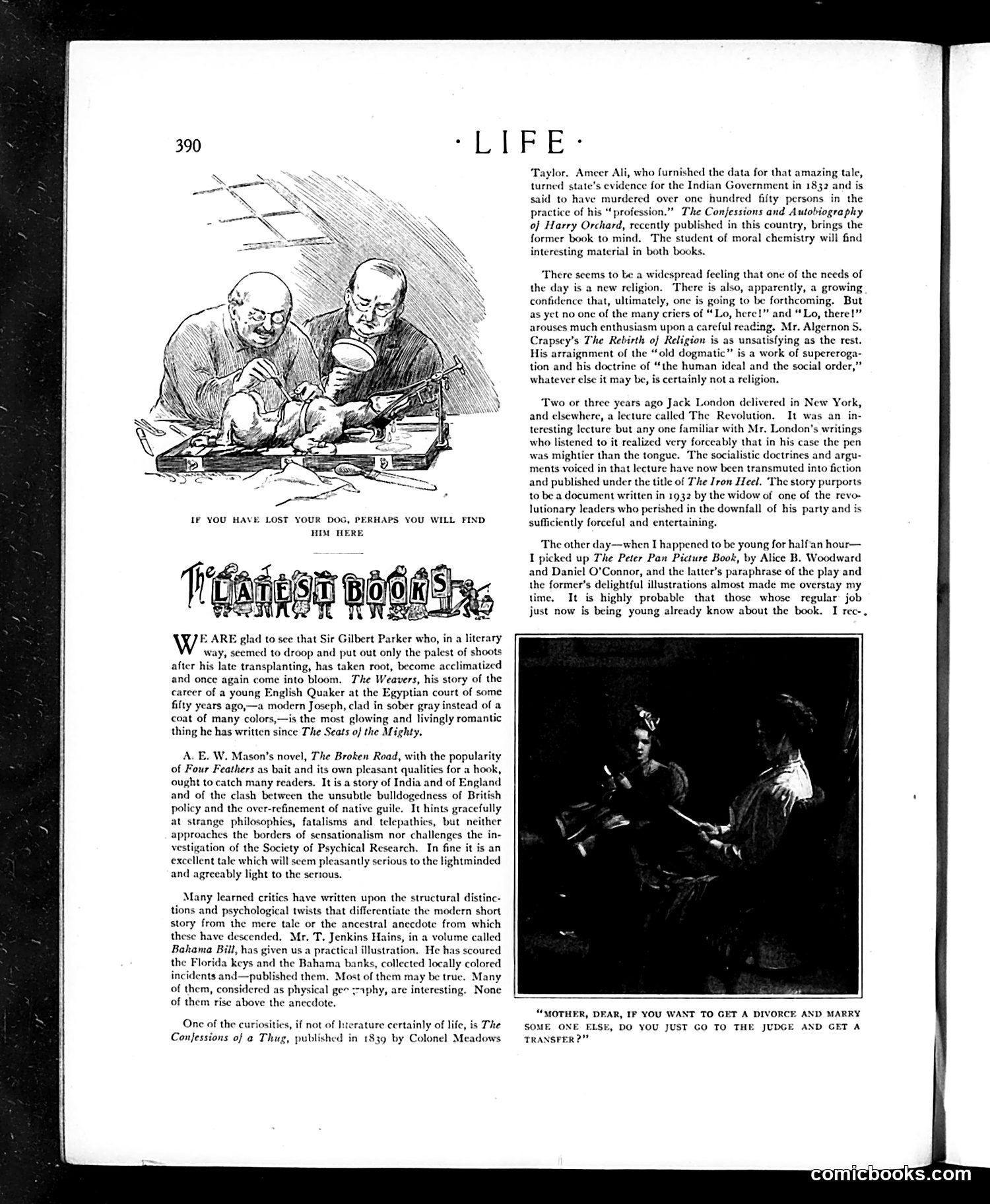
This page from *Life* magazine contains **book reviews and literary criticism**, not political cartoons per se, though it employs satirical commentary. The **top cartoon** shows two men examining something small, captioned "If you have lost your dog, perhaps you will find him here" with "The Latest Books" below—a joke suggesting newly published books are so negligible they'd appeal only to someone looking for a lost dog. The text mocks several contemporary authors and works: Gilbert Parker's renewed literary productivity, A.E.W. Mason's adventure novels, and T. Jenkins Hains's collection of anecdotal stories dismissed as mere "anecdotes" lacking literary merit. The piece also critiques the era's apparent hunger for "new religions," referencing Algernon Crapsey's *The Rebirth of Religion* as unsatisfying. Jack London receives backhanded praise: his written fiction of socialist ideas (*The Iron Heel*) surpasses his spoken lectures on revolution. The **bottom photograph** appears unrelated, showing what seems to be a domestic scene with accompanying caption about divorce procedures. Overall, the page reflects early 20th-century literary gatekeeping and intellectual skepticism toward popular authors.
📄 Transcribed text from this page (OCR, searchable)
Machine-transcribed from the original scan — historical spelling and the odd misread are preserved.
LIFE If YOU HAVE LOST YOUR DOG, P HIM HERE ARE glad to see that Sir Gilbert Parker who, in a literary y, seemed to droop and put out only the palest of shoots after his late transplanting, has taken root, become acclimatized and once again come into bloom. The Weavers, his story of the carcer of a young English Quaker at the Egyptian court of some fifty years ago,—a modern Joseph, clad in sober gray instead of a coat of many colors,—is the most glowing and livingly romantic thing he has written since The Seats of the Mighty. A. E. W, Mason’s novel, The Broken Road, with the popularity of Four Feathers as bait and its own pleasant qualities for a hook, ought to catch many readers, It is a story of India and of England and of the clash between the unsubtle bulldogedness of British policy and the over-refinement of native guile. It hints gracefully at strange philosophics, fatalisms and telepathies, but neither approaches the borders of sensationalism nor challenges the in- vestigation of the Society of Psychical Research. In fine it is an excellent tale which will scem pleasantly serious to the lightminded and agreeably light to the scrious. Many learned critics have written upon the structural distine- tions and psychological twists that differentiate the modern short story from the mere tale or the ancestral anecdote from which these have descended. Mr, T. Jenkins Hains, in a volume called Bahama Bill, has given us a practical illustration. He has scoured the Florida keys and the Bahama banks, collected locally colored incidents and—published them. Most of them may be true. Many of them, considered as physical gee ;-aphy, are interesting. None of them rise above the anecdote. One of the curiosities, if not of lncrature certainly of life, is The Confessions of a Thug, published in 1839 by Colonel Meadows Taylor. Ameer Ali, who furnished the data for that amazing tal turned state’s evidence for the Indian Government in 1832 and is said to have murdered over one hundred filty persons in the practice of his “profession.” The Conjessions and Autobiography of Harry Orchard, recently published in this country, brings the former book to mind. ‘The student of moral chemistry will find interesting material in both books. ‘There scems to be a widespread feeling that one of the needs of the day is a new religion. There is also, apparently, a growing confidence that, ultimately, one is going to be forthcoming. But as yet no one of the many cricrs of “Lo, here!” and “Lo, there!” arouses much enthusiasm upon a careful reading. Mr. Algernon Crapsey’s The Rebirth of Religion is as unsatisfying as the rest. arraignment of the “‘old dogmatic” is a work of supererog: tion and his doctrine of “the human ideal and the social order,” whatever else it may be, is certainly not a religion. ‘Two or three years ago Jack London delivered in New York, lecture called The Revolution, It was an in- teresting lecture but any one familiar with Mr. London's writings ized very forceably that in his case the pen was mighticr than the tongue. ‘The socialistic doctrines and argu- ments voiced in that lecture have now been transmuted into fiction and published under the title of The Iron Heel. ‘The story purports to be a document written in 1932 by the widow of one of the revo- lutionary leaders who perished in the downfall of his party and is sufficiently forceful and entertaining. The other day—when I happened to be young for half'an hour— I picked up The Peter Pan Picture Book, by Alice B. Woodward and Daniel O'Connor, and the latter’s paraphrase of the play and the former's delightful illustrations almost made me overstay my time. It is highly probable that those whose regular job just now is being young already know about the book. I re: “MOTHER, DEAR, IF YOU WANT TO GET A DIVORCE AND MARRY SOME ONE ELSE, DO YOU JUST GO TO THE JUDGE AND GET A TRANSFER?” icbooks.com