
Life, 1908-04-09 · page 4 of 20
Life — April 9, 1908 — page 4: what you’re looking at
What you’re looking at
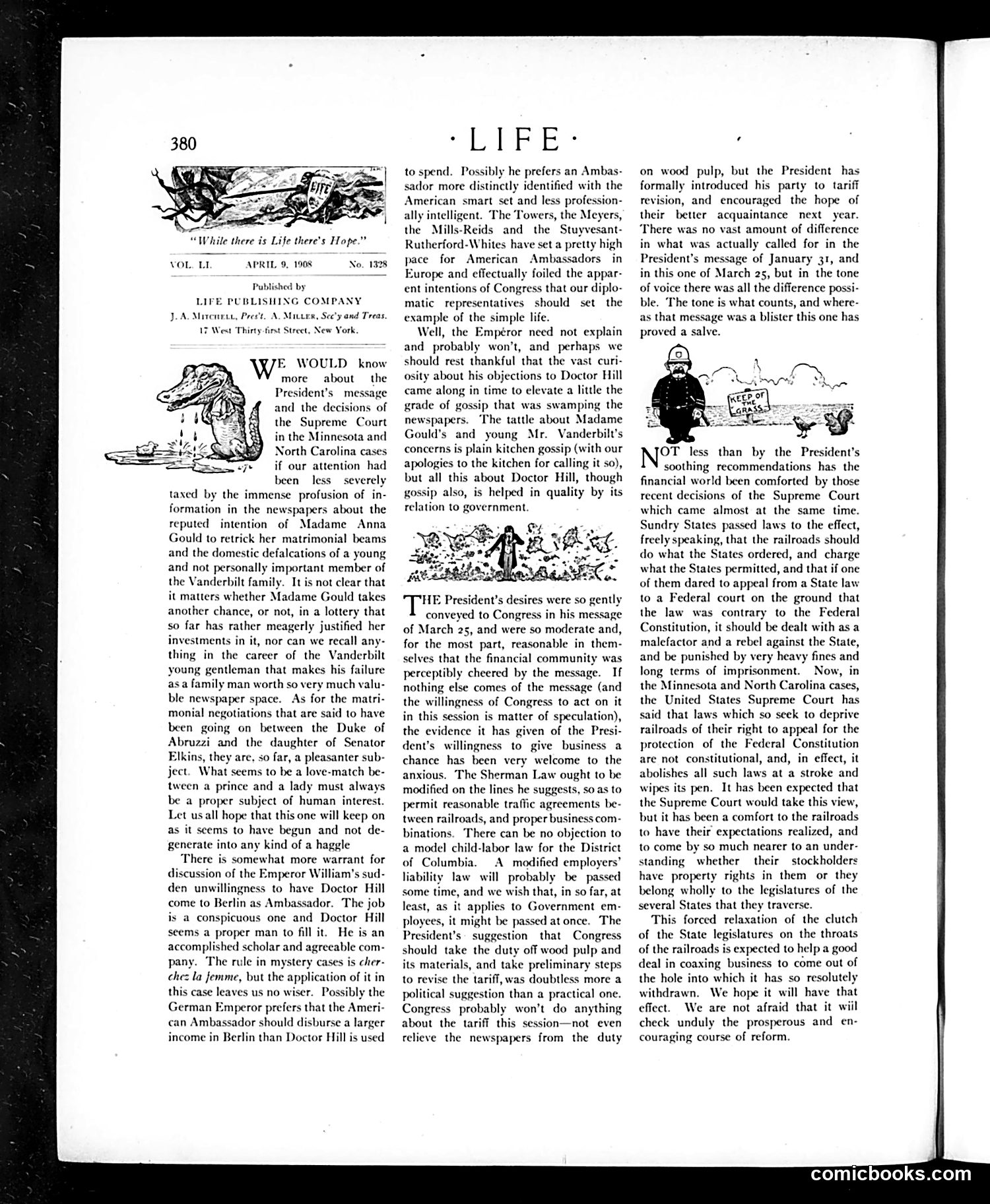
This page contains editorial commentary on President Theodore Roosevelt's message to Congress regarding financial and railroad regulation. The text discusses Roosevelt's moderate proposals favorably, noting they reassured the financial community while addressing reform concerns. The small cartoon at top left appears to show a figure in water, captioned "While there is Life there's Hope"—likely a visual pun on the magazine's name relating to economic recovery prospects. The page also addresses the Madame Anna Gould matrimonial scandal, dismissing it as gossip unworthy of serious attention compared to substantive policy matters. The editorial tone suggests approval of Roosevelt's balanced approach to railroad regulation and tariff reform, viewing his proposals as pragmatic rather than radical.
📄 Transcribed text from this page (OCR, searchable)
Machine-transcribed from the original scan — historical spelling and the odd misread are preserved.
VOL. LI APRIL 9, 1908 Published by LIFE PUBLISHING COMPANY J. A. Mirenrtt, Pree't, A Mattes, Sec’y and 17 West Thirty:tirst Street, New York, E WOULD know more about the President’s message and the decisions of the Supreme Court in the Minne: North Caroli if our attention had been less severely ed by the immense profusion of in- formation in the newspapers about the reputed intention of Madame Anna sould to retrick her matrimonial beams and the domestic defalcations of a young and not personally important member of the Vanderbilt family. It is not clear that it matters whether Madame Gould takes another chance, or not, in a lottery that so far has rather meagerly justified her investments in it, nor can we recall any- thing in the career of the Vanderbilt young gentleman that makes his failure asa family man worth so very much valu- ble newspaper space. As for the matri- monial negotiations that are said to have been going on between the Duke of Abruzzi and the daughter of Senator ins, they are, so far, a pleasanter sub- ject. What seems to be a love-match be tween a prince and a lady must always be a proper subject of human interest. Let usall hope that this one will keep on as it seems to have begun and not de- generate into any kind of a haggle There is somewhat more warrant for discussion of the Emperor William's sud- den unwillingness to have Doctor Hill come to Berlin as Ambassador. The job is a conspicuous one and Doctor Hill seems a proper man to fill it. He is an accomplished scholar and agreeable com- pany. The rule in mystery cases is cher- chez la femme, but the application of it in this case leaves us no wiser. Possibly the rman Emperor prefers that the Ameri- can Ambassador should disburse a larger income in Berlin than Doctor Hill is used LIFE to spend. Possibly he prefers an Ambas- sador more distinctly identified with the American smart set and less profession- ally intelligent. The Towers, the Meyers, the Mills-R: and the Stuyvesant- Rutherford-Whites have set a pretty high pace for American Ambassadors in Europe and effectually foiled the appar- ent intentions of Congress that our diplo- matic representatives should set the example of the simple life. Well, the Empéror need not explain and probably won't, and perhaps we should rest thankful that the vast curi- osity about his objections to Doctor Hill came along in time to elevate a little the grade of gossip that was swamping the newspapers. ‘The tattle about Madame Gould’s and young Mr. Vanderbilt's concerns is plain kitchen gossip (with our apologies to the kitchen for calling it so), but all this about Doctor Hill, though gossip also, is helped in quality by its relation to government Ten President’s desires were so gently conveyed to Congress in his message of March 25, and were so moderate and, for the most part, reasonable in them- selves that the financial community was perceptibly cheered by the message. If nothing else comes of the message (and the willingness of Congress to act on it in this session is matter of speculation), the evidence it has given of the Presi- dent’s willingness to give business a chance has been very welcome to the anxious. The Sherman Law ought to be modified on the lines he suggests, so as to permit reasonable traflic agreements be- tween railroads, and proper business com- binations. There can be no objection to a model child-labor law for the District of Columbia. A modified employers’ liability law will probably be passed some time, and we wish that, in so far, at least, as it applies to Government em- ployees, it might be passed at once. The President’s. suggestion that Congress should take the duty off wood pulp and its materials, and take preliminary steps to revise the tariff, was doubtless more a political suggestion than a practical one. Congress probably won't do anything about the tariff thi ion—not even relieve the newspapers from the duty on wood pulp, but the President has formally introduced his party to tariff revision, and encouraged the hope of their better acquaintance next year. ‘There was no vast amount of difference in what was actually called for in the President’s message of January 31, and in this one of March 25, but in the tone of voice there was all the difference possi- ble. The tone is what counts, and where: as that message was a blister this one has proved a salve. OT less than by the President's soothing recommendations has the financial world been comforted by those recent decisions of the Supreme Court which came almost at the same time. Sundry States passed laws to the effect, freely speaking, that the railroads should do what the States ordered, and charge what the States permitted, and that if one of them dared to appeal from a State law to a Federal court on the ground that the law was contrary to the Federal Constitution, it should be dealt with as a malefactor and a rebel against the State, and be punished by very heavy fines and long terms of imprisonment. Now, in the Minnesota and North Carolina cases, the United States Supreme Court has said that laws which so seek to deprive railroads of their right to appeal for the protection of the Federal Constitution are not constitutional, and, in effect, it abolishes all such laws at a stroke and s its pen. It has been expected that upreme Court would take this view, but it has been a comfort to the railroads to have their expectations realized, and to come by so much nearer to an under- standing whether their stockholders have property rights in them or they belong wholly to the legislatures of the several States that they traverse. This forced relaxation of the clutch of the State legislatures on the throats of the railroads is expected to help a good deal in coaxing business to come out of the hole into which it has so resolutely withdrawn. We hope it will have that efiect. We are not afraid that it wiil check unduly the prosperous and en- couraging course of reform. comicbooks.com