
Life, 1908-04-09 · page 12 of 20
Life — April 9, 1908 — page 12: what you’re looking at
What you’re looking at
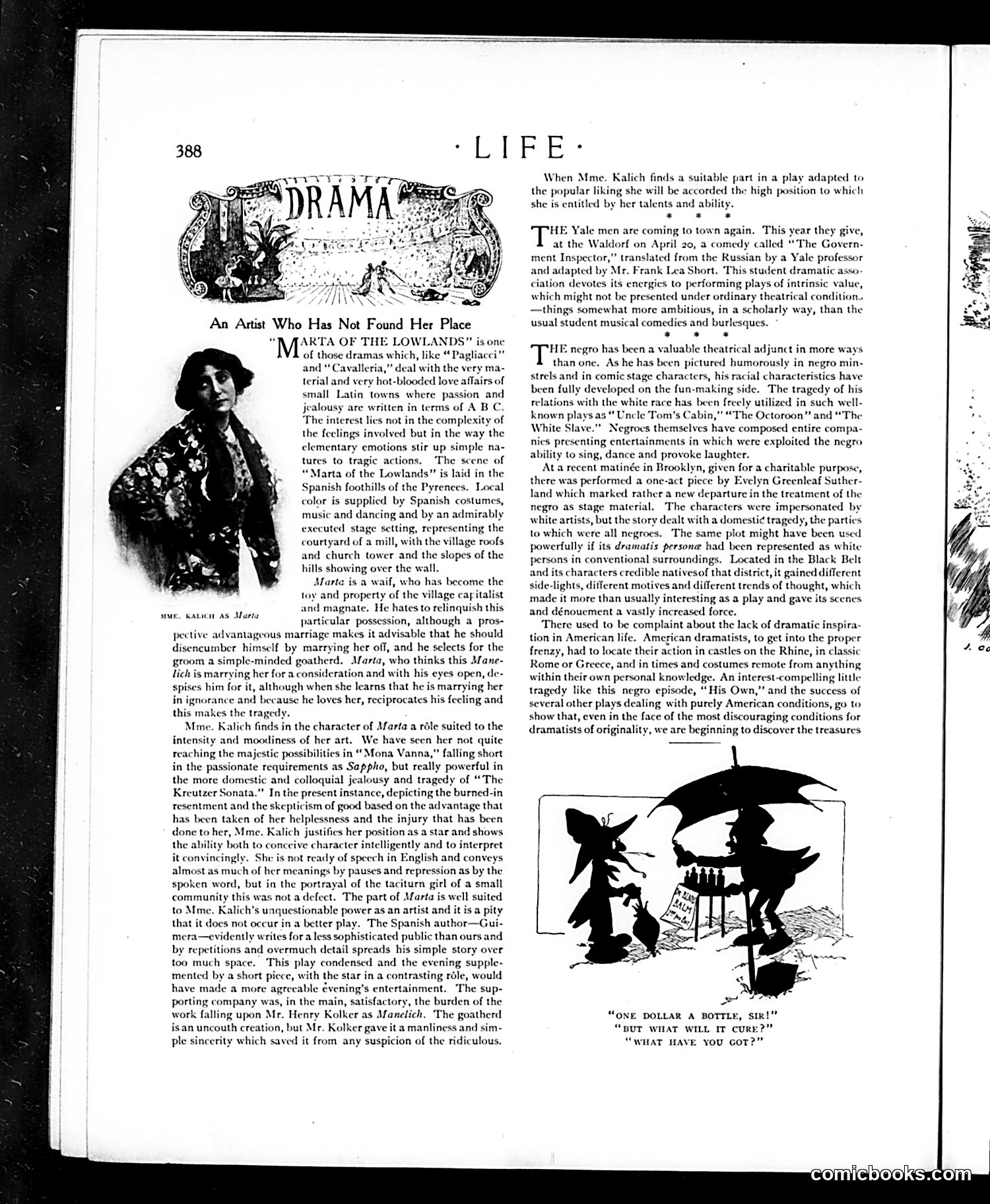
This drama section reviews theatrical productions. The main article discusses "Marta of the Lowlands," praising actress Mme. Kalich's performance in a Spanish play set in the Pyrenees featuring passion and jealousy. The text also covers the Yale Dramatic Association's performance of "The Government Inspector" (adapted from Russian), and discusses the theatrical use of Black performers and characters—noting how African American actors have appeared in plays dealing with domestic tragedy, though typically in stereotypical roles. The cartoon at bottom shows silhouetted figures with dialogue: "One dollar a bottle, sir!" / "But what will it cure?" / "What have you got?" This appears to be satirical commentary on patent medicine or quack remedies—a common target of Life magazine's satire.
📄 Transcribed text from this page (OCR, searchable)
Machine-transcribed from the original scan — historical spelling and the odd misread are preserved.
*LIFE> An Artist Who Has Not Found Her Place be ARTA OF THE LOWLANDS of those dramas which, like “ Pagliacci” and “Cavalleria,” deal with the very ma- tcrial and very hot-blooded love affairs of small Latin towns where passion and jealousy are written in terms of A BC. ‘The interest lics not in the complexity of the feelings involved but in the way the clementary emotions stir up simple na- tures to tragic actions. The scene of “ Marta of the Lowlands” is laid in the Spanish foothills of the Pyrenees. Local color is supplied by Spanish costumes, music and dancing and by an admirably executed stage setting, representing the courtyard of a mill, with the village roofs and church tower and the slopes of the hills showing over the wall. Marta is a waif, who has become the toy and property of the village capitalist and magnate. He hates to relinquish this particular possession, although a pros- pective advantageous marriage makes it advisable that he should disencumber himself by marrying her off, and he selects for the groom a simple-minded goatherd. Marta, who thinks this Mane- lich is marrying her for a consideration and with his eyes open, de- pises him for it, although when she learns that he is marrying her in ignorance and because he loves her, reciprocates his feeling and this makes the tragedy. Mme. Kalich finds in the character of Marta a rdle suited to the intensity and moodiness of her art. We have seen her not quite reaching the majestic possibilities in “Mona Vanna,” falling short in the passionate requirements as Sappho, but really powerful in the more domestic and colloquial jealousy and tragedy of “The Kreutzer Sonata.” In the present instance, depicting the burned-in resentment and the skepticism of good based on the advantage that has been taken of her helplessness and the injury that has been done to her, Mme. Kalich justifies her position as a star and shows the ability both to conceive character intelligently and to interpret it convincingly. She is not ready of speech in English and convey almost as much of her meanings by pauses and repression as by the spoken word, but in the portrayal of the taciturn girl of a small community this was not a defect. The part of Marta is well suited to Mme. Kalich’s unquestionable power as an artist and it is a pity that it docs not occur in a better play. The Spanish author—Gui- mera—evidently writes for a less sophisticated public than ours and by repetitions and overmuch detail spreads his simple story over too much space. This play condensed and the evening supple- mented by a short pice, with the star in a contrasting réle, would have made a more agrccable évening’s entertainment. ‘The sup- porting company was, in the main, satisfactory, the burden of the work falling upon Mr. Henry Kolker as Manelich, ‘The goatherd isan uncouth creation, but Mr. Kolker gave it a manliness and sim- ple sincerity which saved it from any suspicion of the ridiculous. site. KALI AS Marta When Mme. Kalich finds a suitable part in a play adapted to the popular liking she will be accorded the high position to which she is entitled by her talents and abili + * HE Yale men are coming to town again. This year they give, at the Waldorf on April 20, a comedy called “The Govern- ment Inspector," translated from the Russian by a Yale professor and adapted by Mr. Frank Lea Short, ‘This student dramatic asso: ciation devotes its energies to performing plays of intrinsic value, which might not be presented under ordinary theatrical condition. —things somewhat more ambitious, in a scholarly way, than the usual student musical comedies and burlesques. * 8 * HE negro has been a valuable theatrical adjunct in more ways than one. Ashe has been pictured humorously in n i strels and in comic stage characters, his racial characteristics have been fully developed on the fun-making side. The tragedy of his relations with the white race has been frcely utilized in such well- known playsas“ Uncle Tom’s Cabin,” “The Octoroon” and “The White Slav grocs themselves have composed entire compa- nics presenting entertainments in which were exploited the negro ability to sing, dance and provoke laughter. Ata recent matinée in Brooklyn, given for a charitable purpose, there was performed a one-act piece by Evelyn Greenleaf Suther- land which marked rather a new departure in the treatment of the negro as stage material. The characters were impersonated by white artists, but the story dealt with a domesti¢ tragedy, the parties to which were all negroes. The same plot might have been used powerfully if its dramatis personae had been represented as white persons in conventional surroundings. Located in the Black Belt and its characters credible nativesof that district, it gained different side-lights, different motives and different trends of thought, which made it more than usually interesting as a play and gave its scenes and dénoucment a vastly increased force. There used to be complaint about the lack of dramatic inspira- tion in American life. American dramatists, to get into the proper frenzy, had to locate their action in castles on the Rhine, in classic Rome or Greece, and in times and costumes remote from anything within their own personal knowledge. An interest-compelling little tragedy like this negro episode, “His Own,” and the success of several other plays dealing with purely American conditions, go to show that, even in the face of the most discouraging conditions for dramatists of originality, we are beginning to discover the treasures “ONE DOLLAR A BOTTLE, SIR! “BUT WHAT WILL IT CURE “WHAT HAVE YOU GOT?