
A complete issue · 24 pages · 1908
Life — February 20, 1908
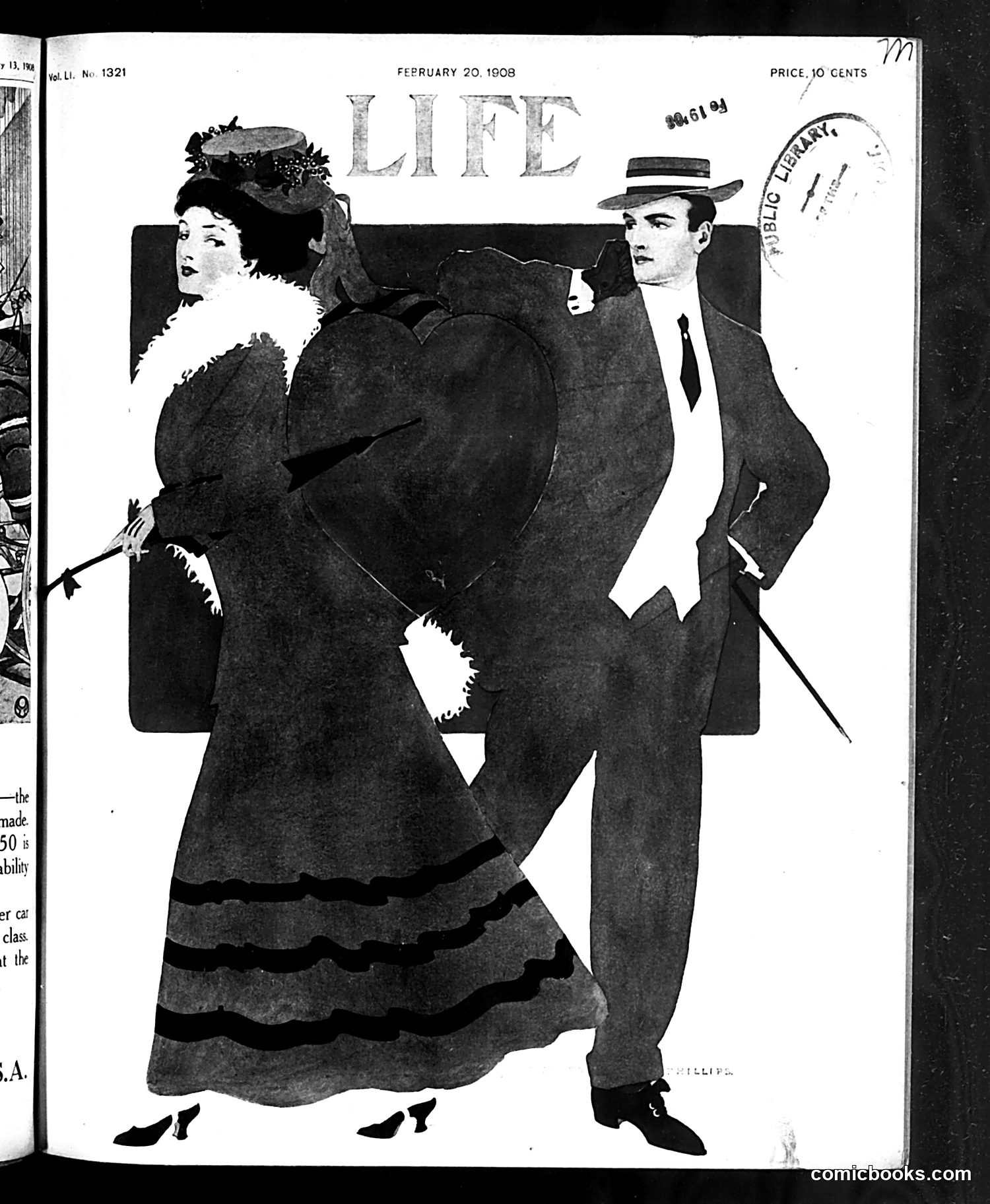
This is a *Life* magazine cover depicting a romantic or flirtatious scene between a well-dressed man and woman. The woman wears an elaborate dark coat with fur trim and an ornate hat typical of Edwardian fashion (circa 1908). The man sports formal attire including a boater hat and carries a walking stick. The illustration appears to be satirizing upper-class courtship or social interaction of the era. The woman's exaggerated posture and elaborate costume, combined with the man's somewhat bemused expression, suggest the cover is mocking fashionable society's affectations or romantic conventions of the period. Without additional OCR text visible on the page, the specific satirical point remains unclear, though it likely comments on contemporary social customs or fashion pretension.
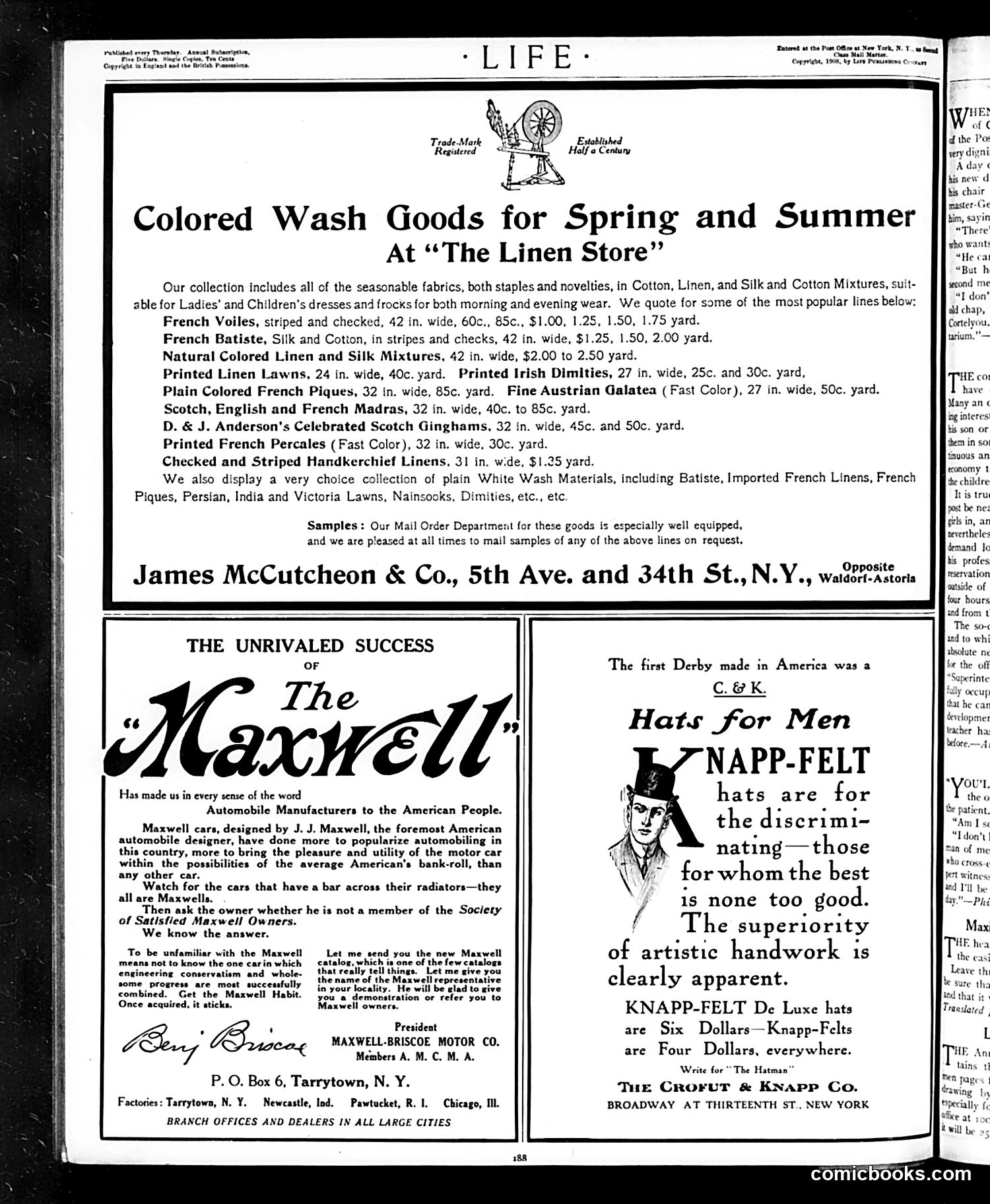
This page is primarily **advertising, not satire or editorial content**. It contains three commercial advertisements: 1. **"The Linen Store"** - promoting colored wash goods (fabrics) for spring/summer clothing 2. **"Maxwell" automobiles** - claiming to be the most successful car, appealing to American manufacturers and the general public 3. **"Knapp-Felt" hats** - marketing men's hats as superior products for "discriminating" consumers There are **no political cartoons or satirical commentary** on this page. The Maxwell ad includes a portrait of what appears to be the company president, but it's a straightforward product endorsement rather than caricature. This represents Life magazine's business model: combining satirical editorial content (on other pages) with commercial advertisements to fund publication.
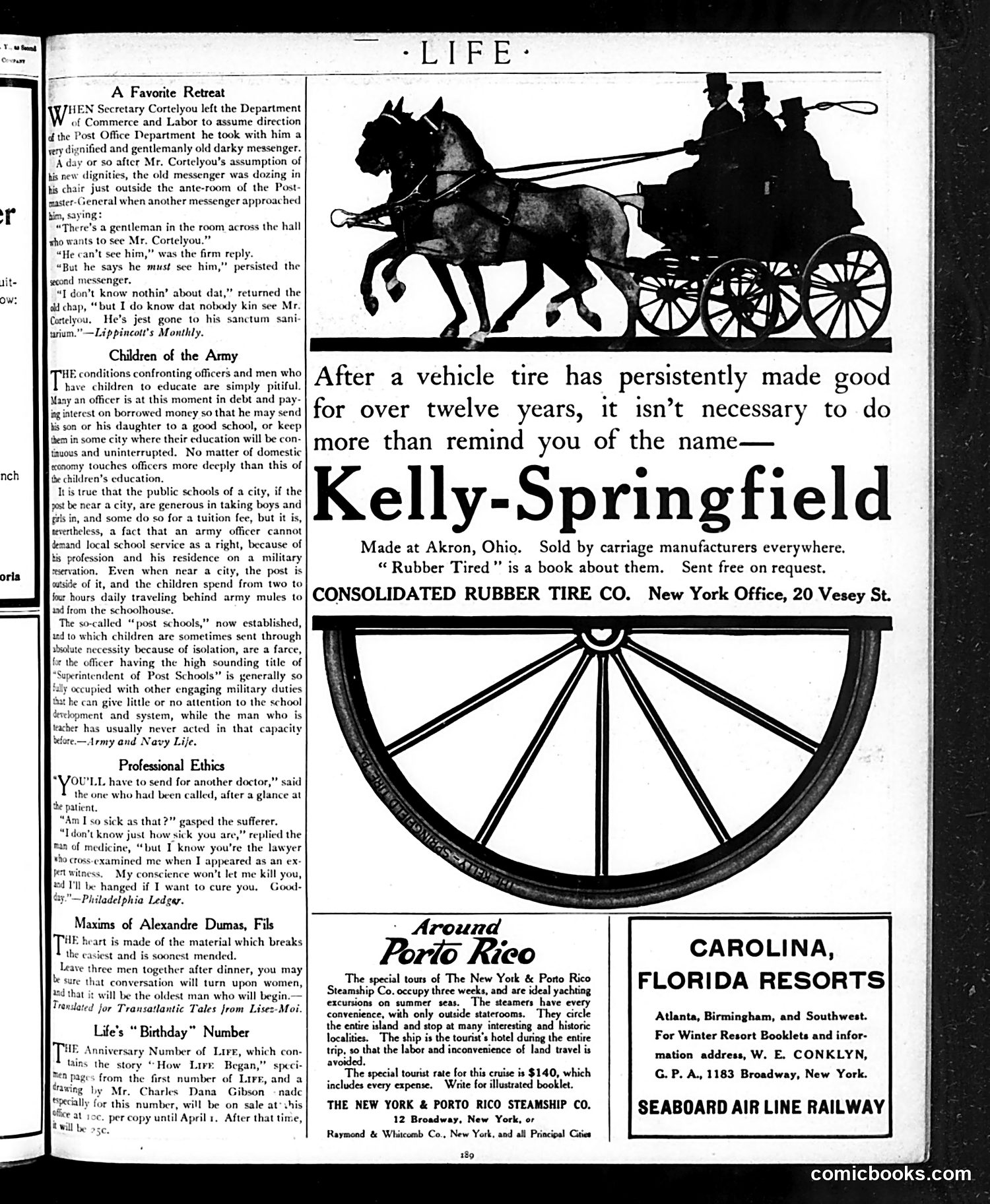
This page is primarily **advertising**, not political satire. The main content features a Kelly-Springfield tire advertisement showing a horse-drawn carriage with passengers, emphasizing the tire's twelve-year reliability record. Below is a large wheel illustration. The left column contains three brief, unrelated humor pieces: "A Favorite Retreat" (about a Post Office Department secretary), "Children of the Army" (discussing officers' financial struggles supporting their children's education), and "Professional Ethics" (a doctor-lawyer anecdote). These are light social commentary rather than political satire. Additional ads promote Puerto Rico steamship cruises and Carolina/Florida winter resorts. There's no identifiable political cartoon or caricature on this page—it reflects Life magazine's typical mixed content of advertising, light humor, and travel promotions.
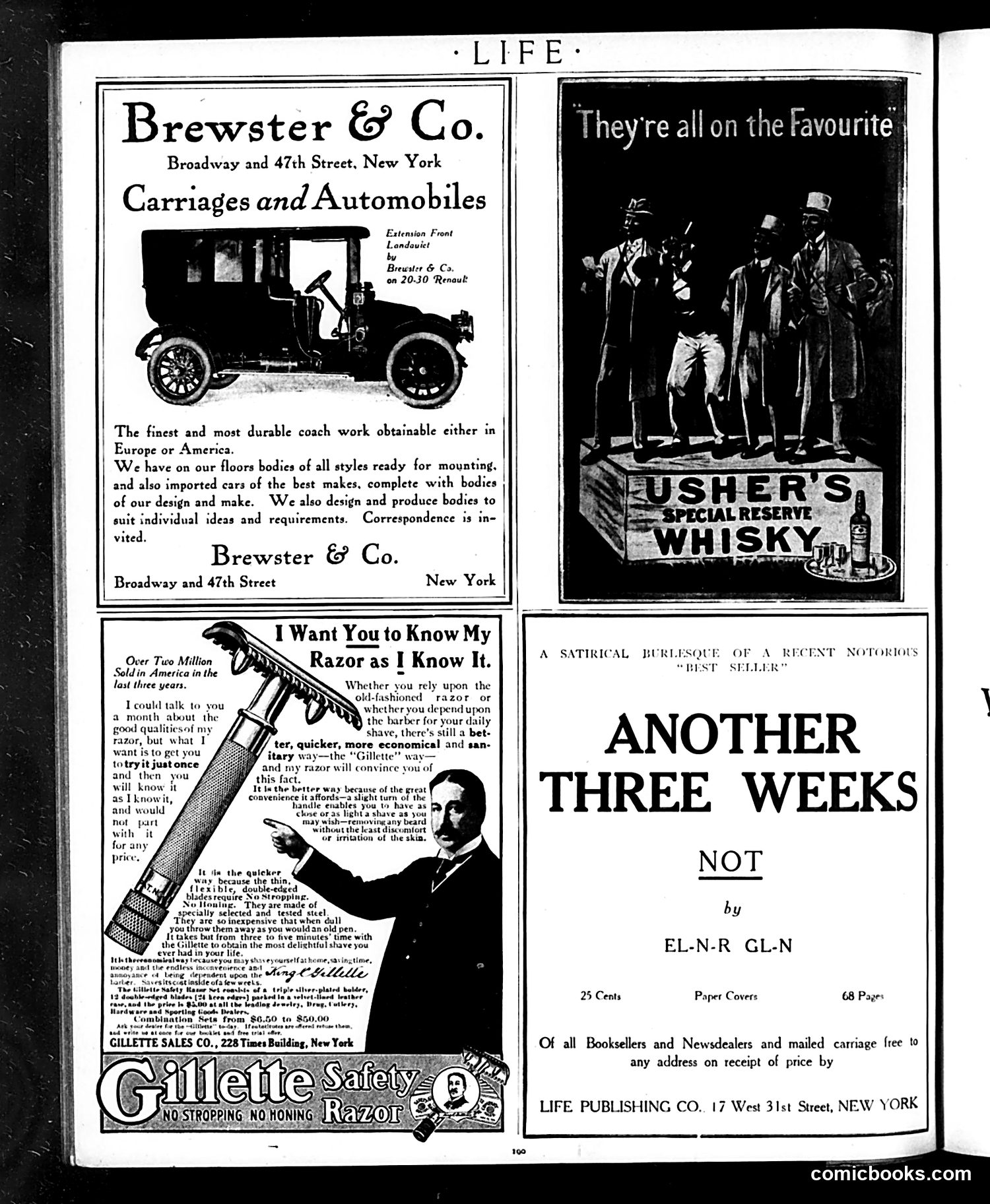
This page is primarily **advertising and book promotion** rather than political satire. The top half features ads for Brewster & Co. (carriages and automobiles) and Usher's Special Reserve Whisky. The whisky ad shows men in formal dress with the caption "They're all on the Favourite"—likely referencing a popular racehorse or betting context. Below is a Gillette Safety Razor advertisement featuring testimonial copy about the product's superiority. The right side promotes a book titled "Another Three Weeks Not" by "EL-N-R GL-N" (possibly a pseudonym), priced at 25 cents. This appears to be a satirical or humorous response to another popular work, though the exact reference is unclear without additional context. The page reflects early 20th-century advertising practices mixing commercial promotion with entertainment content.
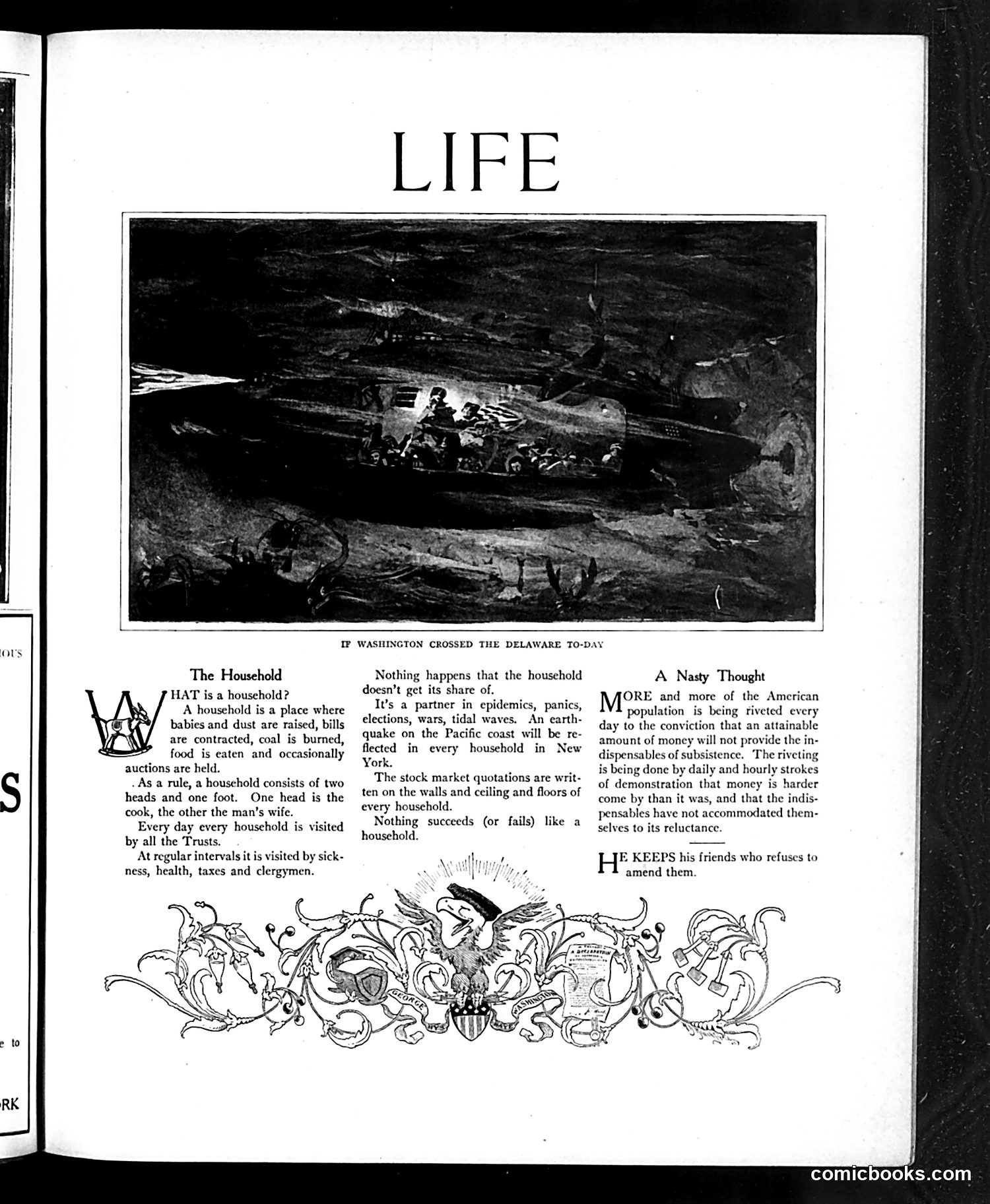
The page's header image, captioned "IF WASHINGTON CROSSED THE DELAWARE TO-DAY," depicts a modern recreation of Emanuel Leutze's famous 1851 painting of George Washington's Revolutionary War crossing. However, this version shows the boat crowded with what appear to be modern figures and industrial elements, satirizing contemporary American life. The three accompanying text sections—"The Household," "Nothing happens that the household doesn't get its share of," and "A Nasty Thought"—critique early 20th-century American materialism and economic anxiety. They mock how households are affected by market fluctuations, epidemics, and wars, suggesting ordinary Americans feel powerless against larger forces. The satire implies that Washington's heroic sacrifice contrasts sharply with modern Americans' preoccupation with money and self-interest.
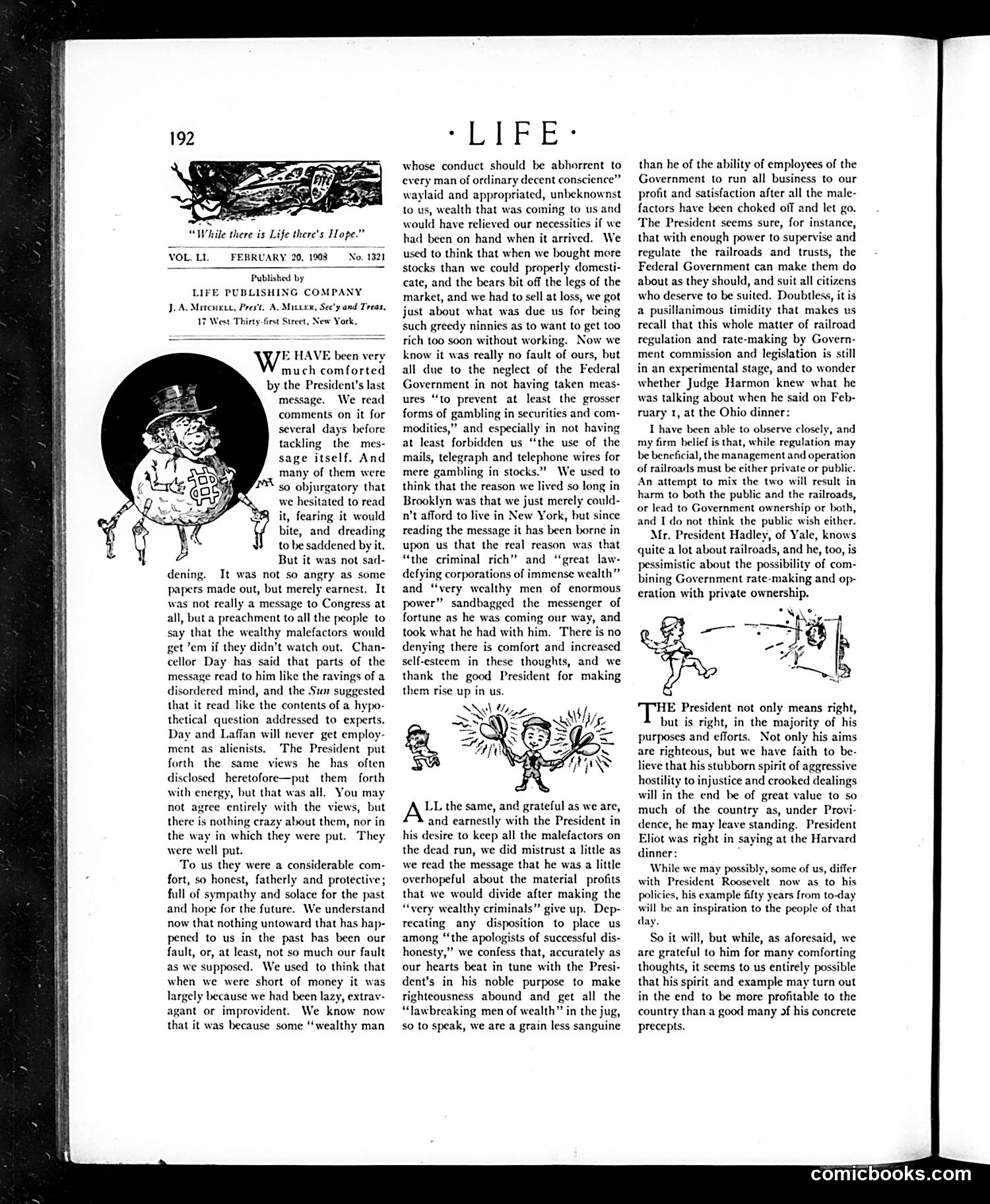
This editorial page discusses President Theodore Roosevelt's efforts to regulate wealthy industrialists and prevent securities fraud. The text references Roosevelt's message to Congress about preventing "gambling in securities and commodities" and controlling "the criminal rich" and wealthy corporations. The accompanying cartoons (though small and stylized) appear to satirize the tension between government regulation and private wealth. The editorial expresses cautious optimism about Roosevelt's anti-corruption stance while debating whether direct government operation of railroads or continued private ownership with regulation is preferable. The piece reflects the Progressive Era's central conflict: how to curb robber-baron excesses without embracing socialism. The writer credits Roosevelt with sincerity but remains somewhat skeptical about whether regulation alone can truly address systemic corruption among "wealthy men of enormous power."
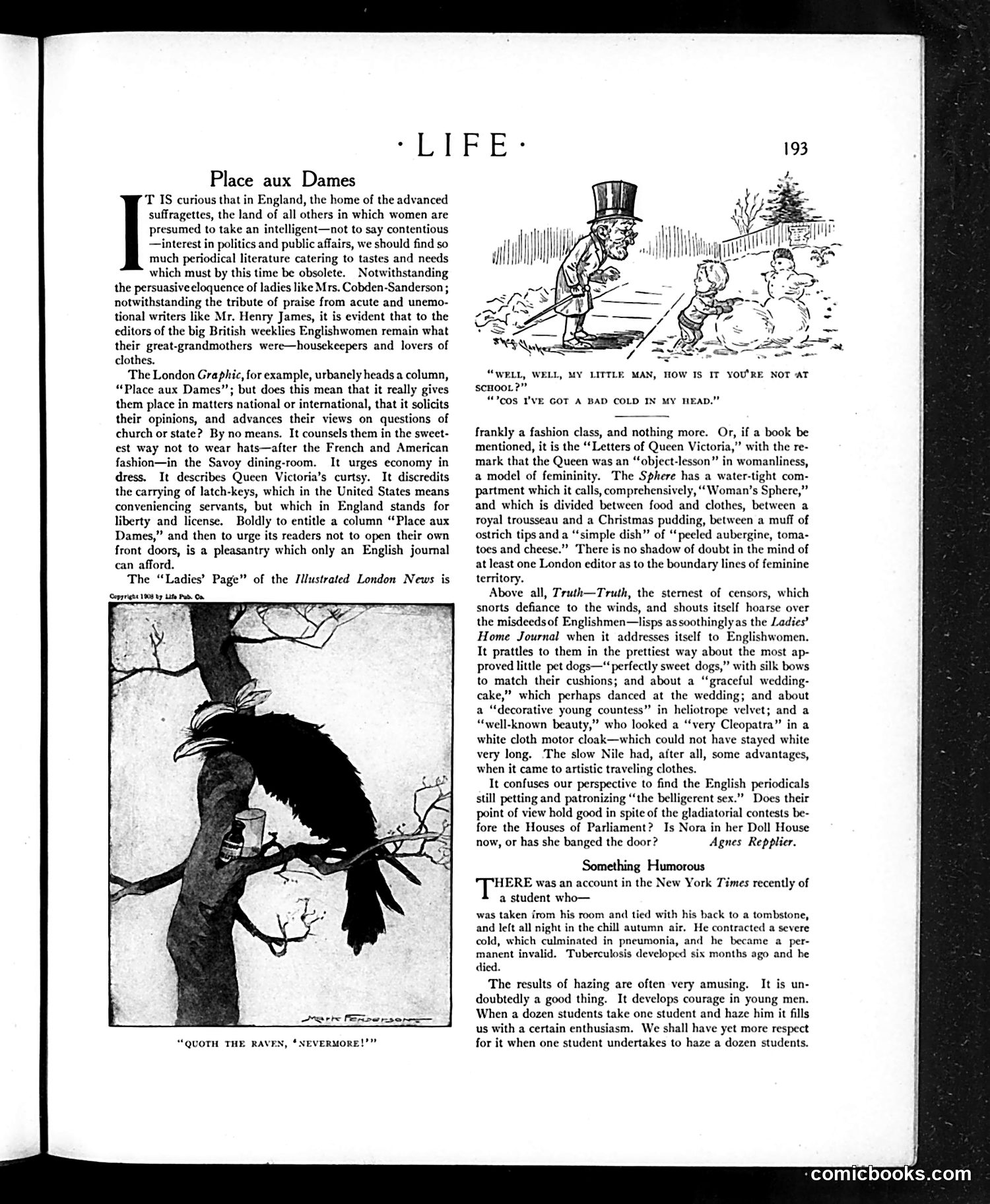
**Top Cartoon:** Shows a well-dressed man with a top hat scolding a young boy about school attendance. The boy claims he has a cold. This illustrates a common domestic scene satirizing parental authority and childhood excuses. **Bottom Illustration:** Depicts a large raven perched on a bare branch with the caption "QUOTH THE RAVEN, 'NEVERMORE!'" This references Edgar Allan Poe's famous 1845 poem "The Raven," likely used as decorative illustration rather than satire. The page's main article, "Place aux Dames," critiques British periodicals for trivializing women's intellectual capacity by publishing fashion-focused content instead of serious journalism. The text argues these publications underestimate female readers' intelligence and interests.
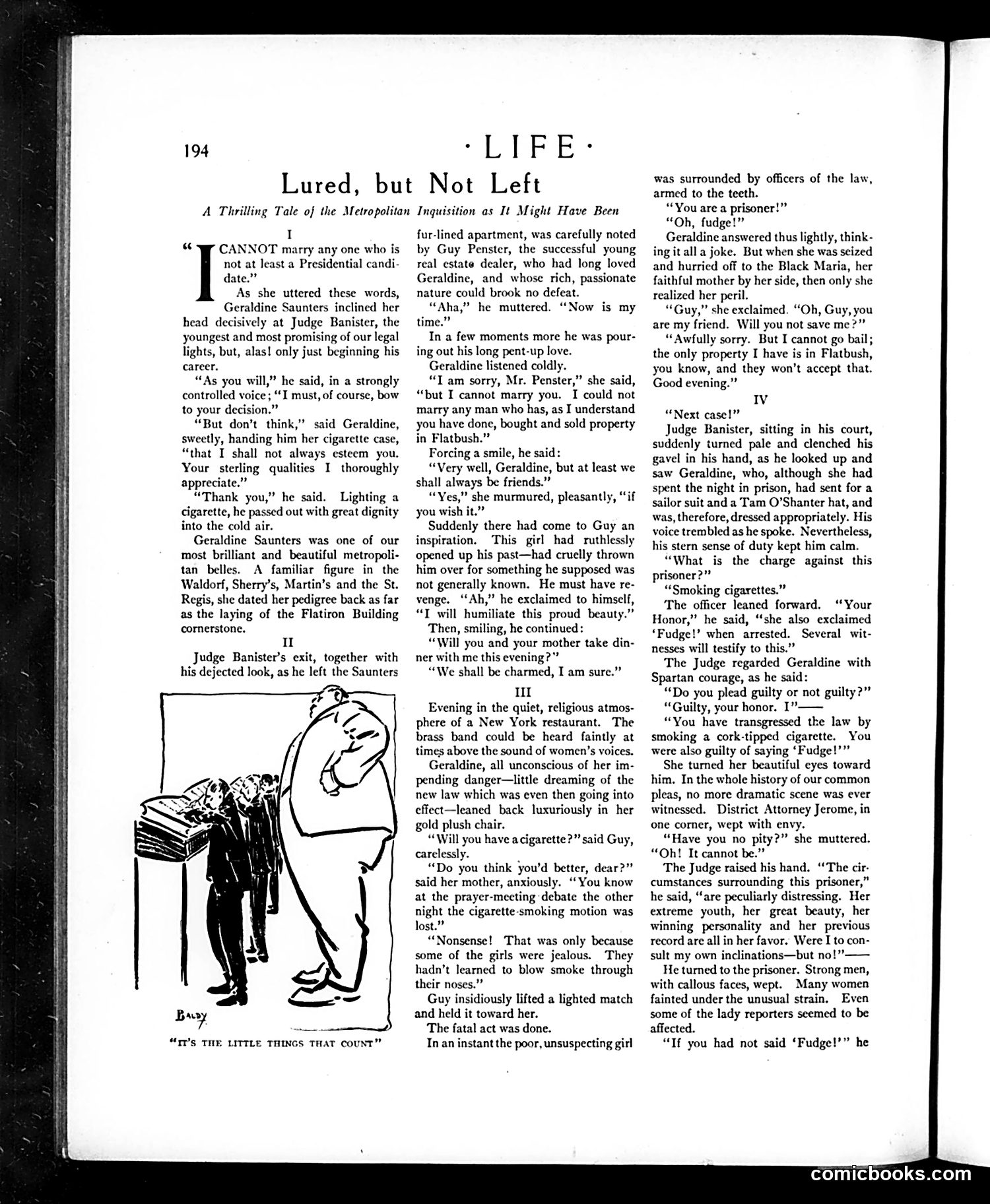
This page contains a short story about Geraldine Saunters, a prominent metropolitan woman who smokes cigarettes—then a scandalous behavior for respectable women. The narrative follows her arrest for this transgression and subsequent court appearance before Judge Banister. The accompanying cartoon by Cessy depicts a large figure (likely representing conventional society or morality) being "lured" by small temptations but ultimately "not left" behind—suggesting the tension between modern vices and traditional values. The satire mocks early-20th-century social hypocrisy: Geraldine's smoking violation is treated as a serious crime worthy of legal prosecution, highlighting the absurd prudishness of the era's moral standards and the arbitrary enforcement of social conventions against women.
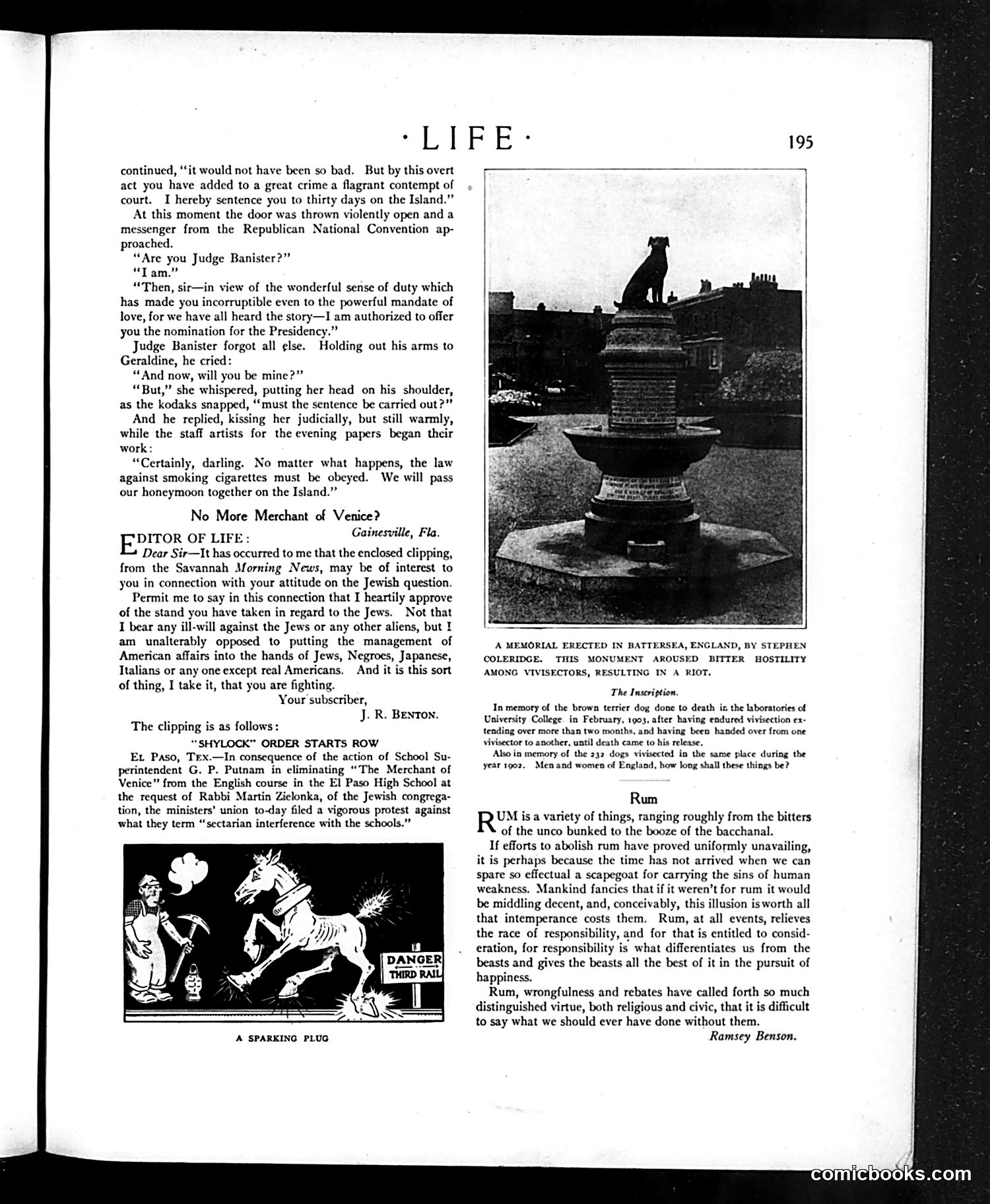
This cartoon appears to satirize railroad safety regulations or labor disputes. The image shows a figure being struck or jolted near railroad tracks, with "DANGER" and "THIRD RAIL" warning signs visible. The caption "A SPARKING PLUG" suggests wordplay on both electrical danger and labor agitation. The cartoon likely references contemporary debates about workplace safety standards or union activism in the early 20th century. The "sparking plug" metaphor suggests someone or something that ignites conflict or controversy—possibly critiquing either dangerous working conditions or disruptive labor organizing. Without additional historical context visible on this page, the specific incident or controversy remains unclear, though the railroad imagery indicates this concerns transportation industry conflicts.
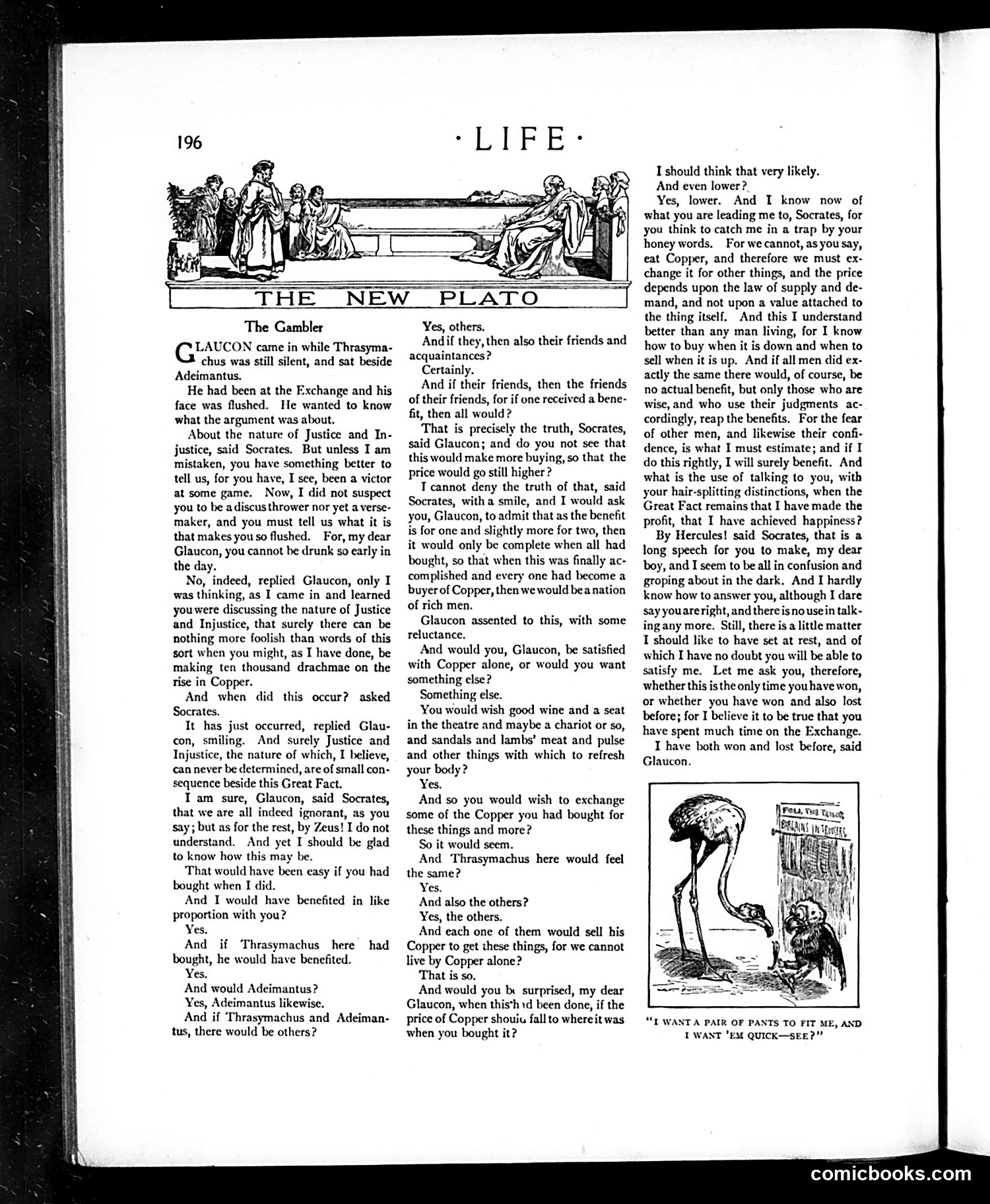
This page presents a philosophical dialogue titled "The New Plato" featuring characters named Socrates and Glaucon discussing economics. The dialogue examines supply-and-demand economics and market principles through Socratic questioning. The accompanying cartoon depicts a tall, thin ostrich-like figure bent over, captioned "I want a pair of pants to fit me, and I want 'em quick—see!" This appears to satirize absurd or unrealistic consumer demands. The satire likely critiques either naive economic thinking or the gap between theoretical economics and practical reality. The Platonic dialogue form parodies philosophical discourse by applying it to mundane commercial transactions, suggesting that economic principles—not value or sentiment—truly govern markets.
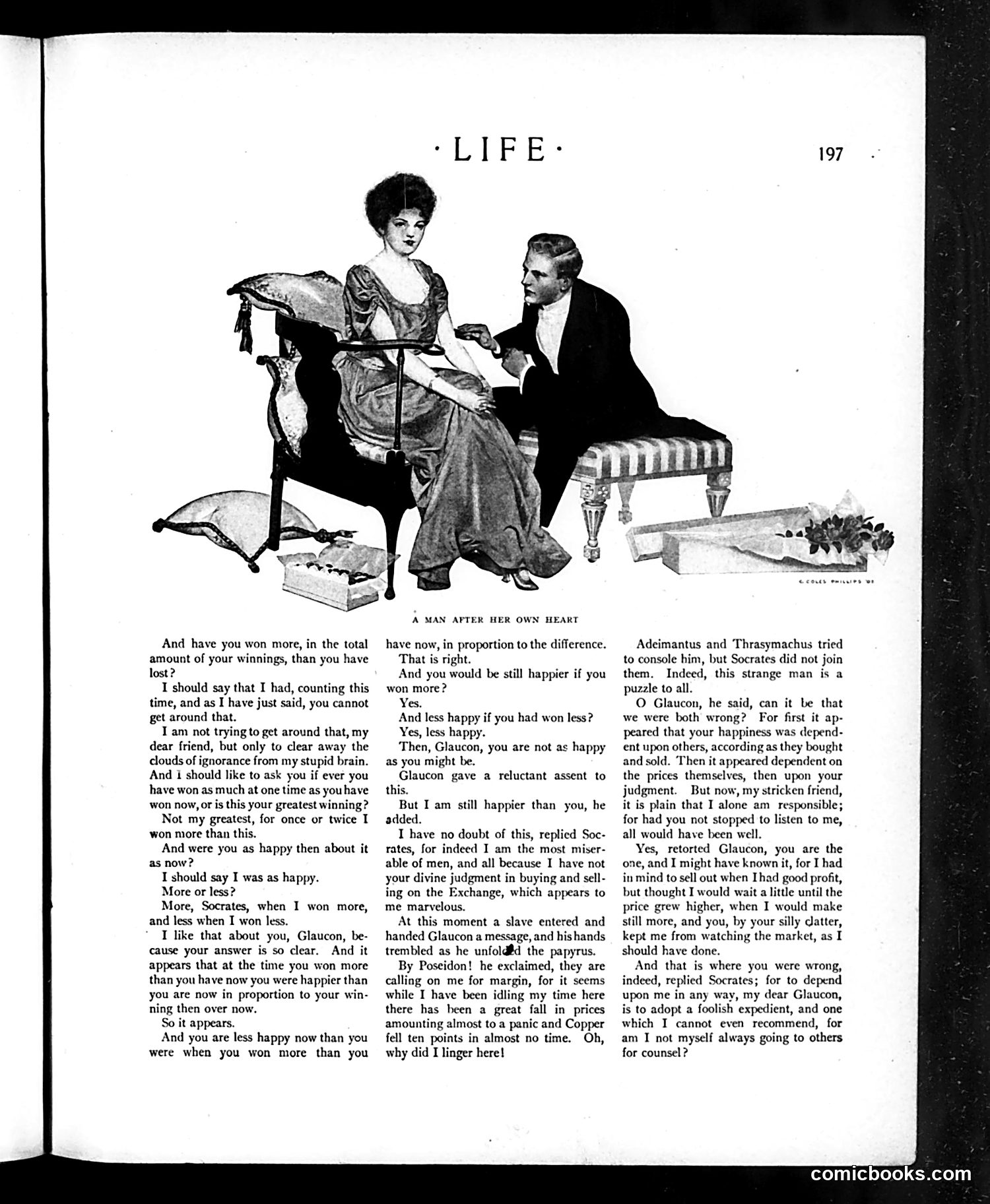
This illustration depicts a wealthy couple—a woman in an elegant gown and a man in formal attire—examining fish they've caught. The satirical caption and accompanying dialogue suggest social commentary on marriage and wealth. The text presents a philosophical debate between characters (Socrates and Glaucon are referenced) about happiness and material gain. The dialogue explores whether winning money brings lasting contentment, with one character arguing that happiness depends on how one obtains wealth rather than the amount acquired. The cartoon likely satirizes upper-class courtship or marriage dynamics, suggesting that a woman seeks a man who shares her materialistic values—someone "after her own heart" because he also pursues wealth and luxury.
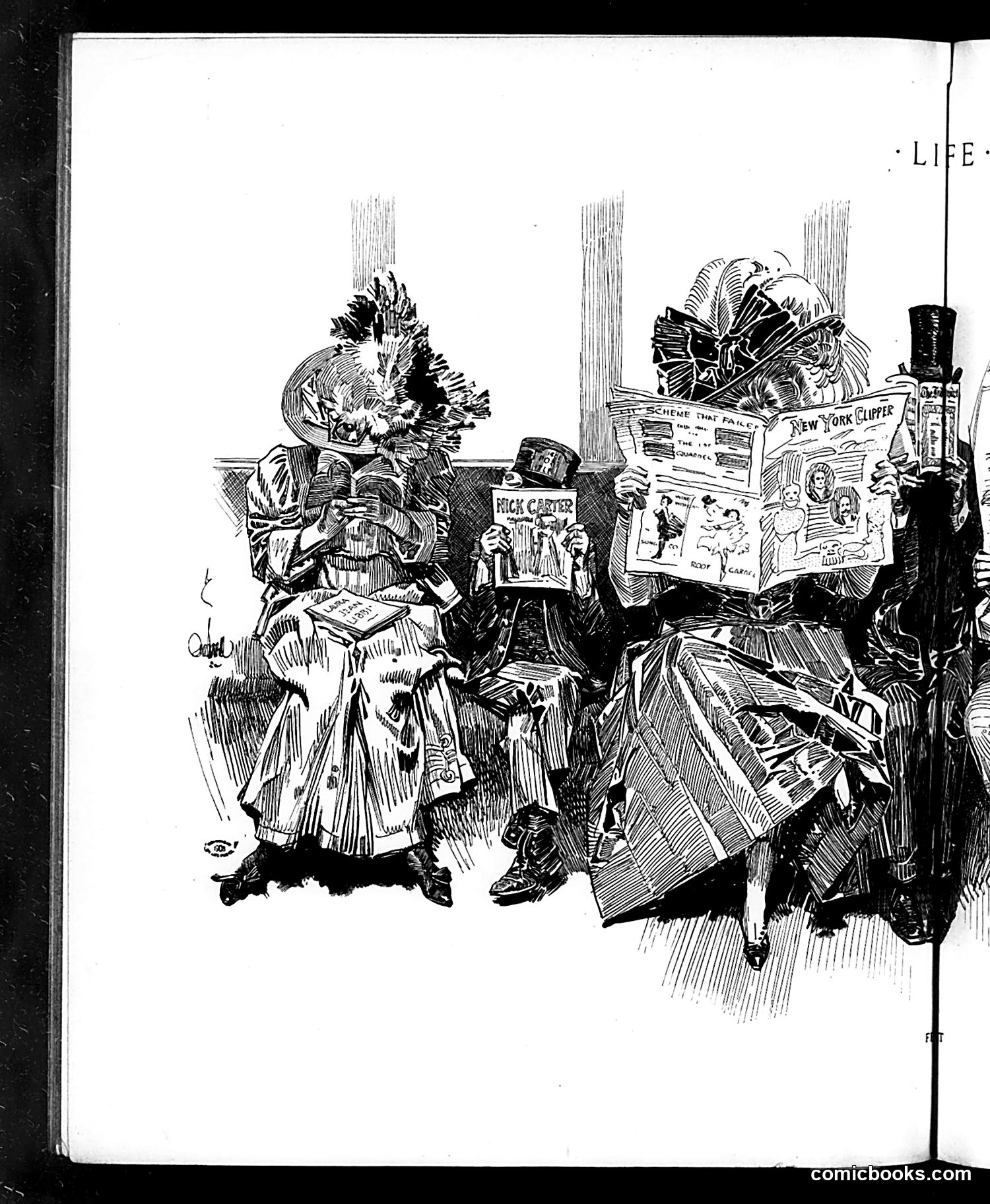
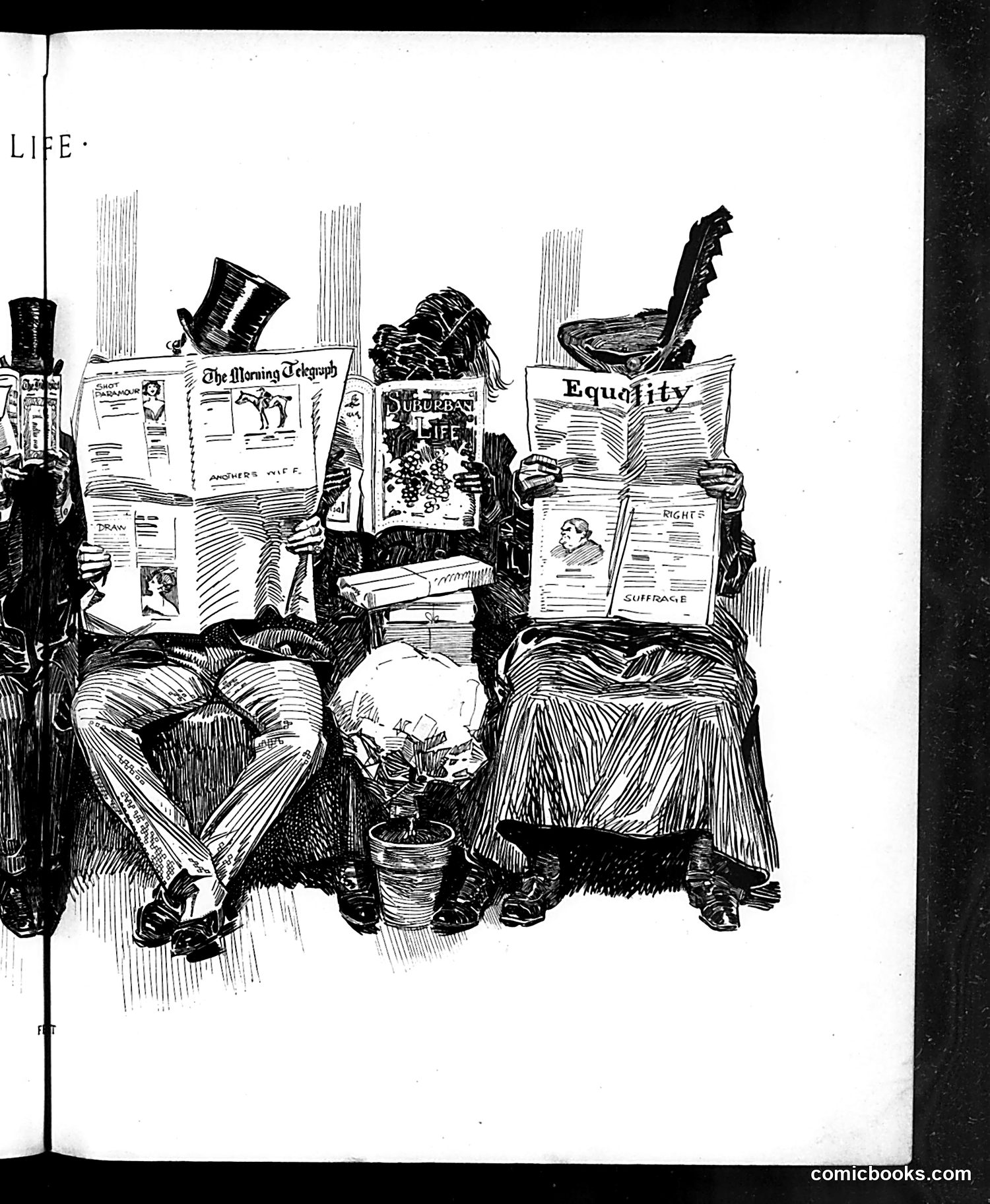
This political cartoon depicts three figures reading newspapers and publications while seated together. The visible publication titles include "The Morning Telegraph," "Success in Life," and "Equality" (which displays "Rights" and "Suffrage"). The cartoon appears to satirize the disconnect between what people *read about* regarding social progress—equality, rights, and suffrage—versus the reality of their lives. The figures' engaged absorption in these idealistic publications, contrasted with their cramped, ordinary seating arrangement, suggests irony about how media and literature promise social change while actual conditions remain unchanged. This likely critiques early 20th-century American journalism's tendency to promote progressive ideals without substantive societal reform, particularly regarding workers' rights and women's suffrage.
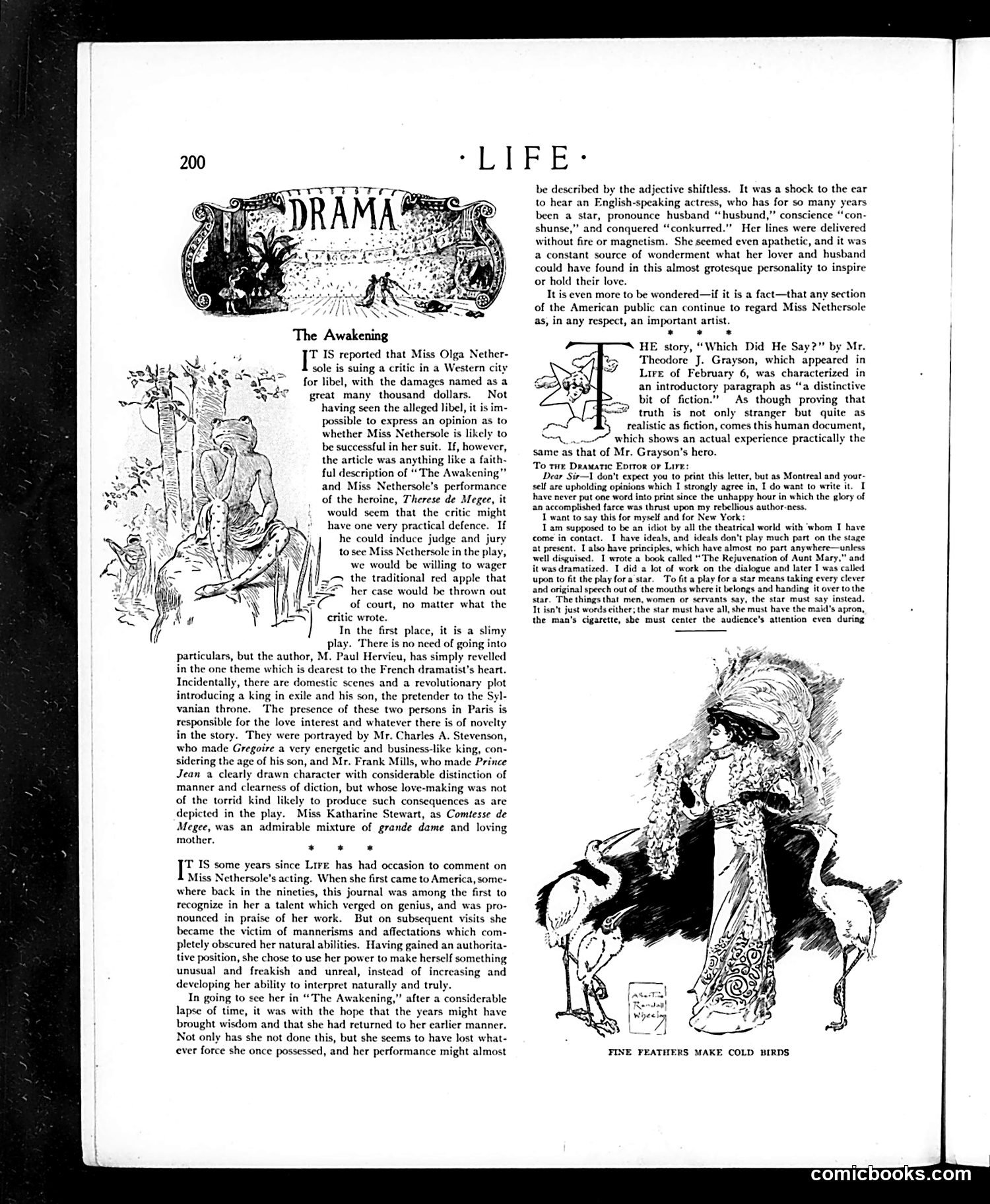
This page critiques actress Olga Nethersole's performance in the play "The Awakening," a French drama about an affair. Life magazine takes a harsh stance, calling the play itself "slimy" and accusing Nethersole of declining artistry through affected mannerisms—mispronouncing words like "husband" as "husbund." The satire works on two levels: the magazine attacks both the morally questionable subject matter (infidelity) and Nethersole's descent from a once-talented performer into an affected, "shiftless" actress. The mention of her libel suit suggests she's litigious about criticism. Life essentially argues that if the critic's description was accurate, the play's own poor quality would be his best defense in court—a cutting implication that seeing her perform would prove the critic's point. The illustration (bottom) shows elegantly dressed figures in period costume, likely depicting a scene from the play.
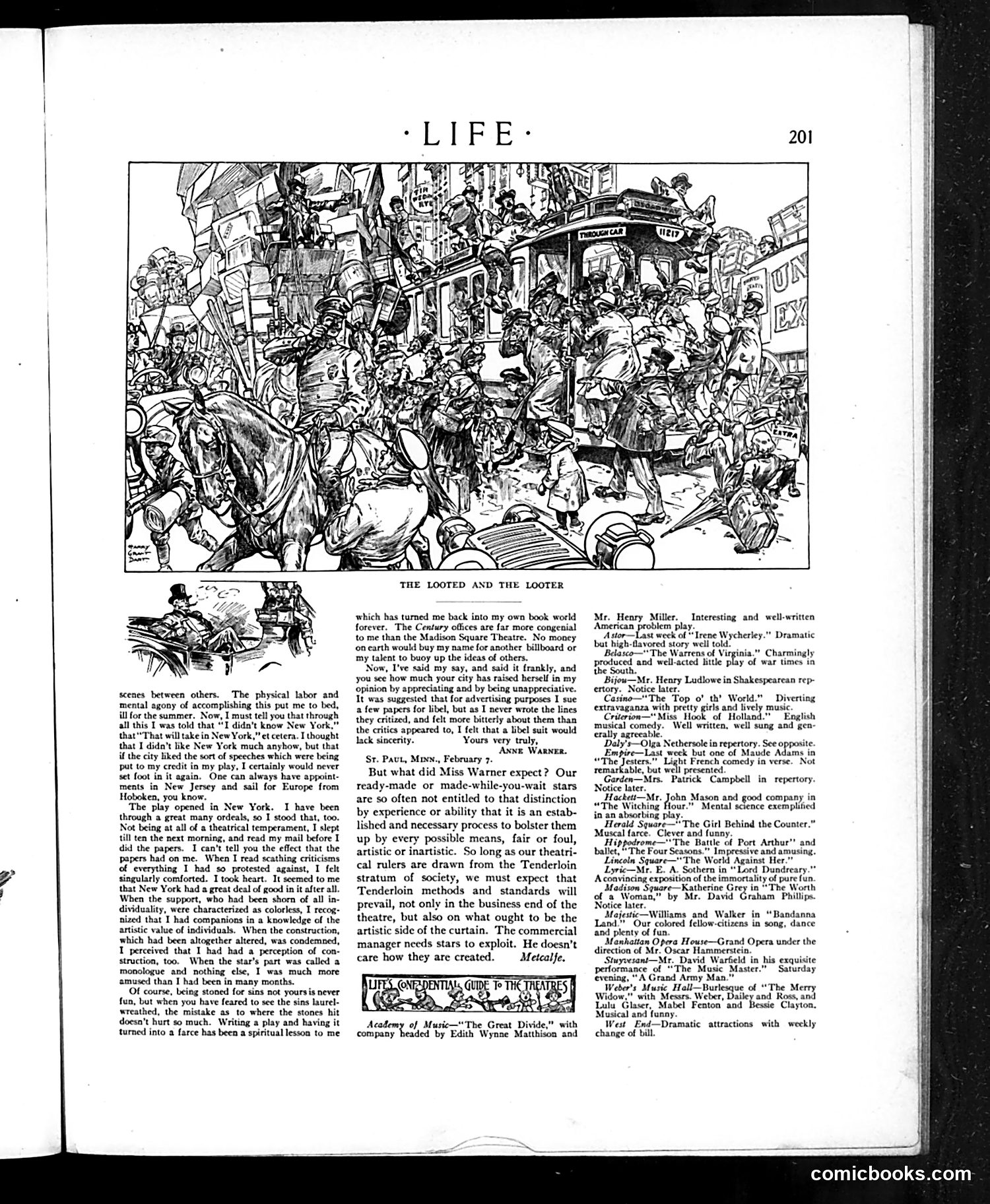
This page features a letter from playwright **Anne Warner** complaining about her theatrical experience in New York. The main cartoon (top) depicts a chaotic street scene titled "The Looted and the Looter," illustrating her grievance. Warner describes having her play altered by producers and stars who added lines she didn't write, then received scathing reviews—which ironically comforted her, since critics condemned the *changes* she'd protested. She concludes that New York's theater world lacks artistic integrity. The editor's response (signed Metcalfe) sardonically agrees: Broadway's commercial managers prioritize exploiting stars over artistic merit, using any means necessary—fair or foul—to promote them. The system rewards appearance over substance. For modern readers: this satirizes how commercial entertainment prioritizes marketing and profit over artistic authenticity, a timeless complaint about show business compromising creative vision.
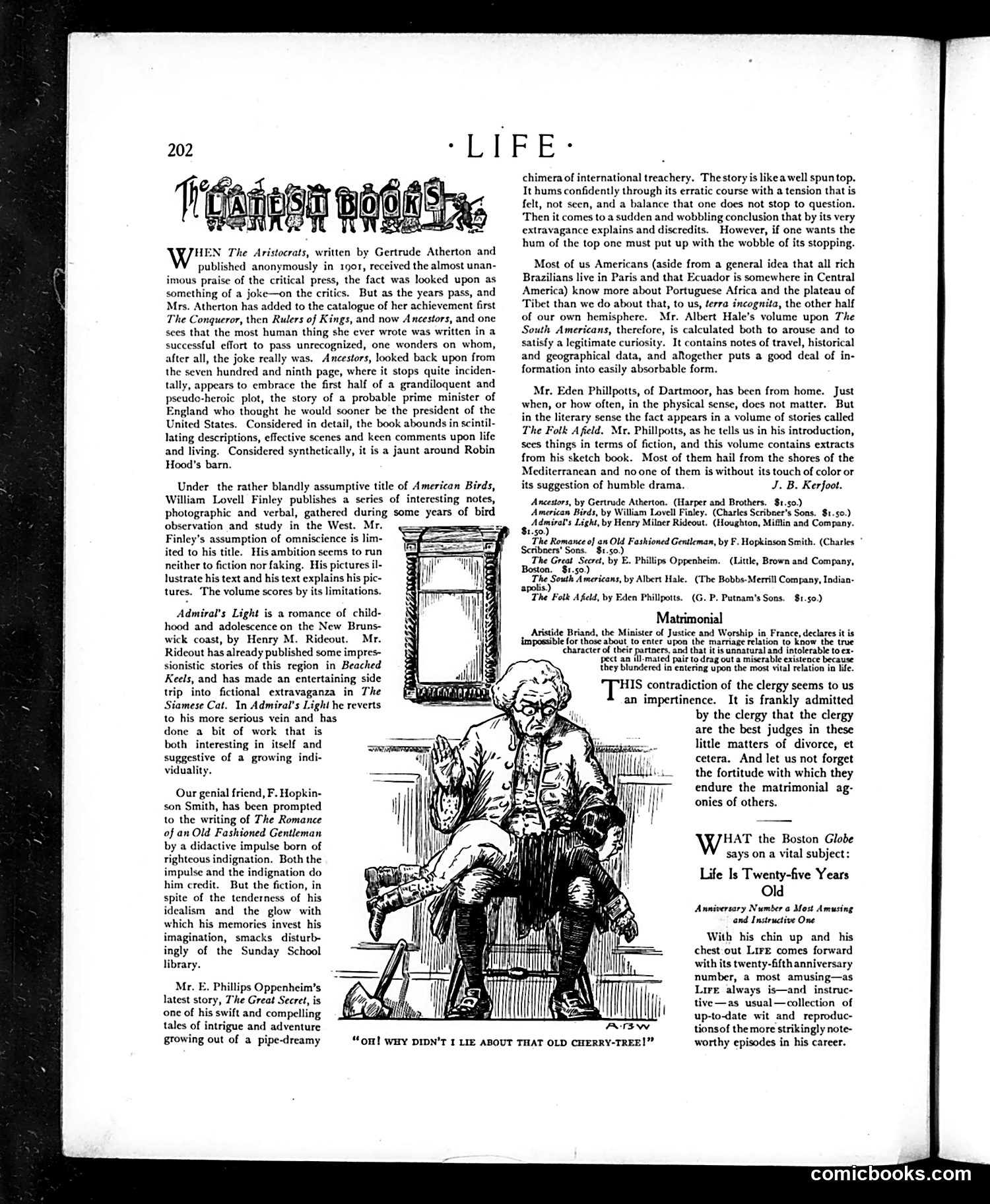
This page contains literary reviews rather than political cartoons. The single illustration depicts an elderly man in period dress (possibly 18th-19th century), exclaiming "Oh! why didn't I lie about that old cherry-tree!"—a reference to the famous (likely apocryphal) story of young George Washington confessing to chopping down his father's cherry tree. The joke critiques American mythology: the caption suggests that even Washington's most celebrated virtue—his honesty—might have been fabricated. By having the aged figure regret *not* lying about the cherry tree, the cartoon mocks how Americans reverence historical legends that may themselves be dishonest inventions. The page reviews contemporary novels by Gertrude Atherton, William Lovell Finley, Henry M. Rideout, F. Hopkinson Smith, E. Phillips Oppenheim, and Albert Hale's *The South Americans*, offering literary criticism typical of Life's sophisticated readership.
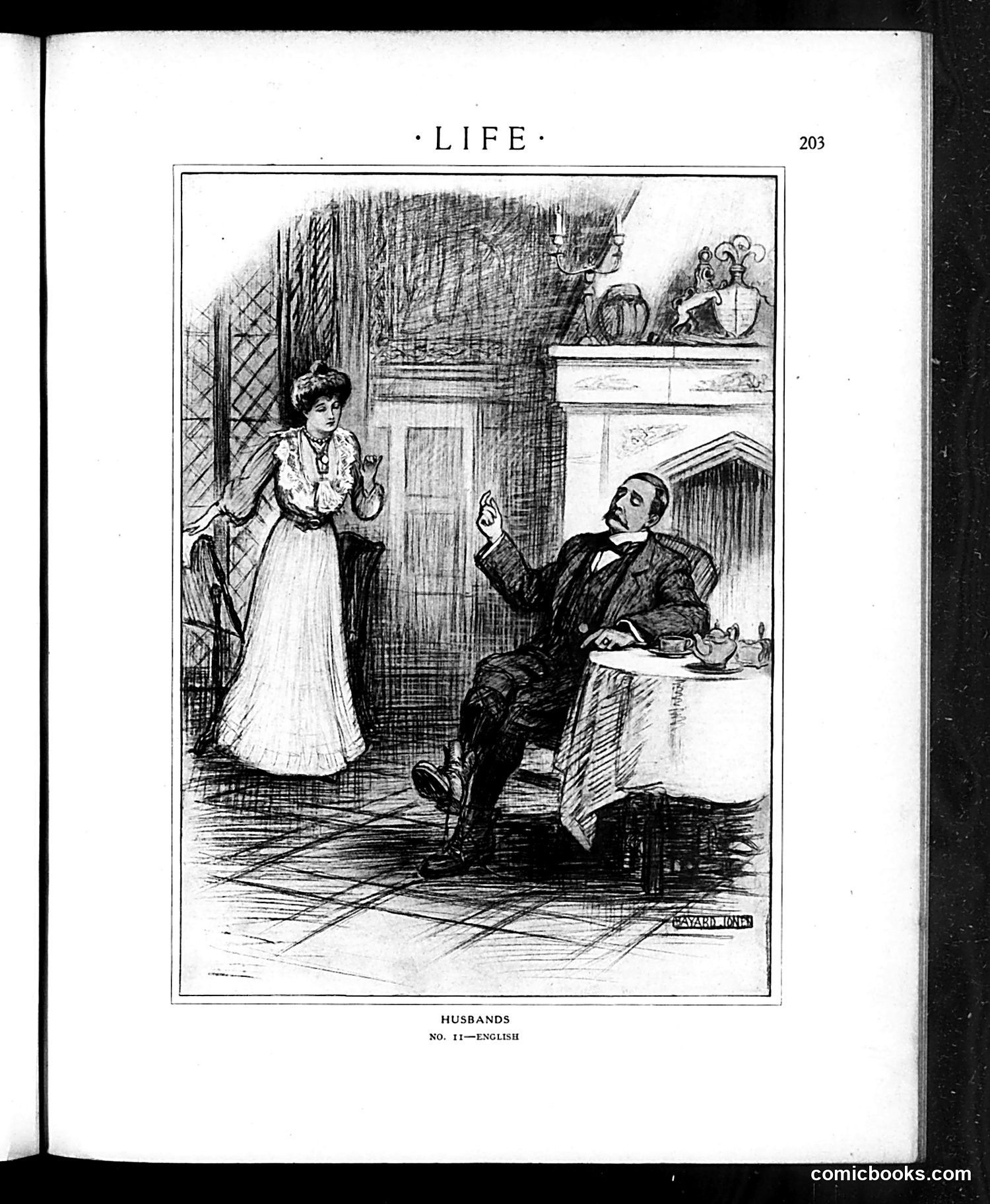
This satirical cartoon depicts a domestic scene titled as the eleventh in a series about English husbands. A woman in an elegant Edwardian dress stands assertively while a man sits at a small table with tea service, looking upward with apparent exasperation or pleading. The composition suggests role reversal or marital tension—likely satirizing the "English husband" archetype of the era. The cartoon appears to mock domestic power dynamics, possibly commenting on wives' authority over husbands in English households, or critiquing male passivity. Without additional context about this specific series, the exact social commentary remains somewhat unclear, though it evidently plays on contemporary stereotypes about English marital relationships for humorous effect.
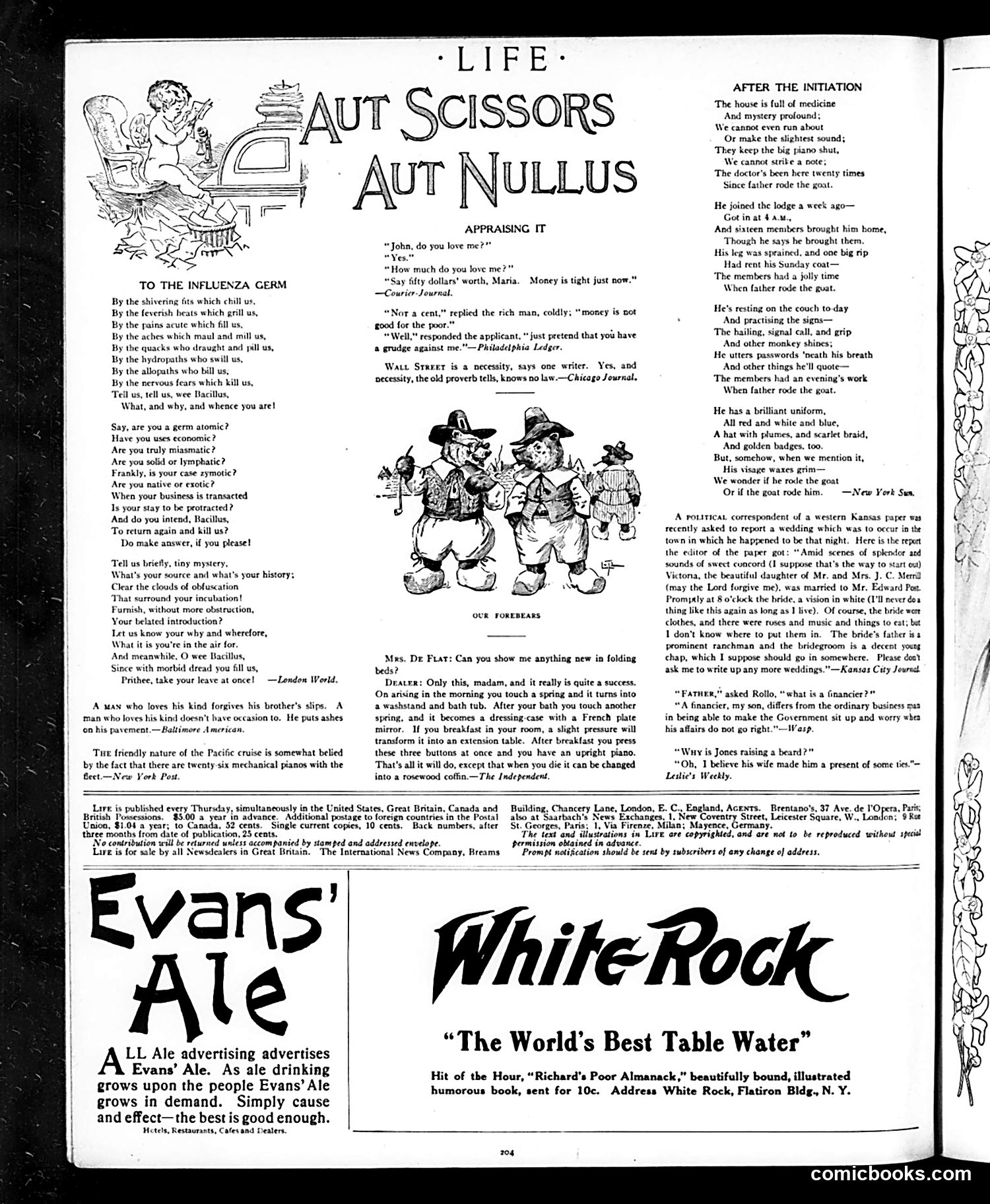
This page contains three distinct satirical pieces: **"To the Influenza Germ"** (left column): A mock-formal interrogation poem addressing the influenza virus, personified as "wee Bacillus." It sarcastically demands the germ explain itself—its origins, purpose, and duration—while humorously cataloging flu symptoms (fever, aches) and quack treatments. The satire targets both the mysterious illness itself and the medical charlatans profiting from it. **"Our Forebears"** (center): A brief cartoon and joke mocking husbands' attempts to impress wives with expensive, over-engineered furniture that serves multiple purposes (bed-washstand-dressing case-piano-coffin). It satirizes materialist marriages and conspicuous consumption. **"After the Initiation"** (right): A humorous poem about a man's hazing during fraternal lodge initiation. It describes the physical damage and ridiculous rituals (passwords, monkey-shine signs), culminating in the joke that he rode a goat—or perhaps the goat rode *him*—leaving readers uncertain which actually happened. All pieces employ period-typical satirical verse and gentle mockery of contemporary social customs.
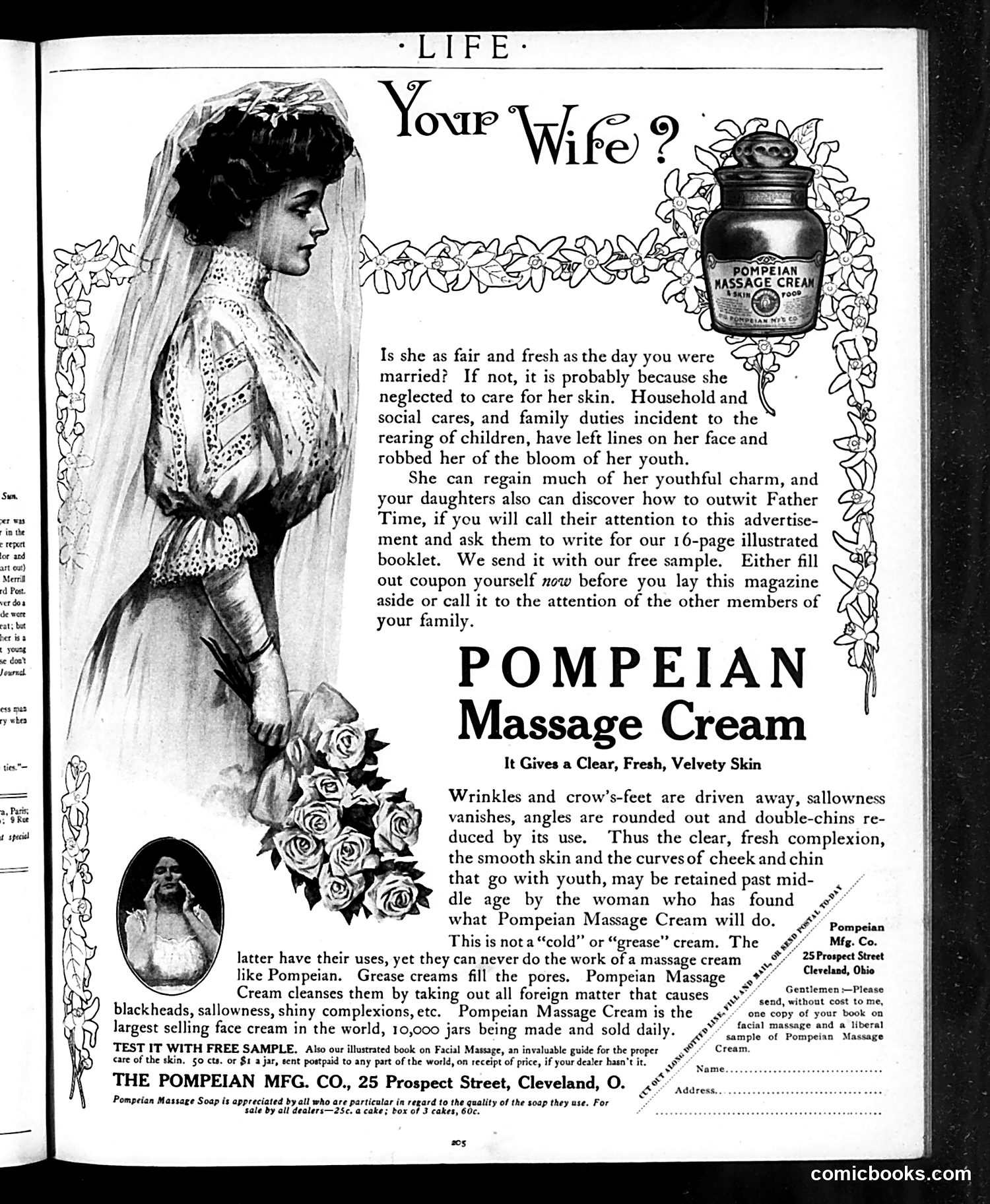
This is primarily a **beauty product advertisement**, not satire or political content. It promotes Pompeian Massage Cream to female readers. The ad uses guilt-based messaging typical of early 20th-century marketing: it suggests wives have lost their youthful beauty due to household duties and child-rearing, implying this makes them less attractive to husbands ("Is she as fair and fresh as the day you were married?"). The solution—applying the cream—will restore "youthful charm" and prevent aging signs like wrinkles, sagging skin, and double chins. The illustration shows an idealized bride in wedding attire, contrasting the youthful appearance women supposedly lose through domestic life. The ad encourages husbands to direct wives and daughters to the product, reflecting the era's paternalistic attitudes about women's appearance as a marital obligation. There is no political cartoon here—this is straightforward commercial messaging that reveals period attitudes about women, aging, beauty standards, and consumerism rather than offering satire.
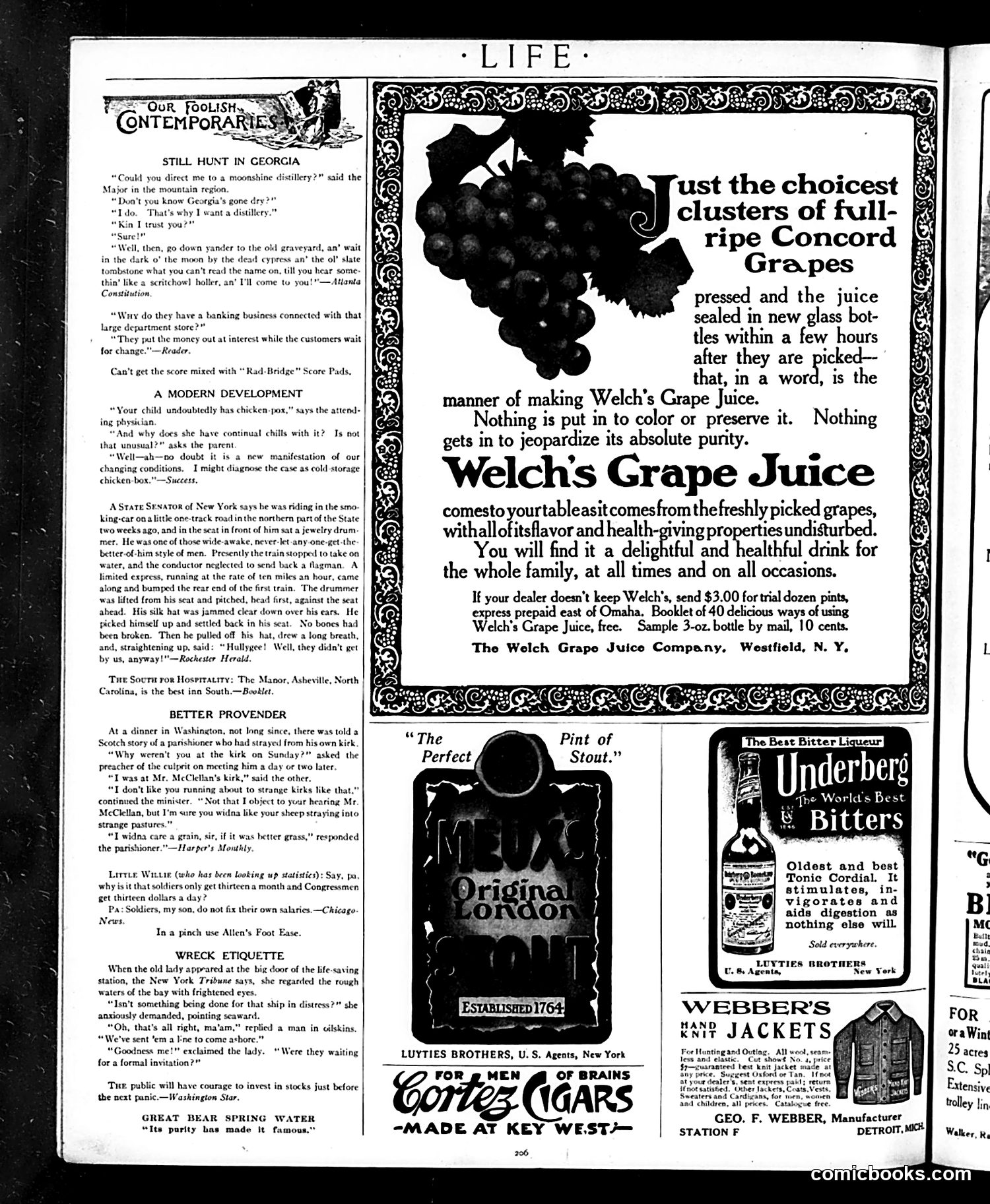
This page is primarily **advertising**, not political satire. The dominant content is a large Welch's Grape Juice advertisement featuring an illustration of dark grape clusters, emphasizing the product's purity and freshness. The left column contains brief humorous anecdotes labeled "Our Foolish Contemporaries"—short, satirical observations about everyday life rather than political cartoons. These include jokes about moonshine in Georgia, banking practices, childhood illnesses, and train accidents. The humor is gentle social commentary on contemporary customs and absurdities, not pointed political criticism. The remaining advertisements promote Underberg Bitters, Webber's Knit Jackets, and Coffee Cigars. **No identified political figures or events appear on this page.** It represents typical early 20th-century magazine content mixing light humor with commercial messaging.
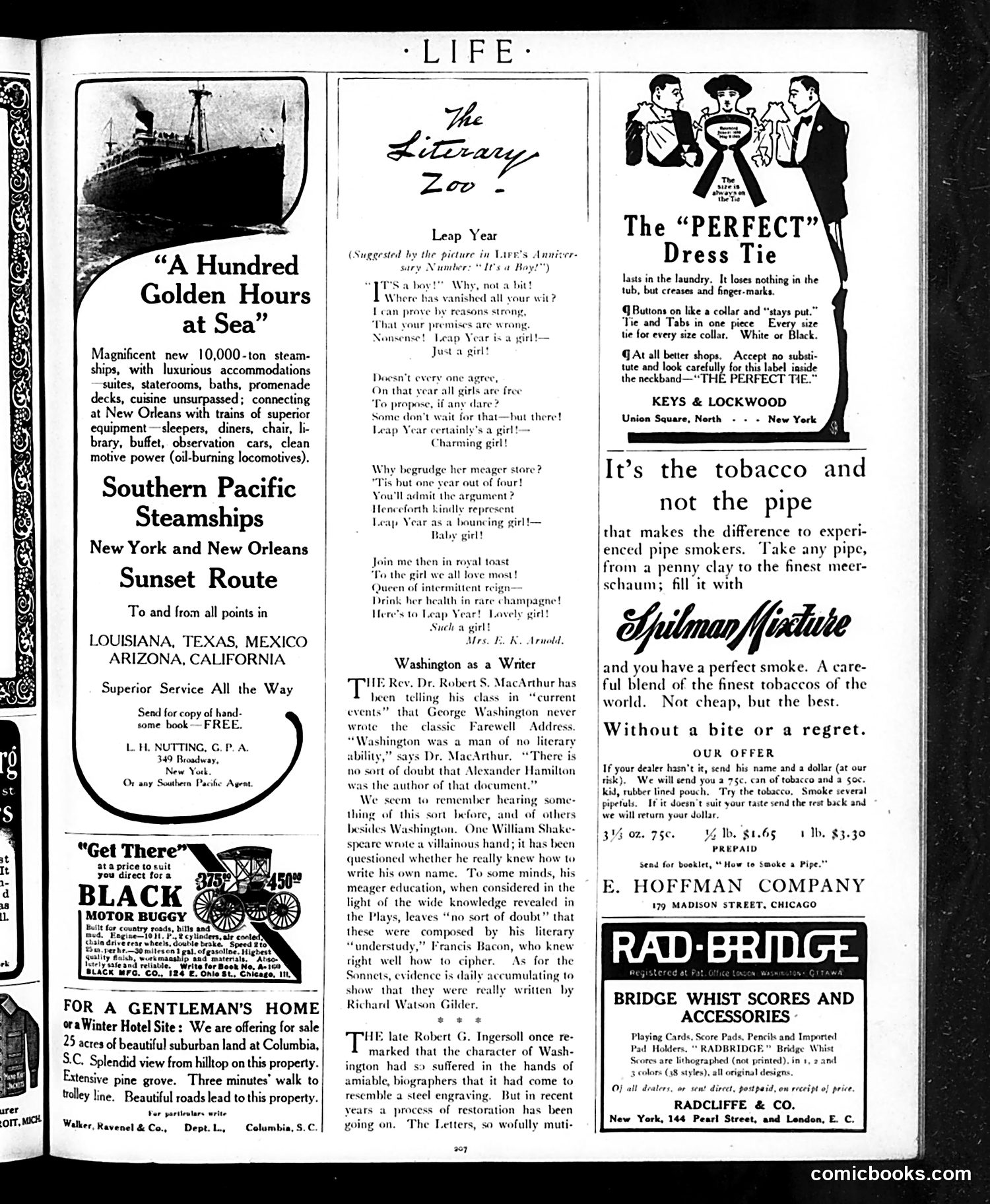
This page is primarily **advertising** with one satirical article. The main content is **"The Literary Zoo,"** a humorous essay mocking the scholarly attribution debates of the era. The author ridicules Dr. MacArthur's claim that Alexander Hamilton wrote Washington's Farewell Address by drawing absurd parallels: just as scholars question whether Shakespeare wrote his own plays (attributing them to Francis Bacon), perhaps Washington didn't write his famous address either. The satire targets the pretentious academic practice of denying historical figures authorship of their own works based on insufficient evidence. The page is otherwise filled with period advertisements for steamships, motor cars, real estate, dress ties, and tobacco—typical of *Life* magazine's commercial content. No political cartoons are present; the satire is purely textual.
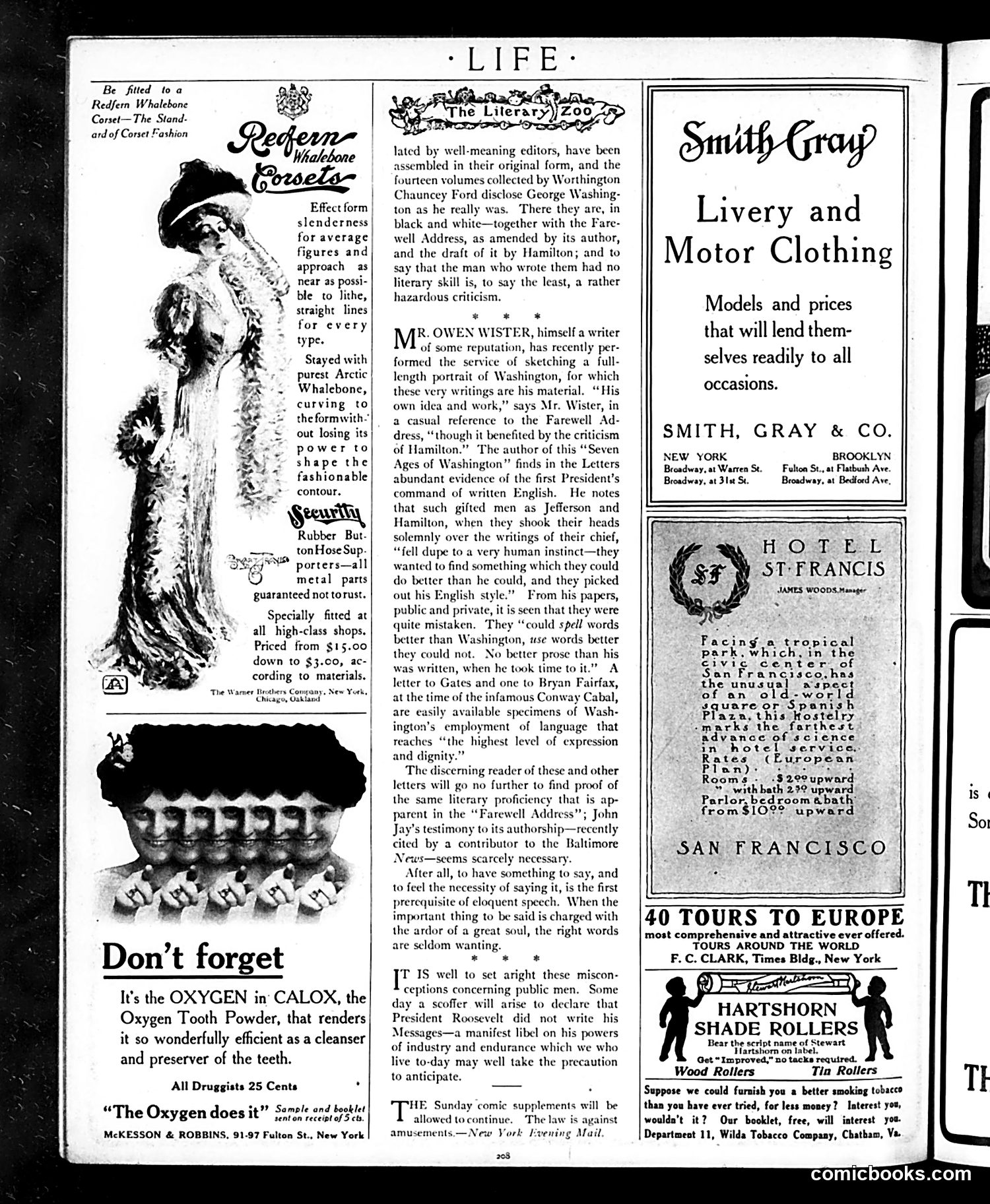
This page is primarily **advertising and editorial content** rather than political satire. The main elements are: **Left side**: Fashion advertisements for Redfern corsets and Calox tooth powder, featuring illustrated women in period dress—typical early 20th-century promotional material emphasizing "slenderness" and fashionable silhouettes. **Center**: A lengthy literary essay discussing George Washington's writing ability and eloquence, referencing Owen Wister's biographical work "Seven Ages of Washington." The piece defends Washington against claims that Hamilton improved his writing, citing letters and the Farewell Address as evidence of his literary skill. **Right side**: Travel and hospitality advertisements—the Hotel St. Francis in San Francisco, European tours, and clothing retailers (Smith, Gray & Co.). **The satire section** ("The Literary Zoo" header visible) appears to discuss editorial misconceptions about public figures, but the specific cartoon or satirical illustration is not clearly visible in this image reproduction. The page functions primarily as a commercial publication mixed with cultural commentary.
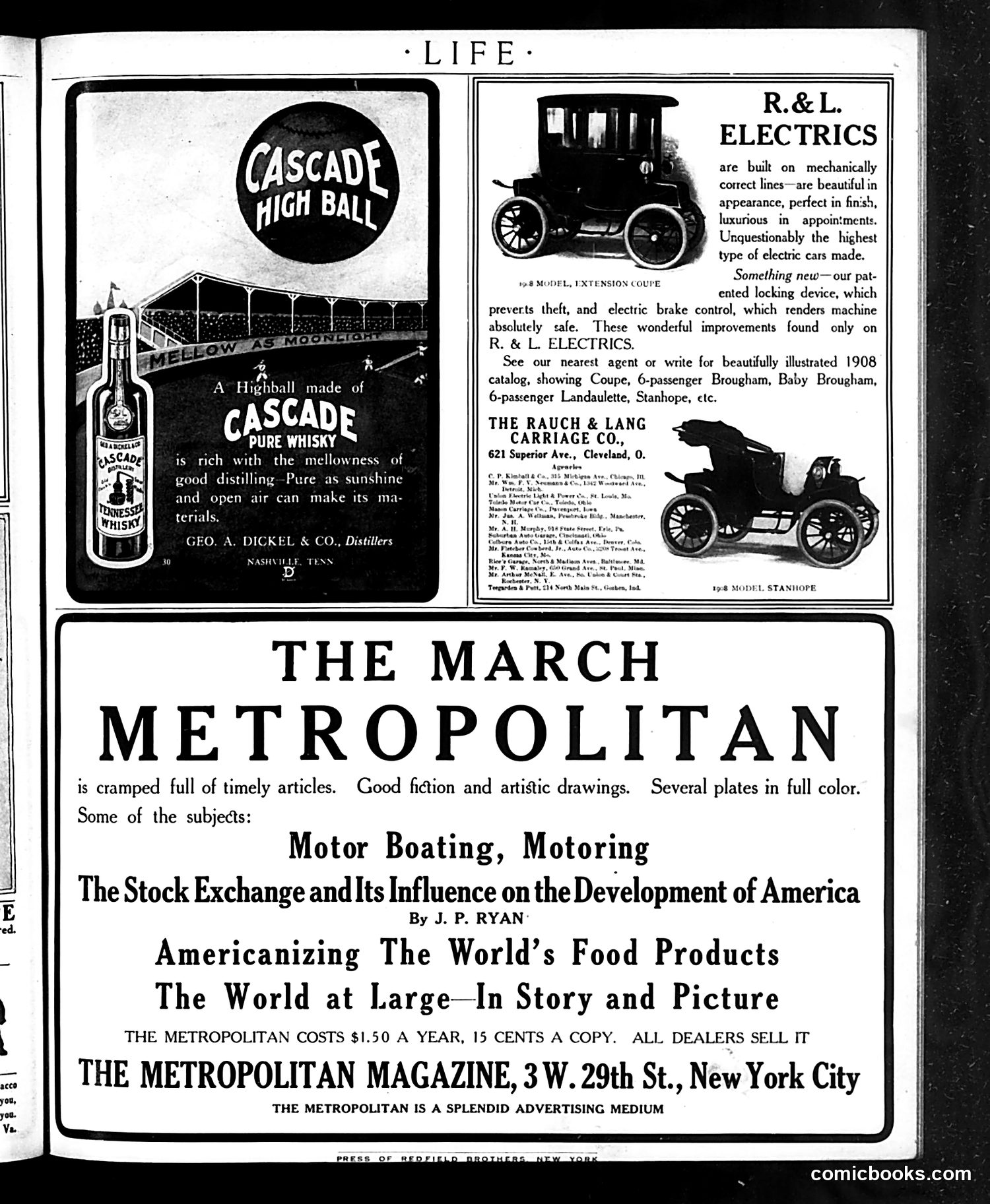
This page is primarily **advertising**, not satire or political commentary. It contains three distinct ads: 1. **Cascade Pure Whisky** (left): A straightforward product advertisement emphasizing the whisky's purity and quality—typical early 1900s liquor marketing before Prohibition. 2. **R&L Electrics** (right): Promotes electric automobiles as luxury vehicles with safety features like a "patented locking device" against theft and electric brakes. This reflects the era when electric cars competed with gasoline models as a viable transportation option. 3. **The March Metropolitan Magazine** (bottom): Promotes the magazine's March issue, listing article topics including motoring, stock markets, and food production—reflecting contemporary middle-class interests. The page captures early-1900s consumer culture and emerging technologies (automobiles, electric vehicles) before such advertising became regulated. There is no political satire visible.
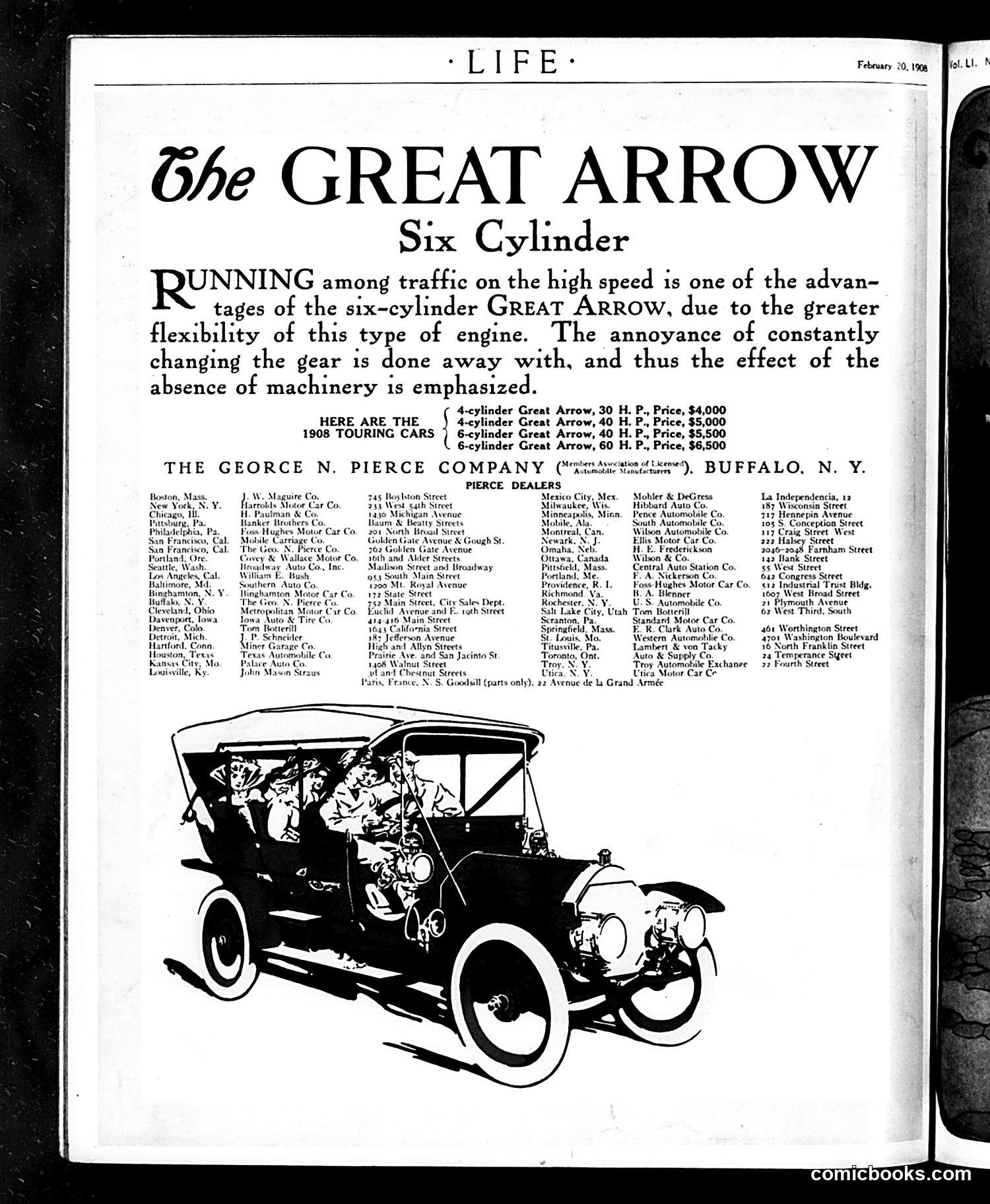
This is primarily an **automobile advertisement**, not political satire. It appears in *Life* magazine from February 20, 1908 (not 1903 as the OCR suggests). The page promotes the **Great Arrow**, a six-cylinder touring car manufactured by the George N. Pierce Company of Buffalo, New York. The illustration shows a stylized drawing of the vehicle with well-dressed passengers, emphasizing its modern engineering and reliability. The advertisement's main selling point is that the six-cylinder engine provides superior **flexibility in traffic**—eliminating the need for constant gear-shifting, a common annoyance with four-cylinder vehicles of the era. The text emphasizes this mechanical advantage as evidence of advanced automotive engineering. Multiple models are listed with prices ($4,000-$6,500), along with an extensive dealer network across North America, demonstrating the company's market reach during the early automobile boom. This is a straightforward commercial advertisement with no apparent satirical content or political commentary.