
Life, 1908-02-20 · page 7 of 24
Life — February 20, 1908 — page 7: what you’re looking at
What you’re looking at
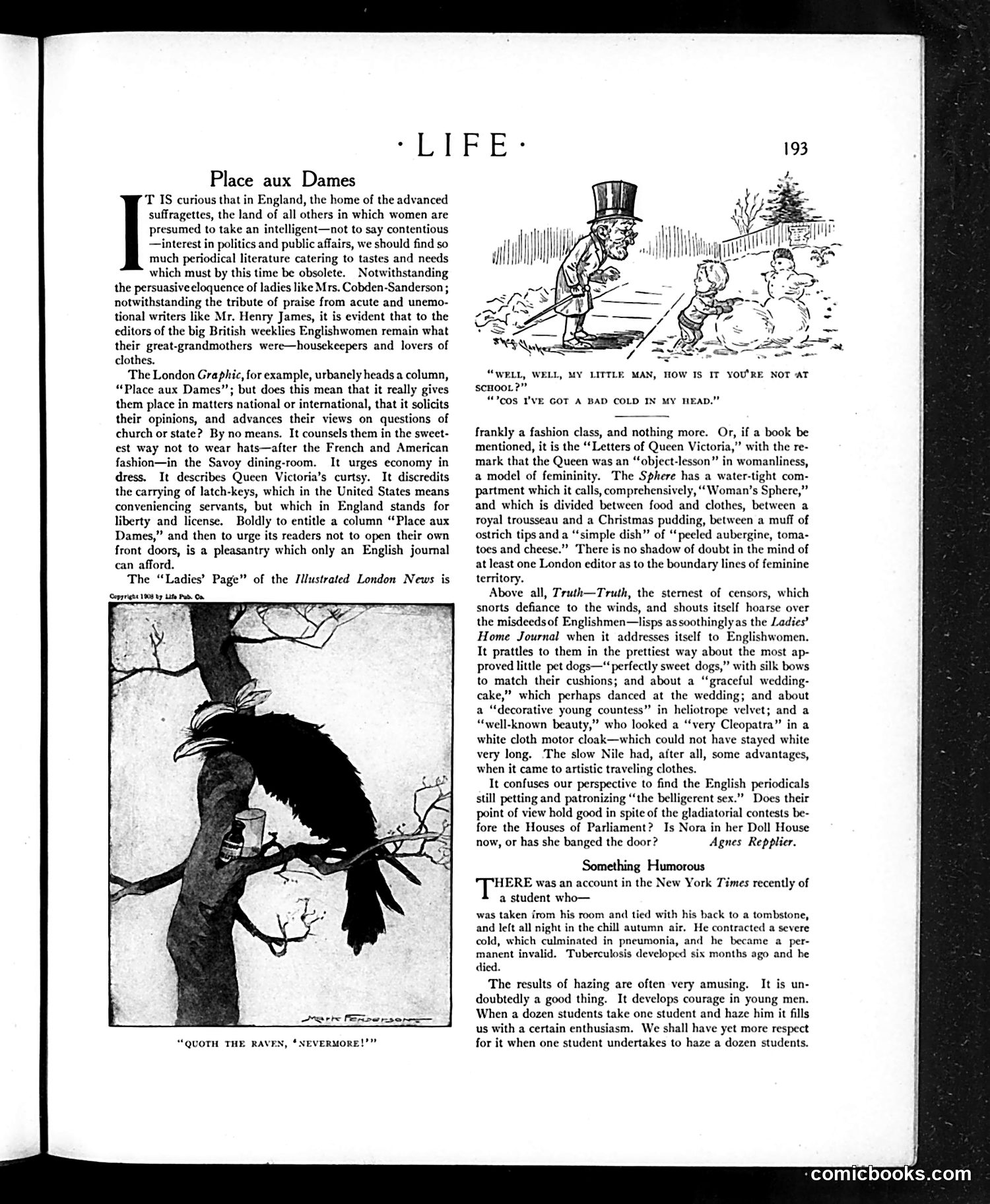
**Top Cartoon:** Shows a well-dressed man with a top hat scolding a young boy about school attendance. The boy claims he has a cold. This illustrates a common domestic scene satirizing parental authority and childhood excuses. **Bottom Illustration:** Depicts a large raven perched on a bare branch with the caption "QUOTH THE RAVEN, 'NEVERMORE!'" This references Edgar Allan Poe's famous 1845 poem "The Raven," likely used as decorative illustration rather than satire. The page's main article, "Place aux Dames," critiques British periodicals for trivializing women's intellectual capacity by publishing fashion-focused content instead of serious journalism. The text argues these publications underestimate female readers' intelligence and interests.
📄 Transcribed text from this page (OCR, searchable)
Machine-transcribed from the original scan — historical spelling and the odd misread are preserved.
* LIFE * Place aux Dames T IS curious that in England, the home of the advanced suffragettes, the land of all others in which women are presumed to take an intelligent—not to say contentious —interest in politics and public affairs, we should find so much periodical literature catering to tastes and needs which must by this time be obsolete. Notwithstanding the persuasive eloquence of ladies like Mrs. Cobden-Sanderson ; notwithstanding the tribute of praise from acute and unemo- tional writers like Mr. Henry James, it is evident that to the editors of the big British weeklies Englishwomen remain what their great-grandmothers were—housekeepers and lovers of clothes. The London Graphic, for example, urbanely heads a column, “Place aux Dames”; but does this mean that it really gives them place in matters national or international, that it solicits their opinions, and advances their views on questions of church or state? By no means. It counsels them in the sweet- est way not to wear hats—after the French and American fashion—in the Savoy dining-room. It urges economy in dress. It describes Queen Victoria’s curtsy. It discredits the carrying of latch-keys, which in the United States means conveniencing servants, but which in England stands for liberty and license. Boldly to entitle a column “Place aux Dames,” and then to urge its readers not to open their own front doors, is a pleasantry which only an English journal can afford. The ‘Ladies’ Page” of the Illustrated London News is Cepyright 1908 by Life Pa. On “QUOTH THE RAVEN, ‘NEVERMORE!’”” Wi linggrte 1H | “WELL, WELL, MY LITTLE MAN, HOW IS IT YOU'RE NOT AT SCHOOL?” “CoS I'VE GOT A BAD COLD IN MY HEAD.” frankly a fashion class, and nothing more. Or, if a book be mentioned, it is the ‘‘Letters of Queen Victoria,” with the re- mark that the Queen was an “object-lesson” in womanliness, a model of femininity. The Sphere has a water-tight com- partment which it calis, comprehensively, “Woman’s Sphere,” and which is divided between food and clothes, between a royal trousseau and a Christmas pudding, between a muff of ostrich tips and a ‘simple dish” of “peeled aubergine, toma- toes and cheese.” There is no shadow of doubt in the mind of at least one London editor as to the boundary lines of feminine territory. Above all, Truth—Truth, the sternest of censors, which snorts defiance to the winds, and shouts itself hoarse over the misdeeds of Englishmen—lisps as soothingly as the Ladies? Home Journal when it addresses itself to Englishwomen. It prattles to them in the prettiest way about the most ap- proved little pet dogs—“ perfectly sweet dogs,” with silk bows to match their cushions; and about a “graceful wedding- cake,” which perhaps danced at the wedding; and about a “decorative young countess” in heliotrope velvet; and a “well-known beauty,” who looked a ‘‘very Cleopatra” in a white cloth motor cloak—which could not have stayed white very long. The slow Nile had, aiter all, some advantages, when it came to artistic traveling clothes. It confuses our perspective to find the English periodicals still petting and patronizing ‘“‘the belligerent sex.” Does their point of view hold good in spite of the gladiatorial contests be- fore the Houses of Parliament? Is Nora in her Doll House now, or has she banged the door? Agnes Repplier. Something Humorous 'HERE was an account in the New York Times recently of a student who— was taken irom his room and tied with his back to a tombstone, and left all night in the chill autumn air. He contracted a severe cold, which culminated in pneumonia, and he became a per- manent invalid. Tuberculosis developed six months ago and he died. The results of hazing are often very amusing. It is un- doubtedly a good thing. It develops courage in young men. When a dozen students take one student and haze him it fills us with a certain enthusiasm. We shall have yet more respect for it when one student undertakes to haze a dozen students. -comicbooks.com