
Life, 1908-02-20 · page 14 of 24
Life — February 20, 1908 — page 14: what you’re looking at
What you’re looking at
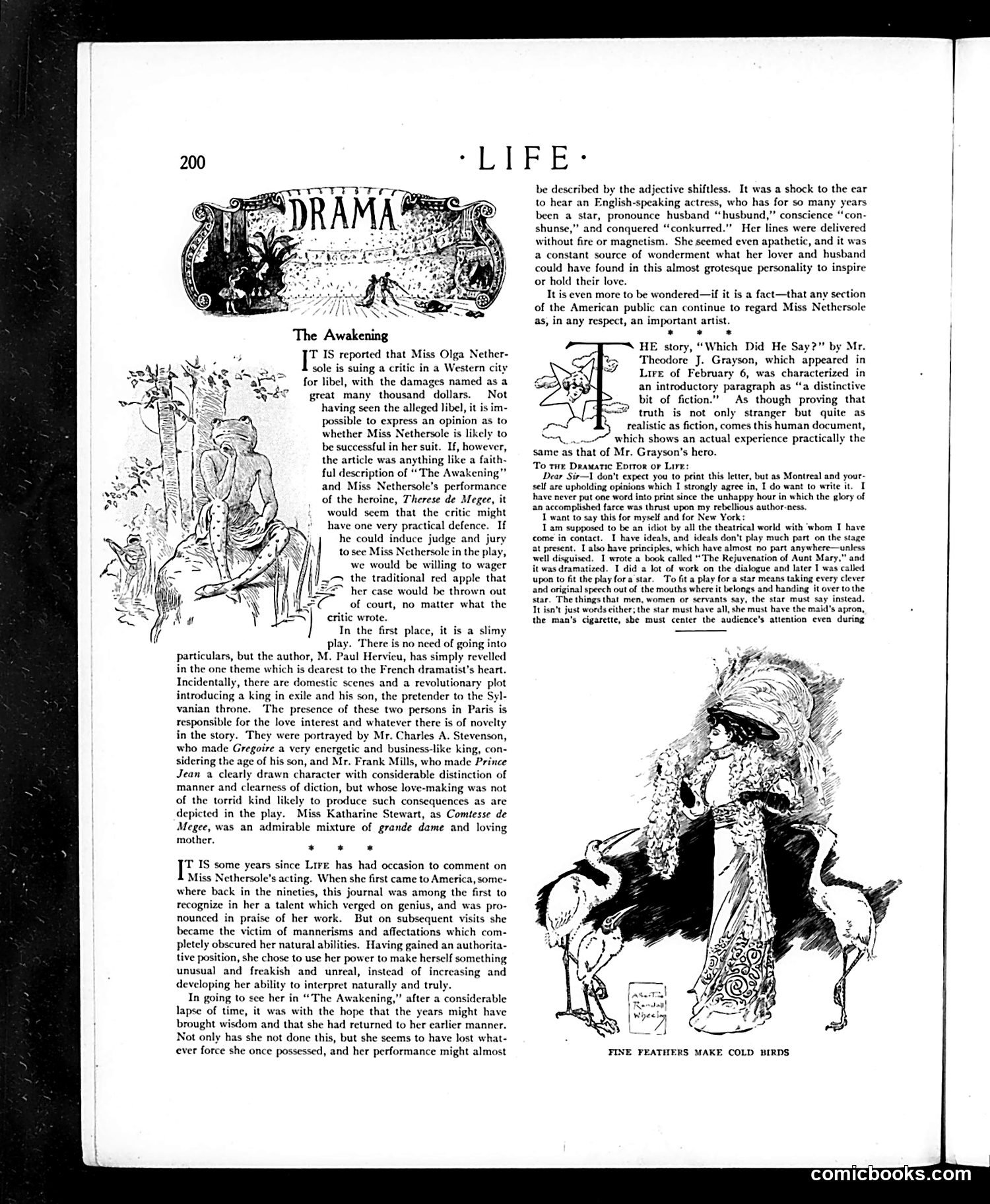
This page critiques actress Olga Nethersole's performance in the play "The Awakening," a French drama about an affair. Life magazine takes a harsh stance, calling the play itself "slimy" and accusing Nethersole of declining artistry through affected mannerisms—mispronouncing words like "husband" as "husbund." The satire works on two levels: the magazine attacks both the morally questionable subject matter (infidelity) and Nethersole's descent from a once-talented performer into an affected, "shiftless" actress. The mention of her libel suit suggests she's litigious about criticism. Life essentially argues that if the critic's description was accurate, the play's own poor quality would be his best defense in court—a cutting implication that seeing her perform would prove the critic's point. The illustration (bottom) shows elegantly dressed figures in period costume, likely depicting a scene from the play.
📄 Transcribed text from this page (OCR, searchable)
Machine-transcribed from the original scan — historical spelling and the odd misread are preserved.
‘LIFE: The Awakening i IS reported that Miss Olga Nether- sole is suing a critic in a Western city for libel, with the damages named as a great many thousand dollars. Not having seen the alleged libel, it is im- possible to express an opinion as to whether Miss Nethersole is likely to be successful in her suit. If, howe the article was anything like a faith- ful description of “The Awakening” and Miss Nethersole’s performance of the heroine, Therese de Megee, it would seem that the critic might have one very practical defence. If he could induce judge and jury to see Miss Nethersole in the play, | we would be willing to wager i > the traditional red apple that her case would be thrown out critic wrote. In the first place, it is a slimy play. ‘There is no need of going into particulars, but the author, M. Paul Hervicu, has simply revelled in the one theme which is dearest to the French dramatist’s heart. Incidentally, there are domestic scenes and a revolutionary plot introducing a king in exile and his son, the pretender to the vanian throne. The presence of these two persons in Paris responsible for the love interest and whatever there is of novelty in the story. They were portrayed by Mr. Charles A. Stevenson, who made Gregoire a very energetic and business-like king, con- sidering the age of his son, and Mr. Frank Mills, who made Prince Jean a clearly drawn character with considerable distinction of manner and clearness of diction, but whose love-making was not of the torrid kind likely to produce such consequences as are depicted in the play. Miss Katharine Stewart, as Comtesse de Megee, was an admirable mixture of grande dame and loving mother. os xe ‘ " C of court, no matter what the * * « T IS some years since Lire has had occasion to comment on Miss Nethersole’s acting. When she first came to America, some- where back in the nineties, this journal was among the first to recognize in her a talent which verged on genius, and was pro- nounced in praise of her work. But on subsequent visits she became the victim of mannerisms and affectations which com- pletely obscured her natural abilities. Having gained an authorita- tive position, she chose to use her power to make herself something unusual and freakish and unreal, instead of increasing and developing her ability to interpret naturally and truly. In going to sce her in “The Awakening,” after a considerable lapse of time, it was with the hope that the years might have brought wisdom and that she had returned to her earlier manner. Not only has she not done this, but she seems to have lost what- ever force she once possessed, and her performance might almost be described by the adjective shiftless. It was a shock to the car to hear an English-speaking actress, who has for so many years been a star, pronounce husband “husbund,” conscience “con- shunse,” and conquered “conkurred.” Her lines were delivered without fire or magnetism. She seemed even apathetic, and it was a constant source of wonderment what her lover and husband could have found in this almost grotesque personality to inspire or hold their love. It is even more to be wondered—if it is a fact—that any section of the American public can continue to regard Miss Nethersole as, in any respect, an important artist. * * 8 HE story, “Which Did He Say?” b ‘Theodore J. Grayson, which appeared in Lire of February 6, was characterized in an introductory paragraph as “a distinctive bit of fiction.” As though proving that truth is not only stranger but quite as realistic as fiction, comes this human document, SL which shows an actual experience practically the same as that of Mr. Grayson’s hero. To tHe Drawatic Eprror or Dear Sir don't expect you to print this letter, but as Montreal and your- self are upholding opinions which I strongly agree in, I do want to write it. I have never put one word into print since the unhappy hour in which the glory of an accomplished farce was thrust upon my rebellious author-ness. I want to say this for myself and for New York: Tam supposed to be an idiot by all the theatrical world with ‘whom T have come in contact. I have ideals, and ideals don't play much part on the stage at present. I also have principles, which have almost no part anywhere—unless well disguised. I wrote a book called “The Rejuvenation of Aunt Mary,” and it was dramatized. I did a lot of work on the dialogue and later I was called. upon to fit the play fora star. To fit a play for a star means taking every clever and original speech out of the mouths where it belongs and handing it over to the star. The things that men, women or servants say, the star must say instead. It isn't just words either; the star must have all, she must have the maid’s apron, the man’s cigarette, sbe must center the audience's attention even during FINE FEATHERS MAKE COLD BIRDS comicbooks.com