
Life, 1908-02-20 · page 6 of 24
Life — February 20, 1908 — page 6: what you’re looking at
What you’re looking at
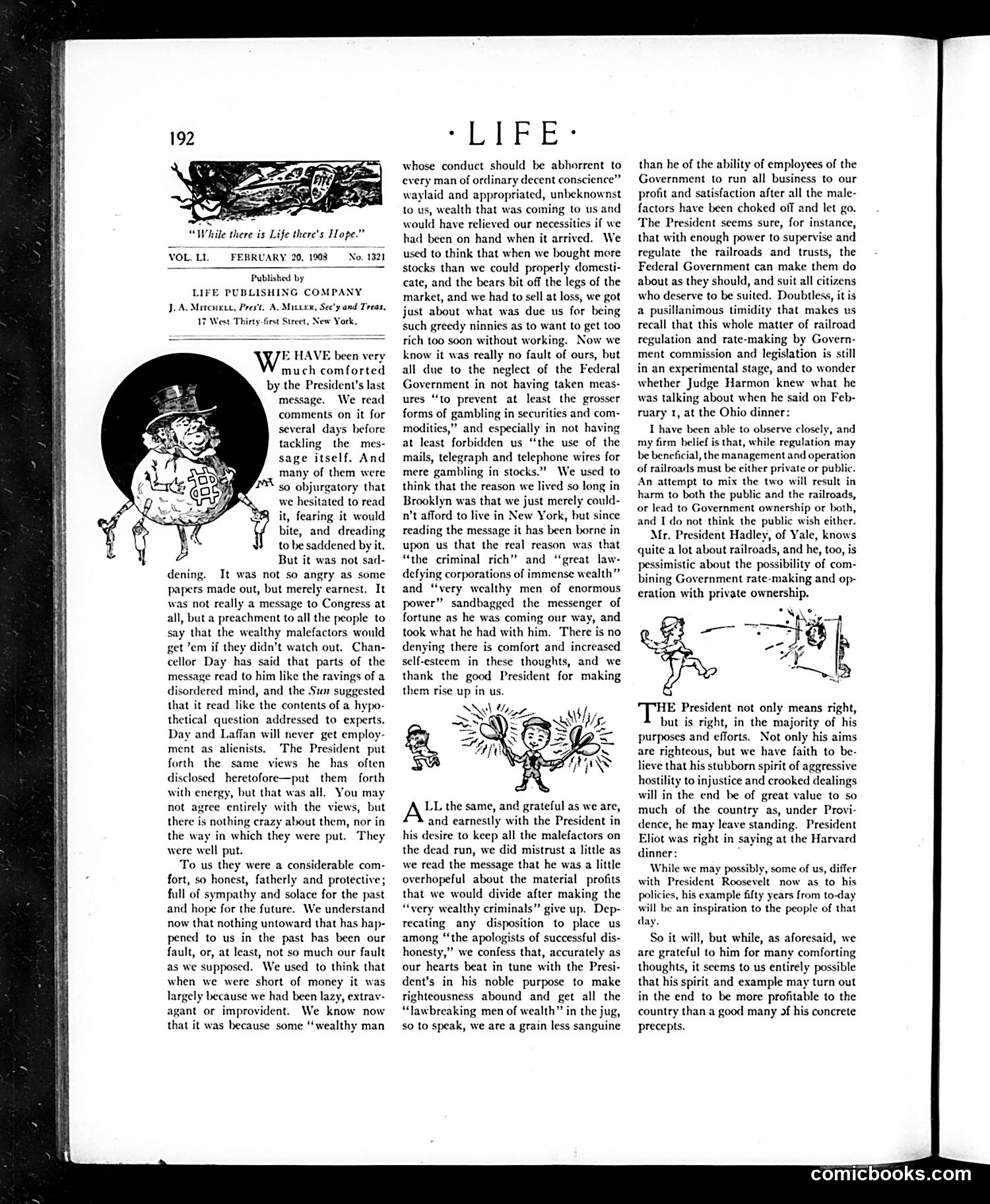
This editorial page discusses President Theodore Roosevelt's efforts to regulate wealthy industrialists and prevent securities fraud. The text references Roosevelt's message to Congress about preventing "gambling in securities and commodities" and controlling "the criminal rich" and wealthy corporations. The accompanying cartoons (though small and stylized) appear to satirize the tension between government regulation and private wealth. The editorial expresses cautious optimism about Roosevelt's anti-corruption stance while debating whether direct government operation of railroads or continued private ownership with regulation is preferable. The piece reflects the Progressive Era's central conflict: how to curb robber-baron excesses without embracing socialism. The writer credits Roosevelt with sincerity but remains somewhat skeptical about whether regulation alone can truly address systemic corruption among "wealthy men of enormous power."
📄 Transcribed text from this page (OCR, searchable)
Machine-transcribed from the original scan — historical spelling and the odd misread are preserved.
“While there is Life there's Hope.” No. 1321 VOL. LI. FEBRUARY 20, 1908 Published by LIFE PUBLISHING COMPANY J.A. Mireur, Pres't. A, Mittxx, Sec'y and Treas, 17 West Thirty-first Street, New York, W HAVE been very much comforted by the President’s last message. We read comments on it for several days before tackling the mes- sage itself. And many of them were so objurgatory that we hesitated to read it, fearing it would bite, and dreading to be saddened by it. But it was not sad- dening. It was not so angry as some papers made out, but merely earnest. It was not really a message to Congress at all, but a preachment to all the people to say that the wealthy malefactors would get ’em if they didn’t watch out. Chan- cellor Day has said that parts of the message read to him like the ravings of a disordered mind, and the Sun suggested that it read like the contents of a hypo- thetical question addressed to experts. Day and Laffan will never get employ- ment alienists. The President put forth the same views he has often disclosed heretofore—put them forth with energy, but that was all. You may ce entirely with the views, but there is nothing crazy about them, nor in the way in which they were put. They were well put. To us they were a considerable com- fort, so honest, fatherly and protective; full of sympathy and solace for the past and hope for the future. We understand now that nothing untoward that has hap- pened to us in the past has been our fault, or, at least, not so much our fault as we supposed. We used to think that when we were short of money it was largely because we had been lazy, extrav- agant or improvident. We know now that it was because some “wealthy man “LIFE * whose conduct should be abhorrent to every man of ordinary decent conscience” waylaid and appropriated, unbeknownst to us, wealth that was coming to us and would have relieved our necessities if we had been on hand when it arrived. We used to think that when we bought more stocks than we could properly domesti- cate, and the bears bit off the legs of the market, and we had to sell at loss, we got just about what was due us for being such greedy ninnies as to want to get too rich too soon without working. Now we know it was really no fault of ours, but all due to the neglect of the Federal Government in not having taken meas- ures “to prevent at least the grosser forms of gambling in securities and com- modities,” and especially in not having at least forbidden us “the use of the mails, telegraph and telephone wires for mere gambling in stocks.” We used to think that the reason we lived so long in Brooklyn was that we just merely could- n't afford to live in New York, but since reading the message it has been borne in upon us that the real reason was that “the criminal rich” and ‘‘great law- defying corporations of immense wealth” and “very wealthy men of enormous power” sandbagged the messenger of fortune as he was coming our way, and took what he had with him. There is no denying there is comfort and increased self-esteem in these thoughts, and we thank the good President for making them rise up in us. Alt the same, and grateful as we are, and earnestly with the President in his desire to keep all the malefactors on the dead run, we did mistrust a little as we read the message that he was a little overhopeful about the material profits that we would divide after making the “very wealthy criminals” give up. Dep- recating any disposition to place us among “the apologists of successful dis- honesty,” we confess that, accurately as our hearts beat in tune with the Presi- dent’s in his noble purpose to make righteousness abound and get all the “lawbreaking men of wealth” in the jug, so to speak, we are a grain less sanguine than he of the ability of employees of the Government to run all business to our profit and satisfaction after all the male- factors have been choked off and let go. The President seems sure, for instance, that with enough power to supervise and regulate the railroads and trusts, the Federal Government can make them do about as they should, and suit all citizens who deserve to be suited. Doubtless, it is a pusillanimous timidity that makes us recall that this whole matter of railroad regulation and rate-making by Govern- ment commission and legislation is still in an experimental stage, and to wonder whether Judge Harmon knew what he was talking about when he said on Feb- ruary 1, at the Ohio dinner: I have been able to observe closely, and my firm belief is that, while regulation may be beneficial, the management and operation of railroads must be either private or public. An attempt to mix the two will result in harm to both the public and the railroads, or lead to Government ownership or both, and I do not think the public wish either. Mr. President Hadley, of Yale, knows quite a lot about railroads, and he, too, is pessimistic about the possibility of com- bining Government rate-making and op- eration with private ownership. — ~— he PAG 4 E President not only means right, but is right, in the majority of his purposes and efforts. Not only his aims are righteous, but we have faith to be- lieve that his stubborn spirit of aggressive hostility to injustice and crooked dealings will in the end be of great value to so much of the country as, under Provi- dence, he may leave standing. President Eliot was right in saying at the Harvard dinner: While we may possibly, some of us, differ with President Roosevelt now as to his policies, his example fifty years from to-day will be an inspiration to the people of that day. So it will, but while, as aforesaid, we are grateful to him for many comforting thoughts, it seems to us entirely possible that his spirit and example may turn out in the end to be more profitable to the country than a good many of his concrete comicbooks.com