
Life, 1908-02-20 · page 16 of 24
Life — February 20, 1908 — page 16: what you’re looking at
What you’re looking at
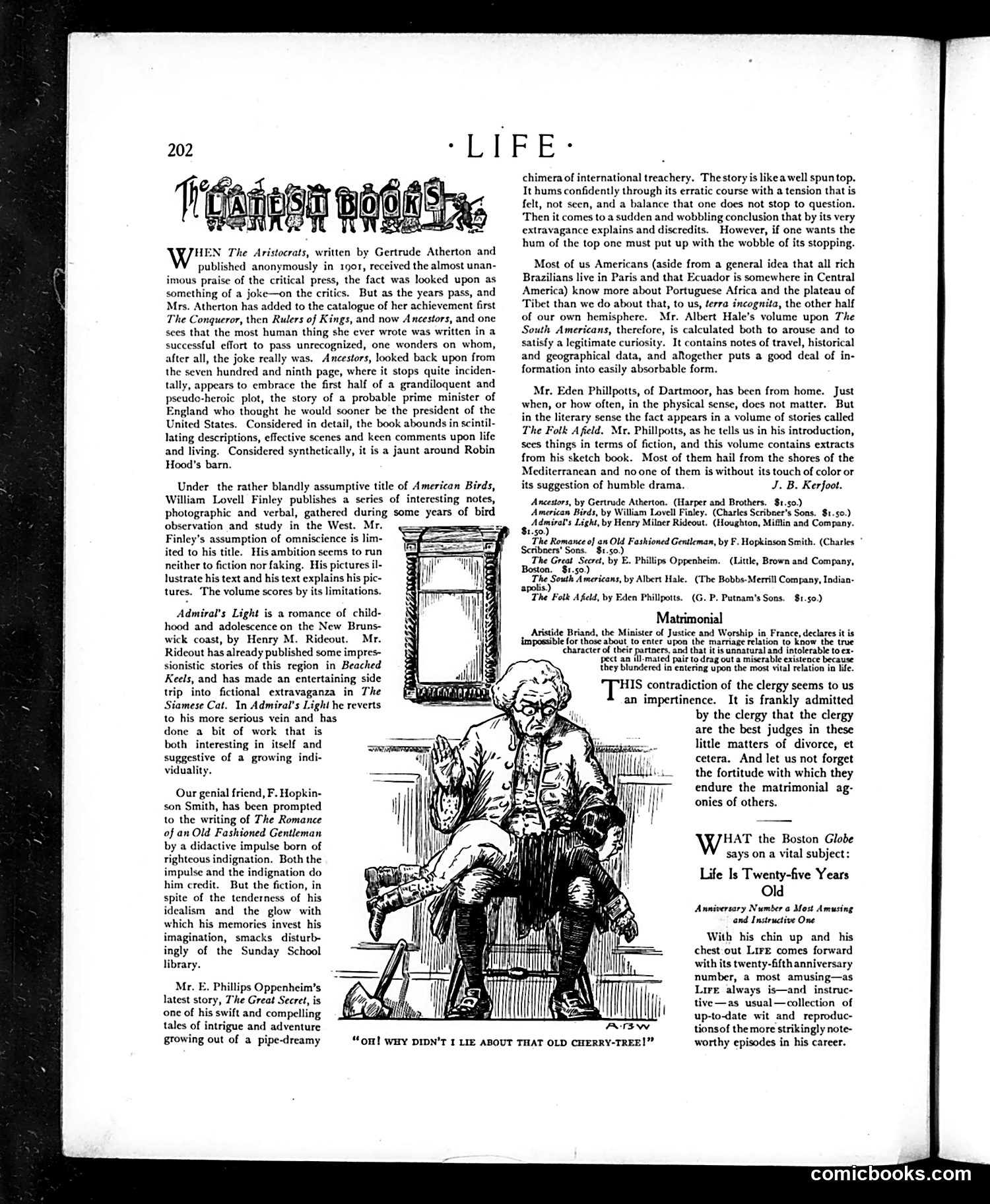
This page contains literary reviews rather than political cartoons. The single illustration depicts an elderly man in period dress (possibly 18th-19th century), exclaiming "Oh! why didn't I lie about that old cherry-tree!"—a reference to the famous (likely apocryphal) story of young George Washington confessing to chopping down his father's cherry tree. The joke critiques American mythology: the caption suggests that even Washington's most celebrated virtue—his honesty—might have been fabricated. By having the aged figure regret *not* lying about the cherry tree, the cartoon mocks how Americans reverence historical legends that may themselves be dishonest inventions. The page reviews contemporary novels by Gertrude Atherton, William Lovell Finley, Henry M. Rideout, F. Hopkinson Smith, E. Phillips Oppenheim, and Albert Hale's *The South Americans*, offering literary criticism typical of Life's sophisticated readership.
📄 Transcribed text from this page (OCR, searchable)
Machine-transcribed from the original scan — historical spelling and the odd misread are preserved.
-LIFE- HEN The Aristocrats, written by Gertrude Atherton and published anonymously in 1901, received the almost unan- imous praise of the critical press, the fact was looked upon as something of a joke—on the critics. But as the years pass, and Mrs. Atherton has added to the catalogue of her achievement first The Conqueror, then Rulers of Kings, and now Ancestors, and one sees that the most human thing she ever wrote was written in a successful effort to pass unrecognized, one wonders on whom, after all, the joke really was. Ancestors, looked back upon from the seven hundred and ninth page, where it stops quite inciden- tally, appears to embrace the first half of a grandiloquent and pseudo-heroic plot, the story of a probable prime minister of England who thought he would sooner be the president of the United States. Considered in detail, the book abounds in scintil- lating descriptions, effective scenes and keen comments upon life and living. Considered synthetically, it is a jaunt around Robin Hood's barn. Under the rather blandly assumptive title of American Birds, William Lovell Finley publishes a series of interesting notes, photographic and verbal, gathered during some years of bird observation and study in the West. Mr. = _ Finley’s assumption of omniscience is lim- ited to his title. His ambition seems to run neither to fiction nor faking. His pictures il- lustrate his text and his text explains his pic- tures. The volume scores by its limitations. Admiral’s Light is a romance of child- hood and adolescence on the New Bruns- wick coast, by Henry M. Rideout. Mr. Rideout has already published some impres- sionistic stories of this region in Beached Keels, and has made an entertaining side trip into fictional extravaganza in The Siamese Cat. In Admiral’s Light he reverts to his more serious vein and has done a bit of work that is both interesting in itself and suggestive of a growing indi- viduality. Our genial friend, F. Hopkin- son Smith, has been prompted to the writing of The Romance of an Old Fashioned Gentleman by a didactive impulse born of rightcous indignation. Both the impulse and the indignation do him credit. But the fiction, in spite of the tenderness of “his idealism and the glow with which his memories invest his imagination, smacks disturb- ingly of the Sunday School library. Mr. E. Phillips Oppenheim’s latest story, The Great Secret, is one of his swift and compelling tales of intrigue and adventure growing out of a pipe-dreamy “on! WHY DIDN'T I LIE ABOUT THAT OLD CHERRY-TREE!” chimeraof international treachery. Thestory is likea well spun top. It hums confidently through its erratic course with a tension that is felt, not seen, and a balance that one does not stop to question. ‘Then it comes to a sudden and wobbling conclusion that by its very extravagance explains and discredits. However, if one wants the hum of the top one must put up with the wobble of its stopping. Most of us Americans (aside from a general idea that all rich Brazilians live in Paris and that Ecuador is somewhere in Central America) know more about Portuguese Africa and the plateau of Tibet than we do about that, to us, ferra incognita, the other half of our own hemisphere. Mr. Albert Hale’s volume upon The South Americans, therefore, is calculated both to arouse and to satisfy a legitimate curiosity. It contains notes of travel, historical and geographical data, and aRogether puts a good deal of in- formation into casily absorbable form. Mr. Eden Phillpotts, of Dartmoor, has been from home. Just when, or how often, in the physical se, docs not matter. But in the literary sense the fact appears in a volume of stories called The Folk A field, Mr. Phillpotts, as he tells us in his introduction, sees things in terms of fiction, and this volume contains extracts from his sketch book. Most of them hail from the shores of the Mediterranean and noone of them is without its touch of color or its suggestion of humble drama. J.B. Kerfoot. Ancestors, by Gertrude Atherton. (Harper and Brothers. $1.50.) American Birds, by William Lovell Finley. (Charles Scribner's Sons. $1.50.) Admiral’s Light, by Henry Milner Rideout. (Houghton, Mifflin and Company. 1.50. The Romance} an Old Fashioned Gentleman, by F Hopkinson Smith. (Charles Scribners’ Sons. $1.50.) The Great Scere, by E. Phillips Oppenheim. (Little, Brown and Company, Boston. $1.50.) The South Americans, by Albert Hale. (The Bobbs-Merrill Company, Indian- apolis) The Folk Afeld, by Eden Phillpotts. (G.P. Putnam's Sons. 81.50) Matnmonial Aristide Briand, the Minister of Justice and Worship in France, declares it is Impossible for those about to enter upon the marriage relation to Know the true character of their partners, and that itis unnatural and intolerable toca pect an ill-mated pair to drag out a miserable existence because they blundered in entering upon the most vital relation in life. Ts contradiction of the clergy seems to us an impertinence. It is frankly admitted by the clergy that the clergy are the best judges in these little matters of divorce, et cetera. And let us not forget the fortitude with which they endure the matrimonial ag- onies of others. HAT the Boston Globe says on a vital subject: Life Is Twenty-five Years Old Anniversary Number a Most Amusing and Instructive One With his chin up and his chest out Lire comes forward with its twenty-fifth anniversary number, a most amusing—as Lire always is—and instruc- tive—as usual—ocollection of up-to-date wit and reproduc- tionsof the more strikingly note- worthy episodes in his career. comicbooks.com