
Life, 1908-02-20 · page 15 of 24
Life — February 20, 1908 — page 15: what you’re looking at
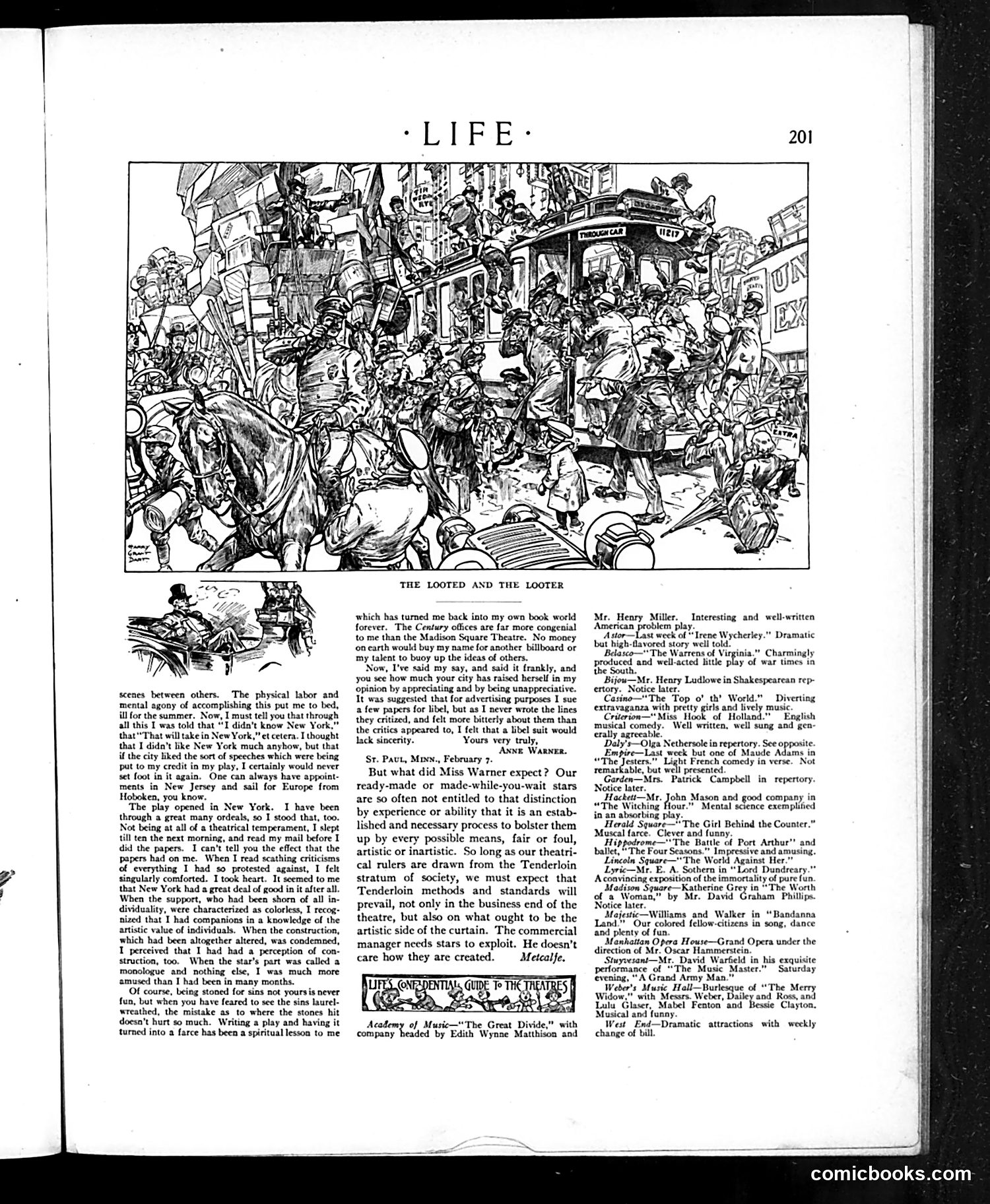
What you’re looking at
This page features a letter from playwright **Anne Warner** complaining about her theatrical experience in New York. The main cartoon (top) depicts a chaotic street scene titled "The Looted and the Looter," illustrating her grievance. Warner describes having her play altered by producers and stars who added lines she didn't write, then received scathing reviews—which ironically comforted her, since critics condemned the *changes* she'd protested. She concludes that New York's theater world lacks artistic integrity. The editor's response (signed Metcalfe) sardonically agrees: Broadway's commercial managers prioritize exploiting stars over artistic merit, using any means necessary—fair or foul—to promote them. The system rewards appearance over substance. For modern readers: this satirizes how commercial entertainment prioritizes marketing and profit over artistic authenticity, a timeless complaint about show business compromising creative vision.
📄 Transcribed text from this page (OCR, searchable)
Machine-transcribed from the original scan — historical spelling and the odd misread are preserved.
scenes between others. The physical labor and mental agony of accomplishing this put me to bed, ill for the summer. Now, I must tell you that throug all this I was told that “I didn't know New York,’ that""That will take in New York," et cetera. I thought that I dida’t like New York much anyhow, but that if the city liked the sort of speeches which were being put to my credit in my play, I certainly would never set foot in it again. One can always have appoint- ments in New Jersey and sail for Europe from Hoboken, you know. The play opened in New York. I have been through a great many ordeals, so I stood that, too. Not being at all of a theatrical temperament, I slept till ten the next morning, and read my mail before I did the papers. I can't tell you the effect that the papers had on me. When I read scathing criticisms of everything I had so protested against, I felt singularly comforted. I took heart. It seemed to me that New York had a great deal of good in it after all. When the support, who had been shorn of all in- dividuality, were characterized as colorless, I recog- nized that I had companions in a knowledge of the artistic value of individuals. When the construction, which had been altogether altered, was condemned, I perceived that I had had a perception of con: struction, too. When the star's part was called a monologue and nothing else, I was much more ‘amused than I had been in many months. Of course, being stoned for sins not yoursis never fun, but when you have feared to see the sins laurel- wreathed, the mistake as to where the stones hit doesn't hurt so much. Writing a play and having it turned into a farce has been a spiritual lesson to me THE LOOTED AND THE LOOTER which has turned me back into my own book world forever, The Century offices are far more congenial to me than the Madison Square Theatre. No money ‘on earth would buy my name for another billboard or my talent to buoy up the ideas of others. ‘Now, I've said my say, and said it frankly, and you see how much your city has raised herself in my opinion by appreciating and by being unappreciative. Tt was suggested that for advertising purposes I sue a few papers for libel, but as I never wrote the lines, they critized, and felt more bitterly about them than the critics appeared to, I felt that a libel suit would lack sincerity. Yours very truly, Anne Warner. Sr. Pat, Mryy., February 7. But what did Miss Warner expect? Our ready-made or made-while-you-wait stars are so often not entitled to that distinction by experience or ability that it is an estab- lished and necessary process to bolster them up by every possible means, fair or foul, artistic or inartistic. So long as our theatri- cal rulers are drawn from the Tenderloin stratum of society, we must expect that Tenderloin methods and standards will prevail, not only in the business end of the theatre, but also on what ought to be the artistic side of the curtain. The commercial manager needs stars to exploit. He doesn’t care how they are created. Metcalfe. Academy of Music—'The Great Divide," with company headed by Edith Wynne Matthison ‘and Mr. Henry Miller. Interesting and well-written American problem play. Astor—Last week of * Dramatic Belasco—'" The Warrens of Virginia.” Charmingly produced and well-acted little play of war times in the South. Bijou—Mr. Henry Ludlowe in Shakespearean rep- ertory. Notice later. Casino—"The Top o' th’ World.” _ Diverting extravaganza with pretty girls and lively music. Criterion—" Miss. Hook of Holland.” English musical comedy. Well written, well sung and gen- erally agreeable. Daly’s—Olga Nethersole in repertory. Sce opposite. Empire—Last week but one of Maude Adams in The Jesters.” Light French comedy in verse. Not remarkable, but well presented. Garden—Mrs. Patrick Campbell in repertory. Notice lates Hoacket—Mr. John Mason and good company in “The Witching Hour.” Mental science exemplified in an absorbing pla} Herald Square—"'The Girl Behind the Counter.” Muscal farce. Clever and funny. Hippodrome—"The Battle of Port Arthur’ and ballet, “The Four Seasons.” Impressive and amusing. ‘oln Square—"The World Against Her.” Lyric—Mr. E. A. Sothern in “Lord Dundreary.”* Aconvincing exposition of the immortality of pure fun. Madison Square—Katherine Grey in "The Worth ofa Woman,” by Mr. David Graham Phillips. Notice later. Mojestic—Williams and Walker in “Bandanna Land.” Our colored fellow-citizens in song, dance and plenty of fun. Manhattan Opera House—Grand Opera under the direction of Mr. Oscar Hammerstein. Stuyvesant—Mr. David Warfield in his exquisite performance of “The Music Master.” Saturday evening, “A Grand Army Man.” Weber's Music Hall—Burlesque of “The Merry Widow," with Messrs. Weber, Dailey and Ross, and Lulu Glaser, Mabel Fenton’ and Bessie Clayton, Musical and funny West End—Dramatic attractions with weekly change of bi comicbooks.com