
A complete issue · 22 pages · 1908
Life — January 9, 1908
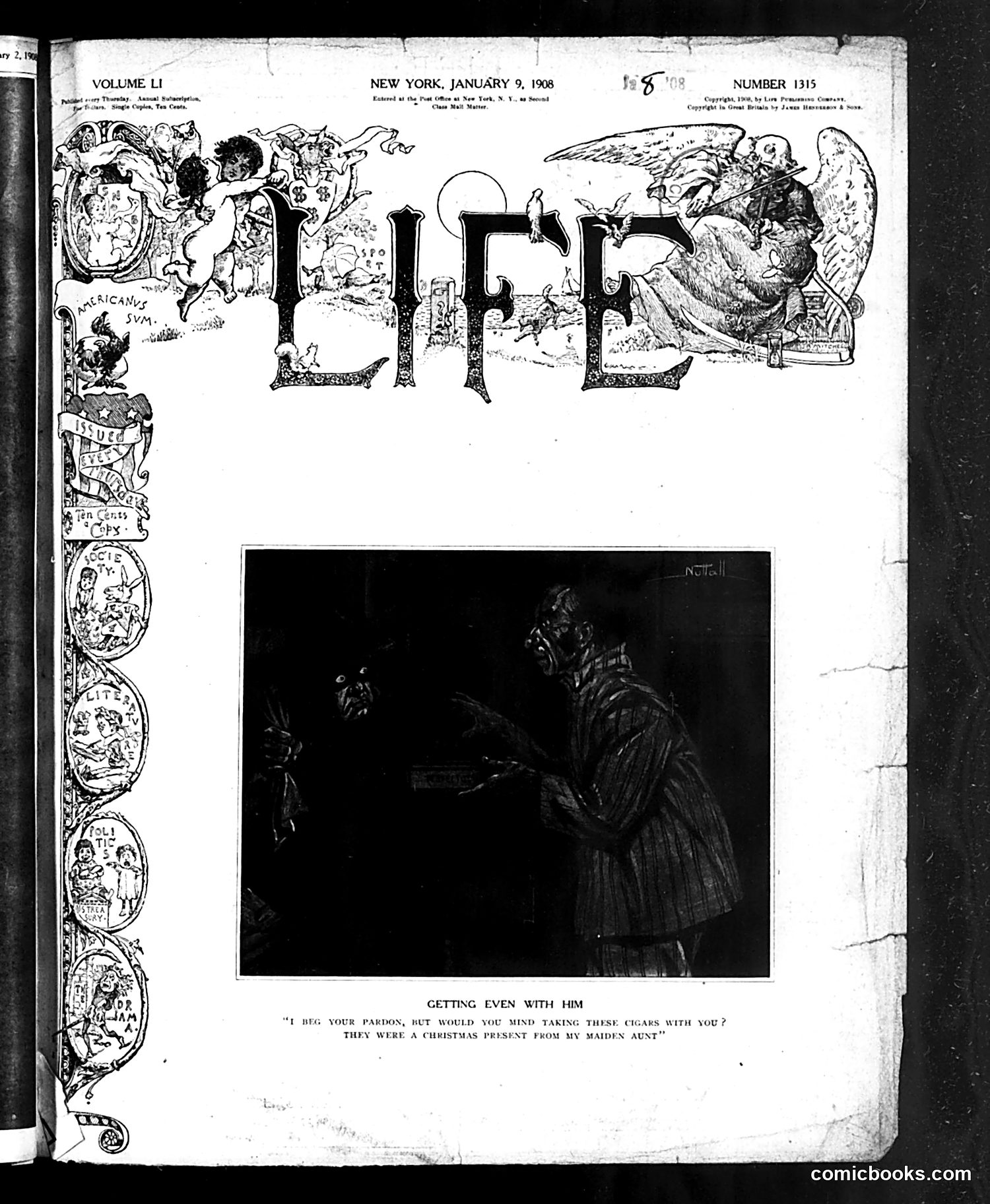
This single-panel cartoon depicts two men in what appears to be a tense confrontation. The caption reads: "I BEG YOUR PARDON, BUT WOULD YOU MIND TAKING THESE CIGARS WITH YOU? THEY WERE A CHRISTMAS PRESENT FROM MY MAIDEN AUNT." The joke concerns an unwanted gift—cigars from a maiden aunt—that the recipient is passive-aggressively returning under the pretense of politeness. The humor lies in the social awkwardness: the speaker claims offense at receiving such a gift while actually using the exchange as a veiled insult, suggesting the cigars are of poor quality. The title "Getting Even with Him" implies the speaker is exacting revenge through this humiliating rejection, likely for some prior offense by the other man.
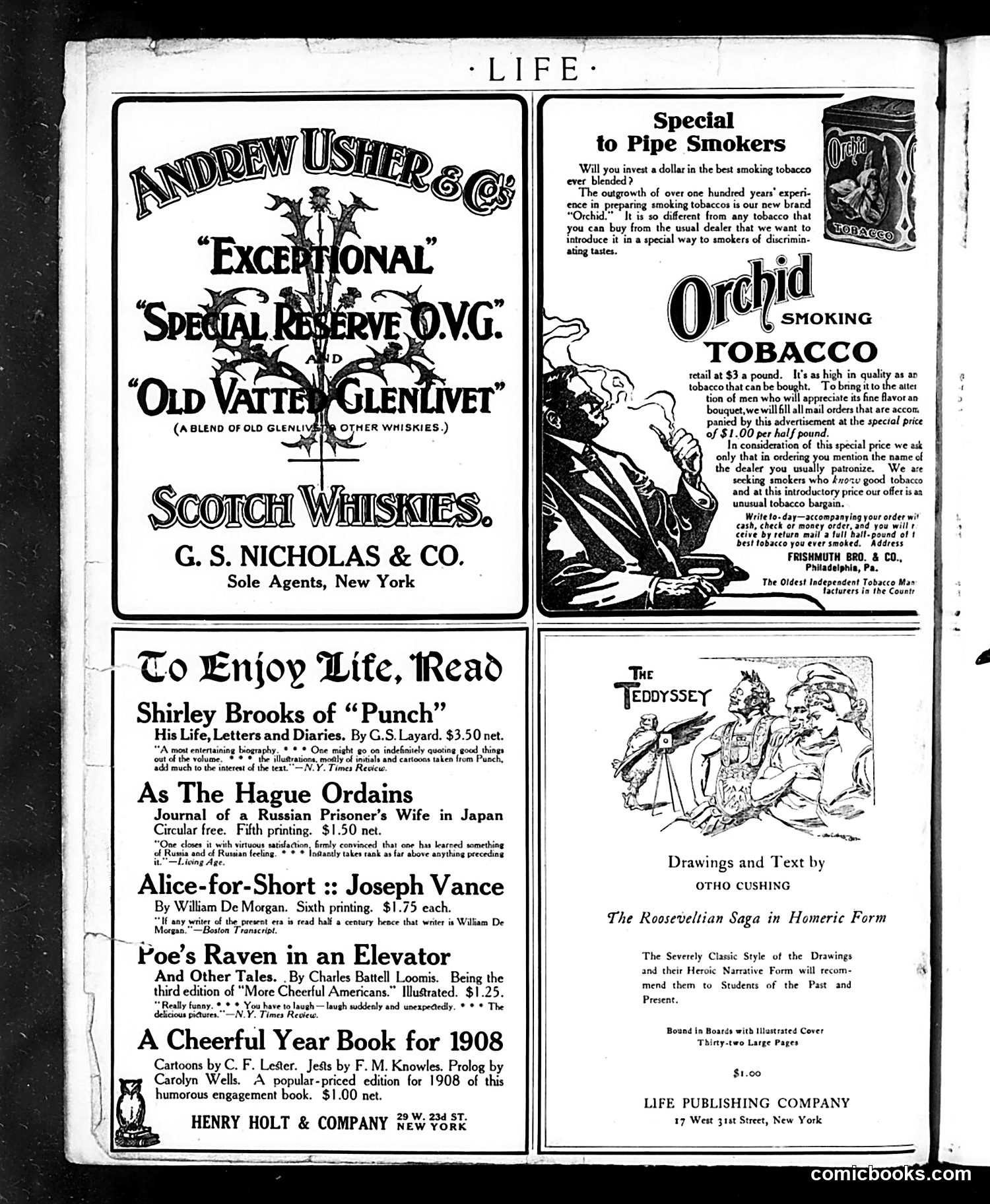
This page consists primarily of **advertisements and book announcements** rather than political cartoons or satirical content. The left side advertises **Scotch whiskies** (Andrew Usher & Co.) and lists several books for sale, including works about Russian prisoners, Joseph Vance, and Poe's Raven. The right side advertises **Orchid Smoking Tobacco** at $1.00 per half pound, and "The Teddssey," a book of drawings by Otho Cushing described as "The Rooseveltian Saga in Homeric Form." The Teddssey drawing (visible but unclear) appears to reference **President Theodore Roosevelt**, though specific details are indistinct in this reproduction. The page reflects early-1900s consumer culture and Roosevelt-era humor, but contains no clearly identifiable political satire or caricature requiring historical context beyond the products advertised.
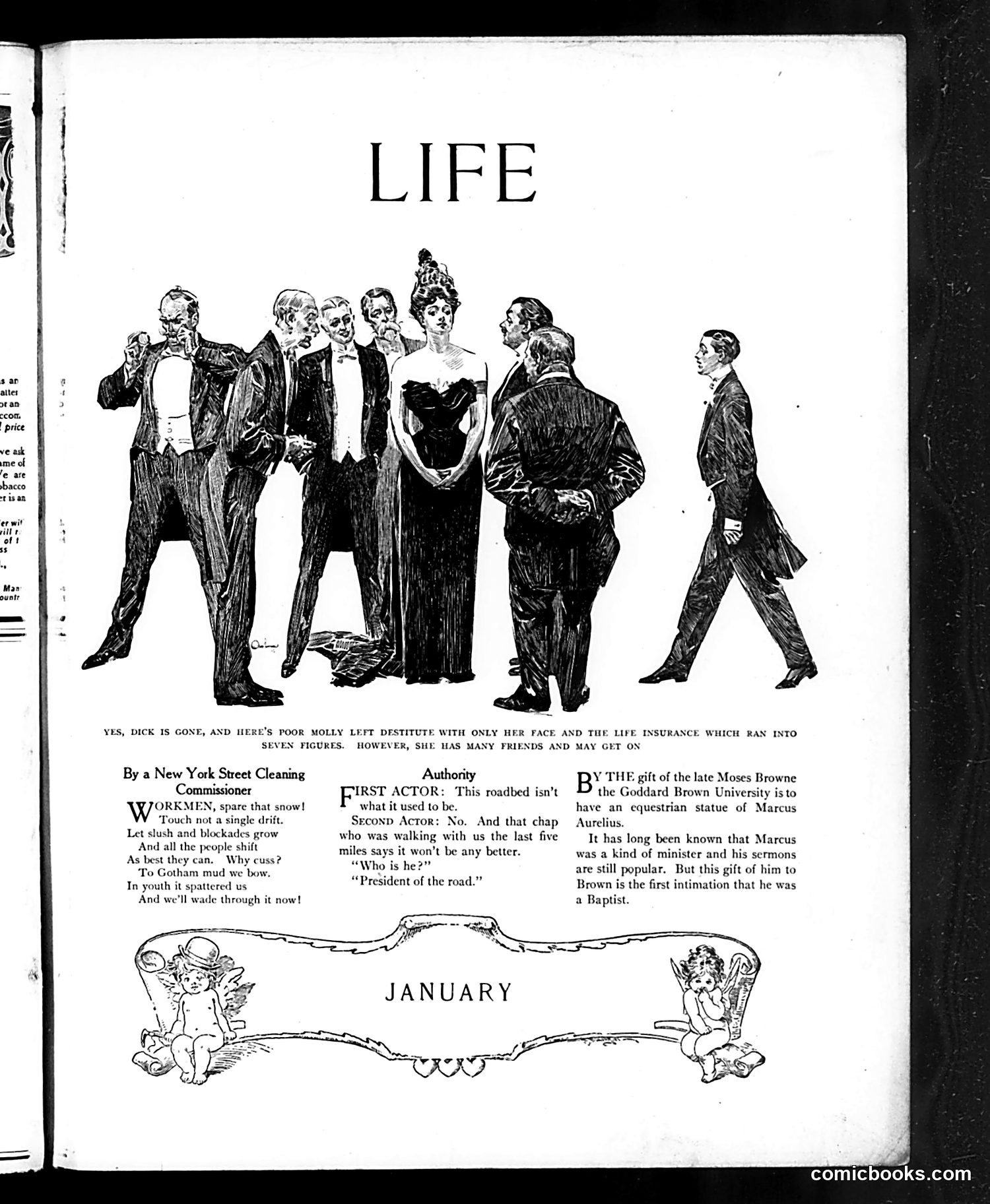
This page satirizes wealth disparity and social climbing in early 20th-century America. The main illustration depicts a wealthy woman in an elegant black dress surrounded by well-dressed men in formal attire, suggesting a high-society gathering. The caption references "Dick" and "poor Molly" - apparently a cautionary tale about a woman left with only life insurance after a man's death, implying financial instability despite social connections. The left column's poem mocks New York Street cleaning and urban decay ("touch not a single drift"), contrasting with the genteel society scene above. The right column discusses a statue of Marcus Aurelius at Goddard Brown University, donated by Moses Browne's estate, noting Aurelius was "a kind of minister" - likely satirizing pretentious philanthropy and classical affectation among the wealthy. The overall message critiques superficial upper-class values.
This page discusses Yale University's athletic philosophy and competitive spirit. The main editorial criticizes Yale's obsession with winning at all costs, arguing that overemphasizing athletic victory corrupts the institution's educational mission. The small cartoon at left (captioned "While there is Life there's Hope") depicts a dejected Yale athlete, likely illustrating the pressure and competitive anxiety permeating Yale sports culture. The text argues Yale shouldn't sacrifice broader principles for athletic supremacy, and warns against the "very spirit" of winning that dominates the institution. It also critiques Congress's proposed "In God we trust" motto on currency, calling such religious references inappropriate for secular government purposes. The satire targets institutional hypocrisy—Yale's stated values versus actual priorities.
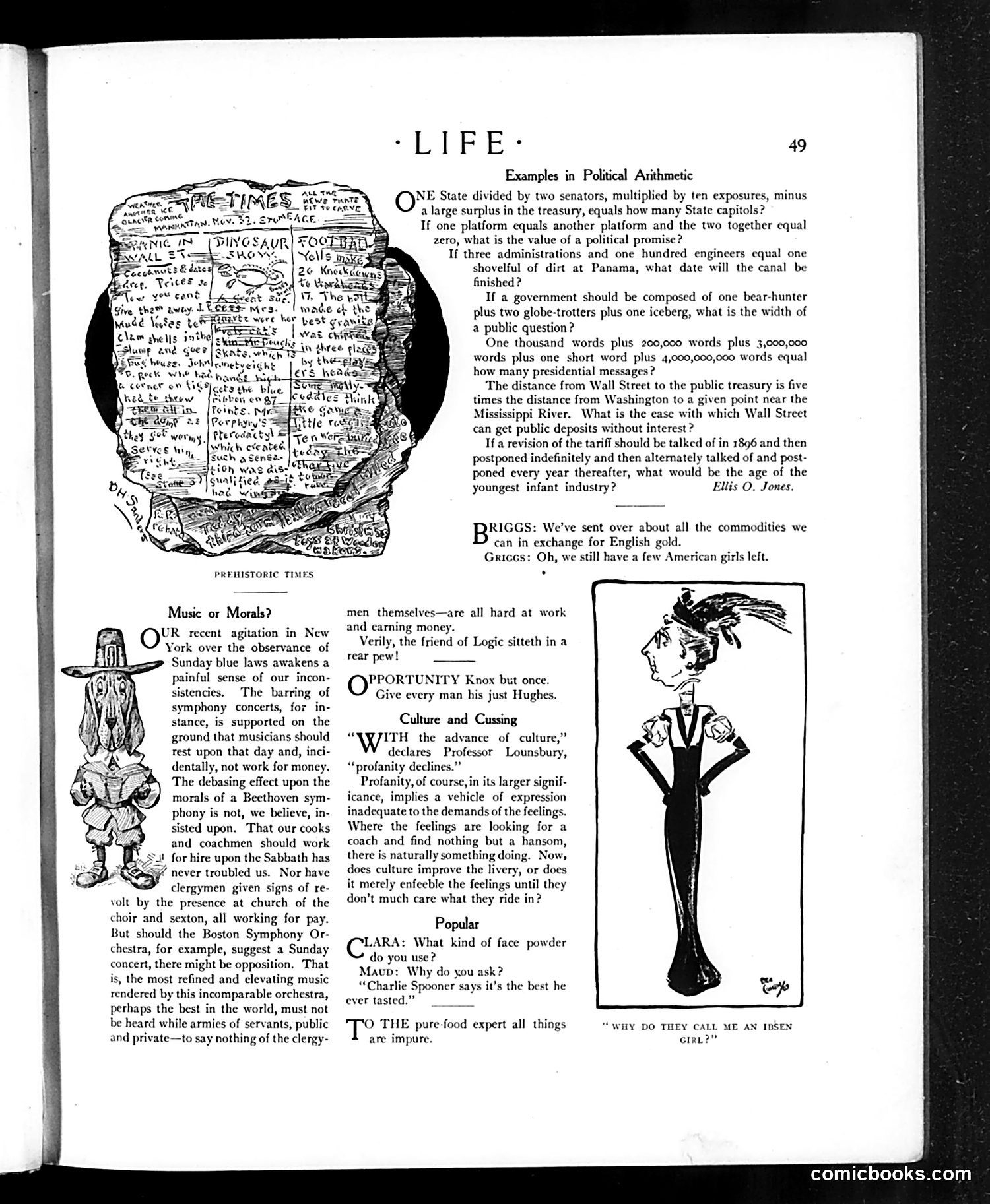
This satirical page contains several distinct pieces: **"Prehistoric Times"** (left illustration): A caveman's brain depicted as a stone tablet crowded with modern concerns—dinosaurs, football, snow, etc.—satirizing how primitive human cognition struggles with contemporary complexity. **"Music or Morals?"**: Critiques New York's Sunday blue laws restricting activities. The piece argues that requiring musicians to work (rather than rest) on Sundays for pay contradicts the spiritual purpose of the Sabbath, while noting that servants and clergy already work Sundays without protest. **Fashion cartoon** (right): A woman in fashionable dress with the caption "WHY DO THEY CALL HER AN IBSEN GIRL?"—likely mocking women who adopt avant-garde styles while lacking intellectual substance. The page overall satirizes contemporary American social hypocrisy and cultural pretension.
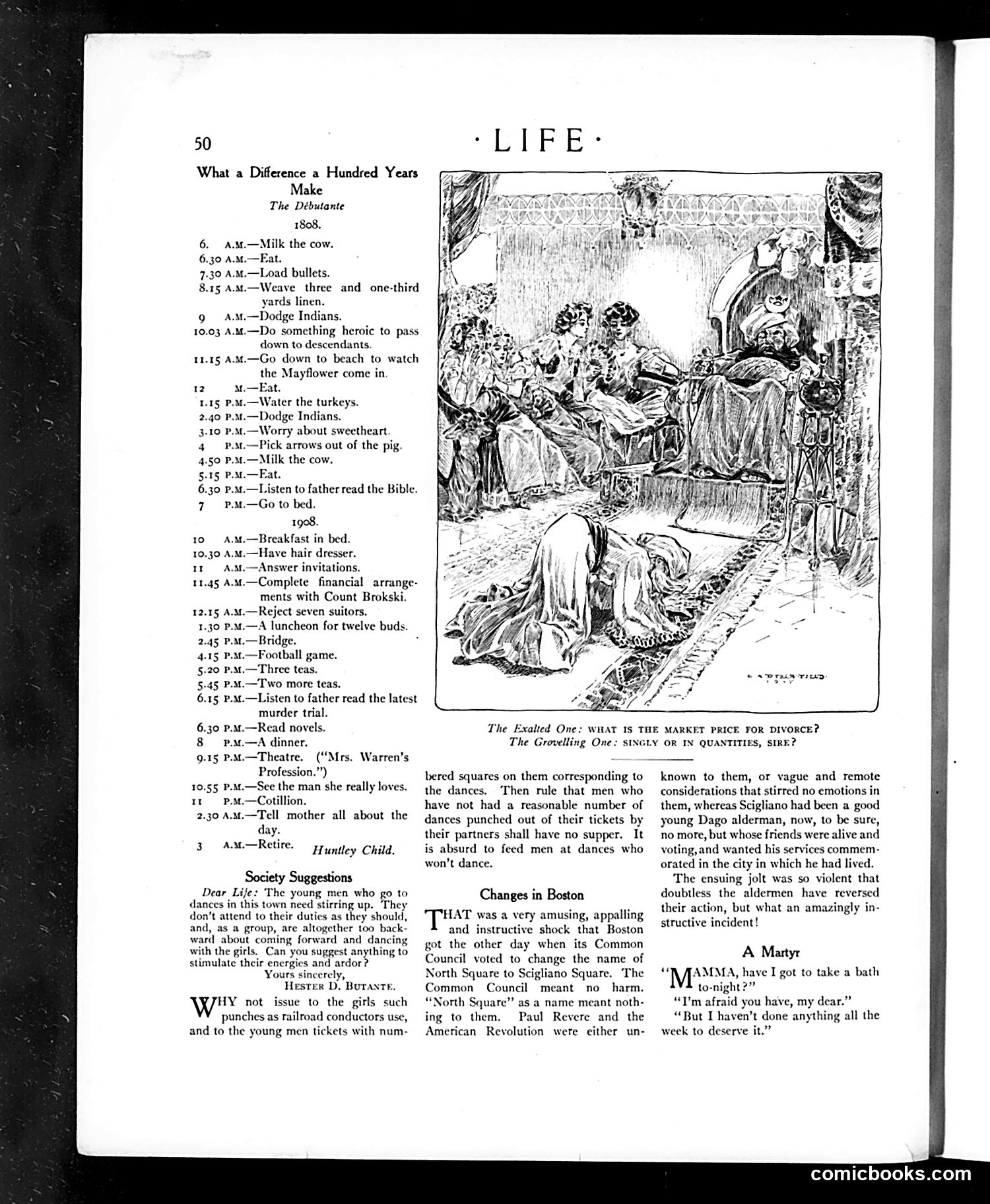
The main illustration depicts a social gathering of upper-class women in period dress, with one woman kneeling or bowing before others in what appears to be a gesture of deference or supplication. The caption reads "The Exalted One: what is the market price for divorce? The Grovelling One: singly or in quantities, sir?" This satirizes the commodification of divorce among the wealthy, mocking both the presumed ease with which affluent women obtain divorces and the mercenary attitudes toward marriage dissolution. The "exalted one" treats divorce as a casual market transaction, while the "grovelling one" responds with crass commercial language—suggesting divorce has become a trivial commodity rather than a serious legal matter. The satire critiques upper-class moral degradation and the trivialization of marriage.
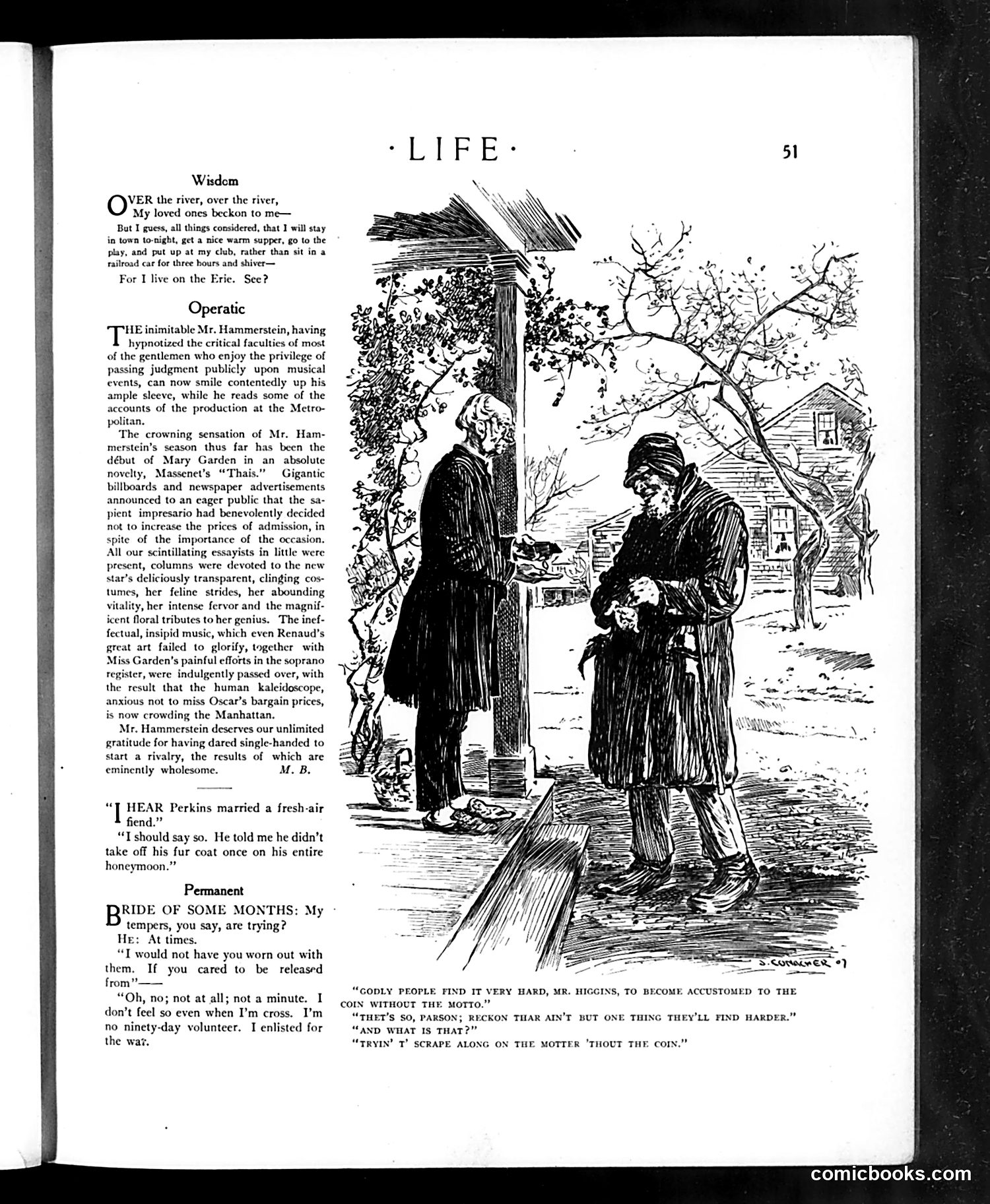
This page contains three distinct literary/humorous sections rather than political cartoons. The "Wisdom" section quotes someone choosing to stay in town rather than visit loved ones across a river ("For I live on the Erie"). The "Operatic" section satirizes conductor Oscar Hammerstein's season debut with soprano Mary Garden, mocking critical praise and advertising hype while suggesting the "ineffectual, insipid music" didn't live up to expectations. The illustration shows a figure at a rural cottage, accompanying a dialogue between "Bride of Some Months" and her husband about marital temperament and war service. The page is primarily satirical commentary on contemporary cultural figures and domestic life rather than political content. Without visible publication date context, precise historical references remain uncertain.
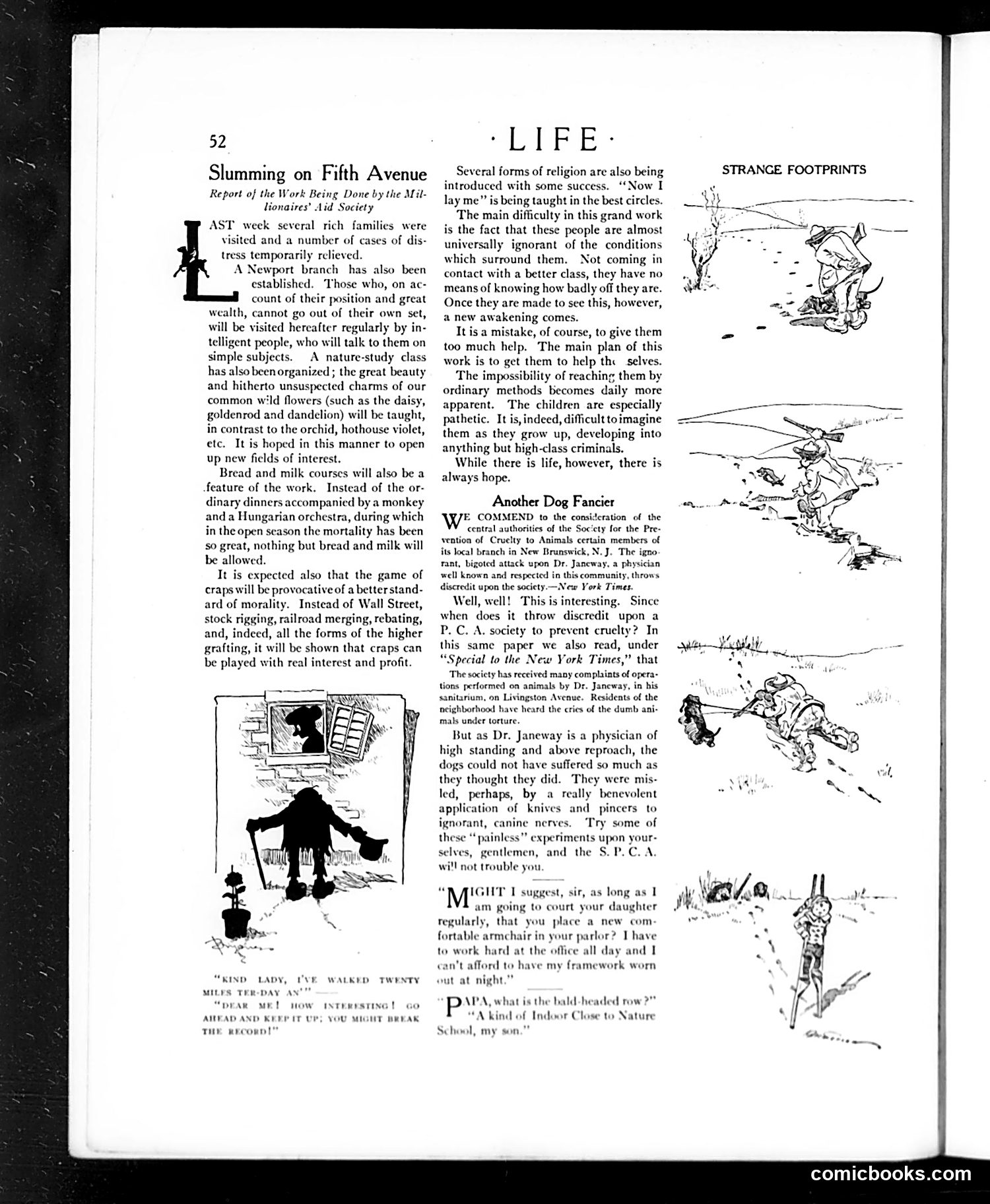
This page contains two distinct pieces: **"Slumming on Fifth Avenue"** (left column) discusses wealthy New Yorkers visiting poor neighborhoods, arguing such visits create false understanding of poverty. The accompanying cartoon shows a well-dressed woman in a tenement, appearing uncomfortable—satirizing upper-class "slumming" as performative charity that fails to generate genuine empathy or lasting change. **"Another Dog Fancier"** (right column) critiques a Dr. Janeway's animal cruelty experiments, sarcastically questioning why the SPCA doesn't prevent such abuse. The accompanying sketches labeled "Strange Footprints" appear to depict dogs or animals in distress, visualizing the article's concern about scientific experiments on animals. Both pieces target hypocrisy: wealthy people's performative concern for the poor, and society's selective moral outrage.
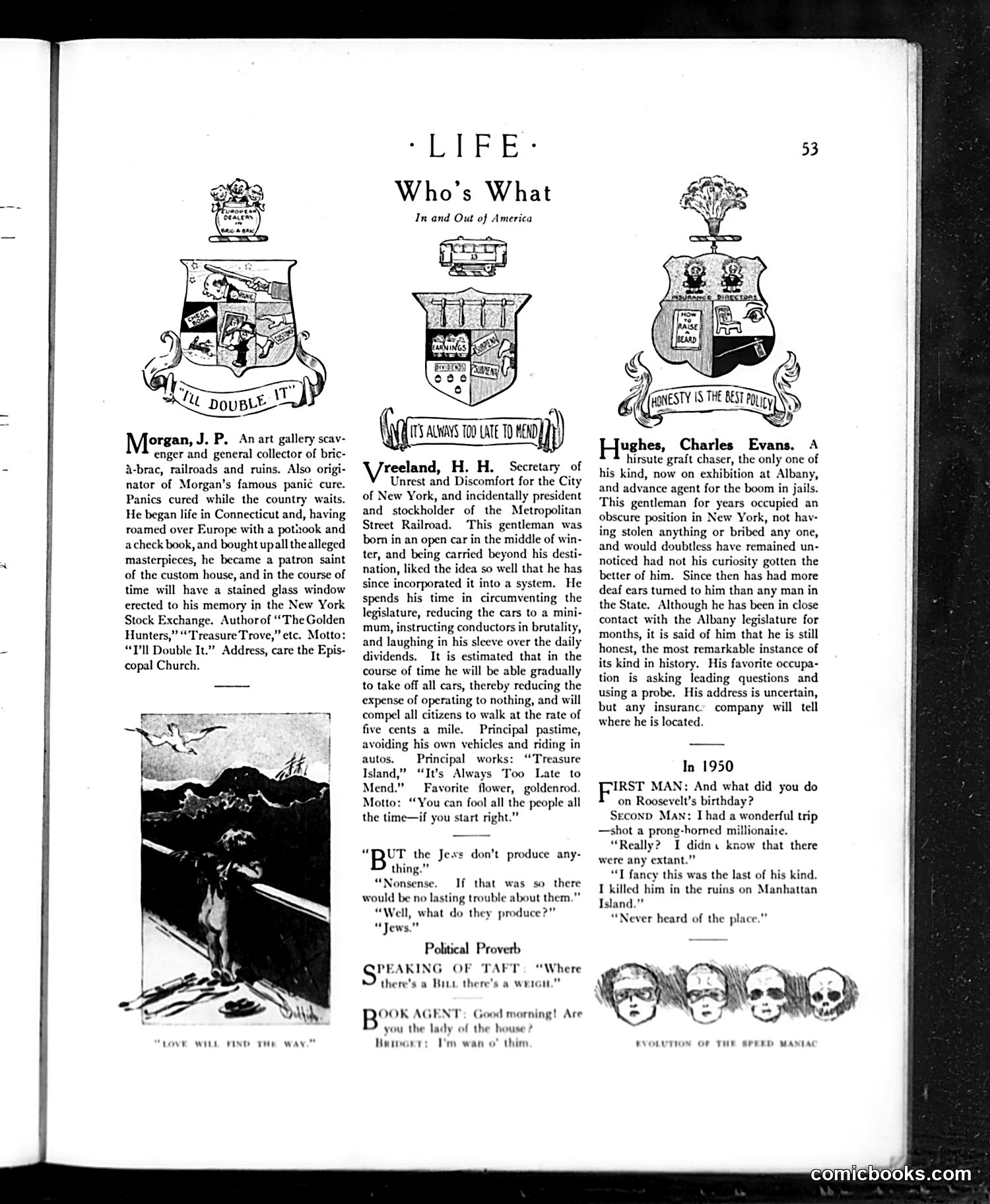
This page from *Life* magazine contains satirical biographical sketches of notable figures under "Who's What: In and Out of America." The main cartoons mock: 1. **Morgan, J.P.** — An art gallery scavenger depicted with a coat of arms reading "I'll Double It," mocking his reputation for aggressive collecting and financial manipulation. 2. **Vreeland, H.H.** — A railroad executive satirized for implementing a system where conductors brutalize passengers while reducing operating costs to five cents per mile—a jab at corporate greed prioritizing profit over human dignity. 3. **Hughes, Charles** — A con artist/chaser whose favorite occupation is asking leading questions with a probe, satirizing manipulative investigative tactics. The lower section contains period humor including antisemitic stereotypes and jokes about gender roles, reflecting the magazine's early 20th-century satirical style.
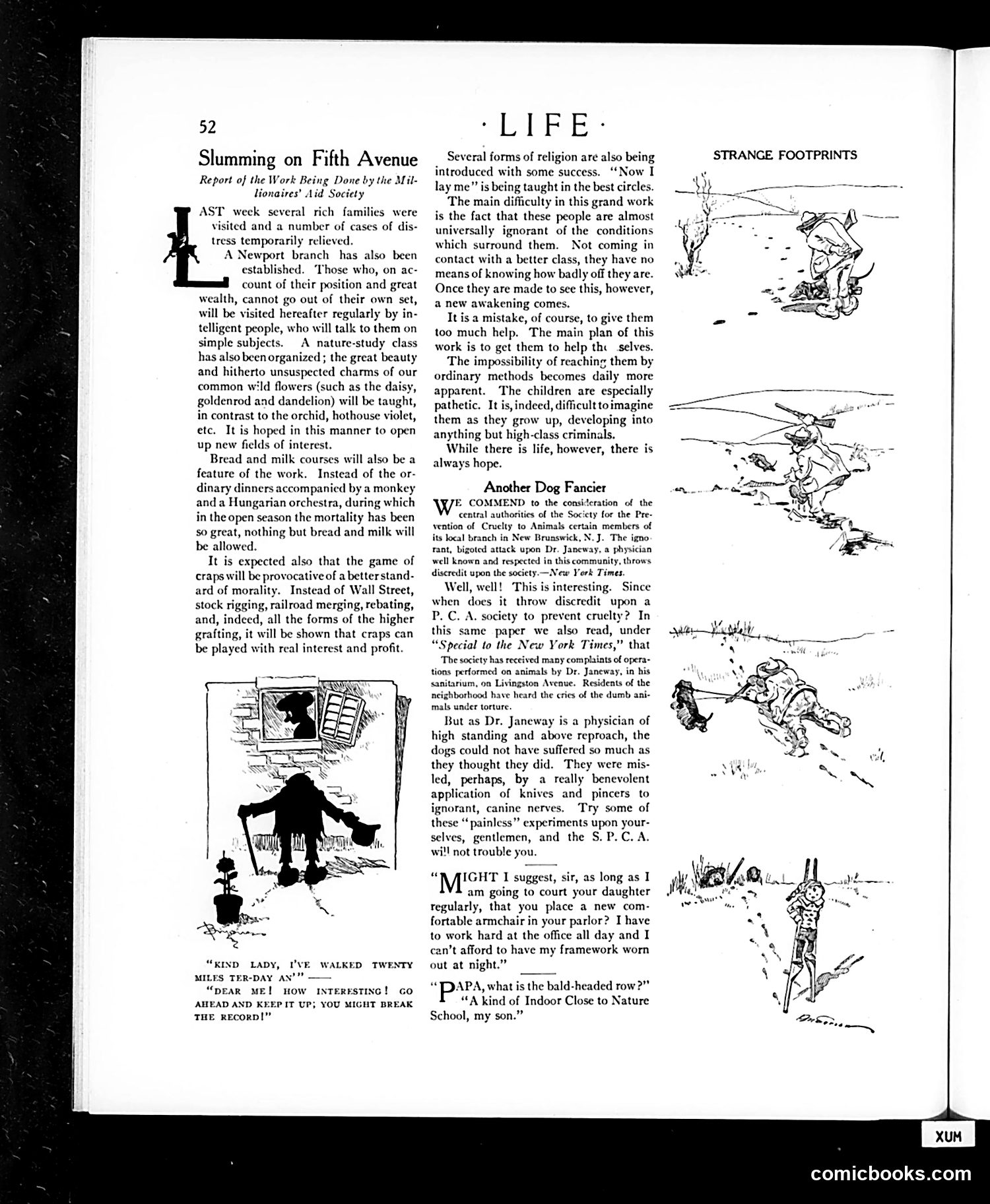
This page from *Life* magazine contains two distinct pieces: **Left side**: "Slumming on Fifth Avenue" discusses charitable work among poor families in New York, noting that wealthy people visiting slums need education about poverty conditions. It mentions teaching about wildflowers and establishing "bread and milk courses." **Right side**: "Another Dog Fancier" satirizes the Society for Prevention of Cruelty to Animals (S.P.C.A.), attacking Dr. Janeway—a respected physician—for allegedly conducting painful experiments on dogs. The satire questions the S.P.C.A.'s selective enforcement: they publicize complaints about restaurant animal mistreatment but ignore a prominent member's own cruelty. The cartoon illustrations on the right appear to show animals in various states, possibly reflecting the subject matter about animal welfare debates.
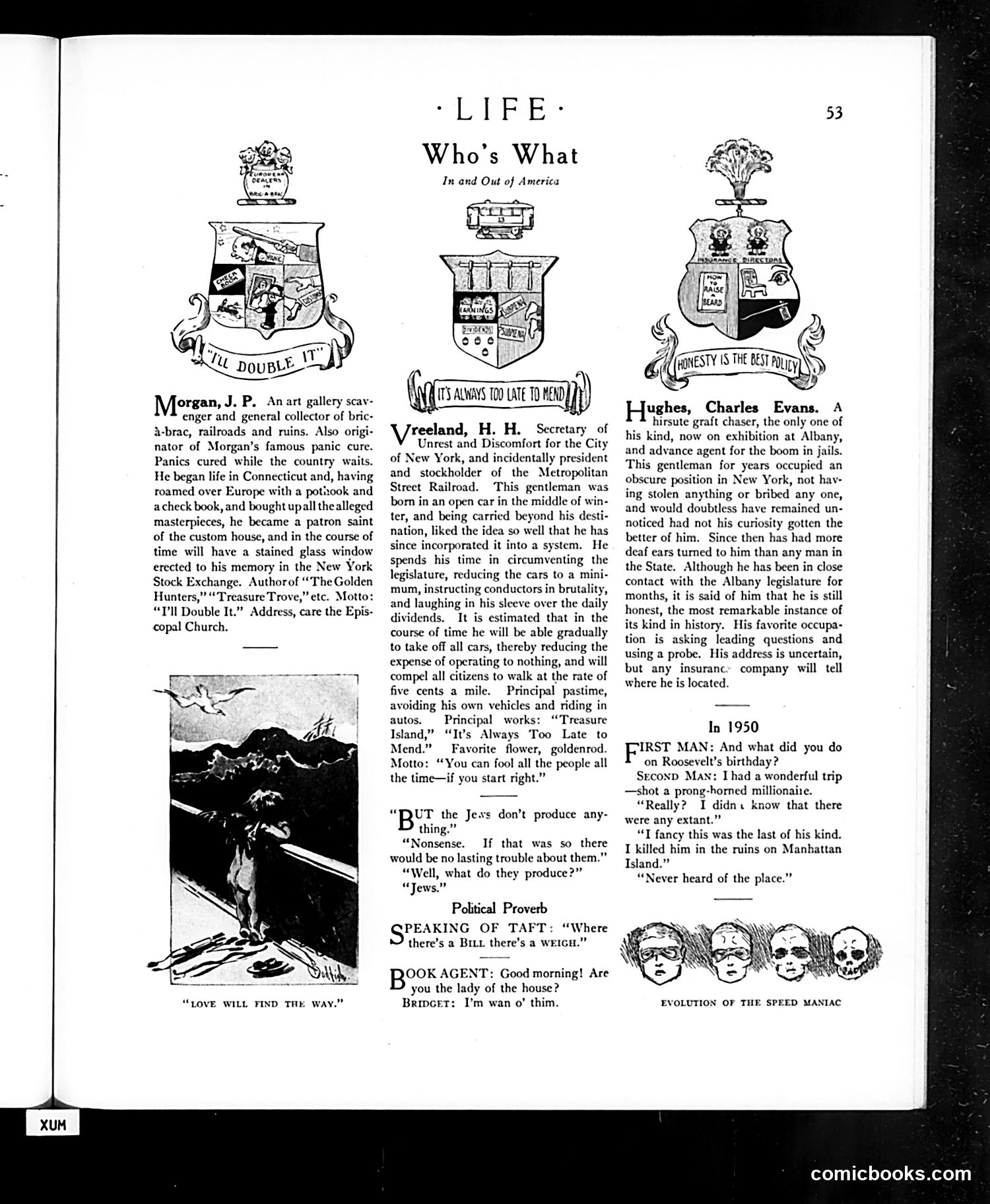
This page presents satirical biographical sketches of three men with coats of arms. The humor relies on mocking their professional roles and character flaws: **Morgan, J.P.** - Portrayed as an art gallery scavenger and panic-cure originator, the sketch jokes that he'll have a stained glass window erected in his memory at the New York Stock Exchange. **Vreeland, H.H.** - Secretary of "Unrest and Discomfort for the City of New York," mocked for his railroad reforms aimed at reducing operating costs by forcing citizens to walk at five cents per mile. **Hughes, Charles Evans** - Called a "graft chaser" who ironically never stole anything or took bribes, making him oddly unsuccessful in New York politics. The bottom section contains political proverbs mocking Taft and a humorous exchange about Jesuits, typical of Life's sharp social commentary.
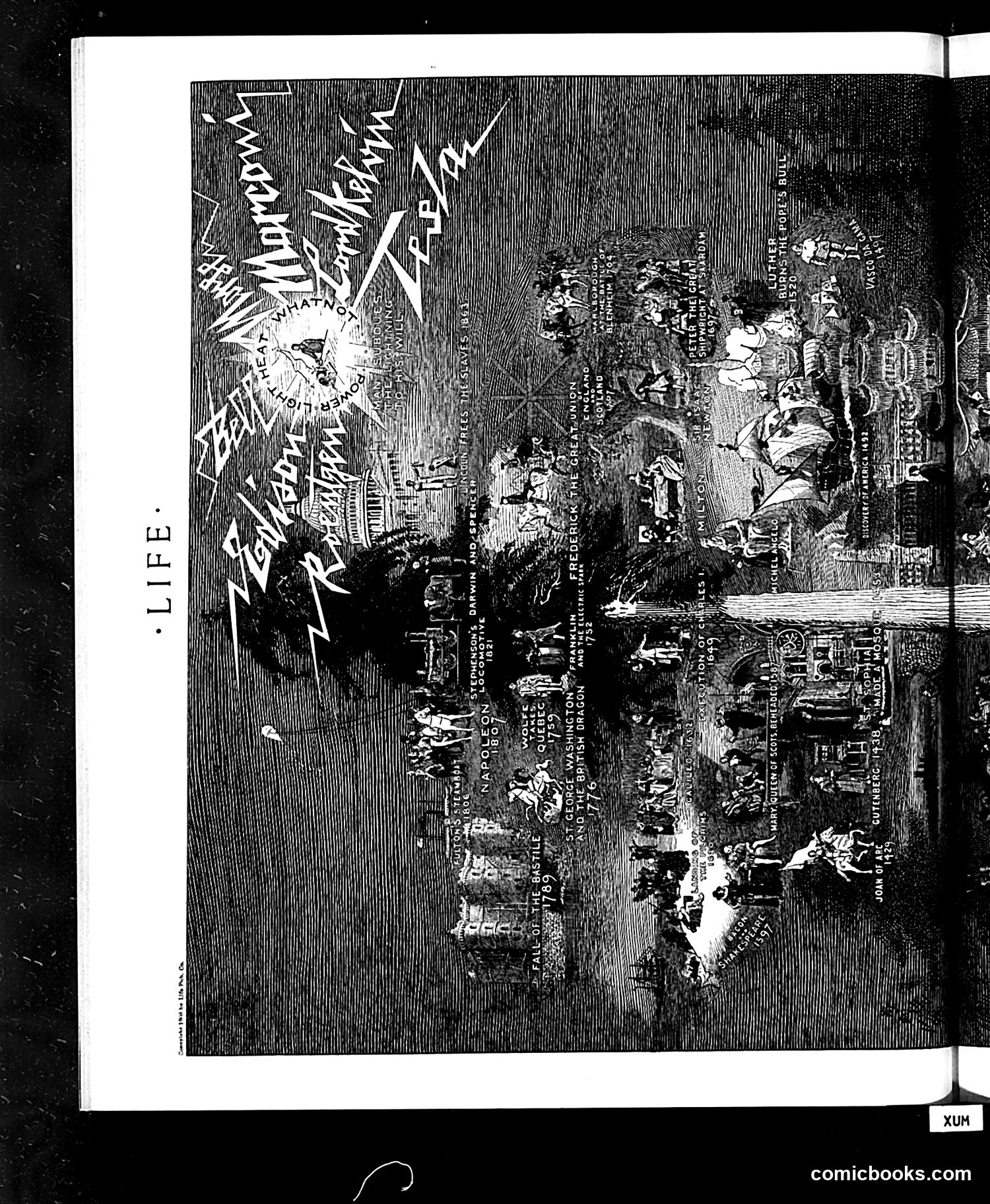
This page appears to be from *Life* magazine and shows an engraving-style illustration labeled "LIFE" on the left margin. The image depicts what appears to be a crowded urban or industrial street scene with multiple figures and architectural elements. However, the OCR text provided is essentially empty (only showing "LIFE" and some reference markers), making it impossible to read the actual caption, title, or explanatory text that would clarify the cartoon's subject, the figures depicted, or its satirical point. Without legible text content, I cannot reliably identify specific political figures, social references, or the intended satire. To properly analyze this page's meaning for a modern reader, the OCR text would need to be accurate and complete.
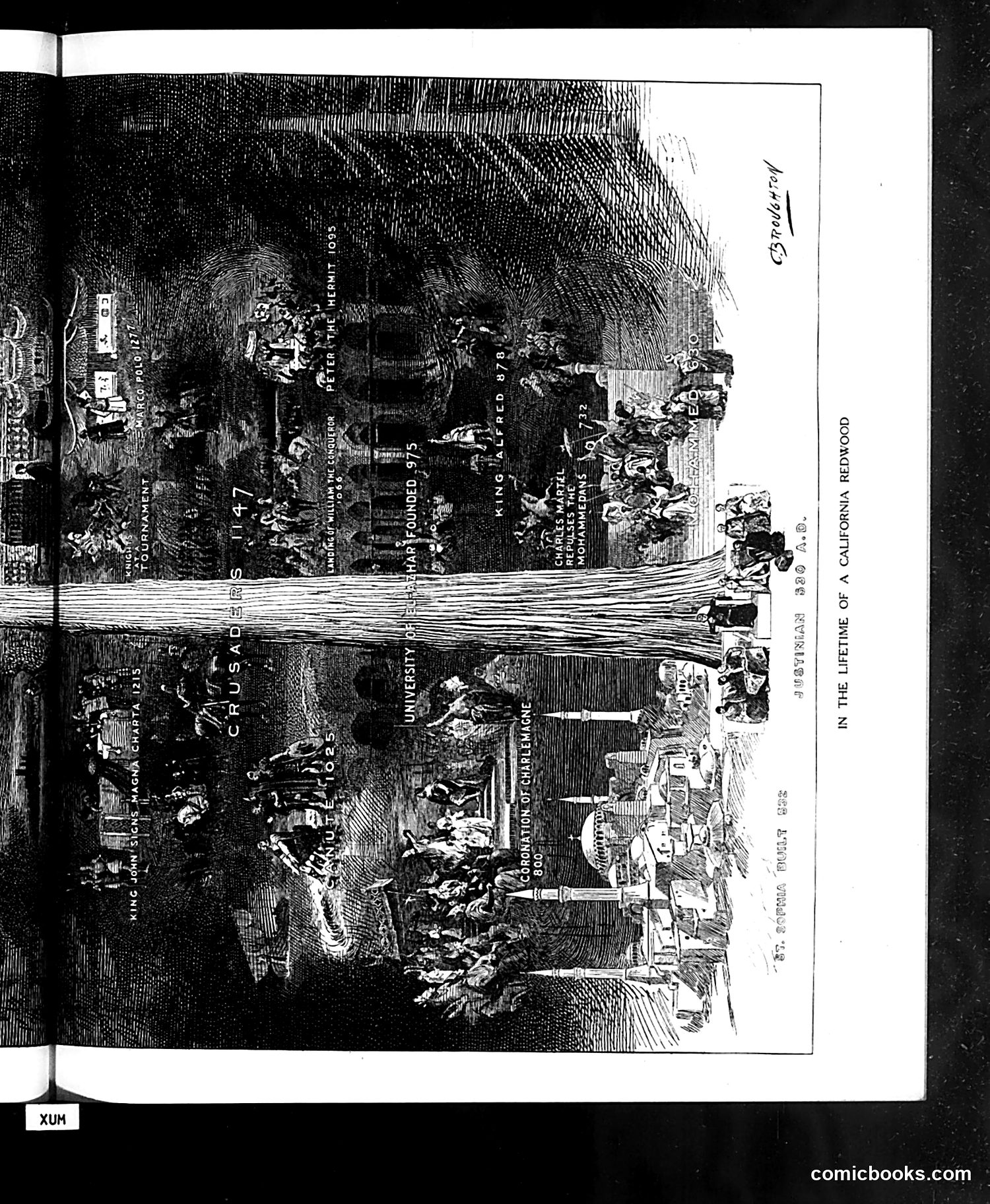
I can see this is a page from *Life* magazine dated 1903, but the image quality and orientation make it difficult to read the specific text and identify the cartoon details with certainty. The page appears to contain an engraved illustration showing what looks like a crowded scene, possibly depicting a political or social event from the early 1900s. However, without being able to clearly read the OCR text or identify specific figures in the illustration, I cannot reliably explain what political figures, events, or satirical points are being referenced. To provide accurate historical context, I would need either a clearer image or legible caption text identifying the subject matter.
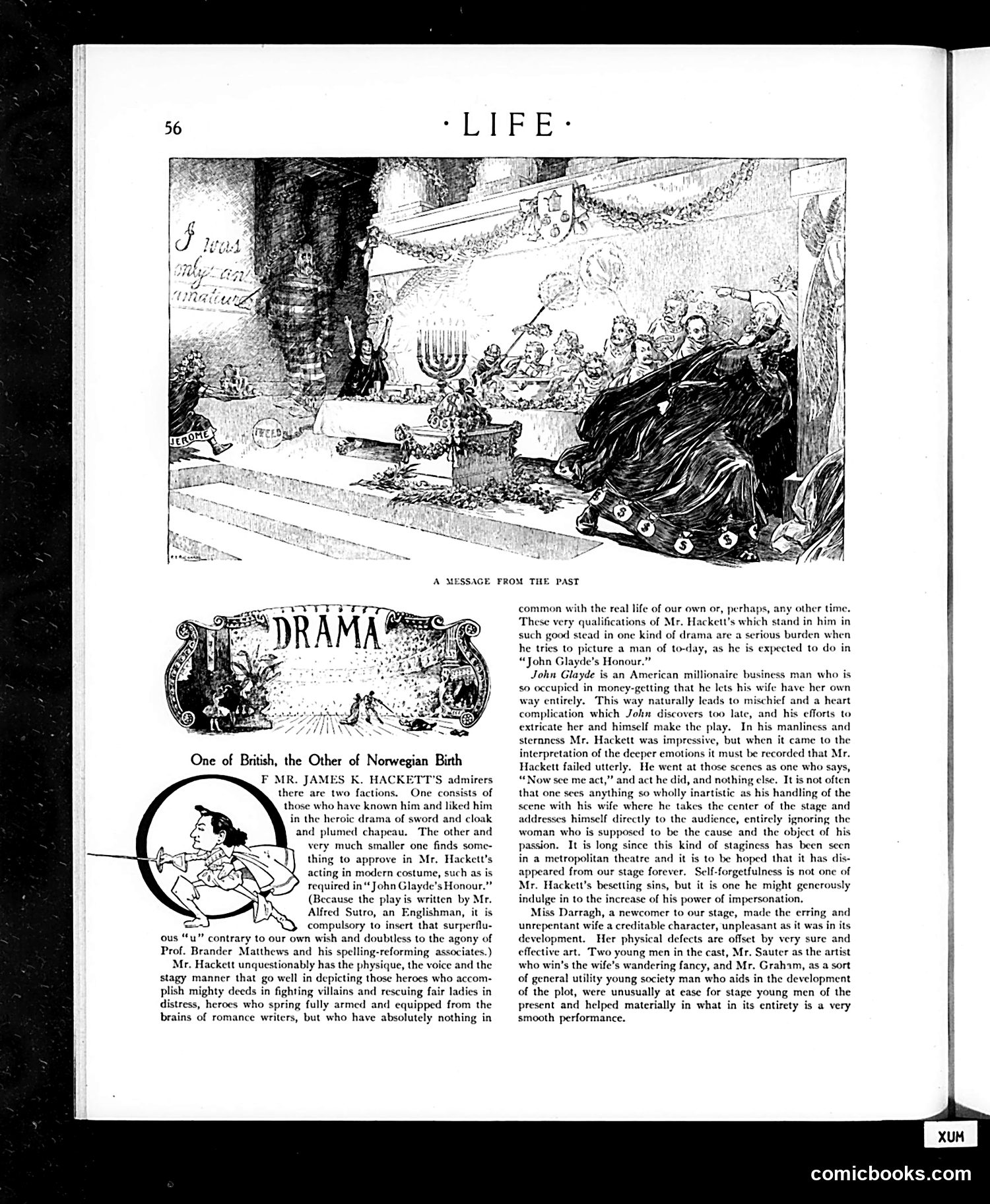
This page reviews a theatrical production of "John Glayde's Honour," a play by English playwright Alfred Sutro (featuring a deliberately British spelling of "u" that the critic mocks). The top illustration depicts a historical/classical dramatic scene, contrasting with the review's subject matter. **The Drama Criticism:** Actor James K. Hackett has two factions of admirers: those who appreciate him in historical costume dramas (sword-and-cloak roles), and a much smaller group who tolerate his modern-dress acting. The review argues Hackett excels at heroic, stagy roles but fails dramatically in contemporary settings requiring emotional subtlety. **The Satire:** The critic ridicules Hackett's performance as a modern American businessman, noting he plays scenes directly to the *audience* rather than engaging authentically with his co-star, demonstrating "staginess" and lack of self-forgetfulness. This was apparently an old-fashioned theatrical technique already considered embarrassingly outdated by the critic's standards. The supporting cast (Miss Darragh, Messrs. Sauter and Graham) receives qualified praise.
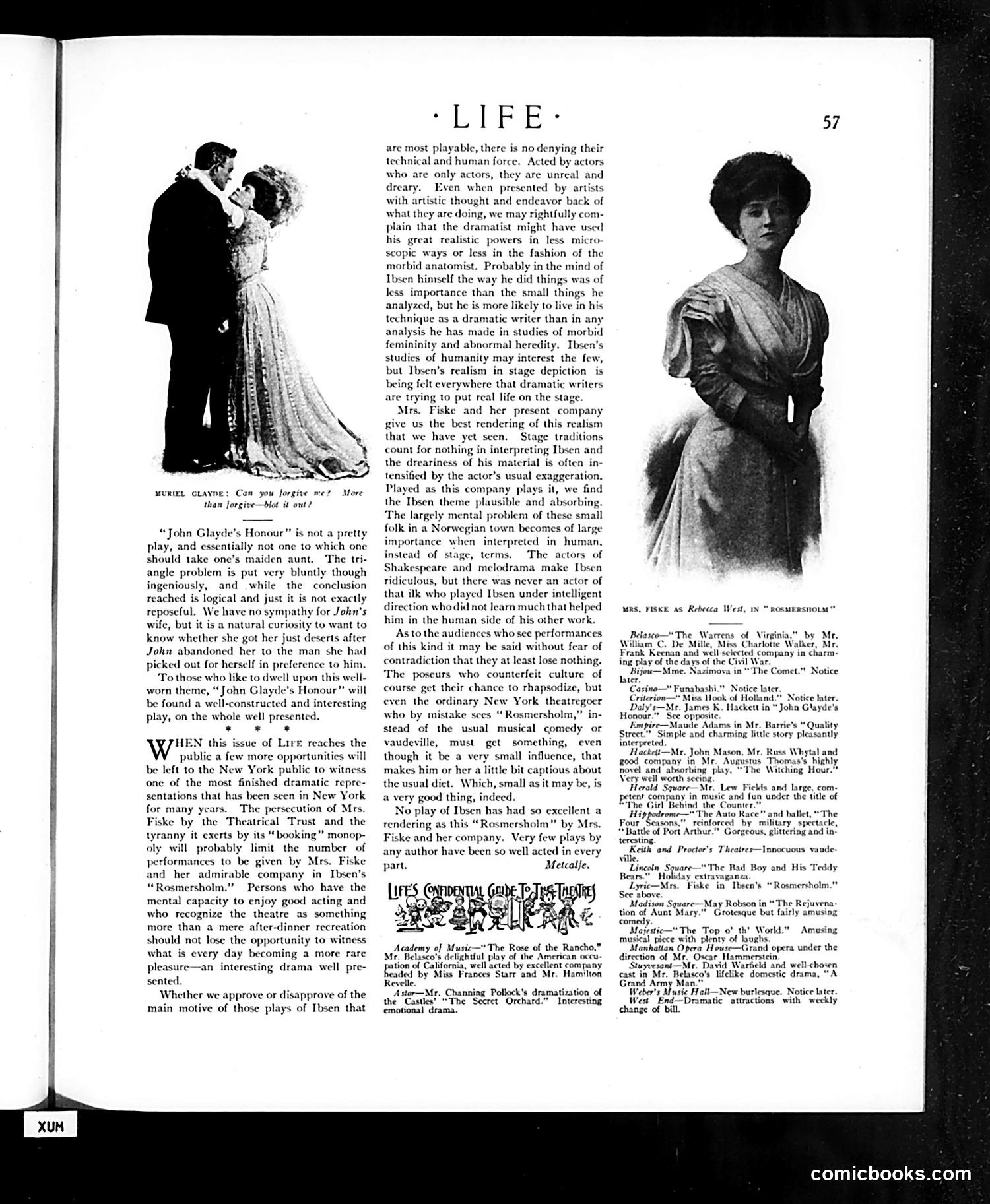
This page reviews theatrical productions, primarily focusing on Henrik Ibsen's "Rosmersholm" starring Mrs. Fiske. **The Main Subject:** The text praises Mrs. Fiske's performance in Ibsen's Norwegian drama as superior to typical theatrical presentations of the period. The critic argues that Ibsen's realistic plays require intelligent acting—not exaggerated melodramatic style—to convey their psychological depth about ordinary people's moral dilemmas. **The Social Context:** The review mentions the "Theatrical Trust" monopoly's persecution of Mrs. Fiske, referring to the real-world conflict between independent producers and the booking monopoly controlling American theater. The critic suggests this censorship will limit performances of serious drama. **The Satire:** The implicit critique targets both highbrow "poseurs who counterfeit culture" and ordinary theatergoers accustomed to frivolous entertainment (musical comedy, vaudeville). The author suggests even casual audiences benefit from exposure to serious drama, however reluctantly. The photographs show scenes from theatrical productions, illustrating the performances being discussed.
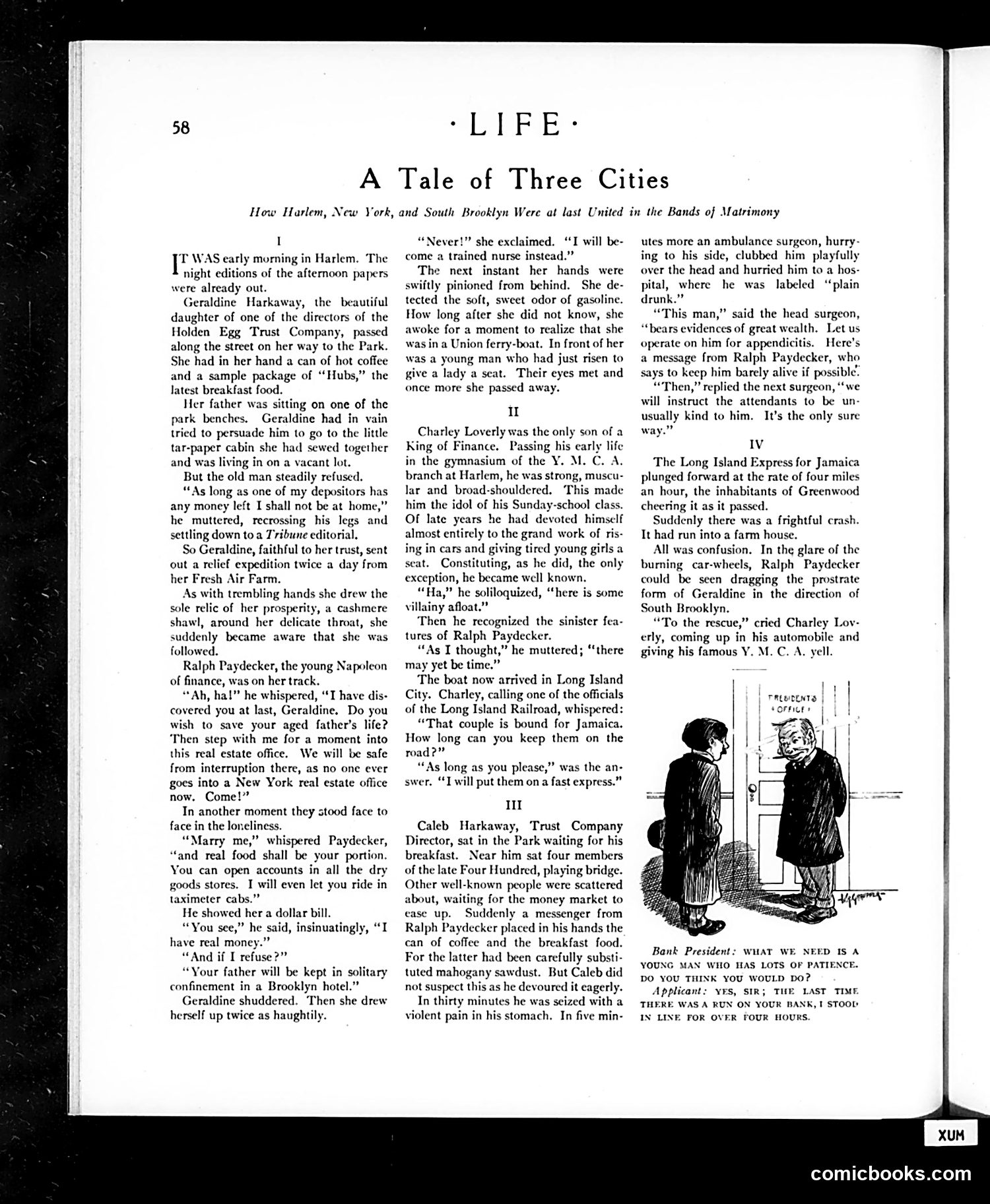
This page presents a serialized melodramatic story satirizing early 1900s New York social anxieties. The narrative parodies Victorian romance tropes while mocking contemporary financial concerns. The plot features recognizable types: Geraldine Harkaway (a wealthy director's daughter now impoverished), Ralph Paydecker (a ruthless financier villain), and Charley Loverly (a virtuous YMCA gymnasium member as hero). The satire targets: **Financial instability**: Geraldine's father refuses to leave the park bench while depositors have money—mocking both his honor and the era's economic precarity. **Conspicuous consumption**: Paydecker tempts Geraldine with "accounts in dry goods stores" and taximeter cabs—luxuries coded as desirable yet ridiculous. **Class mobility**: The story connects Harlem, New York, and Brooklyn through romantic/financial intrigue, reflecting anxieties about urban social movement. The cartoon accompanying the text (showing two men at an office door) illustrates the melodramatic kidnapping plot. The humor lies in exaggerating contemporary fears—financial collapse, seduction, abduction—into absurdist parody.
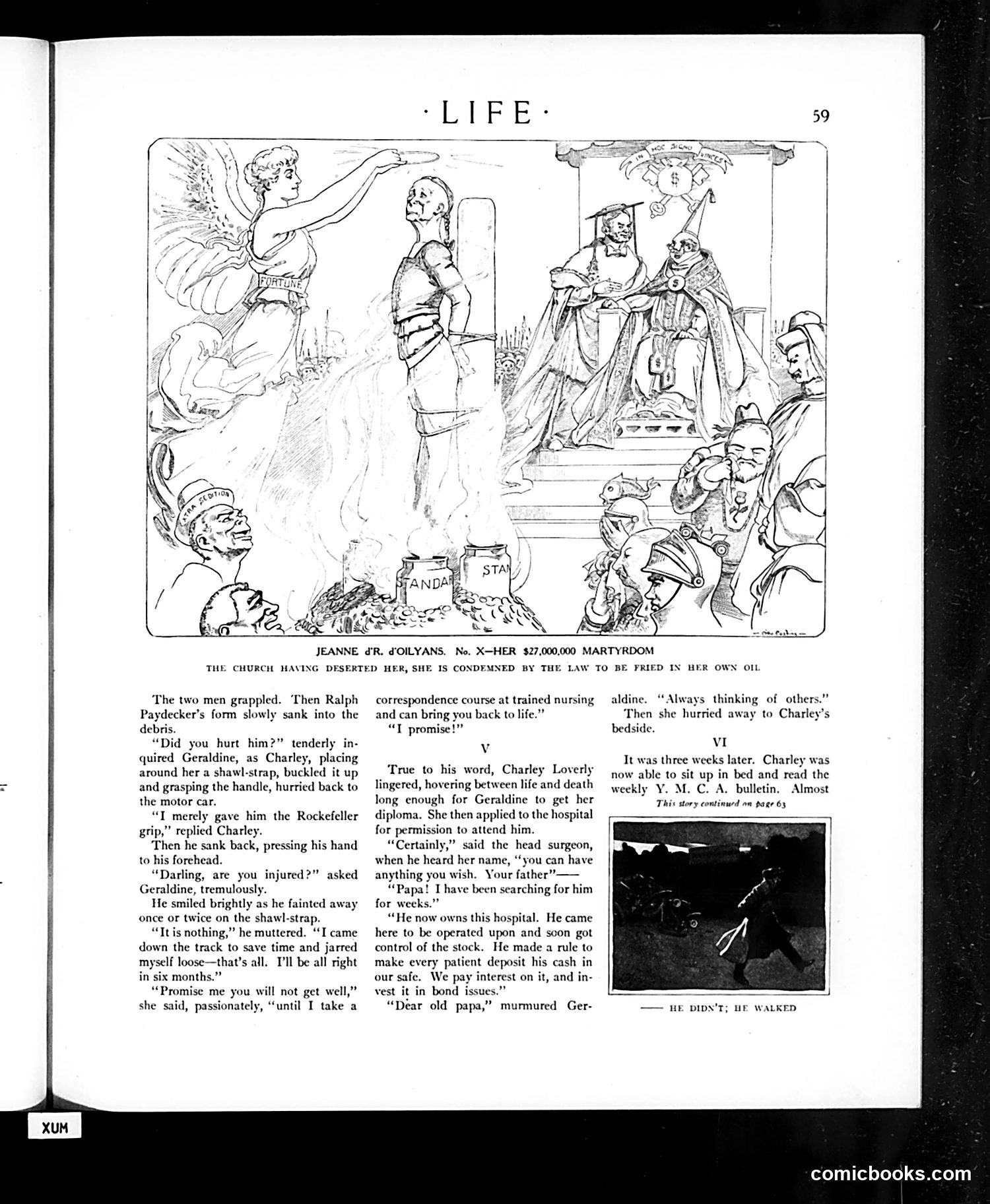
This Life magazine page satirizes wealthy industrialists and their corrupt practices during the Gilded Age. The headline references "Jeanne d'Arc d'Oilya ns" (a pun combining Joan of Arc with "oil"), mocking the $27 million fortune involved—likely alluding to Standard Oil magnate John D. Rockefeller. The cartoon and accompanying narrative mock: 1. **Ruthless business tactics**: The "Rockefeller grip" joke references predatory monopolistic practices. 2. **Hospital corruption**: Geraldine's father uses a hospital as a financial scheme, forcing patients to deposit cash and investing in bonds rather than patient care—critiquing how wealthy industrialists exploited essential services for profit. 3. **Wealth's moral emptiness**: Characters constantly faint, linger dramatically, and prioritize financial schemes over genuine concern. The satire targets how turn-of-the-century tycoons converted social institutions into personal profit centers while claiming philanthropic virtue.
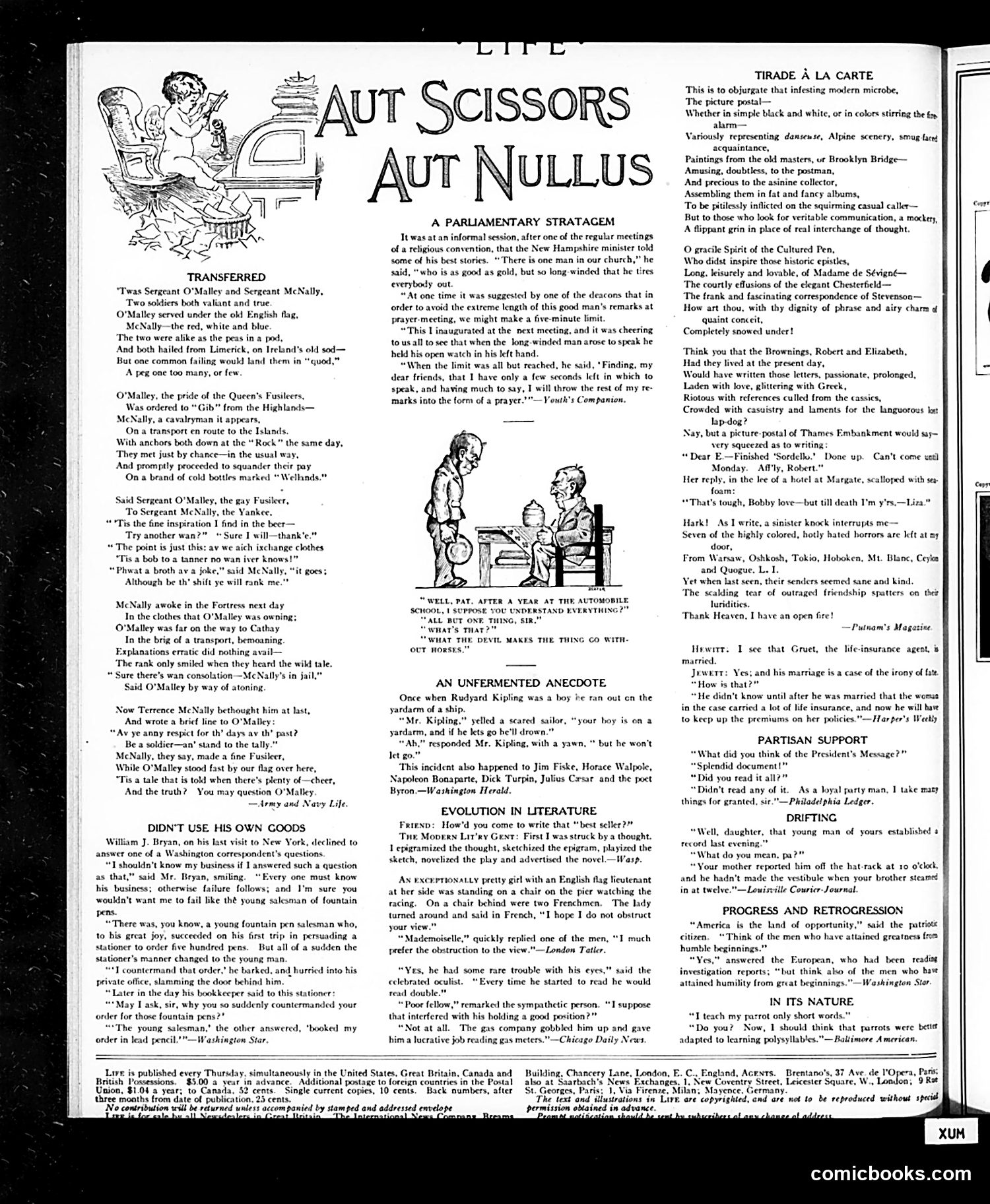
This page contains three distinct satirical pieces: **"Aut Scissors Aut Nullus"** (top): A humorous poem about two sergeants—one Irish-British (O'Malley) and one Irish-American (McNally)—who meet by chance and swap uniforms while drunk as a prank. O'Malley ends up court-martialed aboard a transport ship while McNally serves successfully in the British Army. The satire gently mocks military rigid hierarchy and the irony that uniforms matter more than the man wearing them. **"An Unfermented Anecdote"** (middle right): A brief anecdote about an English officer's romantic misadventure, typical light humor. **"Didn't Use His Own Goods"** (bottom left): William J. Bryan tells a joke about a fountain pen salesman who loses a large order because his own booking was made in pencil—satirizing the principle that one should use/believe in one's own product. These are typical turn-of-century Life magazine fare: gentle, whimsical satire on military life, business practices, and public figures, targeting educated readers familiar with contemporary figures like Bryan.
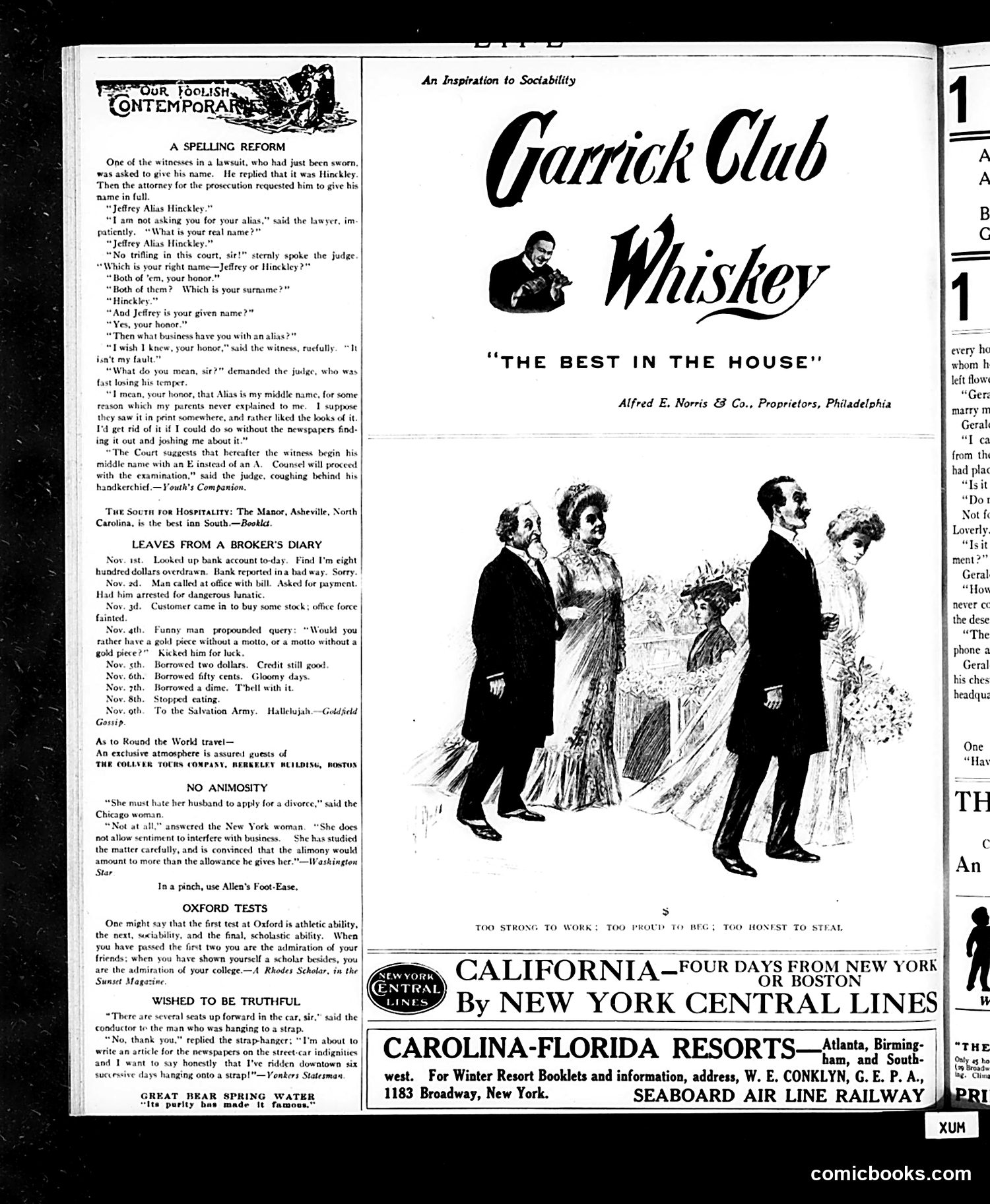
This page from Life magazine (likely early 1900s) contains several humorous anecdotes and advertisements rather than political cartoons. The main illustration shows well-dressed couples in what appears to be a social setting, captioned "Too strong to work; too proud to beg; too honest to steal"—satirizing idle wealthy people who contribute nothing to society. The text pieces mock various social absurdities: - **"A Spelling Reform"**: A joke about a witness named "Jeffrey Alias Hinckley," where his middle name is literally "Alias," creating courtroom confusion. It satirizes bureaucratic rigidity. - **"Leaves from a Broker's Diary"**: Dark humor about financial desperation during economic hardship, showing a desperate man arrested for proposing absurd business schemes. - **"No Animosity"**: Critiques how divorce has become transactional rather than emotional—a woman calculates alimony value rather than expressing hurt. The overall tone reflects turn-of-the-century American satirical commentary on wealth inequality, business ethics, and changing social attitudes toward marriage.
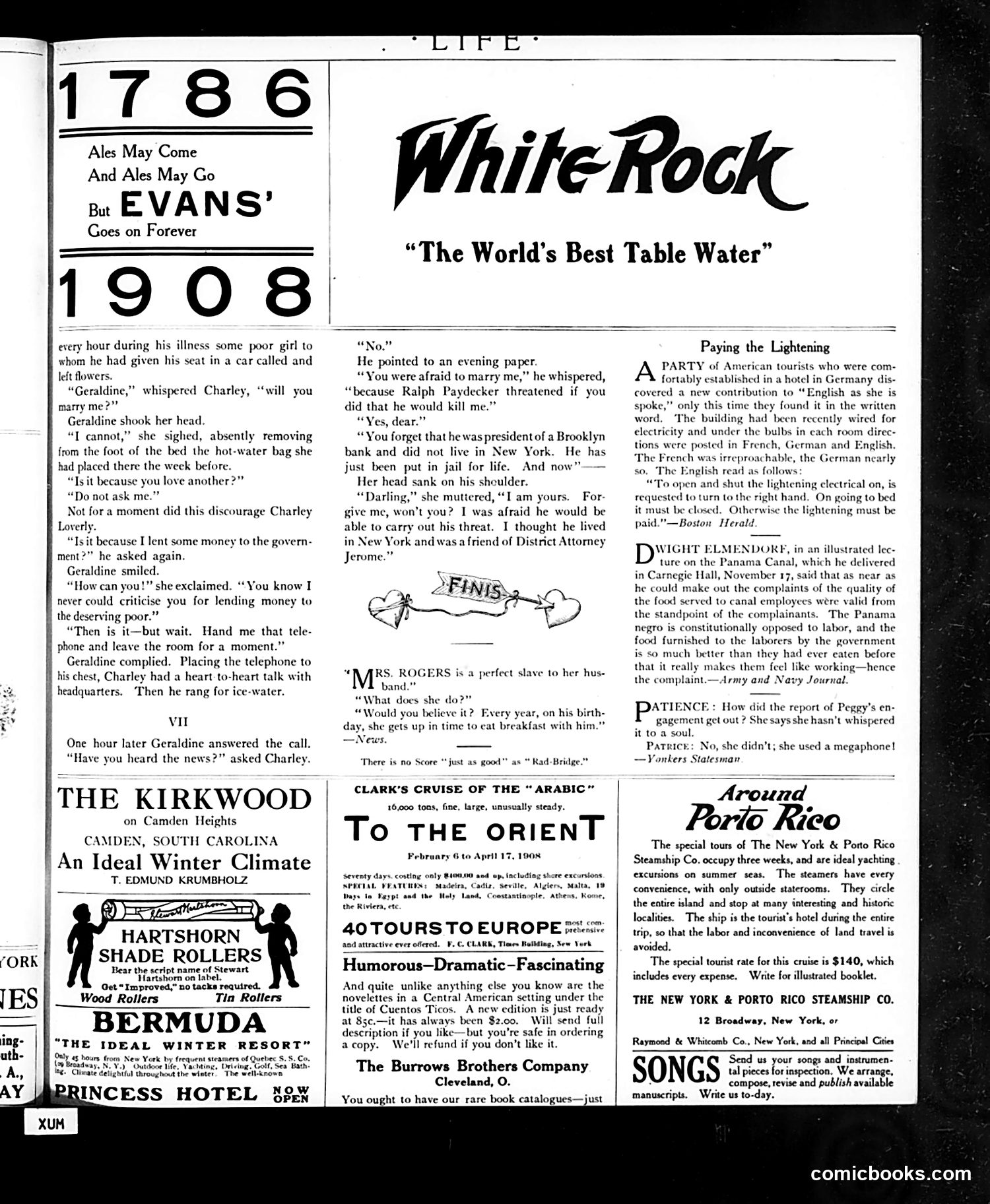
This page is primarily **advertisements and short humor pieces** from Life magazine, circa 1908. The main narrative feature is a romantic comedy sketch about "Charley Loverly" pursuing "Geraldine." The joke: Charley repeatedly proposes but Geraldine refuses because she fears her ex, Brooklyn banker Ralph Paydecker, will kill him if she marries. Charley solves this by calling "headquarters" (unclear what organization), learns Paydecker has been jailed for life, and returns to propose successfully. The satire appears to mock both melodramatic romance and casual acceptance of institutional power—Charley's solution involves contacting some unnamed authority rather than, say, police. Other humor pieces include brief anecdotes mocking women's roles ("Mrs. Rogers is a perfect slave") and English-language errors in foreign hotels ("the lightening must be paid"). The remainder consists of travel advertisements (cruises, winter resorts) and product ads typical of the era. No political cartoons are visible on this page.
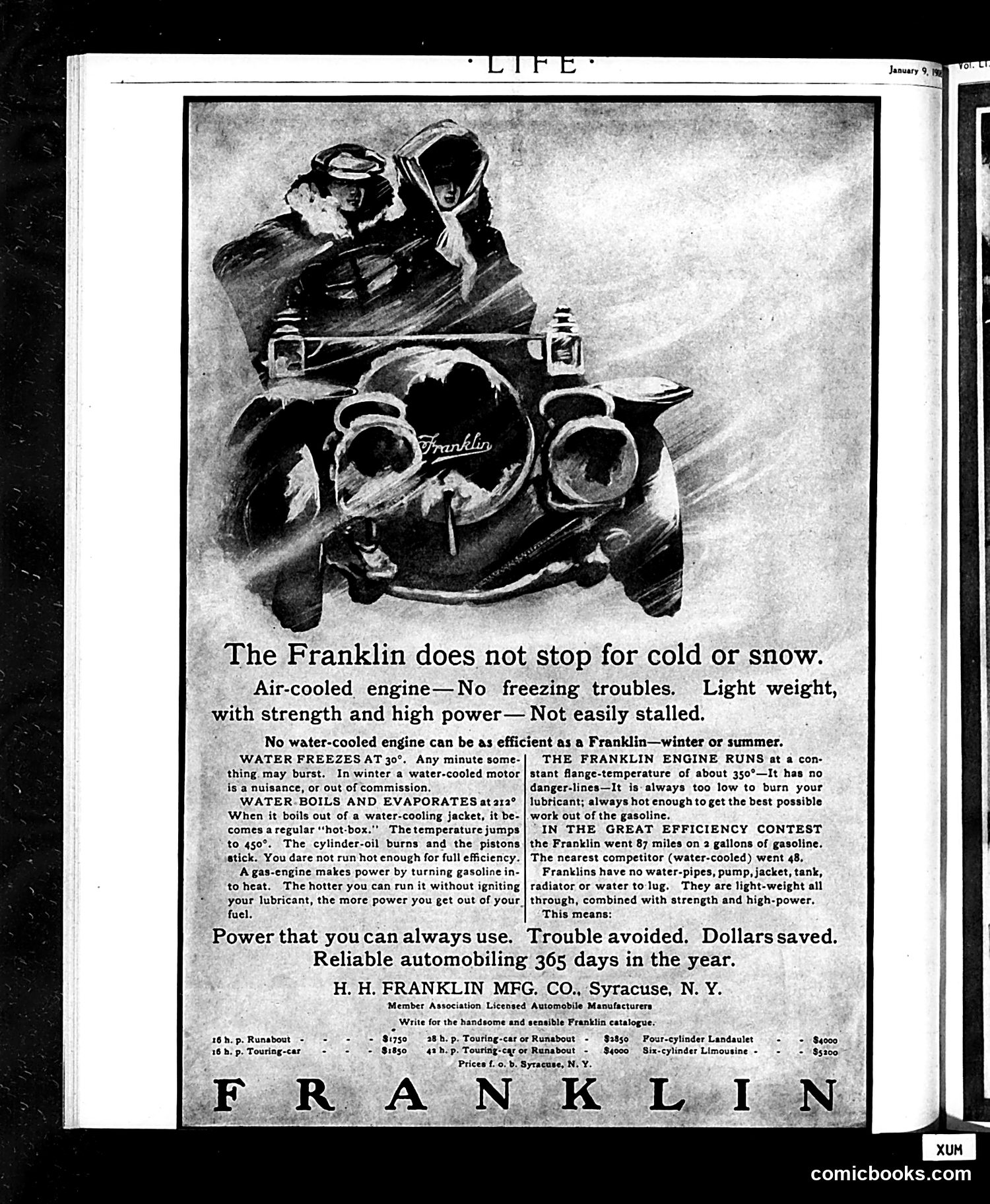
This is primarily a **product advertisement**, not political satire. It promotes the Franklin automobile, manufactured in Syracuse, New York, emphasizing its air-cooled engine as superior to competitors' water-cooled engines. The illustration shows two bundled figures driving a Franklin car through snow, visually demonstrating the headline claim: "The Franklin does not stop for cold or snow." The advertisement's argument: water-cooled engines freeze in winter (at 30°) and overheat in summer (boiling at 212°), causing mechanical failure. Franklin's air-cooled engine maintains constant temperature (350°) year-round, offering reliability "365 days in the year." The text includes competitive claims (e.g., Franklin achieved 87 miles on 2 gallons versus a competitor's 48 miles), plus pricing for various models ($1,750–$5,200). This reflects early 20th-century automotive marketing emphasizing engineering advantages during a period when vehicle reliability remained a significant concern for buyers.