
Life, 1908-01-09 · page 16 of 22
Life — January 9, 1908 — page 16: what you’re looking at
What you’re looking at
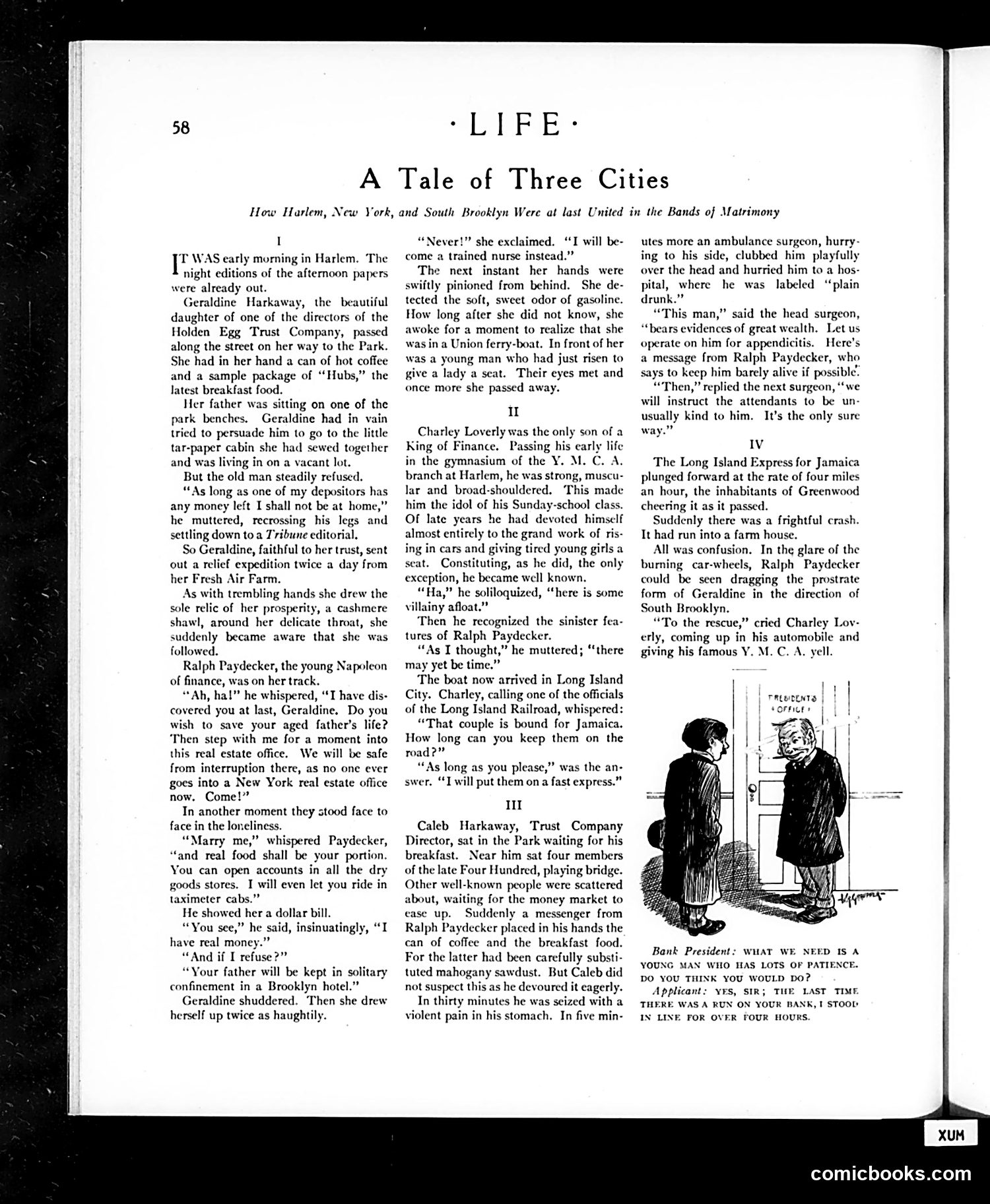
This page presents a serialized melodramatic story satirizing early 1900s New York social anxieties. The narrative parodies Victorian romance tropes while mocking contemporary financial concerns. The plot features recognizable types: Geraldine Harkaway (a wealthy director's daughter now impoverished), Ralph Paydecker (a ruthless financier villain), and Charley Loverly (a virtuous YMCA gymnasium member as hero). The satire targets: **Financial instability**: Geraldine's father refuses to leave the park bench while depositors have money—mocking both his honor and the era's economic precarity. **Conspicuous consumption**: Paydecker tempts Geraldine with "accounts in dry goods stores" and taximeter cabs—luxuries coded as desirable yet ridiculous. **Class mobility**: The story connects Harlem, New York, and Brooklyn through romantic/financial intrigue, reflecting anxieties about urban social movement. The cartoon accompanying the text (showing two men at an office door) illustrates the melodramatic kidnapping plot. The humor lies in exaggerating contemporary fears—financial collapse, seduction, abduction—into absurdist parody.
📄 Transcribed text from this page (OCR, searchable)
Machine-transcribed from the original scan — historical spelling and the odd misread are preserved.
1 WAS early morning in Harlem. The night editions of the afternoon papers. were already out. Geraldine Harkaway, the beautiful daughter of one of the directors of the Holden Egg Trust Company, passed along the street on her way to the Park. She had in her hand a can of hot coffee and a sample package of “Hubs,” the latest breakfast food. Her father was sitting on one of the park benches. Geraldine had in vain tried to persuade him to go to the little tar-paper cabin she had sewed together and was living in on a vacant lot. But the old man steadily refused. “As long as one of my depositors has any money left I shall not be at home,” he muttered, recrossing his legs and settling down to a Tribune editorial, So Geraldine, faithful to her trust, sent out a relief expedition twice a day from her Fresh Air Farm. As with trembling hand: sole relic of her prosperity, a cashmere shawl, around her delicate throat, she suddenly became aware that she was followed. Ralph Paydecker, the young Napoleon of finance, was on her track. “Ah, hal” he whispered, “I have dis- covered you at last, Geraldine. Do you h to save your aged father’s life? ‘Then step with me for a moment into this real estate office. We will be safe from interruption there, as no one ever goes into a New York real estate office now. Come!” In another moment they stood face to face in the loneliness. “Marry me,” whispered Paydecker, “and real food shall be your portion. You can open accounts in all the dry goods stores. I will even let you ride in taximeter cabs.” He showed her a dollar bill. “You see,” he said, insinuatingly, “I have real money.” “And if I refuse?” “Your father will be kept in solitary confinement in a Brooklyn hotel.” Geraldine shuddered. Then she drew herself up twice as haughtily. she drew the *LIFE: A Tale of Three Cities How Harlem, New York, and South Brooklyn Were at last United in the Bands of Matrimony “Never!” she exclaimed. ‘I will be- come a trained nurse instead.” The next instant her hands were swiftly pinioned from behind. She de- tected the soft, sweet odor of gasoline. How long after she did not know, she awoke for a moment to realize that she was in a Union ferry-boat. In front of her was a young man who had just risen to give a lady a seat. Their eyes met and once more she passed away. II Charley Loverly was the only son of a King of Finance. Passing his early life in the gymnasium of the Y. M. C. branch at Harlem, he was strong, muscu- lar and broad-shouldered. This made him the idol of his Sunday-school class. Of late years he had devoted himself almost entirely to the grand work of ri: ing in cars and giving tired young girls a seat. Constituting, as he did, the only xception, he became well known, “Ha,” he soliloquized, “here is some villainy afloat.” Then he recognized the sinister fea- tures of Ralph Paydecker. “‘As I thought,” he muttered; “there may yet be time.” The boat now arrived in Long Island City. Charley, calling one of the officials of the Long Island Railroad, whispered: “That couple is bound for Jamaica. How long can you keep them on the road ?”” “As long as you please,” was the an- swer, “I will put them ona fast express.” Ill Caleb Harkaway, Trust Company Director, sat in the Park waiting for his breakfast. Near him sat four members of the late Four Hundred, playing bridge. Other well-known people were scattered about, waiting for the money market to case up. Suddenly a messenger from Ralph Paydecker placed in his hands the can of coffee and the breakfast food. For the latter had been carefully substi- tuted mahogany sawdust. But Caleb did not suspect this as he devoured it eagerly. In thirty minutes he was seized with a violent pain in his stomach. In five min- utes more an ambulance surgeon, hurry- ing to his side, clubbed him playfully over the head and hurried him to a hos- pital, where he was labeled “plain drunk.” “This man,” said the head surgeon, “bears evidences of great wealth, Let us operate on him for appendicitis. Here's a message from Ralph decker, who says to keep him barely alive if possible. “Then,” replied the next surgeon, “we will instruct the attendants to be un usually kind to him. It’s the only sure way.” IV The Long Island Express for Jamaica plunged forward at the rate of four miles an hour, the inhabitants of Greenwood cheering it as it passed. Suddenly there was a frightful crash. It had run into a farm house. All was confusion. In the glare of the burning car-wheels, Ralph Paydecker could be seen dragging the prostrate form of Geraldine in the direction of South Brooklyn. “To the rescue,” cried Charley Lov- erly, coming up in his automobile and giving his famous Y. M.C. A. yell. | TReerENTs | Bank President: WUAT WE NEED IS A YOUNG MAN WHO HAS LOTS OF PATIENCE. DO YOU THINK YoU WOULD Do? Applicant: V¥S, SIR; TUE LAST TIME. THERE WAS A RUN ON YOUR BANK, 1 STOOL IN LINE FOR OVER FOUR HOURS. comicbooks.com