
Life, 1908-01-09 · page 14 of 22
Life — January 9, 1908 — page 14: what you’re looking at
What you’re looking at
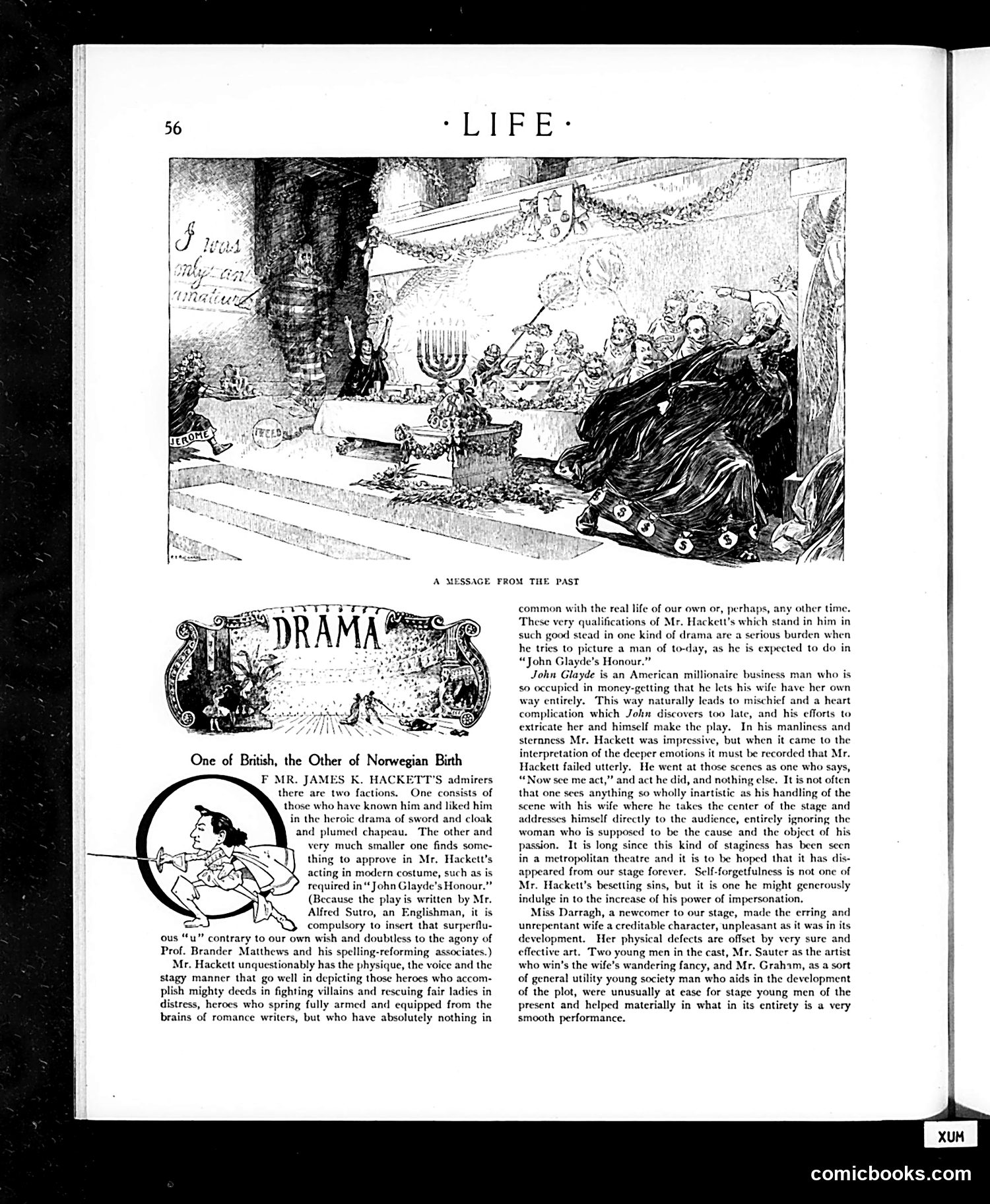
This page reviews a theatrical production of "John Glayde's Honour," a play by English playwright Alfred Sutro (featuring a deliberately British spelling of "u" that the critic mocks). The top illustration depicts a historical/classical dramatic scene, contrasting with the review's subject matter. **The Drama Criticism:** Actor James K. Hackett has two factions of admirers: those who appreciate him in historical costume dramas (sword-and-cloak roles), and a much smaller group who tolerate his modern-dress acting. The review argues Hackett excels at heroic, stagy roles but fails dramatically in contemporary settings requiring emotional subtlety. **The Satire:** The critic ridicules Hackett's performance as a modern American businessman, noting he plays scenes directly to the *audience* rather than engaging authentically with his co-star, demonstrating "staginess" and lack of self-forgetfulness. This was apparently an old-fashioned theatrical technique already considered embarrassingly outdated by the critic's standards. The supporting cast (Miss Darragh, Messrs. Sauter and Graham) receives qualified praise.
📄 Transcribed text from this page (OCR, searchable)
Machine-transcribed from the original scan — historical spelling and the odd misread are preserved.
\ MESSAGE FROM THE PAST K. HACKETT’S admirers there are two factions. One consists of those who have known him and liked him in the heroic drama of sword and cloak and plumed chapeau. The other and very much smaller one finds some- thing to approve in Mr. Hackctt’s acting in modern costume, such as is required in“ John Glayde's Honour.” (Because the play is written by Mr. Alfred Sutro, an Englishman, it is < compulsory to insert that surperflu- ous “u” contrary to our own wish and doubtless to the agony of Prof. Brander Matthews and his spelling-reforming associates.) Mr. Hackett unquestionably has the physique, the voice and the stagy manner that go well in depicting those heroes who accom- plish mighty deeds in fighting villains and rescuing fair ladies in distress, heroes who spring fully armed and equipped from the brains of romance writers, but who have absolutely nothing in ulifications of Mr. Hackett’s which such good stead in one kind of drama are a serious burden when he tries to picture a man of to-day, as he is expected to do in “John Glayde’s Honour.” John Glayde is an American millionaire business man who is so occupied in money-getting that he lets his wife have her own way entirely. This way naturally leads to mischief and a heart complication which John discovers too late, and efforts to extricate her and himself ma play. In his manliness and sternness Mr. Hackett was impressive, but when it came to the interpretation of the deeper emotions it must be recorded that Mr. Hackett failed utterly. He went at those scencs as one who says, “ Now sce me act,” and act he did, and nothii Ise. It is not often that one sees anything so wholly inartistic as his handling of the scene with his wife where he takes the center of the ce and addresses himself directly to the audience, entirely ignoring the woman who is supposed to be the cause and the object of his passion. It is long since this kind of staginess has been seen in a metropolitan theatre and it is to be hoped that it has dis- appeared from our stage forever. Self-forgetfulness is not one of Mr. Hackett’s besetting sins, but it is one he might gencrously ¢ in to the increase of his power of impersonation, Miss Darragh, a newcomer to our stage, made the erring and unrepentant wife a creditable character, unpleasant as it was in its development. Her physical defects are offset by very sure and ¢ art. Two young men in the cast, Mr. Sauter as the artist who win's the wife’s wandering fancy, and Mr. Graham, as a sort of general utility young society man who aids in the development of the plot, were unusually at case for stage young men of the present and helped materially in what in its entirety is a very smooth performance. comicbooks.com