
Life, 1908-01-09 · page 18 of 22
Life — January 9, 1908 — page 18: what you’re looking at
What you’re looking at
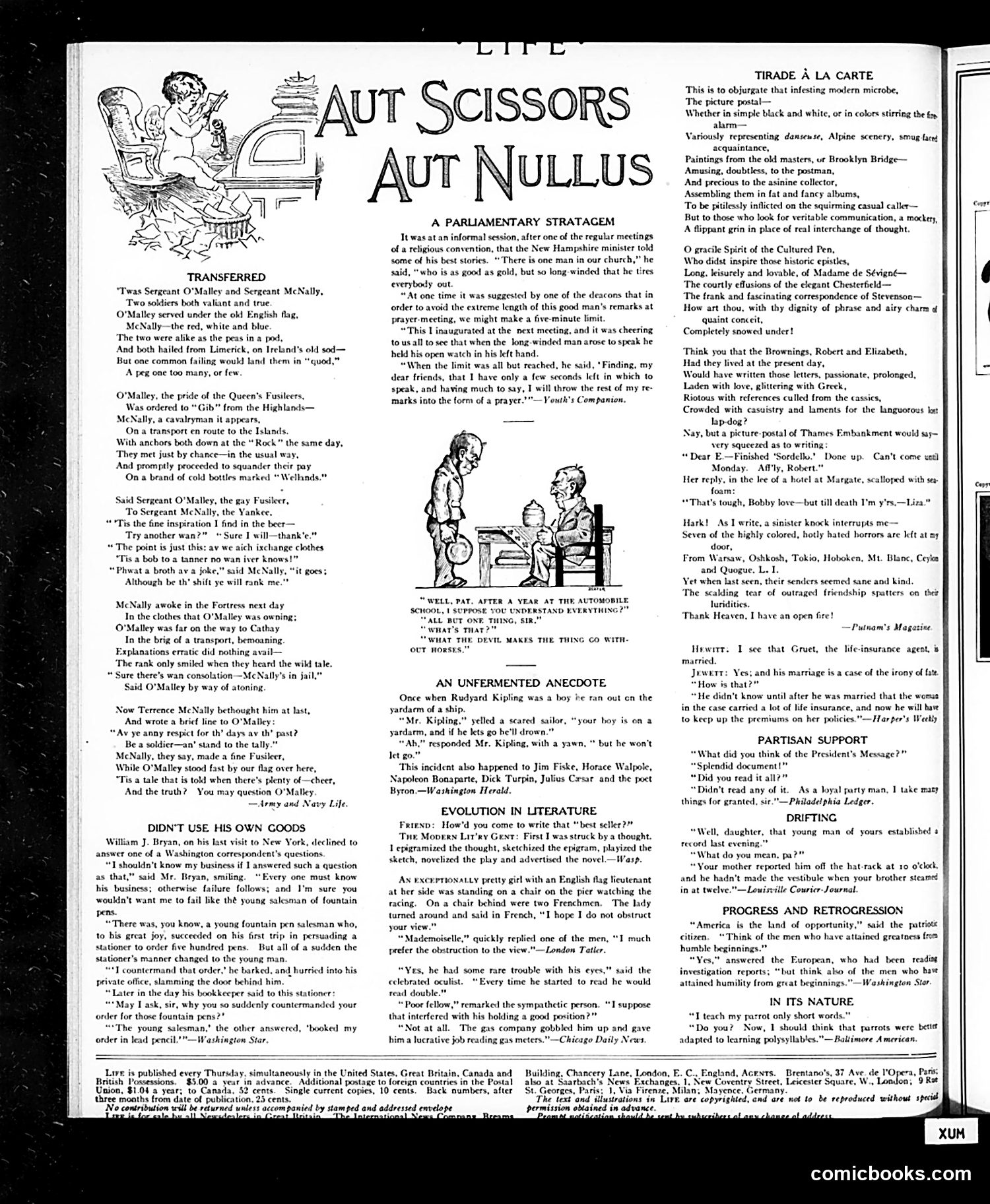
This page contains three distinct satirical pieces: **"Aut Scissors Aut Nullus"** (top): A humorous poem about two sergeants—one Irish-British (O'Malley) and one Irish-American (McNally)—who meet by chance and swap uniforms while drunk as a prank. O'Malley ends up court-martialed aboard a transport ship while McNally serves successfully in the British Army. The satire gently mocks military rigid hierarchy and the irony that uniforms matter more than the man wearing them. **"An Unfermented Anecdote"** (middle right): A brief anecdote about an English officer's romantic misadventure, typical light humor. **"Didn't Use His Own Goods"** (bottom left): William J. Bryan tells a joke about a fountain pen salesman who loses a large order because his own booking was made in pencil—satirizing the principle that one should use/believe in one's own product. These are typical turn-of-century Life magazine fare: gentle, whimsical satire on military life, business practices, and public figures, targeting educated readers familiar with contemporary figures like Bryan.
📄 Transcribed text from this page (OCR, searchable)
Machine-transcribed from the original scan — historical spelling and the odd misread are preserved.
“Twas Sergeant O'Malley and Sergeant McNally, ‘Two soldiers both valiant and true. O'Malley served under the okt English flag, McNally—the red, white and blue. The two were alike as the peas in a pod, And both hailed from Limerick, on Ireland’s old sod— But one common failing would land them in “quod,” A peg one too many, or few O'Malley, the pride of the Queen's Fusileers, Was ordered to “Gib” from the Highlands— McNally, a cavalryman it appears, On a transport en route to the Islands. With anchors both down at the “Rock” the same day, ‘They met just by chance—in the usual way, And promptly proceeded to squander their pay On a brand of cold bottles marked “Welland, Said Sergeant O'Malley, the gay Fusileer, To Sergeant McNally, the Yankee. “'Tis the fine inspiration I find in the beer— ‘Try another wan?” * Sure I will—thank’e.” “The point is just this: ay we aich ixchange clothes "Tis. a bob toa tanner no wan iver knows!” “Phwat a broth ay a joke, y Although be th’ shift ye will rank me. McNally awoke in the Fortress next day In the clothes that O'Malley was owning; O'Malley was far on the way to Cathay In the brig of a transport, bemoaning. Explanations erratic did nothing avail— ‘The rank only smiled when they heard the wild tale. there's wan consolation —McNally’s in jai Said O'Malley by way of atoning. Now Terrence McNally bethought him at last, And wrote a brief line to O’Malley: “Ay ye anny respict for th’ days av th’ past? Be a soldier—an’ stand to the tally.” McNally, they say, made a fine Fusileer, stood fast by our flag over here, “Tis a tale that is told when there's plenty of —cheer, And the truth? You may question O'Malley. Army and Navy Life DIDN'T USE HIS OWN GOODS William J. Bryan, on his last visit to New York, declined to answer one of a Washington correspondent's questions. “I shouldn't know my business if I answered such a question as that,” said Mr. Bryan, smiling. “Every one must know his business; otherwise failure follows; and I'm sure you woulda’t want me to fail like tht young salesman of fountain pens. “There was, you know, a young fountain pen salesman who, to his great joy, succeeded on his first trip in persuading a stationer to order five hundred pens. But all of a sudden the stationer’s manner changed to the young man “*T countermand that order," he barked, and hurried into his private office, slamming the door behind him. “Later in the day his bookkeeper “*May Lask, sir, why you so suddenly countermanded your ‘order for those fountain pens?* he young salesman,’ the other answered, ‘booked my order in lead pencil.!"—Washington to this stationer: Aut NULLUS A PARLIAMENTARY STRATAGEM It was at an informal session, after one of the regular meetings of a religious convention, that the New Hampshire minister told some of his best stories. “There is one man in our church,” he said, “who is as good as gold, but so long-winded that he Ures everybody out. “At one time it was suggested by one of the deacons that in order to avoid the extreme length of this good man's remarks at prayer-meeting, we might make a five-minute limit “This I inaugurated at the next meeting, and it was cheering to.usall to sce that when the long-winded man arose to speak he held his open watch in his left hand. “When the limit was all but reached, he said, ‘Finding, my dear friends, that I have only a few seconds left in which to speak, and having much to say, I will throw the rest of my re- marks into the form of a prayer."""—Youth's Companion “WELL, PAT. AYTER A YEAR AT THE AUTOMOBILE SCHOOL, 1 SUPPOSE YOU UNDERSTAND EVERYTHING 2” UT ONE. THING, SIR.” 1's THAT? DEVIL MAKES THE THING Go WITH. ovr Horses.” AN UNFERMENTED ANECDOTE Once when Rudyard Kipling was a boy he ran out cn the yardaem of a ship. “Mr. Kipling,” yelled a scared sailor, “your boy is on a yardarm, and if he kets go he'll drown.” “Ah,” responded Mr. Kipling, with a yawn, let go.” ‘This incident also happened to Jim Fiske, Horace Walpole, Napoleon Bonaparte, Dick Turpin, Julius Cxsar and the poet Byron.—Washington Herald. EVOLUTION IN LITERATURE Frtexp: How'd you come to write that “best seller?”” ‘Tne. Moores Lit'ry Gent: First I was struck by a thought. 1 epigramized the thought, sketchized the epigram, playized the sketch, novelized the play and advertised the novel—Wasp. but he won't AN rxexPTIONALLY pretty gil with an English flag licutenant at her side was standing on a chair on the pier watching the racing. On a chair behind were two Frenchmen. ‘The lady turned around and said in French, “I hope I do not obstruct your view “ Mademoiselle,” quickly replied one of the men, “I much prefer the obstruction to the view."—London Tatler “Yes, he had some rare trouble with his eyes," said the celebrated oculist. “Every time he started to read he would read double. * Poor fellow," remarked the sympathetic person. "I suppose that interfered with his holding a good position?” “Not at all. ‘The gas company gobbled him up and gave him a lucrative job reading gas meters.” —Chicago Daily News. TIRADE A LA CARTE This is to objurgate that infesting modern microbe, ‘The picture postal— Whether in simple black and white, or in colors stirring the fre alarm— musly representing dansense, Alpine scenery, smug face acquaintance, Paintings from the old masters, ur Brooklyn Bridge— Amusing, doubtless, to the postman, And precious to the asinine collector, Assembling them in fat and fancy albums, To be pitilessly inflicted on the squirming casual caller— But to those who look for veritable communication, a mockery, A Glippant grin in place of real interchange of thought. O gracile Spirit of the Cultured Pen, Who didst inspire those historic epistles, Long, leisurely and lovable, of Madame de Sévigné— ‘The courtly effusions of the elegant Chesterfield— ‘The frank and fascinating correspondence of Stevenson— How art thou, with thy dignity of phrase and airy cham d quaint conceit, Completely snowed under! ‘Think you that the Brownings, Robert and Elizabeth, Had they lived at the present day, Would have written those letters, passionate, prolonged, Laden with love, glittering with Greek, Riotous with references culled from the cassics, Crowded with casuistry and laments for the languorous ket lap-dog? Nay, but a picture-postal of Thames Embankment would sap~ very squeezed as to writing: “Dear E.—Finished ‘Sordello.’ Done up. Can't come ved Monday. Aft'ly, Robert.” Her reply, in the Iee of a hotel at Margate, scalloped with sex foam: “That's tough, Bobby love—but till death I'm y'rs.—Liza.” Hark! As I write, a sinister knock interrupts me— Seven of the highly colored, hotly hated horrors are left at sy door, From Warsaw, Oshkosh, Tokio, Hoboken, Mt. Blanc, Ceyion and Quogue, L. I. Yet when last seen, their senders seemed sane and kind. ‘The scalding tear of outraged friendship spatters on ther luridities. ‘Thank Heaven, I have an open fire! Putnam's Magazine Hewrrrs I see that Gruet, the life-insurance agest, s married. Jewett: Ves; and his marriage is a case of the irony of fat “How is that?" “He didn't know until after he was married that the worst in the case carried a lot of life insurance, and now he will have to keep up the premiums on her policies."—Harper's Weekly PARTISAN SUPPORT What did you think of the President's Message?” Splendid document!” Did you read it all?” Didn't read any of it. Asa loyal party man, 1 take maty things for granted, sir."—Philadelphia Ledger. DRIFTING “Well, daughter, that young man of yours established + record last evening.” What do you mean, pa?” ‘our mother reported him off the hat-rack at 10 o'clock and be hadn't made the vestibule when your brother steamed in at twelve." —Louisville Courier-Journal PROGRESS AND RETROGRESSION “America is the Lind of opportunity,” said the patriots citizen. “Think of the men who have attained greatness fre humble beginnings.” "Yes," answered the European, who had been readitt investigation reports; “but think alo of the men who bat attained humility from great beginnings." —Washington Stor IN ITS NATURE “T teach my parrot only short words." “Do you? Now, 1 should think that parrots were bettet adapted to learning polysyllables."— Baltimore America Lire is published every Thursday, simultaneously in the United States, Great Britain, Canada and British Possessions. $5.00 a year in advance. Additional postage to foreign countries in the Postal also at Saarbach’s News Building, Chancery Lane, London, E. C., England, AGENTS. Brentano's, 37 Ave. de l'Opera, Paris: changes. 1, New Coventry Street, Leicester S fe, W., London,” 9 Rot Union, $1.04 a year; to Canada, 52 cents. Single current copies, 10 cents. Back numbers, after St. Georges, Paris: 1, Via Firenze, Milan; Mayence. Germany. The text'and illustrations in Lire. are copyrighted, and are not to be reproduced without special three moaths from date of publication, 25 cents. No contribution sel be returned unless accom panied by stamped and addressed envelope permission objained in advance. comicbooks.com