
Life, 1908-01-09 · page 15 of 22
Life — January 9, 1908 — page 15: what you’re looking at
What you’re looking at
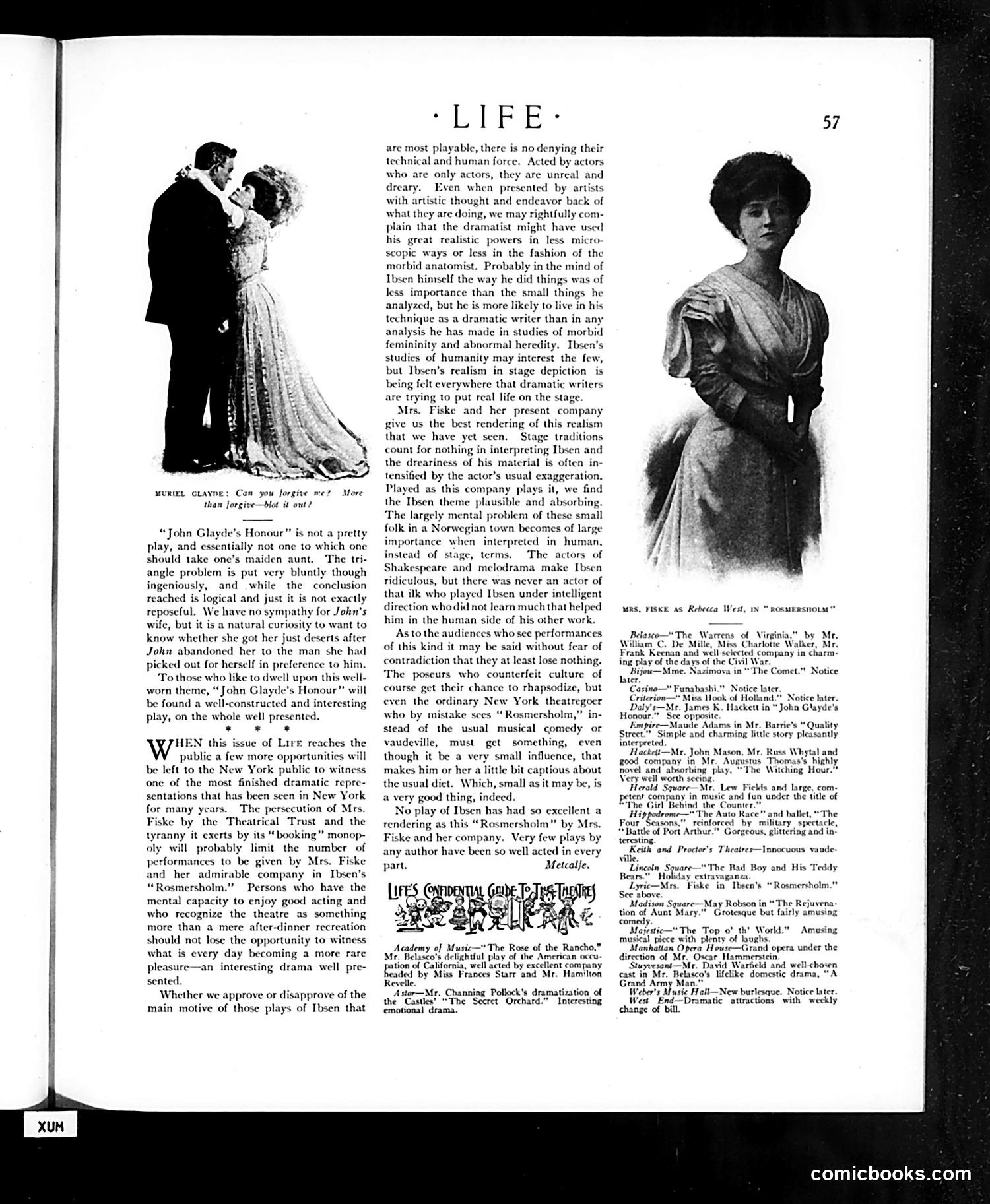
This page reviews theatrical productions, primarily focusing on Henrik Ibsen's "Rosmersholm" starring Mrs. Fiske. **The Main Subject:** The text praises Mrs. Fiske's performance in Ibsen's Norwegian drama as superior to typical theatrical presentations of the period. The critic argues that Ibsen's realistic plays require intelligent acting—not exaggerated melodramatic style—to convey their psychological depth about ordinary people's moral dilemmas. **The Social Context:** The review mentions the "Theatrical Trust" monopoly's persecution of Mrs. Fiske, referring to the real-world conflict between independent producers and the booking monopoly controlling American theater. The critic suggests this censorship will limit performances of serious drama. **The Satire:** The implicit critique targets both highbrow "poseurs who counterfeit culture" and ordinary theatergoers accustomed to frivolous entertainment (musical comedy, vaudeville). The author suggests even casual audiences benefit from exposure to serious drama, however reluctantly. The photographs show scenes from theatrical productions, illustrating the performances being discussed.
📄 Transcribed text from this page (OCR, searchable)
Machine-transcribed from the original scan — historical spelling and the odd misread are preserved.
Munn CLAVDE: Can you forgive me? More than forgive—blot it ont? “John Glayde’s Honour” is not a pretty play, and essentially not one to which one should take one’s maiden aunt. The tri- angle problem is put very bluntly though ingeniously, and while the conclusion reached is logical and just it is not exactly reposeful. We have no sympathy for John's wife, but it is a natural curiosity to want to know whether she got her just deserts after John abandoned her to the man she had picked out for herself in preference to him. To those who like to dwell upon this well worn theme, “John Glayde's Honour” will be found a well-constructed and interesting play, on the whole well presented. + * * HEN this issue of Lire reaches the public a few more opportunities will be left to the New York public to witness one of the most finished dramatic repre- sentations that has been seen in New York for many years. The persecution of Mrs. iske by the Theatrical Trust and the tyranny it exerts by its “booking” monop- oly will probably limit the number of performances to be given by Mrs. Fiske and her admirable company in Ibsen’ “Rosmersholm.” Persons who have the mental capacity to enjoy good acting and who recognize the theatre as something more than a mere after-dinner recreation should not lose the opportunity to witness what is every day becoming a more rare pleasure—an interesting drama well pre sented, Whether we approve or disapprove of the main motive of those plays of Ibsen that ‘LIPE: ost playable, there is no denying their technical and human force. Acted by actors who are only actors, they are unreal and dreary. Even when presented by artists with artistic thought and endeavor back of what they are doing, we may rightfully com- plain that the dramatist might ha his great realistic powers in I scopic ways or less in the fashion of the morbid anatomist. Probably in the mind of Ibsen himself the way he did things was of less importance than the small things he analyzed, but he is more likely to live in his technique as a dramatic writer than in any analysis he has made in studies of morbid femininity and abnormal heredity, Ibsen's studies of humanity may interest the few, but Ibsen's realism in stage depiction is being felt everywhere that dramatic writers are trying to put real life on the stage. Mrs. Fiske and her present company give us the best rendering of this realism that we have yet seen, Stage traditions count for nothing in interpreting Ibsen and the dreariness of his material is often in- tensified by the actor’s usual exaggeration, Played as this company plays it, we find the Ibsen theme plausible and absorbing. ‘The largely mental problem of these small folk in a Norwegian town becomes of large importance when interpreted in human, instead of stage, terms, The actors of Shakespeare and melodrama make Ibsen ridiculous, but there was never an actor of that ilk who played Ibsen under intelligent direction who did not learn much that helped him in the human side of his other work. As to the audiences who see performances of this kind it may be said without fear of contradiction that they at least lose nothing. The poseurs who counterfeit culture of course get their chance to rhapsodize, but even the ordinary New York theatregoer who by mistake sees “Rosmersholm,” in- stead of the usual musical comedy or vaudeville, must get something, even though it be a very small influence, that makes him or her a little bit captious about the usual diet. Which, small as it may be, is a very good thing, indeed. No play of Ibsen has had so excellent a rendering as this “Rosmersholm” by Mrs. Fiske and her company. Very few plays by any author have been so well acted in every part. Metcalje. used Academy of Music—"The Rose of the Rancho,” Mr. Belasco’s delightful play of the American occu- pation of California, well acted by excellent company readed by Miss Frances Surr and Mr. Ham'lton Revelle. Astor—Mr. Channing Pollock's dramatization of the Castles’ "The Secret Orchard.” Interesting emotional drama. urs, riske as Rebecca West, iN “ RossieRstioust” Belasco—" The Warrens of Virginia,” by Mr. William C. De Mille, Miss Charlotte Walker Frank Keenan and well selected company in ing play of the days of the Civil War. Bijou—Mme. Nazimova in "The Comet.” Notice later. Casino—" Funabashi." Notice later Criterion—" Miss Hook of Holland Daly’s—Mr. James K. Hackett in "John Glayde's Honour.” See opposite Em pire—Maude Adams in Mr. Barrie's “Quality Street.” Simple and charming little story pleasantly interpreted Hackett—Mr. John Mason, Mr. Russ Whytal and good company in Mr. Augustus Thomas's highly novel and absorbing play, “The Witching Hour.” Very weil worth secing Herald Square—Me. Lew Fiekis and large, com- petent company in music and fun under the title of "The Girl Behind the Counter.” Hippodrome—"*The Auto Race” and ballet, “The Four Seasons,” reinforced by military. spectacle, “Battle of Port Arthur.” Gorgeous, glittering and in! teresting. Keith and Procter's Thestres—Innocwous vaude- ville. Lincoln Square—"'The Bad Boy and His Teddy Bears.” Holiday extravaganza Lyric—Mrs. Fiske in Ibsen's " Rosmersholm See above. Madison Square—May Robson in “The Rejuvena tion of Aunt Mary.” Grotesque but fairly amusing comedy. Majestio— Top o! th’ World.” musical piece with plenty of ughs. Manhattan Opera House—Grand opera under the direction of Mr. Oxcar Hammerstein Stuyvesant—Mr. David Warfield and well-choven cast in Mr. Belasco’s lifelike domestic drama, “A Grand Army Man.” Weber's Music Hall—New burlesque. Notice later. West End—Dramatic attractions with weekly change of bill. Amusing comicbooks.com