
A complete issue · 24 pages · 1907
Life — October 24, 1907
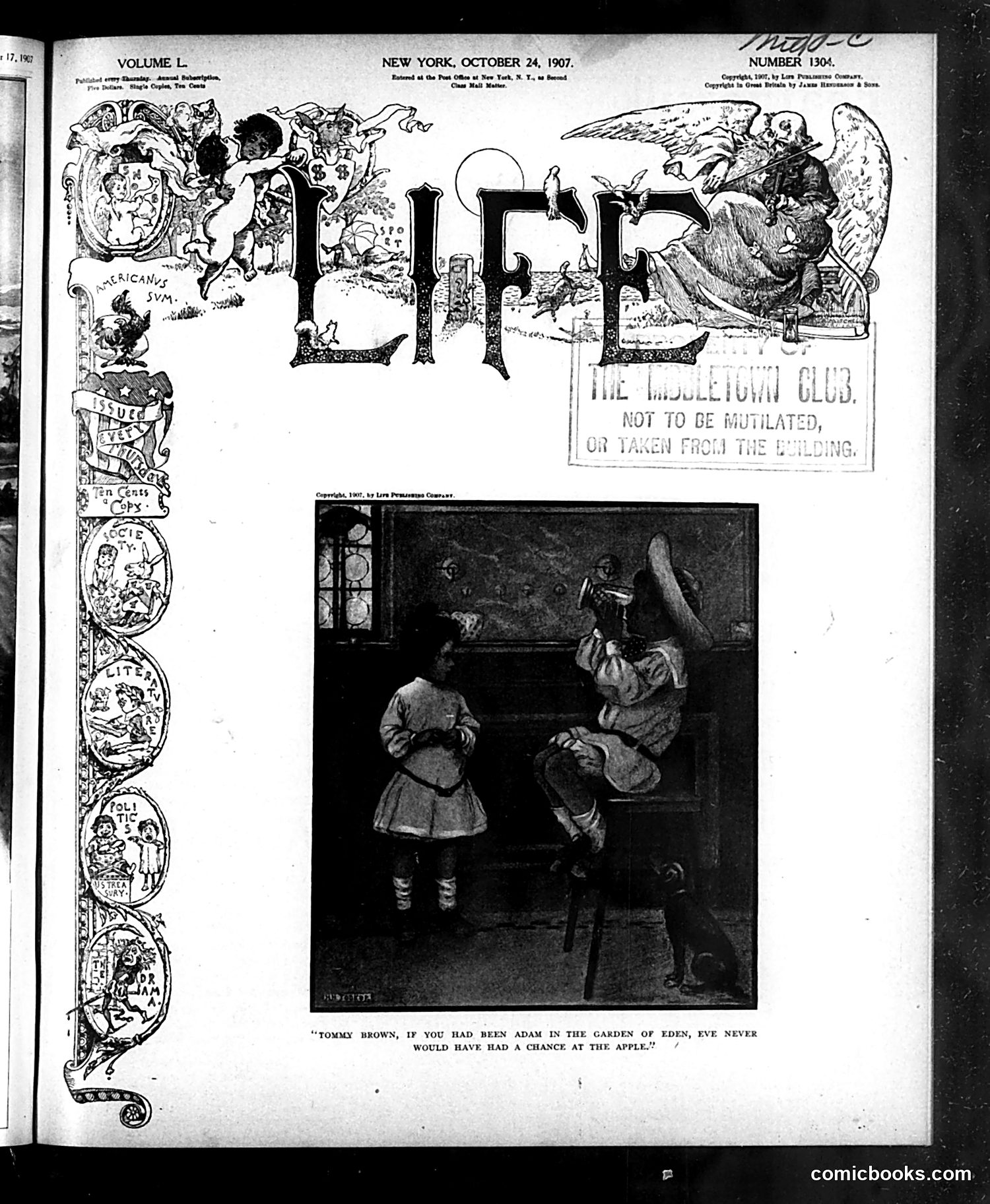
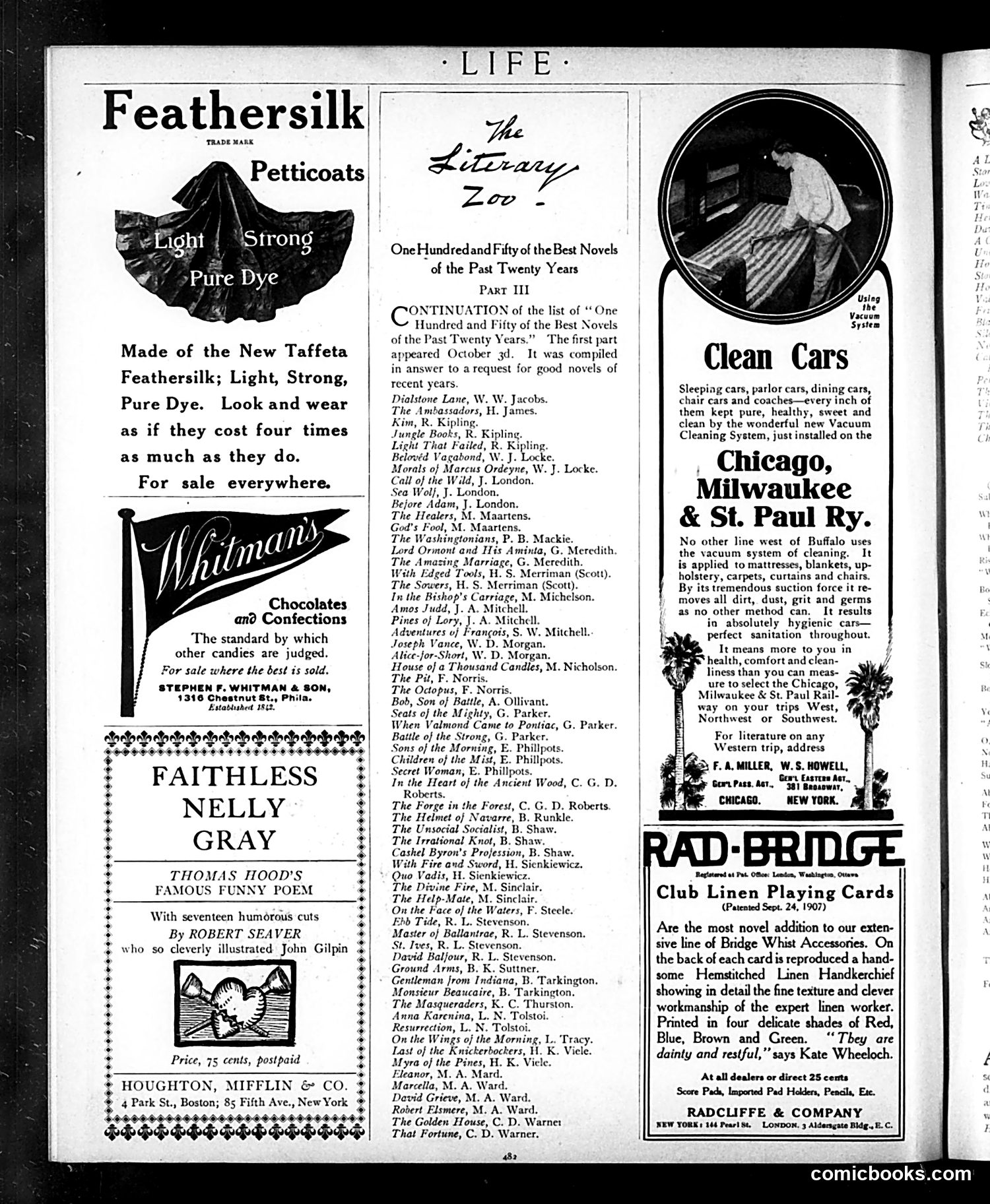
This page is primarily **advertising**, not political satire. It contains four advertisements: 1. **Feathersilk Petticoats** - promoting lightweight, durable undergarments made from new taffeta fabric 2. **Whitman's Chocolates** - candy advertisement emphasizing quality 3. **"Faithless Nelly Gray"** - book advertisement for Thomas Hood's humorous poem, illustrated by Robert Seaver 4. **"The Literary Zoo"** - a continuation of Life's novel recommendations (Part III) 5. **Clean Cars** (Chicago, Milwaukee & St. Paul Railway) - promoting vacuum cleaning technology for train cars 6. **Rad-Bridge Club Linen Playing Cards** - advertising novelty playing cards with textile details The page reflects early 20th-century consumer advertising rather than political commentary or satire.
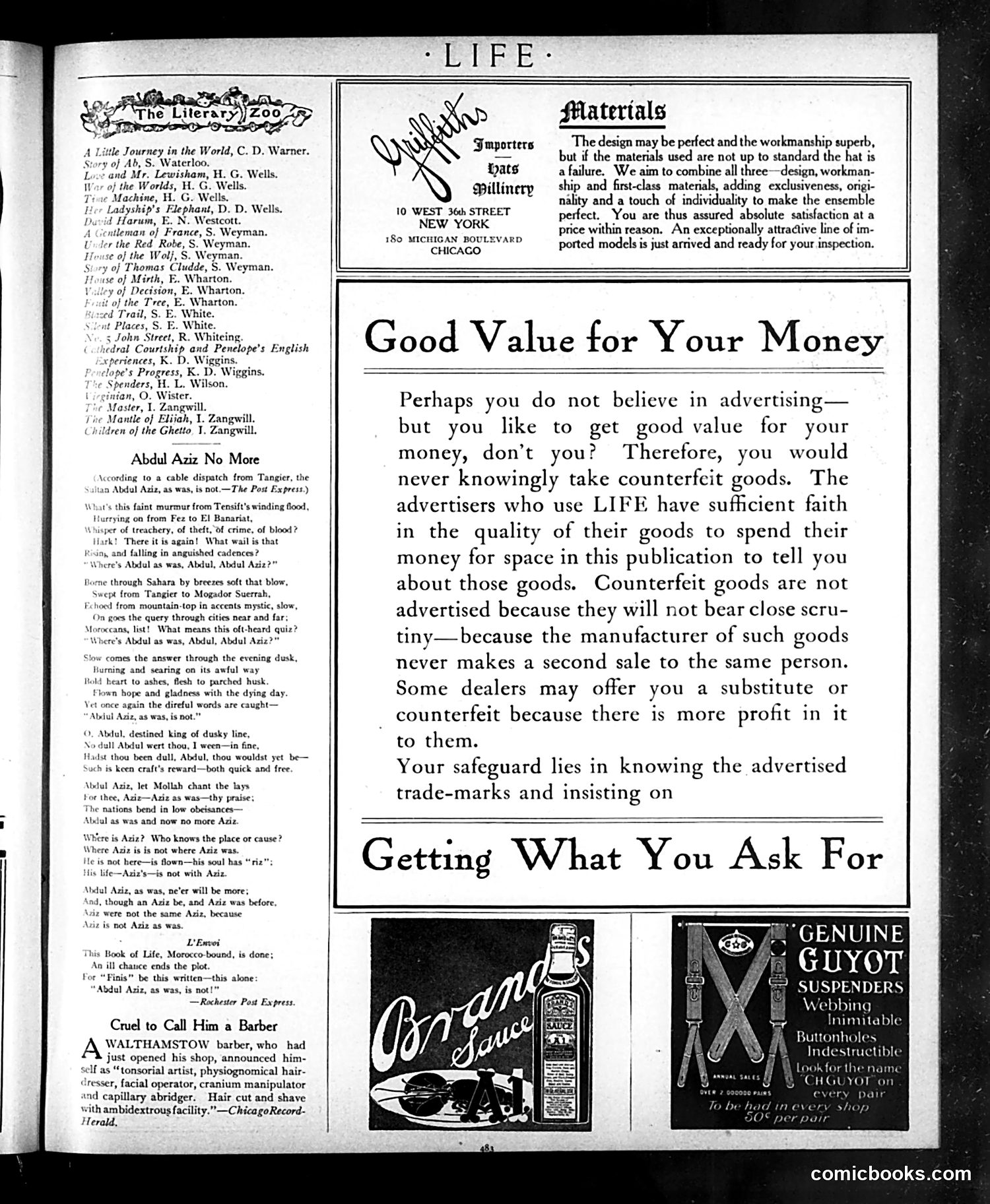
This page is **primarily advertising and editorial content**, not political satire. The main feature is an advertisement for "Materials Importers" (hats and millinery) at addresses in New York and Chicago, accompanied by a general consumer-protection essay titled "Good Value for Your Money." The essay argues that readers should trust advertised brands over counterfeits because legitimate manufacturers maintain quality standards—they depend on repeat customers. It warns against dealers offering cheap substitutes for profit. Two product advertisements appear at bottom: one for "Branda Sauce" and another for "Genuine Guyot Suspenders." The left column contains literary content and a brief anecdote about a Walthamstow barber. There is no discernible political cartoon or social satire on this page.
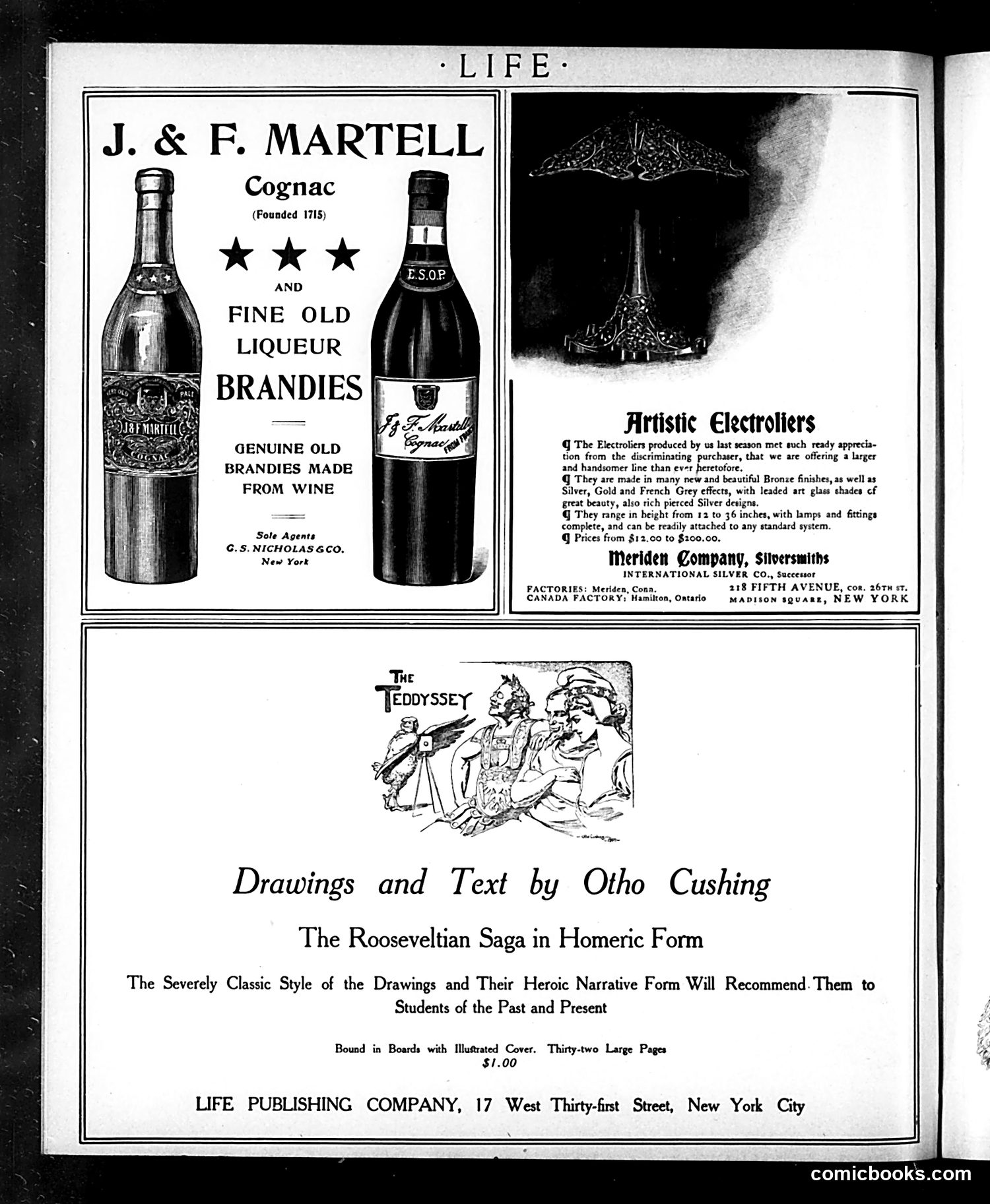
This page is primarily **advertising**, not political satire. The top left advertises **J. & F. Martell Cognac** (founded 1715), featuring two brandy bottles and emphasizing "genuine old brandies made from wine." The sole agent is listed as G.S. Nicholas & Co., New York. The top right promotes **Meriden Company Silversmiths' "Artistic Electroliers"** — decorative electric light fixtures available in bronze, silver, and gold finishes, ranging from 15-16 inches tall, priced $13-$500. The bottom section advertises **"The Teddyssey,"** a book with drawings and text by Otho Cushing presenting "The Rooseveltian Saga in Homeric Form" — apparently a humorous narrative about Theodore Roosevelt in classical style. Published by Life Publishing Company at $1.00. No political commentary or satire is evident on this page.
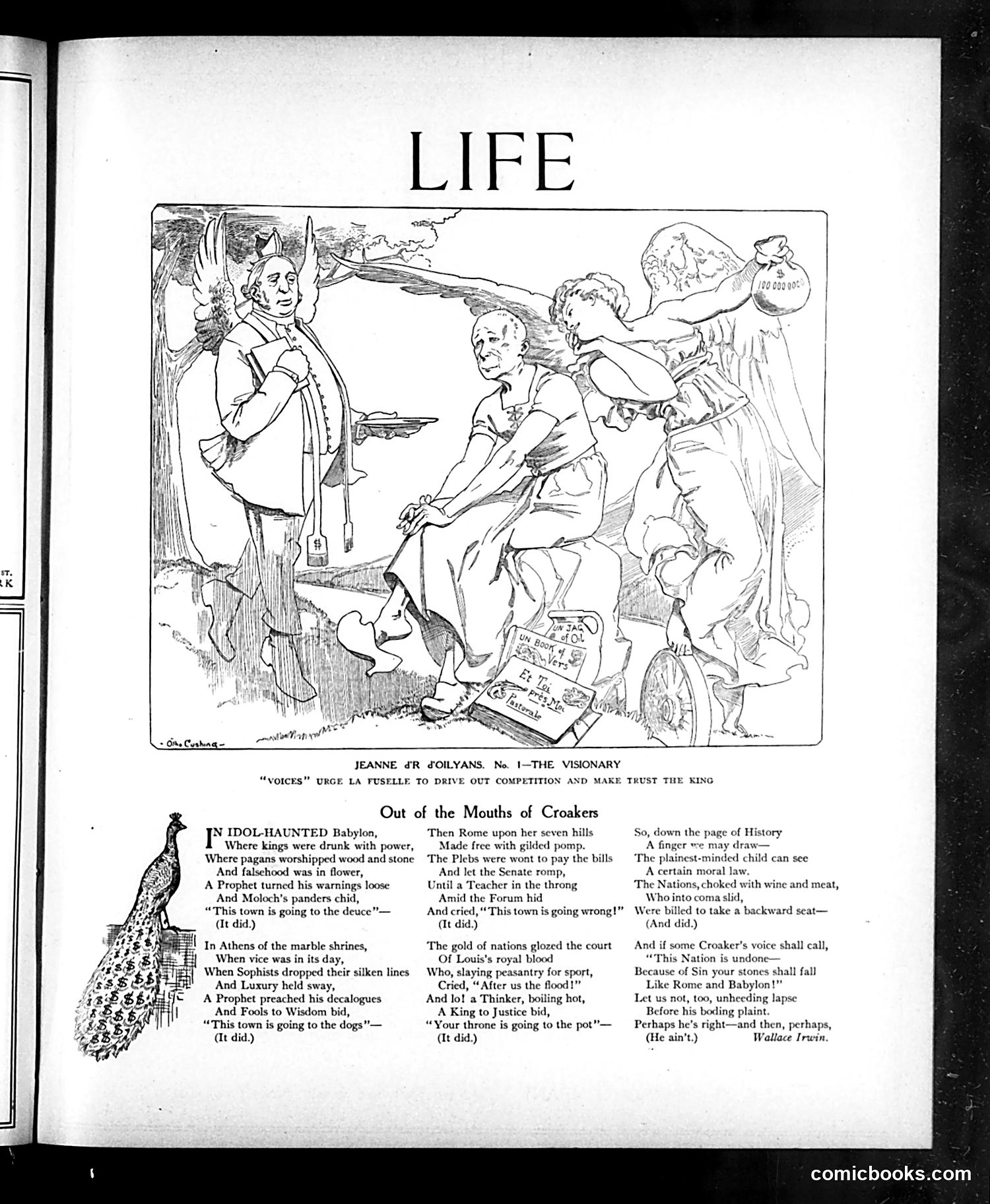
This page satirizes political corruption and moral decline in early 20th-century America using allegorical imagery. The top cartoon depicts "Jeanne d'Orléans"—a female figure representing the nation or justice—confronting various corrupting forces (competition, greed). The accompanying poem "Out of the Mouths of Croakers" mocks pessimistic critics, referencing ancient Rome's decline to warn against similar American decay. The peacock illustration symbolizes vanity and excess. The satirical verse invokes historical parallels: Rome's corrupt Senate, prophets ignored, luxury breeding weakness. The poem's refrain "(It did)" sarcastically suggests America ignores these warnings. The closing attribution to Wallace Irwin indicates this is political/moral commentary criticizing contemporary American institutions—political leaders, commerce, and society—for abandoning principle amid prosperity.
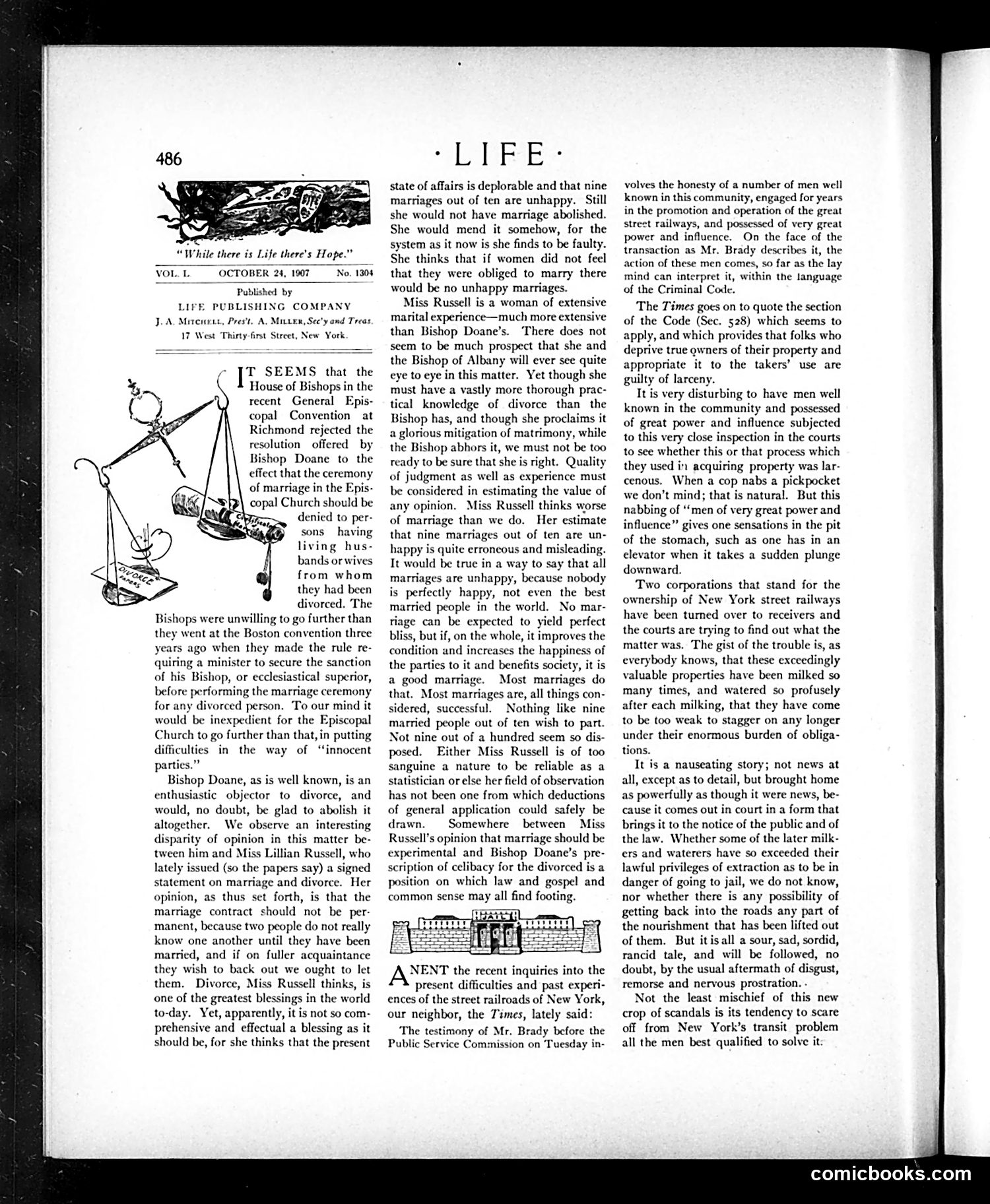
The page contains an editorial cartoon and accompanying text criticizing Bishop Henry Doane's opposition to divorce. The cartoon depicts a scale of justice weighted unevenly, symbolizing the imbalance in marriage law. The text references a recent General Episcopal Convention where Bishop Doane rejected a proposal to allow the Episcopal Church to perform remarriage ceremonies for divorced persons. The editorial argues against Doane's position, suggesting his view that nine of ten marriages are unhappy is exaggerated and that divorce, while sometimes necessary, shouldn't be categorically forbidden by the Church. The satire critiques religious institutional rigidity on marriage and divorce—a progressive stance for the early 20th century advocating secular rather than purely ecclesiastical judgment on these matters.
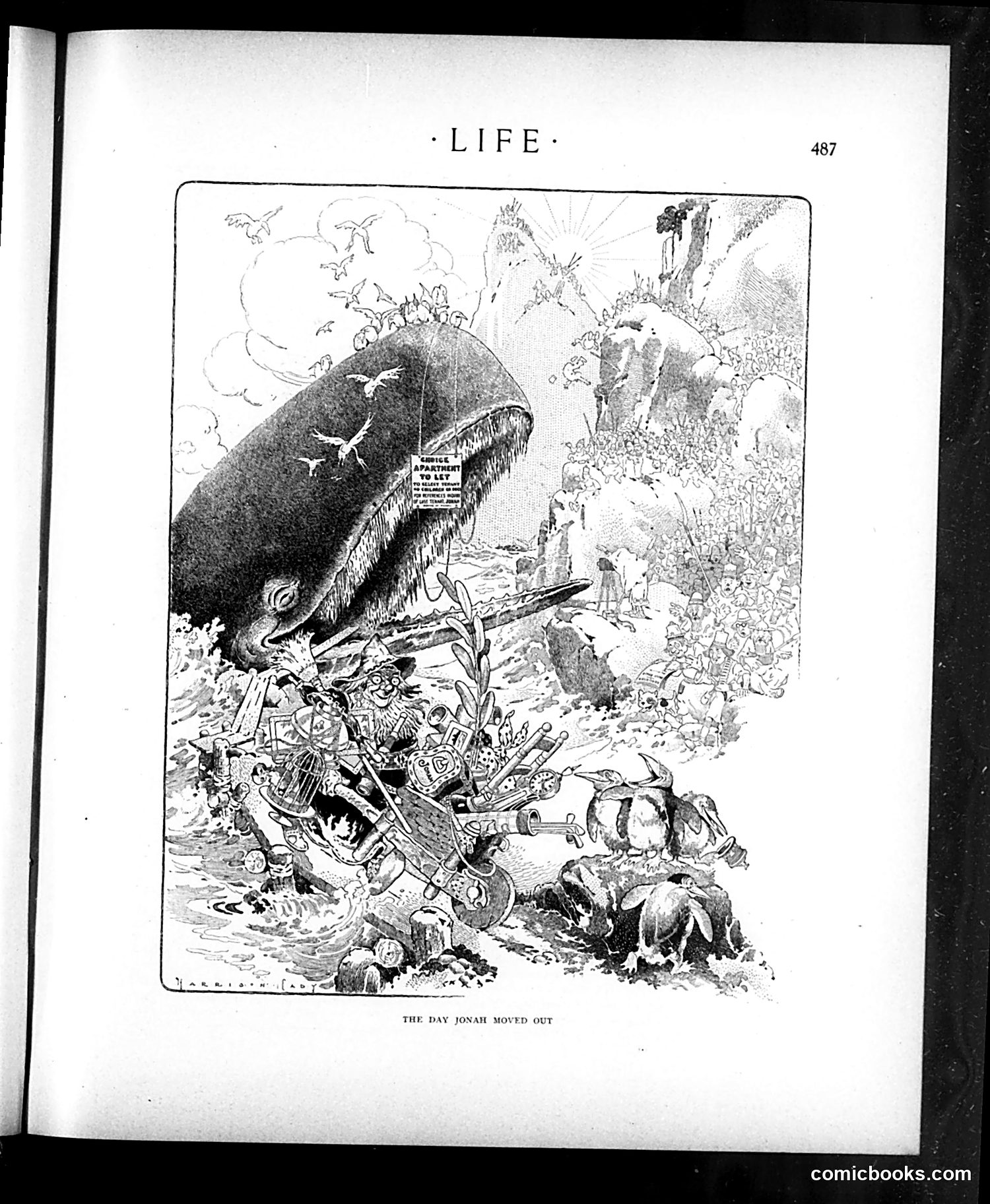
This is a political cartoon satirizing a biblical reference to comment on contemporary events. A massive whale expels Jonah and his possessions from its mouth onto a crowded shore, where numerous figures appear displaced or in disarray. The caption "The Day Jonah Moved Out" suggests commentary on eviction or forced removal. The whale represents a powerful force (likely a government, landlord, or institution), while Jonah and the scattered crowd symbolize working-class people being expelled. Given Life magazine's satirical nature and the emphasis on displacement and crowding, this likely critiques early 20th-century housing policies, evictions during economic hardship, or labor disputes. The biblical allusion adds ironic commentary—treating forced removal as if it were a biblical inevitability rather than a preventable social problem.
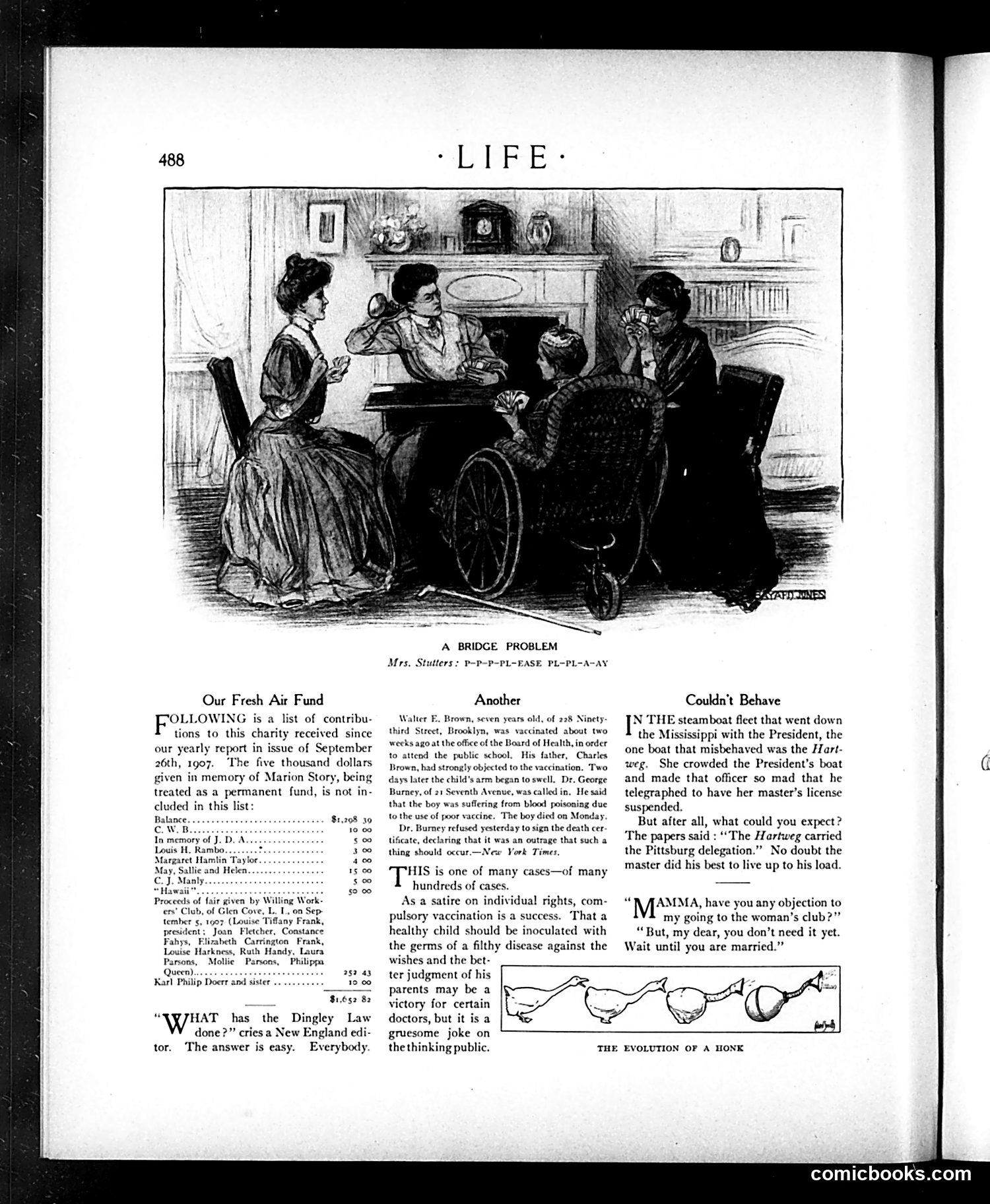
**Main Cartoon:** "A Bridge Problem" depicts four people playing cards around a piano in a parlor. The title is a pun on the card game "bridge." **The Articles:** 1. **"Our Fresh Air Fund"** discusses charitable donations for children's health and welfare. 2. **"Another"** recounts a anecdote about a seven-year-old boy named Walter E. Brown who died after vaccination, presented as criticism of compulsory vaccination policy—a contentious public health issue of the era. 3. **"Couldn't Behave"** satirizes an unnamed female passenger who crowded the President's boat during a Mississippi steamboat excursion, unable to obtain a proper master's license. 4. **"The Evolution of a Hone"** (bottom right) is a humorous illustration showing stages of bone development or deformation. The page reflects early 20th-century American social anxieties about public health, women's behavior, and leisure activities.
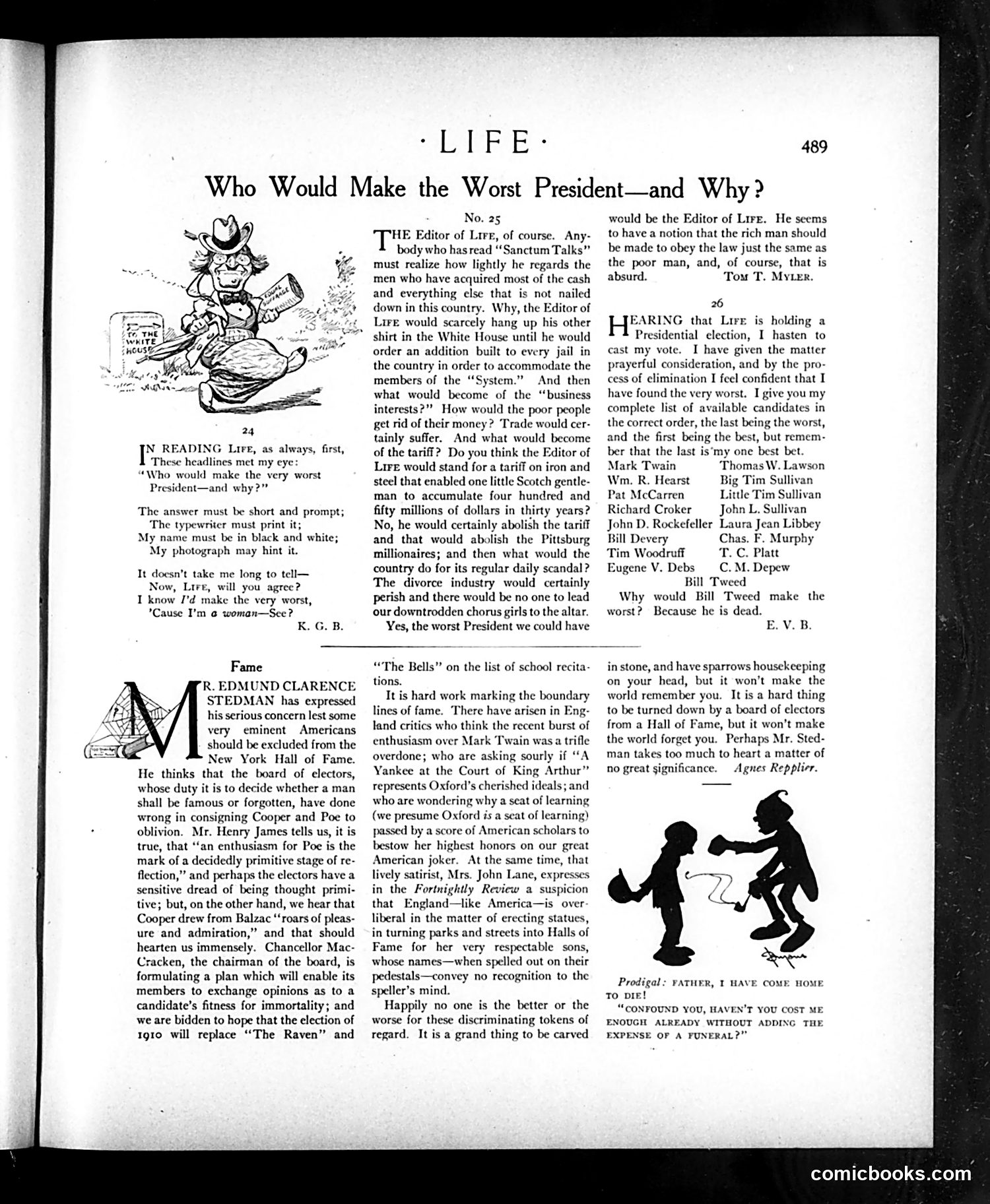
This satirical piece from *Life* magazine presents reader submissions on who would be the worst presidential candidate. The large cartoon depicts a caricatured figure (appears to be a wealthy industrialist or "robber baron" type, based on the money imagery and exaggerated features) riding what looks like a money bag or corrupt institution. The editorial text mocks the notion that a wealthy businessman should become president, arguing such a figure would dismantle tariffs, harm workers, and serve only elite "business interests." The satire targets economic inequality and the assumption that successful industrialists would make competent leaders—a common Progressive Era critique of unchecked capitalism and political corruption.
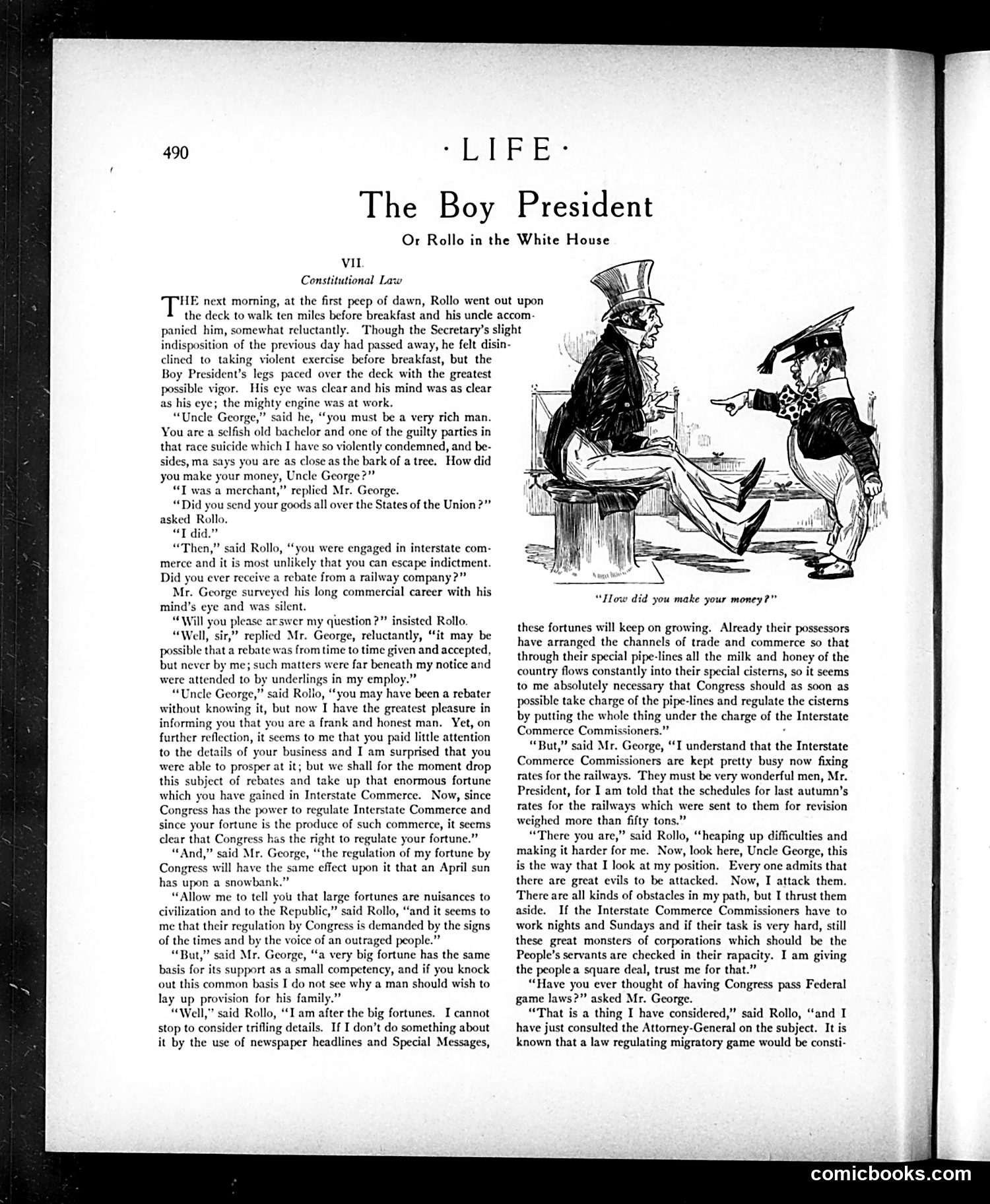
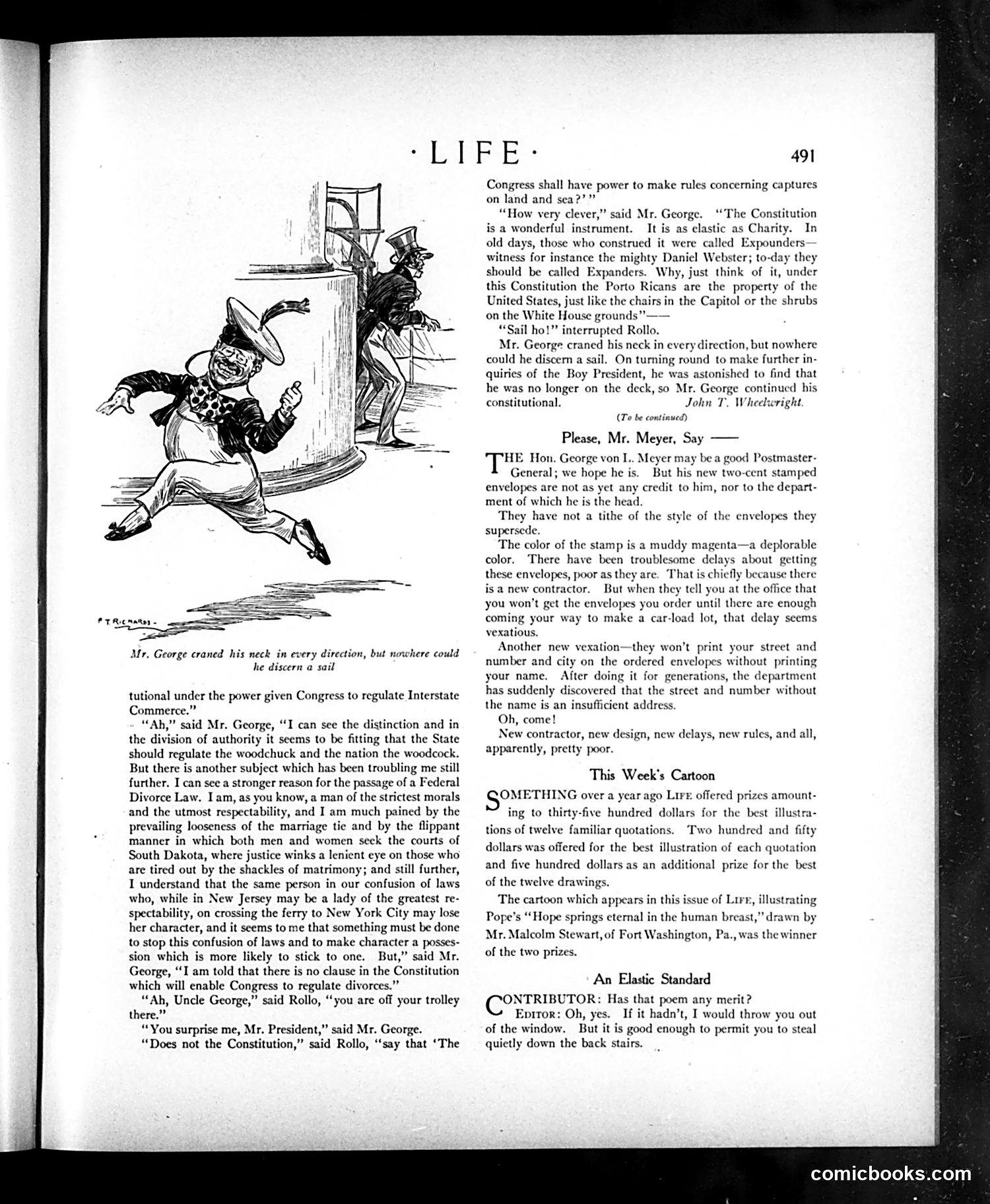
This satirical piece mocks a young president figure nicknamed "Rollo" through a dialogue with "Uncle George." The cartoon illustrates their conversation on a White House deck. The satire targets the president's youth and inexperience in handling serious matters like interstate commerce, railroad regulation, and federal game laws. Uncle George suggests Rollo made his fortune through questionable means—interstate commerce and potential railroad rebates—and now must reckon with Congressional oversight. The humor lies in portraying the "Boy President" as naive and unprepared for constitutional governance, while powerful business interests attempt to guide his decisions. The piece critiques both youthful incompetence in high office and the influence of wealthy advisors on presidential policy. The specific references to Interstate Commerce Commissioners and railroad regulation suggest this targets a particular historical administration, though the fictional names obscure the exact target.
This page satirizes the postal service under Postmaster General George von L. Meyer. The cartoon shows a figure being literally twisted into contortions—visualizing the chaos of Meyer's administration. The accompanying text criticizes Meyer's incompetence despite his good intentions. Specific complaints include: poorly designed muddy-colored envelopes, chronic delivery delays blamed on contractor mismanagement, and a new policy omitting street addresses and city names on envelopes—creating further inefficiency. The satire's point is that Meyer, while perhaps honorable, has bungled postal reform through bureaucratic mismanagement and contractor incompetence. The twisted figure effectively conveys the frustration citizens experienced with deteriorating mail service under his leadership.
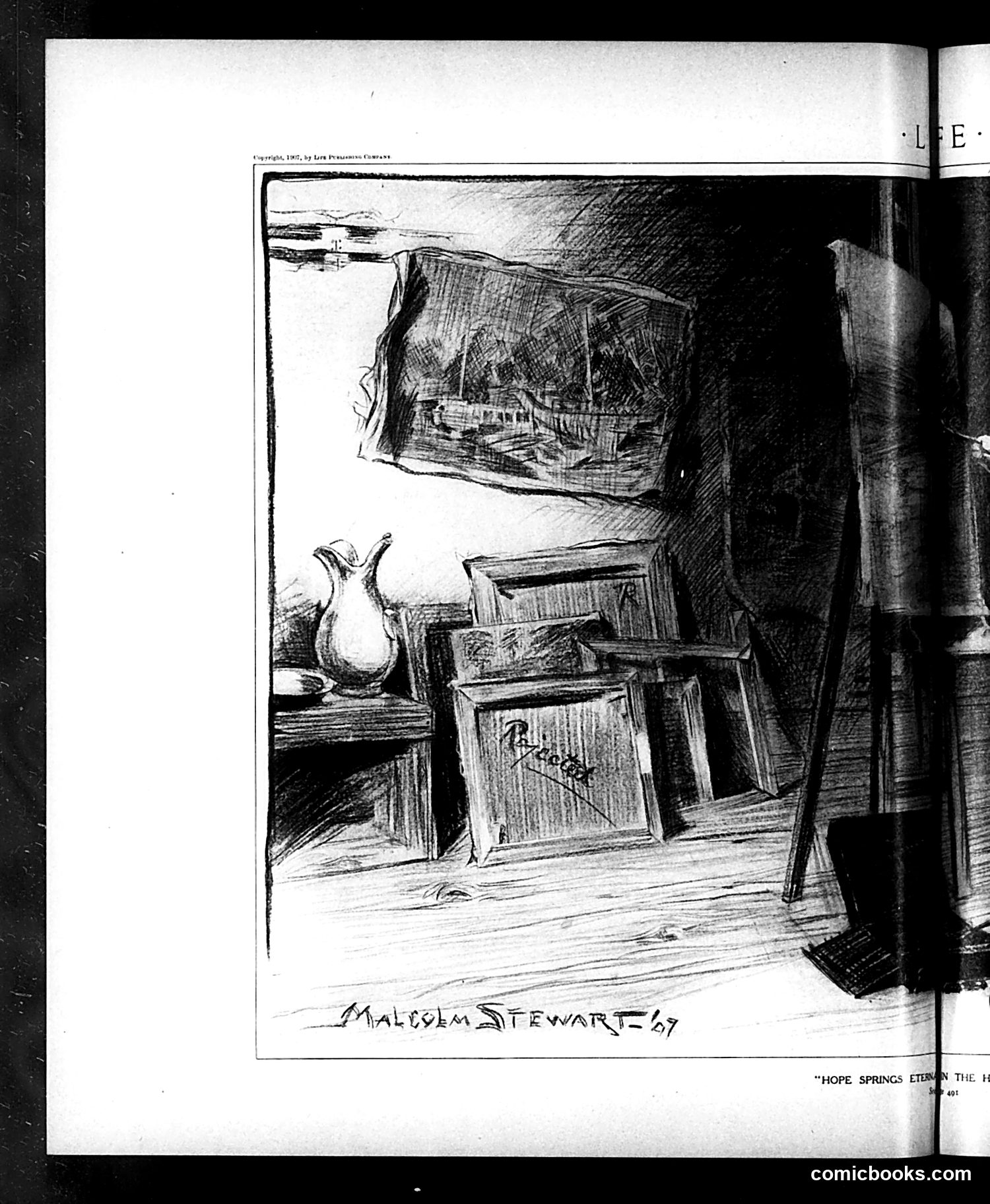
This sketch by Malcolm Stewart (signed and dated '57) depicts an artist's studio interior. The composition shows wooden picture frames stacked against a floor, a ceramic pitcher on a shelf, and what appears to be a painting or artwork hanging on the wall above. A figure (likely the artist) is visible on the right side. The cartoon likely satirizes the art world—possibly commenting on struggling artists, the commercial nature of art sales, or the gap between artistic aspiration and material reality. The modest studio furnishings and stacked frames suggest economic hardship or the precarious circumstances of an artist's life. Without additional context from the magazine's text, the specific satirical target remains unclear.
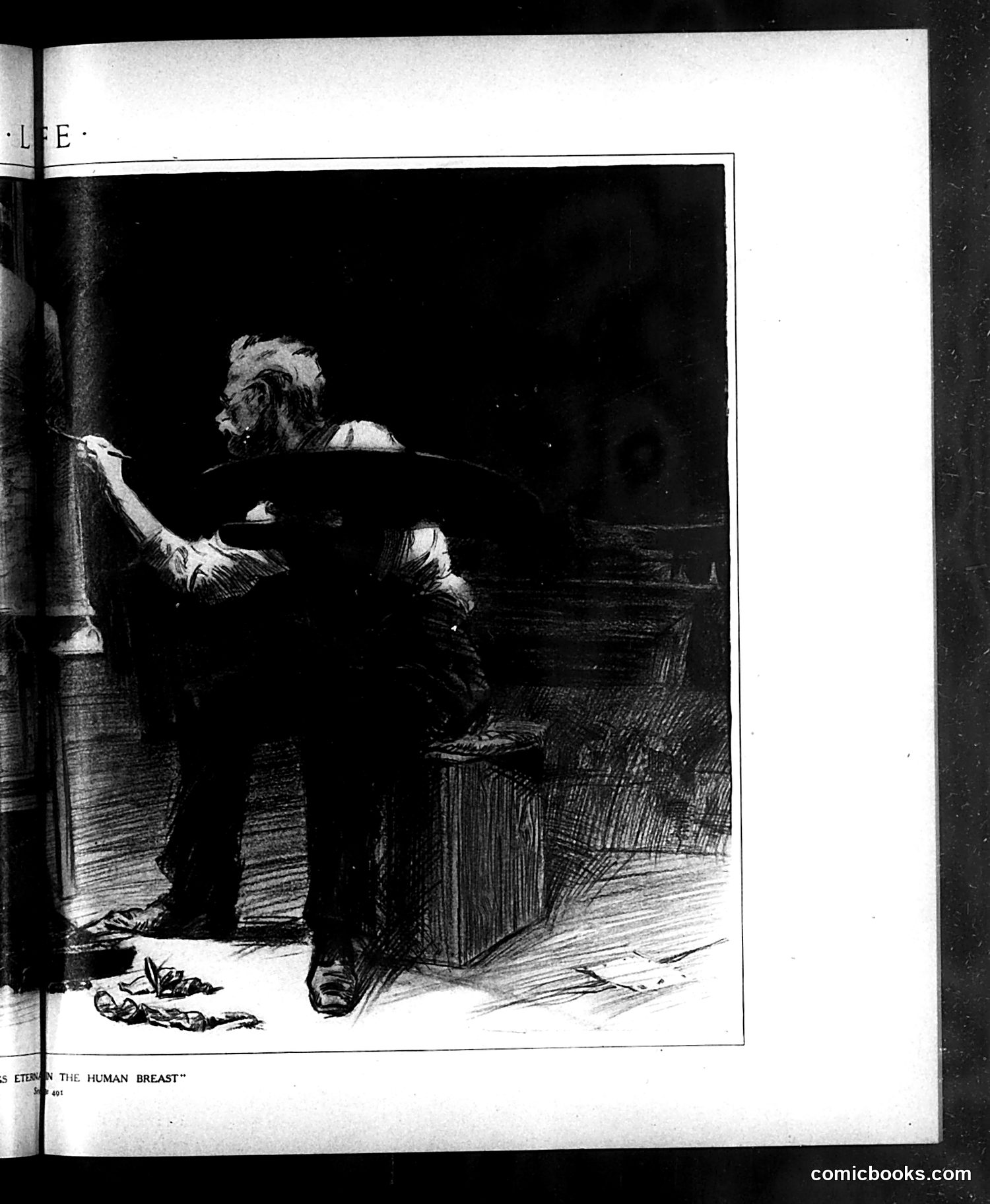
The partial caption visible reads "...ETERNAL IN THE HUMAN BREAST" (appears to be cut off). The sketch shows a figure in formal dress viewed from behind, standing in what appears to be an interior space with strong chiaroscuro lighting typical of early 20th-century satirical illustration. Without the complete caption and title, I cannot definitively identify which specific political figure or social commentary this depicts. The formal posture and classical reference in the text suggest this may reference a literary or philosophical concept about human nature, but the exact satirical target remains unclear from the visible portions. The artistic style is consistent with Life magazine's editorial illustrations from approximately the 1910s-1920s. More context would be needed for accurate interpretation.
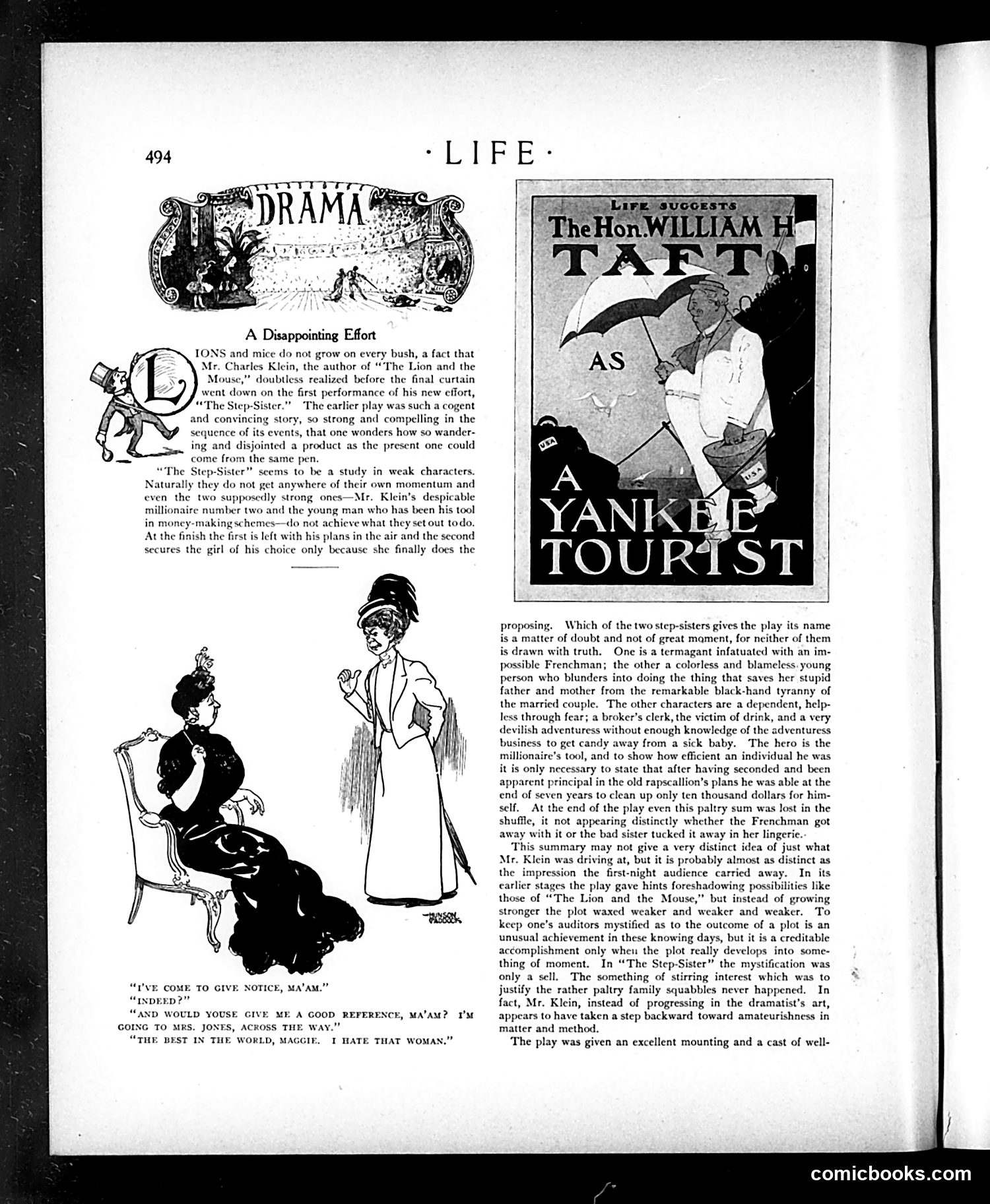
This is a theater review of Charles Klein's play *The Step-Sister*. The critic compares it unfavorably to Klein's earlier success, *The Lion and the Mouse*, arguing that the new play features weak, unmotivated characters and a poorly constructed plot. The accompanying cartoon depicts a domestic servant giving notice to her employer—illustrating the play's shallow characterization. The dialogue's triviality ("I hate that woman") mirrors the critic's complaint that the play lacks substance. The adjacent advertisement for William H. Taft's *A Yankee Tourist* is simply promotional content. The review's broader point: Klein has regressed artistically, replacing his previous dramatic sophistication with amateur plotting and unconvincing character development. The mystification surrounding the plot's outcome is criticized as a "sell"—mere manipulation rather than genuine dramatic tension.
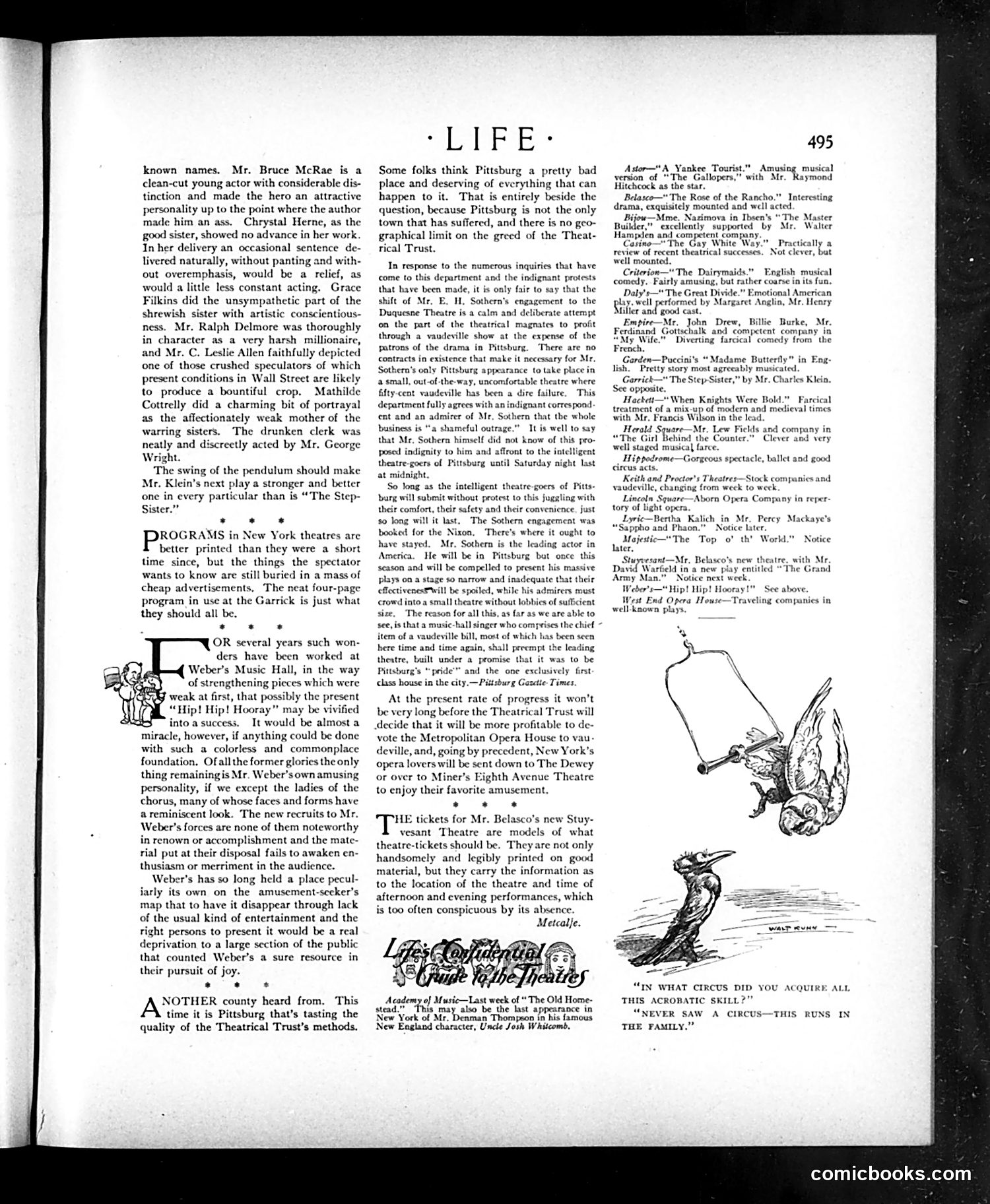
This page contains theater reviews and criticism rather than political cartoons. The main content addresses grievances against the "Theatrical Trust"—a monopolistic cartel that controlled American theater distribution in the early 1900s. The key controversy concerns **E. H. Sothern**, a prominent actor whose engagement was moved to an inferior venue (the Duquesne Theatre in Pittsburgh) featuring cheap vaudeville. The author condemns this as a "shameful outrage" by theater magnates exploiting Sothern's name to profit from low-quality entertainment. The criticism reflects broader anti-trust sentiment of the era: the Theatrical Trust's monopoly allowed them to dictate unfavorable terms to actors and venues, harming both artistic quality and public access to legitimate drama. A small illustration at bottom right shows acrobatic performers—likely referencing the vaudeville acts the Trust forced upon audiences. This represents Progressive Era criticism of corporate consolidation in entertainment.
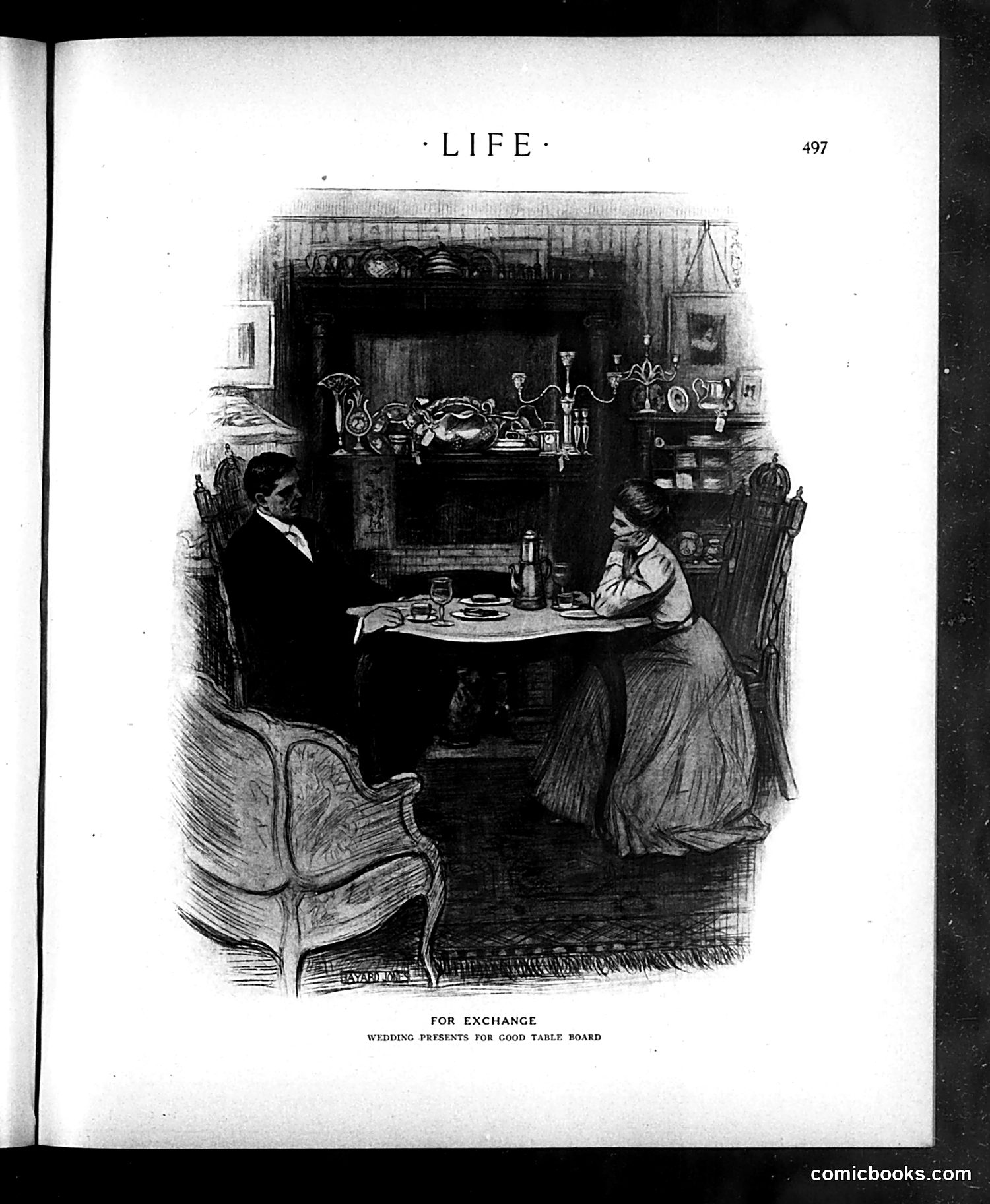
This satirical cartoon depicts a couple dining together, with the caption suggesting an ironic "exchange" between wedding gifts and good meals. The illustration appears to critique a practical, transactional view of marriage—specifically the notion that a wife's primary value lies in her cooking and domestic service, which could metaphorically "repay" the wedding presents a husband provides. The intimate dining scene, with its modest furnishings and domestic setting, emphasizes this domestic economy. The satire targets either newlyweds' pragmatic expectations or broader social attitudes about women's domestic roles as economic trade-offs within marriage. The cartoon reflects early-20th-century anxieties about marriage as a financial and domestic arrangement rather than a romantic partnership.
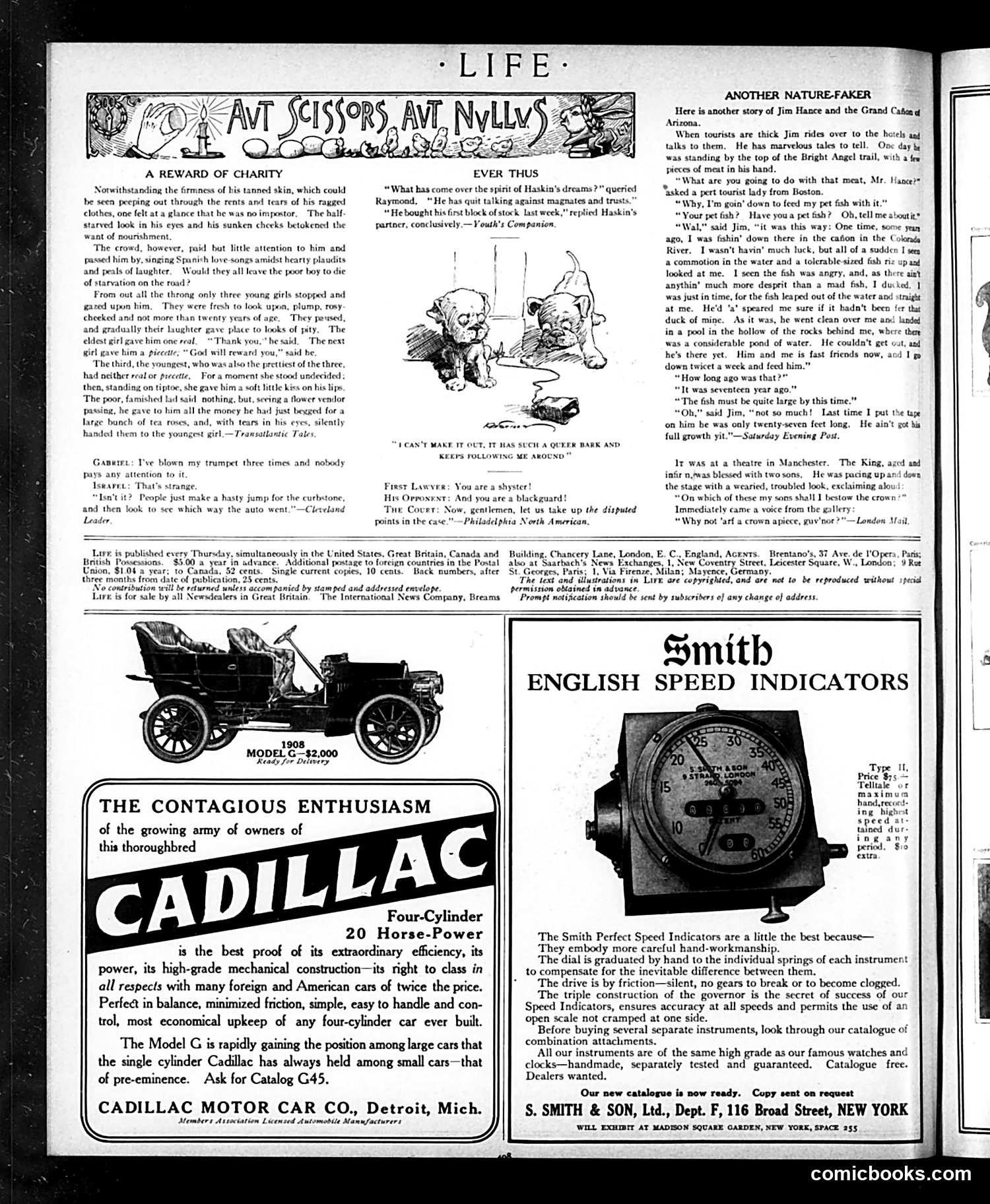
This page contains multiple short satirical pieces typical of Life magazine's humor format: **"A Reward of Charity"** is a sentimental story (not political satire) about a starving boy who receives coins and a kiss from young women, then gives the money to buy flowers for the girl who kissed him—playing on romantic idealism. **"Ever Thus"** satirizes how wealth corrupts political principles: a man who previously railed against monopolies and trusts stops criticizing them once he buys stock—mocking how financial self-interest silences reform rhetoric. **The shyster lawyer cartoon** jokes about courtroom hostility, where opposing lawyers hurl insults but the judge tells them to focus on legal arguments. **"Another Nature-Faker"** mocks exaggerated tall tales: Jim Hance claims to have a pet fish in the Grand Canyon that's now "twenty-seven feet long" after seventeen years—satirizing the era's popular "nature-faker" stories that blended fact with obvious fiction for entertainment. The page also contains automobile advertisements (Cadillac, Smith speed indicators), reflecting early 1900s commercial content.
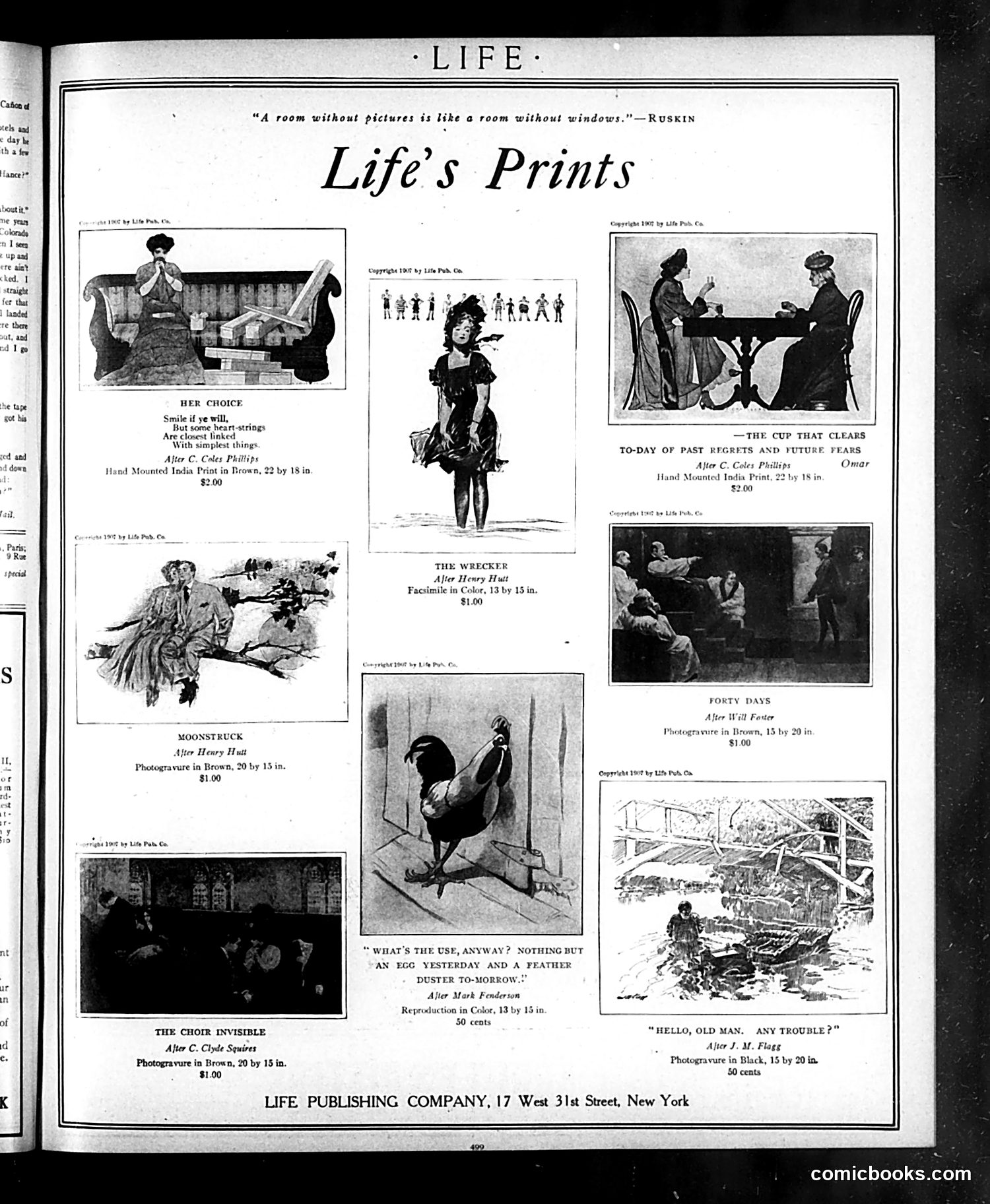
This is primarily an **advertising page** for Life Publishing Company, selling art prints and reproductions rather than satirical cartoons. The page showcases various illustrated artworks available for purchase, ranging from 50 cents to $2.00. The images feature romantic or sentimental scenes typical of early 20th-century popular art: a woman contemplating choices ("Her Choice"), a lovestruck figure ("Moonstruck"), two women having tea ("The Cup That Clears"), and genre scenes. Artists credited include C. Coles Phillips and Henry Hutt, popular illustrators of the era. The Ruskin epigraph at top suggests these prints function as affordable "windows" into tasteful interior decoration for middle-class homes. Rather than political satire, this represents Life magazine's commercial side—selling mass-produced art reproductions and photographs to readers seeking home decoration. The page demonstrates how early 20th-century magazines monetized their illustrated content.
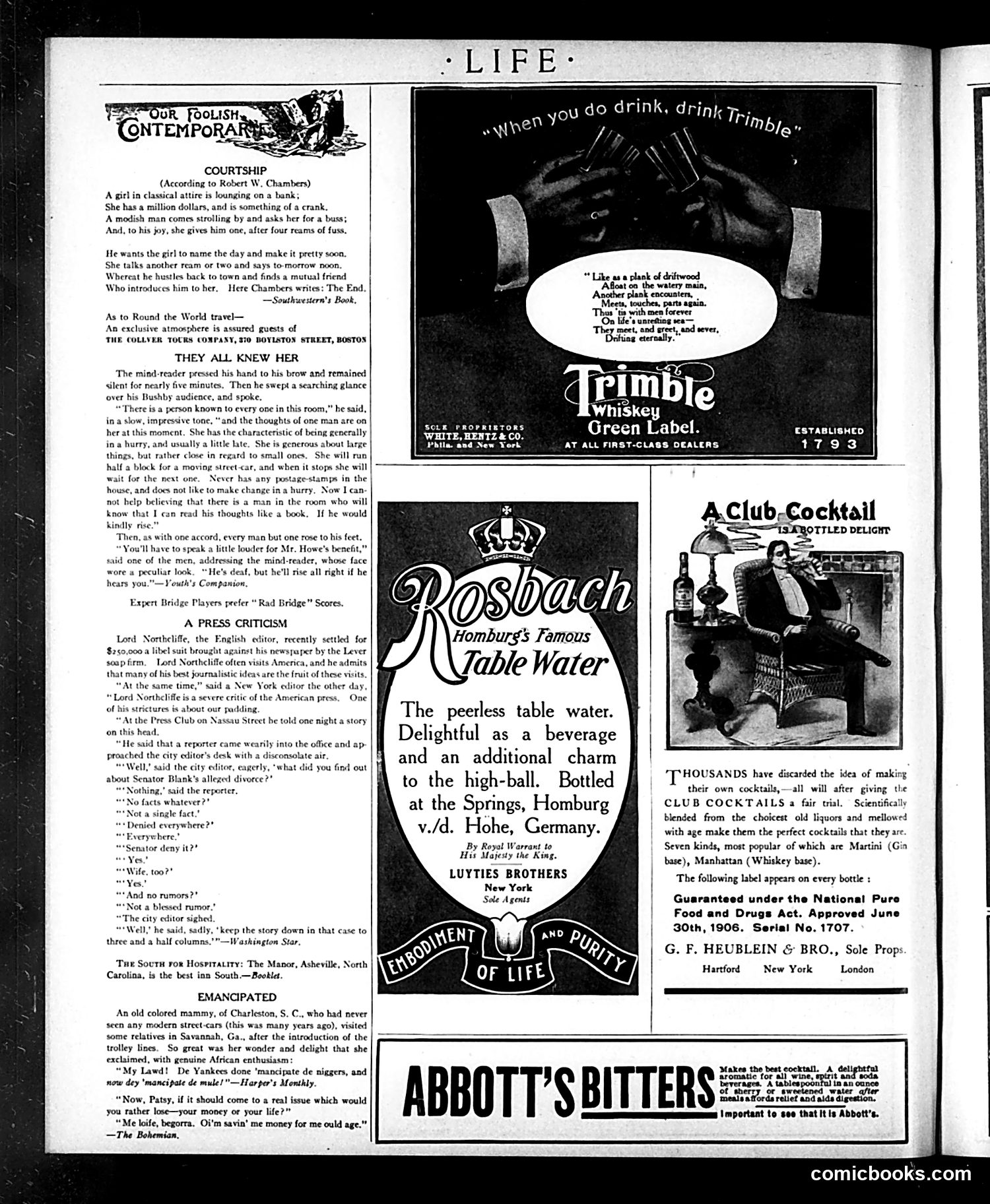
This page from *Life* magazine (circa 1910s) is primarily **advertisements interspersed with humorous short pieces**, typical of the era. The cartoons aren't political but social satire: **"Courtship"** parodies romantic fiction by Robert W. Chambers—mocking the absurdity of courtship rituals through exaggeration (a woman requiring "four reams of fuss" before granting a kiss). **"They All Knew Her"** is a mind-reader joke playing on a familiar female type: the perpetually late, disorganized woman who avoids carrying change and always misses her streetcar. The humor derives from every man immediately recognizing her. **"A Press Criticism"** satirizes American newspaper sensationalism—a city editor instructing reporters to pad empty stories to three columns, critiquing how American journalism manufactures news from nothing. The remaining pieces are light ethnic humor typical of the period. The page's primary function is selling **Trimble Whiskey**, **Rosbach Table Water**, and **Abbott's Bitters**—classic early-20th-century patent medicines and alcoholic beverages.
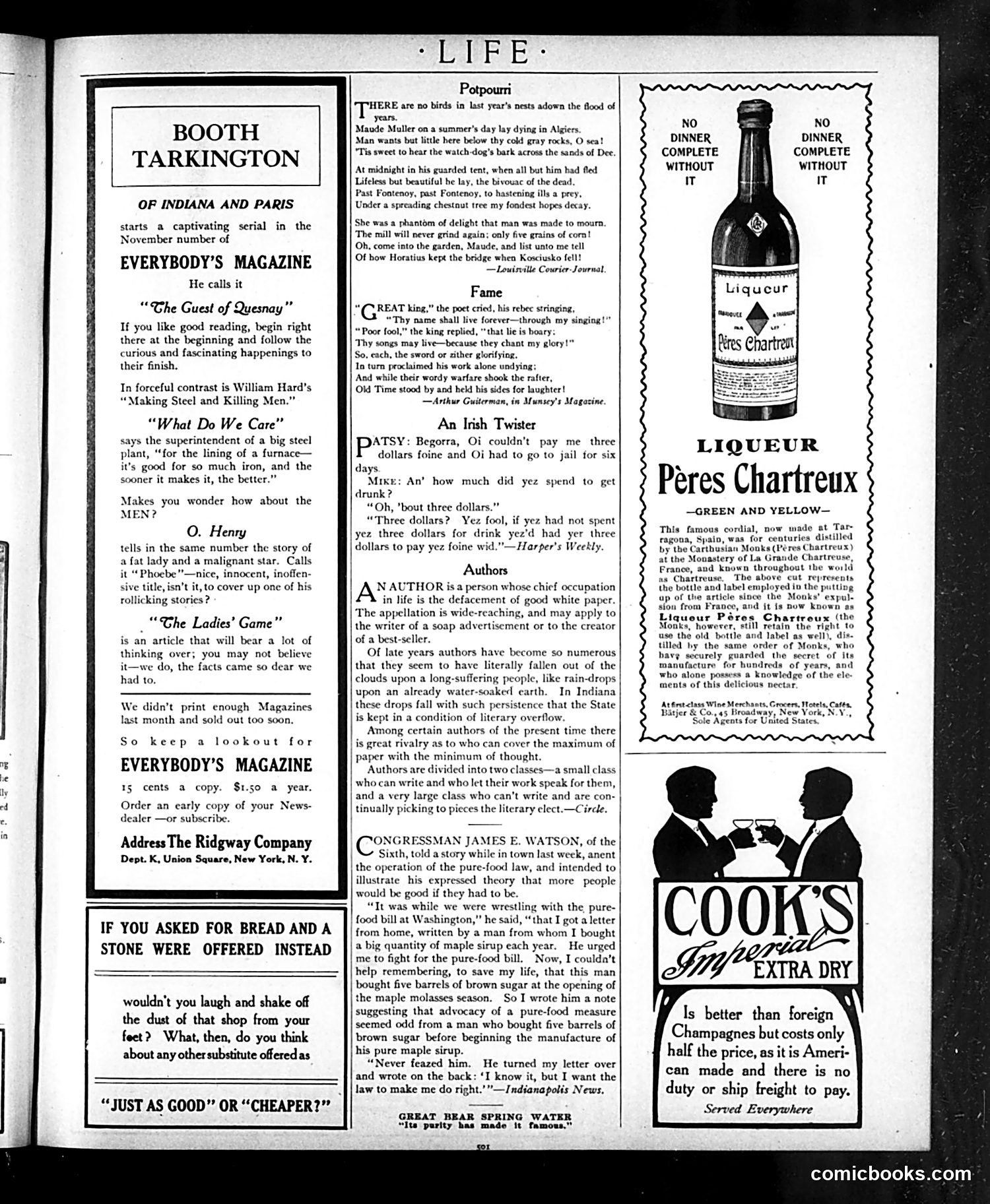
This page contains literary advertisements and light satirical content typical of early 20th-century *Life* magazine. The main content promotes serialized fiction in *Everybody's Magazine*, including works by Booth Tarkington and O. Henry—popular authors of the era. The "Potpourri" section presents absurdist humor by combining opening lines from famous poems into nonsensical mashups (e.g., "Maude Muller...lay dying in Algiers"). This satirizes overly sentimental Victorian poetry. The "Authors" section gently mocks the proliferation of writers, suggesting Indiana produces them in excessive quantities and that many are merely "soap advertisement" writers rather than serious artists. An "Irish Twister" joke plays on Irish-American stereotypes about drinking and poverty. The advertisement at bottom promotes champagne as superior to foreign brands—typical product marketing of the period. The overall tone is lighthearted satire rather than sharp political commentary.
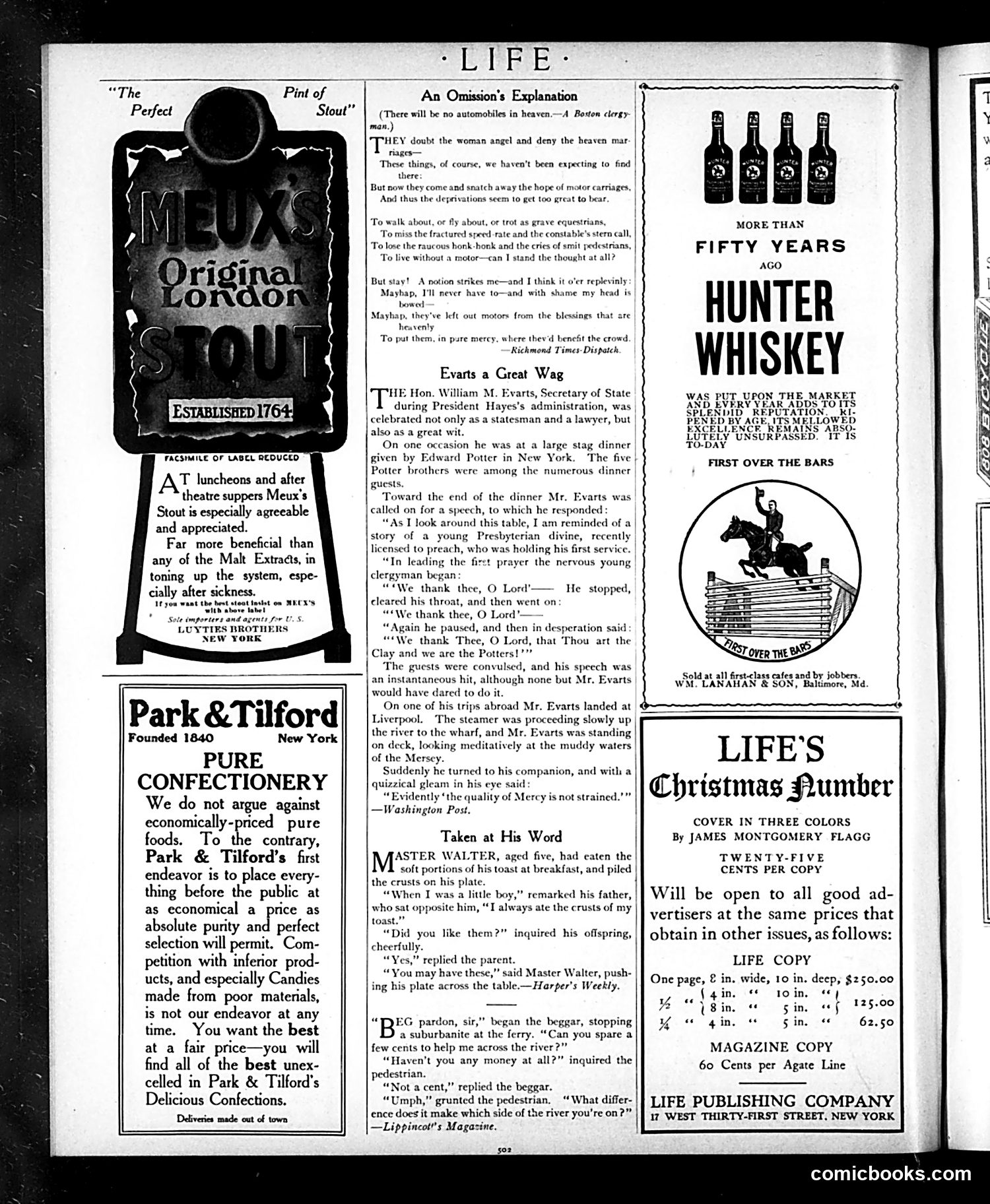
This page is primarily **advertising and humor content**, not political cartoons. The main elements are: **Advertisements:** Meux's Stout (beer), Park & Tilford confectionery, and Hunter Whiskey dominate the page, typical for Life magazine's revenue model. **Humorous Articles:** - "An Omission's Explanation" satirizes a Boston clergyman's claim that heaven will have no automobiles. The joke: people lament losing cars in the afterlife, but perhaps God wisely removed them to benefit the poor masses below. - "Evarts a Great Wag": Anecdote about Secretary of State William M. Evarts, known for wit. A pun about "Potters" (the family name) and biblical clay/pottery. - "Taken at His Word" and the beggar story: Simple domestic humor pieces, no political content. The page reflects early 1900s concerns (automobile culture) and celebrates notable figures like Evarts through genteel humor typical of Life's educated, wealthy readership.
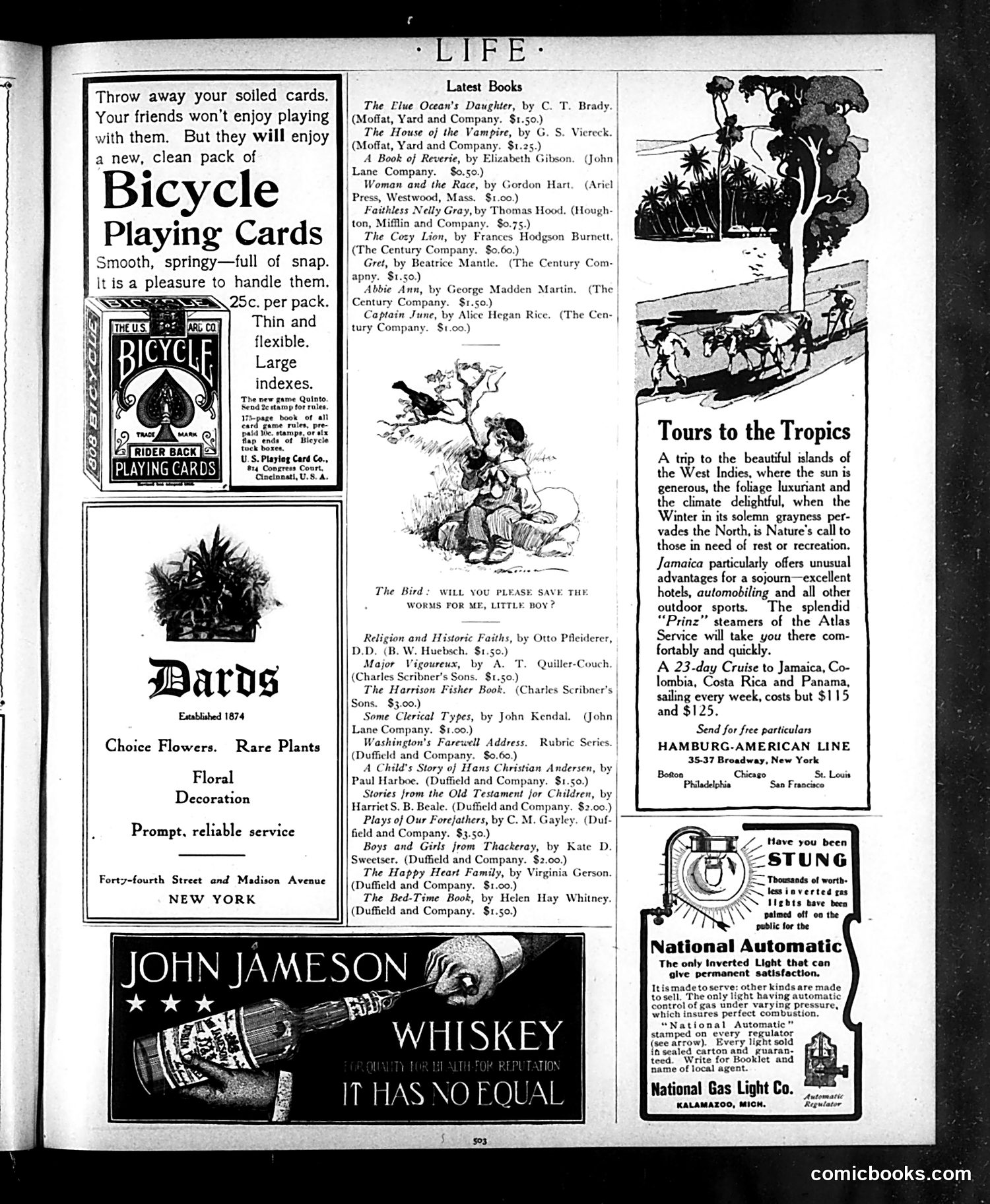
This page is primarily **advertising and book listings**, not political satire. It contains: **Main Content:** - Bicycle Playing Cards advertisement (emphasizing quality) - Bards florist service ad - Book reviews/listings for contemporary titles (early 1900s literature) - A small illustration captioned "The Bird" showing a boy with a bird asking him to save worms—a gentle, humorous domestic scene with no political meaning **The Cartoon:** The only image with narrative content is "The Bird," a simple joke about a child being asked by a bird to save worms. This is light humor, not satire. **Advertising:** - Hamburg-American Line cruise advertisement (tropical vacations) - John Jameson Whiskey ad - National Gas Light Company ad (promoting automatic gas lamps) **Conclusion:** This is a standard magazine page mixing commerce with literary content. There's no political commentary or social satire visible—it reflects early 20th-century consumer culture and leisure activities for affluent readers.
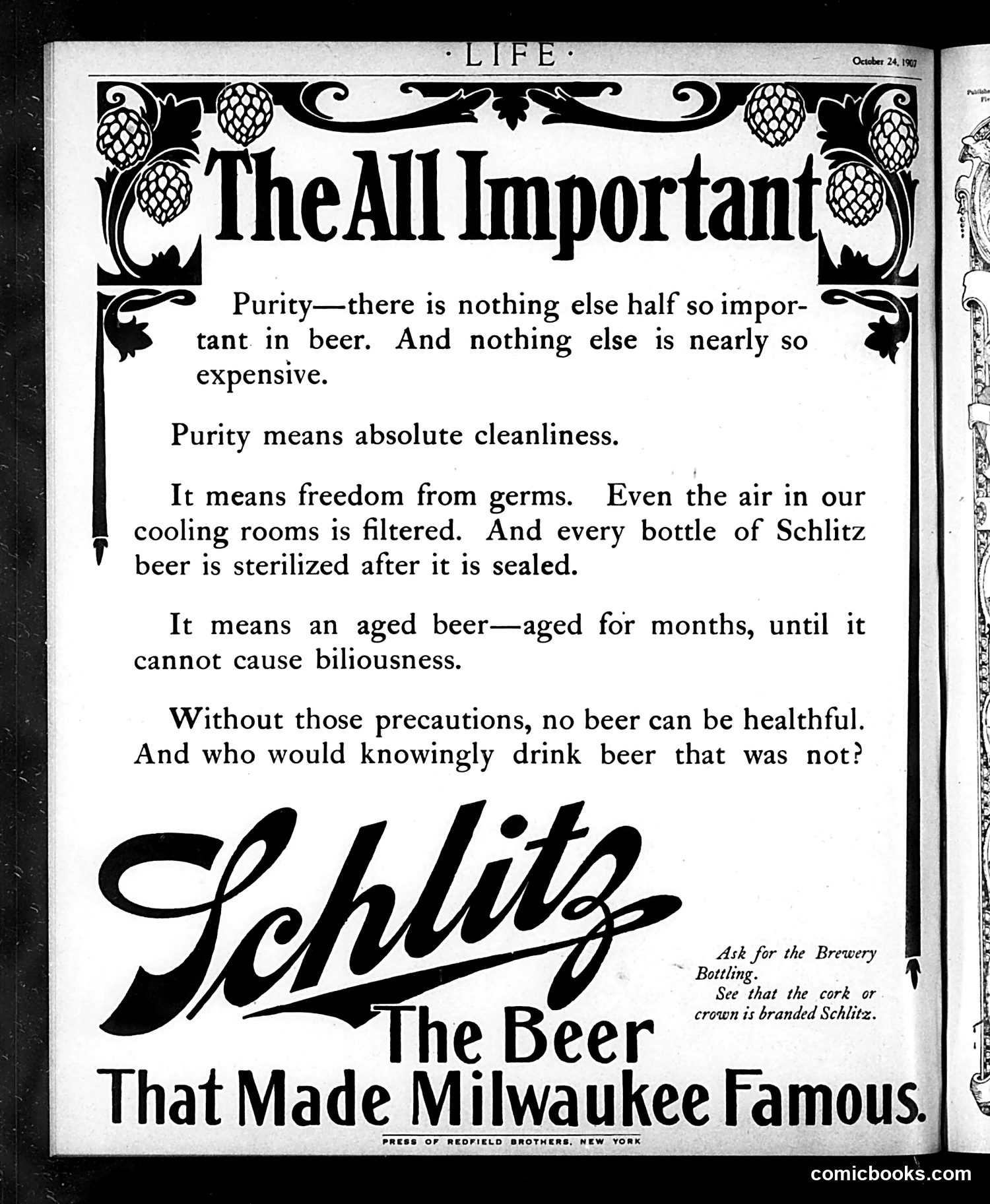
This is a **full-page advertisement**, not satire or political commentary. It's a Schlitz brewery ad from October 24, 1903, promoting beer as a health product. The ad emphasizes "purity" as the beer's main selling point, claiming Schlitz maintains cleanliness through filtered air, sterilization after bottling, and extended aging to prevent "biliousness" (digestive upset). This reflects early 20th-century marketing that positioned beer as wholesome and medicinal. The rhetorical question "who would knowingly drink beer that was not [healthful]?" uses social pressure to encourage purchase. The decorative hop border reinforces the product's natural origins. This represents an era when beer companies marketed their product's safety and health benefits—concerns that became central after contaminated water and foodborne illnesses made "purity" a major advertising theme.