
Life, 1907-10-24 · page 10 of 24
Life — October 24, 1907 — page 10: what you’re looking at
What you’re looking at
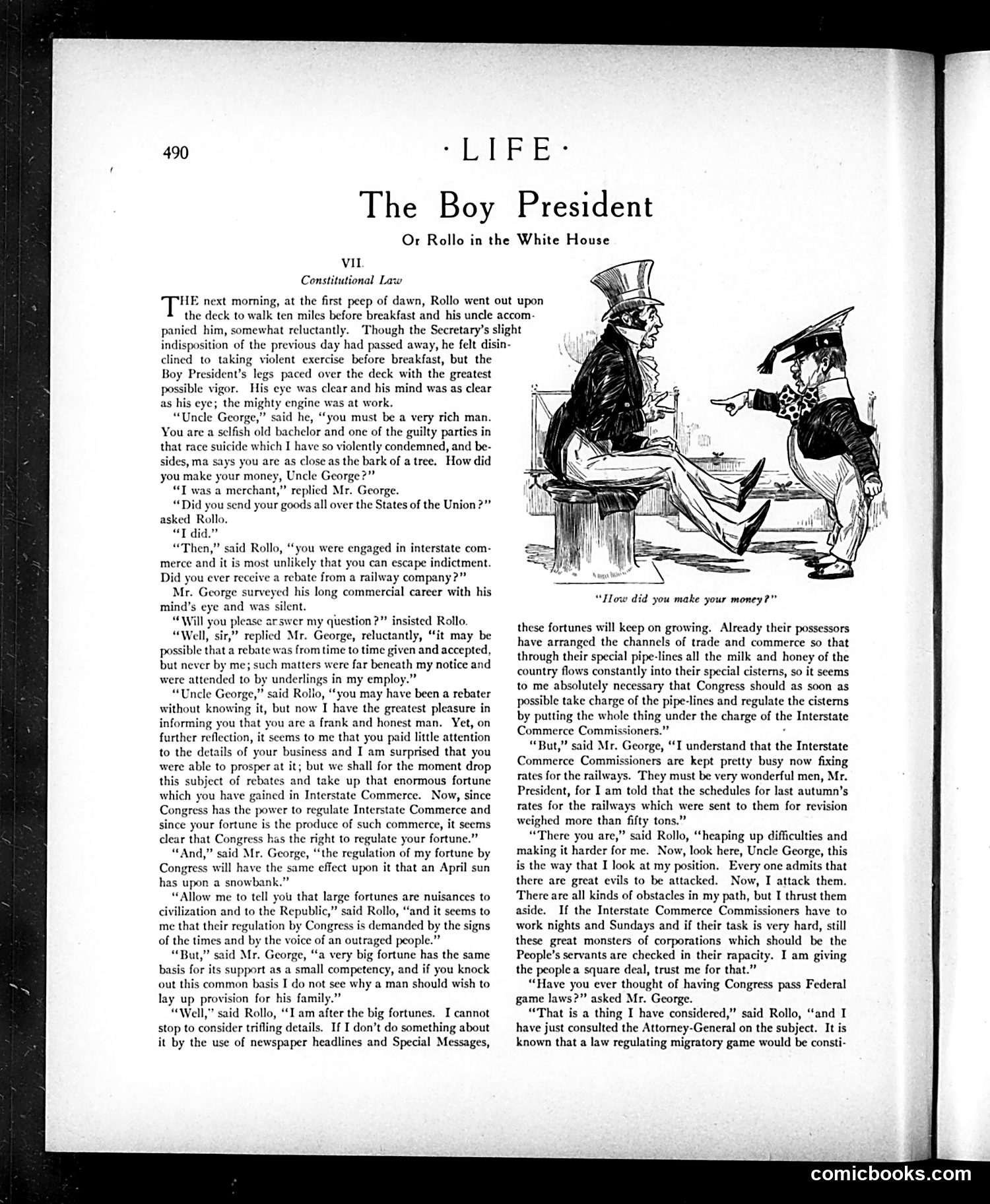
This satirical piece mocks a young president figure nicknamed "Rollo" through a dialogue with "Uncle George." The cartoon illustrates their conversation on a White House deck. The satire targets the president's youth and inexperience in handling serious matters like interstate commerce, railroad regulation, and federal game laws. Uncle George suggests Rollo made his fortune through questionable means—interstate commerce and potential railroad rebates—and now must reckon with Congressional oversight. The humor lies in portraying the "Boy President" as naive and unprepared for constitutional governance, while powerful business interests attempt to guide his decisions. The piece critiques both youthful incompetence in high office and the influence of wealthy advisors on presidential policy. The specific references to Interstate Commerce Commissioners and railroad regulation suggest this targets a particular historical administration, though the fictional names obscure the exact target.
📄 Transcribed text from this page (OCR, searchable)
Machine-transcribed from the original scan — historical spelling and the odd misread are preserved.
“REE The Boy President Or Rollo in the White House VIL Constitutional Law HE next morning, at the first peep of dawn, Rollo went out upon the deck to walk ten miles before breakfast and his uncle accom- panied him, somewhat reluctantly. ‘Though the Secretary’s slight indisposition of the previous day had passed away, he felt disin- clined to taking violent exercise before breakfast, but the Boy President’s legs paced over the deck with the greatest clear and his mind was as clear ye; the mighty engine was at work. “Uncle George,” said he, “you must be a very rich man. You are a selfish old bachelor and one of the guilty parties in that race suicide which I have so violently condemned, and be- sides, ma says you are as close as the bark of a tree. How did you make your money, Uncle George?” “T was a merchant,” replied Mr. George. “Did you send your goods all over the States of the Union ?”” asked Rollo. “T did.” “Then,” said Rollo, “you were engaged in interstate com- merce and it is most unlikely that you can escape indictment. Did you ever receive a rebate from a railway company?” Mr. George surveyed his long commercial career with his mind’s eye and was silent. “Will you please arswer my question ?” insisted Rollo “Well, sir,” replicd Mr. George, reluctantly, “it may be possible that a rebate was from time to time given and accepted, but never by me; such matters were far bencath my notice and were attended to by underlings in my employ.” “Uncle George,” said Rollo, “you may have been a rebater without knowing it, but now I have the greatest pleasure in informing you that you are a frank and honest man. Yet, on further reflection, it seems to me that you paid little attention to the details of your business and I am surprised that you were able to prosper at it; but we shall for the moment drop this subject of rebates and take up that enormous fortune which you have gained in Interstate Commerce. Now, since Congress has the power to regulate Interstate Commerce and since your fortune is the produce of such commerce, it seems clear that Congress has the right to regulate your fortune.” “And,” said Mr. George, “the regulation of my fortune by Congress will have the same effect upon it that an April sun has upon a snowbank.” “Allow me to tell you that large fortunes are nuisances to civilization and to the Republic,” said Rollo, “and it seems to me that their regulation by Congress is demanded by the signs of the times and by the voice of an outraged people.” “But,” said Mr. George, “a very big fortune has the same basis for its support as a small competency, and if you knock out this common basis I do not see why a man should wish to lay up provision for his family.” “Well,” said Rollo, “I am after the big fortunes. I cannot stop to consider trifling details. If I don’t do something about it by the use of newspaper headlines and Special Messages, “How did you make your money?” these fortunes will keep on growing. Already their possessors have arranged the channels of trade and commerce so that through their special pipe-lines all the milk and honey of the country flows constantly into their special cisterns, so it seems to me absolutely necessary that Congress should as soon as possible take charge of the pipe-lines and regulate the cisterns by putting the whole thing under the charge of the Interstate Commerce Commissioners.” ‘ “But,” said Mr. George, “I understand that the Interstate Commerce Commissioners are kept pretty busy now fixing rates for the railways. They must be very wonderful men, Mr. President, for I am told that the schedules for last autumn’s rates for the railways which were sent to them for revision weighed more than fifty tons.” “There you are,” said Rollo, “heaping up difficulties and making it harder for me. Now, look here, Uncle George, this is the way that I look at my position. Every one admits that there are great evils to be attacked. Now, I attack them. There are all kinds of obstacles in my path, but I thrust them aside. If the Interstate Commerce Commissioners have to work nights and Sundays and if their task is very hard, still these great monsters of corporations which should be the People’s servants are checked in their rapacity. I am giving the people a square deal, trust me for that.” “Have you ever thought of having Congress pass Federal game laws?” asked Mr. George. “That is a thing I have considered,” said Rollo, “and I have just consulted the Attorney-General on the subject. It is known that a law regulating migratory game would be consti- comicbooks.com