
Life, 1907-10-24 · page 16 of 24
Life — October 24, 1907 — page 16: what you’re looking at
A restored page from Life, 1907-10-24. Page through the whole issue in the reader above.
📄 Transcribed text from this page (OCR, searchable)
Machine-transcribed from the original scan — historical spelling and the odd misread are preserved.
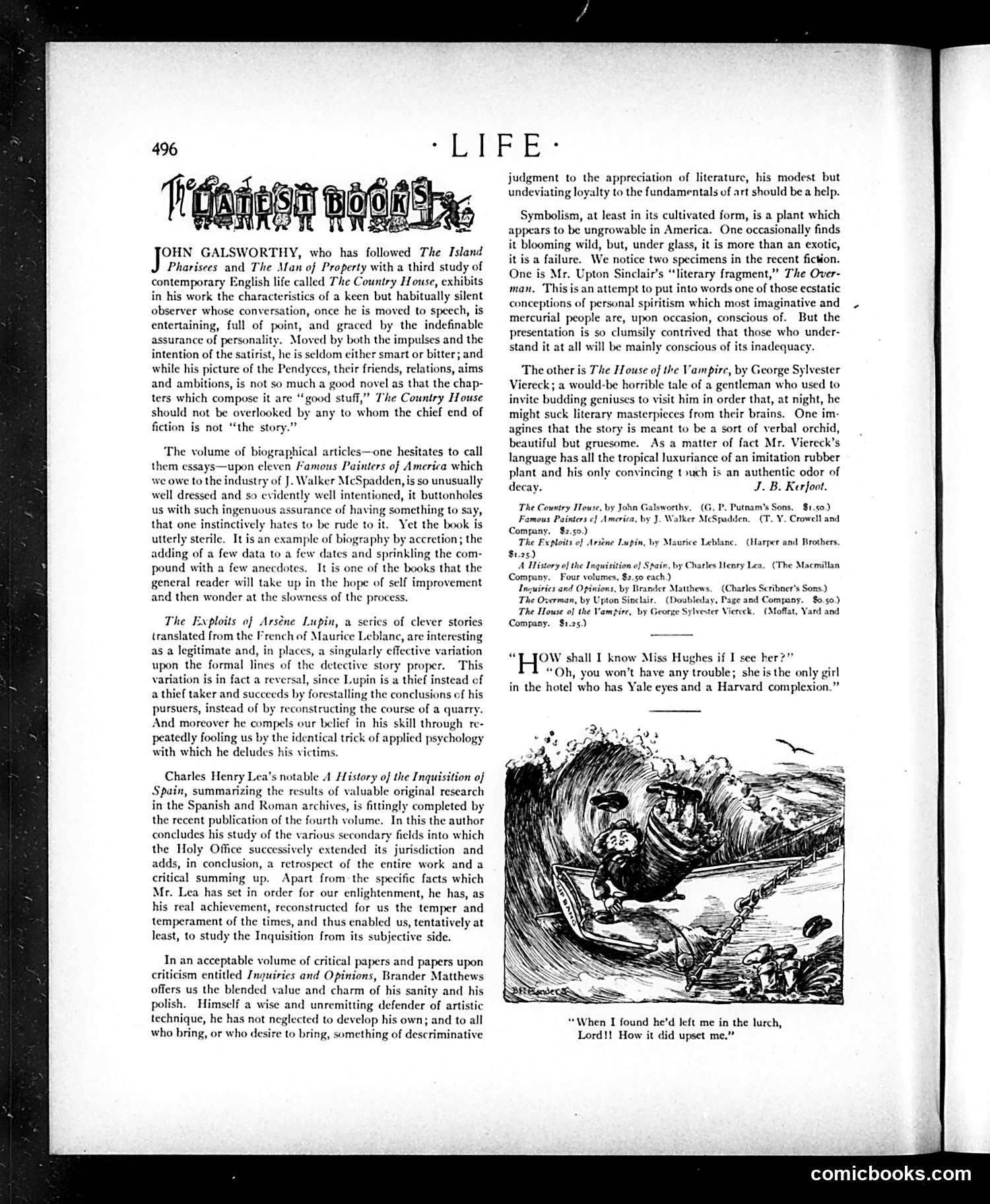
eet | eas OHN GALSWORTHY, who has followed The Island Pharisees and The Man of Property with a third study of contemporary English life called The Country House, exhibits in his work the characteristics of a keen but habitually silent observer whose conversation, once he is moved to speech, is entertaining, full of point, and graced by the indefinable assurance of personality. Moved by both the impulses and the intention of the satirist, he is seldom either smart or bitter; and while his picture of the Pendyces, their friends, relations, aims and ambitions, is not so much a good novel as that the chap- ters which compose it are “good stuff,” The Country House should not be overlooked by any to whom the chief end of fiction is not ‘‘the story.” The volume of biographical articles—one hesitates to call them essays—upon cleven Famous Painters of America which we owe to the industry of J. Walker McSpadden, is so unusually well dressed and so evidently well intentioned, it buttonholes us with such ingenuous assurance of having something to say, that one instincti s to be rude to it. Yet the book is utterly sterile. It is an example of biography by accretion; the adding of a few data to a few dates and sprinkling the com- pound with a few anecdotes. It is one of the books that the general reader will take up in the hope of self improvement and then wonder at the slowness of the proc: The Exploits of Arséne Lupin, a series of clever stories translated from the French of Maurice Leblanc, are interesting as a legitimate and, in places, a singularly effective variation upon the formal lines of the detective story proper. ‘This variation is in fact a reversal, since Lupin is a thief instead cf a thief taker and succeeds by forestalling the conclusions of his pursuers, instead of by reconstructing the course of a quarry. And moreover he compels our belief in his skill through re- peatedly fooling us by the identical trick of applied psychology with which he deludes his victims. Charles Henry Lea’s notable A History of the Inquisition of Spain, summarizing the results of valuable original research in the Spanish and Roman archives, is fittingly completed by the recent publication of the fourth volume. In this the author concludes his study of the various secondary fields into which the Holy Office successively extended its jurisdiction and adds, in conclusion, a retrospect of the entire work and a critical summing up. Apart from: the specific facts which Mr. Lea has set in order for our enlightenment, he has, as his real achievement, reconstructed for us the temper and temperament of the times, and thus enabled us, tentatively at least, to study the Inquisition from its subjective side. In an acceptable volume of critical papers and papers upon criticism entitled Jnguiries and Opinions, Brander Matthews offers us the blended value and charm of his sanity and his polish. Himself a wise and unremitting defender of artistic technique, he has not neglected to develop his own; and to all who bring, or who desire to bring, something of descriminative judgment to the appreciation of literature, his modest but undeviating loyalty to the fundamentals of art should be a help. Symbolism, at least in its cultivated form, is a plant which appears to be ungrowable in America. One occasionally finds it blooming wild, but, under glass, it is more than an exotic, it is a failure. We notice two specimens in the recent fiction. One is Mr. Upton Sinclair’s “literary fragment,” The Over- man, This isan attempt to put into words one of those ecstatic conceptions of personal spiritism which most imaginative and mercurial people are, upon occasion, conscious of. But the presentation is so clumsily contrived that those who under- stand it at all will be mainly conscious of its inadequacy. The other is The House of the Vampire, by George Sylvester Viereck; a would-be horrible tale of a gentleman who used to invite budding geniuses to visit him in order that, at night, he might suck literary masterpieces from their brains. One im- agines that the story is meant to be a sort of verbal orchid, beautiful but gruesome. As a matter of fact Mr. Viereck’s language has all the tropical Juxuriance of an imitation rubber plant and his only convincing touch is an authentic odor of decay. J.B. Kerfoot. The Country House, by John Galsworthy. (GP. Putnam's Sons. $1.50.) Famous Painters cf America, by J. Walker McSpadden. (T. Y. Crowell and Company. $2.50.) The Exploits of Arsine Lupin, by Maurice Leblanc $1.25) A History of the Inquisition of Spain, by Charles Henry Lea. (The Macmillan Company. Four volumes, $2.50 each.) Inquiries and Opinions, by Brander Matthews, (Charles Scribner's Sons.) The Overman, by Upton Sinclair. (Doubleday, Page and Company. $0.50.) The House of the Vampire, by George Sylvester Viercck. (Moffat, Yard and Company. $1.25.) (Harper and Brothers. ae OW shall I know Miss Hughes if I see her?” “Oh, you won't have any trouble; she is the only girl in the hotel who has Yale eyes and a Harvard complexion.” “When I found he'd left me in the lurch, Lord!! How it did upset me.” comicbooks.com