
Life, 1907-10-24 · page 6 of 24
Life — October 24, 1907 — page 6: what you’re looking at
What you’re looking at
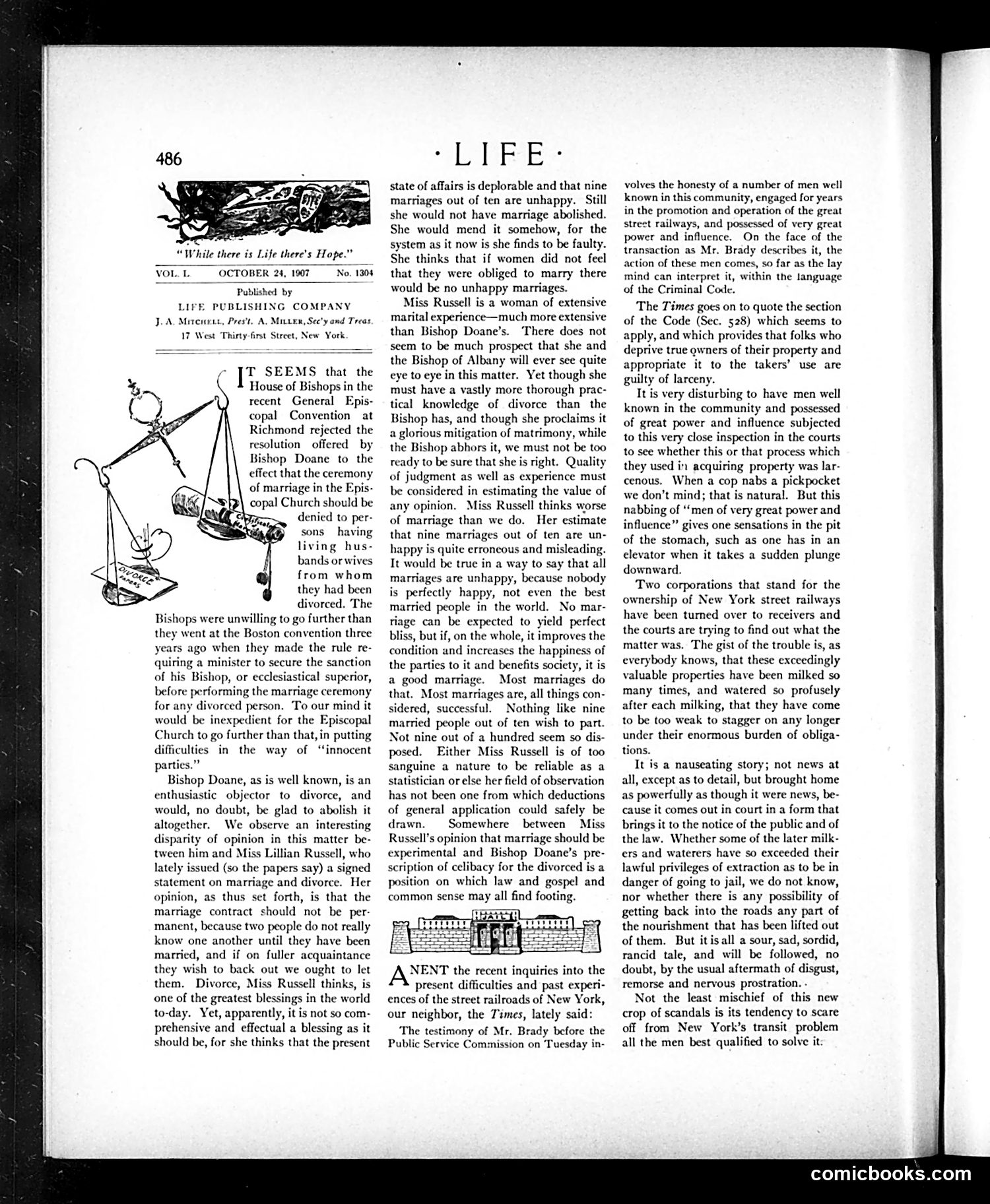
The page contains an editorial cartoon and accompanying text criticizing Bishop Henry Doane's opposition to divorce. The cartoon depicts a scale of justice weighted unevenly, symbolizing the imbalance in marriage law. The text references a recent General Episcopal Convention where Bishop Doane rejected a proposal to allow the Episcopal Church to perform remarriage ceremonies for divorced persons. The editorial argues against Doane's position, suggesting his view that nine of ten marriages are unhappy is exaggerated and that divorce, while sometimes necessary, shouldn't be categorically forbidden by the Church. The satire critiques religious institutional rigidity on marriage and divorce—a progressive stance for the early 20th century advocating secular rather than purely ecclesiastical judgment on these matters.
📄 Transcribed text from this page (OCR, searchable)
Machine-transcribed from the original scan — historical spelling and the odd misread are preserved.
“While there is Life there's Hope.” vor No. 1304 OCTOBER 24, 1907 lished by LIFE PUBLISHING COMPANY J.A. Mrrcurit, Pres't. A. Miter, See’y and Treas 17 West Thirty-first Street, New York T SEEMS that the House of Bishops in the recent General Epis- copal Convention at Richmond rejected the resolution offered by Bishop Doane to the effect that the ceremony of marriage in the Epis- }\ copal Church should be SS Sy denied to per- eee sons having ‘T living hus- bands or wives from whom they had been divorced. The Bishops were unwilling to go further than they went at the Boston convention three years ago when they made the rule re- quiring a minister to secure the sanction of his Bishop, or ecclesiastical superior, before performing the marriage ceremony for any divorced person. To our mind it would be inexpedient for the Episcopal Church to go further than that, in putting difficulties in the way of “innocent parties.” Bishop Doane, as is well known, is an enthusiastic objector to divorce, and would, no doubt, be glad to abolish it altogether. We observe an interesting disparity of opinion in this matter be- tween him and Miss Lillian Russell, who lately issued (so the papers say) a signed statement on marriage and divorce. Her opinion, as thus set forth, is that the marriage contract should not be per- manent, because two people do not really know one another until they have been married, and if on fuller acquaintance they h to back out we ought to let them. Divorce, Miss Russell thinks, is one of the greatest blessings in the world to-day. Yet, apparently, it is not so com- prehensive and effectual a blessing as it should be, for she thinks that the present “LEAs: state of affairs is deplorable and that nine marriages out of ten are unhappy. Still she would not have marriage abolished. She would mend it somehow, for the system as it now is she finds to be faulty. She thinks that if women did not feel that they were obliged to marry there would be no unhappy marriages. Miss Russell is a woman of extensive marital experience—much more extensive than Bishop Doane’s. There does not seem to be much prospect that she and the Bishop of Albany will ever see quite eye to eye in this matter. Yet though she must have a vastly more thorough prac- tical knowledge of divorce than the Bishop has, and though she proclaims it a glorious mitigation of matrimony, while the Bishop abhors it, we must not be too ready to be sure that she is right. Quality of judgment as well as experience must be considered in estimating the value of any opinion. Miss Russell thinks worse of marriage than we do. Her estimate that nine marriages out of ten are un- happy is quite erroncous and misleading. It would be true in a way to say that all marriages are unhappy, because nobody is perfectly happy, not even the best married people in the world. No mar- riage can be expected to yield perfect bliss, but if, on the whole, it improves the condition and increases the happiness of the parties to it and benefits society, it is a good marriage. Most marriages do that. Most marriages are, all things con- sidered, successful. Nothing like nine married people out of ten wish to part. Not nine out of a hundred seem so dis- posed. Either Miss Russell is of too sanguine a nature to be reliable as a statistician or else her field of observation has not been one from which deductions of general application could safely be drawn. Somewhere between Miss Russell's opinion that marriage should be experimental and Bishop Doane’s pre- scription of celibacy for the divorced is a position on which law and gospel and common sense may all find footing. AvERE the recent inquiries into the present difficulties and past experi- ences of the street railroads of New York, our neighbor, the Times, lately said: The testimony of Mr. Brady before the Public Service Commission on Tuesday in- volves the honesty of a number of men well known in this community, engaged for years in the promotion and operation of the great street railways, and possessed of very great power and influence. On the face of the transaction as Mr. Brady describes it, the action of these men comes, so far as the lay mind can interpret it, within the language of the Criminal Code. The Times goes on to quote the section of the Code (Sec. 528) which seems to apply, and which provides that folks who deprive true qwners of their property and appropriate it to the takers’ use are guilty of larceny. It is very disturbing to have men well known in the community and possessed of great power and influence subjected to this very close inspection in the courts to see whether this or that process which they used in acquiring property was lar- cenous. When a cop nabs a pickpocket we don’t mind; that is natural. But this nabbing of “men of very great power and influence” gives one sensations in the pit of the stomach, such as one has in an elevator when it takes a sudden plunge downward. Two corporations that stand for the ownership of New York street railways have been turned over to receivers and the courts are trying to find out what the matter was. The gist of the trouble is, as everybody knows, that these exceedingly valuable properties have been milked so many times, and watered so profusely after each milking, that they have come to be too weak to stagger on any longer under their enormous burden of obliga- tions. It is a nauseating story; not news at all, except as to detail, but brought home as powerfully as though it were news, be- cause it comes out in court in a form that brings it to the notice of the public and of the law. Whether some of the later milk- ers and waterers have so exceeded their lawful privileges of extraction as to be in danger of going to jail, we do not know, nor whether there is any possibility of getting back into the roads any part of the nourishment that has been lifted out of them. But itis all a sour, sad, sordid, rancid tale, and will be followed, no doubt, by the usual aftermath of disgust, remorse and nervous prostration. . Not the least mischief of this new crop of scandals is its tendency to scare off from New York’s transit problem all the men best qualified to solve it. comicbooks.com