
Life, 1907-10-24 · page 15 of 24
Life — October 24, 1907 — page 15: what you’re looking at
What you’re looking at
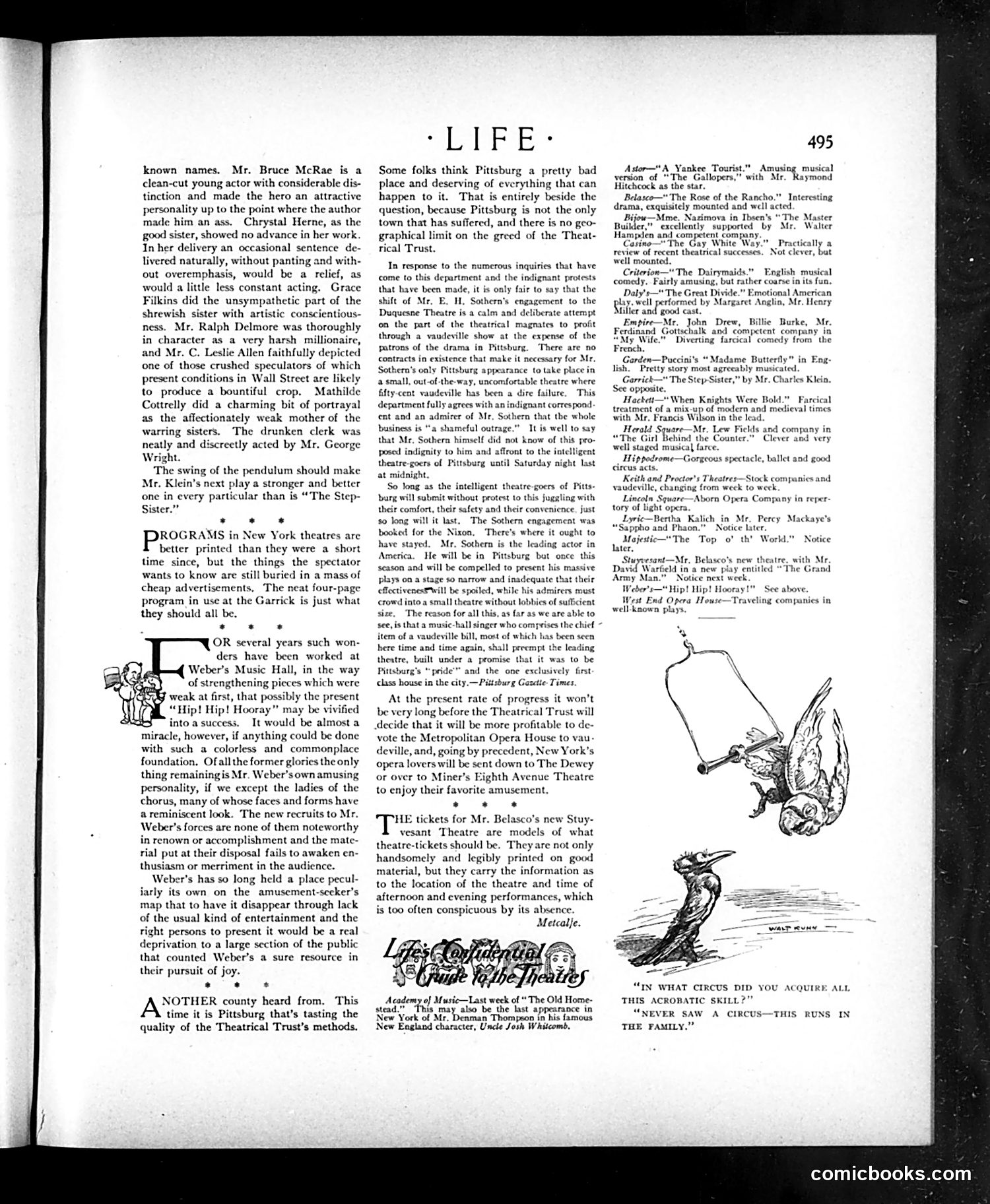
This page contains theater reviews and criticism rather than political cartoons. The main content addresses grievances against the "Theatrical Trust"—a monopolistic cartel that controlled American theater distribution in the early 1900s. The key controversy concerns **E. H. Sothern**, a prominent actor whose engagement was moved to an inferior venue (the Duquesne Theatre in Pittsburgh) featuring cheap vaudeville. The author condemns this as a "shameful outrage" by theater magnates exploiting Sothern's name to profit from low-quality entertainment. The criticism reflects broader anti-trust sentiment of the era: the Theatrical Trust's monopoly allowed them to dictate unfavorable terms to actors and venues, harming both artistic quality and public access to legitimate drama. A small illustration at bottom right shows acrobatic performers—likely referencing the vaudeville acts the Trust forced upon audiences. This represents Progressive Era criticism of corporate consolidation in entertainment.
📄 Transcribed text from this page (OCR, searchable)
Machine-transcribed from the original scan — historical spelling and the odd misread are preserved.
known names. Mr. Bruce McRae is a clean-cut young actor with considerable dis- tinction and made the hero an attractive personality up to the point where the author made him an ass, Chrystal Herne, as the good sister, showed no advance in her work. In her delivery an occasional sentence de- livered naturally, without panting and with- out overemphasis, would be a relief, as would a little less constant acting. Grace Filkins did the unsympathetic part of the shrewish sister with artistic conscientious- ness. Mr. Ralph Delmore was thoroughly in character as a very harsh millionaire, and Mr. C. Leslie Allen faithfully depicted one of those crushed speculators of which present conditions in Wall Street are likely to produce a bountiful crop. Mathild Cottrelly did a charming bit of portrayal as the affectionately weak mother of the warring sisters. The drunken clerk was neatly and discreetly acted by Mr. George Wright. The swing of the pendulum should make Mr. Klein’s next play a stronger and better one in every particular than is “The Step- Sister. + *# 6 ROGRAMS in New York theatres are better printed than they were a short time since, but the things the spectator wants to know are still buried in a mass of cheap advertisements, The neat four-page program in use at the Garrick is just what they should all be. * *# «8 OR several years such won- ders have been worked at Weber’s Music Hall, in the way of strengthening pieces which were & weak at first, that possibly the present Iip! Hip! Hooray” may be vivified into a success. It would be almost a miracle, however, if anything could be done with such a colorless and commonplace foundation, Ofall the former glories the only thing remaining is Mr. Weber'sown amusing personality, if we except the ladies of the chorus, many of whose faces and forms have a reminiscent look. The new recruits to Mr. Weber’s forces are none of them noteworthy in renown or accomplishment and the mate- rial put at their disposal fails to awaken en- thusiasm or merriment in the audience. Weber's has so long held a place pecul- jarly its own on the amuscment-secker’s map that to have it disappear through lack of the usual kind of entertainment and the right persons to present it would be a real deprivation to a large section of the public that counted Weber’s a sure resource in their pursuit of joy. ee: Se NOTHER county heard from, This time it is Pittsburg that’s tasting the quality of the Theatrical Trust’s methods, ig! lb a Some folks think Pittsburg a pretty bad place and deserving of everything that can happen to it. That is entirely beside the question, because Pittsburg is not the only town that has suffered, and there is no geo- aphical limit on the greed of the Theat- In response to the numerous inquiries that have come to this department and the indignant protests that have been made, it is only fair to say that the shift of Mr. E. H. Sothern’s engagement to the Duquesne Theatre is a calm and deliberate attempt on the part of the theatrical magnates to profit through a vaudeville show at the expense of the patrons of the drama in Pittsburg. There are no contracts in existence that make it necessary for Mr. Sothern’s oaly Pittsburg appearance to take place in a small, out-of-the-way, uncomfortable theatre where fifty-cent vaudeville has been a dire failure, This department fully agrees with an indignant correspond ent and an admirer of Mr, Sothern that the whole business is “a shameful outrage." It is well to say that Mr, Sothern himself did not know of this pro- posed indignity to him and affront to the intelligent theatre-goers of Pittsburg until Saturday night last at midnight. So long as the intelligent theatre-goers of Pitts- burg will submit without protest to this juggling with their comfort, their safety and their convenience, just 30 long will it last, ‘The Sothern engagement was booked for the Nixon, ‘There's where it ought to have stayed. Mr. Sothern is the leading actor in America. He will be in Pittsburg bat once this season and will be compelled to present his massive plays on a stage so narrow and inadequate that their effectivenesWill be spoiled, while his admirers must crowd into a small theatre without lobbies of sufficient size, The reason for all this, as far as we are able to see, is that a music-hall singer who comprises the chief item of a vaudeville bill, most of which has been seen here time and time again, shall preempt the leading theatre, built under a promise that it was to be Pittsburg’s “pride” and the one exclusively first class house in the city.— Pittsburg Gazette: Times At the present rate of progress it won't be very long before the Theatrical Trust will decide that it will be more profitable to de- vote the Metropolitan Opera House to vau- deville, and, going by precedent, New York's opera lovers will be sent down to The Dewey or over to Miner’s Eighth Avenue Theatre to enjoy their favorite amusement, * 6 6 'HE tickets for Mr. Belasco’s new Stuy- vesant Theatre are models of what theatre-tickets should be. They are not only handsomely and legibly printed on good material, but they carry the information as to the location of the theatre and time of afternoon and evening performances, which is too often conspicuous by its absence. Metcalje. Academy of Music—Last week of “ The Old Home- stead.” ‘This may also be the last appearance in New York of Mr. Denman Thompson in his famous New England character, Uncle Josh Whitcomb, 495 Astor—"A Yankee Tourist.” Amusing musical version of The Gallopers,”” with Mr. Raymond Hitchcock as the star. Belasco—" The Rose of the Rancho.” Interesting drama, exquisitely mounted and well acted Bijouw—Mme. Nazimova in Ibsen's “The Master Builder,” excellently supported by Mr. Walter Hampden and competent company Casino—"The Gay White Way.” Practically a review of recent theatrical successes. Not clever, but well mounted. Criterion—"The Dairymaids.” English musical comedy. Fairly amusing, but rather coarse in its fun, Daly’s—" The Great Divide.” Emotional American pliy, well performed by Margaret Anglin, Mr. Henry Miller and"good cast. Empire—Mr. John Drew, Billie Burke, Mr. Ferdinand Gottschalk and competent company in ty Wife.” Diverting farcical comedy from the French. Garden—Puccini's “Madame Butterfly lish. Pretty story most agreeably musicated Gorrick— The Step-Sister,” by Mr. Charles Klein, See opposite, Hacketi—" When Knights Were Bold.” Farcical treatment of a mix-up of modern and medieval times with Mr. Francis Wilson in the lead. Herald Square—Mr. Lew Fields and company in “The Giri Behind ‘the Counter.” Clever and very well staged musical farce. Hippodrome—Gorgeous spectacle, ballet and good Gircus acts. Keith and Proctor's Theatres—Stock companies and in Eng- Kalich in Mr. Percy Notice later, of th World.” Mackaye’s Notice Stuyvesant—Mr, Belasco’s new theatre, with Mr David Warfield in a new play entitled “The Gran Army Man.” Notice next week Weber’s—" Hip! Hip! Hoo West End Opera House—Trave' well-known plays. “IN WHAT CIRCUS DID THIS ACROBATIC SKILL?” NEVER SAW A CIRCU THE FAMILY.” You acquire THIS RUNS comicbooks.com ALL IN