
Life, 1907-10-24 · page 21 of 24
Life — October 24, 1907 — page 21: what you’re looking at
What you’re looking at
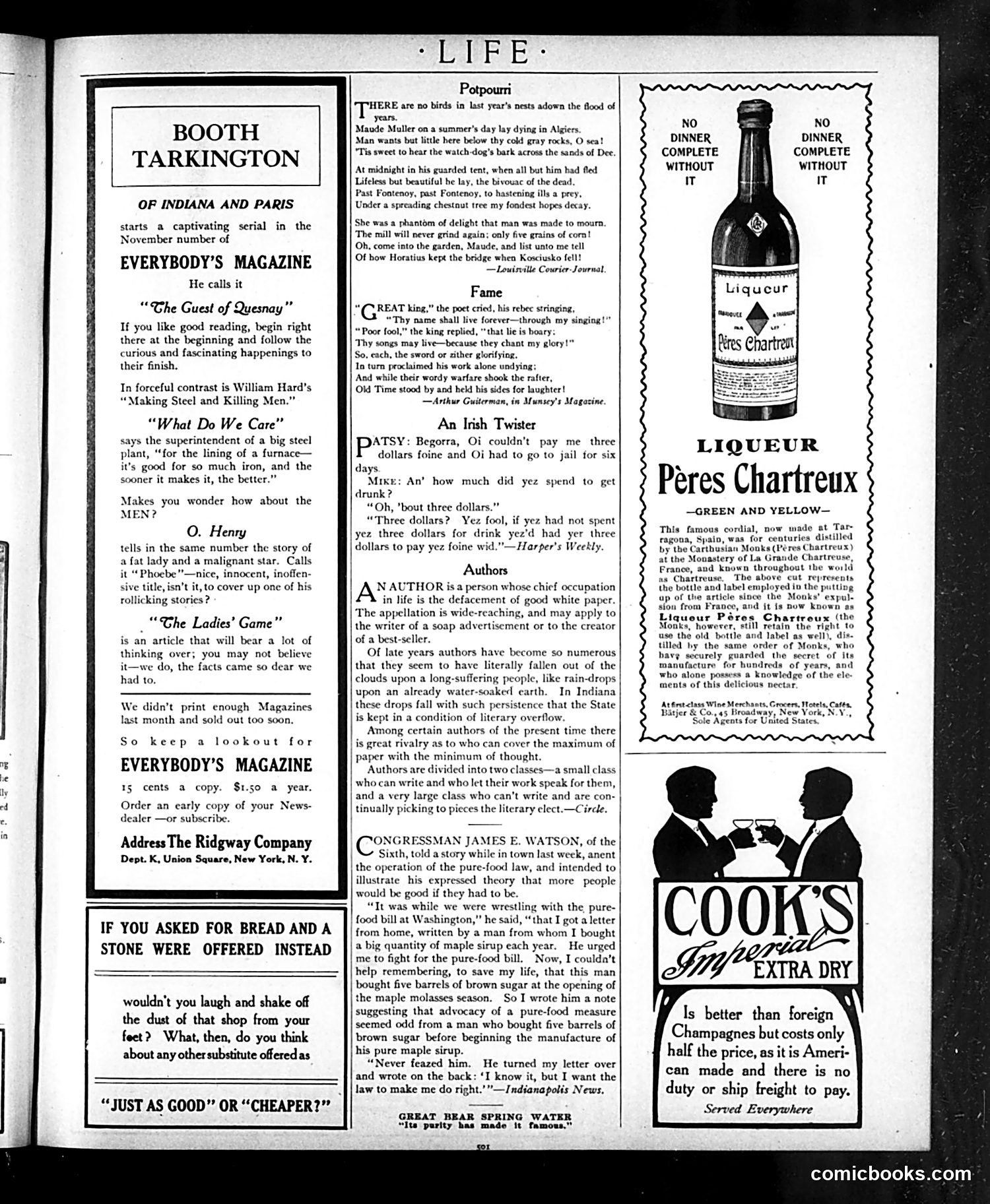
This page contains literary advertisements and light satirical content typical of early 20th-century *Life* magazine. The main content promotes serialized fiction in *Everybody's Magazine*, including works by Booth Tarkington and O. Henry—popular authors of the era. The "Potpourri" section presents absurdist humor by combining opening lines from famous poems into nonsensical mashups (e.g., "Maude Muller...lay dying in Algiers"). This satirizes overly sentimental Victorian poetry. The "Authors" section gently mocks the proliferation of writers, suggesting Indiana produces them in excessive quantities and that many are merely "soap advertisement" writers rather than serious artists. An "Irish Twister" joke plays on Irish-American stereotypes about drinking and poverty. The advertisement at bottom promotes champagne as superior to foreign brands—typical product marketing of the period. The overall tone is lighthearted satire rather than sharp political commentary.
📄 Transcribed text from this page (OCR, searchable)
Machine-transcribed from the original scan — historical spelling and the odd misread are preserved.
BOOTH TARKINGTON OF INDIANA AND PARIS starts a captivating serial in the November number of EVERYBODY’S MAGAZINE He calls it “The Guest of Quesnay”” If you like good reading, begin right there at the beginning and follow the curious and fascinating happenings to their finish. In forceful contrast is William Hard’s “Making Steel and Killing Men.” “What Do We Care” says the superintendent of a big steel plant, ‘for the lining of a furnace— it’s good for so much iron, and the sooner it makes it, the better.” Makes you wonder how about the O. Henry tells in the same number the story of a fat lady and a malignant star. Calls it “Phoebe"—nice, innocent, inoffen- sive title, isn’t it, to cover up one of his rollicking stories ? _ “Che Ladies’ Game” is an article that will bear a lot of thinking over; you may not believe it—we do, the facts came so dear we had to, We didn’t print enough Magazines last month and sold out too soon, So keep a lookout for EVERYBODY’S MAGAZINE 15 cents a copy. $1.50 a year. Order an early copy of your News- dealer —or subscribe. Address The Ridgway Company Dept. K, Union Square, New York, N. Y. IF YOU ASKED FOR BREAD AND A STONE WERE OFFERED INSTEAD wouldn't you laugh and shake off the dust of that shop from your feet? What, then, do you think about any other substitute offered as “JUST AS GOOD” OR “CHEAPER?” : odd ses leys Potpourri tT RERE are no birds in last year's nests adown the flood of years. Maude Muller on a summer's day lay dying in Algiers, ‘Man wants but little here below thy cold gray rocks, O sea! "Tis sweet to hear the watch-dog’s bark across the sands of Dee. At midnight in his guarded tent, when all but him had fled Lifeless but beautiful he lay, the bivouac of the dead, Past Fontenoy, past Fontenoy, to hastening ills a prey, Under a spreading chestnut tree my fondest hopes decay. She was a phantom of delight that man was made to mourn. ‘The mill will never grind again; only five grains of corn! Oh, come into the garden, Maude, and list unto me tell Of bow Horatius kept the bridge when Kosciusko fell! Louisville Courier-Jowrnal. Fame “CREAT king,” the poet cried, his rebec stringing, “Thy name shall live forever—through my singing!” “Poor fool," the king replied, “that lie is boary: ‘Thy songs may live—because they chant my glory!” So, each, the sword of zither glorifying. In turn proclaimed his work alone undying: And while their wordy warfare shook the rafter, Old Time stood by and held his sides for laughter! —Arthur Guiterman, in Munsey's Magosine. An Irish Twister ATSY: Begorra, Oi couldn't pay me three dollars foine and Oi had to go to jail for six days Mike: An’ how much did yez spend to get drunk? “Oh, ’bout three dollars.”” “Three dollars? Yez fool, if yez had not spent |yez three dollars for drink yez’d had yer three dollars to pay yez foine wid,” —Harper's Weekly. Authors N AUTHOR isa person whose chief occupation in life is the defacement of good white paper. ‘The appellation is wide-reaching, and may apply to the writer of a soap advertisement or to the creator of a best-seller. Of late years authors have become so numerous that they seem to have literally fallen out of the clouds upon a long-suffering people, like rain-drops upon an already water-soaked earth. In Indiana these drops fall with such persistence that the State is kept in a condition of literary overflow. Among certain authors of the present time there | is great rivalry as to who can cover the maximum of paper with the minimum of thought. Authors are divided into two classes—a small class who can write and who let their work speak for them, and a very large class who can't write and are con- tinually picking to picces the literary clect.—Cirde. ONGRESSMAN JAMES E. WATSON, of the Sixth, told a story while in town last week, anent the opcration of the pure-food law, and intended to illustrate his expressed theory that more people would be good if they had to be. “Tt was while we were wrestling with the pure- food bill at Washington,” he said, “that I got a letter | from home, written by a man from whom I bought a big quantity of maple sirup each year. He urged me to fight for the pure-food bill. Now, I coulda’t help remembering, to save my life, that this man bought five barrels of brown sugar at the opening of the maple molasses season. So I wrote him a note suggesting that advocacy of a pure-food measure seemed odd from a man who bought five barrels of brown sugar before beginning the manufacture of his pure maple sirup. Never feazed him. He turned my letter over and wrote on the bac! know it, but I want the law to make me do right.’”"—Indianapolis News. GREAT BEAR SPRING WATER “Ite purity has made it famous," DINNER COMPLETE WITHOUT IT IT DINNER COMPLETE LIQUEUR Peres Chartreux —GREEN AND YELLOW— This famous cordial, now made at Tar ragona, Spain, was for centuries distilled Monks (Péres Chartreux) at the 3 {La Grande Chartreu; France, and known throughout the world as Chartreuse. The above cut represents the bottle and label employed in the putting ap of the article since the Monks’ expul- sion from France, and {t {s now known as Liqueur Péres Chartreux (the Monks, however, still retain the right to use the old bottle and label as well), dis- tilled hy the same order of Monks, who have securely guarded the secret of its manufacture for hundreds of years, and who alone possess a knowledge of the ele- ments of this delicious nectar, Atfrstclass Wine Merchants, Grocers, Hotels, Cafés, Bitjer & Co., 45 Broadway, New York, N-V Sole Agents for United States. Is better than foreign Champagnes but costs only half the price, as it is Ameri- can made and there is no duty or ship freight to pay. Served Everywhere comicbooks.com