
Life, 1907-10-24 · page 9 of 24
Life — October 24, 1907 — page 9: what you’re looking at
What you’re looking at
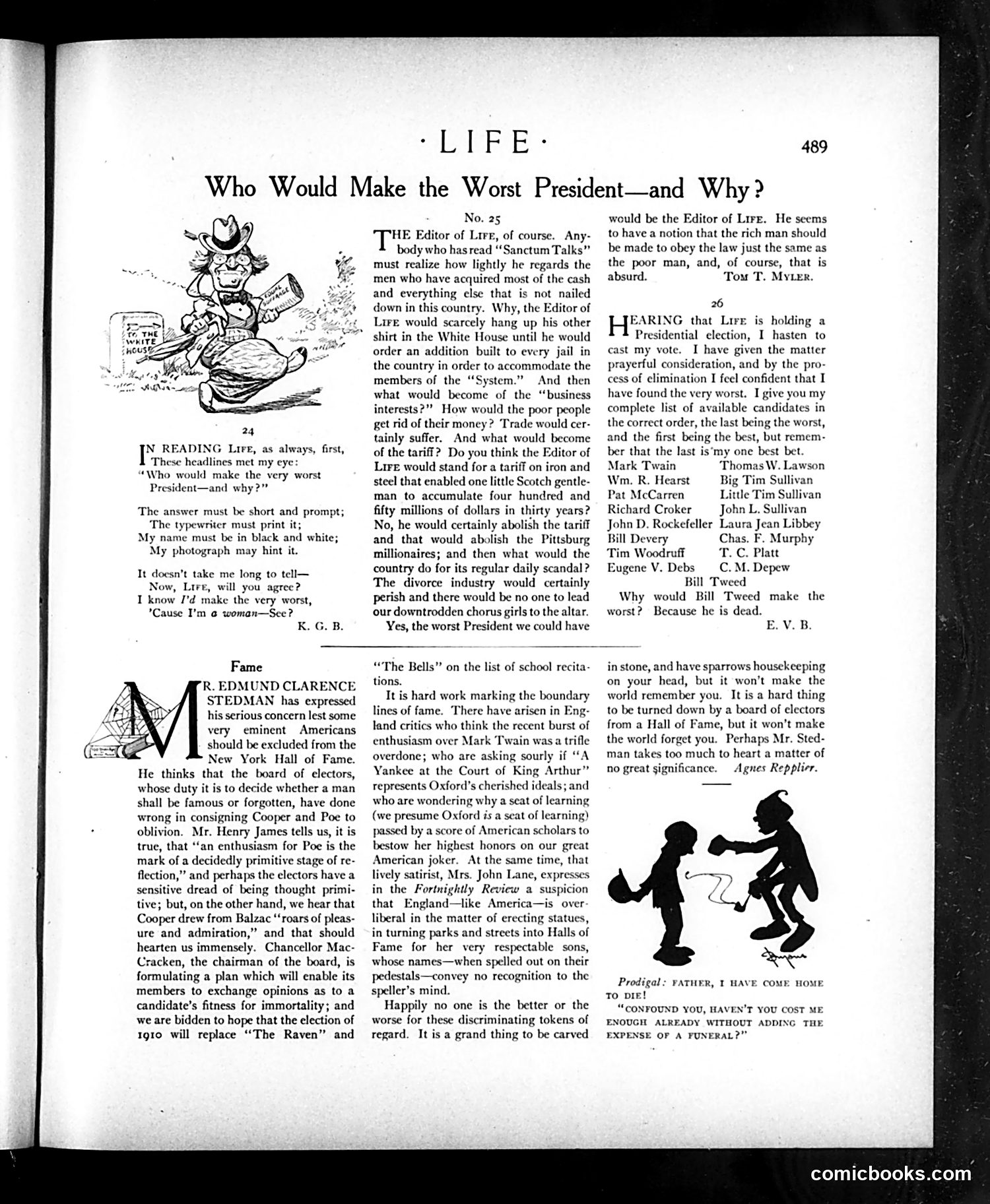
This satirical piece from *Life* magazine presents reader submissions on who would be the worst presidential candidate. The large cartoon depicts a caricatured figure (appears to be a wealthy industrialist or "robber baron" type, based on the money imagery and exaggerated features) riding what looks like a money bag or corrupt institution. The editorial text mocks the notion that a wealthy businessman should become president, arguing such a figure would dismantle tariffs, harm workers, and serve only elite "business interests." The satire targets economic inequality and the assumption that successful industrialists would make competent leaders—a common Progressive Era critique of unchecked capitalism and political corruption.
📄 Transcribed text from this page (OCR, searchable)
Machine-transcribed from the original scan — historical spelling and the odd misread are preserved.
ABER E * Who Would Make the Worst President—and Why ? N READING Lire, as always, first, These headlines met my eye: “Who would make the very worst President—and why?” The answer must be short and prompt; The typewriter must print it; My name must be in black and white; My photograph may hint it. It doesn’t take me long to tell— Now, Lrre, will you agree? I know I’d make the very worst, "Cause I'm @ woman—Sce? K. G. B. Fame R. EDMUND CLARENCE STEDMAN has expressed his serious concern lest some very eminent Americans should be excluded from the New York Hall of Fame. He thinks that the board of electors, whose duty it is to decide whether a man shall be famous or forgotten, have done wrong in consigning Cooper and Poe to oblivion. Mr. Henry James tells us, it is true, that “an enthusiasm for Poe is the mark of a decidedly primitive stage of re- flection,” and perhaps the electors have a sensitive dread of being thought primi- tive; but, on the other hand, we hear that Cooper drew from Balzac “roars of pleas- ure and admiration,” and that should hearten us immensely. Chancellor Mac- Cracken, the chairman of the board, is formulating a plan which will enable its members to exchange opinions as to a candidate’s fitness for immortality; and we are bidden to hope that the election of 1gto will replace “The Raven” and No. 25 HE Editor of Lirr, of course. Any- body who has read ‘Sanctum Talks” must realize how lightly he regards the men who have acquired most of the cash and everything else that is not nailed down in this country. Why, the Editor of Lire would scarcely hang up his other shirt in the White House until he would order an addition built to every jail in the country in order to accommodate the members of the “System.” And then what would become of the “business interests?” How would the poor people get rid of their money? Trade would cer- tainly suffer. And what would become of the tariff? Do you think the Editor of Lire would stand for a tariff on iron and steel that enabled one little Scotch gentle- man to accumulate four hundred and fifty millions of dollars in thirty years? No, he would certainly abolish the tariff and that would abolish the Pittsburg millionaires; and then what would the country do for its regular daily scandal? The divorce industry would certainly perish and there would be no one to lead our downtrodden chorus girls to the altar. Yes, the worst President we could have “The Bells” on the list of school recita- tions. It is hard work marking the boundary lines of fame. There have arisen in Eng- land critics who think the recent burst of enthusiasm over Mark Twain was a trifle overdone; who are asking sourly if ‘A Yankee at the Court of King Arthur” represents Oxford’s cherished ideals; and who are wondering why a seat of learning (we presume Oxford is a scat of learning) passed by a score of American scholars to bestow her highest honors on our great American joker. At the same time, that lively satirist, Mrs. John Lane, expresses in the Fortnightly Review a suspicion that England—like America—is over liberal in the matter of erecting statues, in turning parks and streets into Halls of Fame for her very respectable sons, whose names—when spelled out on their pedestals—convey no recognition to the speller’s mind. Happily no one is the better or the worse for these discriminating tokens of regard. It is a grand thing to be carved would be the Editor of Lire. He seems to have a notion that the rich man should be made to obey the law just the same as the poor man, and, of course, that is absurd. Tom T. MyLer. 26 EARING that Lire is holding a Presidential election, I hasten to cast my vote. I have given the matter prayerful consideration, and by the pro- cess of elimination I feel confident that I have found the very worst. I give you my complete list of available candidates in the correct order, the last being the worst, and the first being the best, but remem- ber that the last is‘my one best bet. Mark Twain Thomas W. Lawson Wm. R. Hearst Big Tim Sullivan Pat McCarren Little Tim Sullivan Richard Croker John L, Sullivan John D. Rockefeller Laura Jean Libbey Bill Devery Chas. F. Murphy Tim Woodruff T.C. Platt Eugene V. Debs C. M. Depew Bill Tweed Why would Bill Tweed make the worst? Because he is dead. EVs B; in stone, and have sparrows housekeeping on your head, but it won’t make the world remember you. It is a hard thing to be turned down by a board of electors from a Hall of Fame, but it won’t make the world forget you. Perhaps Mr. Sted- man takes too much to heart a matter of no great significance. Agnes Repplicr. Prodigal: PATHER, 1 HAVE COME HOME To vie! be FOUND YOU, HAVEN'T YOU COST ME ENOUGH ALREADY WITHOUT ADDING THE EXPENSE OP A FUNERAL?” comicbooks.com