
Life, 1907-10-24 · page 14 of 24
Life — October 24, 1907 — page 14: what you’re looking at
What you’re looking at
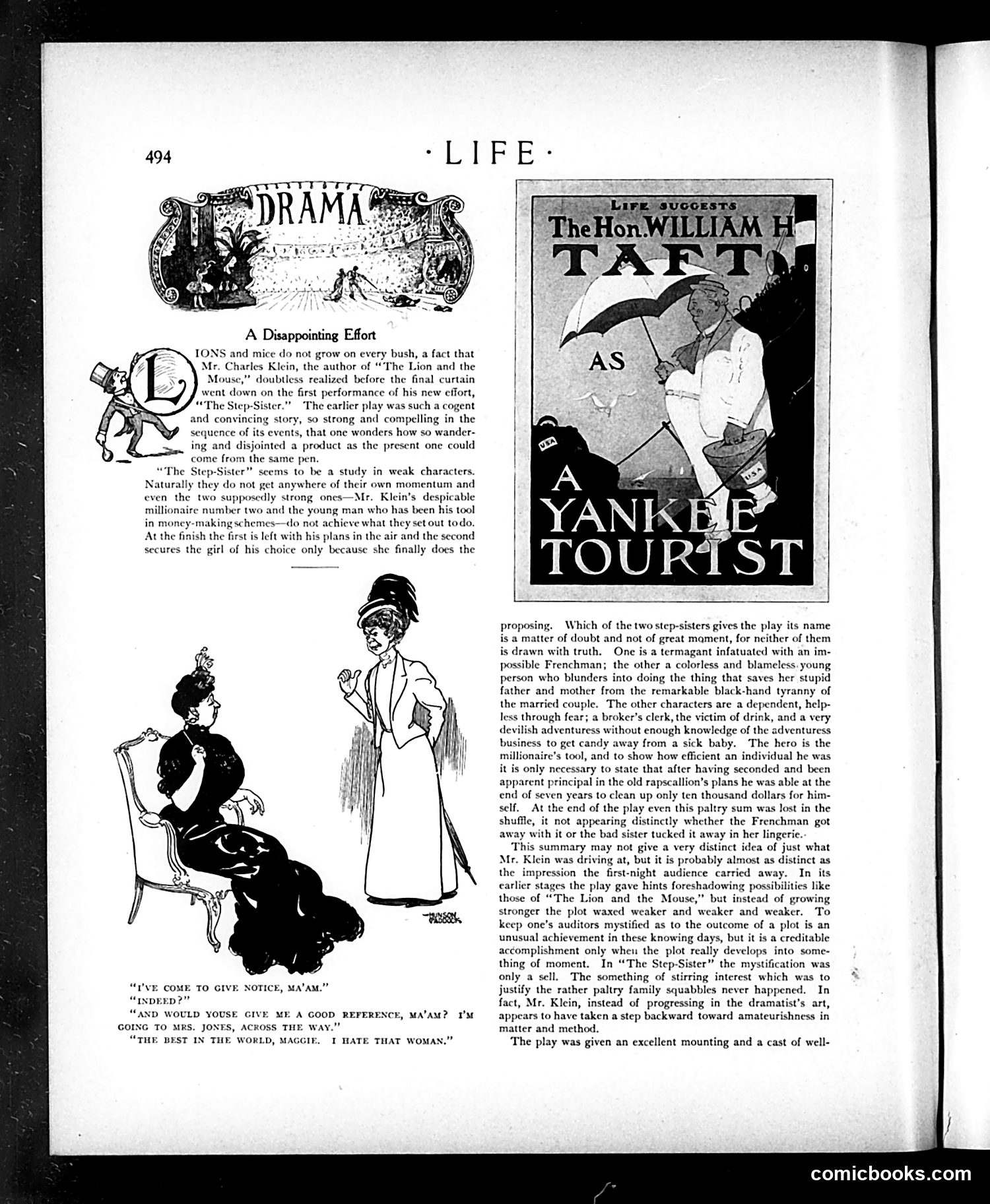
This is a theater review of Charles Klein's play *The Step-Sister*. The critic compares it unfavorably to Klein's earlier success, *The Lion and the Mouse*, arguing that the new play features weak, unmotivated characters and a poorly constructed plot. The accompanying cartoon depicts a domestic servant giving notice to her employer—illustrating the play's shallow characterization. The dialogue's triviality ("I hate that woman") mirrors the critic's complaint that the play lacks substance. The adjacent advertisement for William H. Taft's *A Yankee Tourist* is simply promotional content. The review's broader point: Klein has regressed artistically, replacing his previous dramatic sophistication with amateur plotting and unconvincing character development. The mystification surrounding the plot's outcome is criticized as a "sell"—mere manipulation rather than genuine dramatic tension.
📄 Transcribed text from this page (OCR, searchable)
Machine-transcribed from the original scan — historical spelling and the odd misread are preserved.
A Disappointing Effort IONS and mice do not grow on every bush, a fact that Mr. Charles Klein, the author of “The Lion and the Mouse,” doubtless realized before the final curtain went down on the first performance of his new effort, Step-Sister.” ‘The earlier play was such a cogent and convincing story, so strong and compelling in the sequence of its events, that one wonders how so wander- ing and disjointed a product as the present one could come from the same pen. “The Step-Sister” scems to be a study in weak characters. Naturally they do not get anywhere of their own momentum and even the two supposedly strong ones—Mr. Klein's de millionaire number two and the young man who has been his tool in money-making schemes—do not achieve what they set out todo. At the finish the first is left with his plans in the air and the second secure: “I'VE COME TO GIVE NOTICE, MA'AM.” “INDEED?” “AND WOULD YOt GIVE ME A GOOD REFERENCE, MA’AM? I’M GOING TO MRS. JONES, ACROSS THE way.’ THE BEST IN THE WORLD, MAG I HATE THAT WOMAN.” YANK BE” TOURAST proposing. Which of the two step-sisters gives the play its name is a matter of doubt and not of great mament, for neither of them is drawn with truth. One is a termagant infatuated with an im- possible Frenchman; the other a colorless and blameless. young person who blunders into doing the thing that saves her stupid father and mother from the remarkable black-hand tyranny of the married couple. The other characters are a dependent, help- less through fear; a broker's clerk, the victim of drink, and a very sh adventuress without enough knowledge of the adventuress ess to get candy away from a sick baby. The hero is the aire’s tool, and to show how efficient an individual he was it is only necessary to state that after having seconded and been apparent principal in the old rapscallion’s plans he was able at the end of seven years to clean up only ten thousand dollars for him- self. At the end of the play even this paltry sum was lost in the shufile, it not appearing distinctly whether the Frenchman got away with it or the bad sister tucked it away in her lingerie. This summary may not give a very distinct idea of just what Mr. Klein was driving at, but it is probably almost as distinct as the impression the first-night audience carried away. In its carlicr stages the play gave hints foreshadowing possibilities like those of “The Lion and the Mouse,” but instead of growing stronger the plot waxed weaker and weaker and weaker. To keep one’s auditors mystified as to the outcome of a plot is an unusual achievement in these knowing days, but it is a creditable accomplishment only when the plot really develops into some- thing of moment. In “The Step-Sister” the mystification was only a sell. The something of stirring interest which was to justify the rather paltry family squabbles never happened. In fact, Mr. Klein, instead of progressing in the dramatist’s art, appears to have taken a step backward toward amateurishness in matter and method. ‘The play was given an excellent mounting and a cast of well- comicbooks.com