
A complete issue · 24 pages · 1907
Life — September 12, 1907
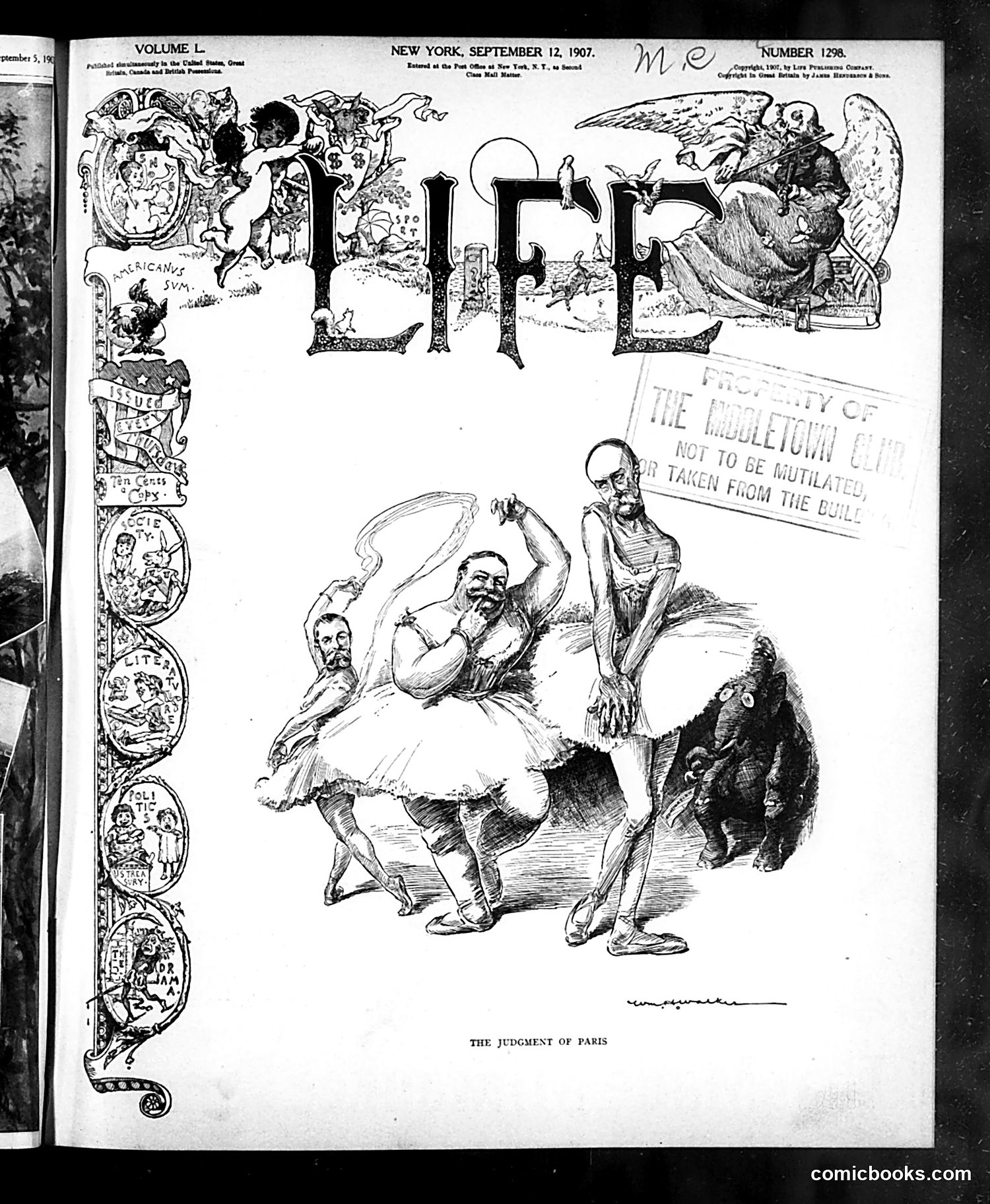
This political cartoon adapts the classical Greek myth where Paris must judge which goddess is most beautiful. Here, the three figures appear to represent competing political or social interests of the era, depicted as dancers in a beauty contest scenario. The cartoon satirizes some form of contemporary judgment or decision—likely regarding policy or political favor—by presenting it as absurd aesthetic competition rather than serious deliberation. The classical reference suggests the situation is ridiculous or ephemeral. The ornate left border contains zodiacal or seasonal imagery typical of Life's decorative style. The stamp indicates restricted distribution from the Middletown Library. Without clearer identification of the specific figures or contemporary event, the precise political target remains unclear, though the satire clearly mocks shallow decision-making processes.
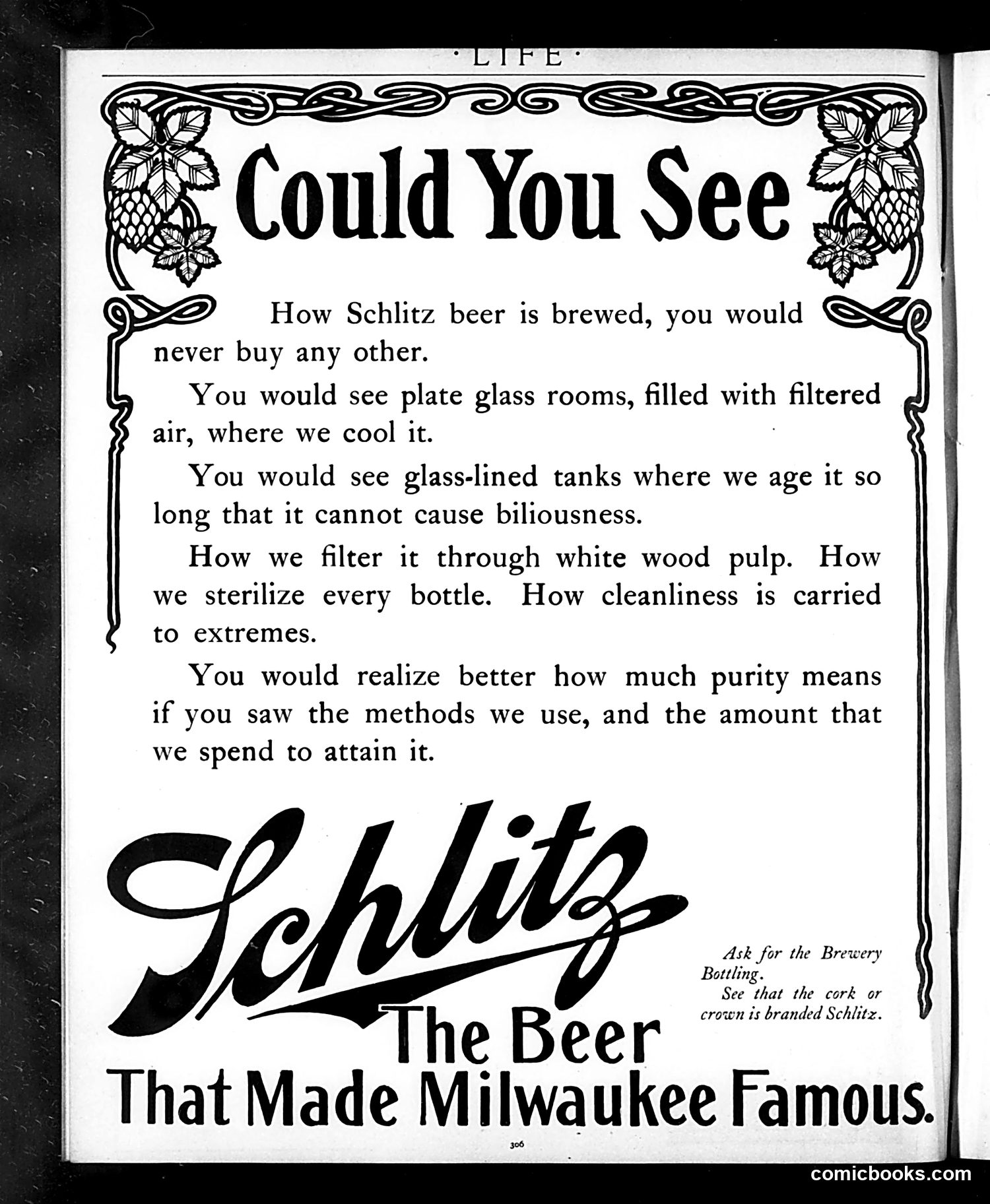
This is **not satire or a cartoon—it's a straightforward advertisement** for Schlitz beer from the early 20th century. The ad uses a common marketing appeal of the era: inviting consumers to mentally tour the brewery's production facilities. It emphasizes purity and cleanliness as key selling points, highlighting: - Temperature-controlled plate glass rooms - Aging tanks that prevent biliousness (a health concern of the time) - White wood pulp filtration - Sterilized bottles The tagline "The Beer That Made Milwaukee Famous" references Milwaukee's dominant position as America's brewing center. The note about checking cork or crown branding suggests product authenticity concerns were relevant to period consumers. This represents typical early-1900s industrial-era advertising logic: detailed manufacturing transparency as a trust-building tool.
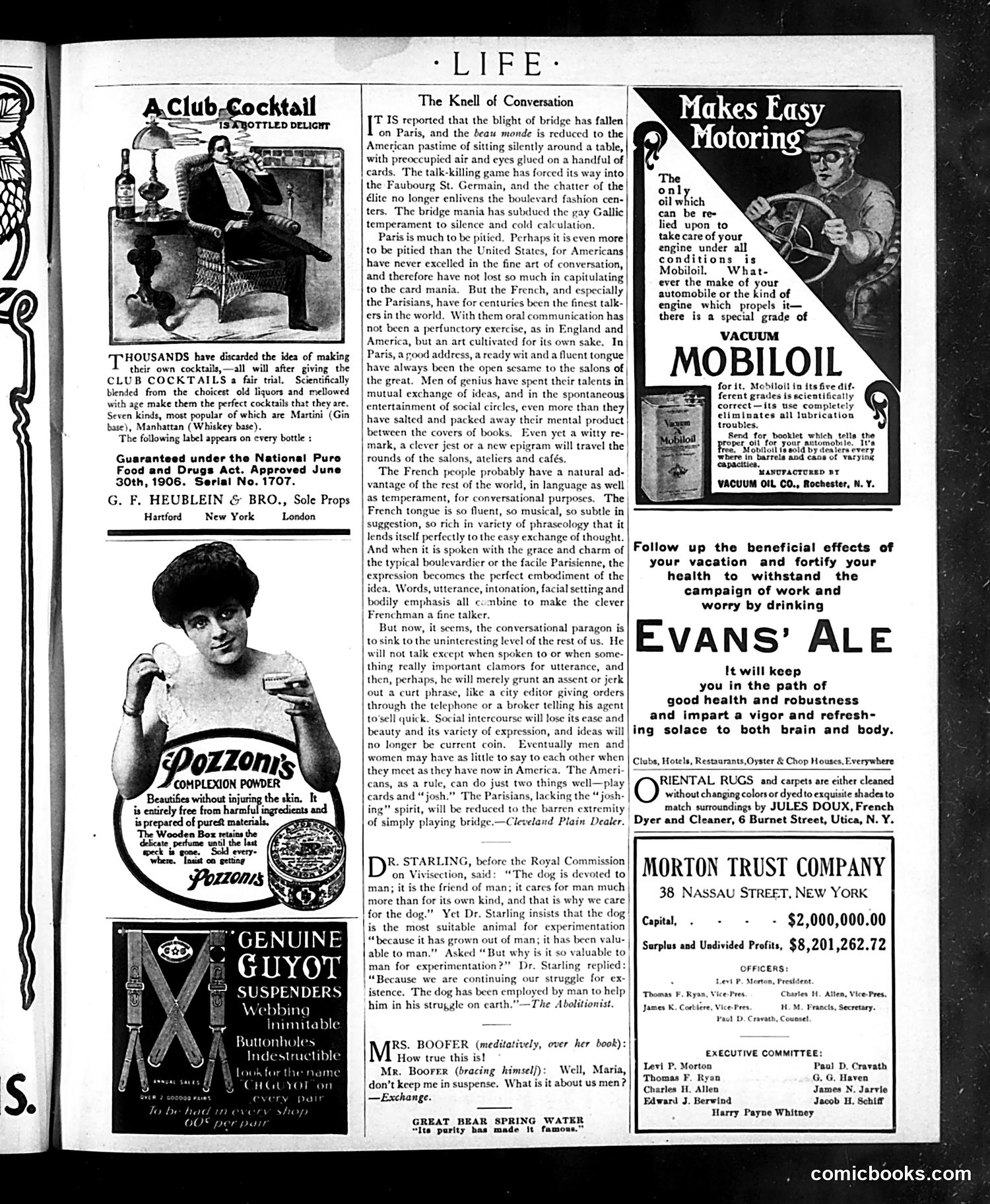
This page is primarily **advertising**, not political satire. The left side features ads for Pozzoni's Complexion Powder (emphasizing skin whitening/beauty standards of the era) and Guyot Suspenders. The center contains "The Knell of Conversation," a humorous essay lamenting how bridge card games have replaced French-style salon conversation in Paris and America. The author playfully complains that Americans, lacking conversational refinement, now favor silent card-playing over the witty, eloquent discourse traditionally valued in French intellectual circles. The right side advertises Mobiloil motor oil, Evans' Ale, and Morton Trust Company—typical period commercial content. There are no political cartoons on this page; it's a standard early 20th-century magazine layout mixing light cultural commentary with commercial promotions.
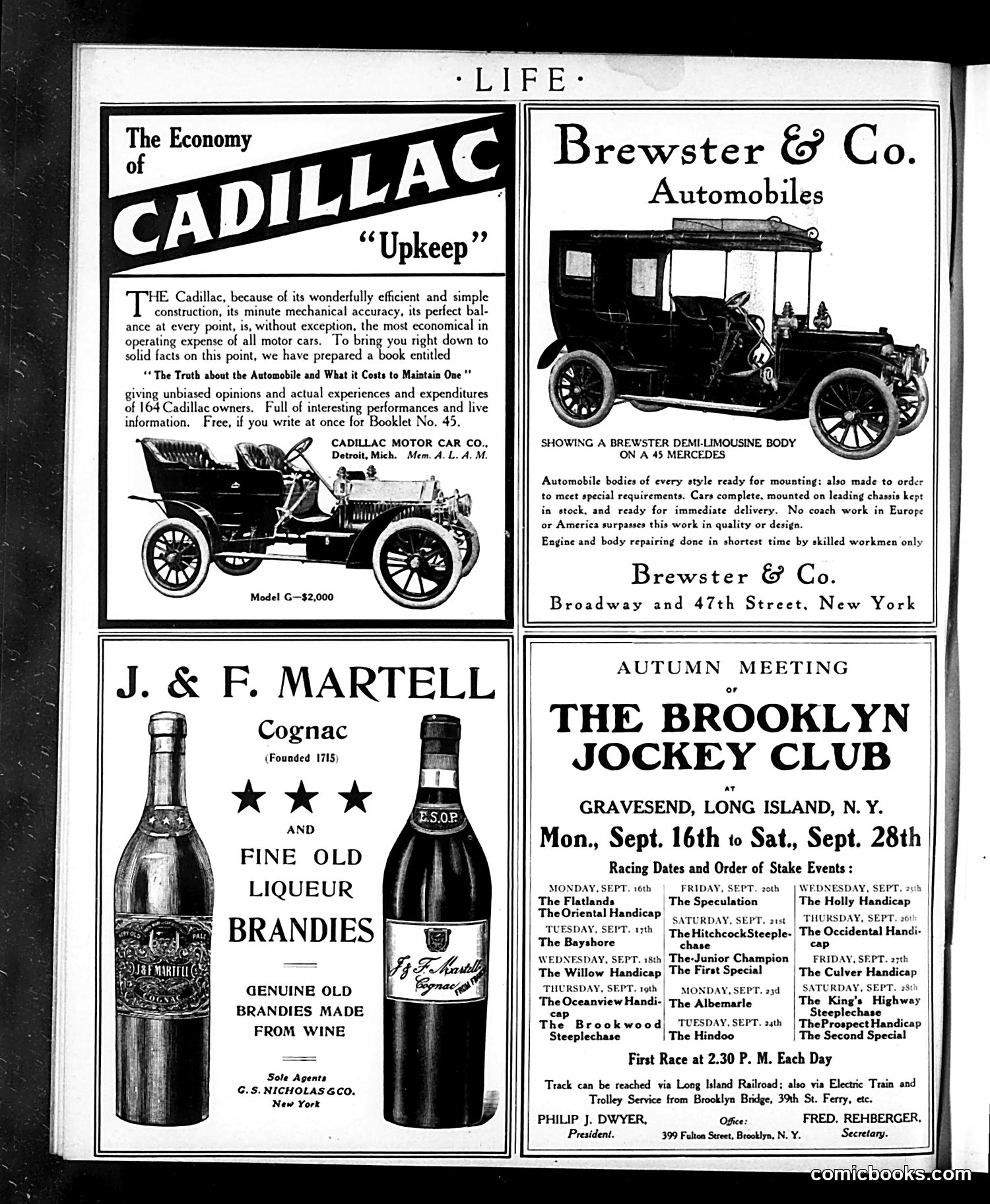
This page contains **no political cartoons or satire**—it's purely **advertising content** from an early 1900s Life magazine. The four advertisements promote: 1. **Cadillac automobiles** (Model G at $2,000), emphasizing economical upkeep and efficiency 2. **Brewster & Co.**, a custom automobile body manufacturer in New York 3. **J. & F. Martell cognac and brandy**, highlighting its age and authenticity 4. **The Brooklyn Jockey Club's autumn horse-racing meeting** at Gravesend, Long Island These ads target wealthy readers with disposable income—expensive automobiles, luxury spirits, and thoroughbred racing. There are no caricatures, political references, or satirical commentary present on this page.
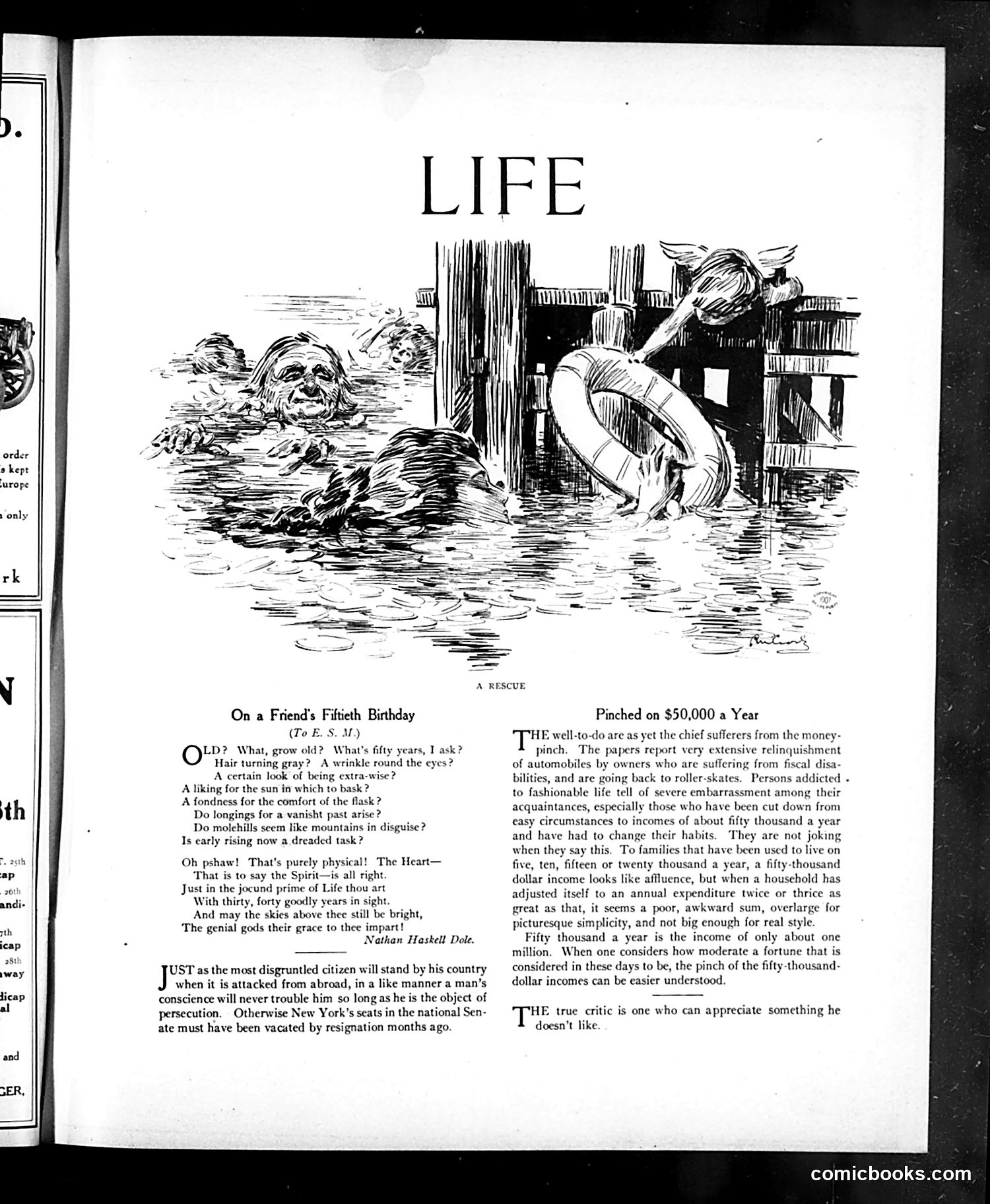
**The Cartoon "A Rescue":** The illustration depicts an angel rescuing an elderly man from water, likely representing death or financial ruin. The heading "Pinched on $50,000 a Year" indicates the satire targets wealthy Americans claiming poverty. **The Satire:** The article mocks affluent citizens suffering from a "money-pinch"—those with $50,000 annual incomes (substantial in this era) claiming financial hardship. It critiques the disconnect between genuine poverty and the complaints of the wealthy, noting that families accustomed to luxury find it difficult to adjust spending even when earning amounts most citizens consider affluence. **Historical Context:** This appears to reference post-WWI economic adjustments or early Depression-era anxieties among the wealthy class, satirizing their sense of victimhood during periods of economic constraint.
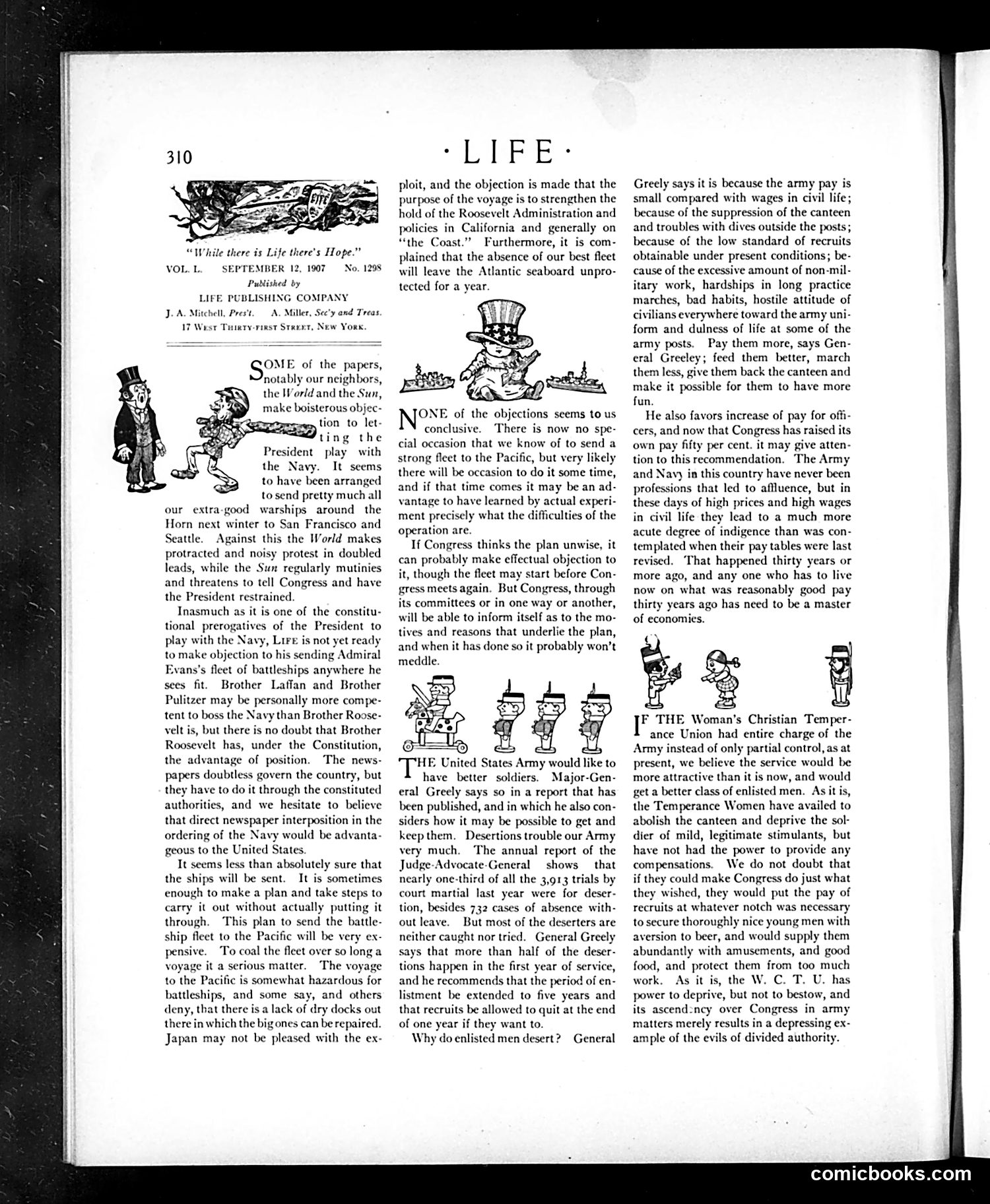
This page discusses military readiness and recruitment problems in the U.S. Army. The text debates whether sending warships to the Pacific is wise, with concerns about fleet maintenance and the constitutional limits of presidential power. The central issue concerns Army desertion rates—the text notes that nearly one-third of recruits deserted in the previous year. General Greely's report recommends extending enlistment periods to five years and allowing one-year quits. The small cartoon figures appear to illustrate soldiers or recruits, though they're too stylized to identify specific individuals. The satire critiques both military pay inadequacy (compared to civilian wages) and the W.C.T.U.'s (Women's Christian Temperance Union) influence over Army canteen management—the author argues this well-intentioned but ineffective control contributes to recruitment problems.
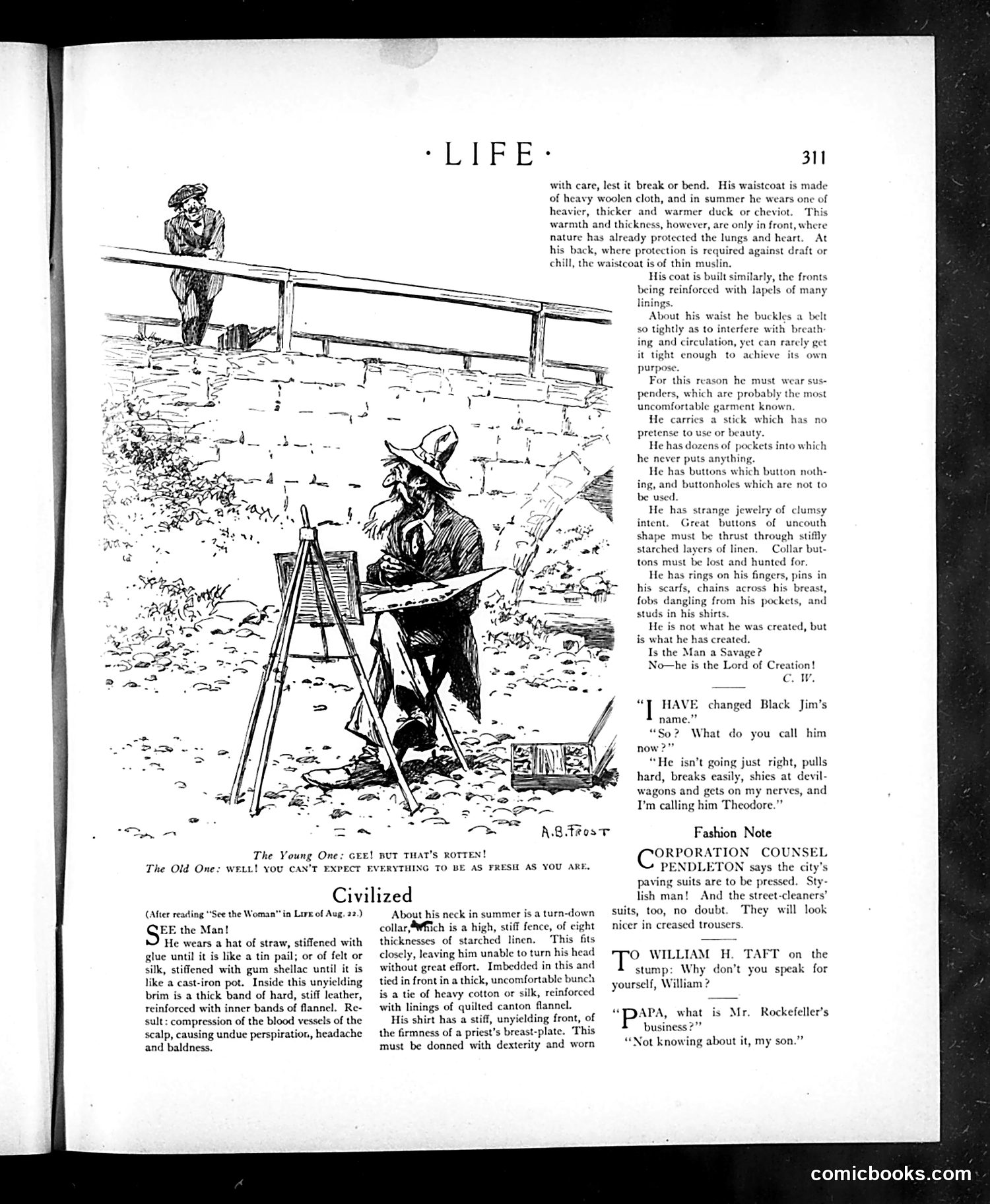
This page contains two distinct satirical pieces: **"Civilized"** (main illustration): A detailed critique of men's formal Victorian/Edwardian dress. The cartoon shows a man constrained by stiff collars, tight waistcoats, suspenders, and various uncomfortable garments. The accompanying text mocks how "civilization" has created impractical, painful clothing that restricts movement and breathing—the opposite of comfort. The satire contrasts natural human needs with absurd social conventions. **"The Young One" and "The Old One"** (dialogue): A brief joke about generational differences in expectations regarding food freshness. **"Fashion Note" section**: Brief witty social commentary about pressed suits, creased trousers, and street-cleaners' appearance—standard satirical observations on fashion pretension. The overall thrust: civilization's formal dress codes are instruments of discomfort masquerading as sophistication.
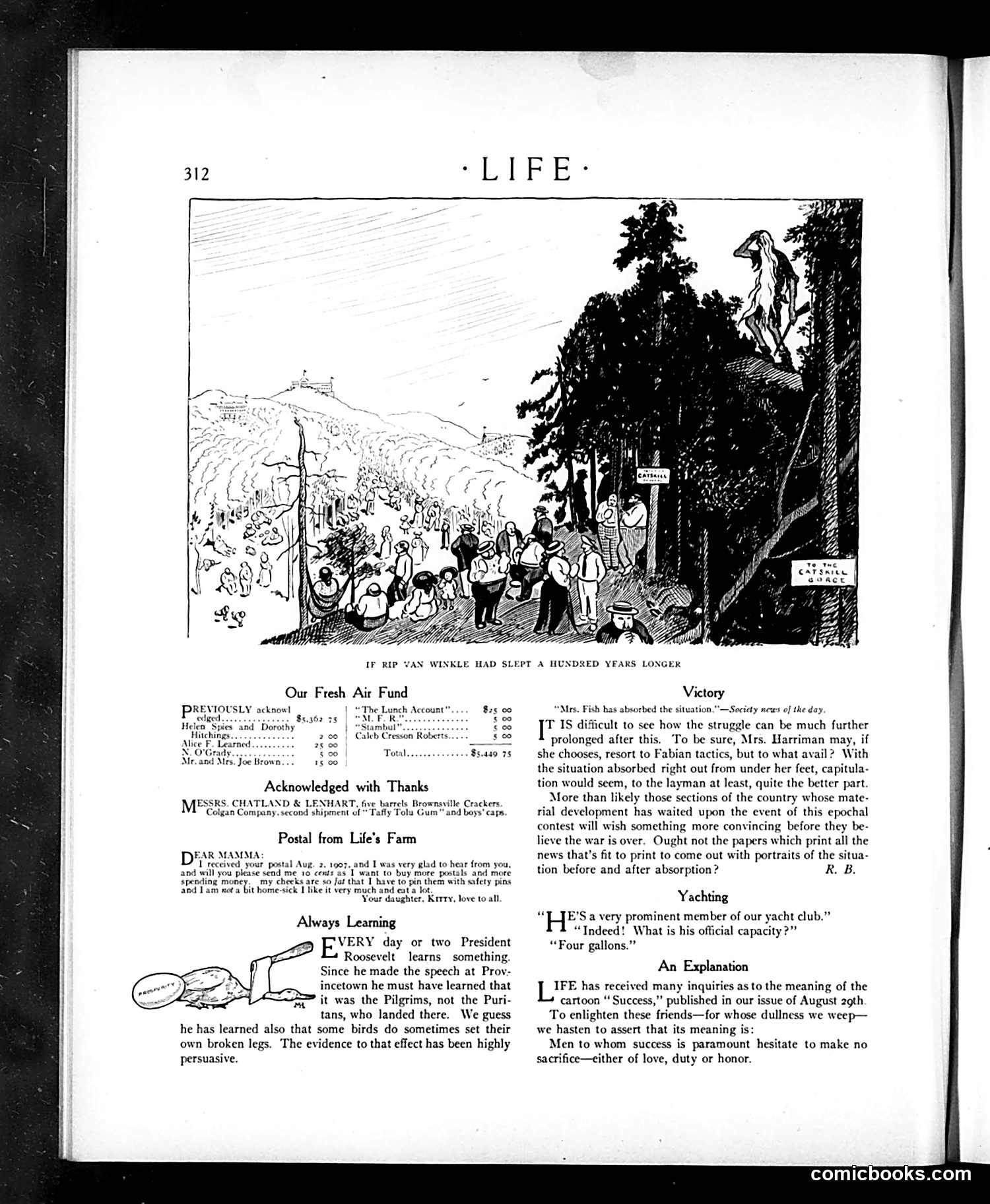
This page contains several short humor pieces and a prominent cartoon titled "If Rip Van Winkle Had Slept a Hundred Years Longer." The main cartoon depicts a massive crowd of modern people in what appears to be a developed landscape, contrasting with the solitary figure of Rip Van Winkle (the legendary character who slept for decades). The satire suggests that if Rip had slept even longer than his famous 100 years, he would awake to find the world dramatically more crowded and urbanized—a commentary on early 20th-century population growth and rapid development. The surrounding text includes reader letters, acknowledgments, and brief humor pieces about learning and yacht club membership. The overall message critiques how drastically civilization has transformed through increased population density and modernization.
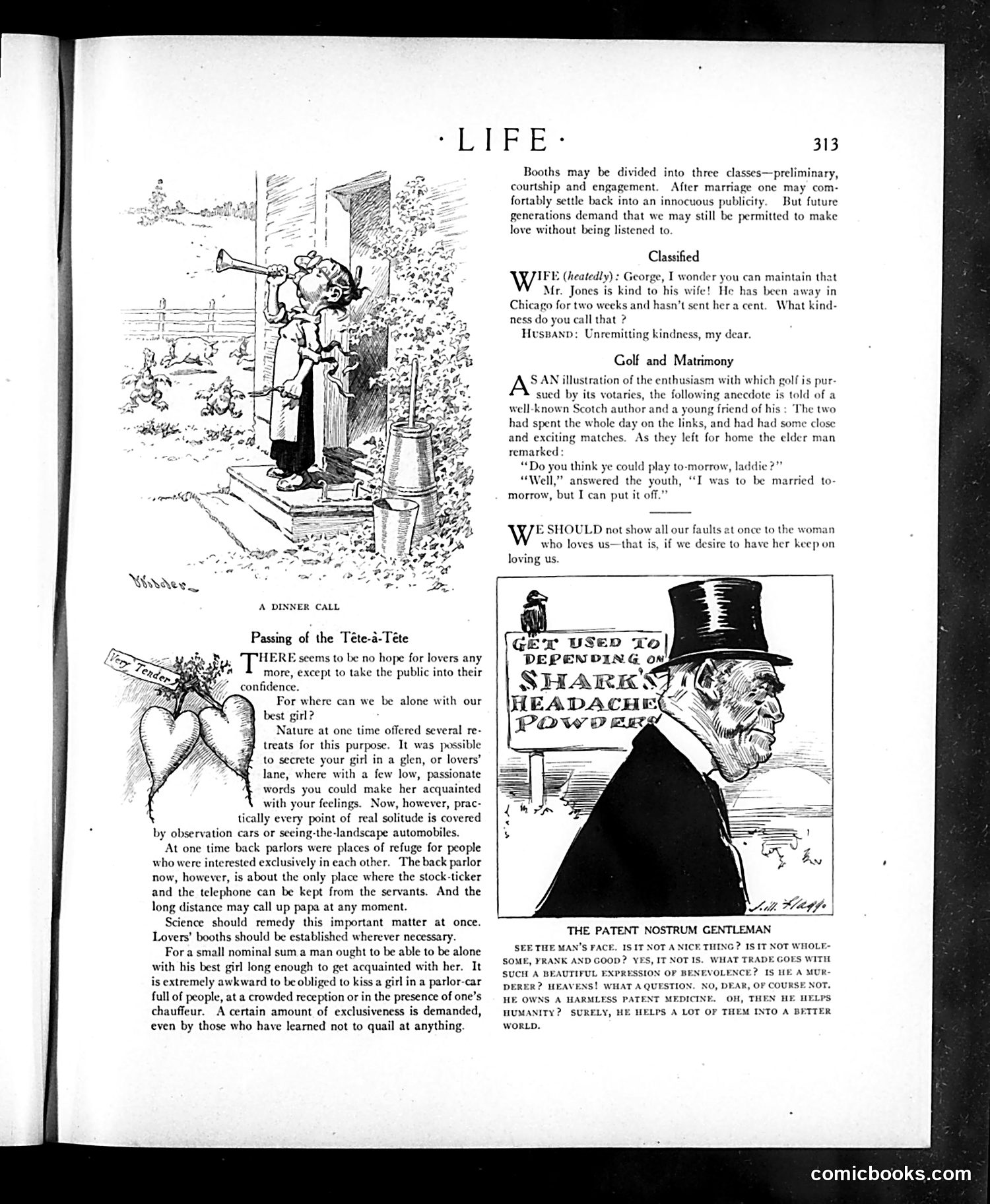
The page contains three satirical pieces about courtship and marriage: 1. **"A Dinner Call"** (top illustration): Shows a woman at a gate, likely depicting the challenge of private courting moments given early 20th-century social constraints. 2. **"Passing of the Tête-à-Tête"** (middle section): A text commentary lamenting that lovers can no longer find solitude. It critiques modern intrusions—automobiles, telephones, and public spaces—that have eliminated private moments. The piece sarcastically notes that back parlors once offered refuge but are now replaced by stock tickers and servant access. 3. **"The Patent Nostrum Gentleman"** (bottom advertisement parody): A caricatured figure hawking "Shark's Headache Powder." The caption mockingly questions whether this dubious patent medicine reflects benevolence or mercenary exploitation. Overall, the page satirizes changing social norms and commercialism's invasion of private life.
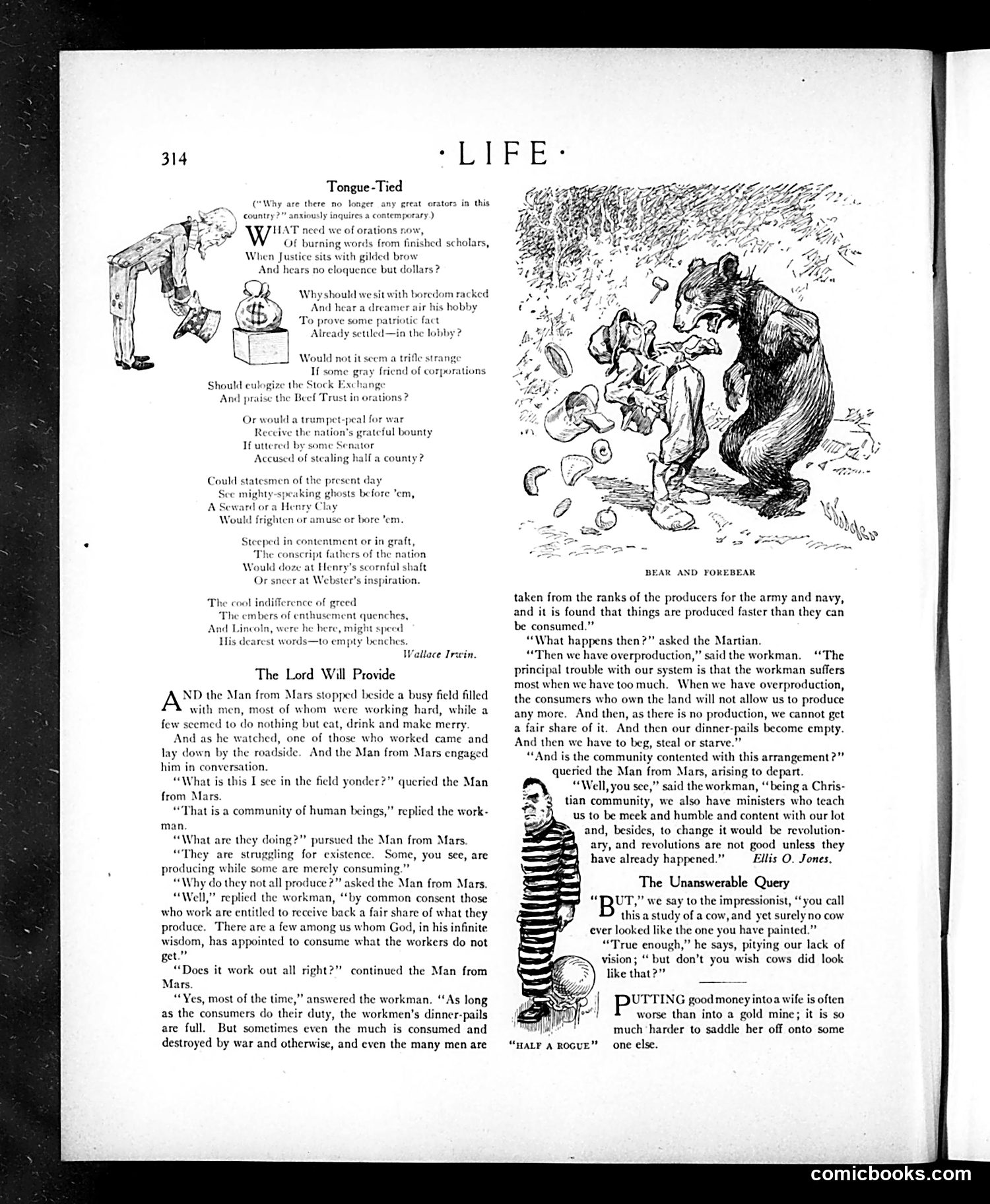
This page contains several satirical pieces critiquing early 20th-century American society: **"Tongue-Tied"** (left): A poem questioning why great orators have disappeared, sarcastically asking if we should praise corporations and "the best Trust in orations." It mocks the loss of meaningful public discourse, replaced by corporate and financial interests. **"The Lord Will Provide"** (center): A dialogue between a Man from Mars and a workwoman discussing production and consumption. The satire exposes the contradiction in the economic system: workers produce goods they cannot afford to buy, leading to empty dinner pails and poverty amid plenty. **Right illustrations**: "Bear and Forebear" and "Half a Rogue" appear to be separate humorous sketches with captions critiquing social behaviors regarding money and marriage. The overall theme attacks economic inequality and systemic injustice of the era.
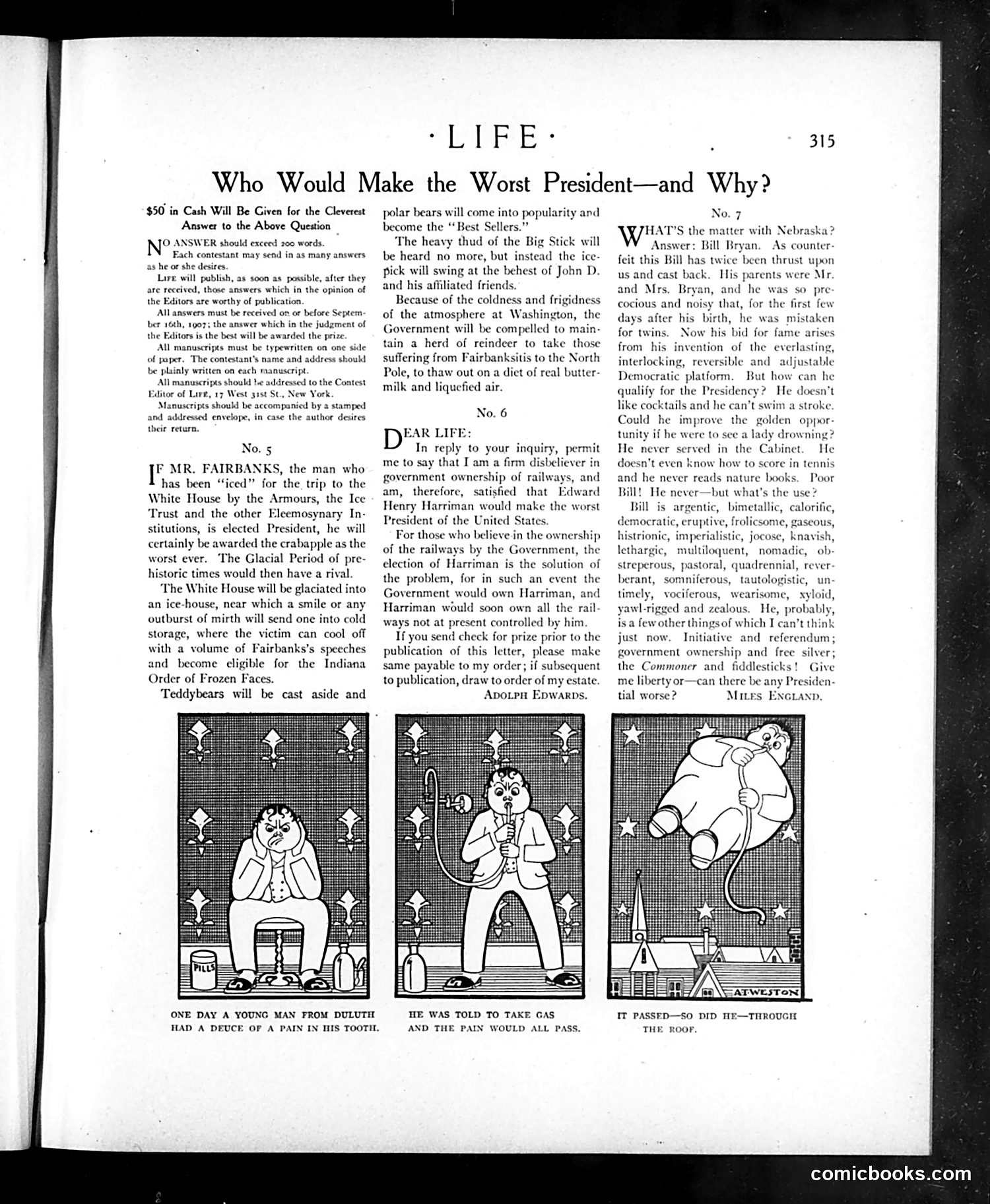
This 1912 *Life* magazine page features reader submissions debating presidential candidates. The three-panel cartoon (bottom) depicts a humorous medical scenario: a young man from Duluth with tooth pain, told gas anesthesia will help, experiences the gas passing "through the roof"—literally lifting him skyward. The cartoon is a visual pun mocking political hot air. The text responses debate Edward Henry Harriman (railroad magnate) and other candidates' fitness for presidency, with contributors like Adolph Edwards arguing over government ownership of railways. The cartoonist (signed "Atwood") satirizes both the absurd remedies offered to voters and the inflated rhetoric of political debate during the Progressive Era.
This page appears to be primarily a title page or section divider for *Life* magazine, featuring the word "LIFE" printed vertically on the left margin. The main content is a black-and-white photograph showing what appears to be figures in an interior setting, though the image quality and contrast make specific details difficult to discern clearly. Without clearer text or visual context identifying specific political figures, events, or satirical targets, I cannot reliably explain what particular commentary this image was intended to convey to contemporary readers. The photograph's subject matter and any satirical intent remain unclear from this reproduction alone.
This appears to be a political cartoon from Life magazine's satirical tradition. The image shows a figure in dark clothing reaching out or gesturing in what appears to be a dark, confined space—possibly a mine, cave, or similar industrial setting. The title "THE HELPING HAND" suggests irony about assistance or intervention. Without clearer visibility of specific details, caricatures, or accompanying article text, I cannot definitively identify which political figure or historical event this references. The composition suggests commentary on labor conditions, industrial safety, or possibly political intervention of some kind, but the specific satirical target remains unclear from this image alone. The darkness of the photograph makes precise identification difficult.
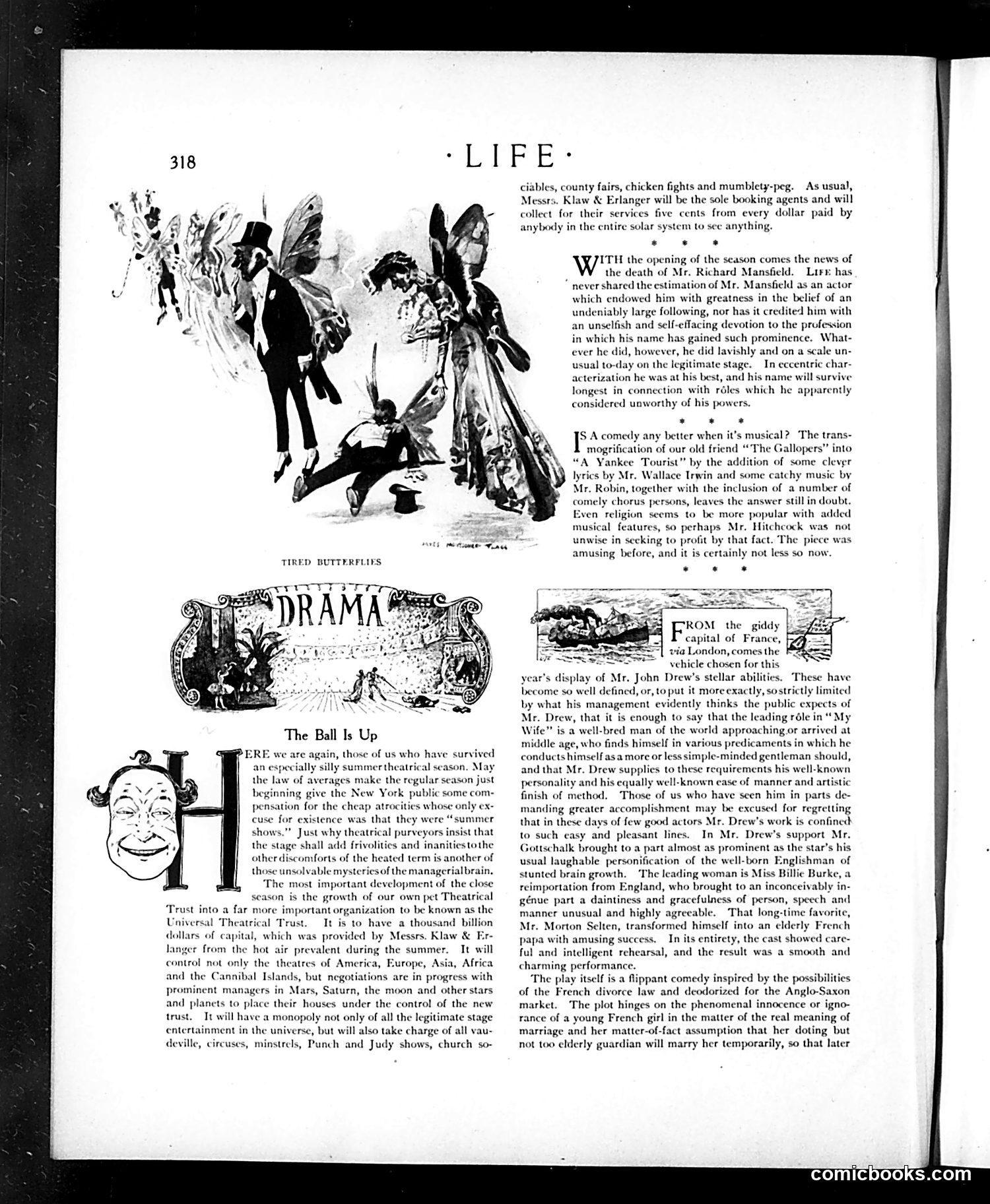
This page satirizes the theatrical monopoly of **Klaw & Erlanger**, prominent theater managers of the era. The main article, "The Ball Is Up," mocks their creation of the "Universal Theatrical Trust"—a consolidation of theatrical control that Life sarcastically claims will extend to "Mars, Saturn, the moon and other stars," controlling everything from legitimate theater to church socials and chicken fights. The joke is that Klaw & Erlanger will extract "five cents from every dollar paid" as booking agents—essentially profiteering from total market dominance. The cartoon titled "Tired Butterflies" (top left) likely illustrates this theatrical machinery crushing performers during the "especially silly summer theatrical season." The page also reviews new productions: Richard Mansfield's death, a musical adaptation of "The Gallopers" as "A Yankee Tourist," and John Drew's vehicle "My Wife." These reviews are secondary to the satirical main target: **theatrical trust monopolization and corporate greed** during a period of actual trust-building in American industry.
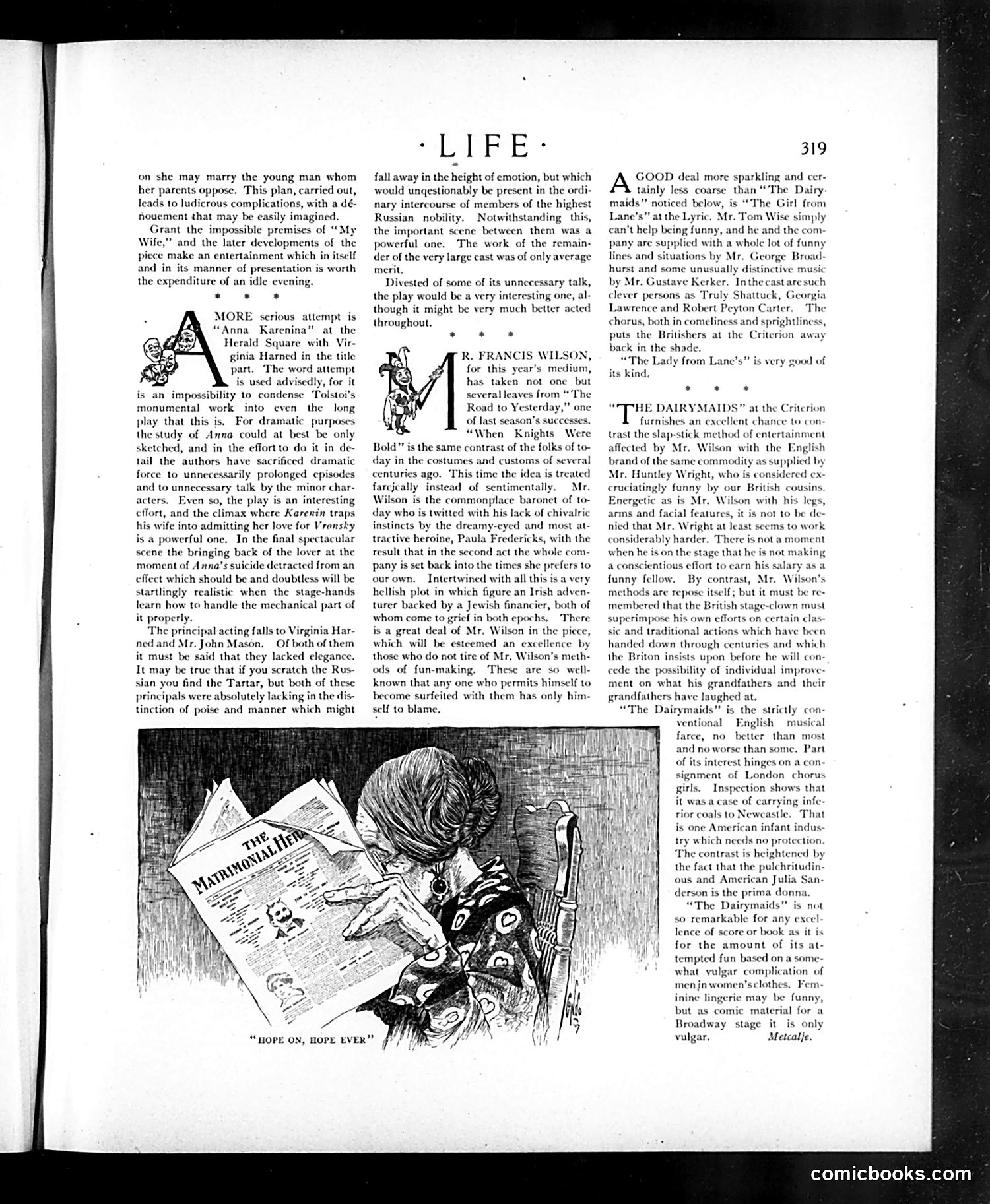
This page contains theater reviews from Life magazine's "Drama" section. The illustration shows a figure reading a newspaper called "The Matrimonialite," captioned "Hope on, Hope Ever" — a satirical comment on romantic optimism in theatrical narratives. The reviews discuss three Broadway productions: "My Wife" (a comedic plot about parental opposition to romance), "Anna Karenina" (Tolstoi's novel adapted with Virginia Harned), and "When Knights Were Bold" (a farce by Francis Wilson involving time-travel and class contrast). The critic praises Wilson's comedic talents but critiques the acting in "Anna Karenina" for lacking the refinement expected of Russian nobility characters. The reviews reflect early 20th-century theatrical standards, emphasizing whether productions properly matched their dramatic material and whether performers embodied appropriate social grace.
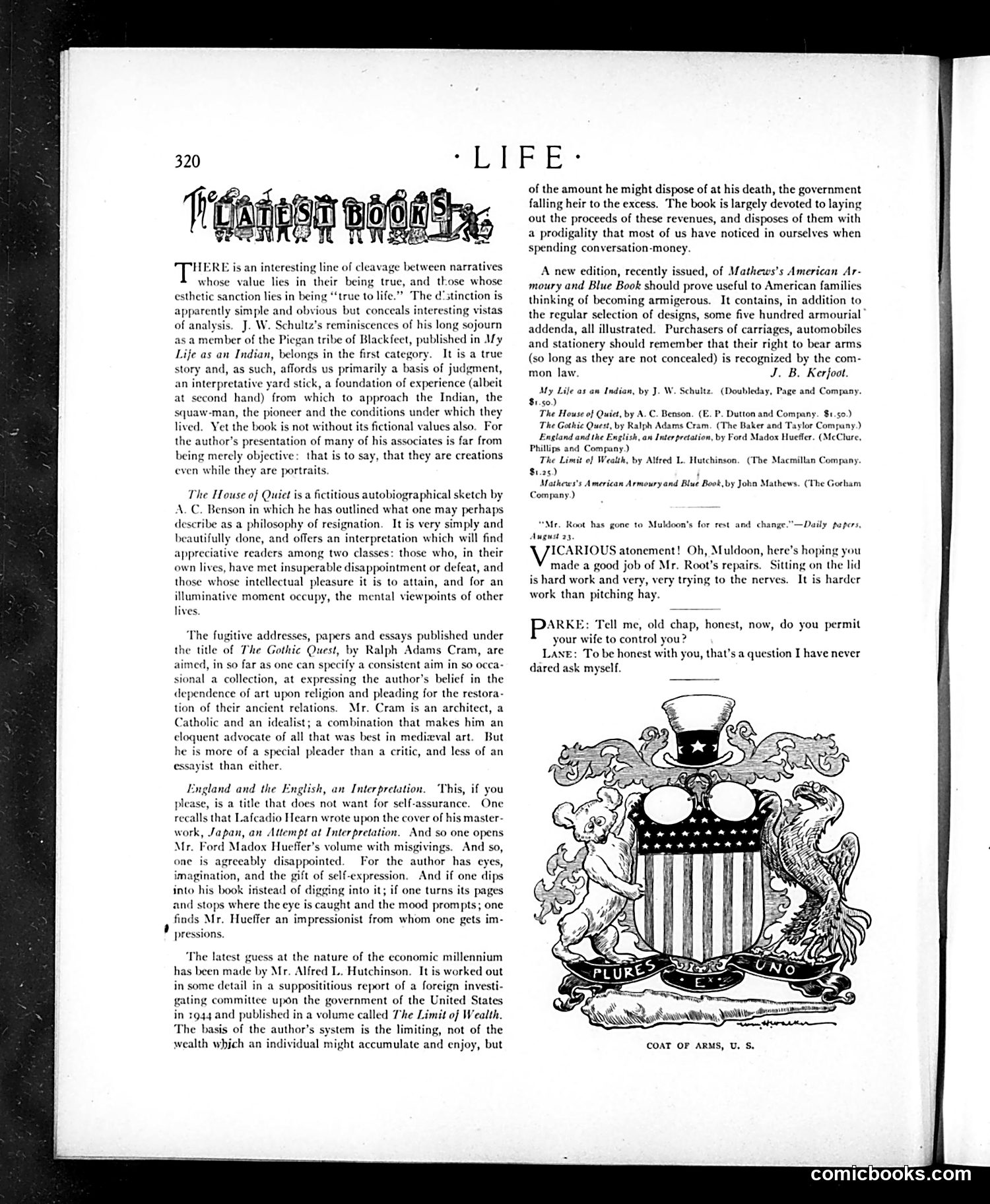
This page contains literary reviews and a heraldic illustration. The **coat of arms shown** is the official **Seal of the United States** — identifiable by its eagle, shield with vertical stripes, and the motto "E PLURIBUS UNUM" (Out of Many, One). The reviews discuss books on diverse topics: Native American memoir, philosophy of resignation, medieval architecture advocacy, and notably, a speculative 1944 futuristic work proposing wealth redistribution at death. The final review mentions *Mathews's American Armoury and Blue Book*, a guide to heraldic designs for American families. The U.S. seal's placement alongside a review about American family heraldry and wealth limitation appears intentionally paired — likely satirizing Americans' aspirations toward aristocratic status symbols while the nation's founding principles emphasize equality ("e pluribus unum"). The juxtaposition gently mocks the pretension of acquiring coat-of-arms in a nominally classless society.
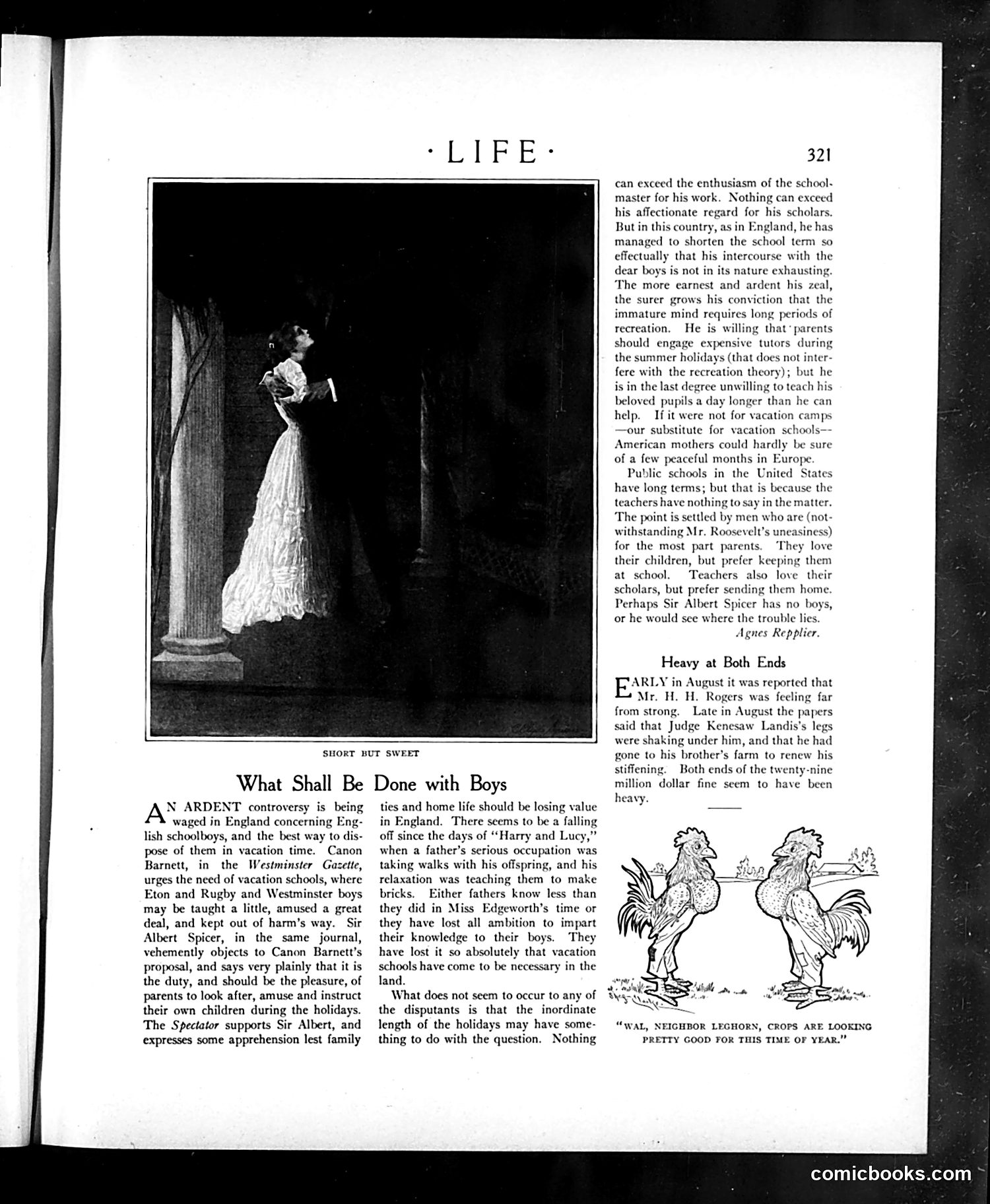
This page contains two distinct pieces of social commentary: **"What Shall Be Done with Boys"** debates English education policy. Canon Barnett advocates vacation schools to occupy schoolboys during long holidays; Sir Albert Spicer argues parents should personally educate and entertain their children at home. The author (Agnes Repplier) satirizes both sides, suggesting the real problem—rarely mentioned—is that schools have shortened terms so drastically that long vacations become necessary. She further mocks the hypocrisy: schoolmasters won't teach extra days (claiming children need recreation), yet parents prefer keeping children in school rather than managing them at home. **"Heavy at Both Ends"** reports on two contemporary figures experiencing difficulties: H. H. Rogers (appears to be a businessman) felt unwell in August; Judge Kenesaw Landis's legs were "shaking"—he recovered at his brother's farm. The author suggests both the wealthy businessman and the judge suffered from a "$29 million dollar fine," implying financial or legal strain affected them heavily. The image shows a woman in an elegant dress, captioned "Short But Sweet"—possibly illustrating domestic leisure themes.
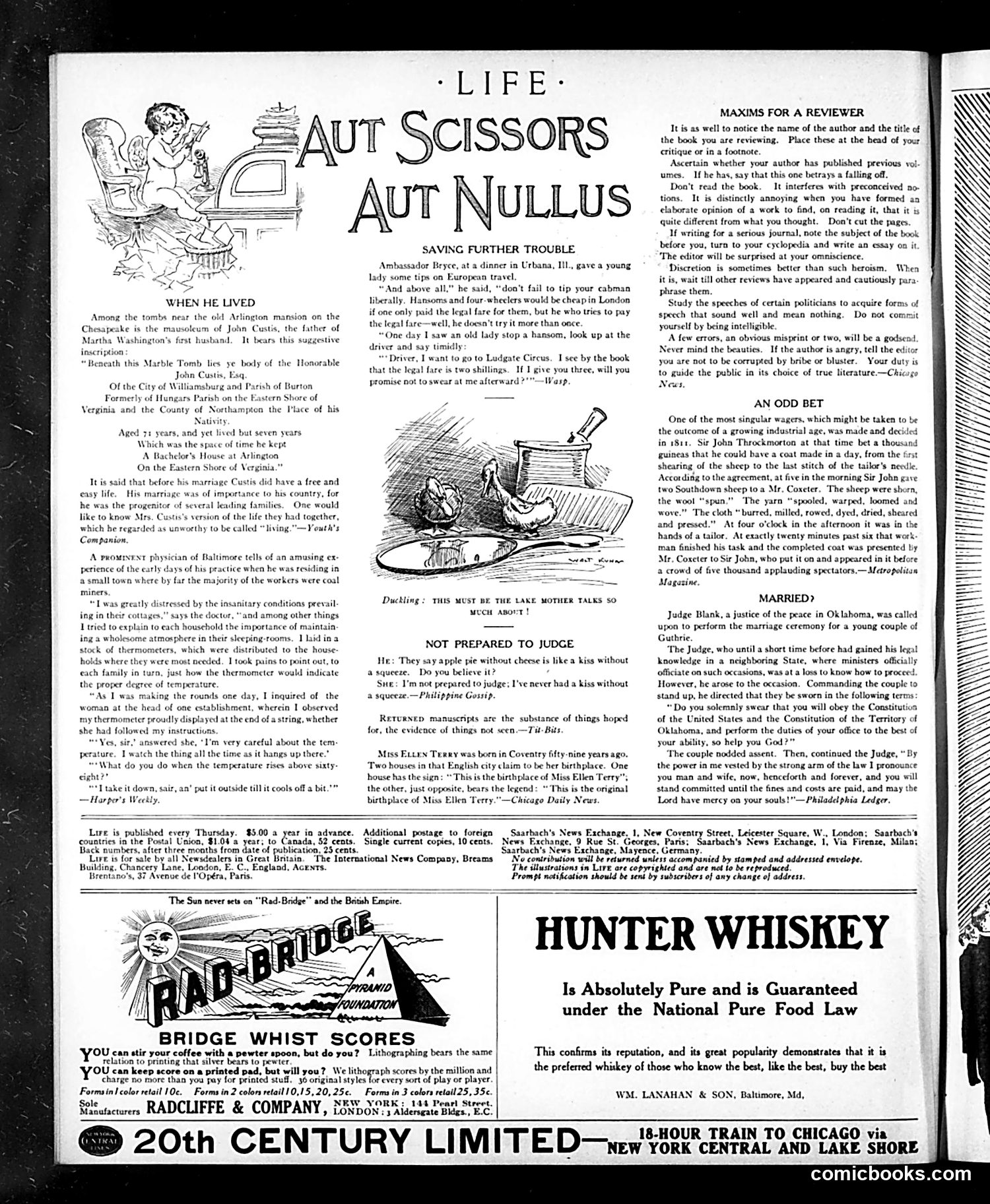
This page contains several brief humorous anecdotes rather than political cartoons. The main pieces mock social pretension and obliviousness: **"Aut Scissors Aut Nullus"** satirizes a wealthy colonial Virginia gentleman (John Custis) who considered his married life so miserable he claimed to have "lived but seven years" despite reaching 71. The irony: he regarded marriage as beneath dignified living. **The thermometer story** ridicules rural miners' wives who misunderstand scientific advice—literally removing the thermometer when it registers too high, defeating its purpose entirely. This reflects period class attitudes toward working-class education. **Ambassador Bryce's tipping anecdote** comments on American/European travel expectations and the necessity of over-paying service workers beyond legal fares. **The "apple pie without cheese" joke** plays on romantic double-entendre. The page functions as light social comedy targeting various foolishness: aristocratic unhappiness, working-class ignorance, and travel complications. The satire assumes educated, affluent readers.
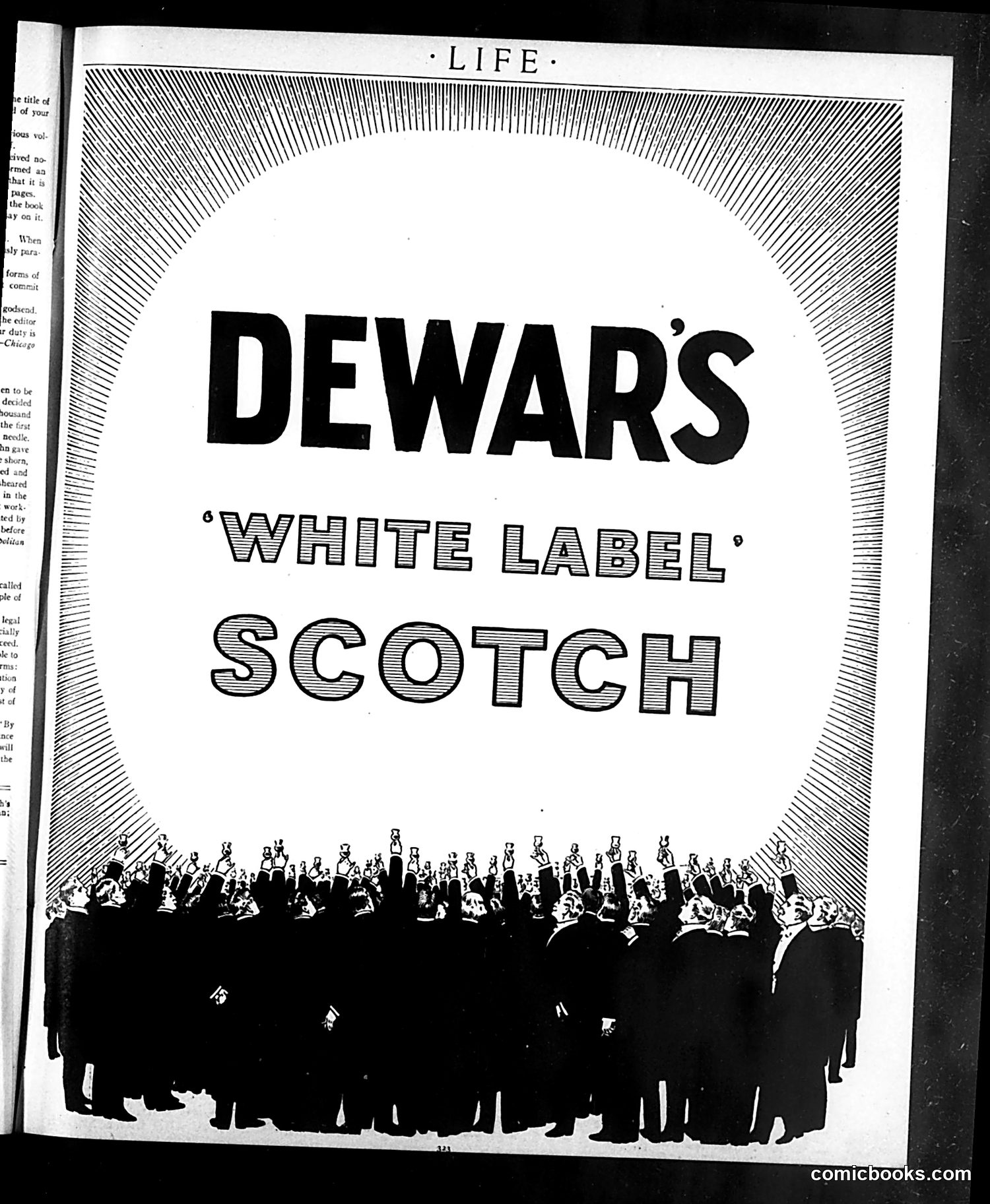
This appears to be a **LIFE magazine advertisement or satirical commentary** on Dewar's White Label Scotch whisky. The image shows a large crowd of silhouetted figures raising bottles in celebration beneath a glowing orb, suggesting widespread consumption or endorsement of the product. The satire likely targets **mass consumer culture and advertising excess** of the era—depicting Dewar's as so popular it commands cultish devotion from crowds. The grandiose visual treatment (the radiating lines, the masses) parodies how advertising inflates products' importance. Without clearer OCR text or visible date/context, I cannot specify whether this references a particular historical moment, but the style suggests **early-to-mid 20th century satire** on commercial persuasion and conformist consumption patterns.
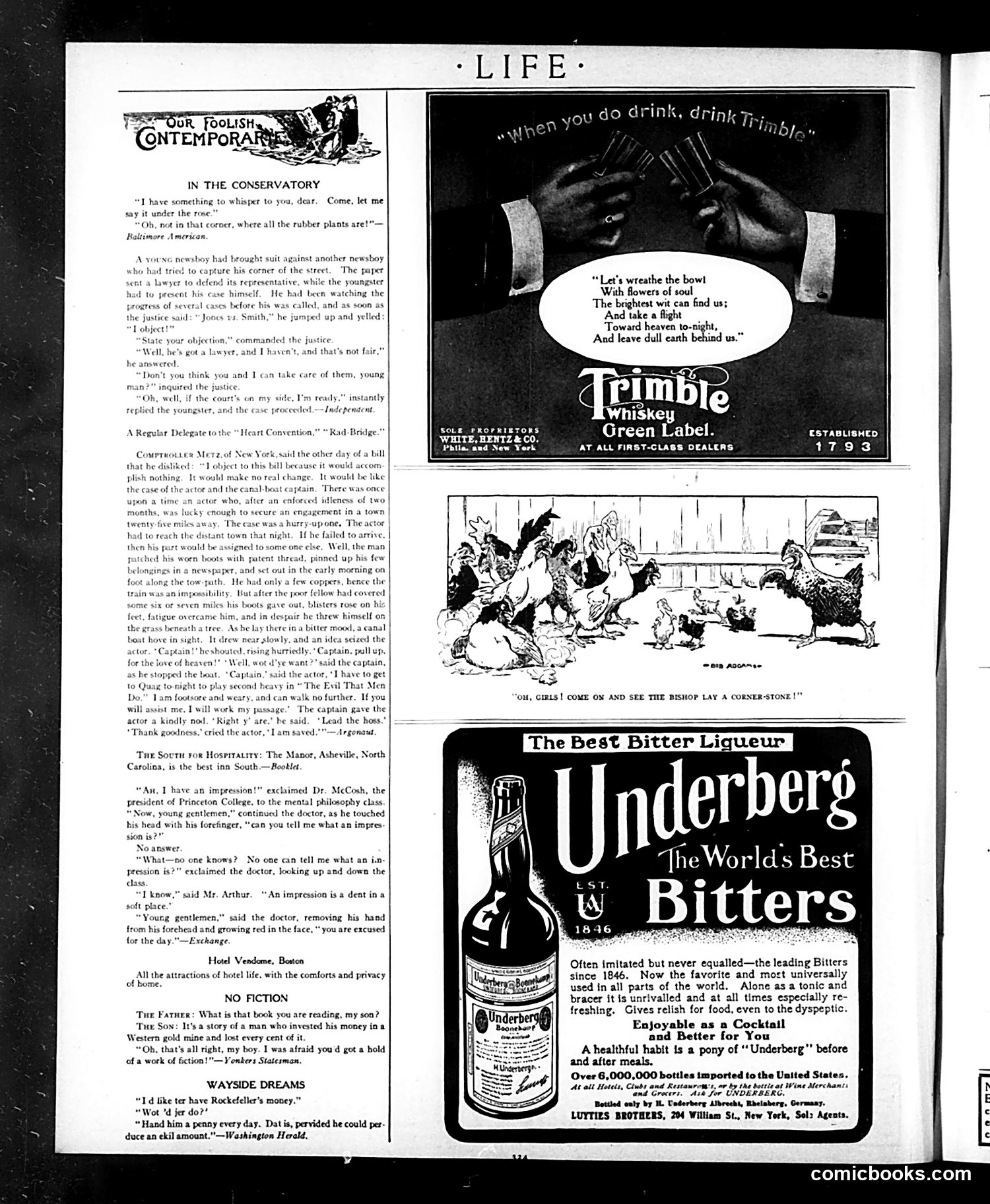
This page contains several brief satirical pieces typical of Life's humor section, plus period advertisements. **"In the Conservatory"** plays on the phrase "say it under the rose" (speak confidentially). The joke: a man wants to whisper romantic secrets to a woman, but she refuses because rubber plants in that corner might overhear—absurdist humor treating plants as potential gossips. **"A Regular Delegate to the Heart Convention"** and other short pieces use courtroom and professional settings for comedic misunderstandings and wordplay about impressions, objections, and impressionism. The **cartoons** depict everyday social situations: one shows people gathered outdoors with the caption "Oh, Gus! Come on and see the bishop lay a corner-stone!"—likely poking fun at public religious ceremonies or the bishop's importance. **The advertisements**—Trimble Whiskey and Underberg Bitters—are period liquor ads using romantic/philosophical language to market alcoholic beverages as medicinal tonics, typical of early 1900s marketing before Prohibition and FDA regulations. The page reflects pre-WWI American humor: innocent puns, social observation, and casual alcohol promotion.
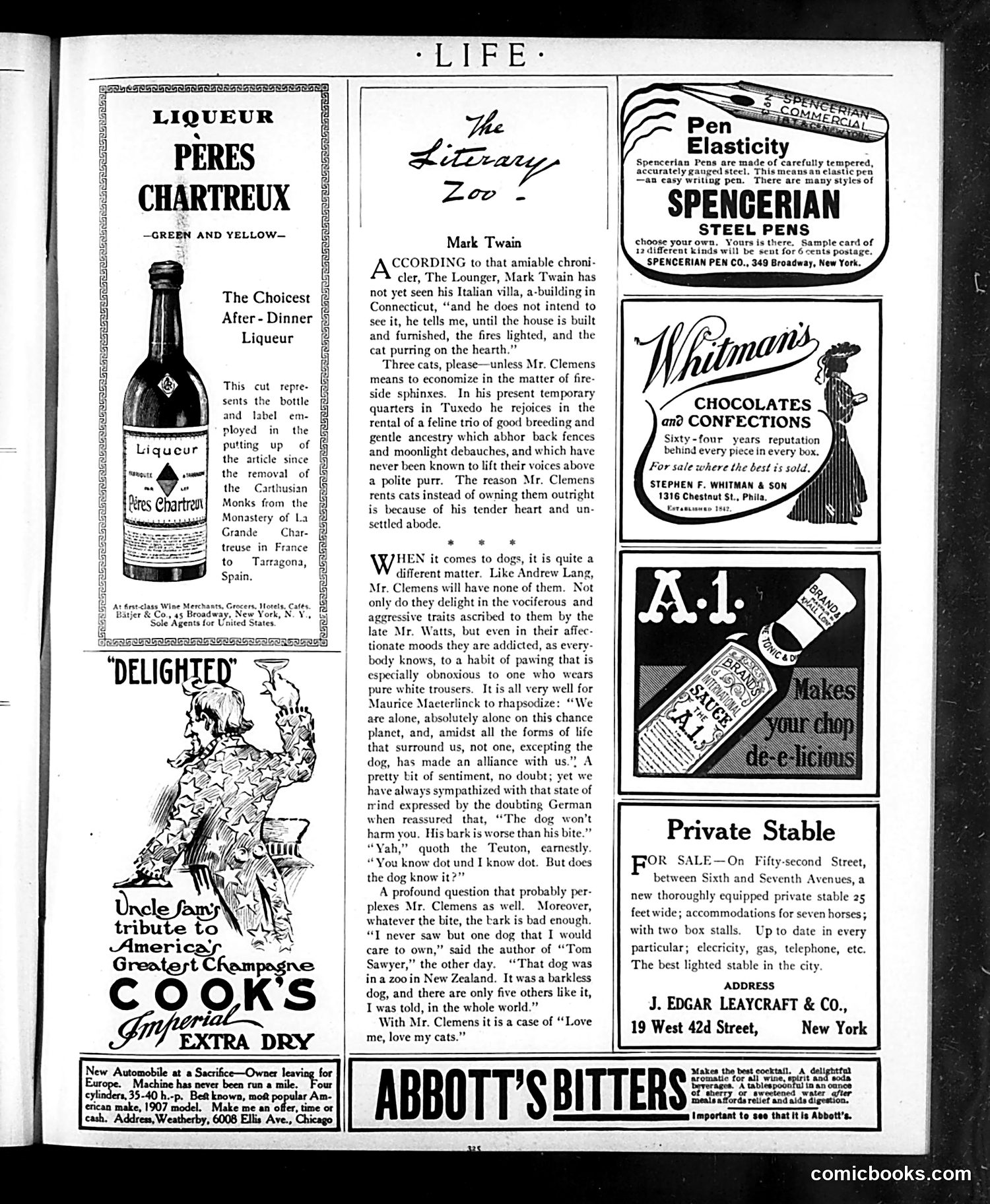
This page centers on a humorous essay about author Mark Twain's household pets—specifically his peculiar preference for cats over dogs. The satire depicts Twain living in temporary quarters in Tuxedo, New York, while his Connecticut villa is being constructed, and keeping a rented trio of well-bred cats that never disturb the peace. The essay contrasts this with his absolute refusal to own dogs, noting they paw furniture and bark. The author quotes various literary figures (Maurice Maeterlinck and others) before reaching the humorous conclusion that for Twain, it's simply "Love me, love my cats." The cartoon illustrates Twain's refined sensibilities—he demands civilized companions, not the noisy, enthusiastic dogs that most people keep. This likely reflected actual attitudes among the era's intellectual elite. The page is primarily advertisements (liqueur, chocolate, pens, stables) surrounding this central essay.
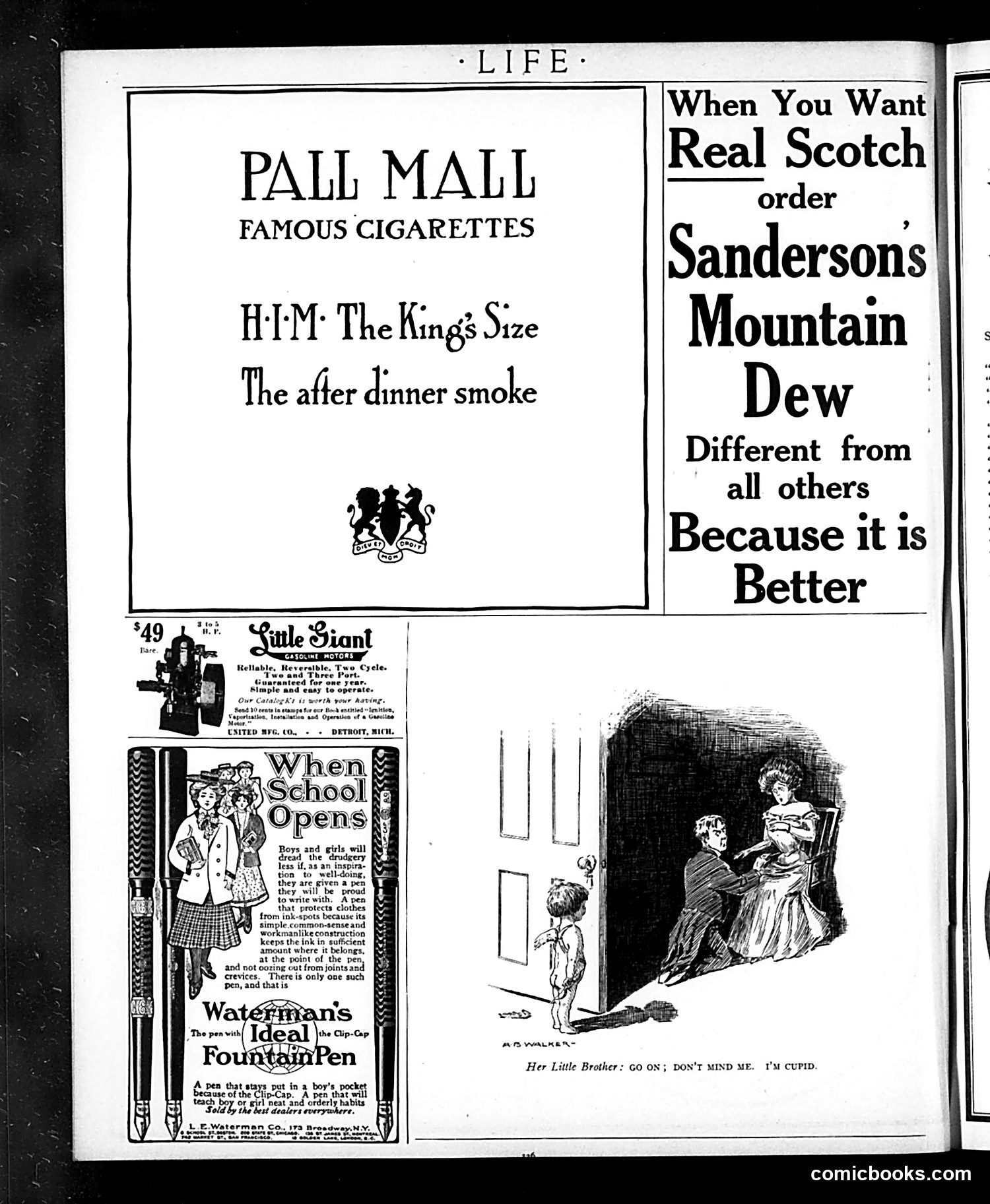
This page is primarily **advertising**, not political satire. It contains three ads: 1. **Pall Mall cigarettes** - promoting their "King's Size" as an "after dinner smoke" 2. **Sanderson's Mountain Dew whisky** - emphasizing Scottish authenticity and superiority 3. **Waterman's Ideal Fountain Pen** - targeted at schoolchildren, highlighting the pen's reliability for school use The only cartoon element is a small illustration accompanying the fountain pen ad, showing children at a doorway with the caption "Her Little Brother: GO ON; DON'T MIND ME. I'M CUPID" - a mild domestic humor joke about a younger sibling interrupting an older girl's romantic moment. The page reflects early 20th-century advertising norms and consumer goods marketing to middle-class Americans.
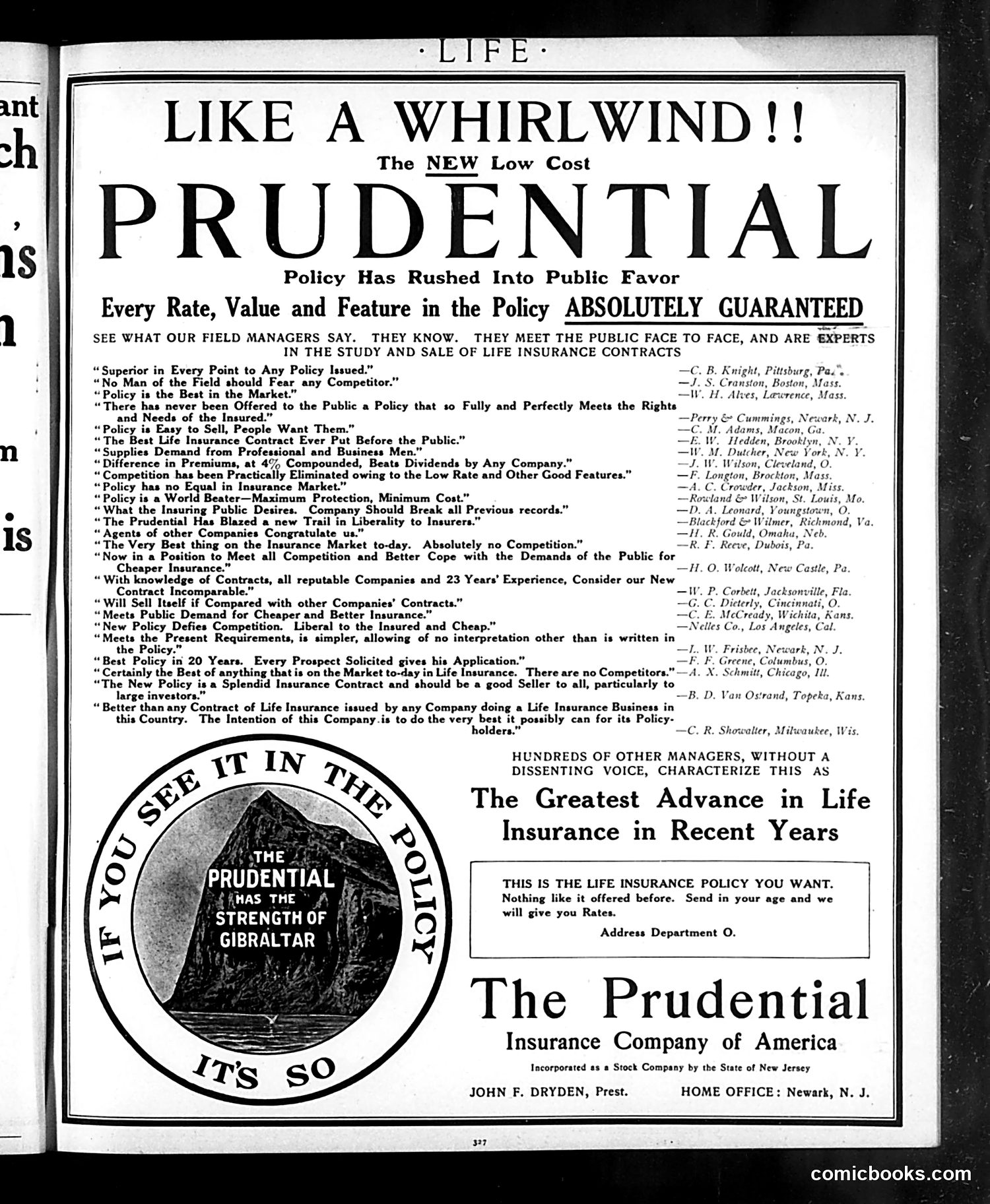
This is a full-page advertisement for Prudential Insurance's new low-cost life insurance policy, not satire or political commentary. The page presents testimonials from field managers praising the policy's competitiveness, affordability, and market appeal. The circular logo featuring Gibraltar appears to emphasize stability and strength—Gibraltar being historically synonymous with unshakeable fortitude. The repeated claims of "no competition" and "absolutely no competitors" constitute the page's notable hyperbole, though this reflects genuine marketing language of the era rather than satire. The overwhelming density of positive quotes (presented as objective expert testimony) is the advertisement's rhetorical strategy: drowning readers in consensus to establish the policy's superiority. **For modern readers:** This represents early-20th-century life insurance marketing in *Life* magazine—a publication mixing satire with conventional advertising. The grandiose tone and absolute claims typify insurance industry messaging of the period.
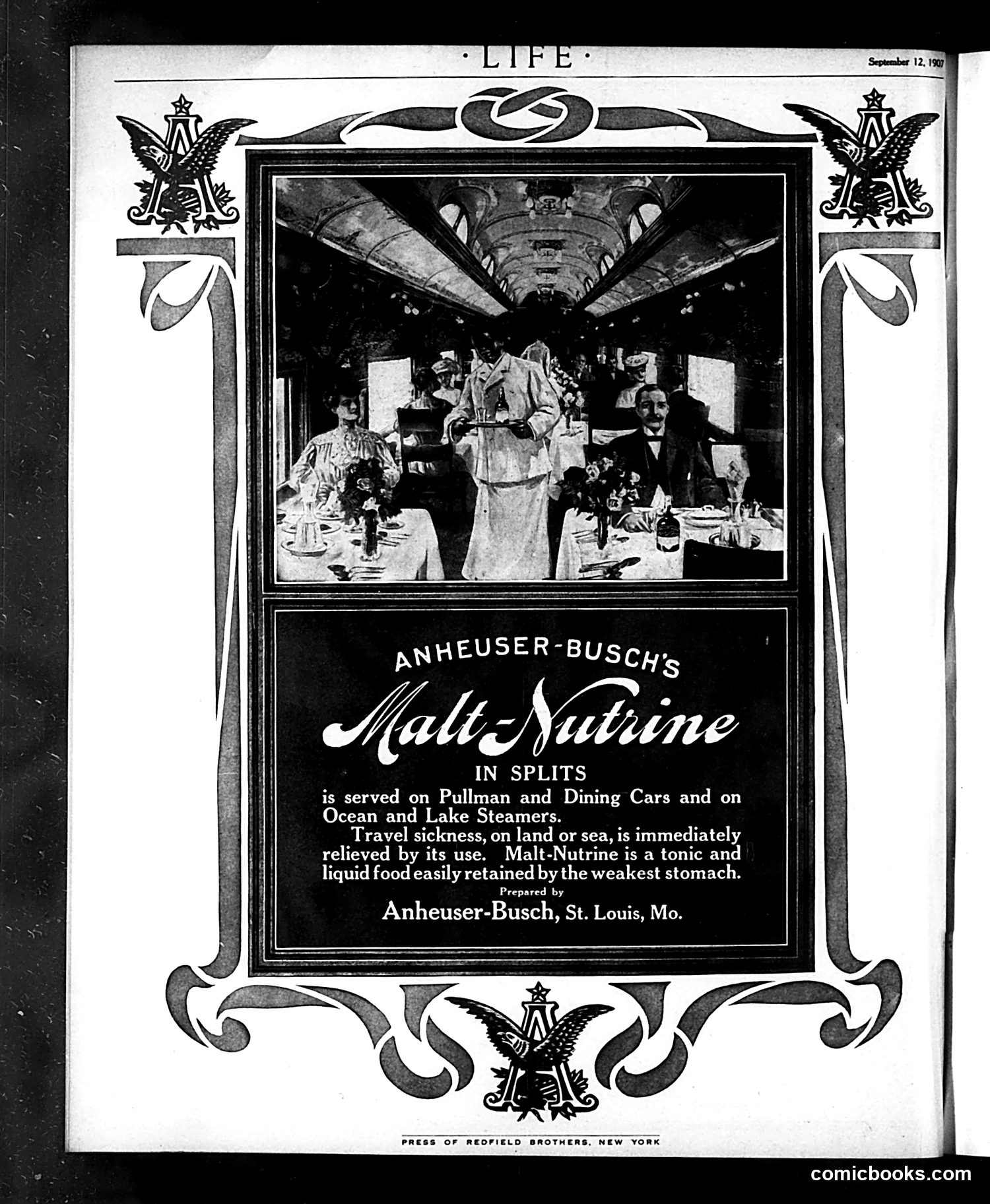
This is a **full-page advertisement**, not satirical content. It promotes Anheuser-Busch's "Malt-Nutrine" product from September 12, 1909. The ad uses an elegant photograph of well-dressed diners in what appears to be a luxury train or ship dining car to market the beverage as a remedy for travel sickness. The claim that it "is immediately relieved by its use" and functions as "a tonic and liquid food easily retained by the weakest stomach" reflects early 20th-century patent medicine marketing—making quasi-medical health claims for what was essentially a malt beverage. The ornate art nouveau border and prestigious venue imagery (Pullman cars, steamers) positioned the product as upscale and respectable, despite alcohol being the likely active ingredient. This represents pre-FDA regulation advertising practices, when such therapeutic claims were unregulated and commonplace.