
Life, 1907-09-12 · page 6 of 24
Life — September 12, 1907 — page 6: what you’re looking at
What you’re looking at
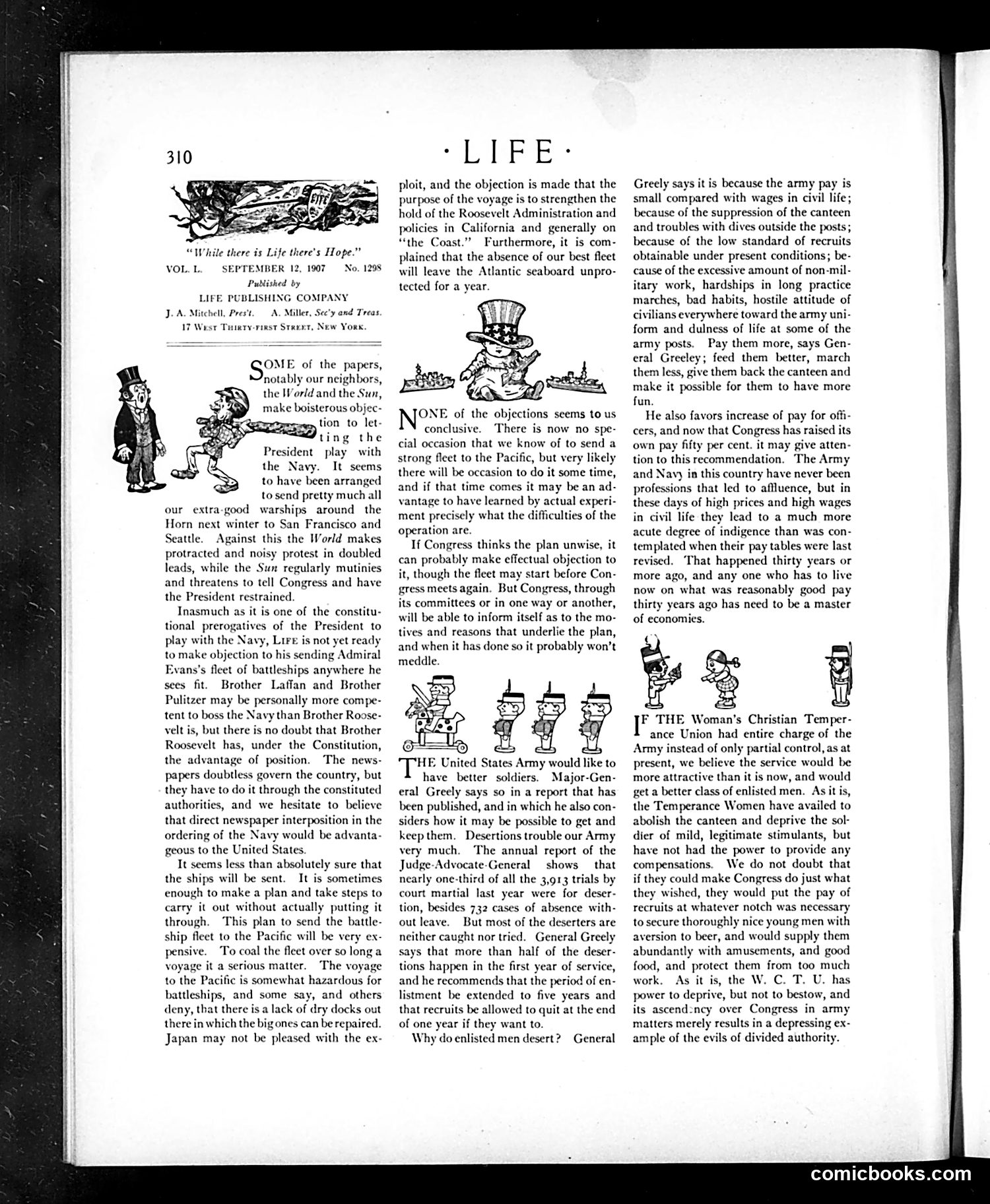
This page discusses military readiness and recruitment problems in the U.S. Army. The text debates whether sending warships to the Pacific is wise, with concerns about fleet maintenance and the constitutional limits of presidential power. The central issue concerns Army desertion rates—the text notes that nearly one-third of recruits deserted in the previous year. General Greely's report recommends extending enlistment periods to five years and allowing one-year quits. The small cartoon figures appear to illustrate soldiers or recruits, though they're too stylized to identify specific individuals. The satire critiques both military pay inadequacy (compared to civilian wages) and the W.C.T.U.'s (Women's Christian Temperance Union) influence over Army canteen management—the author argues this well-intentioned but ineffective control contributes to recruitment problems.
📄 Transcribed text from this page (OCR, searchable)
Machine-transcribed from the original scan — historical spelling and the odd misread are preserved.
“While there is Life there's Hope.” VOL.L. SEPTEMBER 12, 1907 Ni Published by LIFE PUBLISHING COMPANY J.A. Mitchell, Pres't, A. Miller, Sec'y and Treas. 17 West Tuuery-rinst Stanet, New Yous. OME of the papers, notably our neighbors, the World and the Sun, make boisterous objec- tion to let- ting the President play with the Navy. It seems to have been arranged to send pretty much all our extra-good warships around the Horn next winter to San Francisco and eattle. Against this the World makes protracted and noisy protest in doubled leads, while the Sun regularly mutinies and threatens to tell Congress and have the President restrained. Inasmuch as it is one of the constitu- tional prerogatives of the President to play with the Navy, Lire is not yet ready to make objection to his sending Admiral Evans's fleet of battleships anywhere he sees fit. Brother Laffan and Brother Pulitzer may be personally more compe- tent to boss the Navy than Brother Roose- velt is, but there is no doubt that Brother Roosevelt has, under the Constitution, the advantage of position. The news- papers doubtless govern the country, but they have to do it through the constituted authorities, and we hesitate to believe that direct newspaper interposition in the ordering of the Navy would be advanta- geous to the United States. It seems less than absolutely sure that the ships will be sent. It is sometimes enough to make a plan and take steps to carry it out without actually putting it through plan to send the battle- ship fleet to the Pacific will be very ex- pensive. To coal the fleet over so long a voyage it a serious matter. The voyage to the Pacific is somewhat hazardous for battleships, and some say, and others deny, that there is a lack of dry docks out there in which the big ones can be repaired. Japan may not be pleased with the ex- LIP - ploit, and the objection is made that the purpose of the voyage is to strengthen the hold of the Roosevelt Administration and policies in California and generally on “the Coast.” Furthermore, it is com- plained that the absence of our best fleet will leave the Atlantic seaboard unpro- tected for a year. ONE of the objections seems to us conclusive. There is now no spe- cial occasion that we know of to send a strong fleet to the Pacific, but very likely there will be occasion to do it some time, and if that time comes it may be an ad- vantage to have learned by actual experi- ment precisely what the difficulties of the operation are. If Congress thinks the plan unwise, it can probably make effectual objection to it, though the fleet may start before Con- gress meets again. But Congress, through its committees or in one way or another, will be able to inform itself as to the mo- tives and reasons that underlie the plan, and when it has done so it probably won’t T IE United States Army would like to have better soldiers. Major-Gen- eral Greely says so in a report that has been published, and in which he also con- iders how it may be possible to get and pthem. Desertions trouble our Army very much. The annual report of the Judge-Advocate-General shows _ that nearly one-third of all the 3,913 trials by court martial last year were for deser- tion, besides 732 cases of absence with- out leave. But most of the deserters are neither caught nor tried. General Greely says that more than half of the deser- tions happen in the first year of service, and he recommends that the period of en- listment be extended to five years and that recruits be allowed to quit at the end of one year if they want to. Why do enlisted men desert? General Greely says it is because the army pay is small compared with wages in civil life; because of the suppression of the canteen and troubles with dives outside the post because of the low standard of recruits obtainable under present conditions; be- cause of the excessive amount of non-mil- itary work, hardships in long practice marches, bad habits, hostile attitude of civilians everywhere toward the army uni- form and dulness of life at some of the army posts. Pay them more, says Gen- eral Greeley; feed them better, march them less, give them back the canteen and make it possible for them to have more fun. He also favors increase of pay for offi- cers, and now that Congress has raised its own pay fifty per cent. it may give atten- tion to this recommendation. The Army and Navy in this country have never been professions that led to affluence, but in these days of high prices and high wages in civil life they lead to a much more acute degree of indigence than was con- templated when their pay tables were last revised. That happened thirty years or more ago, and any one who has to live now on what was reasonably good pay thirty years ago has need to be a master of economies. F THE Woman's Christian Temper- ance Union had entire charge of the Army instead of only partial control, as at present, we believe the service would be more attractive than it is now, and would get a better class of enlisted men. it is, the Temperance Women have availed to abolish the canteen and deprive the sol- dier of mild, legitimate stimulants, but have not had the power to provide any compensations. We do not doubt that if they could make Congress do just what they wished, they would put the pay of recruits at whatever notch was necessary to secure thoroughly nice young men with aversion to beer, and would supply them abundantly with amusements, and good food, and protect them from too much work. As it is, the W. C. T. U. has power to deprive, but not to bestow, and its ascend2ncy over Congress in army matters merely results in a depressing ex- ample of the evils of divided authority. comicbooks.com