
Life, 1907-09-12 · page 17 of 24
Life — September 12, 1907 — page 17: what you’re looking at
What you’re looking at
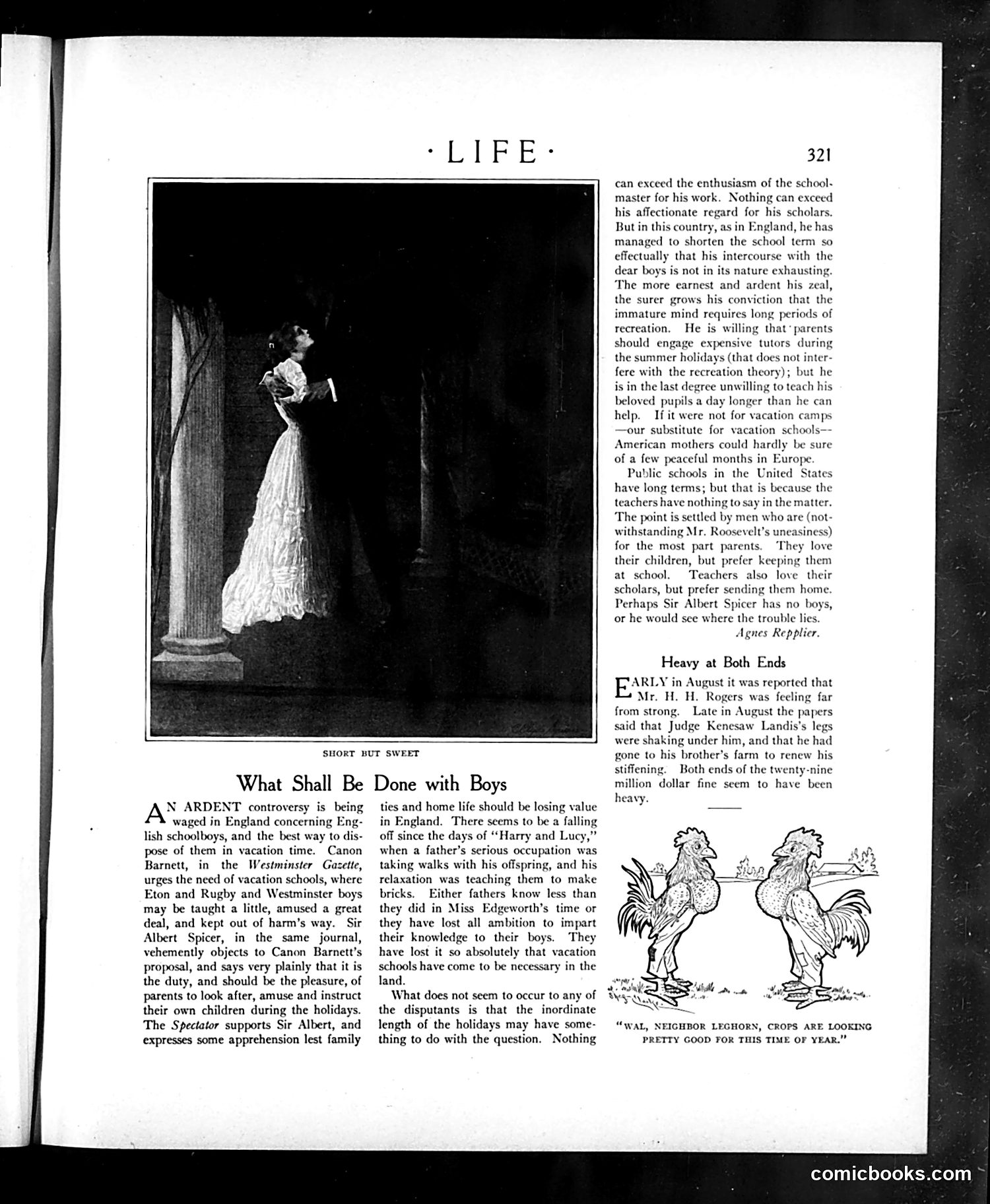
This page contains two distinct pieces of social commentary: **"What Shall Be Done with Boys"** debates English education policy. Canon Barnett advocates vacation schools to occupy schoolboys during long holidays; Sir Albert Spicer argues parents should personally educate and entertain their children at home. The author (Agnes Repplier) satirizes both sides, suggesting the real problem—rarely mentioned—is that schools have shortened terms so drastically that long vacations become necessary. She further mocks the hypocrisy: schoolmasters won't teach extra days (claiming children need recreation), yet parents prefer keeping children in school rather than managing them at home. **"Heavy at Both Ends"** reports on two contemporary figures experiencing difficulties: H. H. Rogers (appears to be a businessman) felt unwell in August; Judge Kenesaw Landis's legs were "shaking"—he recovered at his brother's farm. The author suggests both the wealthy businessman and the judge suffered from a "$29 million dollar fine," implying financial or legal strain affected them heavily. The image shows a woman in an elegant dress, captioned "Short But Sweet"—possibly illustrating domestic leisure themes.
📄 Transcribed text from this page (OCR, searchable)
Machine-transcribed from the original scan — historical spelling and the odd misread are preserved.
SHORT BUT SWEET What Shall Be Done with Boys N ARDENT controversy is being waged in England concerning Eng- lish schoolboys, and the best way to dis- pose of them in vacation time. Canon Barnett, in the Westminster Gazette, urges the need of vacation schools, where Eton and Rugby and Westminster boys may be taught a little, amused a great deal, and kept out of harm’s way. Sir Albert Spicer, in the same journal, vehemently objects to Canon Barnett’s proposal, and says very plainly that it is the duty, and should be the pleasure, of parents to look after, amuse and instruct their own children during the holidays. The Spectator supports Sir Albert, and expresses some apprehension lest family ties and home life should be losing value in England. There seems to be a falling off since the days of “Harry and Lucy,” when a father’s serious occupation was taking walks with his offspring, and his relaxation was teaching them to make bricks. Either fathers know less than they did in Miss Edgeworth’s time or they have lost all ambition to impart their knowledge to their boys. They have lost it so absolutely that vacation schools have come to be necessary in the land. What does not seem to occur to any of the disputants is that the inordinate length of the holidays may have some- thing to do with the question. Nothing 321 can exceed the enthusiasm of the school- master for his work. Nothing can exceed his affectionate regard for his scholar: But in this country, as in England, he h; managed to shorten the school term so effectually that his intercourse with the is not in its nature exhausting. The more earnest and ardent his zeal, the surer grows his conviction that the immature mind requires long periods of recreation. He is willing that’ parents should engage expensive tutors during the summer holidays (that does not inter- fere with the recreation theory); but he is in the last degree unwilling to teach his beloved pupils a day longer than he can help. If it were not for vacation camps —our substitute for vacation schools—- American mothers could hardly be sure of a few peaceful months in Europe. Public schools in the United States have long terms; but that is because the teachers have nothing to say in the matter. The point is settled by men who are (not- withstanding Mr. Roosevelt’s uneasiness) for the most part parents. ‘They love their children, but prefer keeping them at school. Teachers their scholars, but prefer sending them home. Perhaps Sir Albert Spicer has no boys, or he would see where the trouble lies. Agnes Repplier. also love Heavy at Both Ends RLY in August it was reported that Mr. H. H. Rogers was feeling far from strong. Late in August the papers said that Judge Kenesaw Landis’s legs were shaking under him, and that he had gone to his brother’s farm to renew his stiffening. Both ends of the twenty-nine million dollar fine m to have been heavy. EIGHBOR LEGHORN, CROPS ARE LOOKING PRETTY GOOD FOR THIS TIME OF YEAR.’ comicbooks.com ~