
Life, 1907-09-12 · page 16 of 24
Life — September 12, 1907 — page 16: what you’re looking at
What you’re looking at
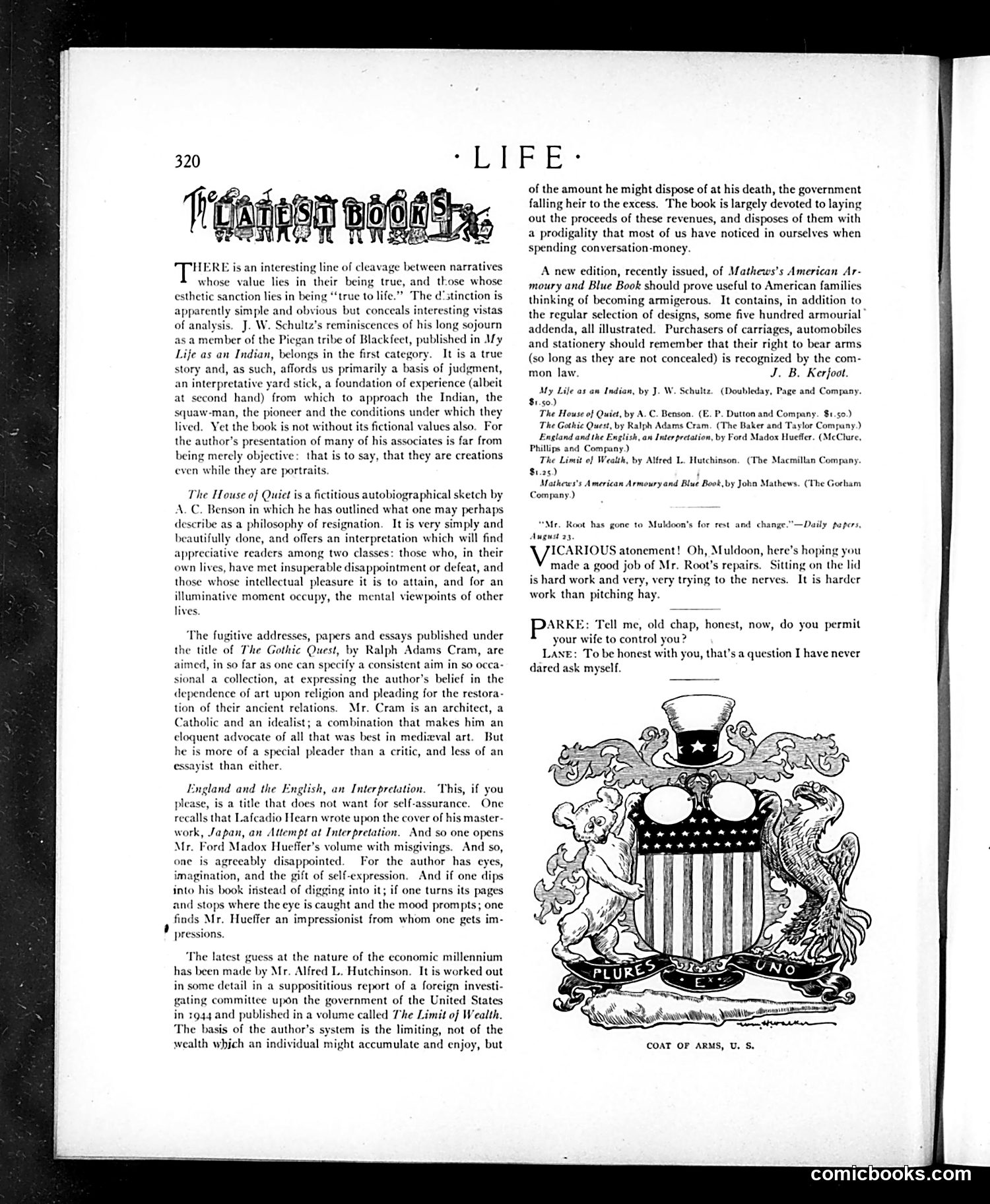
This page contains literary reviews and a heraldic illustration. The **coat of arms shown** is the official **Seal of the United States** — identifiable by its eagle, shield with vertical stripes, and the motto "E PLURIBUS UNUM" (Out of Many, One). The reviews discuss books on diverse topics: Native American memoir, philosophy of resignation, medieval architecture advocacy, and notably, a speculative 1944 futuristic work proposing wealth redistribution at death. The final review mentions *Mathews's American Armoury and Blue Book*, a guide to heraldic designs for American families. The U.S. seal's placement alongside a review about American family heraldry and wealth limitation appears intentionally paired — likely satirizing Americans' aspirations toward aristocratic status symbols while the nation's founding principles emphasize equality ("e pluribus unum"). The juxtaposition gently mocks the pretension of acquiring coat-of-arms in a nominally classless society.
📄 Transcribed text from this page (OCR, searchable)
Machine-transcribed from the original scan — historical spelling and the odd misread are preserved.
eo el HERE is an interesting line of cleavage between narratives whose value lies in their being true, and those whose esthetic sanction lies in being “‘true to life.” The d’stinction is apparently simple and obvious but conceals interesting vistas of analysis. J. W. Schultz's reminiscences of his long sojourn as a member of the Piegan tribe of Blackfeet, published in My Life as an Indian, belongs in the first category. It is a true story and, as such, affords us primarily a basis of judgment, an interpretative yard stick, a foundation of experience (albeit at second hand) from which to approach the Indian, the squaw-man, the pioneer and the conditions under which they lived. Yet the book is not without its fictional values also. For the author’s presentation of many of his associates is far from being merely objective: that is to say, that they are creations even while they are portraits. The House of Quiet is a fictitious autobiographical sketch by C. Benson in which he has outlined what one may perhaps describe as a philosophy of resignation. It is very simply and beautifully done, and offers an interpretation which will find appreciative readers among two classes: those who, in their own lives, have met insuperable disappointment or defeat, and those whose intellectual pleasure it is to attain, and for an illuminative moment occupy, the mental viewpoints of other lives. ‘The fugitive addresses, papers and essays published under the title of The Gothic Quest, by Ralph Adams Cram, are aimed, in so far as one can specify a consistent aim in so occa- sional a collection, at expressing the author’s belief in the dependence of art upon religion and pleading for the restora- tion of their ancient relations. Mr. Cram is an architect, a Catholic and an idealist; a combination that makes him an eloquent advocate of all that was best in mediceval art. But he is more of a special pleader than a critic, and less of an essayist than either. England and the English, an Interpretation. This, if you please, is a title that does not want for self-assurance. One recalls that Lafcadio Hearn wrote upon the cover of his master- work, Japan, an Attempt at Interpretation. And so one opens Mr. Ford Madox Hueffer’s volume with misgivings. And so, one is agreeably disappointed. For the author has eyes, imagination, and the gift of self-expression. And if one dips into his book iristead of digging into it; if one turns its pages and stops where the eye is caught and the mood prompts; one finds Mr. Hueffer an impressionist from whom one gets im- pressions. ‘The latest guess at the nature of the economic millennium has been made by Mr. Alfred L. Hutchinson. It is worked out in some detail in a supposititious report of a foreign inv gating committee upon the government of the United States in 1944 and published in a volume called The Limit of Wealth. The basis of the author’s system is the limiting, not of the wealth which an individual might accumulate and enjoy, but of the amount he might dispose of at his death, the government falling heir to the excess. The book is largely devoted to laying out the proceeds of these revenues, and disposes of them with a prodigality that most of us have noticed in ourselves when spending conversation-money. A new edition, recently issued, of Mathews’s American Ar- moury and Blue Book should prove useful to American families thinking of becoming armigerous. It contains, in addition to the regular selection of designs, some five hundred armourial addenda, all illustrated. Purchasers of carriages, automobiles and stationery should remember that their right to bear arms (so long as they are not concealed) is recognized by the com- mon law J. B. Kerjoot. My Lile as am Indian, by J. W. Schultz. (Doubleday, Page and Company $1.50.) The House of Quiet, by A. C. Benson. (E. P. Dutton and Company. $1.50.) The Gothic Quest, by Ralph Adams Cram. (The Baker and Taylor Company.) gland and the English, an Inter pretation, by Ford Madox Hueffer. (McClure, Phillips and Company.) The Limit of Wealth, by Alfred L. Hutchinson. (The Macmillan Company. 1.25.) ‘ : Mathews's American Armoury and Blue Book, by Joba Mathews. (The Gorham Company.) “Me. Root has gone to Muldoon's for rest a August 23. ICARIOUS atonement! Oh, Muldoon, here’s hoping y made a good job of Mr. Root’s repairs. Sitting on the lid is hard work and very, very trying to the nervy It is harder work than pitching hay. id change.” —Daily papers, ARKE: Tell me, old chap, honest, now, do you permit your wife to control you? Lane: To be honest with you, that’s a question I have never dared ask myself. COAT OF ARMS, U. S. comicbooks.com