
Life, 1907-09-12 · page 15 of 24
Life — September 12, 1907 — page 15: what you’re looking at
What you’re looking at
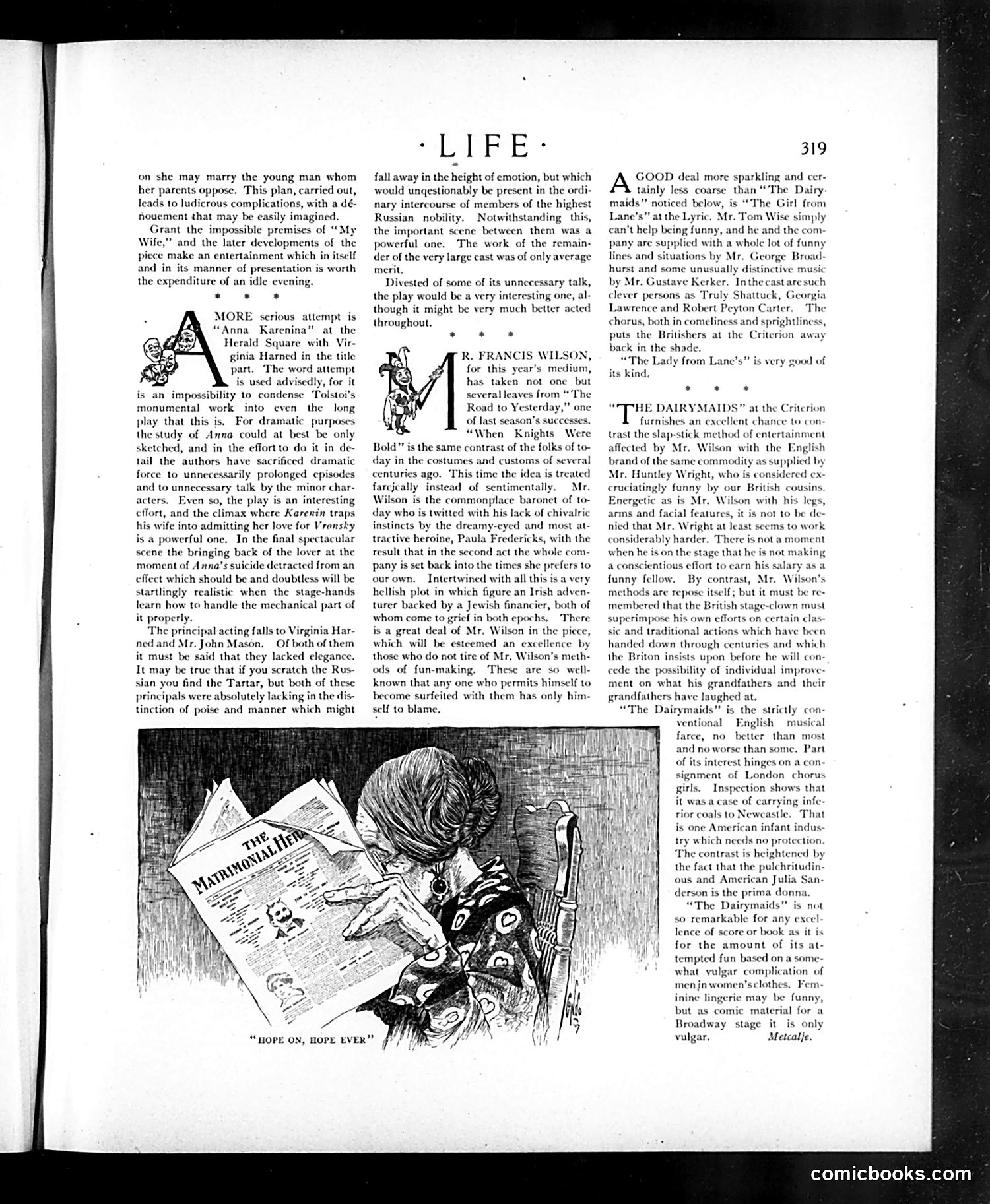
This page contains theater reviews from Life magazine's "Drama" section. The illustration shows a figure reading a newspaper called "The Matrimonialite," captioned "Hope on, Hope Ever" — a satirical comment on romantic optimism in theatrical narratives. The reviews discuss three Broadway productions: "My Wife" (a comedic plot about parental opposition to romance), "Anna Karenina" (Tolstoi's novel adapted with Virginia Harned), and "When Knights Were Bold" (a farce by Francis Wilson involving time-travel and class contrast). The critic praises Wilson's comedic talents but critiques the acting in "Anna Karenina" for lacking the refinement expected of Russian nobility characters. The reviews reflect early 20th-century theatrical standards, emphasizing whether productions properly matched their dramatic material and whether performers embodied appropriate social grace.
📄 Transcribed text from this page (OCR, searchable)
Machine-transcribed from the original scan — historical spelling and the odd misread are preserved.
on she may marry the young man whom her parents oppose. This plan, carried out, leads to ludicrous complications, with a dé houement that may be easily imagined. Grant the impossible premises of “My Wife,” and the later developments of the piece make an entertainment which in itself and in its manner of presentation is worth the expenditure of an idle evening. * * 8 MORE serious attempt is “Anna Karenina” at the Herald Square with Vir- ginia Harned in the title part. The word attempt is used advisedly, for it is an impossibility to condense ‘Tolstoi’s monumental work into even the long y that this is. For dramatic purposes study of Anna could at best be only sketched, and in the effort to do it in de- the authors have sacrificed dramatic force to unnecessarily prolonged episodes and to unnecessary talk by the minor char- acters. Even so, the play is an interesting effort, and the climax where Karenin traps his wife into admitting her love for Vronsky is a powerful one, In the final spectacular scene the bringing back of the lover at the moment of Azna’s suicide detracted from an effect which should be and doubtless will be startlingly realistic when the stage-hands learn how to handle the mechanical part of it properly. ‘The principal acting falls to Virginia Har- ned and Mr. John Mason. Of both of them it must be said that they lacked elegance. It may be true that if you scratch the Rus- sian you find the Tartar, but both of these principals were absolutely lacking in the dis- tinction of poise and manner which might -LIFE- fall away in the height of emotion, but which would ungestionably be present in the ordi- nary intercourse of members of the highes Russian nobility. Notwithstanding this, the important scene between them was a powerful one. The work of the remain- der of the very large cast was of only average merit. Divested of some of its unnecessary talk, the play would be a very interesting one, al- though it might be very much better acted throughout. s 6 8 R. FRANCIS WILSON, for this year's medium, has taken not one but several leaves from “The Road to Yesterday,” one of last season’s successe “When Knights Were Bold” is the same contrast of the folks of to- day in the costumes and customs of several centuries ago. This time the idea is treated farcjcally instead of sentimentally. Mr. Wilson is the commonplace baronet of to- day who is twitted with his lack of chivalric instincts by the dreamy-eyed and most at- tractive heroine, Paula Fredericks, with the result that in the second act the whole com- pany is set back into the times she prefers to our own. Intertwined with all this is a v hellish plot in which figure an Irish adven- turer backed by a Jewish financier, both of whom come to grief in both epochs, There is a great deal of Mr. Wilson in the piece, which will be esteemed an excellence by those who do not tire of Mr. Wilson's meth- ods of fun-making. These are so well- known that any one who permits himself to become surfeited with them has only him- self to blame. 319 GOOD deal more sparkling and cer- tainly less coarse than “The Dairy maids” noticed below, is “The Girl from Lane's” at the Lyric. Mr. Tom Wise simply can't help being funny, and he and the com pany are supplied with a whole lot of funny lines and situations by Mr. George Broad- hurst and some unusually distinctive music by Mr. Gustave Kerker. Inthe cast aresuch clever persons as Truly Shattuck, Georgia Lawrence and Robert Peyton Carter. The chorus, both in comeliness and sprightliness, puts the Britishers at the Criterion away back in the shade. “The Lady from Lane’s” is very good of its kind, * # 8 “CHE DAIRYMAIDS” at the Criterion furnishes an excellent chance to cv trast the slap-stick method of entertains affected by Mr. Wilson with the Enj brand of the same commodity as supplied by Mr. Huntley Wright, who is con iatingly funny by our Brit ic as is Mr. Wilson with his legs, arms and facial features, it is not to be de- nied that Mr. Wright at least seems to work considerably harder. There is not a moment when he is on the stage that he is not making a conscientious effort to earn his salary as a funny fellow. By contrast, Mr. Wilson's methods are repose itself; but it must be re- membered that the British stage-clown must superimpose his own efforts on certain clas: dered ex- h cousins. sic and traditional actions which have been handed down through centuries and which the Briton insists upon before he will con- cede the possibility of individual improve- ment on what his grandfathers and their fathers have laughed at. he Dairymaids” is the strictly con- ventional English — musical farce, no. better than most and noworse than some, Part of its interest hinges on a c« sigament of London chorus girls. Inspection shows that it was a cas als tc e tle. of carrying infe- rior ¢ That is one American infant indus- try which needs no protection The contrast is heightened by the fact that the pulchritudin- ous and American Julia San- derson is the prima donna. “The Dairymaids” is not so remarkable for lence of score or book as it is for the amount of its at- tempted fun based on a som what vulgar complication men jn women’sclothes, Fem- y excel inine lingerie may be funn: but as comic material for a Broadway stage it is only vulgar. Metcalfe. comicbooks.com