
Life, 1907-09-12 · page 10 of 24
Life — September 12, 1907 — page 10: what you’re looking at
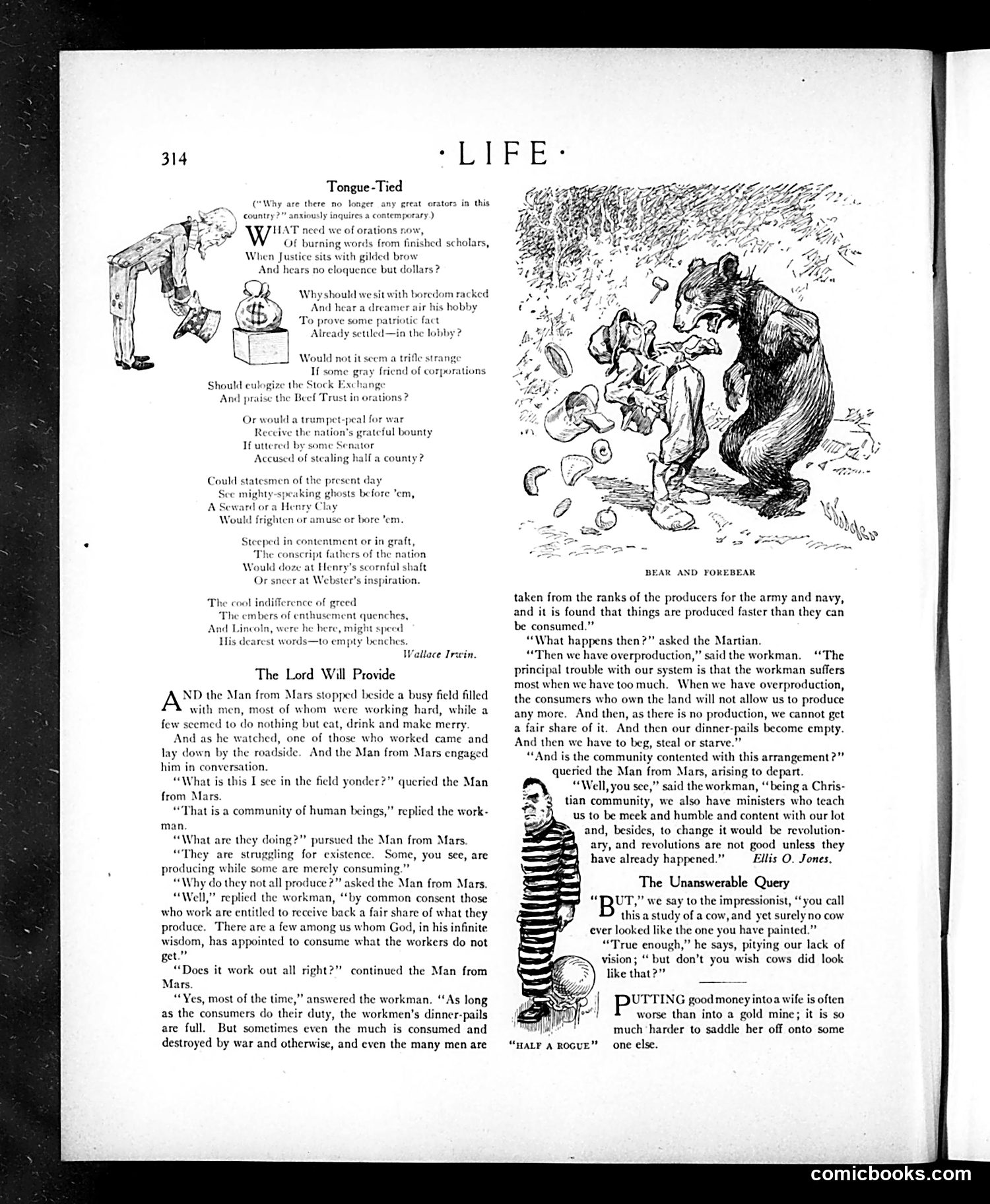
What you’re looking at
This page contains several satirical pieces critiquing early 20th-century American society: **"Tongue-Tied"** (left): A poem questioning why great orators have disappeared, sarcastically asking if we should praise corporations and "the best Trust in orations." It mocks the loss of meaningful public discourse, replaced by corporate and financial interests. **"The Lord Will Provide"** (center): A dialogue between a Man from Mars and a workwoman discussing production and consumption. The satire exposes the contradiction in the economic system: workers produce goods they cannot afford to buy, leading to empty dinner pails and poverty amid plenty. **Right illustrations**: "Bear and Forebear" and "Half a Rogue" appear to be separate humorous sketches with captions critiquing social behaviors regarding money and marriage. The overall theme attacks economic inequality and systemic injustice of the era.
📄 Transcribed text from this page (OCR, searchable)
Machine-transcribed from the original scan — historical spelling and the odd misread are preserved.
Tongue-Tied any great orators in this contemporary.) (Why are there no long country?” anxiously inquire HAT need we of orations now, Of burning words from finished scholars, When Justice sits with gilded brow ars no eloquence but dollars? Why should we sit with pm racked nd hear a dreamer air his hobby To prove some patriotic fact Already settled —in the lobby ? Would not it seem a trifle stra Should culogize the Stock Exchange rations ? And praise the Beef Trust in Or would at Receive the If uttered by son Accused of stealing ateful bounty Senator alfa county? Could statesmen of the present day See mighty-speaking gh A Seward ora Henry Cla: Would frighten or amuse or bore ’em. Steeped in contentment or in graft, ‘The conscript fathers of the nation Would doze at Henry's scornful shaft Or sneer at Webster's inspiration. cool indifference of greed bers of enthusement quenches, in, here, might speed His dearest words—to empty benches. Wallace Irwin. The Lord Will Provide ND the Man from Mars stopped beside a busy field filled with men, most of whom were working hard, while a few seemed to do nothing but cat, drink and make merry. And as he watched, one of those who worked came and lay down by the roadside. And the Man from Mars engaged him in conversation. “What is this I sce in the field yonder?” queried the Man from Mars. “That is a community of human beings,” replied the work- man “What are they doing?” pursued the Man from Mars. “They are struggling for existence. Some, you see, are producing while some are merely consuming.” “Why do they not all produce ?” asked the Man from Mars, “Weil,” replied the workman, “by common consent those who work are entitled to receive back a fair share of what they produce. There are a few among us whom God, in his infinite wisdom, has appointed to consume what the workers do not et.” “Does it work out all right?” continued the Man from “Yes, most of the time,” answered the workman. ‘As long as the consumers do their duty, the workmen's dinner-pails are full. But sometimes even the much is consumed and destroyed by war and otherwise, and even the many men are BEAR AND FOREBEAR taken from the ranks of the producers for the army and navy, and it is found that things are produced faster than they can be consumed.” “What happens then?” asked the Martian. “Then we have overproduction,” said the workman. “The principal trouble with our system is that the workman suffers most when we have too much. When we have overproduction, the consumers who own the land will not allow us to produce any more. And then, as there is no production, we cannot get a fair share of it. And then our dinner-pails become empty. And then we have to beg, steal or starve.” “And is the community contented with this arrangement?” queried the Man from Mars, arising to depart. “Well, you see,” said the workman, “being a Chris- tian community, we also have ministers who teach us to be meek and humble and content with our lot and, besides, to change it would be revolution- y, and revolutions are not good unless they Ellis O. Jones. The Unanswerable Query “DUT,” we say to the impressionist, “you call this a study of a cow, and yet surely no cow ever looked like the one you have painted.” ‘True enough,” he says, pitying our lack of vision; “but don’t you wish cows did look like that?” UTTING good money intoa wife is often worse than into a gold mine; it is so much ‘harder to saddle her off onto some “HALF A ROGUE” — one else. comicbooks.com