
A complete issue · 24 pages · 1907
Life — July 11, 1907
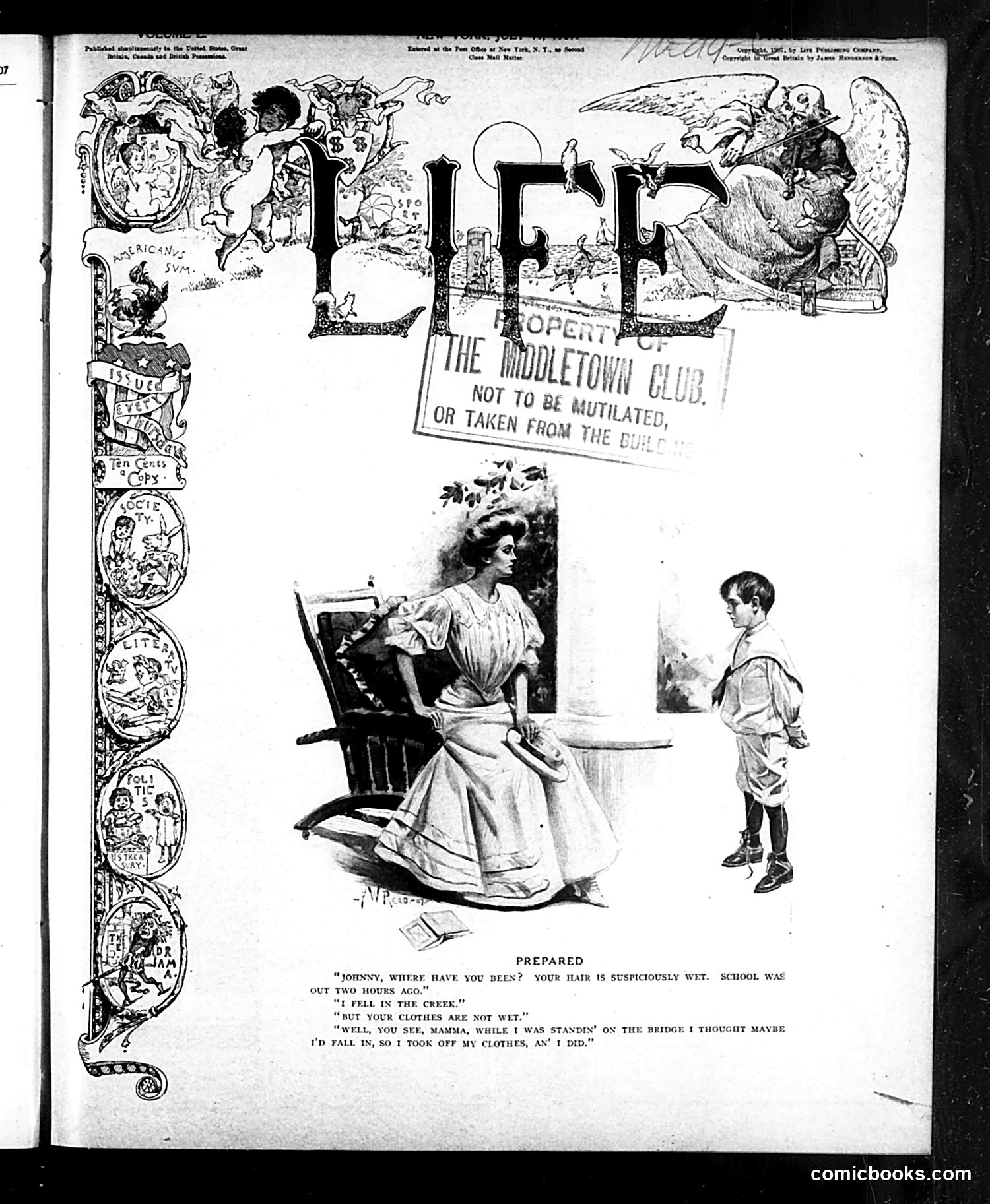
This page features a satirical cartoon titled "Prepared" depicting a domestic scene. A well-dressed woman sits questioning a young boy about his wet appearance and suspicious cleanliness. The boy's dialogue reveals he fell in a creek and removed his clothes to avoid punishment—a practical but socially improper solution. The humor derives from the child's logic versus parental expectations: he solved the immediate problem (wet clothes = trouble) through unconventional means rather than accepting normal consequences. The ornate decorative border with various vignettes is typical of Life's design aesthetic from this era. The cartoon satirizes childhood reasoning and the gap between children's problem-solving and adult propriety—a timeless theme of early 20th-century family humor.
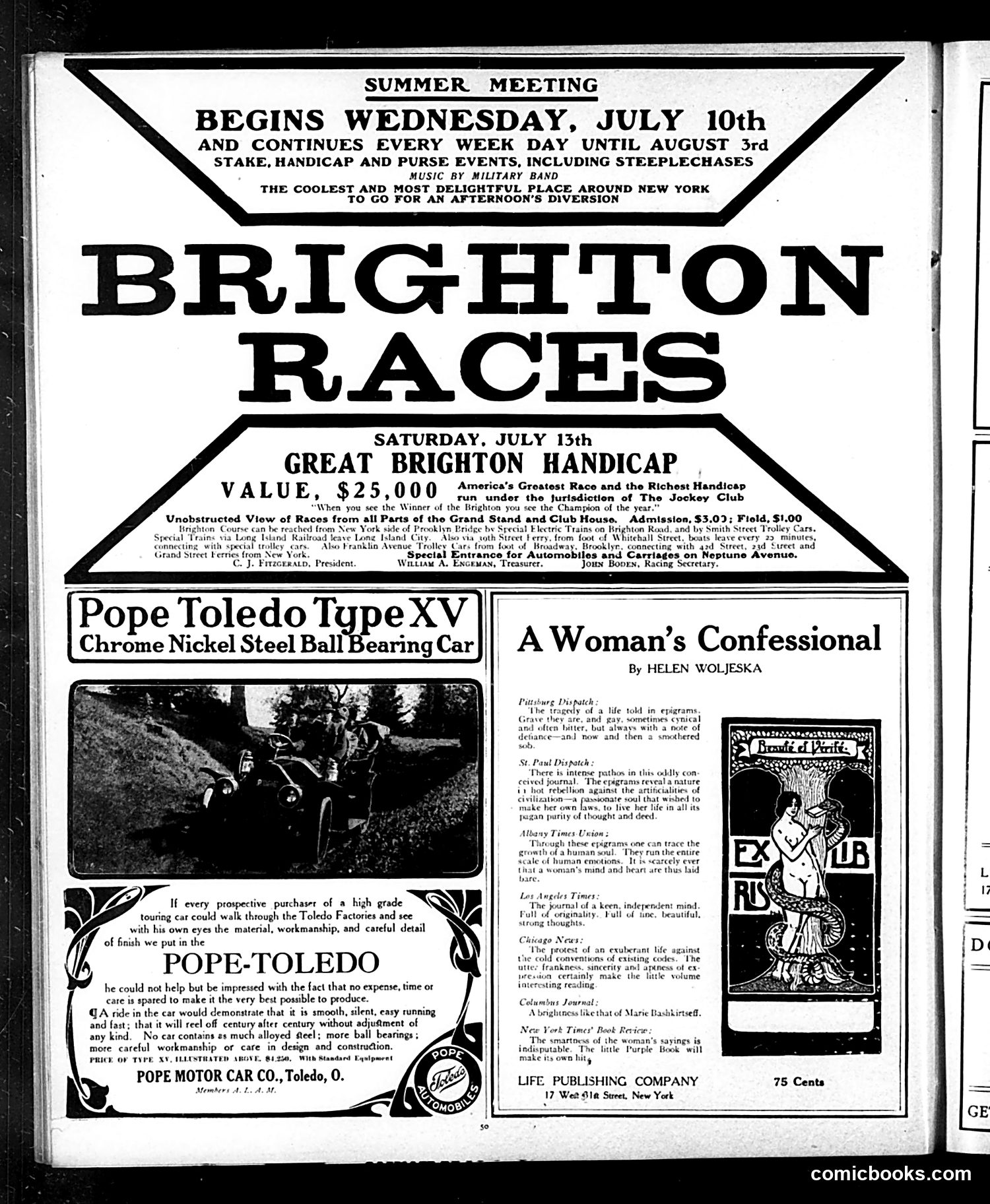
This page is primarily **advertising and event promotion**, not political satire. The dominant content advertises Brighton Races, a summer horse-racing meeting beginning July 10th, with the Great Brighton Handicap race featured for Saturday, July 13th. The races are promoted as "The coolest and most delightful place around New York" for entertainment, with military band music. Below is an advertisement for the Pope-Toledo Type XV automobile, a "Chrome Nickel Steel Ball Bearing Car" from Pope Motor Car Co. in Toledo, Ohio. The ad emphasizes quality construction and craftsmanship. On the right is a book advertisement for *A Woman's Confessional* by Helen Woljeska, published by Life Publishing Company for 75 cents. There is no discernible political cartoon or satire on this page.
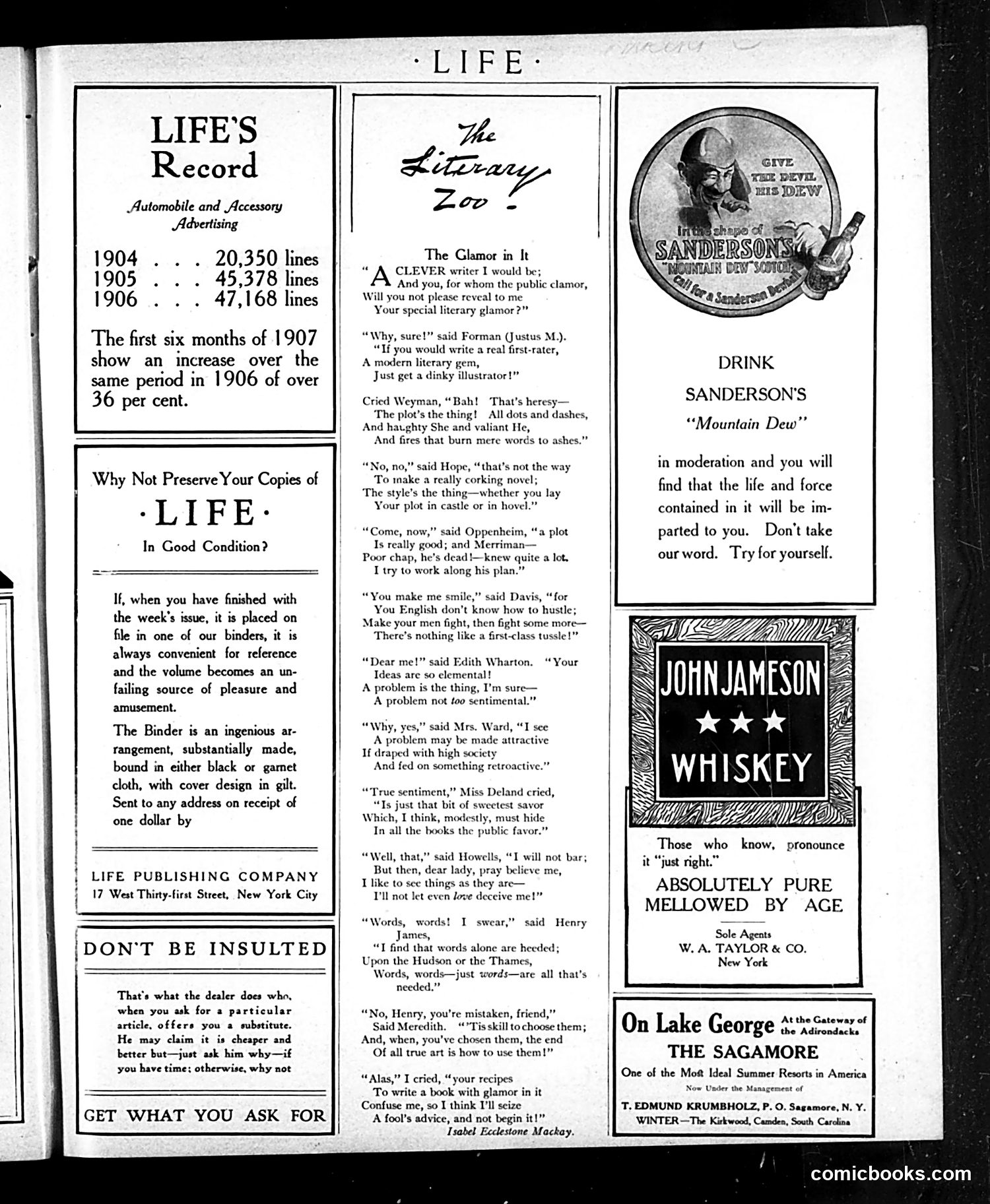
This page is primarily **advertising and business content** rather than political satire. The left column announces Life magazine's growing **automobile advertising revenue** (20,350 lines in 1904, increasing 36% by early 1907), promoting subscription preservation through a binder service. The center features "The Literary Zoo," a humorous poem about literary style, where various characters debate writing techniques—discussing plot, sentiment, and word choice. This appears to be **light satirical commentary on literary pretension** rather than political satire. The right side contains **product advertisements**: Sanderson's "Mountain Dew" beverage, John Jameson whiskey, and The Sagamore resort on Lake George. The page reflects early 1900s publishing economics and consumer culture rather than political commentary.
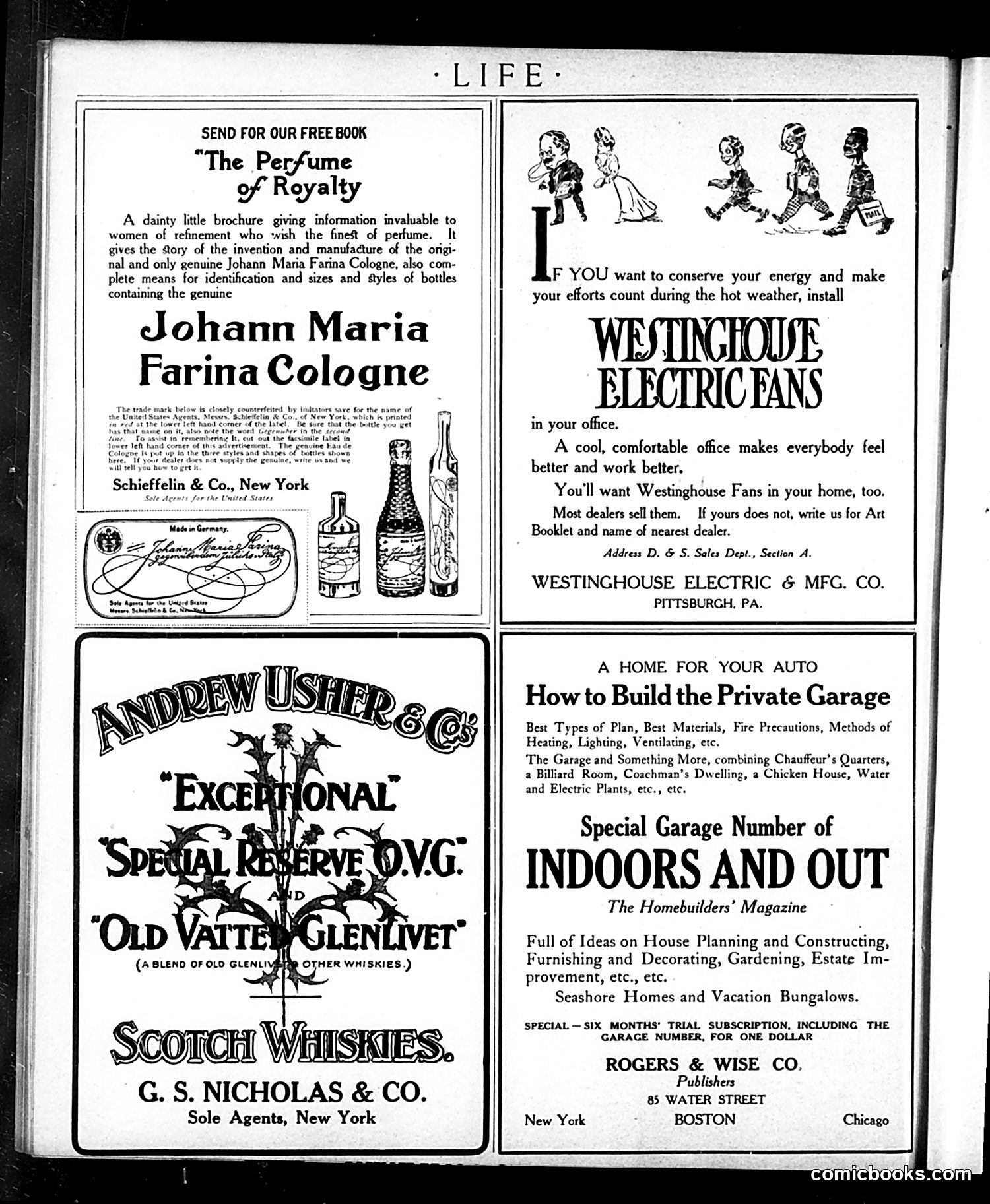
This page is **primarily advertising**, not satirical content. It contains four product advertisements from what appears to be an early 20th-century issue of *Life* magazine: 1. **Johann Maria Farina Cologne** - a luxury perfume with historical branding 2. **Westinghouse Electric Fans** - promoting home and office cooling during hot weather 3. **Andrew Usher & Co. Scotch Whiskies** - spirits advertisement 4. **Indoors and Out Magazine** - a homebuilders' publication offering garage-building plans The only illustration with figures shows children playing outdoors (top right), used to advertise electric fans for climate comfort. There is no political satire, social commentary, or caricature present on this page—it's a straightforward advertising section typical of early 20th-century magazines.
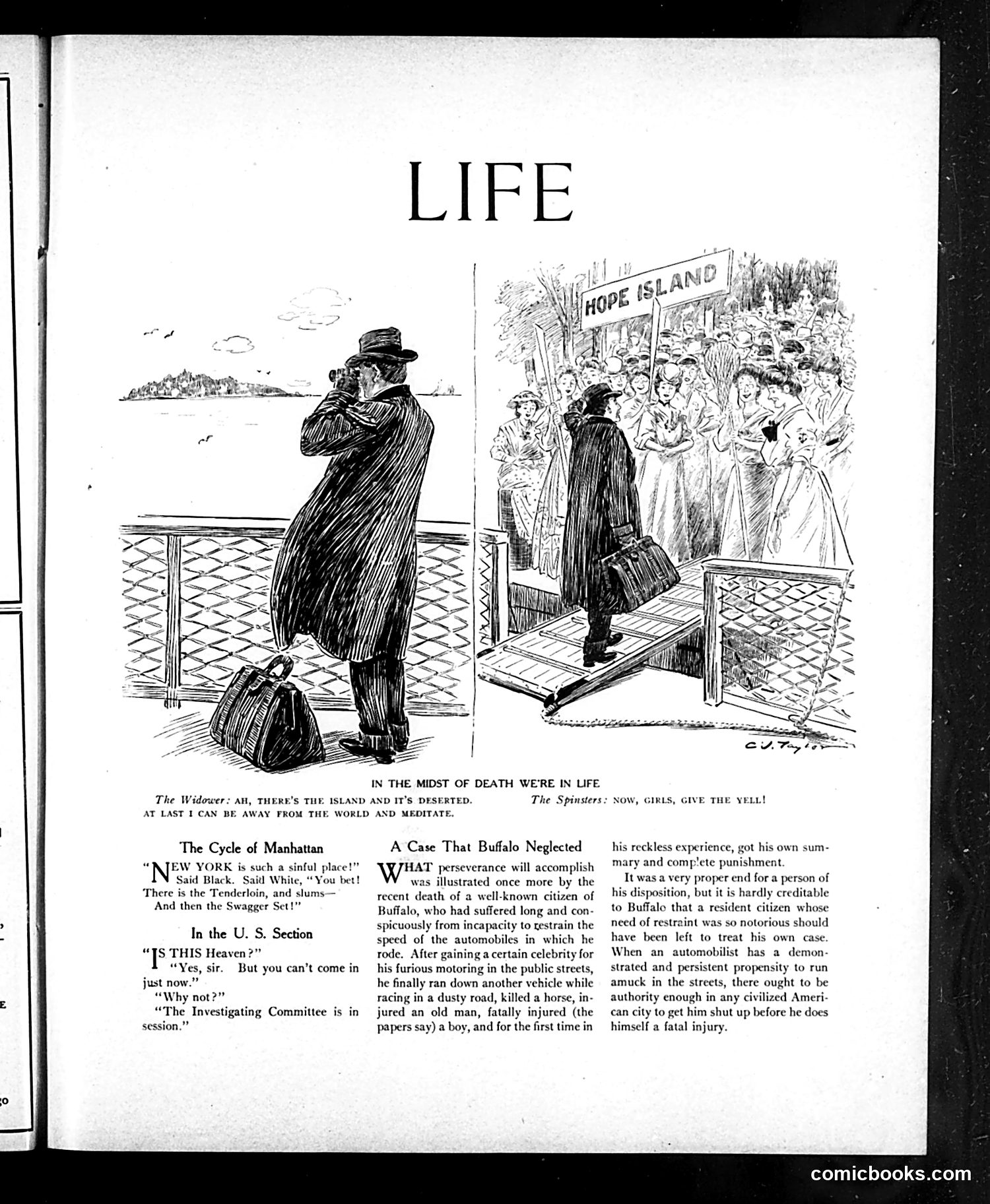
The page features two cartoons satirizing American urban and social conditions. **Top cartoon**: "In the Midst of Death Were in Life" shows a man with binoculars observing "Hope Island" from a ship's railing, while crowds gather at the destination. The widow and stranger dialogue suggests bitter irony about escaping worldly troubles only to find false hope. **Bottom section** contains three brief satirical pieces: 1. **"The Cycle of Manhattan"** mocks New York City's cyclical social problems (terrorism, sweatshops) 2. **"In the U.S. Section"** presents a darkly comic exchange about an investigating committee, suggesting governmental ineffectiveness 3. **"A Case That Buffalo Neglected"** criticizes inadequate authority response to a reckless motorist who killed a horse and injured an elderly man, highlighting the era's automobile danger and lack of accountability. The overall tone criticizes social indifference and institutional failure.
This page discusses President Woodrow Wilson's proposal to reorganize Princeton University's social structure by abolishing existing clubs and creating separate class organizations instead. The decorative illustrations (small sketches of students) are ornamental rather than satirical caricatures. The main content is editorial commentary, not a political cartoon. The satire is implicit: the text notes Wilson's plan represents "the most formidably and radically from existing practice in our older colleges"—essentially mocking the radical nature of his proposal. The piece questions whether such social engineering can truly work, suggesting that students will naturally form groups anyway, making Wilson's intervention somewhat futile. The humor lies in the tension between Wilson's ambitious institutional restructuring and the unchanging human nature of college students.
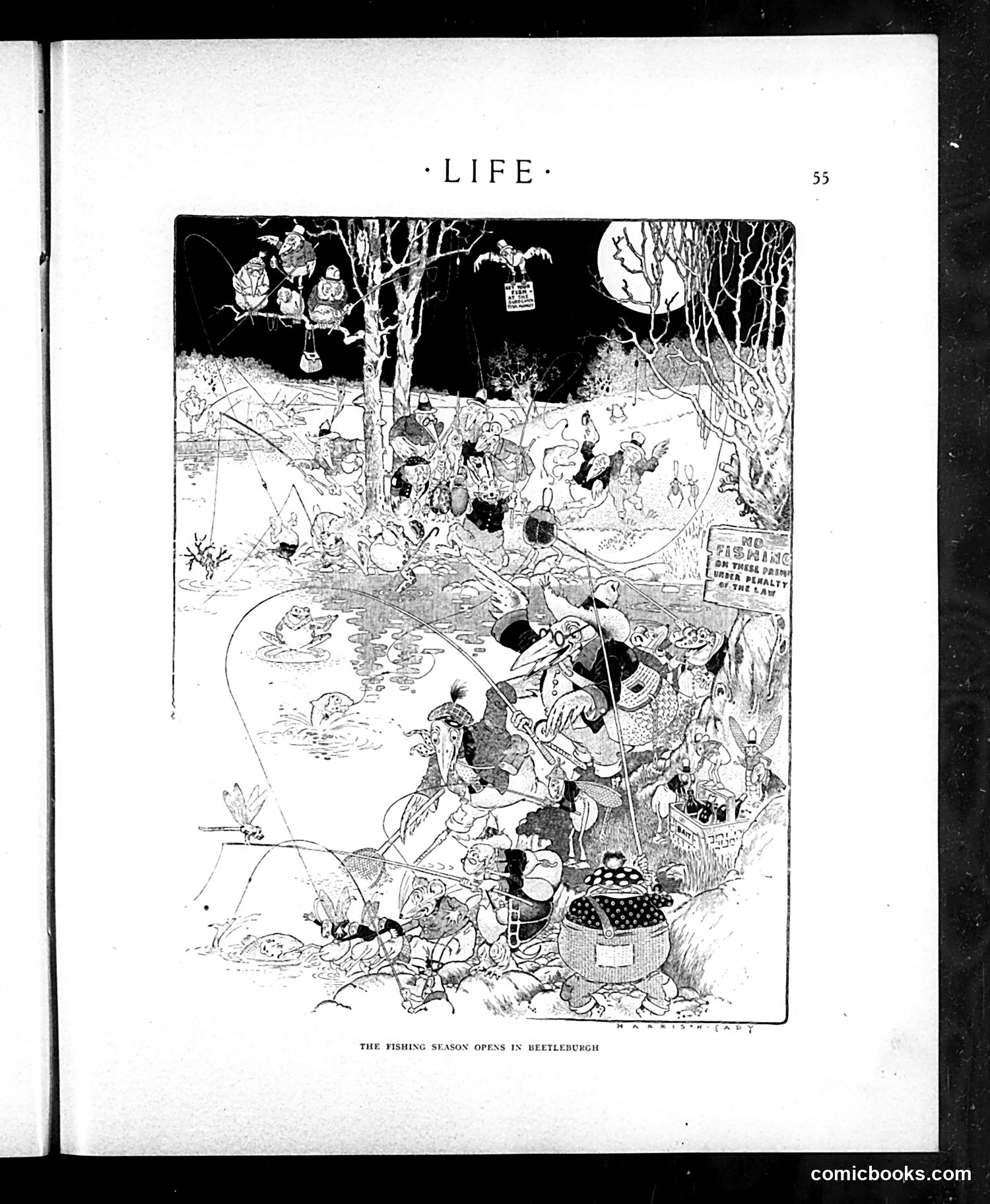
This is a whimsical cartoon depicting an insect community preparing for a fishing expedition. The scene shows various beetles and bugs gathered around a pond or water body, with fishing equipment, baskets, and camping gear scattered about. Some figures appear to be packing provisions or organizing their fishing trip, while others are already fishing or wading in the water. The title "Beetleburgh" suggests a pun—a town of beetles. The satire appears gentle and humorous rather than political, using anthropomorphized insects mimicking human leisure activities and seasonal pastimes. This represents Life magazine's typical use of animal characters for lighthearted social commentary on human behavior and customs. The detailed, busy composition suggests the organized chaos of the opening of fishing season among recreational enthusiasts.
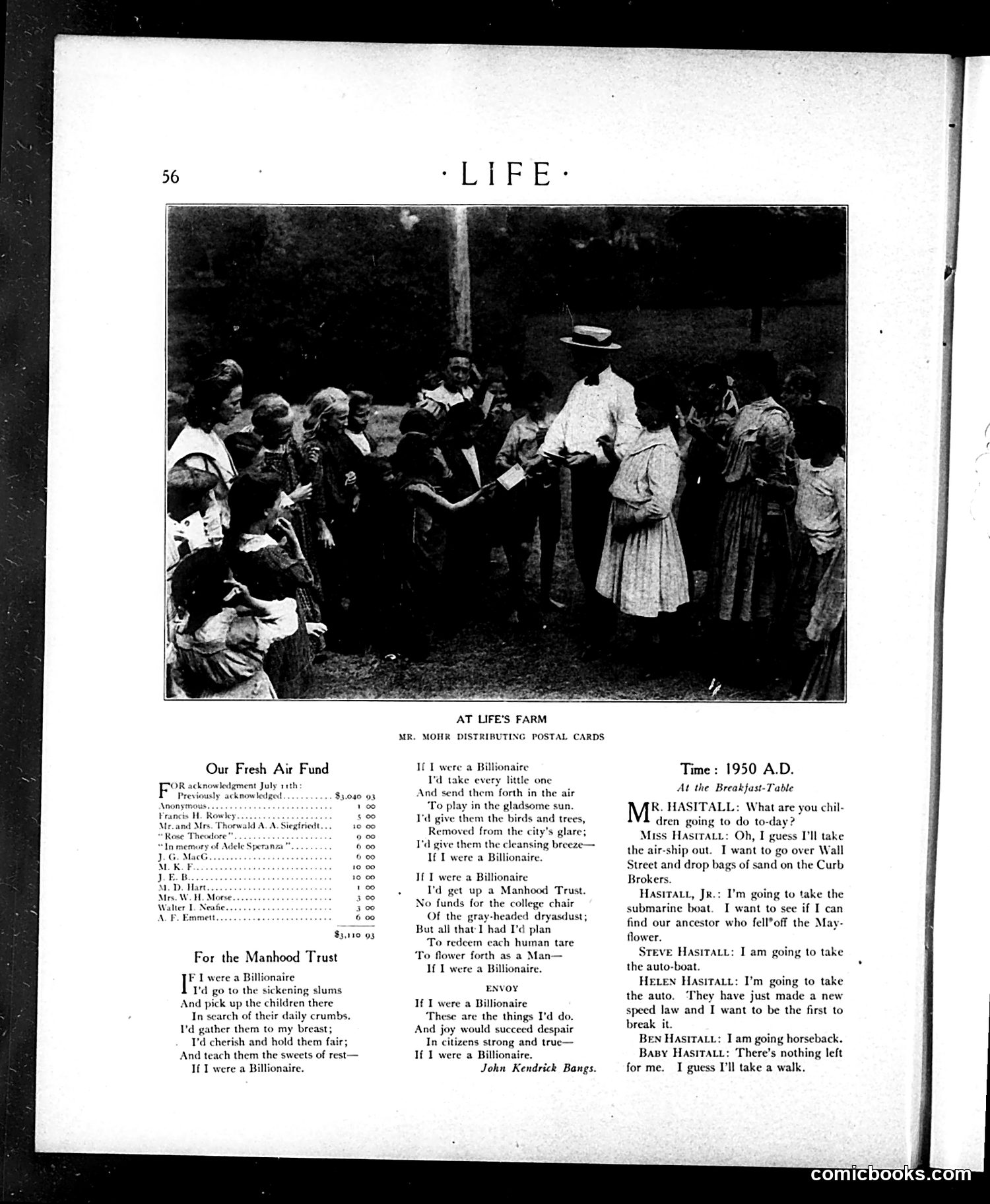
This page features a photograph of Mr. Mohr distributing postal cards at Life's Farm, accompanied by two charitable fundraising campaigns with accompanying poetry. The **"Our Fresh Air Fund"** and **"For the Manhood Trust"** sections list donor names and contributions, suggesting these were real charitable initiatives that Life magazine promoted to readers. The poems express philanthropic sentiment about helping poor urban children and those in slums. The right column contains a humorous domestic dialogue set in 1950, where the Hastall family discusses competing vacation plans—the wife wants Wall Street, children prefer submarines and autos, while the husband chooses horseback riding. This satirizes middle-class aspirations and family disagreements about leisure activities, poking gentle fun at consumer desires and domestic decision-making of the era.
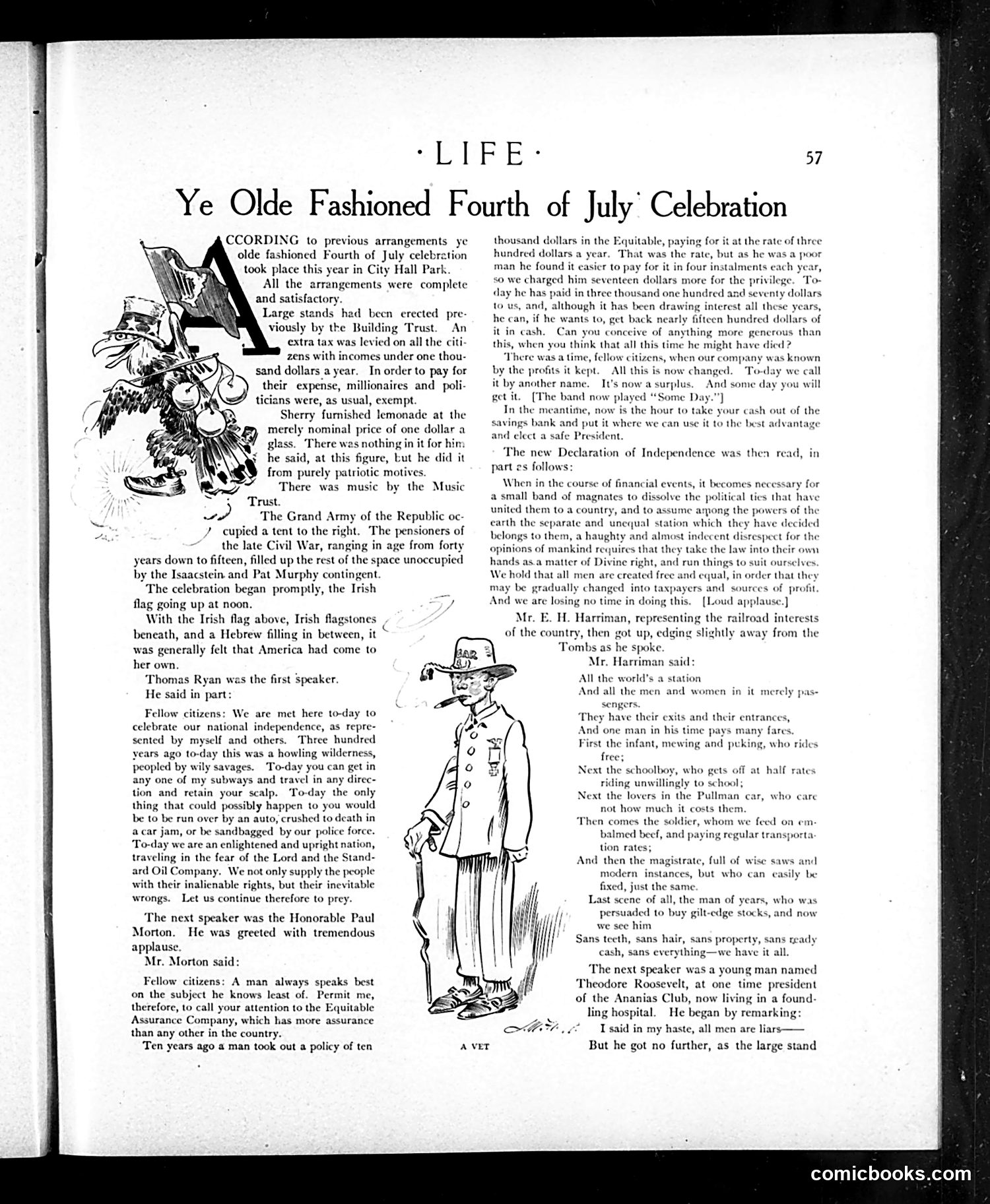
This satirical piece mocks the contrast between 1910s America and its founding ideals. The page features a large cartoon of "A Vet" (appears to be an old soldier or veteran) and critiques how Independence Day celebrations have become commercialized and corrupted. The text attacks wealthy businessmen and financiers who've profited from the nation while ordinary citizens struggle. Speakers like Thomas Ryan and E.H. Harriman (railroad magnate) are highlighted as examples of greed. The satire suggests that America's original promise of freedom and equality has been replaced by corporate interests exploiting workers and common people. The ironic "new Declaration of Independence" passage directly parodies the original document's language to expose how financial manipulation has replaced genuine liberty.
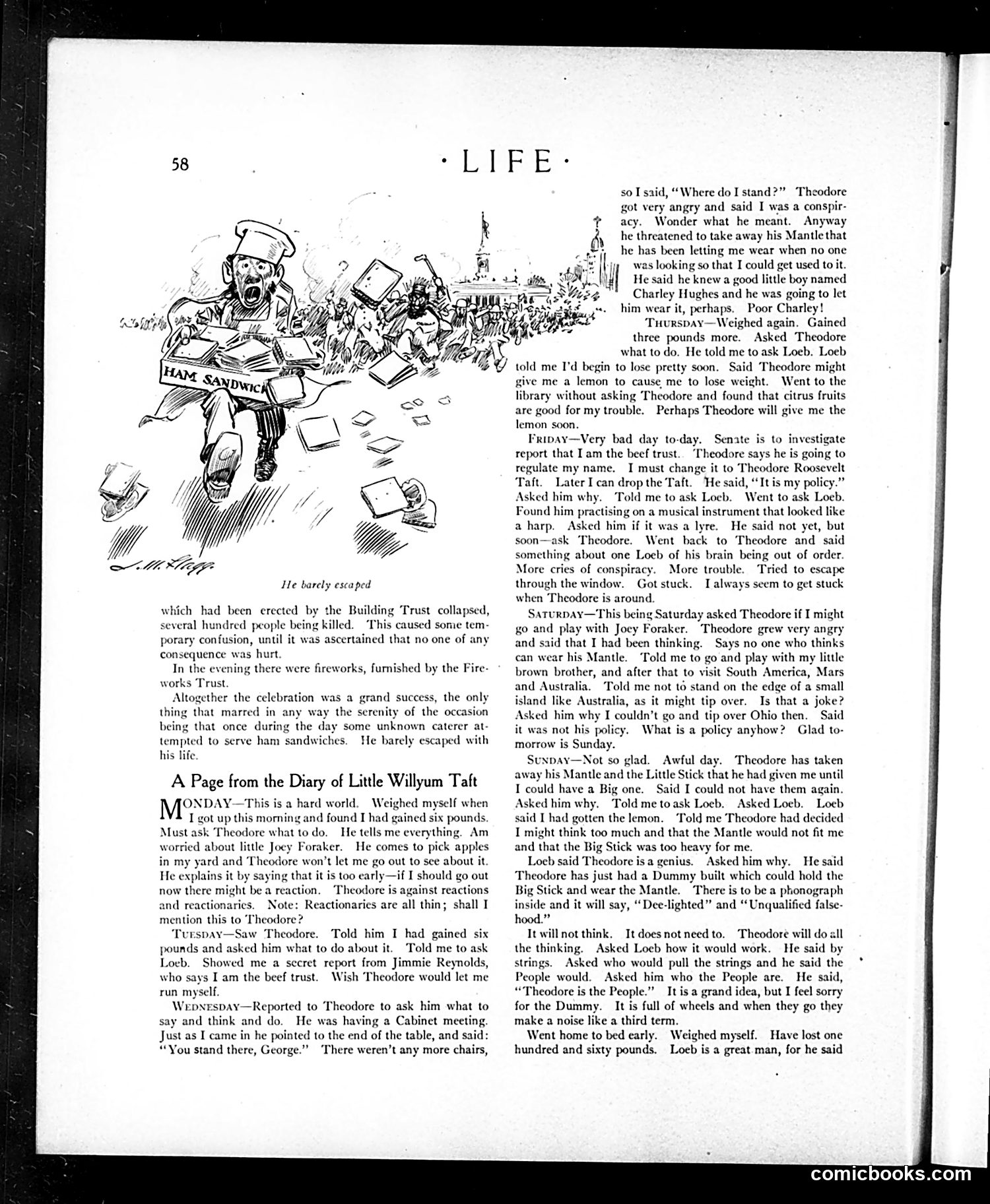
This satirical diary mocks President William Howard Taft's weight gain and political troubles. The cartoon shows Taft as "Ham Sandwich"—a caricature emphasizing his notorious obesity, surrounded by scattered books labeled with policy issues. The diary entries chronicle Taft's week of mismanagement: he's investigated for allegedly being a "beef trust" monopolist, loses his Mantle (possibly referencing Theodore Roosevelt's political legacy), struggles with advisors including someone named Loeb, and is generally depicted as incompetent and buffoonish. The satire attacks Taft's presidency through bodily humor and documented policy failures, portraying him as overwhelmed, indecisive, and conspiratorially entangled—a far cry from the vigorous Roosevelt administration that preceded him.
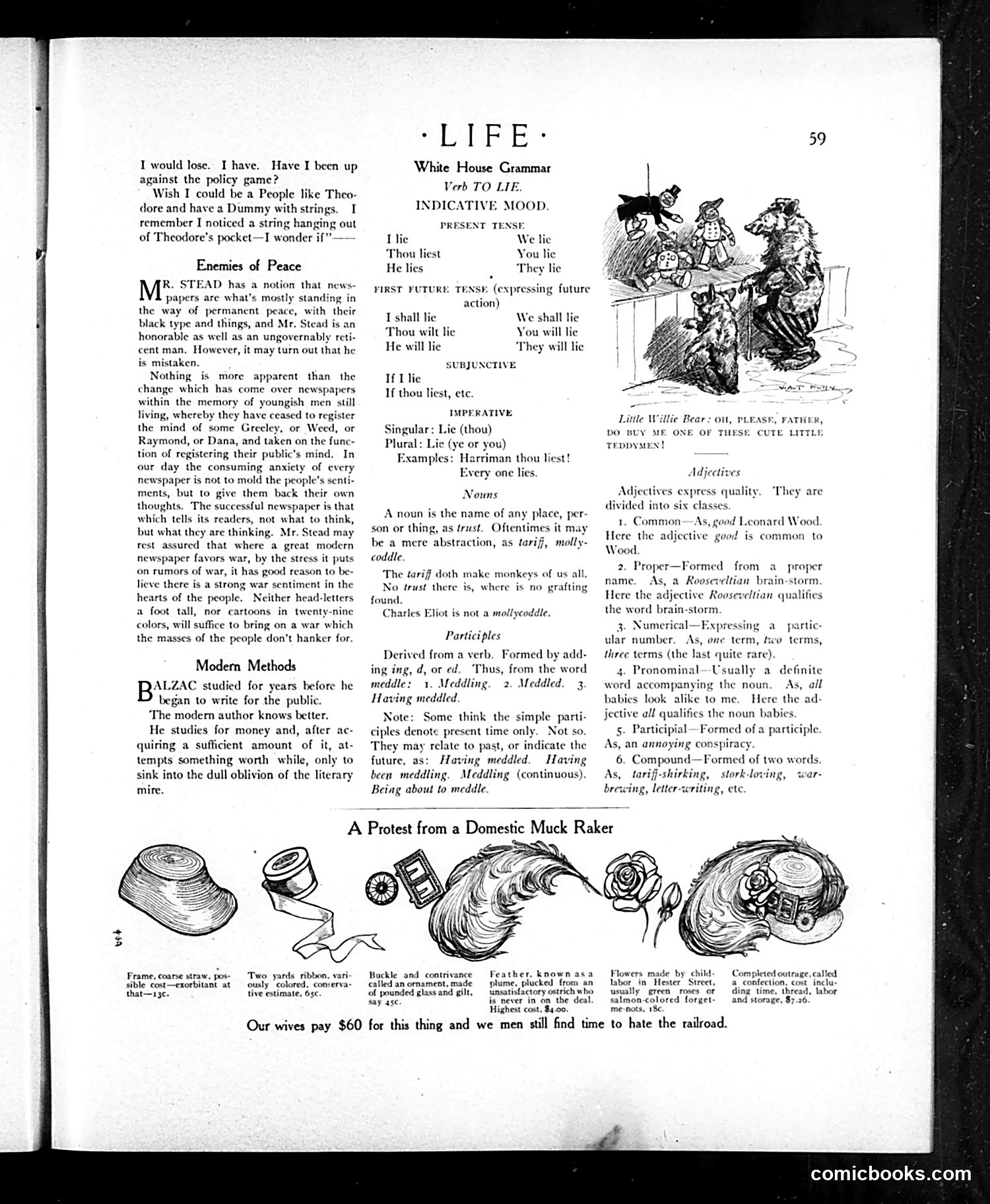
This cartoon satirizes women's complaints about the cost of elaborate hats. The illustrated items—straw frames, ribbons, buckles, feathers, and flowers—represent the expensive decorative elements fashionable women's hats required in this era. The caption's bitter complaint—"Our wives pay $60 for this thing and we men still find time to hate the railroad"—mocks husbands' dual grievances: the extravagant expense of women's fashion and their separate political complaints about railroad companies (likely monopolistic practices, a contemporary reform issue). The satire targets both the frivolous spending on women's accessories and the idea that men have time to complain about multiple issues simultaneously. "Muck raker" refers to investigative journalists exposing corruption.
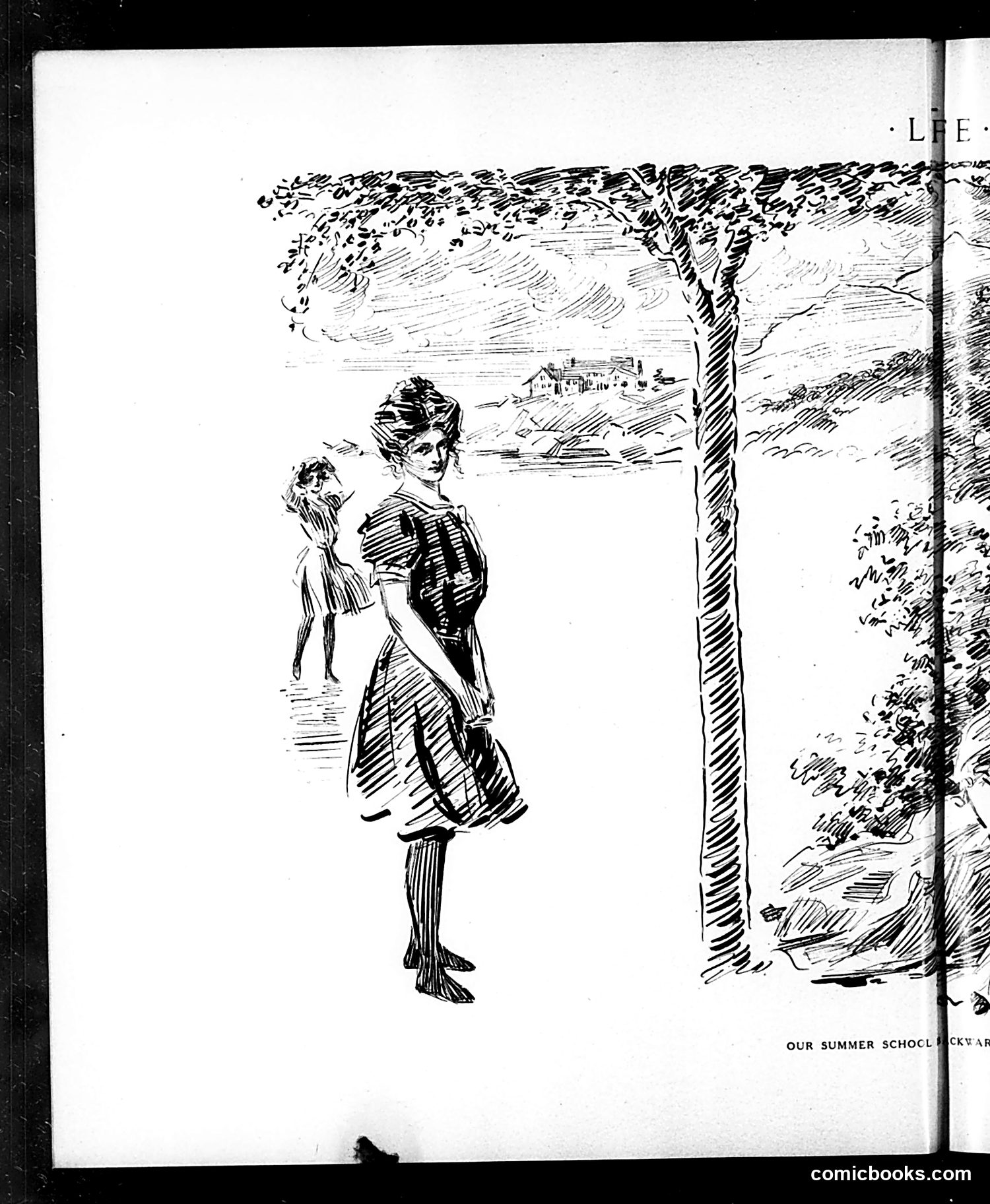
This page from *Life* magazine features an illustration titled "OUR SUMMER SCHOOL" (visible at bottom). The drawing shows a fashionably dressed woman in early 20th-century attire standing beneath a large tree, observing a rural landscape with a farmhouse in the distance. The satire appears to target the urban leisure class and their idealized notions of "summer school" or rural retreats. Rather than depicting actual academic instruction, the illustration suggests that wealthy urbanites used such seasonal excursions primarily as fashion showcases and social occasions. The woman's elegant dress and posed stance emphasize appearance over substance, mocking the pretense that these were genuinely educational experiences rather than social gatherings for the privileged.
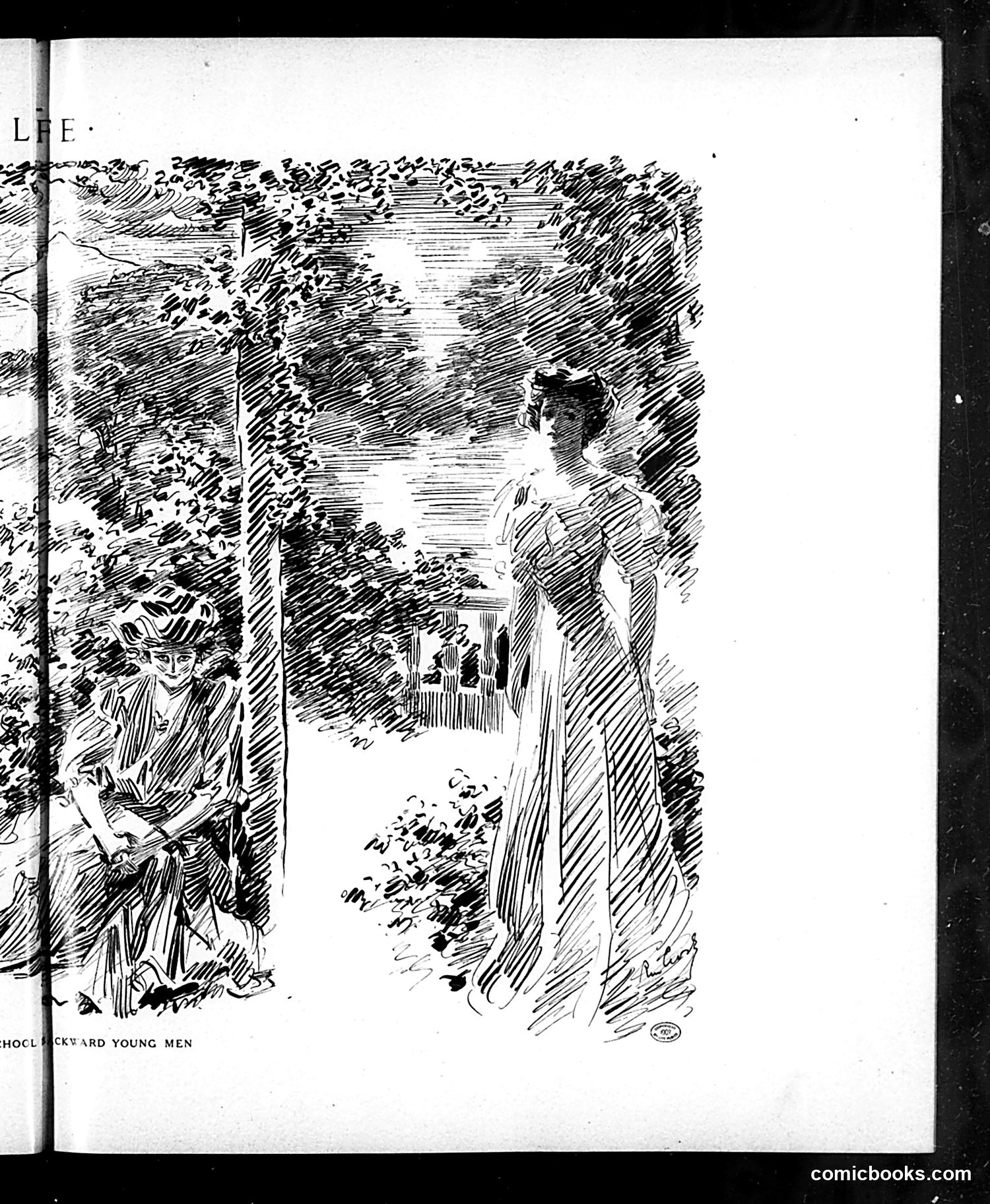
This page from *Life* magazine features a sketch-style illustration showing two women in an outdoor garden setting. The text at the bottom reads "HOCL [?] CKY ARD YOUNG MEN," though the OCR is unclear. The image depicts what appears to be a social scene—one woman seated on the left in a striped dress, another standing on the right in a flowing gown. The setting suggests leisure or courtship, with dense foliage and natural elements rendered in cross-hatching. Without clearer text or caption identifying the specific social commentary, I cannot definitively state what satirical point this makes. It may reference contemporary gender roles, courtship customs, or social expectations of young women, typical subjects for *Life*'s satirical commentary. The artistic style and composition suggest romantic or social themes, but the exact target of satire remains unclear from this page alone.
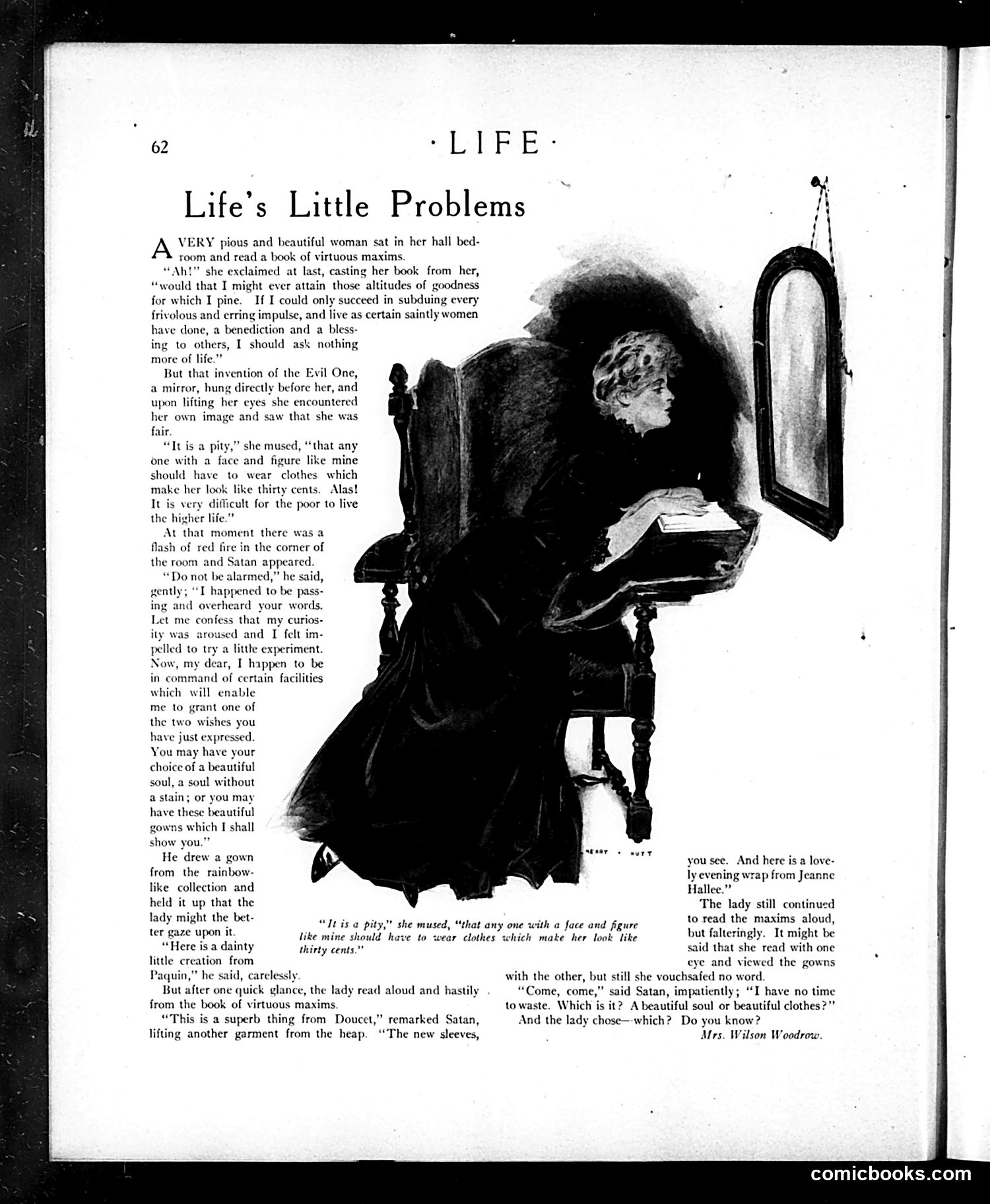
This is a moral cartoon satirizing female vanity and materialism. A pious woman reads virtue maxims, yearning for spiritual goodness, but immediately becomes distracted by her reflection in the mirror. Satan appears offering a Faustian choice: a pure soul OR beautiful designer gowns (from fashionable houses like Paquin and Doucet). The satire targets the hypocrisy of claiming moral aspiration while obsessing over appearance and luxury fashion. The woman's immediate abandonment of her virtuous reading when presented with expensive clothes mocks the shallow priorities of society women—particularly those of modest means ("thirty cents" appearance) who covet high fashion. The final punchline leaves the reader to conclude she chose the gowns, not the soul. This reflects early 20th-century anxieties about consumerism, female materialism, and the corrupting influence of fashion advertising on moral character.
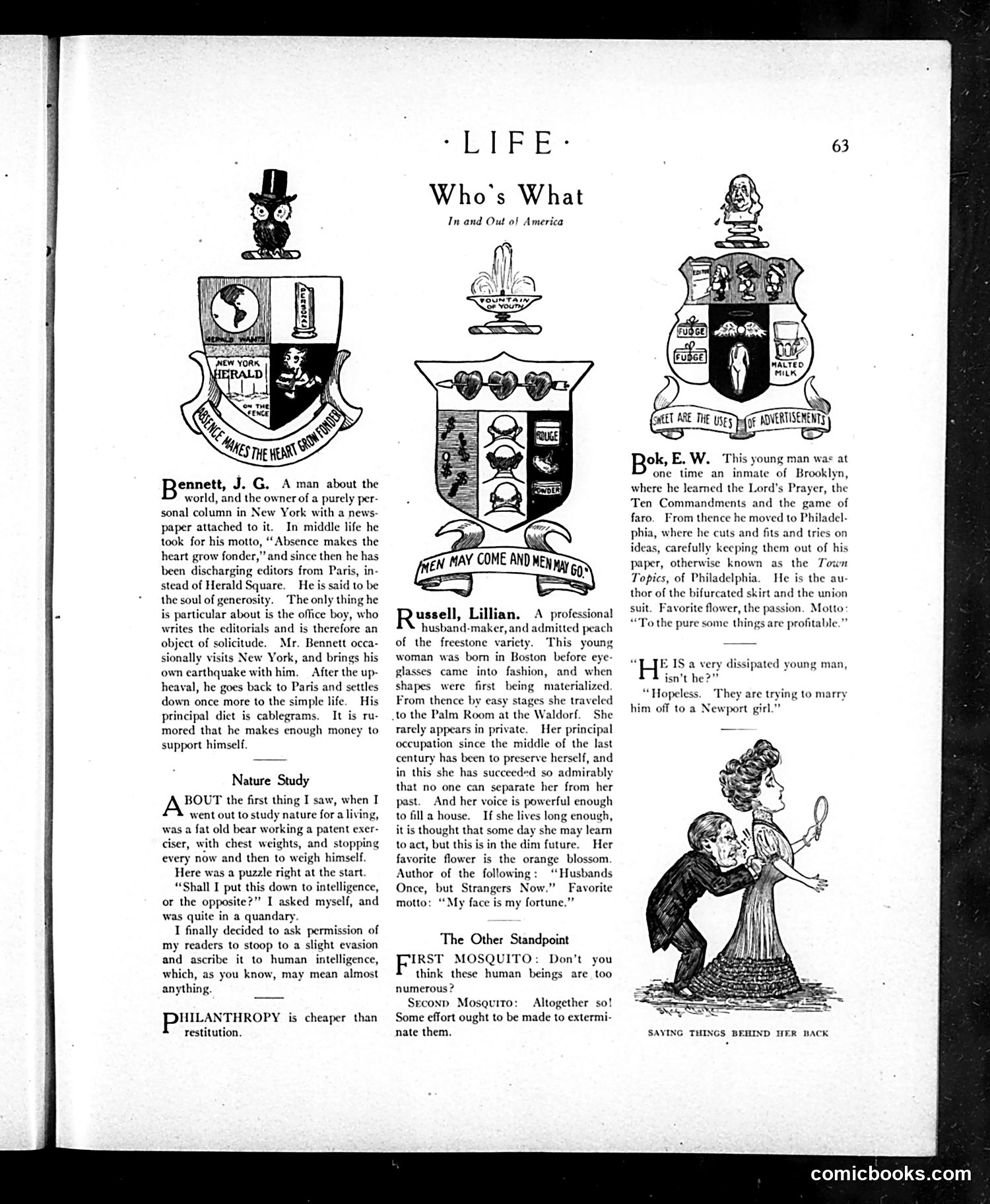
This page from Life magazine satirizes prominent American figures through brief biographical sketches with heraldic illustrations: **J.G. Bennett** — Newspaper publisher and gossip columnist, mocked for living abroad in Paris while running a New York column, funding his lifestyle through editorial work while claiming genteel poverty. **Lillian Russell** — The famous actress/singer is portrayed sarcastically as a professional "husband-maker" and beauty who's preserved herself so carefully she cannot escape her past. The joke: despite her legendary voice, she may never actually learn to act. **E.W. Bok** — Appears to be a Philadelphia editor credited with inventing the bifurcated skirt and union suit, who deliberately keeps good ideas out of his publication. The page also includes two editorial jokes: one mocking naturalists' attribution of animal behavior to "human intelligence," and a mosquito dialogue where insects debate exterminating overpopulated humans—reversing typical perspectives for satirical effect.
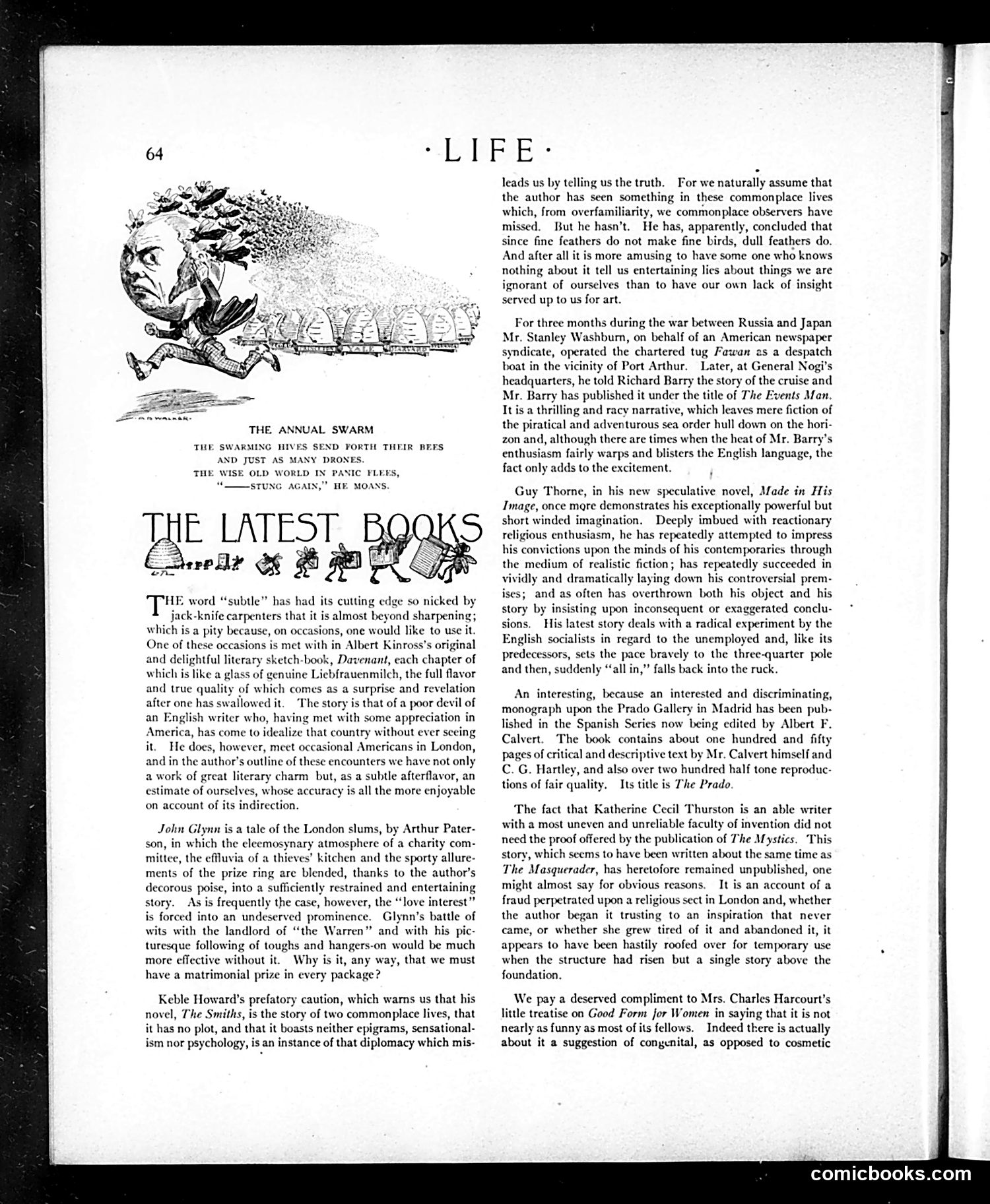
This political cartoon depicts a caricatured figure with exaggerated features being chased or overwhelmed by a swarm of bees, with accompanying text about "drones" returning annually. The accompanying caption suggests this is satirizing recurring social or political problems that return seasonally or cyclically. The cartoon appears to reference anxieties about immigration or population surges—"the wise old world in panic flees"—depicting outsiders as an invasive swarm. The emphasis on "drones" (non-productive members) suggests critique of perceived parasitic elements in society. The page itself is primarily a book review section titled "The Latest Books," discussing contemporary novels including works about London slums and international conflicts. The cartoon functions as visual satire commenting on social conditions discussed in the literary reviews that follow, likely reflecting early 20th-century anxieties about social mobility, immigration, or labor issues that were popular subjects in period fiction.
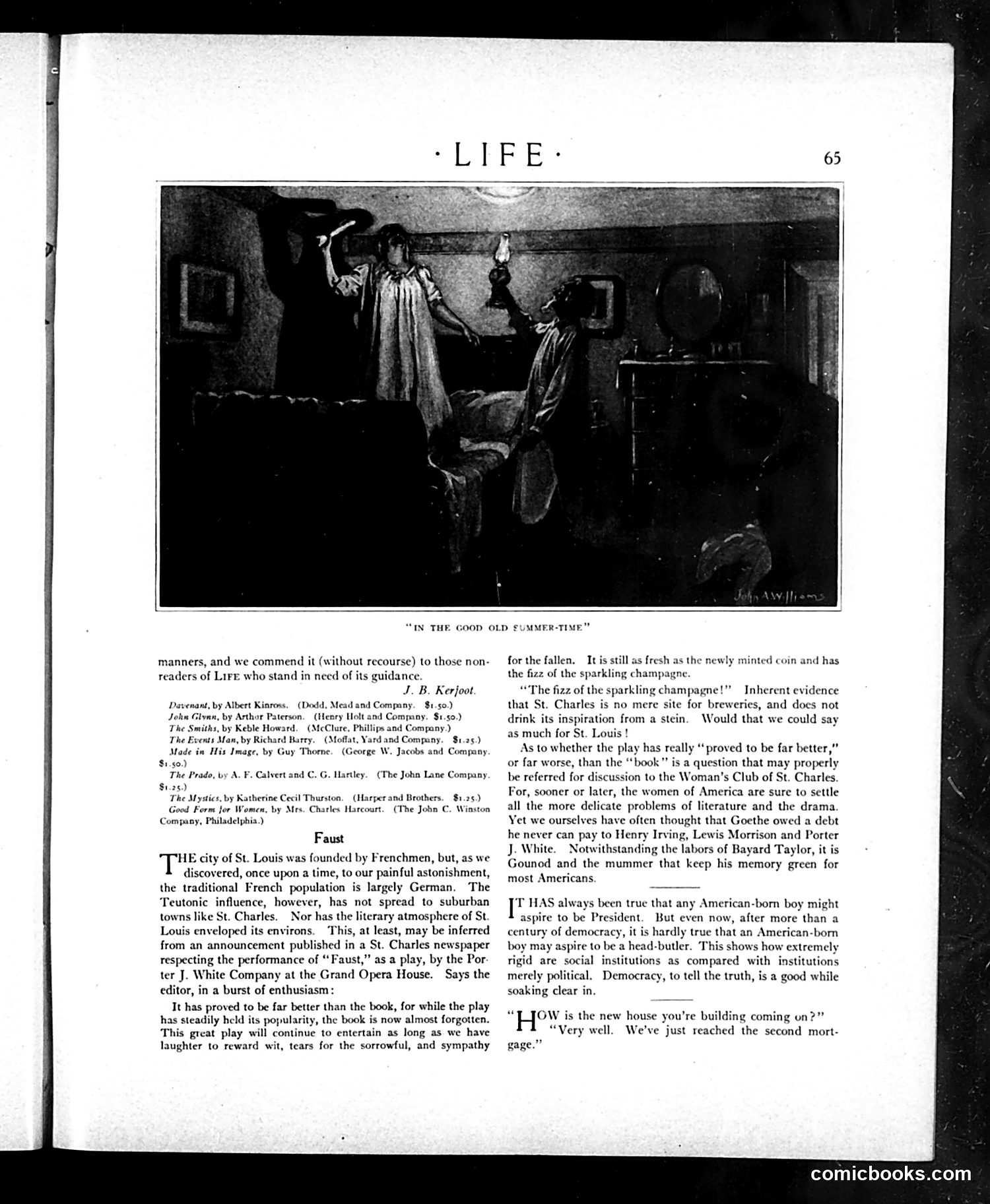
This page from *Life* magazine features a photograph labeled "In the Good Old Summer-Time" showing what appears to be a domestic bedroom scene with figures in period clothing. The accompanying text is primarily a book review section, but includes a satirical essay about *Faust* titled "Faust." The satire mocks a St. Charles, Missouri newspaper's breathless praise of a theatrical production of Goethe's *Faust* by the Porter J. White Company, quoting the editor's claim that the play "has proved to be far better than the book." **The satire's point:** The *Life* writer ridicules this provincial judgment by sarcastically suggesting the editor's enthusiasm reflects St. Charles's lack of literary sophistication. The quoted phrase "fizz of the sparkling champagne" becomes evidence of unsophisticated taste. The piece implies that comparing Gounod's operatic adaptation favorably to Goethe's original work reveals cultural provincialism, while also suggesting American theatrical performers (Irving, Morrison, White) get credited for work originally by European masters. The humor targets small-town American cultural pretensions and the gap between popular entertainment and literary merit.
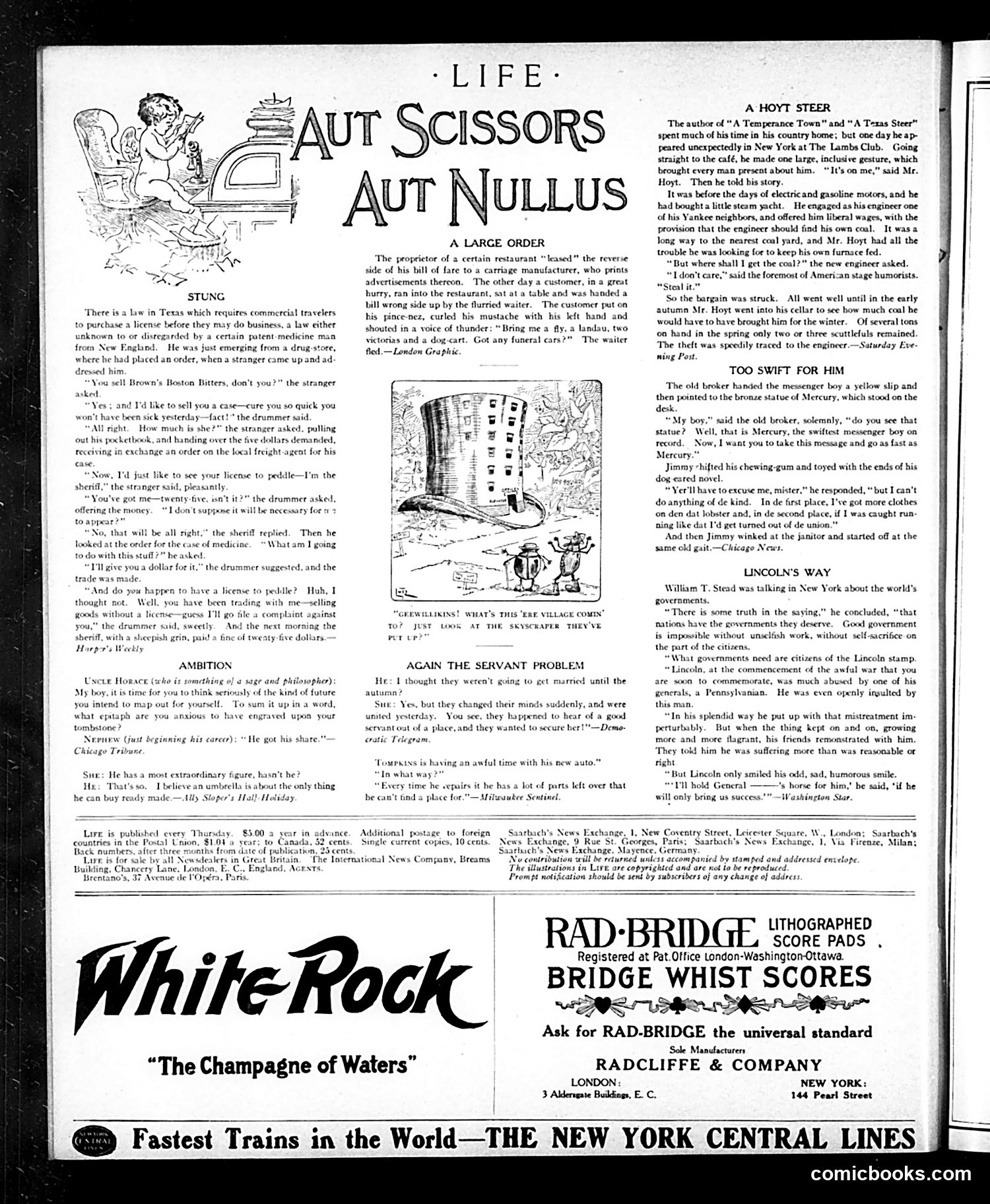
This page from *Life* magazine contains several short satirical pieces typical of the publication's humor: **"Stung"** mocks a patent-medicine drummer (traveling salesman) from New England who operates illegally in Texas without a peddler's license. The joke: he's repeatedly fined by the sheriff—first for selling without a license, then for lacking a license to peddle itself—until he literally pays to leave town. The satire targets both unscrupulous patent-medicine salesmen (common fraudsters of the era) and absurd bureaucratic entanglement. **"Aut Scissors, Aut Nullus"** jokes about a restaurant bill of fare inadvertently printed with carriage advertisements on the reverse. A hungry customer, reading only the ads, hilariously orders carriages instead of food. **"Again the Servant Problem"** satirizes the era's chronic domestic-help shortage: a couple rushes into marriage specifically to secure an available servant before someone else hires her. The pieces reflect *Life's* focus on contemporary social frustrations—regulatory confusion, advertising absurdity, and labor scarcity—presented as brief, punchy anecdotes rather than elaborate political commentary.
This page is **not a cartoon but rather promotional/editorial content** about *The Smart Set* magazine, attributed to literary critic Hamilton Wright Mabie. The piece argues that *The Smart Set*'s success (founded March 1900) proves Mabie's maxim that magazines need a founding "idea" to succeed. That idea was publishing high-quality fiction based purely on merit, not author fame—complete stories without serialization, aimed at readers seeking rest and mental refreshment. The text emphasizes that *The Smart Set* discovers new talent (all great writers were once new) and attracts superior submissions because editors judge work fairly. It positions the magazine as superior to cheaper imitators, justifying its 25-cent price by maintaining "brilliancy, clean sentiment, good English literature." This appears to be **house advertising**—the magazine promoting itself to potential readers and aspiring writers. The implicit satire may target competitor magazines relying on established names rather than merit-based publishing.
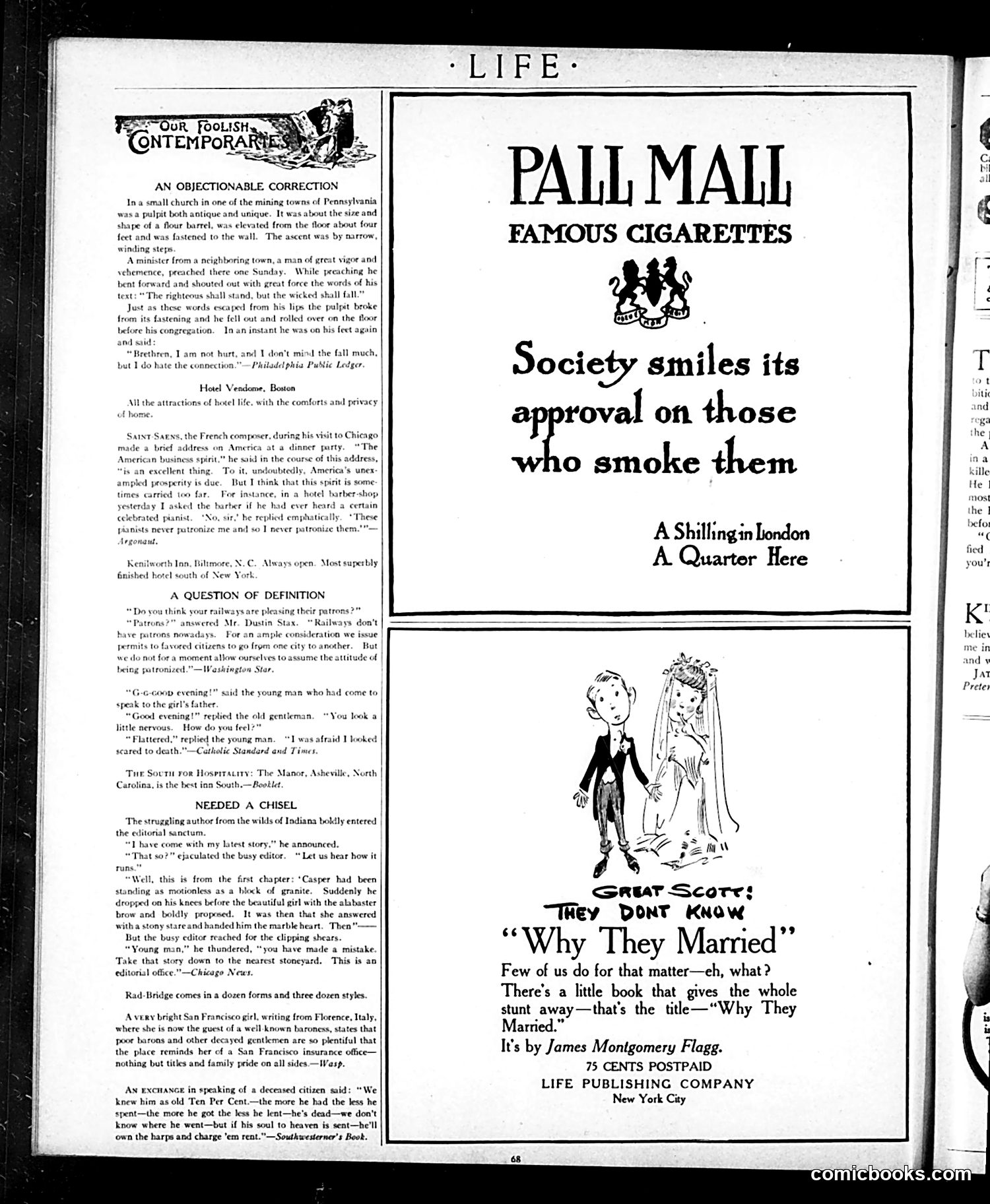
This page combines humorous anecdotes with advertising. The left column contains satirical short stories mocking American life—a minister falling from a pulpit, a barber refusing to patronize musicians, a railroad official denying passengers are "patrons," and an editor rejecting an author's overwrought prose ("stony stare," "marble heart") as belonging in a stoneyard. The right side features a **Pall Mall cigarettes advertisement**—a major tobacco brand. The ad depicts a bride and groom with the phrase "They Don't Know 'Why They Married,'" promoting a book by James Montgomery Flagg (a famous American illustrator). The advertisement claims "Society smiles its approval on those who smoke them"—a period marketing tactic suggesting cigarettes conveyed sophistication and social acceptance. The juxtaposition is notable: satirical critiques of American pretension sit alongside an ad promising social respectability through consumer goods, exemplifying early 20th-century magazine culture.
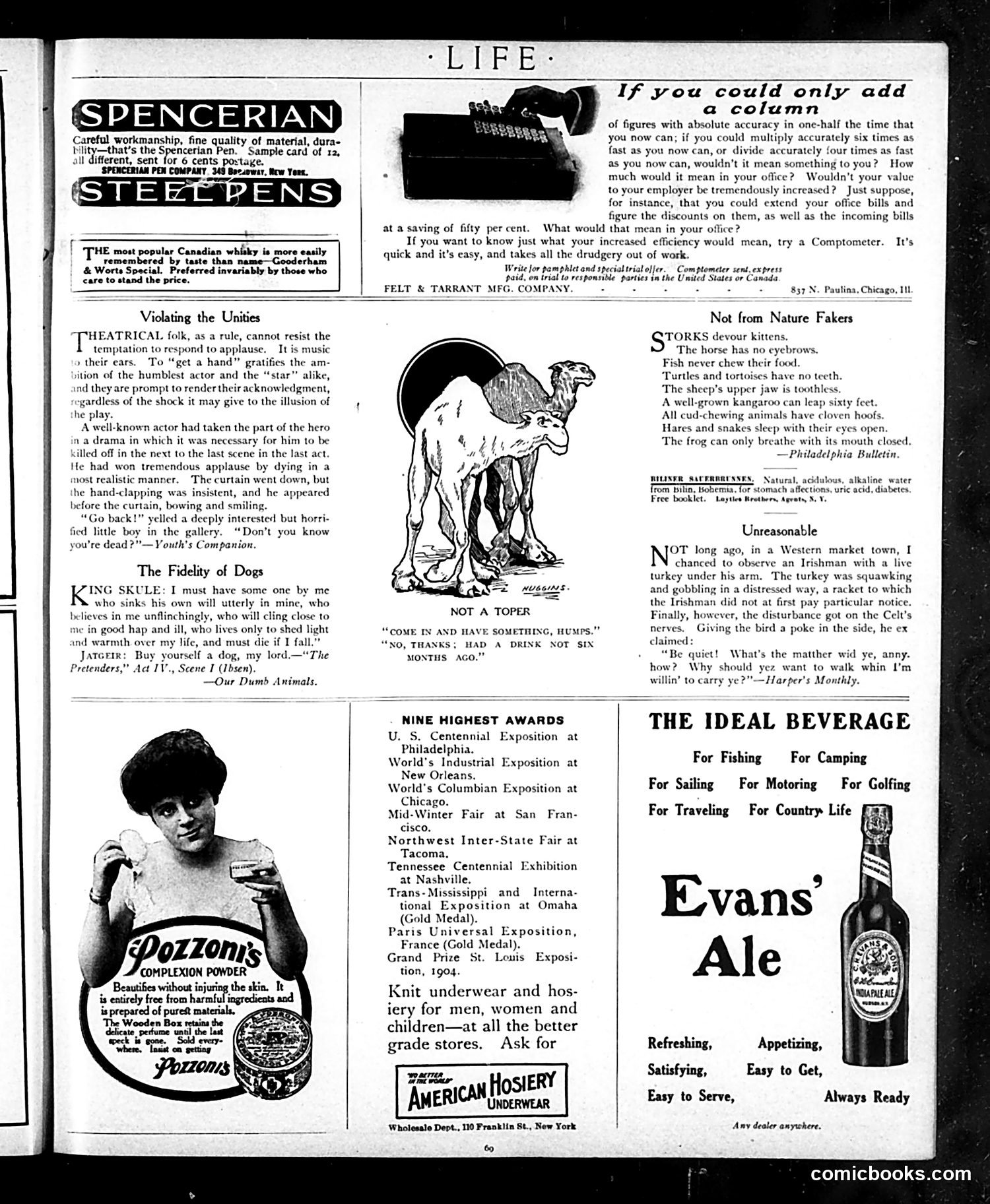
This is a theatrical anecdote satirizing actors' compulsion to accept applause even when it breaks dramatic convention. The story describes a well-known actor playing a hero who dies in the penultimate scene. Despite dying convincingly and receiving tremendous applause, the actor cannot resist emerging from behind the curtain to bow and smile—violating the theatrical "unities" (dramatic conventions about maintaining illusion). A child in the gallery, genuinely invested in the play's realism, yells "Go back!" and asks "Don't you know you're dead?" The joke targets actors' vanity: their ego-driven need for audience approval overrides their commitment to the play itself and the audience's suspension of disbelief. The piece mocks a universal human weakness—the irresistibility of praise—by contrasting professional duty against personal gratification.
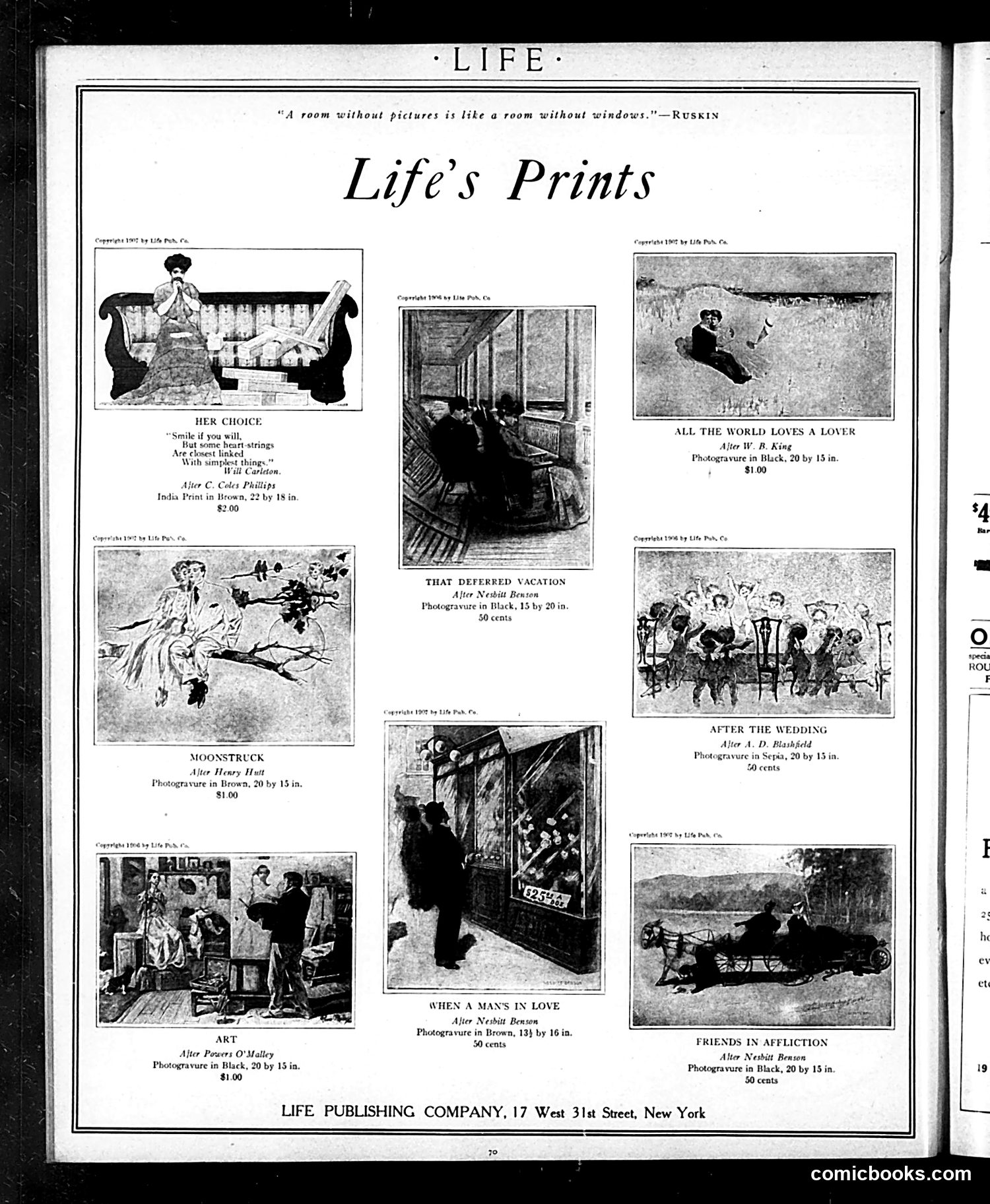
This is primarily a **catalog/advertisement page** rather than political satire. Life Publishing Company is selling art prints—photogravures and India prints—featuring romantic and sentimental scenes by contemporary illustrators (Nesbitt Benson, Henry Hutt, A.D. Blashfeld, and others). The page showcases illustrations depicting early 20th-century courtship and domestic themes: a woman choosing between suitors ("Her Choice"), lovers outdoors ("All the World Loves a Lover"), honeymoon romance ("Moonstruck"), and marital contentment ("After the Wedding"). The epigraph from Ruskin frames these prints as decorative art for the home. Prices range from 30 cents to $2.00, positioning them as affordable luxury goods for middle-class consumers. The content reflects the era's romanticized view of love, marriage, and leisure—suitable wall decorations for parlors and bedrooms of the period.
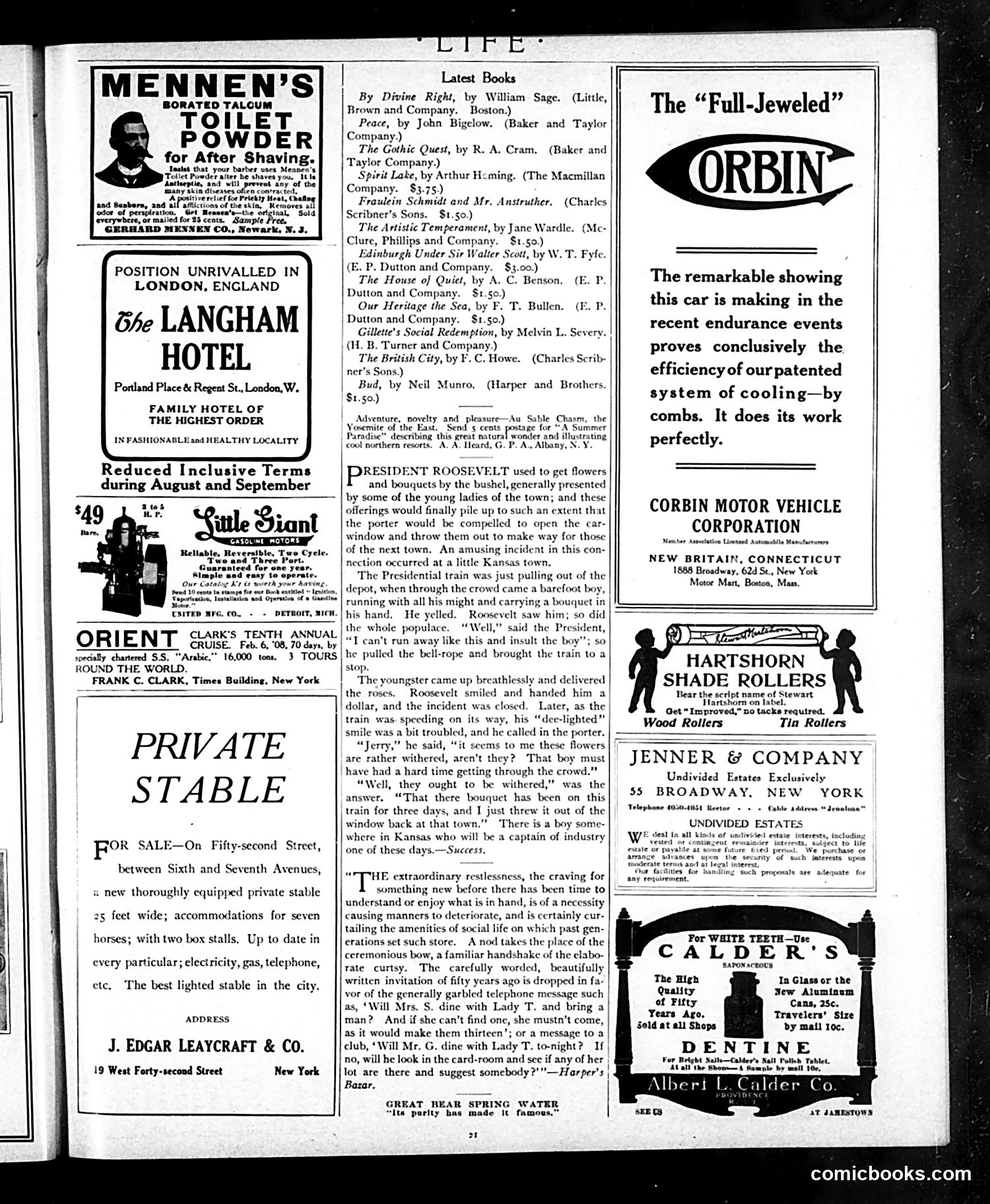
This page is primarily **advertisements and book reviews** with one substantial anecdote about President Theodore Roosevelt. The main content is a humorous story about Roosevelt's train journey through Kansas. A barefoot boy rushes to hand Roosevelt flowers as the train departs; Roosevelt, impressed by the boy's effort, stops the train to accept the bouquet and rewards him with a dollar. The joke's punchline: the porter reveals the same bouquet had been thrown out a window three days earlier—the boy unknowingly delivered old, withered flowers. The anecdote celebrates Roosevelt's character: his willingness to honor the boy's earnest gesture despite the flowers being worthless. The concluding moral suggests this resourceful Kansas boy will become a "captain of industry," reflecting early 20th-century American optimism about social mobility. The rest of the page features typical period advertisements (hotels, books, stables, dental products) with no apparent satirical content.
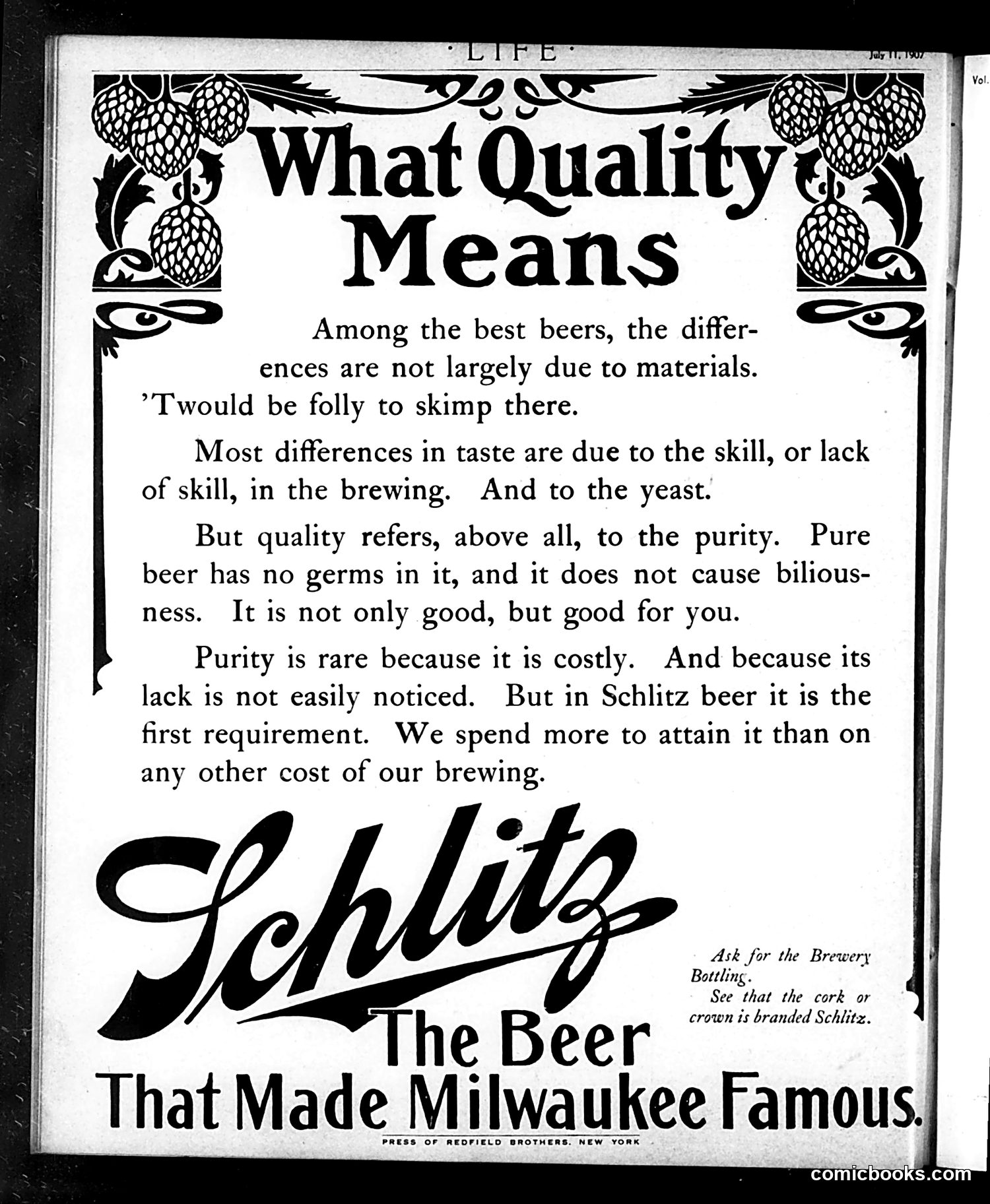
This is a **Schlitz beer advertisement**, not a political cartoon. It's a straightforward commercial pitch from the early 1900s targeting consumers during the pre-Prohibition era. The ad emphasizes "purity" as the defining quality of Schlitz beer—a major marketing angle of that period. The claim that pure beer "does not cause biliousness" reflects contemporary anxieties about contaminated beer and food safety (relevant context: food and beverage regulation was still developing). The decorative hop imagery frames the message as premium. The assertion that Schlitz spends more on purity than any other brewing cost is boastful advertising designed to position the brand as superior and health-conscious. The instruction to verify the "Brewery Bottling" with branded cork/crown indicates concerns about counterfeit products—a real problem before modern quality control. This was "the beer that made Milwaukee famous," Schlitz's signature slogan emphasizing the brewery's regional prestige and Midwestern brewing heritage.