
Life, 1907-07-11 · page 6 of 24
Life — July 11, 1907 — page 6: what you’re looking at
What you’re looking at
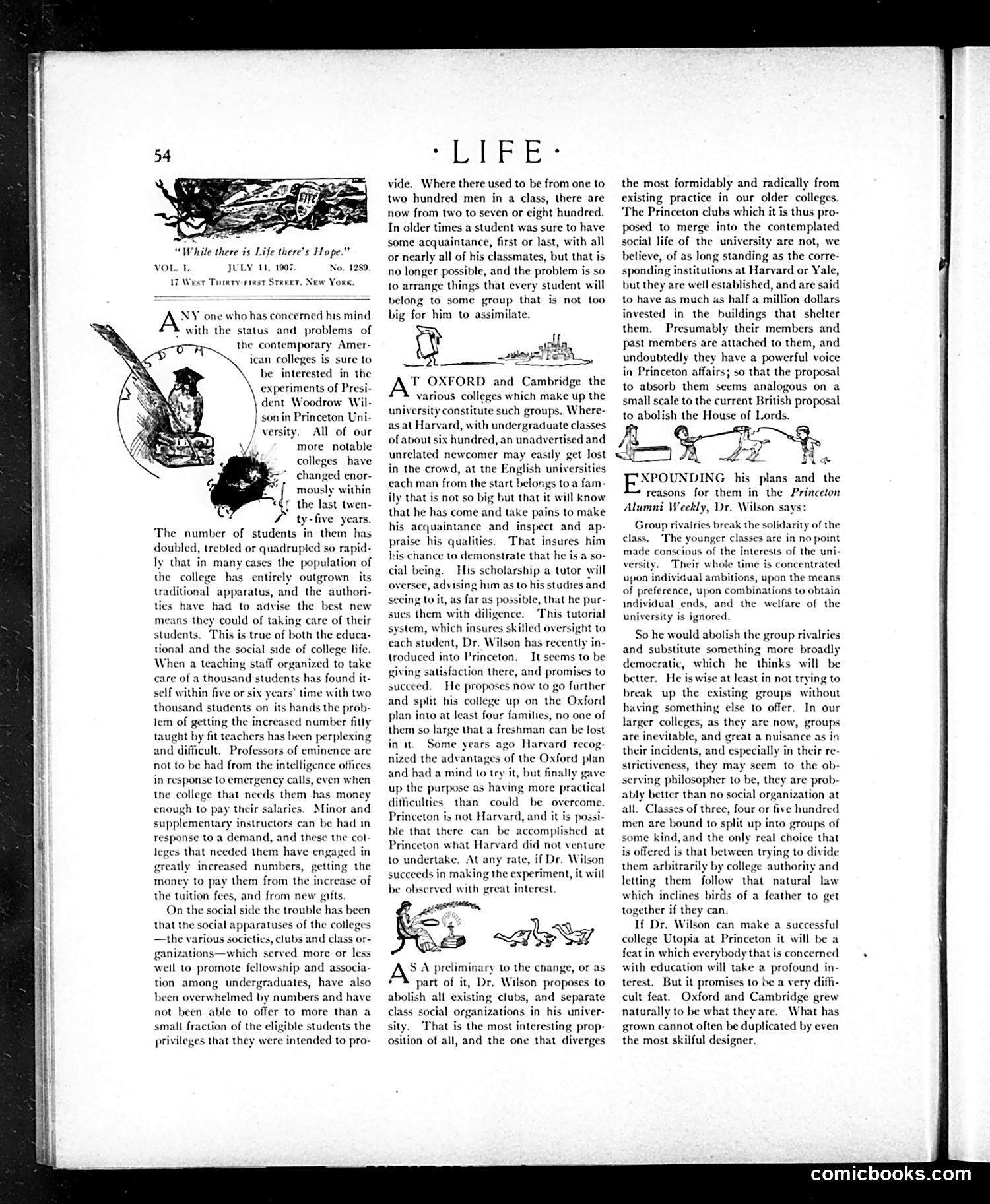
This page discusses President Woodrow Wilson's proposal to reorganize Princeton University's social structure by abolishing existing clubs and creating separate class organizations instead. The decorative illustrations (small sketches of students) are ornamental rather than satirical caricatures. The main content is editorial commentary, not a political cartoon. The satire is implicit: the text notes Wilson's plan represents "the most formidably and radically from existing practice in our older colleges"—essentially mocking the radical nature of his proposal. The piece questions whether such social engineering can truly work, suggesting that students will naturally form groups anyway, making Wilson's intervention somewhat futile. The humor lies in the tension between Wilson's ambitious institutional restructuring and the unchanging human nature of college students.
📄 Transcribed text from this page (OCR, searchable)
Machine-transcribed from the original scan — historical spelling and the odd misread are preserved.
“While there is Life there's Hope.” VOL. 1. JULY 11, 1907, No. 1289. 17 West Tuinry-riest Srener, New York, NY one who has concerned his mind L with the status and problems of the contemporary Amer- ican colleges is sure to be interested in the experiments of Presi- \ dent Woodrow Wil- } son in Princeton Uni- / versity. All of our more notable colleges have changed enor- mously within the last twen- ty-five years. The number of students in them has doubled, trebled or quadrupled so rapid- that in many cases the population of the college has entirely outgrown its traditional apparatus, and the author ties have had to advise the best new means they could of taking care of their students. This is true of both the educ: tional and the social side of college life. When a teaching staff organized to take care of a thousand students has found it- self within five or six years’ time with two thousand students on its hands the prob- lem of getting the increased number fitly taught by fit teachers has been perplexing and difficult. Professors of eminence are not to be had from the intelligence offices in response to emergency calls, even when tne college that needs them has money enough to pay their salaries. Minor and supplementary instructors can be had in ponse to a demand, and these the col- leges that needed them have engaged in greatly increased numbers, getting the money to pay them from the increase of the tuition fees, and from new gaits. On the social side the trouble has been that the social apparatuses of the colle —the v clubs and class ¢ ganizations—which served more or less well to promote fellowship and associa- tion among undergraduates, have also been overwhelmed by numbers and have not been able to offer to more than a small fraction of the eligible students the privileges that they were intended to pro- rious socictie: SE leh vide. Where there used to be from one to two hundred men in a class, there are now from two to seven or cight hundred. In older times a student was sure to have some acquaintance, first or last, with all or nearly all of his classmates, but that is no longer possible, and the problem is so to arrange things that every student will belong to some group that is not too big for him to a wT T OXFORD and Cambridge the various colleges which make up the university constitute such groups. Where- as at Harvard, with undergraduate cla: of about six hundred, an unadvertised and unrelated newcomer may easily get lost in the crowd, at the English universities each man from the start belongs toa fam- ily that is not so big but that it will know that he has come and take pains to make his acquaintance and inspect and ap: praise his qualities. ‘That insures him his chance to demonstrate that he is cial being. His scholarship a tutor will oversee, advising him as to his studies and secing to it, as far as possible, that he pur- sues them with diligence. This tutorial system, which insures skilled oversight to cach student, Dr. Wilson has recently in- troduced into Princeton. It seems to be giving satisfaction there, and promises to succeed. He proposes now to go further and split his college up on the Oxford plan into at least four familes, no one of them so large that a freshman can be lost in 1. Some years ago Harvard recog- nized the advantages of the Oxford plan and had a mind to try it, but finally gave up the purpose as having more practical difficulties than could be overcome. Princeton is not Harvard, and it is possi- ble that there can be accomplished at Princeton what Harvard did not venture to undertake. At any rate, if Dr. Wilson succeeds in making the experiment, it will be observed with great interest 'y to the change, or as part of it, Dr. Wilson propos abolish all existing clubs, and separate ocial organizations in his univer- y. That is the most interesting prop- osition of all, and the one that diverges the most formidably and radically from existing practice in our older colleg ‘The Princeton clubs which it is thus pro- posed to merge into the contemplated social life of the university are not, we believe, of as long standing as the corre- sponding institutions at Harvard or Yale, but they are well established, and are said to have as much as half a million dollars invested in the buildings that shelter them. Presumably their members and past members are attached to them, and undoubtedly they have a powerful voice in Princeton affairs; so that the proposal to absorb them seems analogous on a small scale to the current British proposal to abolish the House of Lords. XPOUNDING his plans and the reasons for them in the Princeton Alumni Weekly, Dr. Wilson says: Group rivairies break the solidarity of the ‘The younger classes are in no point made conscious of the interests of the uni- versity. Their whole time is concentrated upon individual ambitions, upon the means of preference, upon combinations to obtain individual ends, and the welfare of the university is ignored. class. So he would abolish the group rivalries and substitute something more broadly democratic, which he thinks will be better. He is wise at least in not trying to break up the existing groups without having something else to offer. In our larger colleges, as they are now, groups are inevitable, and great a nuisance as in their incidents, and especially in their re- strictiveness, they may seem to the ob- serving philosopher to be, they are prob- ably better than no social organization at all. Classes of three, four or five hundred men are bound to split up into groups of some kind,and the only real choice that is offered is that between trying to divide them arbitrarily by college authority and letting them follow that natural law which inclines birds of a feather to get together if they can. If Dr. Wilson can make a successful college Utopia at Princeton it will be a feat in which everybody that is concerned with education will take a profound in- terest. But it promises to be a very diffi- cult feat. Oxford and Cambridge grew naturally to be what they are. What has grown cannot often be duplicated by even the most skilful designer. comicbooks.com