
Life, 1907-07-11 · page 9 of 24
Life — July 11, 1907 — page 9: what you’re looking at
What you’re looking at
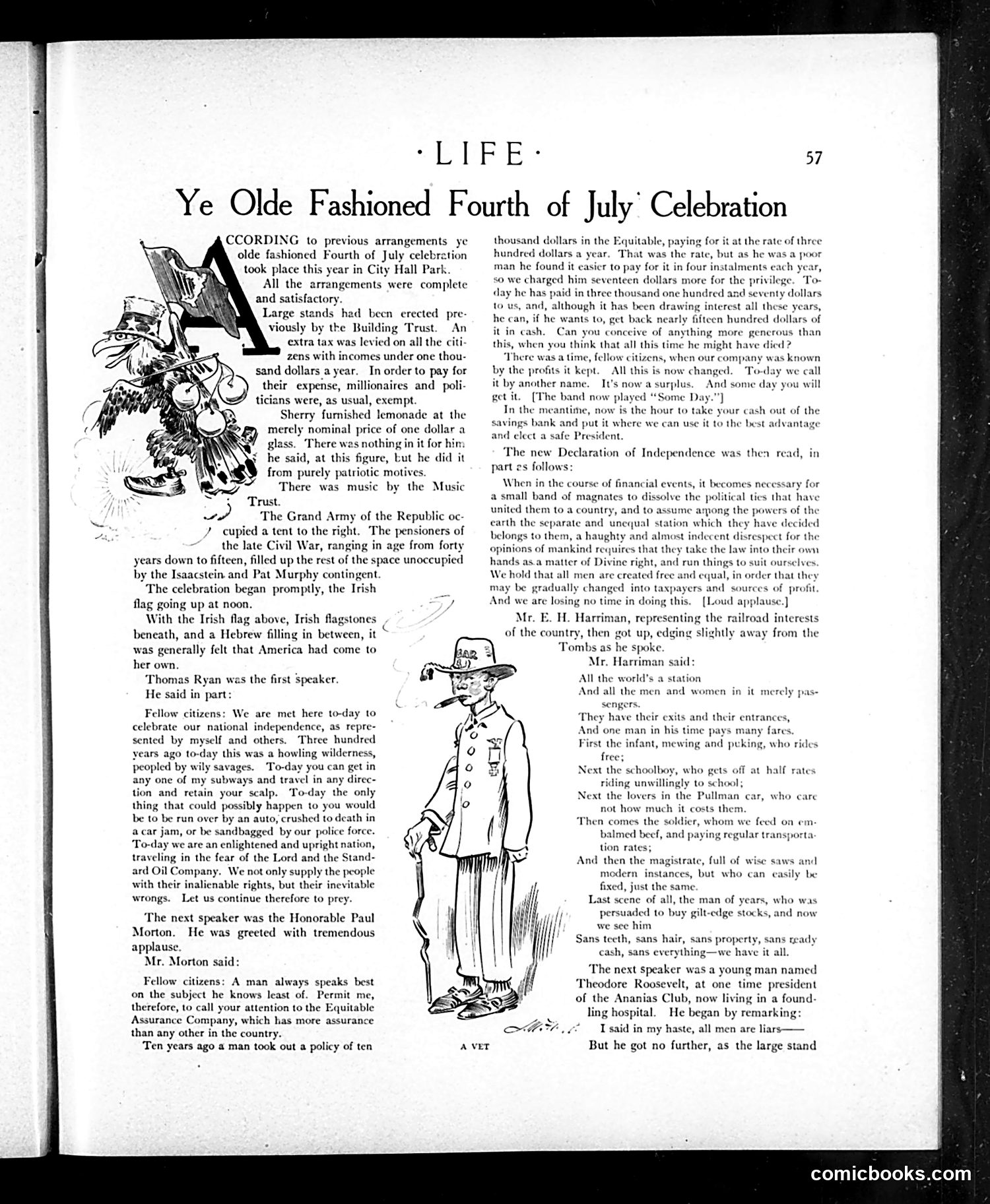
This satirical piece mocks the contrast between 1910s America and its founding ideals. The page features a large cartoon of "A Vet" (appears to be an old soldier or veteran) and critiques how Independence Day celebrations have become commercialized and corrupted. The text attacks wealthy businessmen and financiers who've profited from the nation while ordinary citizens struggle. Speakers like Thomas Ryan and E.H. Harriman (railroad magnate) are highlighted as examples of greed. The satire suggests that America's original promise of freedom and equality has been replaced by corporate interests exploiting workers and common people. The ironic "new Declaration of Independence" passage directly parodies the original document's language to expose how financial manipulation has replaced genuine liberty.
📄 Transcribed text from this page (OCR, searchable)
Machine-transcribed from the original scan — historical spelling and the odd misread are preserved.
-E TPE. * Ye Olde Fashioned Fourth of July’ Celebration CCORDING to previous arrangements ye olde fashioned Fourth of July celebration took place this year in City Hall Park All the arrangements were complete and satisfactory, Large stands had been erected pre- viously by the Building Trust. An extra tax was levied on all the citi- zens with incomes under one thou- sand dollars a year. In order to pay for their expense, millionaires and_poli- ticians were, as usual, exempt. Sherry furnished lemonade at the merely nominal price of one dollar a glass. There was nothing in it for him he said, at this figure, but he did it from purely patriotic motives. There was music by the Music ee “Trust: <4) The Grand Army of the Republic oc- / cupied a tent to the right. The pensioners of the late Civil War, ranging in age from forty years down to fifteen, filled up the rest of the space unoccupied by the Isaacstein and Pat Murphy contingent. The celebration began promptly, the Irish flag going up at noon. With the Irish flag above, Irish flagstones beneath, and a Hebrew filling in between, it was generally felt that America had come to her own. Thomas Ryan was the first speaker. He said in part: < Fellow citizens: We are met here to-day to celebrate our national independence, as repre- sented by myself and others. Three hundred ars ago to-day this was a howling wilderness, peopled by wily savages. To-day you can get in any one of my subways and travel in any direc- tion and retain your scalp. To-day the only thing that could possibly happen to you would be to be run over by an auto, crushed to death in a car jam, or be sandbagged by our police force. ‘To-day we are an enlightened and upright nation, traveling in the fear of the Lord and the Stand- ard Oil Company. We not only supply the people with their inalienable rights, but their inevitable wrongs. Let us continue therefore to prey. ‘The next speaker was the Honorable Paul Morton. He was greeted with tremendous applause. Mr. Morton said: Fellow citizens: A man always speaks best on the subject he knows least of. Permit me, therefore, to call your attention to the Equitable Assurance Company, which has more assurance than any other in the country. Ten years ago a man took out a policy of ten at the rate of three tas he was a poor thousand dollars in the hundred dollars a year man he found it easier to pay for it in four instalments each yea so we charged him seventeen dollars more for the privil day he has paid in three thousand one hundred and seventy dollars to us, and, although it has been drawing interest all these years, he can, if he wants to, get back nearly fifteen hundred dollars of it in cash. Can you conceive of anything more generous than this, when you think that all this time he might have died ? ‘There was a time, fellow citizens, when our company was known by the profits it kept. All this is now changed. To-day we call it by another name. It’s now a surplus. And some get it. (The band now played “Some Day.” In the meantime, now is the hour to ta savings bank and put it where we can usc it to the best advant you will ‘our cash out of the nd elect a safe President. The new Declaration of Independence was then read, in part 2s follows: When in the course of financial events, it becomes necessary for a small band of magnates to dissolve the political ties that have united them to a country, and to assume among the powers of the carth the separate and unequal station which they have decided belongs to them, a haughty and almost indecent disrespect for th opinions « requires that they take the law into their own hands as.a matter of Divine right, and run things to suit ourselves We hold that all men are created free and equal, in order that they may be gradually changed into taxpayers and sources of profit [Loud applause.] Mr. E. H. Harriman, representing the railroad interests of the country, then got up, edging slightly away from the Tombs as he spoke. Mr. Harriman said: All the world’s And all the men sengers They have their exits and their entrances, And one man in his time pays many fares. First the infant, mewing and pking, who rides fr Next the schoolboy, who gets off at half rates riding unwillingly to school; Next the lovers in the Pullman car, who care And we are losing no time in doing this. station pd women in it merely not how much it costs them. Then comes the soldier, whom we feed on em: balmed beef, and paying regular transporta tion rates; And then the magistrate, full of wise saws and modern instances, but who can easily be fixed, just the same Last scene of all, the man of persuaded to buy gilt-edge stocks, and now we see him Sans teeth, sans hair, sans proper cash, sans everything—we have it all. ears, who was ans ready ‘The next speaker was a young man named Theodore Roosevelt, at one time president of the Ananias Club, now living in a found- ling hospital. He began by remarking: I said in my haste, all men are liars—— But he got no further, as the large stand comicbooks.com